

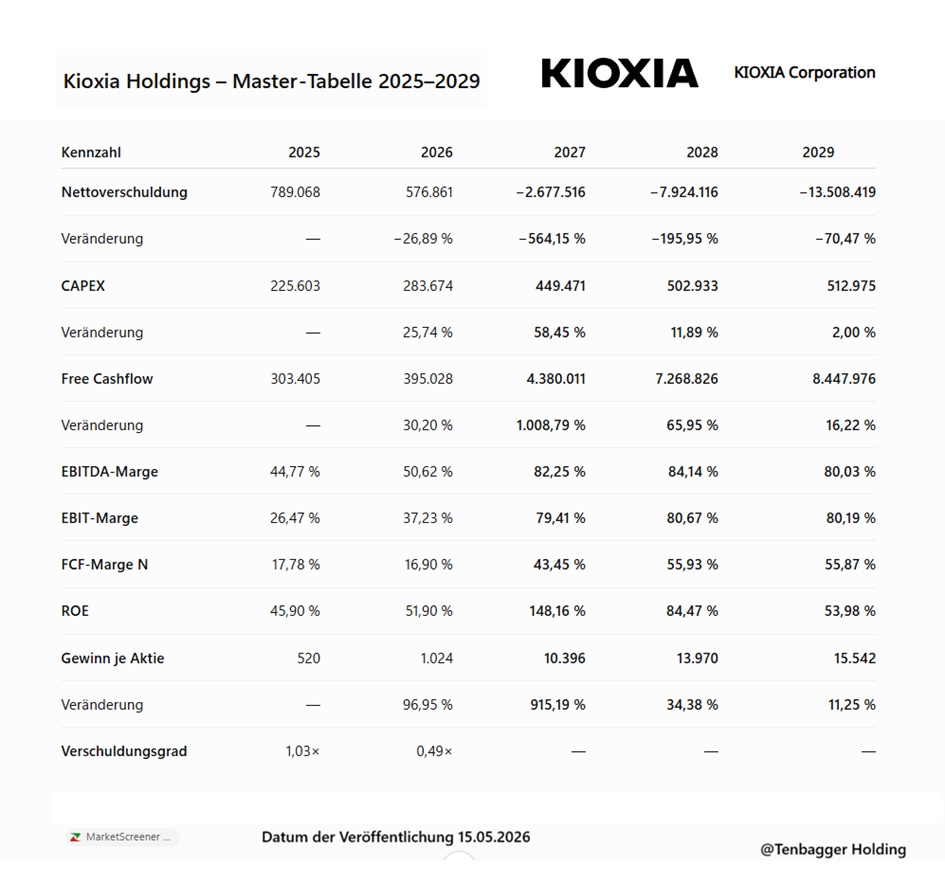
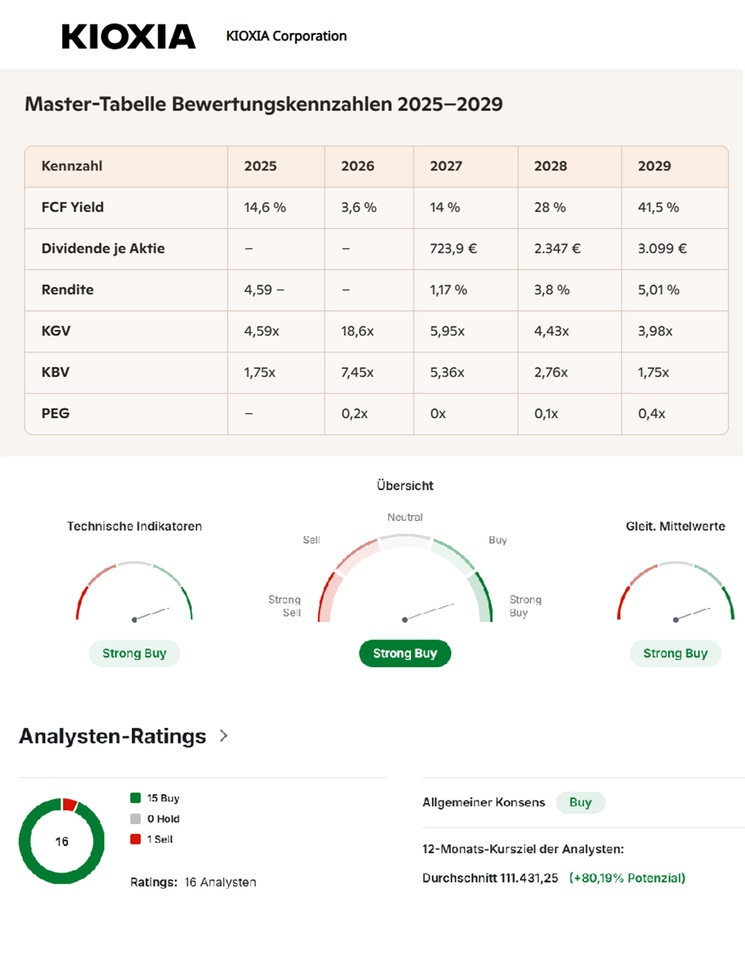
I don't think all memory will suddenly come from China, and DCA will continue to be one of the industry leaders here. I'd love to get even more for even less money...

Kioxia Holdings Corporation
Action
Action
ISIN: JP3236330001
Ticker: 285A
JP3236330001
285A
Price
Discussion sur 285A
Postes
19


1Sem.·
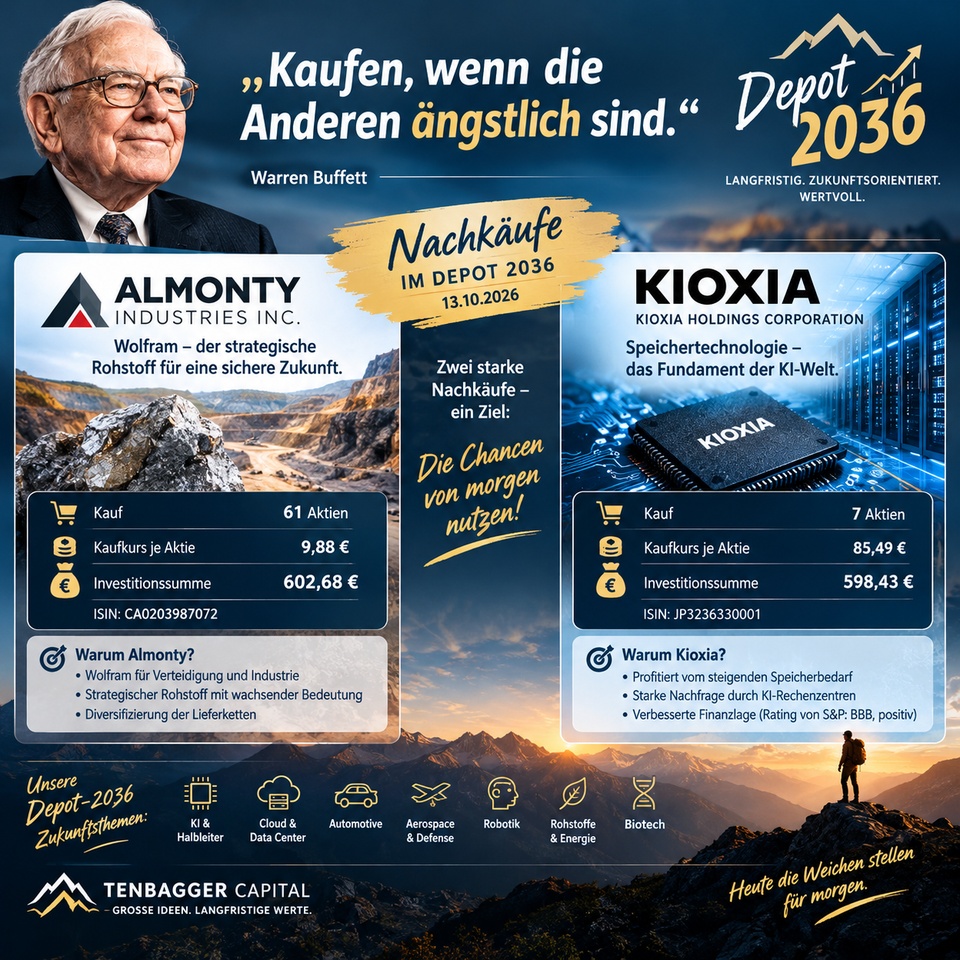
Update on Portfolio 2036
Hello, everyone,
Today, there were two additional purchases in Portfolio 2036.
The AI boom is driving up demand for high-performance storage solutions.
AI data centers require large quantities of enterprise SSDs to quickly store and retrieve data. According to Counterpoint, enterprise SSDs for servers already accounted for 43% of the NAND market in the first quarter of 2026.
Kioxia can benefit from this if the company remains competitive in terms of performance, reliability, and cost.
Added to this is the partnership with SanDisk. Both companies engage in joint production and development activities. This helps share high investment costs and maintain technological competitiveness.
The Chinese manufacturer CXMT plays a negligible role in the NAND sector. Therefore, I consider the current sell-off in KIOXIA to be largely unjustified.
3333
21 Commentaires
$285A Finde ich auch gut:
+ EV / Sales TTM (7,7)
+ EV / FCF (25)
+ Gross Margin TTM (62%)
+ FCF Margin (30%)
+ Rule-of-40 Score TTM (162%)
+ Sales Growth (132%)
+ Sales Growth E (332%)
+ Equity Ratio (38%)
+ ROIC (54%)
+ Debt Ratio (0,3) ✌🏼
+ EV / Sales TTM (7,7)
+ EV / FCF (25)
+ Gross Margin TTM (62%)
+ FCF Margin (30%)
+ Rule-of-40 Score TTM (162%)
+ Sales Growth (132%)
+ Sales Growth E (332%)
+ Equity Ratio (38%)
+ ROIC (54%)
+ Debt Ratio (0,3) ✌🏼
•
44
•
3Sem.·
Waiting Big Time Laps | Nikkei | S&P 500 | HSI
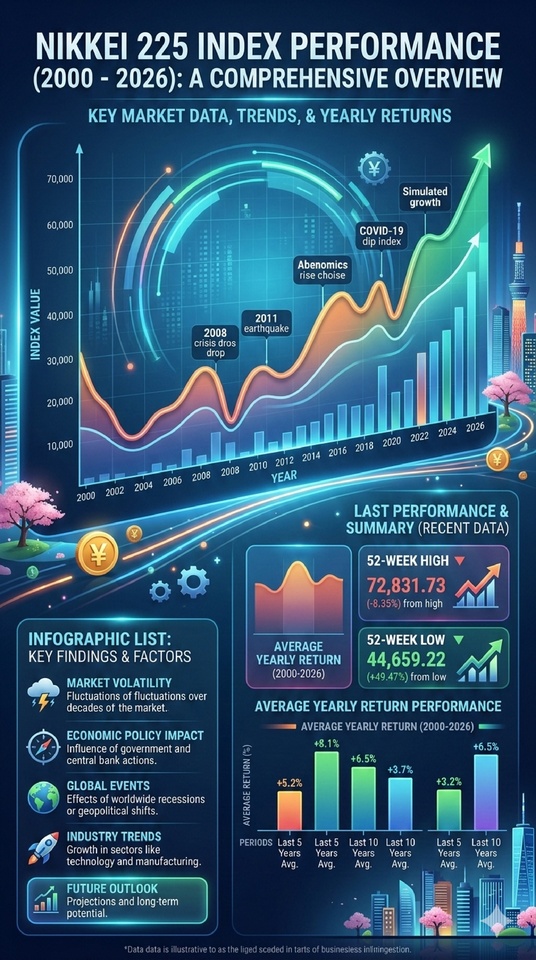
Japan Nikkei 225 index performance with in :
• 52-Week High 72,831.73 (-8.35%)
• 52-Week Low 44,659.22 (+49.47%)
■ Nikkei 225 Index ($NKY)
66,753.72 +1,272.45 (+1.94%) 09/30/26 [SPECIAL]
for Wed, Sep 30th, 2026
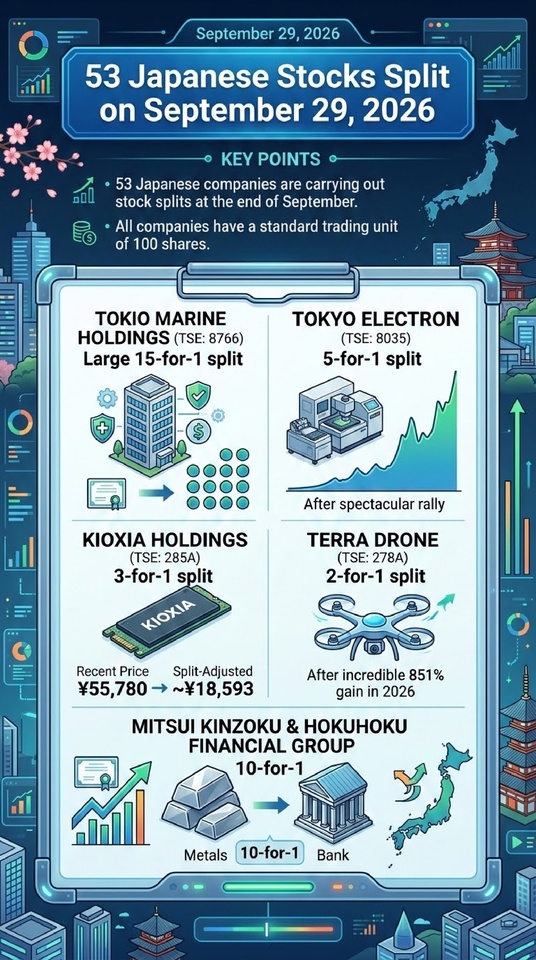
■ Split Stock on September 2026
- 53 Japanese companies are carrying out stock splits at the end of September.
■ Traditional event in frame cycle get performance every years with gap point level position and sink hole in momentum. US S&P 500 market Index | HSI | Japan Nikkei 225 Index. Which on first makes sink drop performance in Q4 season this years.
■ Economic Global Issue with Geopolitical get tension and friction from new story and momentum in market trend. There is still hot and makes point from issue internal on market strategy and frame works must be get balance in standpoint for every years with wave cycle market get average quarter return performance.
• 2025 and 2026 they have its from split stock and this is about "when and how" with market cap and market trends still works on trade meanwhile impact and effect from High Season in high level position. ✅️💫
$285A (-9,26 %) , $SNDK (-10,61 %) , $SMSD (-4,9 %) , $HY9H (-8,13 %) , $MU (-7,58 %) , $ASML (-6,8 %)
22
3Sem.·
A Million with Satellit - MSCI World Momentum Champions - September 2026 Monthly Report
🚀 Month 9 since the start has also gone really well again. 🚀
So far this year, things really only went downhill from mid-June to the end of July, but over the last two months, the upward trend has continued. And yes, the 30k mark has been broken once again 😍
According to the algorithm, I was on track with Lumentum ($LITE (-12,7 %) ), Kioxia ($285A (-9,26 %) ), Micron ($MU (-7,58 %) ), Hewlett Packard Enterprise ($HPE (-5,23 %)), Recruit Holdings ($6098) (+2,12 %) and Dell ($DELL (-7,98 %) ). In addition, outside the algorithm, we are invested in SanDisk ($SNDK (-10,61 %) ).
The starting value was around 26,300 euros. Due to capital gains tax on the sale of Western Digital ($WDC (-15,14 %) ), 650 euros were lost; however, a capital inflow of 720 euros largely offset the tax.
All in all, September delivered a gain of almost exactly +15% for the satellite portfolio.
+4,000 euros in capital gains 🚀
Who was involved and how it went:
- Lumentum +11% 🚀
- Kioxia +16% 🚀
- SanDisk +16% 🚀
- Micron +15% 🚀
- Dell +21% 🚀🚀
- HPE +25% 🚀🚀
- Recruit +1% 🐌
The overall result was driven equally strongly by all of them. Only Recruit Holdings was unable to keep pace with the strength of the others.
YTD, the momentum performance now stands at a strong +110% TTWROR. 🤯😍
The analyses will now show whether there will be any changes for October. At least, that’s what I’m expecting. The analyses are underway...
Only 33 more to go until a million 🥹
Edit: Recruit Holdings is no longer in the portfolio for October. After a long wait, we now officially welcome SanDisk to the MSCI World Index—and thus directly into the portfolio (I’d already held it for a while as a precaution)—and Marvell has also made it back into the lineup. Here’s to a great October, which we’d love to see bring us the 3x.xxx,xx € mark!
7Positions
30 219,25 €
27,78 %
2222
13 Commentaires
Recruit Holdings is being dropped from the index, and SanDisk and Marvell Technology are being added
•
55
•1Mo·
SK Executives: Kioxia's Offer Raises the Stakes in the NAND Competition
$285A (-9,26 %)
$HY9H (-8,13 %)
Is a merger on the horizon here? I’ll just stay invested in both companies for now. And I’ll simply wait and see how things play out.
Japan remains an interesting market when it comes to technology.
My friends, the expansion of production means potential for machinery manufacturers. What do you see here?
(@PikaPika0105 , @Aktienhauptmeister , @Raketentoni )
Chey Tae-won is considering joint production and research & development, while chipmaker Samsung aims to challenge the memory market.
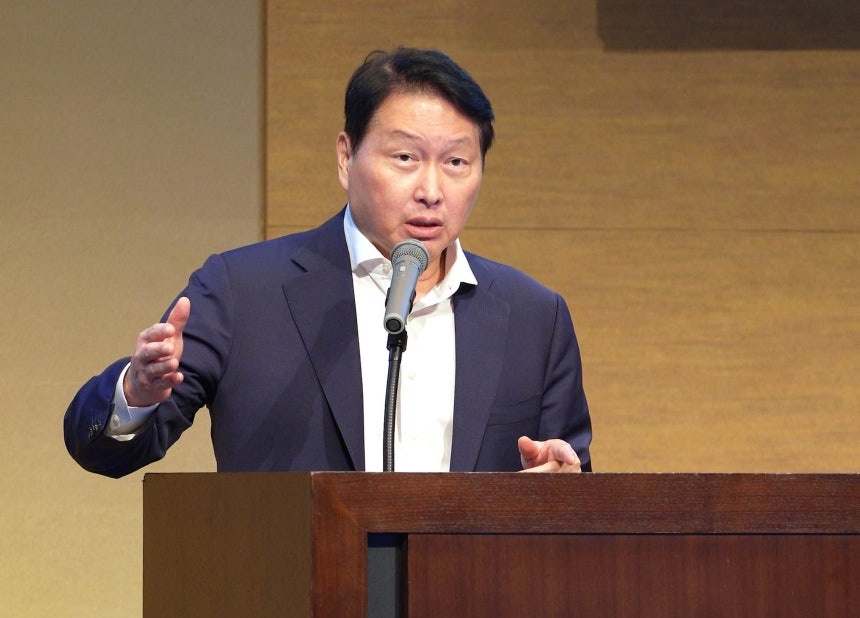
SK Group Chairman Chey Tae-won is considering building a chip plant in Japan, possibly in partnership with NAND flash manufacturer Kioxia, as the South Korean conglomerate seeks closer cooperation with its Japanese competitor.
“One possibility would be joint production,” Chey said in an interview with the Asahi Shimbun published on Tuesday during his visit to Tokyo. He also cited supply chain coordination and joint research and development as potential areas of cooperation.
This move underscores SK hynix’s ambition to leverage its leading position in high-bandwidth memory to challenge Samsung Electronics across the entire memory market. It could also fundamentally transform the global NAND industry, as SK hynix already holds an indirect stake in Kioxia.
“Japan is an extremely attractive candidate in terms of both risk and culture,” Chey said, adding that SK had received proposals from several local governments interested in hosting the planned facility. He did not name any specific locations.
Chey described Kioxia as “a company with many strengths” and explained that SK is ready to become a partner if it can play a role in the Japanese chipmaker’s growth strategy.
“If SK hynix were to be included in Kioxia’s future strategy, we are ready to become a partner at any time,” he said, referring to Kioxia’s manufacturing partnership with SanDisk. Kioxia and SanDisk jointly operate NAND manufacturing facilities in Japan but market their products separately.
Chey also hinted that SK might end its investment in Kioxia if the two companies fail to establish a closer partnership.
SK hynix competes directly with Kioxia in the NAND flash memory sector, but is also a significant indirect investor in the Japanese company. The investment was made through a special purpose company (SPC) managed by Bain Capital, which was established by the consortium that acquired Toshiba’s memory business. In August, the SPC became Kioxia’s largest shareholder with a 14.19 percent stake.
SK hynix holds securities that are convertible into shares with the most voting rights in the SPC and could thus potentially expand its influence over Kioxia. However, an existing agreement prohibits SK hynix from holding 15 percent or more of Kioxia’s direct or indirect voting rights without Kioxia’s consent until 2028.
According to reports, the SK Group is also exploring the acquisition of Japanese semiconductor materials and equipment companies, suggesting a broader effort to establish a stronger position in the Japanese chip ecosystem.
Closer collaboration between SK hynix and Kioxia could alter the competitive dynamics in the global NAND market. Counterpoint Research estimates that Samsung Electronics will lead NAND shipments in the second quarter of 2026 with a 25 percent market share, followed by SK hynix with 22 percent and Kioxia with 14 percent. Together, the latter two have a larger market share than Samsung, even though they remain separate competitors.
Chey’s remarks come as SK hynix is strengthening its position in the High-Bandwidth Memory (HBM) sector, which is used in AI systems and data centers. The sharp rise in demand has brought the company record profits and provided it with the necessary funds to expand beyond HBM.
Lee Jong-hwan, a professor of system semiconductor engineering at Sangmyung University, said, SK hynix appears ready to leverage the profits and confidence it has gained through its leadership in the HBM sector to aim for the top spot in the broader memory market.
“Expanding production capacity is crucial in the semiconductor industry,” Lee said. “SK hynix appears to view Kioxia as a partner that could strengthen its position in the NAND sector and help it challenge Samsung.”
SK hynix is also working with the U.S.-based company SanDisk to develop global standards for High-Bandwidth Flash (HBF). This new technology combines NAND chips to improve performance and storage capacity, using a structure similar to that of HBM. Kioxia’s long-standing partnership with SanDisk could give SK hynix an additional strategic advantage in further developing this technology.
Unlike Samsung, whose business areas include memory, contract manufacturing, and consumer electronics, SK hynix can focus on memory chips. The shift in the AI industry from model development to inference is likely to boost demand for high-capacity NAND memory and potentially create a new market for HBF, according to Lee.
Japan’s strength in semiconductor materials and equipment also makes the country an attractive manufacturing location that SK hynix cannot ignore, he added.
m.koreaherald.comSK chief’s Kioxia overture raises stakes in NAND race
1818
26 Commentaires
Even though I haven’t (yet) invested in Ki, from a neutral perspective I think that if SK Hynix and Kioxia really step on the gas when it comes to expanding NAND production, we’re likely to see a significant amount of CapEx coming our way. And that’s exactly why equipment suppliers like Lasertec or Tokyo Electron could benefit from this. Ultimately, it hardly matters which memory manufacturer comes out on top—the equipment suppliers stand to profit with every new plant.
•
77
•1Mo·
Kioxia and SanDisk Plan Billions in Investments
$285A (-9,26 %)
$SNDK (-10,61 %)
I just invested in Kioxia.
Japanese memory chip manufacturers plan to significantly increase their production. Over the next six years, more than five trillion yen are set to be invested in new and existing factories.
Tokyo. Memory chip manufacturers Kioxia and Sandisk plan to invest Japan more than five trillion Yen . That amounts to approximately 26.9 billion euros. With this expansion over six years, the companies aim to increase production of a component critical to AI data centers, which is currently in short supply.
The Tokyo-based NAND flash memory specialist plans to invest 1.8 trillion yen alone in a new factory in Kitakami, Japan, Kioxia CEO Hiroo Ota said on Thursday. The plant is set to manufacture the company’s latest high-density 3D flash memory chips. These chips are designed to process the enormous volumes of data generated by AI services. The companies wished to remain anonymous because the plans have not yet been made public.
Kioxia plans to carry out the investments together with its manufacturing partner, SanDisk. Demand for memory chips has risen sharply recently, and so have prices. These components are indispensable for data centers and are putting pressure on the margins of companies—from Nvidia to auto and smartphone manufacturers. During a conference call following the release of quarterly earnings, executives from Nvidia warned of supply bottlenecks and pressure on profit margins.
Kioxia Hints at Government Support
Kioxia and SanDisk plan to apply for subsidies from the Japanese government for their projects, reports the financial news agency Bloomberg, citing insiders. Kioxia stated in a press release that the company is considering, among other things, the construction of new facilities to increase corporate value “steadily and sustainably.”
Kioxia has likely secured favorable long-term contracts with customers that will underpin future growth, said Kazuyoshi Saito, a senior analyst at Iwai Cosmo Securities. “That’s extremely positive.”
Major technology companies such as Alphabet and Meta are signing multi-year contracts to secure memory and data storage capacity for their data centers. This has triggered SK Hynix a series of extensive investment plans.
Concerns About an Oversupply
Meanwhile, in the lower-margin consumer memory chip business, Chinese manufacturer Yangtze Memory Technologies is gaining market share. Concerns that Kioxia will only invest once a future oversupply has already begun to weigh on the market again have put pressure on the company’s stock price. Since its peak in June, the stock price has fallen by half.
Kioxia could easily finance investments amounting to billions using its existing cash reserves, said Citi analyst Takero Fujiwara in a report. In his view, a decision to invest would signal that the company has secured long-term contracts. These contracts point to high demand at least through 2028.
“Although the company remains cautious about its investments, it has demonstrated its willingness to invest when necessary,” Fujiwara wrote.
For some time now, Japan has been providing financial support to chip manufacturers with production facilities in the country. These include Taiwan Semiconductor Manufacturing (TSMC), Sony and Micron. The government aims to regain some of Japan’s former leadership role in the semiconductor industry.
Last month, Kioxia began shipping its tenth-generation stacked BiCS flash memory chips. At its facility in Iwate Prefecture, the company plans to produce higher-end NAND chips for data centers. The other major production center in Yokkaichi, Mie Prefecture, will focus on chips for consumer products such as smartphones.
More:
Plötzlich heiß begehrt: Speicherchips werden zum Flaschenhals der KI
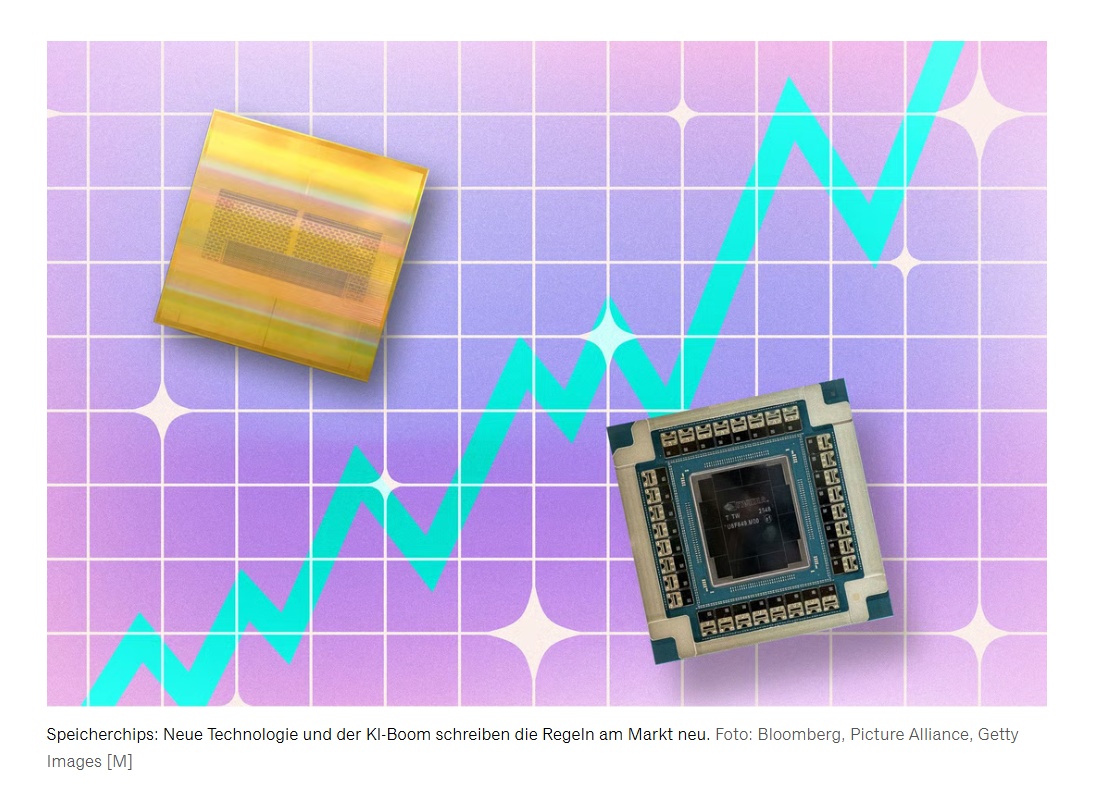
Speicherchips: Kioxia und Sandisk planen Milliardeninvestitionen
1717
15 Commentaires
Kioxia should actually be worth more than SanDisk, since they share manufacturing but Kioxia gets >50% of the products.
So, short SanDisk—long Kioxia is the name of the game.
The only question is how long it will take the market to close the gap.
SanDisk 220 billion – Kioxia 180 billion.
That presents an interesting opportunity. 😉
So, short SanDisk—long Kioxia is the name of the game.
The only question is how long it will take the market to close the gap.
SanDisk 220 billion – Kioxia 180 billion.
That presents an interesting opportunity. 😉
•
55
•2Mo·
Kioxia Stock: Western Digital Considers Merger
Just quickly added to my position. Hope the Japanese are in the mood to buy this weekend.
Kioxia stock is rising thanks to new merger speculation with Western Digital and strong AI storage innovations. A record quarter and an accelerated share buyback underscore the positive trend.
At a Glance:
- Merger Rumors with Western Digital
- Record quarter with 415% revenue growth
- Share buyback completed ahead of schedule
- New QLC storage technology unveiled
Kioxia rose 5.0 percent on Friday to 296.00 euros. This was driven by new speculation about a possible merger with its long-standing joint venture partner, Western Digital. Added to this were positive reactions to technical breakthroughs in AI storage solutions.
Merger talks with Western Digital are picking up steam again
Market observers reported on August 21, 2026, that new rumors were circulating about a takeover or merger between Kioxia and Western Digital. Both companies already operate joint manufacturing facilities in Japan. According to reports, they are now exploring a merger to better keep pace in the rapidly growing market for AI infrastructure.
Despite a spectacular 419 percent surge since the start of the year, the stock price remains below its estimated fair value. Over the past 30 days, the stock had fallen by 17 percent. Today’s rally points to a shift in sentiment—the focus is shifting back to strategic consolidation in the industry.
Technical Advances Support the AI Narrative
The merger talks are based on a close operational relationship. On August 12, 2026, Kioxia and SanDisk, a brand of Western Digital, jointly unveiled a new QLC 3D flash memory technology. The technology is specifically designed for AI and data-intensive applications and, according to the companies, achieves the highest bit density ever measured for QLC NAND memory.
As early as the beginning of August, Kioxia’s “GP Series” SSD was honored as the best new product at the Future of Memory and Storage 2026 trade show. These successes solidify the company’s position in the age of AI inference. It is precisely this trend that is driving the company’s financial results for the current fiscal year.
Record Quarter and Accelerated Share Buyback
At the end of July, Kioxia reported revenue of 1,767.1 billion yen for the first quarter. This represents a 415.5 percent increase over the previous year. Non-GAAP operating profit reached 1,326.2 billion yen in the same quarter—more than the company earned in the entire previous year.
Management is also being generous toward shareholders. On August 10, Kioxia completed a 800 billion yen share buyback program, repurchasing 16.1 million shares. The program was originally scheduled to run through October—Kioxia brought the completion forward by more than two months. This pace signals confidence in future cash flow trends.
Outlook
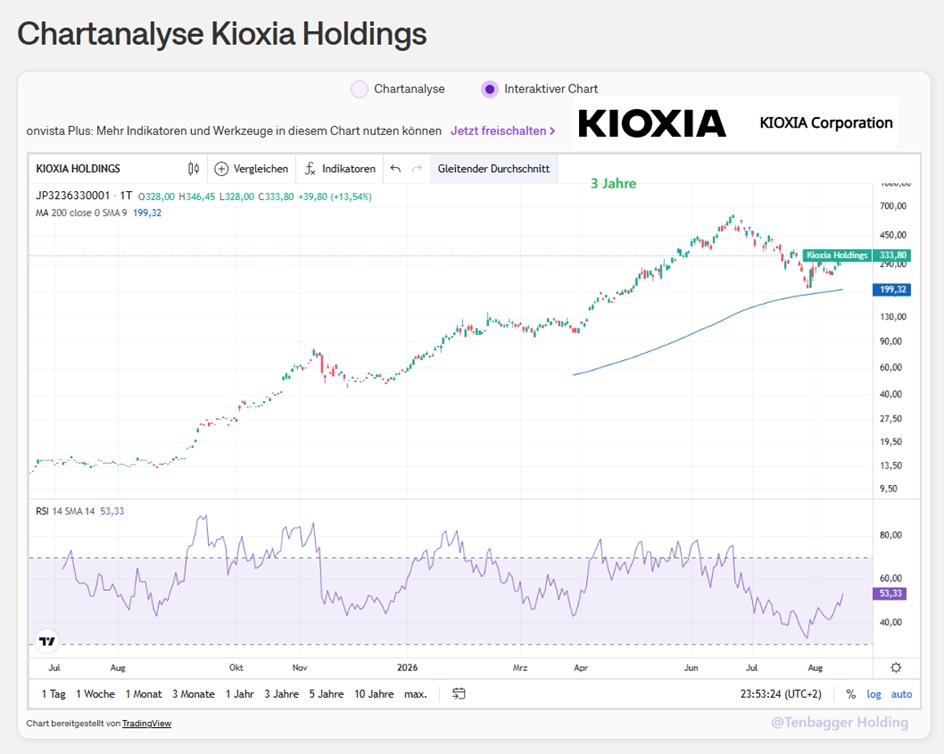
With an RSI of 48.6, the stock is currently in neutral territory. Previous overbought phases from the current year thus appear to have been digested. The memory market is in the midst of a supercycle, driven by demand from generative AI systems. Whether the merger talks with Western Digital result in a concrete deal remains the decisive factor for Kioxia’s long-term valuation.
www.finanztrends.deKioxia Aktie: Western Digital prüft Fusion
1919
8 Commentaires
Unfortunately holding only 5 shares with average €287.89 :(. I dont thing it will go lower than this for now....otherwise I will add more.
•
11
•2Mo·
Leopold Tenbagger strikes again. Not for everyone to try at home
Hello, everyone,
If two of my biggest holdings are already memory chip companies, shouldn’t I definitely add another memory chip company to my portfolio?
🙈🙈🙈🙈
“No risk, no fun”
2Mo·
Midnight Screening. The "fastest" SSD in the world
Hello, everyone,
Today, we have a special midnight screening to mark a certain occasion.
I hope to see lots of comments.
The “fastest” SSD in the world:
The Kioxia GP1 hits a whopping 10 million IOPS
Storage technology for AI is taking a giant leap forward. A new SSD from Kioxia achieves a full ten million I/O operations per second. The next generation is expected to surpass this figure by a factor of ten.
New Storage for AI Systems
Storage manufacturer Kioxia unveiled the world’s first SSD mit fast 250 Terabyte Speicherkapazität and, with its mobilen Speicherchips auf Basis der UFS-5.0-Technologie transfer rates of more than 10 gigabytes per second. Now, another new product from the company is making waves. Earlier this month, the Japanese manufacturer unveiled its GP1 SSD at a trade show in California. With approximately ten million input/output operations per second (IOPS), the GP1 is the “fastest” SSD in the world. It was developed specifically for data centers to eliminate bottlenecks in data processing künstliche Intelligenz .
The first generation uses the PCIe 6.0 standard and serves as a direct memory extension for graphics processors, since fast HBM memory in graphics cards is expensive and severely limited in capacity. Future models are expected to exceed this speed by a factor of ten, reaching a whopping 100 million operations. The first test samples of the SSD are expected to reach enterprise customers by the end of 2026.
Die 'schnellste' SSD der Welt: Die Kioxia GP1 erreicht satte 10 Mio. IOPS
Kioxia Holdings Corp is a Japan-based company primarily engaged in the manufacture, sale, research and development, and other services related to memory and related products. Its business is divided into Solid State Drive (SSD) & Storage, Smart Devices, and Other, based on the use of its products. SSD & Storage includes SSD products and storage products primarily for personal computers (PCs), data centers, and enterprises. Smart Devices include embedded storage products with control functions used in consumer devices such as smartphones, tablets, and televisions, as well as in vehicles and industrial applications. “Other” includes retail products such as SD memory cards and Universal Serial Bus (USB) storage.
Number of employees: 15,042
On August 12, the Japanese memory chip manufacturer announced the completion of a share buyback program intended to remove up to 30 million shares, worth up to 800 billion yen, from the market.
At the same time, the shareholder base is shifting: As of August 3, Toshiba reduced its stake to 14.12 percent, down from the 14.48 percent it previously held.
The largest single shareholder is now the Bain Capital-affiliated company BCPE Pangea Cayman2, with 14.19 percent—although, according to Kioxia’s own announcement regarding convertible bonds, SK Hynix effectively controls nearly all voting rights associated with this stake.
Operations Provide a Boost
These capital measures follow an exceptionally strong quarter. Kioxia reported a 415.5 percent year-over-year jump in revenue to 1.77 trillion yen for the first quarter of fiscal year 2026, with an operating profit of 1.33 trillion yen and a margin of 75 percent.
For the current second quarter, the company forecast a further increase in revenue to 2.39 trillion yen—a 35 percent rise from the previous quarter—driven by higher prices and a slight increase in sales volume. Operating profit is expected to rise by 70 percent.
Awards Highlight Technological Leadership
In addition to the financial news, Kioxia also achieved technological successes. The GP series of super-high-IOPS SSDs was named “Best of Show” at the FMS: The Future of Memory and Storage trade show. Together with SanDisk, Kioxia also unveiled a new 3D flash memory technology that, according to the company, achieves the industry’s highest bit density for QLC NAND memory.
Outlook and Capacity Expansion
AI data centers continue to drive growth in Kioxia’s NAND flash business. According to Nikkei, revenue from data centers and related segments reached 1.1747 trillion JPY in the April–June quarter, more than five times as much as a year earlier. The company generated nearly as much revenue in a single quarter as it did in the entire fiscal year ending in March 2026.
Looking ahead, the company expects bit demand to grow in the high teens in calendar year 2026, with its own bit shipment growth in line with the broader market. Furthermore, demand is expected to continue to exceed supply in calendar year 2027.
Meanwhile, Kioxia expects the strong momentum to continue in the second fiscal quarter, with a revenue forecast of 2.390 trillion JPY, a 35.2% increase quarter-over-quarter, as well as non-GAAP net income of 1.280 trillion JPY, representing a 44.3% year-over-year increase. However, Nikkei points out that the company’s net income forecast fell short of the consensus estimate of 1.3431 trillion JPY.
(July 31, 2026)
Geographic Revenue Breakdown:
2026 (JPY)
United States 1.099 billion
China 382 billion
Taiwan 301 billion
Asia Excluding China and Taiwan 174 billion
North America and Europe Excluding the U.S. 119 billion
August 18, 2026, 3:05:05 PM •
Tradegate BSX (EUR)
334.00 EUR
+40.00 EUR +13.61%
+ 3
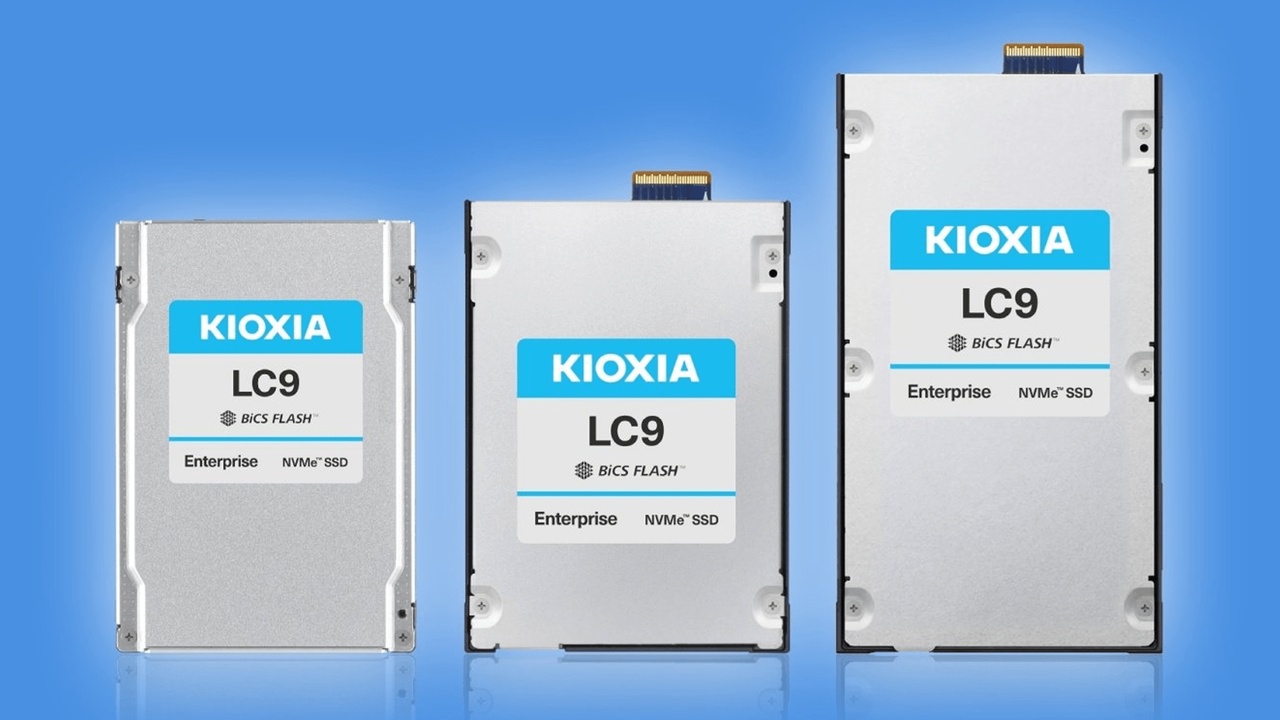
winfuture.deKioxia bringt weltweit erste SSD mit fast 250 Terabyte Speicherkapazität

2Mo·
Midnight Screening. The "fastest" SSD in the world
Hello, everyone,
Today, we have a special midnight screening to mark a certain occasion.
I hope to see lots of comments.
The “fastest” SSD in the world:
The Kioxia GP1 hits a whopping 10 million IOPS
Storage technology for AI is taking a giant leap forward. A new SSD from Kioxia achieves a full ten million I/O operations per second. The next generation is expected to surpass this figure by a factor of ten.
New Storage for AI Systems
Storage manufacturer Kioxia unveiled the world’s first SSD mit fast 250 Terabyte Speicherkapazität and, with its mobilen Speicherchips auf Basis der UFS-5.0-Technologie transfer rates of more than 10 gigabytes per second. Now, another new product from the company is making waves. Earlier this month, the Japanese manufacturer unveiled its GP1 SSD at a trade show in California. With approximately ten million input/output operations per second (IOPS), the GP1 is the “fastest” SSD in the world. It was developed specifically for data centers to eliminate bottlenecks in data processing künstliche Intelligenz .
The first generation uses the PCIe 6.0 standard and serves as a direct memory extension for graphics processors, since fast HBM memory in graphics cards is expensive and severely limited in capacity. Future models are expected to exceed this speed by a factor of ten, reaching a whopping 100 million operations. The first test samples of the SSD are expected to reach enterprise customers by the end of 2026.
Die 'schnellste' SSD der Welt: Die Kioxia GP1 erreicht satte 10 Mio. IOPS
Kioxia Holdings Corp is a Japan-based company primarily engaged in the manufacture, sale, research and development, and other services related to memory and related products. Its business is divided into Solid State Drive (SSD) & Storage, Smart Devices, and Other, based on the use of its products. SSD & Storage includes SSD products and storage products primarily for personal computers (PCs), data centers, and enterprises. Smart Devices include embedded storage products with control functions used in consumer devices such as smartphones, tablets, and televisions, as well as in vehicles and industrial applications. “Other” includes retail products such as SD memory cards and Universal Serial Bus (USB) storage.
Number of employees: 15,042
On August 12, the Japanese memory chip manufacturer announced the completion of a share buyback program intended to remove up to 30 million shares, worth up to 800 billion yen, from the market.
At the same time, the shareholder base is shifting: As of August 3, Toshiba reduced its stake to 14.12 percent, down from the 14.48 percent it previously held.
The largest single shareholder is now the Bain Capital-affiliated company BCPE Pangea Cayman2, with 14.19 percent—although, according to Kioxia’s own announcement regarding convertible bonds, SK Hynix effectively controls nearly all voting rights associated with this stake.
Operations Provide a Boost
These capital measures follow an exceptionally strong quarter. Kioxia reported a 415.5 percent year-over-year jump in revenue to 1.77 trillion yen for the first quarter of fiscal year 2026, with an operating profit of 1.33 trillion yen and a margin of 75 percent.
For the current second quarter, the company forecast a further increase in revenue to 2.39 trillion yen—a 35 percent rise from the previous quarter—driven by higher prices and a slight increase in sales volume. Operating profit is expected to rise by 70 percent.
Awards Highlight Technological Leadership
In addition to the financial news, Kioxia also achieved technological successes. The GP series of super-high-IOPS SSDs was named “Best of Show” at the FMS: The Future of Memory and Storage trade show. Together with SanDisk, Kioxia also unveiled a new 3D flash memory technology that, according to the company, achieves the industry’s highest bit density for QLC NAND memory.
Outlook and Capacity Expansion
AI data centers continue to drive growth in Kioxia’s NAND flash business. According to Nikkei, revenue from data centers and related segments reached 1.1747 trillion JPY in the April–June quarter, more than five times as much as a year earlier. The company generated nearly as much revenue in a single quarter as it did in the entire fiscal year ending in March 2026.
Looking ahead, the company expects bit demand to grow in the high teens in calendar year 2026, with its own bit shipment growth in line with the broader market. Furthermore, demand is expected to continue to exceed supply in calendar year 2027.
Meanwhile, Kioxia expects the strong momentum to continue in the second fiscal quarter, with a revenue forecast of 2.390 trillion JPY, a 35.2% increase quarter-over-quarter, as well as non-GAAP net income of 1.280 trillion JPY, representing a 44.3% year-over-year increase. However, Nikkei points out that the company’s net income forecast fell short of the consensus estimate of 1.3431 trillion JPY.
(July 31, 2026)
Geographic Revenue Breakdown:
2026 (JPY)
United States 1.099 billion
China 382 billion
Taiwan 301 billion
Asia Excluding China and Taiwan 174 billion
North America and Europe Excluding the U.S. 119 billion
August 18, 2026, 3:05:05 PM •
Tradegate BSX (EUR)
334.00 EUR
+40.00 EUR +13.61%
+ 3
winfuture.deKioxia bringt weltweit erste SSD mit fast 250 Terabyte Speicherkapazität
2929
4 Commentaires
Top companies! But of course, they're no longer unknown—and they're not cheap, either. But then again, high-growth top companies almost never are.
•
44
•2Mo·
A single manufacturer's slide shows just how bad the situation is with SSD prices
That's why I'm sticking with $MU (-7,58 %) Micron and $HY9H (-8,13 %) SK Hynix.
But these are also interesting:
My friends, here you should compare growth and valuation.
One of the largest SSD manufacturers is providing insight into its long-term contracts. Most of the storage capacity for the next two years has already been allocated.
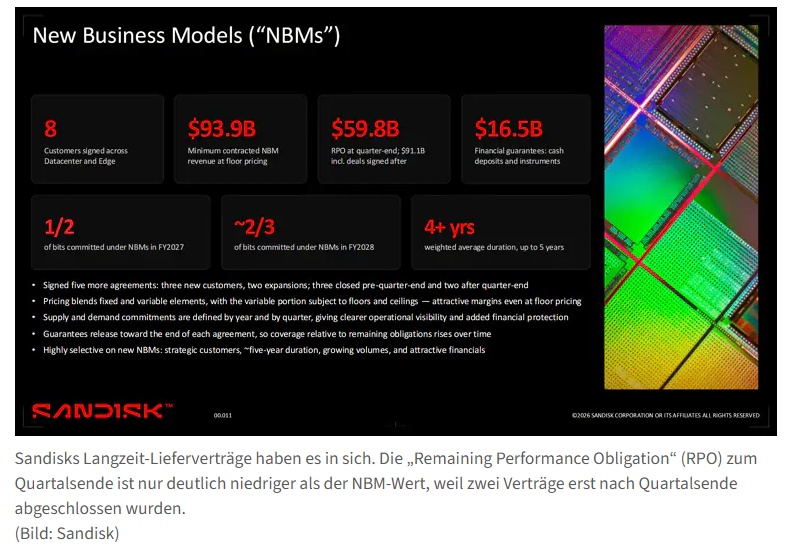
SanDisk has published its latest annual report, and it doesn’t bode well for end customers. A slide on “New Business Models” (NBMs) summarizes the bleak outlook.
SanDisk refers to its long-term supply contracts with major customers for NAND flash memory and finished SSDs as NBMs. The manufacturer has signed eight such contracts with customers for data centers and edge devices. PC, laptop, and smartphone manufacturers are apparently not included. The contracts typically run for four to five years.
For the period from July 2026 to the end of June 2027, SanDisk has already allocated half of its memory production to the eight NBM customers. For the following twelve months, the figure is laut Bekanntmachung it’s even two-thirds. And that doesn’t even include the allocation for contracts outside the NBMs. Either way, it’s clear that less and less is left for PC manufacturers. Meanwhile, the eight contracts combined provide for guarantees totaling $16.5 billion in the event that customers purchase less storage than agreed upon.
In particular, the figures highlight the state of the NAND flash memory and SSD markets: SanDisk is the world’s second-largest manufacturer specializing exclusively in NAND flash and SSDs. Unlike Samsung, SK Hynix, and Micron, its figures are not mixed with DRAM for RAM.
Nearly $94 billion minimum value
The eight contracts have a combined value of at least $93.9 billion. SanDisk clarifies that this figure applies to the lowest agreed-upon NAND flash prices. The companies have negotiated price ranges depending on availability. CFO Luis Visoso said in an analyst conference call regarding the figures that actual revenue will likely be higher. However, even at the lowest prices, the margin is expected to be attractive.
All memory manufacturers are currently negotiating long-term supply contracts, mostly with price ranges. In doing so, they are effectively reducing volatility in the market: When all companies set high minimum prices, they no longer undercut each other significantly. The minimum prices typically correspond to current levels. A Rückkehr zu den Speicherpreisen aus dem Jahr 2025 ist damit unwahrscheinlich.
Revenue and Profit Rise Significantly
SanDisk generated $9 billion in revenue in the second calendar quarter. Compared to the first quarter of 2026 alone, this represents 51 percent growth. According to the manufacturer, one-third of the growth is attributable to additional sales and two-thirds to higher prices. The gross margin stands at a staggering 84.6 percent.
This leaves just over seven billion in operating profit and just under seven billion in net profit. A year earlier, SanDisk had posted a net loss of 23 million US dollars. Due to low SSD prices at the time, the company was operating on the verge of profitability.
Kioxia Is Growing Even Faster
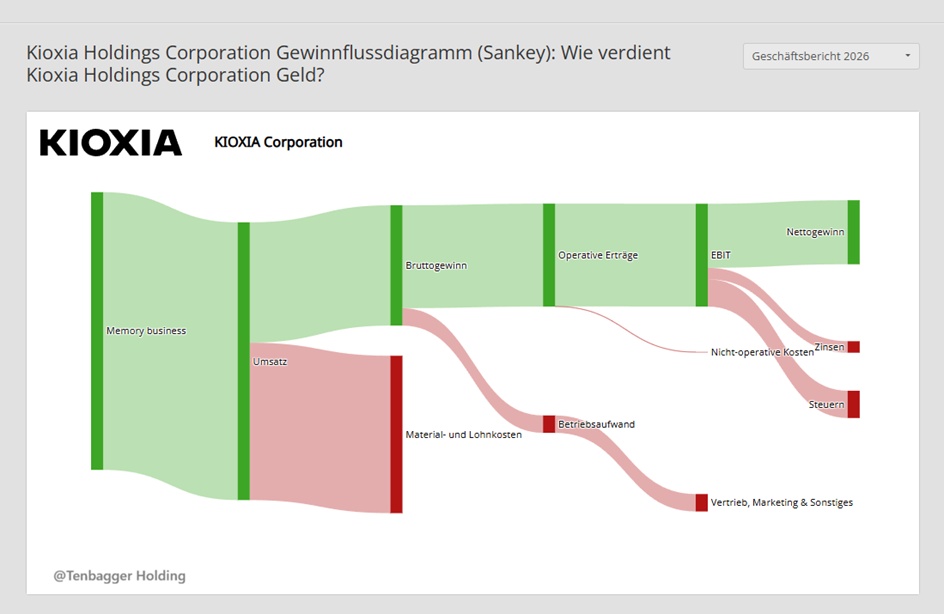
Kioxia, the largest pure-play NAND flash manufacturer based in Japan, reported its neuesten Geschäftsbericht veröffentlicht. The company generated revenue equivalent to 11 billion U.S. dollars in the second quarter of 2026. However, due to higher operating expenses and, above all, taxes, the resulting profit is significantly lower than Sandisk’s: just under 5.3 billion U.S. dollars.
Kioxia is much more secretive about its long-term contracts than its competitors. They exist, but details are unknown.
Eine einzige Herstellerfolie zeigt, wie schlecht es um SSD-Preise steht | heise online
1919
3 Commentaires
2Mo
But that doesn't change the fact that this sector is cyclical. That's why I don't think we'll see any new ATHs anytime soon.
•
11
•Titres populaires
Meilleurs créateurs cette semaine
Données en temps réel par LSX · Données financières de FactSet