
Dear Community,
In the previous parts of our infrastructure journey, we worked our way from the outside in: First, we saw how data centers disconnect from the public power grid through self-sufficient microgrids (Grid Bypassing). Then we looked one level higher and analyzed how smart semiconductors, superconductors, and protective components safely manage the enormous amounts of energy within the server rack (Power Electronics).
But once the power is flowing steadily and the GPUs are running at full speed, we encounter the next technological challenge: Data transmission.
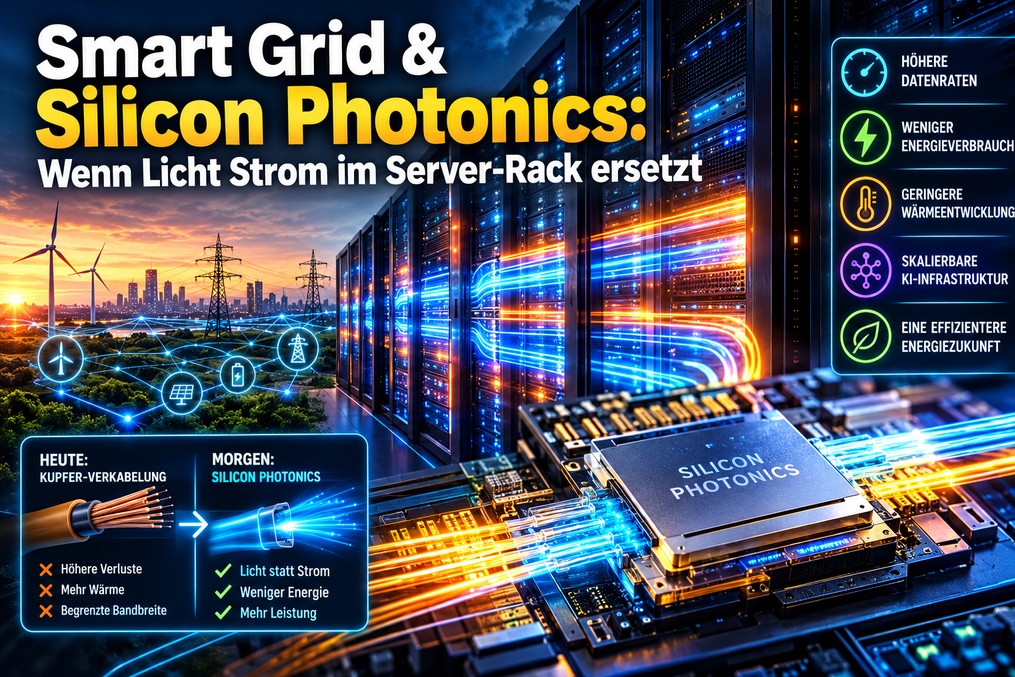
A modern AI cluster does not consist of individual servers, but rather of tens of thousands of GPUs that must exchange gigantic amounts of data with one another in real time during every training step. So far, this has been done via traditional copper cables and electrical circuit board connections. However, with today’s data rates of 800 Gbps—and future rates of 1.6 terabits per second and beyond—electrical connections are increasingly reaching technical and energy-related limits, especially over more demanding transmission paths:
- Signal Loss & Attenuation: As data rates increase, signal loss and signal integrity requirements also rise. Retimers and other signal conditioning components become necessary and result in additional energy consumption.
- Waste Heat & Energy Efficiency: A growing portion of the energy and cooling budget may be attributable to the transmission and processing of electrical data signals. Optical connections offer significant efficiency potential here, depending on the architecture and transmission path.
- Space Constraints & Density: Dense bundles of electrical connections can consume the available space in racks and on printed circuit boards and increase cabling and cooling requirements.
The industry’s response is based on optical interconnect technology, in which three key concepts are intertwined: Silicon Photonics (the integration of photonic functions on silicon-based chips), high-speed optical transceivers (modules for converting electrical signals to optical signals and vice versa), and, increasingly in the future, co-packaged optics (CPO), in which optical engines are placed as close as possible to the switch or accelerator chip.
In this process, electrical data signals are converted into light pulses and transmitted via optical fibers. Especially at high data rates and over suitable transmission distances, this can offer significant advantages over electrical connections in terms of bandwidth, signal quality, and energy efficiency.
After power generation and power electronics, we now ask ourselves: Which companies are building the optical highways for the AI era?
These companies differ significantly: Some supply key optical components, while others integrate complete network platforms or develop the semiconductors that make reliable high-speed communication possible in the first place. The companies I’m introducing to you today are at the heart of this technological turning point:
1. Fabrinet ($FN (-2,6 %))
The indispensable precision manufacturer for the optical AI boom
- Overview & Business Model: Fabrinet operates as a pure-play, highly specialized contract manufacturer (Advanced Optical Packaging). The company does not develop its own products but takes on complex designs from its customers and implements them as high-precision optical and electromechanical assemblies and subsystems. Revenue is derived directly from the number of units produced and shipped—supplemented by services in process engineering, testing, and supply chain management. Once a customer program has been qualified, it generates reliable, recurring revenue over long production cycles.
- Markets & Customers: The customer list reads like a “Who’s Who” of the tech world. In fiscal year 2026, approximately 57.4% of total revenue came from just four major customers: Cisco (19.9%), NVIDIA (16.3%), Nokia (10.7%), and Amazon (10.5%). In addition to its core market of data centers and telecommunications, Fabrinet serves niche markets in the automotive sector (LiDAR), medical technology, and laser systems for semiconductor manufacturing.
- Opportunities & Market Potential: As a “volume seller,” Fabrinet is at the epicenter of the optical AI revolution. In fiscal year 2026, total revenue rose by 35.7% to $4.64 billion, while data center revenue increased by as much as 40.8%. The rising demand for high-speed transceivers (800G and 1.6T) is a key growth driver and supports high capacity utilization on the production lines.
- Risks & Challenges: The flip side of this success is the high concentration of customers: order cuts or negotiations regarding manufacturing relocations by the top four customers would hit Fabrinet hard. In addition, the physical manufacturing operations are heavily concentrated in Thailand (geopolitical, supply chain, and flood risks). Thin gross margins also require constant, strict cost control.
2. Coherent Corp. ($COHR (-5,39 %))
The vertically integrated laser and optics giant of the AI era
- Overview & Technology: Coherent is the vertically integrated heavyweight model student of photonics. Its value chain ranges from proprietary raw materials (such as silicon carbide and gallium arsenide) to high-precision specialty lasers and indium phosphide light sources, all the way to optical transceivers and laser-based subsystems.
- Services & Markets: In addition to the booming sector Data Centers & Communications , Coherent serves markets in industrial material processing, semiconductor equipment manufacturing, and medical technology. It primarily serves global Tier-1 OEMs and system integrators through long-term production contracts.
- Business Model & Structure: Revenue is derived primarily from the sale of high-margin components, optical modules, and complete systems, supplemented by aftermarket and service contracts. A key driver of the stock price is the multi-year strategic agreement with NVIDIA, which includes a purchase commitment worth billions as well as a $2 billion investment by NVIDIA.
- Opportunities & Market Potential: Total revenue in fiscal year 2026 reached $7.12 billion (+22.5%), with the Datacenter & Communications segment growing by 40% to $5.27 billion. As a key supplier of highly efficient specialty lasers and optical transceivers (800G/1.6T), Coherent benefits directly from the hyperscalers’ multi-year AI network transformation.
- Risks & Challenges: High debt remains a key point to monitor. The decisive factor will be whether Coherent can translate this growth into sustainable free cash flow and further strengthen its balance sheet. In addition, the integration of the former II-VI and Coherent businesses, as well as the cyclical nature of the industrial markets, continue to pose execution risks.
3. Lumentum Holdings ($LITE (-5,35 %))
The specialty laser supplier for hyperscalers’ AI infrastructure
- Overview & Technology: Lumentum is a highly specialized developer and manufacturer of optical components, modules, and photonic subsystems. Sophisticated indium phosphide (InP) laser chips form the core of its portfolio. Since silicon itself cannot emit light in silicon photonics circuits, Lumentum provides the essential external laser sources that feed light into optical data highways.
- Services & Markets: The business is divided into two segments: Optical Communications (OpComms) and Commercial Lasers. In the OpComms segment, Lumentum serves telecommunications networks, cloud providers, and AI data centers. The Laser segment addresses industrial precision applications such as wafer separation and PCB drilling.
- Business Model & Structure: As a component supplier, Lumentum sells its assemblies to global OEMs and hyperscalers. Revenue is driven by recurring volume sales following lengthy design wins. In the fourth quarter of fiscal year 2026, Lumentum generated $1.01 billion in revenue and projected revenue of $1.225 billion to $1.275 billion for the first quarter of fiscal year 2027.
- Opportunities & Market Potential: The transition to the next generations of transceivers (800G/1.6T), co-packaged optics (CPO), and optical circuit switches (OCS) opens up massive growth opportunities. The close partnership with NVIDIA and the company’s own InP wafer capacities ensure a high degree of product differentiation.
- Risks & Challenges: Dependence on capital expenditure (CapEx) decisions by a few large cloud providers remains a significant risk. Trade restrictions, geopolitical tensions, and the high capital requirements for ongoing capacity expansion necessitate close monitoring of the balance sheets.
4. Celestica Inc. ($CLS (-2,85 %))
From Contract Manufacturer to Architect of Optical AI Networks
- Overview & Technology: Celestica has undergone one of the most impressive transformations in the hardware industry: The Canadian company has evolved from a traditional Electronics Manufacturing Services (EMS) provider into a specialized design and manufacturing partner for next-generation network architectures. Celestica designs, manufactures, and supports complex system hardware, including modern 800G and future 1.6T network switches as well as optical assemblies.
- Services & Markets: The business is divided into Connectivity & Cloud Solutions (CCS) and Advanced Technology Solutions (ATS). While CCS serves the explosive demand from cloud giants and AI infrastructure operators, ATS addresses niches in industry, medical technology, aviation, and defense.
- Business Model & Structure: Celestica generates revenue through volume manufacturing and manufacturing-related engineering services on behalf of leading OEMs and cloud providers. The model is based on long-term program wins (design wins). Unlike pure-play component suppliers, Celestica assembles complete system platforms and integrates optics, switching, and enclosure technologies.
- Opportunities & Market Potential: Thanks to its position in the design and manufacturing of complex network platforms, Celestica can benefit from the multi-year expansion of AI infrastructure. The key question will be whether the company can translate this growth into higher margins and sustainably rising profits.
- Risks & Challenges: As is common in the manufacturing sector, there is a high degree of customer concentration. Performance depends heavily on the product mix, plant utilization, and the actual margins of individual customer programs. Technological shifts, supply chain bottlenecks, and environmental and power restrictions in the construction of new data centers could weigh on results.
5. POET Technologies ($POET (-5,11 %))
The disruptive wild card for optical chip-to-chip interfaces
- Overview & Technology: POET Technologies is a highly specialized developer that uses its patented POET Optical Interposer . This technology enables the direct integration of electronic and photonic components at the wafer level into a microchip. This allows for the integration of optical engines, light sources, and hybrid lasers (POET Blazar) that accelerate data connections within and between AI servers.
- Services & Markets: With its optical modules, the Canadian company targets hyperscalers, AI server manufacturers, and high-performance data centers. In addition to AI connectivity, the platform can also be adapted for 5G, edge computing, and LiDAR applications.
- Business Model & Structure: POET follows a lean “Fab-Light” model: The company develops and licenses its photonic circuits, while outsourcing mass production. Commercially, POET is just getting started: Although the company reported an initial purchase order from Lumilens worth $50 million for optical engines in the second quarter of 2026, current quarterly revenue remained at a modest ~$570,000, with a net loss of 11.3 million US dollars.
- Opportunities & Market Potential: POET is targeting direct optical chip-to-chip communication. If the technological breakthrough succeeds and the products clear the strict qualification hurdles set by major customers, the business model has significant growth potential. The announced $50 million order is an important step forward, but it should not be equated with revenue already recognized: The successful execution of the delivery program and the actual recognition of revenue are crucial. The liquidity position of $796.3 million (cash and cash equivalents and short-term investments, as of Q2 2026) significantly reduces short-term financing pressure.
- Risks & Obstacles: POET remains the most speculative stock on this list (high-risk/high-reward). Despite a solid cash position, commercial success depends entirely on the timely fulfillment of supply contracts, meeting customer qualification requirements, and gaining acceptance among established semiconductor giants.
6. Astera Labs Inc. ($ALAB (-7,62 %))
The high-speed specialist in signal integrity and AI fabric
- Overview & Technology: Astera Labs is a highly agile semiconductor specialist that solves the acute bottleneck of signal integrity and bandwidth in AI servers. Its product portfolio includes Aries PCIe/CXL Smart DSP Retimer, Leo Memory Controllers, Taurus Ethernet Smart Cable Modules, as well as the new Scorpio fabric switches. Combined with the in-house COSMOSsoftware, the hardware enables real-time diagnostics and data stream control.
- Services & Markets: Astera Labs covers electrical signal conditioning and connectivity (AI fabric) that connects GPUs, CPUs, and memory, but is also increasingly expanding into optical interconnects. Its customers include the world’s leading hyperscalers, server OEMs, and ODMs.
- Business Model & Structure: As a capital-efficient fabless company, Astera Labs outsources manufacturing to foundries. When the modules are integrated into a new server platform (design win), recurring shipments follow throughout the entire hardware cycle. The figures for Q2 2026 demonstrate that the model is working: record revenue of $392.4 million (+104% year-over-year), a GAAP gross margin of 73.3%, and an operating margin of 22.7%.
- Opportunities & Market Potential: The triple-digit revenue growth already evident in the financial results makes Astera Labs one of the most dynamic beneficiaries of the AI infrastructure boom. Whether this will also translate into an attractive long-term stock return depends additionally on the company’s valuation and the continuation of its growth.
- Risks & Obstacles: Key risk factors remain the high concentration of customers among a few cloud giants, the stock’s high valuation, and the need for flawless execution as new product families enter mass production. Delays in major customer programs would noticeably slow growth in the short term.
My Personal Favorites:
If I had to pick two stocks from this list that offer an exciting combination of different roles in a portfolio, they would be Fabrinet ($FN (-2,6 %)) and Astera Labs ($ALAB (-7,62 %)):
- Fabrinet (The Quality & Profitability Anchor): In my view, a strong foundation in the contract manufacturing sector. While the market primarily focuses on well-known chip developers, Fabrinet manufactures the highly complex optical subsystems without which modern 800G and 1.6T transceivers simply cannot function. Its steady revenue growth (FY2026: +35.7%) underscores its indispensable role in the market—even if one must always keep an eye on customer concentration.
- Astera Labs (The High-Growth Pioneer): Those seeking direct leverage from the AI-driven network transformation will find Astera Labs to be an impressively dynamic company. The Q2 2026 results (+104% revenue growth, 73.3% gross margin) demonstrate that demand for smart retimers and switches is not just a pipe dream, but is already fully reflected in the numbers. The gradual push toward optical interconnects also fuels long-term growth potential.
Now we’d like to hear your thoughts:
Light vs. Copper: Do you think the shift to silicon photonics and CPO in AI racks will happen faster than the market expects—or will optimized copper connections for short distances continue to dominate for even longer?
Which camp are you in? When it comes to such technological shifts, do you prefer a solid, already highly profitable contract manufacturer like Fabrinet , or do you prefer to bet directly on highly dynamic connectivity pioneers like Astera Labs?
Best regards ✌🏼
Anderlé


