I know I would have gotten better classes last week & I know there may be better classes to come.
But I'm still at an average purchase price of 76000 & only now had free cash available.
Let's see what happens. What will happen. 🥳🥸
Postes
3 403I know I would have gotten better classes last week & I know there may be better classes to come.
But I'm still at an average purchase price of 76000 & only now had free cash available.
Let's see what happens. What will happen. 🥳🥸

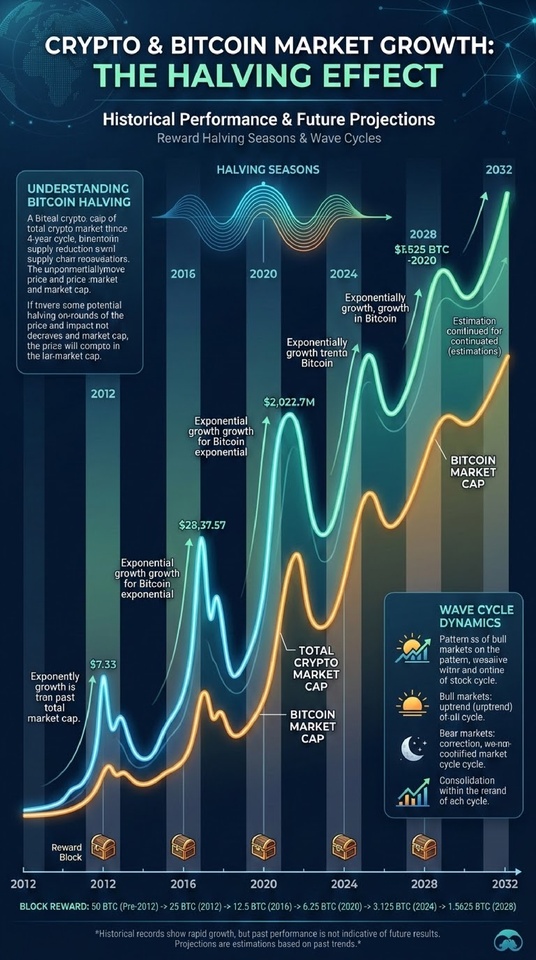
The crypto market expanded by roughly $50B over the past 24 hours not with a surge of noise, but with a steady return of participation. There was no single headline to chase, no dramatic breakout to celebrate. Instead, capital flowed back in calmly, suggesting a shift from defensive positioning toward cautious re-engagement.
Moves like this often matter more than sharp rallies. They signal confidence rebuilding at the margins, where liquidity tests the waters before sentiment fully follows. Volume remains measured, price action orderly, and risk appetite selective the kind of recovery that tends to strengthen structure rather than stretch it.
In a market that has recently been defined by drawdowns and liquidations, this kind of accumulation speaks quietly but clearly. The question now isn’t how fast price can move, but whether this returning capital is patient enough to stay.
When money re-enters without urgency, is it the start of a broader rebuild or simply the market reminding us that balance always comes before belief?

Bitcoin's recent price action once again shows that markets have decoupled from fundamentals and overshot them - a pattern typical of sharp corrections in digital assets. When sentiment becomes disorderly and price becomes detached from underlying signals, it is often more useful to focus on positioning, capital flows and structural stress indicators to assess whether the downward pressure is nearing its end.
Several of these signals are now beginning to synchronize. Global crypto ETPs recorded their highest ever daily trading volume yesterday at USD 18.5 billion. Such volume spikes during price declines have historically signaled capitulation rather than renewed conviction selling. While net outflows from funds have slowed, in previous cycles it was often the lows in the rate of change of flows, rather than the outflows themselves, that marked local lows.
The on-chain behavior also supports this assessment. Addresses with holdings of more than 10,000 Bitcoin had sold around USD 28 billion worth of Bitcoin since October 2025 during the sell-off, but these sales have recently come to a halt. In the past two weeks, these large holders have bought around USD 4.7 billion worth of Bitcoin. Sustainable bottoms have rarely occurred without a stabilization and subsequent reversal in the positioning of the so-called whales. This turning point has not yet been definitively confirmed, but is an encouraging signal.
The $BTC (-0,06 %)-price is currently below the estimated average production costs. From a production perspective, Bitcoin is trading well below the estimated average production costs of listed miners, which we estimate at around USD 74,600. Historically, phases in which the spot price is noticeably below production costs have usually been short-lived, as the pressure on miners' balance sheets, their capital expenditure and marginal supply increases rapidly.
Behavioral indicators also point to a late stress phase. In the past, reports that private investors were temporarily unable to access trading platforms due to a sharp increase in trading volumes often coincided with phases of maximum selling pressure - and not with the start of longer downtrends.
The macroeconomic environment is becoming more supportive at the margin. Yesterday's JOLTS report was significantly weaker than expected; the number of job vacancies fell to a multi-year low. This led to a noticeable increase in the market's implied probabilities of a rate cut in June - despite the uncertainty surrounding the future leadership of the US Federal Reserve. Although a more hawkish chairman could limit the scope for monetary policy, weaker labor market data reduces the possibility of maintaining restrictive interest rates without political and institutional tensions.
Concerns about quantum computing have also re-emerged in the wake of the decline, but these are significantly overestimated. The risks posed by quantum computing are theoretical, distant and only affect a small proportion of older addresses. The core monetary properties of Bitcoin remain intact, and the protocol has sufficient time and clearly defined pathways to implement post-quantum cryptography if required. This is an engineering issue, not a factor that fundamentally challenges the investment thesis.
As the downward pressure appears to be easing, it is worth returning to the fundamental investment thesis of Bitcoin. Bitcoin remains a scarce, non-governmental monetary asset with a fixed supply and no dependence on institutional credibility. In an environment of increasing fiscal dominance, politicized monetary policy and dwindling confidence in traditional stores of value, this central investment thesis remains unchanged.
(Author: James Butterfill, Head of Research at CoinShares)
I always like to test promising systematic strategies. On Getquin and especially from @Epi there are a lot of them. Most recently, GTAA and especially the 3x variant with the certificate received a lot of attention (https://getqu.in/2Ya4VP/). As I would like to expand my momentum strategies, I have now also taken a look at GTAA.
1) Starting point
First of all, I wanted to replicate the GTAA strategy of @Epi to replicate it. Mainly because I am interested in daily data and Epi only looked at monthly data in the backtest.
For this I used the following universe (from Epi's GTAA Max):
3xQQQ, BTC, PRIDX, VUSTX
Period from 01.01.2016
How @Epi I use 200SMA and Dual Momentum as a signal and trade once a month:
I get a strong 42% CAGR, 30% Vola, -50% Max Drawdown and end up pretty much with Epi's numbers. It should be noted that my drawdown is calculated daily and not monthly as with Epi.
Now I have categorized the numbers a bit:
Please have a look at the backtest of @Jesko (https://getqu.in/0ydHY0/). We have also seen drawdowns of -60% and more. @Jesko has rebuilt 3xGTAA better than me (I only used GTAA MAX and did a rather inaccurate test).
2) Target
I would like to add GTAA to my portfolio. But the presented variants of Epi are either too defensive (10-15%CAGR) or too risky (-50% daily drawdown) for me. Epi's 3xGTAA will probably also experience drawdowns of this magnitude. In April it was already 37% (again the reference to @Jesko ).
Therefore, I would like to optimize my GTAA variant for special parameters, which should achieve the following:
I also want to achieve the best possible performance distribution. This allows me to achieve better diversification. If the performance drivers are not so strong, then hopefully there are enough other assets that can at least partially fill the gap.
To do this, it was first necessary to determine the universe. In doing so, I only considered assets that have delivered performance and/or reduced risk.
3) The universe
The following assets are included in my universe:
3xSPY (US equities) $3USL (-0,2 %)
3xEEM (developing country equities) $3EML (-0,52 %)
EXUS (industrialized countries without US equities) $EXUS (+0,07 %)
2xWSML (world small cap equities) $null (+3,73 %)
IXC (Utilities) $IXC (-0,31 %)
3xTLT (long US bonds) Cash + $TLT5 (-0,42 %)
3xIEF (medium US bonds) $3TYL (-0,57 %)
XBCU (commodities) $XBCU (+0,09 %)
2xGOLD (gold) $LBUL (+1,98 %)
BTC (Bitcoin) $BTC (-0,06 %)
This achieves the first goal: diversification in the universe.
All regions are covered and, with the small cap ETF, almost the entire investable market. In addition, there are cyclical components such as commodities or utilities, which are highly correlated but have synergies in my tests that reduce the risk. In addition, gold and BTC + US bonds, as they have provided the best and safest long-term returns.
I would also like to mention that the STOXX50 or oil performed very poorly in my tests and are therefore not in the universe.
In addition, ETFs exist almost everywhere except for the leveraged small caps. There is only one factor certificate that leverages in EUR, i.e. contains the exchange rate twice. My tests reflect this situation. The strategy also works with the unleveraged $WSML (+0,11 %) . This leads to 1-2% CAGR less.
4) Parameters to be optimized
Maximize CAGR - 1.1^MaxDD and Minimize 10%MTU. (Explanation follows)
The most important parameter for me is CAGR - 1.1^MaxDD. In other words, the average growth rate minus the drawdown. The drawdown is weighted with an exponential function so that small drawdowns have little influence.
With 20% CAGR and 20% DD, we can accept +1.5% DD for +1% CAGR. At 20% CAGR and 30% DD, only +0.5% DD is acceptable for +1% CAGR. The higher the drawdown, the more excess return we have to achieve in order to accept an even higher drawdown.
The second parameter is 10%MTU. This describes the following situation:
At each point in time, the share price 3, 5 and 7 years ago is considered. The current price is forecast using the CAGR of the entire strategy. The 3 differences between the actual price and the forecast are then added together. The result is the Medium-Term Underperformance (MTU) of this point in time. Example:
The portfolio is at €100 at time x. Three years ago it was at €100, five years ago at €80 and seven years ago at €60. The CAGR of the strategy is 10%.
Now the current value is forecast based on the past:
3 years ago: 100€ with 10% CAGR in 3 years results in 100€*1.1^3 = 133€
5 years ago: 80€ -> results in 129€
7 years ago: 60€ -> results in 117€
But the current price is only €100. The MTU is now the sum of the percentage deviations:
(100-133€)/133€ +(100€-129€)/129€ + (100€-117€)/117€
= -24.8% - 22.5% - 14.5% = -61.8% MTU at time x.
The MTU is therefore a measure of performance over the medium term (3-7 years) and whether the total return was exceeded or underperformed during this period.
10%MTU is obtained by sorting all MTU values and taking the largest value of the lowest decile (10% quantile).
A higher 10%MTU value indicates that the weakest 10% of all mean time periods have performed better than a lower 10%MTU value.
This means that the higher the 10%MTU, the fewer sideways phases there are.
5) Parameters on Epis GTAA Max
(since 2007, with BTC only from 2018)
GTAA MAX:
I will always show 3 graphs. The gray one is the benchmark (S&P 500 TR). I have abstracted Epi's strategy again to get a better comparison to my strategy. It is not traded at the beginning or end of the month, but a simulation for every possible trading day (e.g. the 1st, 15th, 20th, etc.) in the month. The median is shown in blue and the worst case in red. All the above metrics always refer to the worst case in order to calculate as conservatively as possible.
You can already see very few sideways phases, the 10% MTU value is therefore very strong (for the vola) at -35%. Here all metrics (in brackets the benchmark S&P 500 TR):
CAGR 17.36% (10.74%)
Volatility 23.58% (19.5%)
Sharpe Ratio 0.81 (0.6)
Max Drawdown -49.37% (-55.25%)
Worst Day -24.57% (-11.98%)
10%MTU -35.35% (-21.2%)
CAGR - 1.1^MaxDD -91.2 (-180)
The metrics look quite good, but the value for CAGR - 1.1^MaxDD is very low and the worst day is also very weak at 25%. In addition, my diversification target was not met: TQQQ is responsible for 70% of all gains.
6) First tests
First, I tested my universe with the same parameters as Epi.
This looks very similar to GTAA MAX with lower yield and MTU:
CAGR 15.48% (10.74%)
Volatility 25.04% (19.5%)
Sharpe Ratio 0.68 (0.6)
Max Drawdown -51.32% (-55.25%)
Worst Day -22.77% (-11.98%)
10%MTU -45.68% (-21.2%)
CAGR - 1.1^MaxDD -118 (-180)
However, the diversification target has been met. The strongest asset (gold) only accounts for just under 28% of all gains.
7) Optimizations
The result is okay. However, there are still a few adjustments to be made. First of all, I checked whether it makes more sense to react to signals less frequently or more often. In times of crisis, you can be invested in a high-risk product for up to a month, even though the momentum has long since reversed. I ran a simulation for this purpose:
As you can clearly see, shorter periods are better. From 3 weeks, the maximum drawdown is considerably lower. But I don't want to trade weekly either, as that would be too much effort. So I will check the signals every 14 days and then trade.
Here you also have to be careful not to fall into a fallacy. The data shown is again the worst case. As higher weekly figures look at more cases, the probability that one of them is bad is also higher. However, the median looks similar, with the exception of 1-2 weeks. These have very similar values and support the thesis that 14 days between trades is sufficient.
Then I remembered that I use the SPY and actually wanted to diversify the Spytips strategy. So why not use the TIPS indicator for the SPY?
So the new rule is:
3xSPY is only considered when TIPS is above its own SMA.
CAGR 19.24% (10.74%)
Volatility 23.30% (19.5%)
Sharpe Ratio 0.86 (0.6)
Max Drawdown -36.59% (-55.25%)
Worst Day -12.59% (-11.98%)
10%MTU -43.39% (-21.2%)
CAGR - 1.1^MaxDD -13.5 (-180)
More return with less vola and lower drawdown. The weakest day is also much better. The 10%MTU is also better.
Next, I would like to hold a maximum of 4 (instead of 3) assets at the same time to further reduce the risk profile.
I do this a little differently than EPI: If there are no 4 assets to hold, only 1,2 or 3 will be held with 100, 50-50 or 33-33-33 weighting respectively. Maximum weightings per asset have been set so that the weighting is not too high:
e.g. 3xTLT, 3xIEF, BTC, IXC, Commodities may only account for a maximum of 30% each and 3xEEM only 20% (effectively reducing the leverage from 3x to 2-2.4. Unfortunately, there is no 2x EM). The rest is filled with cash. This means that in market phases in which few assets are running, these can be weighted higher (30-40%):
CAGR 19.20% (10.74%)
Volatility 24.42% (19.5%)
Sharpe Ratio 0.82 (0.6)
Max Drawdown -29.04% (-55.25%)
Worst Day -12.06% (-11.98%)
10%MTU -44.70% (-21.2%)
CAGR - 1.1^MaxDD 3.3 (-180)
Drawdown is significantly better, but performance remains the same. Here you can also see that the median case performed even better than the last test (blue graph)
Finally, I optimized the SMA values. It should be mentioned that this test is overfitted and should only give an insight into what is possible.
CAGR 24.04% (10.74%)
Volatility 24.33% (19.5%)
Sharpe Ratio 0.98 (0.6)
Max Drawdown -28.79% (-55.25%)
Worst Day -12.06% (-11.98%)
10%MTU -38.81% (-21.2%)
CAGR - 1.1^MaxDD 8.5 (-180)
The best asset (3xSPY) only accounts for 20% of the total return. 10%MTU is over -40%.
Again the performance contribution of all assets:
20% 3xSPY
19% 2xGOLD
13.5% BTC
12.5% 3xEEM
11% 3xTLT
11% 2xWSML
5.5% 3xIEF
5.5% EXUS
2% XBCU
0% IXC
Although XBCU and IXC (commodities and utilities) do not generate a return, they reduce the risk in the portfolio.
8) Classification of the figures
Once again, I would like to list arguments for and against the strategy that result from my methodology:
For:
Against:
9) Conclusion
Even if the last test is overfitted, I assume the following metrics:
CAGR: approx. 20%
MaxDD: 30-35%
This means that the GTAA variant, which I MATT (Multi-Asset Trend Targeting), is a lower-risk alternative to 3xGTAA (a kind of 2-2.5xGTAA)
I am very curious to hear your ideas and suggestions.
10) Wikifolio
Yes, I have also created a wikifolio so that I and others can later invest in this strategy in a tax-efficient manner.
Unfortunately, I was not quite at the end of my development when I set it up, which is why gold is included with 3x leverage and the universe was still significantly smaller. I will change this at the next rebalancing. In fact, it would have performed better as a result.
You can already see the strong correlation with 3xGTAA, whereby less vola is included (if instead of 3x, 2x gold were included xD). The future will show.
Here is the link to the wikifolio if you are interested:
https://www.wikifolio.com/de/de/w/wf000matt0
11) Further
I have tested the final strategy again from 2000:
CAGR 22.17% (8.11%)
Volatility 22.56% (19.00%)
Sharpe Ratio 0.97 (0.49)
Max Drawdown -29.27% (-55.25%)
Worst Day -12.06% (-11.98%)
10%MTU -33.64% (-29.85%)
While the benchmark yields less, MATT does quite well and loses only 10% instead of 25% CAGR. 10%MTU looks even better.
In general, the development can be divided into the following phases (with the respective performance drivers):
2000 - 2003
CAGR: 0% (-10%)
+ Gold, TLT
- EXUS
2003-2011
CAGR: 33.35% (5.2%)
+ EEM, gold, WSML
- nothing
2010-2020
CAGR: 13.8% (13.98%)
+ SPY, TLT, IEF
- IXC, BTC
2020-2026
CAGR: 38% (15%)
+ SPY, Gold, BTC
- nothing
+ 3
The cryptocurrency market is navigating a period of pronounced uncertainty and consolidation. In such environments, passive holding often forgoes significant yield opportunities on idle liquidity.
My strategy focuses on generating consistent returns irrespective of directional price action: allocating capital to carefully selected decentralized finance (DeFi) liquidity pools. As illustrated, protocols exist offering up to 30% APR on stablecoin pairs.
This approach transforms liquidity into a productive asset. The yield is sourced from trading fees and protocol incentives, providing a return stream that is decoupled from the volatility of underlying assets like $BTC (-0,06 %) or $ETH (-3,57 %)
Key considerations are paramount: understanding impermanent loss, rigorously auditing smart contract security, and selecting established protocols with sustainable tokenomics. This is not passive income; it is active risk management.
#DeFi #Cryptocurrency #Stablecoins #YieldFarming #LiquidityPools #CryptoInvesting #Finance
The history of $BTC (-0,06 %) does not begin with Satoshi Nakamoto's Bitcoin whitepaper from 2008. Bitcoin did not just fall from the sky. It is the result of over 20 years of research, failed attempts and the tireless struggle of a group of activists who called themselves "cypherpunks". Without them, Bitcoin would not exist today.
In this article, we take a look at who the Cypherpunks were, what they fought for and how their work ultimately paved the way for Bitcoin.
The cypherpunks - activists for digital privacy
In the early 1990s, more and more people realized that the Internet would fundamentally change the world. E-mails, online communication, digital commerce - all this was just around the corner. But some people also realized that the Internet could become a huge surveillance tool. Every email, every message, every transaction could potentially be read by governments or companies. What sounds dystopian almost became reality.
This is exactly where the Cypherpunks come in.
In 1992, three people founded a mailing list that became the nucleus of an entire movement: Eric Hughes (a mathematician from Berkeley), Timothy C. May (a former physicist and engineer at Intel) and John Gilmore (co-founder of the Electronic Frontier Foundation)
Incidentally, the name "Cypherpunk" was coined by Jude Milhon - a play on words from "cipher" (encryption) and "cyberpunk" (the science fiction genre). On this mailing list, mathematicians, programmers, cryptographers and activists discussed how cryptography could be used to protect people's privacy in the digital age.
These weren't hackers in basements with aluminum hats. These were highly intelligent people from universities and tech companies who had recognized a fundamental problem that is still relevant today.
The two manifestos
The cypherpunks wrote down their convictions in two manifestos that are still absolutely worth reading today.
Timothy C. May wrote the "Crypto Anarchist Manifesto" (https://nakamotoinstitute.org/library/crypto-anarchist-manifesto/). In it, he described a future in which cryptography enables people to trade and communicate with each other anonymously - free from state surveillance. At a time when the internet was still in its infancy, May virtually predicted what we are experiencing today: digital communication, digital commerce and the fight for privacy.
In 1993, Eric Hughes followed with "A Cypherpunk's Manifesto" (https://nakamotoinstitute.org/library/cypherpunk-manifesto/). In it, Hughes formulated the core conviction of the movement, which can be summarized as follows: "Privacy is not a luxury, but a fundamental right. And cryptography is the tool to enforce this right in the digital world."
And then the cypherpunks' most famous sentence: "Cypherpunks write code."
Don't talk, don't protest - write code. And that's exactly what they did.
The Crypto Wars - the encryption war
The cypherpunks not only had to develop software - they also had to defend it against their own government.
In the US, strong encryption was officially considered a weapon in the 1990s. The US government had placed encryption software under the same export restrictions as missiles and tanks. Strong cryptography was not allowed to be exported abroad because the government feared that hostile states and criminals could use it to hide their communications from the NSA.
This led to one of the most absurd conflicts in tech history:
Phil Zimmermann and PGP
In 1991, programmer Phil Zimmermann developed encryption software called PGP - "Pretty Good Privacy". PGP made it possible for the first time for normal people to encrypt their emails in such a way that nobody could read them - not even the NSA. Zimmermann published PGP free of charge on the Internet. However, this meant that the software was also available outside the USA.
The result? The US government initiated three years of criminal proceedings against Zimmermann - for the illegal export of weapons. Zimmermann had not exported a missile, but mathematics.
The Cypherpunks reacted in their own way:
Zimmermann printed the complete PGP source code in a book and published it. This is because books are considered protected expression of opinion in the USA and are not subject to Exportbeschränkungen🤷♂️.
Code on a floppy disk? -> weapon!
The same code in a book? -> Freedom of expression!
The Clipper Chip - the NSA's back door
At the same time, the NSA tried to build a backdoor into every encryption system with the so-called "Clipper Chip" - a special chip that was to be built into telephones and computers. The communication would have been encrypted, but the government would have had a duplicate key to read everything at any time.
The resistance to this was enormous. Cypherpunks, civil rights organizations, tech companies - everyone was against it. And then came the final blow: in 1994, cryptographer Matt Blaze discovered a fundamental security flaw in the Clipper Chip and published it (https://www.mattblaze.org/papers/eesproto.pdf). The project was politically and technically finished.
The cypherpunks won
The final victory came in the court case "Bernstein v. United States" (https://en.wikipedia.org/wiki/Bernstein_v._United_States). In 1999, a US appeals court ruled that source code falls under the protection of freedom of speech. As a result, the export restrictions on encryption were massively relaxed.
And now comes the point that puts it all into perspective: without the victory of the cypherpunks in the Crypto Wars, there would be no secure online banking, no encrypted messengers, no HTTPS in browsers - and no Bitcoin either. The cypherpunks fought for the cryptographic foundations on which our entire digital infrastructure is built.
The failed attempts - digital money before Bitcoin
The cypherpunks knew right from the start that privacy is also crucial when it comes to money. That's why there were several attempts to create digital cash from the 1980s onwards. Every single one of them failed - but each one contributed a piece of the puzzle that Satoshi Nakamoto was later able to put together.
David Chaum - DigiCash/eCash (1982-1998)
David Chaum was the pioneer. As early as 1982, he published the concept of "blind signatures" - a cryptographic method with which digital payments can be made anonymously. In 1989, he founded the company DigiCash and launched the "eCash" system on the market with a number of banks in the mid-1990s. It was the first real digital cash.
But DigiCash had a fundamental problem: it was centralized. DigiCash was the central server through which all transactions were processed. When the company filed for bankruptcy in 1998, the attempt had finally failed.
Lesson learned: Centralization is a single point of failure.
Adam Back - Hashcash (1997)
In 1997 Adam Back developed a system called "Hashcash" (http://www.hashcash.org/papers/). Originally it was not intended as money, but as spam protection for e-mails.
The idea: in order to send an e-mail, the computer first has to solve a small arithmetic problem - a "proof of work". No problem for a single e-mail, but for a spammer who wants to send millions of e-mails, it becomes priceless.
Sound familiar? Exactly - that's the basic principle that Bitcoin uses for mining today.
Wei Dai - b-money (1998)
In the same year, Wei Dai published his proposal for "b-money" (http://www.weidai.com/bmoney.txt) - a concept for decentralized digital money in which money is generated by proof of work and transferred via a network with cryptographic signatures. You might think that sounds a bit like Bitcoin, right?
b-money was never implemented - it remained a theoretical concept. But it was so influential that it is the very first reference in the Bitcoin whitepaper. Satoshi even wrote Wei Dai an email explaining that Adam Back had brought his work to his attention. He wrote: "I was very interested to read your b-money page. I am preparing a paper that expands your ideas into a complete, working system." (https://gwern.net/doc/bitcoin/2008-nakamoto)
Nick Szabo - Bit Gold (1998-2005)
Nick Szabo - a computer scientist and cryptographer who also invented the concept of "smart contracts" - developed the idea of "Bit Gold" back in 1998 and first described the concept in full in 2005 (https://nakamotoinstitute.org/library/bit-gold/). Of all its predecessors, Bit Gold came closest to Bitcoin. Szabo's idea: digital units of value are generated through proof of work, provided with a time stamp and linked together in a kind of chain. At its core, this is exactly what Bitcoin does.
However, Bit Gold had an unresolved problem: it could not solve the so-called double-spending problem without a trusted third party. Furthermore, it was never implemented as a functioning system.
Hal Finney - RPOW (2004)
Hal Finney was a longtime member of the Cypherpunk mailing list and in 2004 built the first system that made proof-of-work tokens reusable: RPOW - "Reusable Proofs of Work" (https://nakamotoinstitute.org/finney/rpow/index.html). This made it possible to actually send hashcash-like tokens back and forth as a kind of digital money.
However, RPOW was dependent on a central server, which made it vulnerable to attack. But Finney had proven that the concept basically worked.
And here we come full circle: Hal Finney was not only a cypherpunk and RPOW inventor - he was also the recipient of the very first Bitcoin transaction. On January 12, 2009, Satoshi Nakamoto sent 10 BTC to Hal Finney in block 170. Shortly before this, Finney had sent the now legendary tweet: "Running bitcoin" (halfin auf X: „Running bitcoin“ / X). He was the first person besides Satoshi to run the Bitcoin software.
Satoshi puts the pieces of the puzzle together
On October 31, 2008, a still unknown person or group under the pseudonym "Satoshi Nakamoto" published the Bitcoin whitepaper on the cryptography mailing list (https://www.metzdowd.com/pipermail/cryptography/2008-October/014810.html).
The whitepaper itself (https://bitcoin.org/bitcoin.pdf) directly quotes the work of the Cypherpunks: b-money as reference no. 1 and Hashcash as reference no. 6. Satoshi took the pieces of the puzzle that had been developed over two decades by the Cypherpunks and put them together to form a functioning system:
What Satoshi was the only one to accomplish: Solving the double-spending problem without a central authority - by combining Proof of Work, the blockchain and Difficulty Adjustment in a decentralized peer-to-peer network. This was the missing ingredient that had caused all previous projects to fail.
Why this is more important today than ever
The ideals of the cypherpunks - privacy, financial self-determination and freedom from centralized control - are more relevant today than ever. Governments around the world are working on central bank digital currencies (CBDCs) that could potentially make every single penny you spend traceable at a central location. The surveillance of digital communication is constantly increasing. And under the pretext of combating criminal activities, there are always new regulatory initiatives such as the EU's chat control.
Bitcoin is the cypherpunks' answer to precisely these developments. It is digital cash - without centralized control, without surveillance, without the possibility of simply freezing or devaluing it at the touch of a button. Bitcoin is not just a technology or an investment. It is the realization of a vision that people have been fighting for over two decades.
Conclusion / TL;DR
Bitcoin is the result of a 20+ year journey, driven by a group of brilliant minds who realized that privacy and financial sovereignty in the digital age could only be protected by cryptography.
From the Cypherpunks' manifestos to the encryption war with the US government, the failed but groundbreaking attempts of DigiCash, Hashcash, b-money, Bit Gold and RPOW - to Satoshi's brilliant synthesis of all these ideas in the Bitcoin Whitepaper. Each chapter of this story was necessary for Bitcoin to emerge.
I hope you enjoyed this article and were able to take something new away with you! As always, feel free to ask questions in the comments👇
Thought I'd take your minds off all the price action over the last few days😘
Have a nice Wochenende✌️🧡
Edit: If you have problems with the links... they are sometimes called at the end with the bracket or the dot that comes after it. If necessary, simply remove it from the top of the URL. GetQuin doesn't want it the way I want it😅
My goal is
55/60% $WEBN (-0,06 %)
10/15% $BTC (-0,06 %)
10% $EIMI (-0,45 %)
10% $ZPRV (-0,09 %)
First of all:
Thank you for the warm welcome to the getquin community!
Unfortunately, I did not read the HowTo:Portfolio feedback on GetQuin from @DonkeyInvestor
for a detailed presentation only later and this time I'm trying to write in more detail than the first time and to substantiate the decisions I made in order to possibly receive even more precise feedback from the community. 💛
My personal goal is to become completely debt-free and at the same time start steadily building up assets 📈to improve my private pension provision in 2026. I am expressly prepared to take a higher risk in the first year of my investment and am therefore trying out almost everything.
This year, I would like to operate according to the conscious principle of "set and forget" and consciously review my strategy at the end of 2026 between the holidays and adjust it if necessary.
Instead of "keep it simple", it's more likely to be "overenginerring."
I see your numerous tips as the reason for this, for which I would like to thank you again at
@Epi
@Gehebeltes-EFH
@Stullen-Portfolio
@Multibagger
@Sunrise-Mantis
@EisenEnte
@PositivePossum
@schlimmschlimm
and my general motto in life:
"Anyone can do simple!"
I think at this point in time, investing with "putting everything into the AllWorld ETF" would only be half as much fun for me and would rather bore me. Everything is still so new and unknown. 🤯
I'll then see whether the different investments were generally a good thumbs 👍🏻 or a very bad thumbs down 👎🏻Idee.
The sum of € 5,071.00 that I have already firmly capped and gradually planned to invest in this first year 2026 has already been completely written off in my mind as play money.
For the necessary diversification (ETF, ETC, individual shares and crypto) in my portfolio, I have taken further INCENTIVES and have switched from the initial €100 per month savings plan to an accumulating AllWorld ETF and have set up an additional savings plan of €40 per month on the same AllWorld ETF in distributing form in mid-January 2026.
In the meantime, I came up with the idea at the end of January 2026 and added the two existing savings plans $VWCE (-0,23 %) and $VWGL additional savings plans ($AIQG (-0,04 %)
$RENW (+0,72 %)
$IGLN (+0,38 %)
$BTC (-0,06 %)
$VHYL (-0,22 %)
$ISPA (-0,53 %)
$FGEU (+0,28 %) to a total of 9 savings plans with a monthly sum of €300.
Unfortunately, it was already too late to execute the savings plans by direct debit at Trade Republic at the beginning of 02/2026. Therefore, they will now only be executed in the middle of this month.
Yesterday I spontaneously decided to place a €50 single order in bitcoin. I just let myself be carried away by the postings. 🤑
The planned unscheduled repayment (€500 per month) for my car loan has now worked well for two months and will be prioritized in order to actually become debt-free more quickly.
The specific amounts and items invested to date and in the future can be seen in this Excel table.
Regarding the 6 suggestions from you @Epi (Yes, you'll get the promised feedback here), I've given the following thoughts in detail, from which my plan is then based.
Deka funds:
The two savings plans of €50 per month each were already suspended by me and were actively used to service the first savings plan of €100 per month.
In addition, I am now liquidating the two sub-custody accounts belonging to the savings plans one by one and selling €100 per month in order to achieve the best possible average value in the sale.
The €100 is then immediately reallocated in the form of five savings plans per month and reinvested as follows:
Core: 65%
Satellites: 35%
of which:
Clean Energy 10%
AI: 10%
Bitcoin: 10%
ETC Gold: 5%
VWL:
I will keep the monthly €40 VWL on the third sub-deposit with Deka until I develop the motivation to inform my employer of another contract. At the moment I have no need to be in contact with the HR department any more than necessary.
Nevertheless, I have set up an additional savings plan of €40 per month for the All World ETF distributing from February 2026.
I'm keeping the three individual shares plus the Xiaomi bonus share in my portfolio to develop a feel for shares.
No further individual stocks are currently planned. This fits quite well in this respect, as I have to hold the bonus share for a year before it can be sold.
Bonus savings contract:
The premium savings contract with a term of 99 years under the "old law" has an annual investment of €150 per month at €12.50 with a guaranteed premium of 50% plus interest and compound interest. After checking the terms and conditions of the contract, switching to 0 would result in an immediate loss of the premium. For this reason, I have decided to keep the contract.
Saving & winning without savings:
Just as I was about to decide whether to cancel the savings tickets, one of the tickets won €1,000 in January 2026. For this reason, I decided to keep my 10 tickets after all.
A key point of my savings lottery tickets is that I get €480 of the €600 back at the end of the year.
These will also be distributed by me to the 5 selected savings plans in December in the same weighting as for the reallocation from the Deka Depot.
The profit from the savings lots in the amount of €1,000 goes to$XEON (-0,01 %) for "max. interest".
Nest egg:
My real nest egg, on the other hand, I keep completely in the call money account so that it is always immediately available to me.
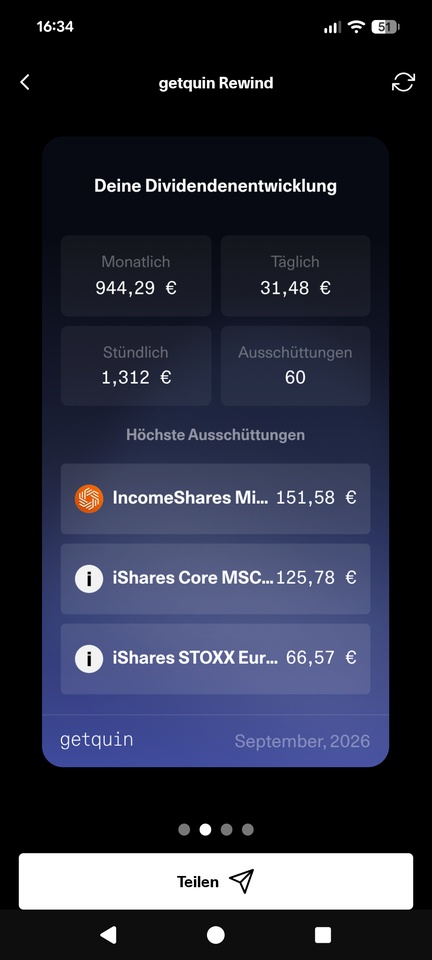
To give me a feel for dividends, I've also picked out three dividend ETFs that I invest €20 a month in.
In combination, these three ETFs ensure that I receive a planned dividend every month. That sounds like a lot of dopamine, at least in theory, so I really like it.
What will actually still be there in 01/2027 from the €5,071 invested is already a 100% profit for me, because after I fell for the game "WOS" 🥶(who knows it?) almost a year ago and blew around 5k on digital crap in 3 months and above all to improve my stove 🔥🪵, this is clearly the better alternative to spend my money on dopamine boosts and pass the time. And being part of a community online at the same time. What more could you want?
So, I'm already looking forward to your feedback. Be honest, I can take it! 🤞🏻
VG
QW3RTY
PS: I could not share my portfolio. The function was grayed out.
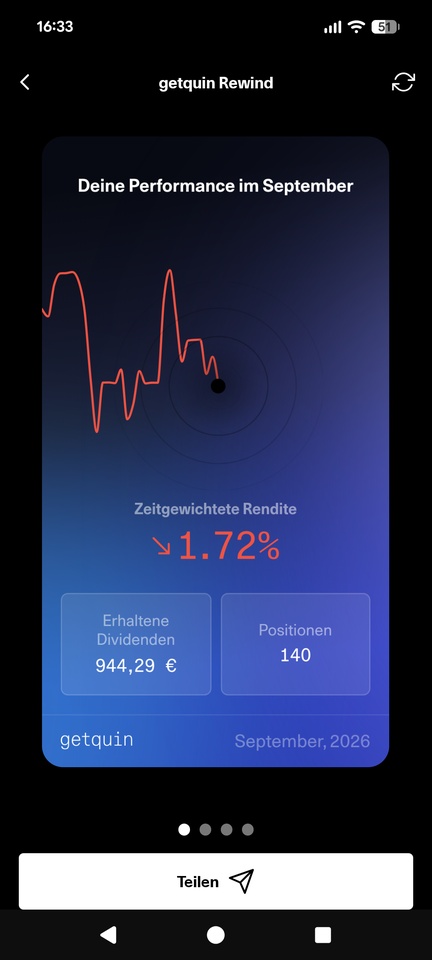
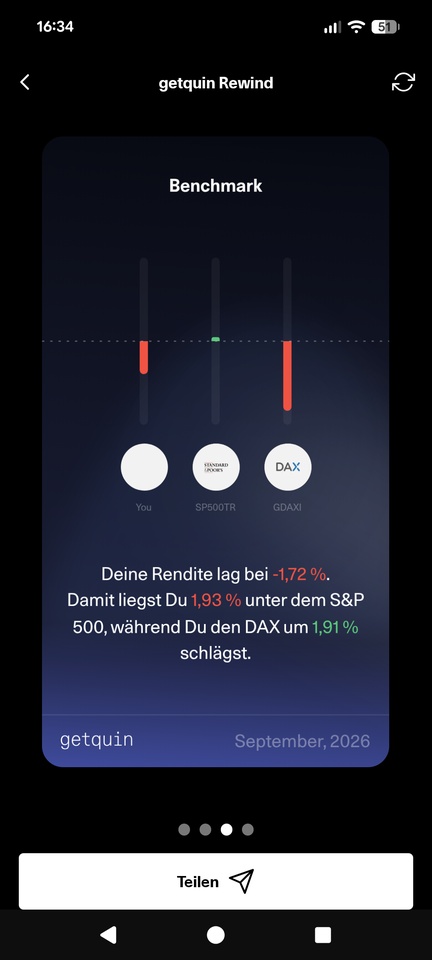
While some people's portfolios are deep red, my portfolio reached a new ATH again today, although the Fear & Greed Index is only at 44. It's hard to imagine what would happen if we were to reach the 80 range. On days like this, you know that the path is absolutely the right one 🤑 $CSNDX (-0,26 %) and $TDIV (-0,23 %) and a few individual shares make it so easy to increase returns and you have time for the important things in life 🙏🏼
$BTC (-0,06 %) but this is tracked separately and only distorts the percentage return.
I wish everyone continued rising prices, although a correction couldn't hurt to buy more intensively 🚀