
$ABBN (-0,89%)
$GE
$RTX (+0,19%)
$HAL (-1,37%)
$MMM (-0,73%)
$NOC (+0,31%)
$MSCI (-0,95%)
$ISRG (+1,78%)
$SPCX (+1,07%)
$NFLX (-0,92%)
$DB1 (-0,49%)
$CME (+0,78%)
$T (-0,1%)
$PM (-1,02%)
$MCO (-0,7%)
$NEE (-1,75%)
$UAL (-0,35%)
$MONC (-1,3%)
$TXN (+0,08%)
$META (-0,55%)
$IBM (+2,72%)
$SAP (+1,32%)
$QS (-2,79%)
$LRCX (+2,93%)
$TSLA (+4,81%)
$RMS (+0,49%)
$NESN (+0,36%)
$BARC (-3,85%)
$ROP (+0,65%)
$DOW (+1%)
$SPOT (-1,86%)
$NDAQ (-0,24%)
$AAL (-0,91%)
$LMT (+0,63%)
$PG (-0,4%)
$BX (+0,79%)
$BESI (+3,72%)
$VLO (-2,04%)
$KER (-0,04%)
$OR (-0,51%)
$VRSN (+1,41%)
$WDC (+5,24%)
$BE (+2,26%)
$NEM (+0,48%)
$TOM (+1,76%)
$AXP (+1,44%)
$FIX (+2,63%)

Verisign
Ação
Ação
Ticker: VRSN
VRSN
Price
Discussão sobre VRSN
Postos
51D·
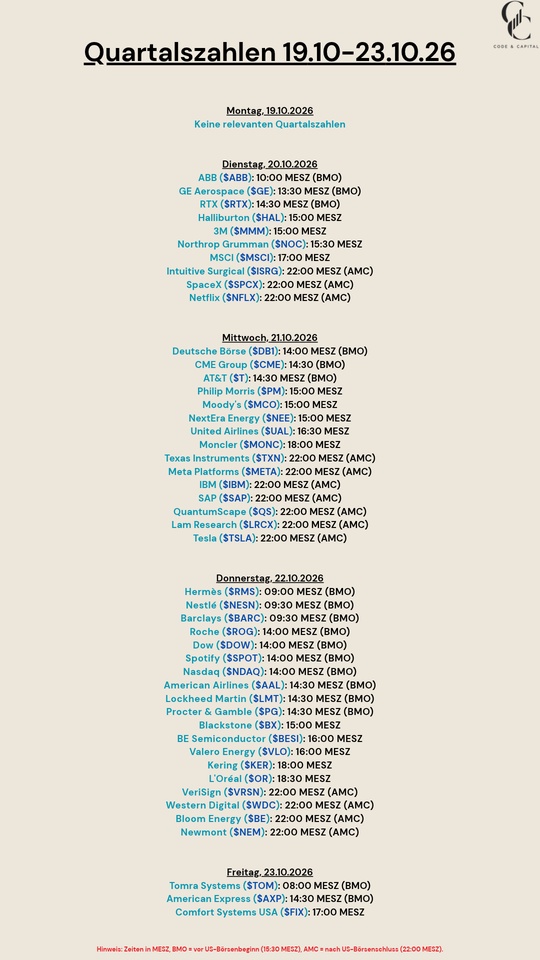
Quarterly Results: Oct. 19–23, 2026
99

4Mês·
The Winners and Losers in AI—From Goldman Sachs' Perspective
After Accenture $ACN (+2,99%) fell by 18% (the stock dropped yesterday to its lowest level since 2017), the entire (consulting) industry was dragged down with it. Capgemini
$CAP (+1,94%) lost 11 percent. Cognizant, Infosys, Wipro, EPAM and Globant were trading lower. Why? Accenture’s business model is based on billable hours. It deploys talented professionals who implement software, restructure processes, and maintain systems at client sites. It is precisely these hours that AI is taking over.
The AI revolution already has its winners and losers. Goldman Sachs has created two thematic portfolios. In the GS US Broad AI includes 94 companies benefiting from AI. The GS AI at Risk contains companies vulnerable to AI, comprising a total of 45 stocks.
Both portfolios start from the same starting point—late November 2022 —after ChatGPT had taken the world by storm—to the present.
The result is clear: The winning portfolio is up 410 percent. That translates to an annualized return of 59 percent per year. The Loser basket stands at minus 26 percent over the same period. That’s a loss of 7 percent per year. The gap between the two stands at around 440 percentage points.
The big winners are the fiber-optic specialist Applied Optoelectronics , up 7,200 percent, SanDisk , up 6,000 percent, and the hard drive manufacturer Western Digital up 2,600 percent, Seagate up 1,900 percent, and Micron up 1,900 percent.
Next up is data center hardware. Celestica rose 3,200 percent, and the cooling and power specialist Vertiv up 2,300 percent, and the equipment manufacturer Argan rose 1,800 percent. Even the laggards in this group of winners are barely in the red. They are the energy providers NextEra, Dominion , and Xcel.
On the other hand, the losers are Globant , down 84 percent, Concentrix down 80 percent, and the payment service provider Bill Holdings down 73 percent, DXC Technology down 71 percent, and the data giant Gartner down 64 percent, the recruitment firm Robert Half and ManpowerGroup each down about 60 percent, and the learning platform Coursera down 62 percent, and Accenture down 57 percent since the end of 2022.
Among the losers, however, there are a few standouts—and they offer valuable lessons. One language AI specialist, SoundHound AI
$SOUN (-1,08%) gained 456 percent. Duolingo
$DUOL rose 80 percent, and Verisign
$VRSN (+1,41%) rose by 32 percent. These companies didn’t just put up with AI—they turned it into their own driving force. Duolingo uses AI to make language learning cheaper and more effective. SoundHound has become AI itself. The lesson is: You have to reinvent yourself—and do so faster than AI can eat away at your old revenue.
Source: "Welt" (excerpt), June 19, 2026

1212

9Mês·
Morningstar Best Stocks to own 2026
$ (+0,87%)TYL (+0,87%)
$GE (-0,09%)
$GD (-0,23%)
$CHRW (-0,28%)
$ROL (-1,85%)
$TW (+1,31%)
$CSGP (-1,37%)
$RKT (-0,73%)
$CLX (-2,07%)
$ROST (+1,45%)
$FAST (+0,79%)
$CSCO (+0,08%)
$YUMC (-0,12%)
$KOF (+1,18%)
$ORLY (+0,13%)
$KO (+0,07%)
$RY (-0,77%)
$MDLZ (-0,6%)
$IMBBY (-1,17%)
$A (-0,96%)
$IDXX (-0,13%)
$SONY (+0,45%)
$MSCI (-0,95%)
$SYY (-0,41%)
$VLTO WI (-0,2%)
$DPZ (-0,73%)
$IDEX (+31,82%)
$VRSN (+1,41%)
$COST (+1%)
$ITT (+0,03%)
$SHW (-0,59%)
$EPD
$SIE (-0,85%)
$CP (-0,17%)
$CTAS (-0,52%)
$ROG (+0,65%)
$BK (+0%)
$CNR (-0,9%)
$PM (-1,02%)
$TSM (+1,77%)
$ITW (-0,21%)
$APD (+0,68%)
$PG (-0,4%)
$AAPL (+0,25%)
$BAC (-1,65%)
$CPB (-2,45%)
$VRSK (-1,17%)
$HSY (-1,68%)
$GWRE (+2,6%)
$HII (+0,71%)
$GSK (+0,66%)
$SBUX (+1,04%)
$ALLE (-0,39%)
$INTU (+0,66%)
$MSI (+0,37%)
$GWW (-0,3%)
$UNP (-0,31%)
$WCN (-0,8%)
$WM (+0,85%)
$NOC (+0,31%)
$CAT (-0,57%)
$PAYX (-0,24%)
$ADP (-0,33%)
$MCO (-0,7%)
$SPGI (+0,42%)
$NDSN (+0,98%)
$WMT (+0,62%)
$OTIS (+0,41%)
$CL (+0,02%)
Best Companies to Own: Methodology
The companies on this list are covered by Morningstar Research Services’ equity analysts and have shares available to US investors. This means that Morningstar equity analysts have calculated fair value estimates for the shares of the companies that trade on US exchanges. As a result, most of the companies on this list are based in the US.
Within that coverage list, the best companies meet the following criteria:
- Wide Economic Moat. The Morningstar Economic Moat Rating summarizes the length of a company’s competitive advantages. An economic moat is a structural feature allowing a firm to generate excess profits over a long period. If Morningstar Research Services believes that excess returns will persist for 20 years or more, that company earns a wide moat rating.
- Standard or Exemplary Capital Allocation.The stock’s Morningstar Capital Allocation Rating is an assessment of the quality of management’s capital allocation, with particular emphasis on the firm’s balance sheet, investments, and shareholder distributions. Capital allocation is judged from an equity shareholder’s perspective, considering companies’ investment strategy and valuation, balance-sheet management, and dividend and share buyback policies on a forward-looking basis. A company can receive an Exemplary, Standard, or Poor Capital Allocation Rating.
- Low or Medium Fair Value Uncertainty. The fair value Morningstar Uncertainty Ratingrepresents the predictability of a company’s future cash flows and, therefore, the level of certainty in the fair value estimate of that company. The Uncertainty Rating for a company can be Low, Medium, High, Very High, or Extreme. It captures a range of likely potential intrinsic values for a company based on the characteristics of the business underlying the stock, including such things as operating and financial leverage, sales sensitivity to the economy, product concentration, and other factors. The more predictable cash flows, the smaller the range of potential intrinsic values, the lower the uncertainty.
What Gives a Company an Economic Moat?
Companies with moats have one or more of the following characteristics:
- Network Effect. Lots of people are using the service, which then makes the service more valuable to the people who use it.
- Intangible Assets. Patents, brands, regulatory licenses, and other intangible assets can prevent competitors from duplicating a company’s products or allow the company to charge a significant price premium.
- Cost Advantage. Firms with a structural cost advantage can either undercut competitors on price while earning similar margins or charge market-level prices while earning relatively high margins.
- Switching Costs. When it would be too expensive or troublesome to stop using a company’s products, the company often has pricing power.
- Efficient Scale. When a niche market is effectively served by one or a small handful of companies, there is no room or incentive for potential competitors to enter the market.
To maintain analysts’ independence, Morningstar Research Services does not publicly rate its parent company Morningstar Inc. Therefore, Morningstar, Inc. is not on the list of the best companies available to US investors.
https://www.morningstar.com/stocks/best-companies-own-2026-edition
1010

1Ano·
Why are cybersecurity shares suddenly going against the current trend?
Presumably because the New York Times reports on the Pentagon's war plans against China, which Musk was apparently briefed on at the Pentagon today.
In a military conflict between the two economic powers USA and China, the first "Line of Contact" would be a digital one: cyber attacks.
And even if only hypothetical scenarios are reported, this will probably already lead to an intensification of the constant mutual cyber attacks. Information is key.
- Cyberark $CYBR
- Palantir Tech $PLTR (+4,95%)
- Check Point Software Technologies $CHKP (+1,67%)
- Crowdstrike $CRWD (+0,82%)
- VeriSign $VRSN (+1,41%)
- Zscaler $ZS (+3,6%)
- Okta $OKTA (+3,2%)
- Cloudflare $NET (+1,21%)
- Fortinet $FTNT (+2,1%)
- Cisco Systems $CSCO (+0,08%)
- Palo Alto Networks $PANW (+1,91%)
- Akamai Technologies $AKAM (-0,27%)
- BlackBerry $BB (+1,35%)
- NetScout Systems $NTCT (+1,95%)
- CommVault Systems $CVLT (+3,47%)
Sources:
- The Pentagon set up a briefing for Musk on plans for a potential war with China.
- NYTimes Liveblog: Trump Administration Live Updates: Trump Rejects Idea of Letting Musk See Secret Plans for War With China

22
4 Comentários
Tobi60@Tobi60
1Ano
•
11
•Mostrar resposta

3Ano·
Investment philosophy, "diversification" and dividends
Hi all, as this is my first slightly larger post I would generally appreciate some constructive feedback.
First something About Me
I'll be 22 in a month and I've been active in the stock market for about 2 years now. After a lot of back and forth, I can almost say that I have tried every strategy - but I never really felt comfortable. One learns from mistakes, and I have made many of them.
But what I have also done is to spend countless hours, days and weeks with books, videos, shareholder letters and internet research. I was particularly fascinated by the investment approaches of Terry Smith and the way of Joseph Carlson on Youtube.
My goal quickly became clear, I don't want to have thousands of companies in my portfolio that I don't know, understand or fully support. So an ETF focus was off the table.
Thereupon I built my own investment philosophy, which I would like to present to you in the following.
If you want to know more about me and my goals, there might be another article with a portfolio presentation soon :-)
First I would like to explain to you why I do not believe in diversification hold:
A quote from Warren Buffet is well known: "Diversification is protection against ignorance. It makes little sense if you know what you are doing."
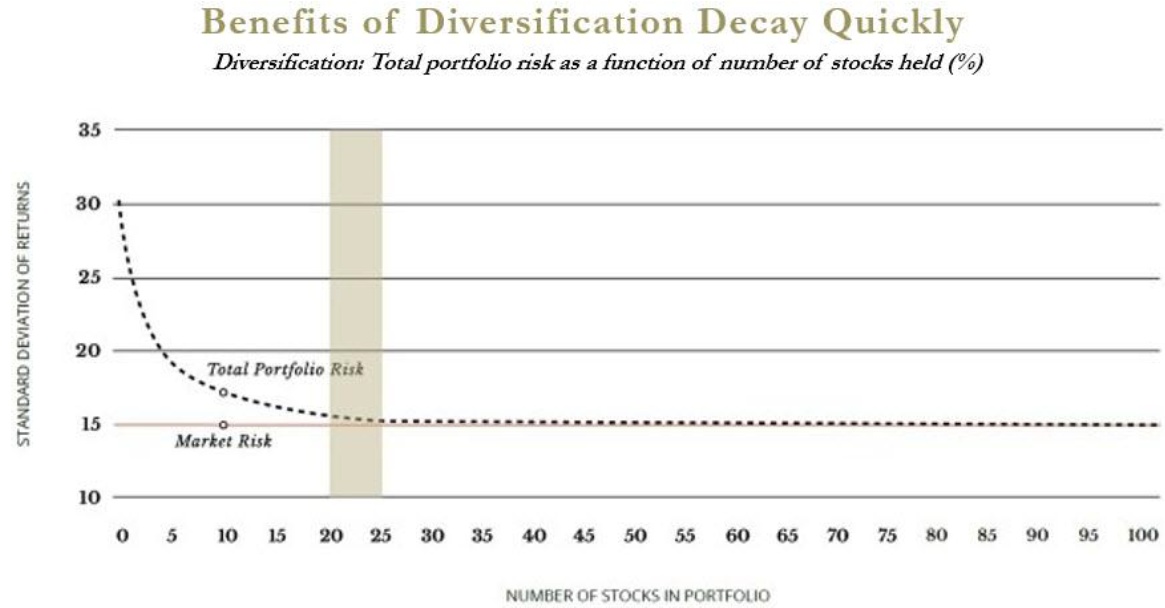
However, a quote from one of the world's best investors alone is unlikely to convince everyone. Studies also support Buffet's view. The advantages of diversification decrease very fast and the gap between market risk and total portfolio becomes minimal from a portfolio size of 20-25 companies - 25 companies give you all the advantages of diversification, more positions only worsen your performance and overview. (Figure 1)
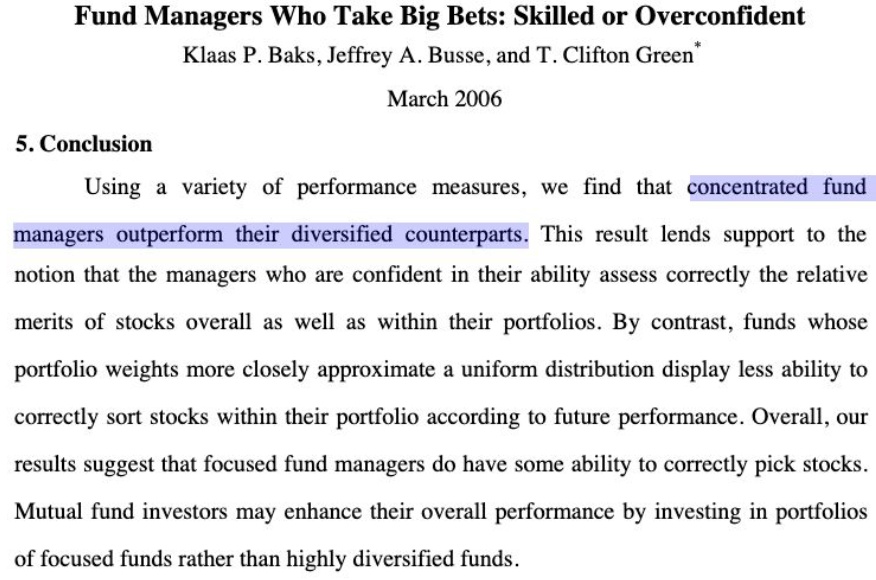
Because concentration delivers better performance. Fund managers who concentrate their knowledge in a few companies deliver better results than more diversified managers. (Figure 2)
Investment philosophy
I want to outperform the market, so I look for the best companies. What makes good companies?
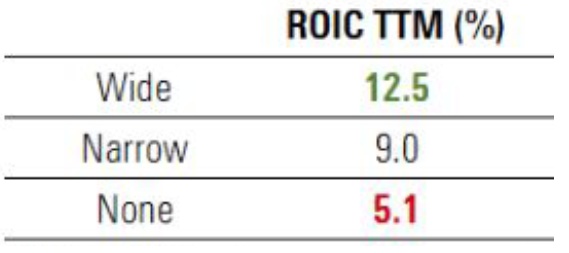
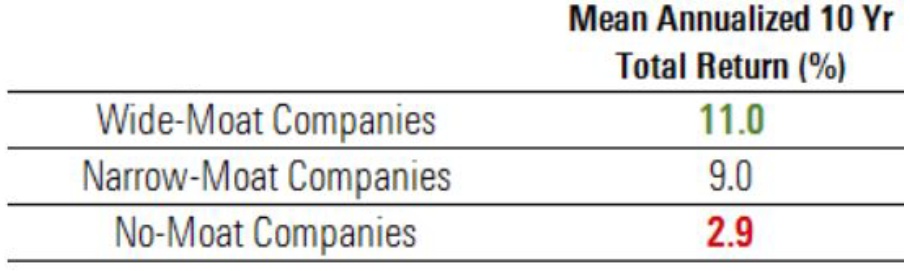
Companies with competitive advantages (moats) outperform the market (Figure 3), and they do so because they have high returns on capital. My first metric for evaluating quality of a company and with a high value in my company analysis is ROIC (Return on Capital Invested). I look for companies with at least 10% ROIC. (Figure 4) Furthermore I want high ROCE (Return on capital employed) and high ROA (Return on Assets) figures.
This directly eliminates some companies and also whole sectors, namely exactly those in which it is not worth to invest anyway. Why is this so?
There are sectors that historically outperform the market (Software, Consumer, Healthcare) - on which my focus is -, and sectors that consistently underperform and are not considered in my investment approach (Banking, Energy, Insurance, Mining, Utilities, Airlines) - just compare the sectors with the main index ;-)
Consumer goods, healthcare and software companies perform better because they generate sustained profits, so they remain profitable even during economic downturns. This allows for consistently high returns on capital.
Next, a look at the margin here I would like to see high Gross Margins >60%, which are also a good indicator of a competitive advantage, and a high Profit Margin, which is an indicator of the efficiency of a company's value creation. However, the most important margin for assessing profitability is the FCF margin.
A company's focus should be maximally on Free Cash Flow, we should invest in companies that are as profitable as possible. In the long run, the share price follows the Fcf/Share.
Beyond that I don't want any debt, any company with Debt/EBITDA > 3 flies right out, preferably anything less than 2.
In terms of growth, I look for stable and good EPS and revenue growth, but FCF growth has the highest priority.
The higher the better, the more important the key performance indicators are.
My minimum benchmarks for the most important metrics:
- ROIC > 15%, ROCE > 15-0%
- Gross Margin > 60%
- Profit Margin > 20%
- FCF Margin > 20%
- Debt / EBITDA < 3, preferably < 1
- FCF 5Y CAGR > 10-15%
(Not all of my companies always meet every metric, but I have built my own score where a minimum score must be met and by score I set the "Conviction" to a company).
Buy & Hold and long-term investing outperforms
As long as a company continues to reinvest its capital at high returns there is no reason to sell. (Figure 5)
What about dividends?
Some of my companies pay a dividend, others don't - I don't put much emphasis on dividends, and will definitely not put bad companies in my portfolio just to get a payout in a given month ;) Dividends should be minimized if capital can be reinvested at high rates of return. At my young age and with a long term investment horizon the focus should be on yield, in old age I will also shift to dividends ;)
The most important thing to conclude: Invest in profitable companies that you UNDERSTAND
A few final tips:
- Don't chase trends, they fade away
- Do not be blinded by dividends
- Don't care about macroeconomics, invest in companies - not cycles
- Market timing is impossible
- Look for established companies, not one-hit wonders
- BUY GOOD COMPANIES - DON'T OVERPAY - DO NOTHING (Terry Smith)
My current investable universe:
$ADBE (+1,22%)
$NVO (-0,52%)
$CUV (+1,63%)
$CDNS (+1,55%)
$ASML (+1,69%)
$VRTX (+1,17%)
$V (+0,45%)
$MA (+0,48%)
$MSFT (+1,36%)
$QLYS (+4,87%)
$MKTX (+0,15%)
$KLAC (+0,83%)
$GOOGL (+1,36%)
$REG1V (-3,41%)
$TNE (-1,02%)
$ENX (+1,36%)
$EW (+1,13%)
$VRSN (+1,41%)
$FICO (+1,97%)
$FTNT (+2,1%)
$NEM (+4,55%)
$MONC (-1,3%)
$CSU (-0,07%)
$6861 (+0,83%)
$ENGH (+1,34%)
$MC (-1,12%)
$AAPL (+0,25%)
$6857 (+5,24%)
$7741 (+0,96%)
$PAYX (-0,24%)
$MTD (+0,59%)
$TXN (+0,08%)
$OR (-0,51%)
$ZTS (+0,71%) (Companies I watch, in my portfolio I have only 8 of them).
That's it from me for now. Please leave me some feedback and share the post if you like it :-)
What would you like to hear from me next? More about free cash flow? Portfolio presentation? Company presentation? My slightly different valuation approach, far away from P/E?
Some of the illustrations are from a slightly smaller fund ("Long Equity Investing" on Twitter - can only recommend you) or from Terry Smith's Shareholder Letter.
No investment advice
+ 1
1010
21 Comentários
Many would like to outperform the market, but the current state of science/data is that this does not work systematically. It might work, but then you have to be lucky that it works for you.
•
22
•Títulos em alta
Principais criadores desta semana
Dados tempo real da LSX · Dados financeiros e EOD da FactSet