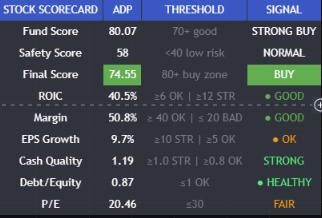
- ROIC: 40.5%
- Margin: 50.8%
- EPS growth: 9.7%
- D/E: 0.87
- P/E : 20.46
Overal FUND score
80.07

Postos
57$ADP (-0,39%) was there a display error or did the price go up to 200, if so... anyone have an idea why? ?

I would be very pleased to hear your views. From a long-term dividend perspective, I think this company is very exciting at the moment.
Does anyone have any information that could be important for the decision?
Best regards 🖖🏽
First purchase of Automatic Data Processing. The stock will remain in my dividend portfolio for the long term and the position will be expanded further if the share price falls! With over 50 consecutive years of dividend increases, I personally think it's a great addition to my portfolio.
$COST (+1,11%)
$HD (+0,55%)
$ADP (-0,39%)
$MMC (-0,31%)
$SHW (-0,75%)
$CTAS (-0,38%)
$RACE (-0,45%)
$ZTS (+0,65%)
$PAYX (-0,19%)
$TSCO (-1,01%)
$TPL (-1,32%)
$WSO (-0,72%)
$DPZ (-0,73%)
Is it Black Friday again?
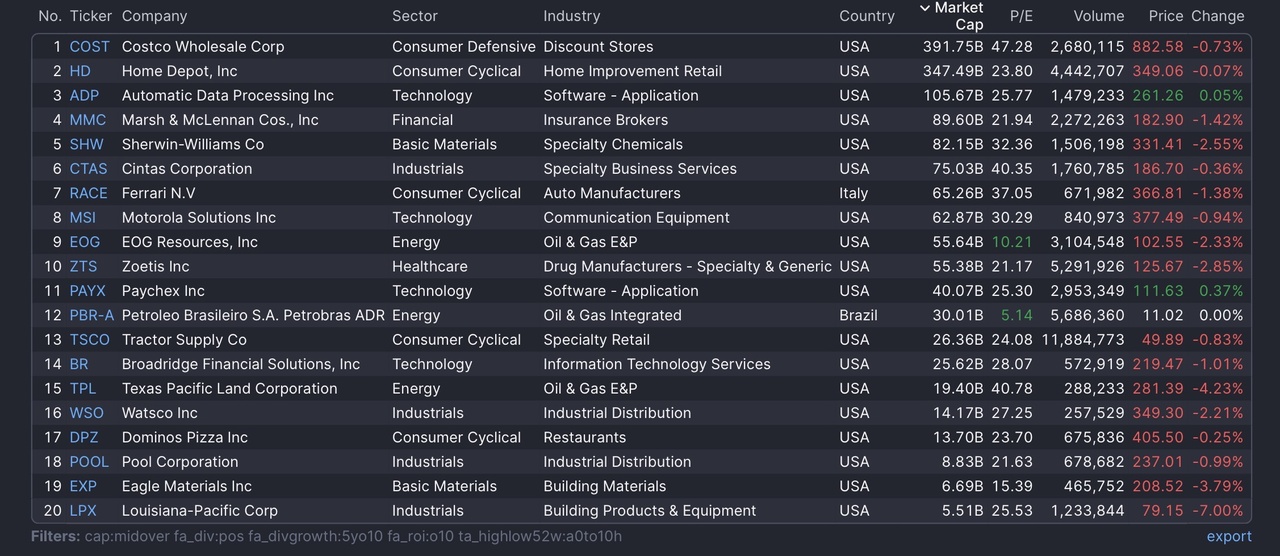
Quality companies pop up in my weekly screenings from time to time. Admittedly, they are designed for this. Recently, however, the number has been increasing.
Filters:
It seems that outstanding companies with proven business models, strong and in some cases very predictable cash flows, high returns on capital and little or no debt are going out of fashion.
Is the AI narrative driving this development? Are the companies simply too boring? Do they not promise sufficient returns compared to the hype stocks? Is it perhaps the phenomenon of the quality anomaly or are the companies really all doomed?
Who knows for sure.
What I do know is that I know nothing!
I humbly look at the market and gratefully accept what it offers me, and right now I see quality companies on sale.
How do you see what the market is offering? Which company do we buy first? Do we buy at all or do we continue to exercise patience?
Let me know and write it in the comments as added value for everyone!
Link to the screening
Dear Community,
At the end of the year, I would like to share my portfolio and my strategy with you.
I am 38 years old, have been in the stock market since 2024 and am aiming for financial freedom at the age of 58. Time will tell whether that will work out... 😉 I'm not investing to maximize my profits, but to be able to live a relaxed life in the long term. To this end, I have deliberately separated my investments into two portfolios with a clear purpose.
Portfolio 1 - Growth (ING)
$VWCE (+0,53%) , $XNAS (+1,36%) , $WGLD (-0,18%) and as an admixture some Bitcoin via ETP $IB1T (+0,4%) .
This portfolio is saved monthly until 58 and then remains more or less untouched.
My savings rates would be:
800€ $VWCE (+0,53%)
375€ $XNAS (+1,36%)
150€ $WGLD (-0,18%)
0€ $IB1T (+0,4%) - Position is currently at 10% and should rest for the time being
Portfolio 2 - Cash flow (SC)
Here I am investing via 2 dividend ETFs ($VHYL (-0,14%) , $TDIV (-0,64%) ) and selected quality stocks to build up a steadily growing cash flow. All distributions are reinvested equally in the ETFs. Furthermore, a small cushion is built up here via $XEOD (+0%) is built up here.
My savings rates would be
250€ $XEOD (+0%)
200€ $VHYL (-0,14%) - Start January 26
200€ $TDIV (-0,64%) - Start January 26
425€ Individual assets (as required, no savings plan, no obligation)
My individual stocks:
Allianz $ALV (-1,36%)
Munich Re $MUV2 (-0,57%)
Procter & Gamble $PG (-0,47%)
PepsiCo $PEP (+1,69%)
Johnson & Johnson $JNJ (-0,22%)
Novo Nordisk $NOVO B (-0,84%)
Lime $LIN (+1,13%)
ADP $ADP (-0,39%)
Waste Management $WM (+0,47%)
Siemens $SIE (-0,92%)
Accenture $ACN (+2,74%)
Alphabet $GOOGL (+1,23%)
Itochu $8001 (+0,89%)
visas $V (+0,27%)
No speculation, no trading. For most people here, extremely boring... 😴 But hopefully the selection will bring some stability to the portfolio in turbulent times. 😉
For the time being, we will stick with these stocks and gradually buy more when good opportunities arise. Each individual position will of course be capped later and should make up between 2-3% of the portfolio (including the proportion within the ETFs). Alphabet would be an exception.
The reallocation idea
Nothing is invested from 58. The plan is to reallocate around 5 % annually from custody account 1 to custody account 2. In this way, growth is gradually converted into cash flow - without significant erosion of assets. And in the best-case scenario, my growth portfolio can continue to grow. I consciously accept taxes 😉
Thank you for reading and have a successful 2026.
P.S. My allocation doesn't fit yet because I've been focusing more on my individual stocks in recent weeks. Chart is also not meaningful because of ING Autosync and Itochu split 🥲

$ (+0,5%)TYL (+0,5%)
$GE (-0,31%)
$GD (-0,36%)
$CHRW (-0,36%)
$ROL (-2,3%)
$TW (+1,21%)
$CSGP (-2,17%)
$RKT (-0,63%)
$CLX (-2,41%)
$ROST (+1,13%)
$FAST (+1,03%)
$CSCO (-0,08%)
$YUMC (-0,25%)
$KOF (+1,65%)
$ORLY (+0,19%)
$KO (+0,29%)
$RY (-0,6%)
$MDLZ (-0,61%)
$IMBBY (-1,75%)
$A (-0,68%)
$IDXX (-0,06%)
$SONY (+0,45%)
$MSCI (-1,31%)
$SYY (-0,55%)
$VLTO WI (-0,43%)
$DPZ (-0,73%)
$IDEX (+14,08%)
$VRSN (+1,69%)
$COST (+1,11%)
$ITT (-0,06%)
$SHW (-0,75%)
$EPD
$SIE (-0,92%)
$CP (-0,24%)
$CTAS (-0,38%)
$ROG (+0,63%)
$BK (+0%)
$CNR (-1,13%)
$PM (-1,11%)
$TSM (+1,49%)
$ITW (-0,25%)
$APD (+0,58%)
$PG (-0,47%)
$AAPL (+0,02%)
$BAC (-1,62%)
$CPB (-2,51%)
$VRSK (-1,17%)
$HSY (-1,92%)
$GWRE (+1,98%)
$HII (+0,17%)
$GSK (+0,64%)
$SBUX (+0,94%)
$ALLE (-0,48%)
$INTU (+0,17%)
$MSI (+0,26%)
$GWW (-0,13%)
$UNP (-0,47%)
$WCN (-1,1%)
$WM (+0,47%)
$NOC (-0,08%)
$CAT (-1,01%)
$PAYX (-0,19%)
$ADP (-0,39%)
$MCO (-0,46%)
$SPGI (+0,24%)
$NDSN (+0,8%)
$WMT (+0,54%)
$OTIS (+0,24%)
$CL (-0,07%)
Best Companies to Own: Methodology
The companies on this list are covered by Morningstar Research Services’ equity analysts and have shares available to US investors. This means that Morningstar equity analysts have calculated fair value estimates for the shares of the companies that trade on US exchanges. As a result, most of the companies on this list are based in the US.
Within that coverage list, the best companies meet the following criteria:
What Gives a Company an Economic Moat?
Companies with moats have one or more of the following characteristics:
To maintain analysts’ independence, Morningstar Research Services does not publicly rate its parent company Morningstar Inc. Therefore, Morningstar, Inc. is not on the list of the best companies available to US investors.
https://www.morningstar.com/stocks/best-companies-own-2026-edition
Automatic Data Processing, Inc. (ticker: ADP) is a leading global provider of human capital management, payroll, personnel management and outsourcing services. Headquartered in Roseland, New Jersey, the company has been established for decades and serves over one million clients in more than 140 countries.
In the financial year to June 30, 2025, ADP generated revenue of around USD 20.56 billion, which corresponds to stable growth compared to the previous year. Net profit amounted to around USD 4.08 billion, which corresponds to a net margin of around 19.8 %. The operating margin is over 25%, which is relatively high compared to many other software and service providers. The return on equity is over 70 %, which indicates a very efficient use of capital.
The share is currently moderately valued: The price/earnings ratio is between 25 and 30, reflecting the stability and quality of earnings. The price/sales ratio is around 4.75-5.0, which is a moderate valuation compared to many technology and software stocks.
ADP pays a regular dividend, which most recently amounted to around USD 6.02-6.80 per share, corresponding to a dividend yield of around 2.3-2.7%. The dividend has been continuously increased over many years. The payout ratio is at a level that enables a sustainable dividend payment without restricting growth potential too much.
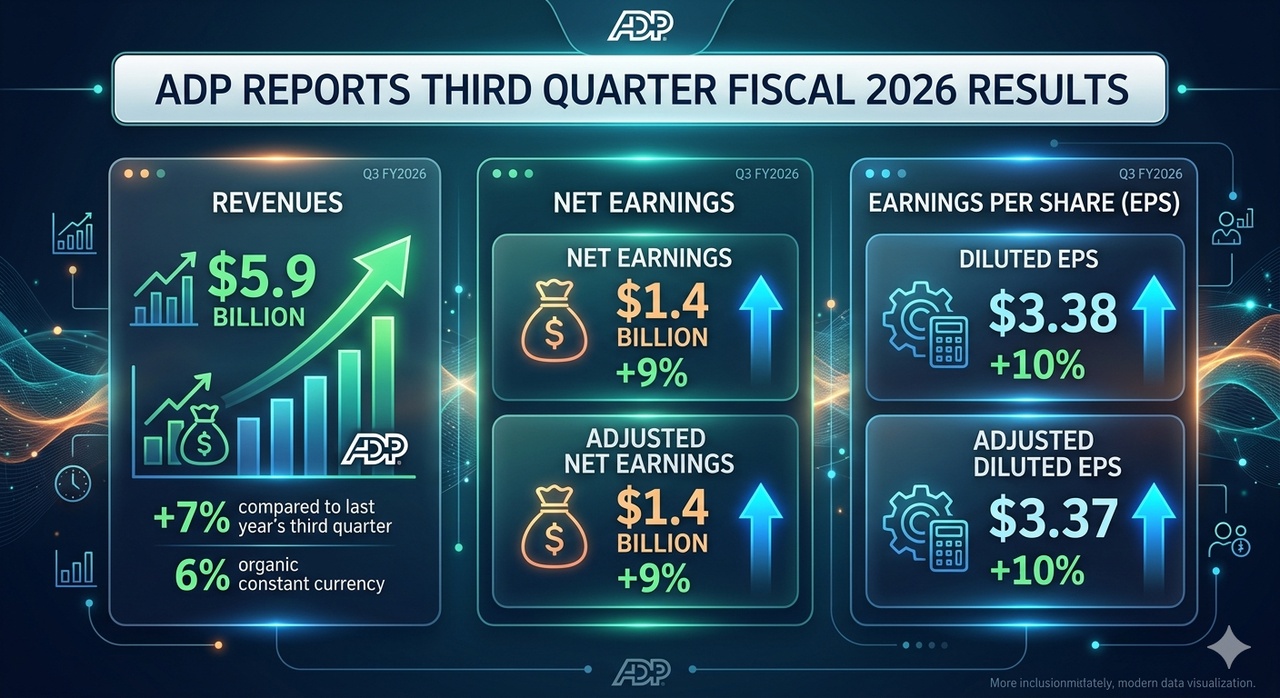
In operational terms, ADP is showing healthy organic development: revenue is growing steadily, and in the fourth quarter of the 2025 financial year, revenue increased by around 8% year-on-year, while adjusted earnings per share also rose by around 8%. In the first quarter of financial year 2026, revenue also grew by around 7% year-on-year and earnings per share increased to around USD 2.49. This demonstrates the company's operational strength and the resilience of its business model.
A long-term advantage of ADP is its high customer loyalty and broad customer base. Many companies use ADP solutions for critical HR and payroll processes, which leads to high switching costs and thus creates a strong competitive position. The market for HCM software is also growing as more and more companies digitize their HR processes and prefer outsourcing solutions.
However, there are also risks. Despite the defensive nature of the business, ADP is dependent on the employment situation: Declines in new hires or outsourcing budgets could have a negative impact on demand. In addition, the valuation is not favorable by historical standards, meaning that short-term price gains could be limited.
In summary, ADP is more suitable for long-term investors who value stable earnings, dividend income and an established business model. The company shows solid growth rates, stable cash flows and a sustainable dividend policy, which makes it an interesting component of a balanced portfolio - provided you accept moderate growth and no extreme short-term price gains.
Sources: Annual Report ADP 2025; finanzen.net; AlphaQuery; Yahoo Finance; Investing.com - Text summarized and formulated with the support of ChatGPT. | Without guarantee
No investment advice - only a summary of public data
PS: I have the share in my portfolio myself.

Principais criadores desta semana