
$ABBN (-0,89%)
$GE
$RTX (-0,26%)
$HAL (-2,29%)
$MMM (-1,11%)
$NOC (-0,08%)
$MSCI (-1,34%)
$ISRG (+1,92%)
$SPCX (+0,83%)
$NFLX (-1,04%)
$DB1 (-0,52%)
$CME (+0,72%)
$T (-0,34%)
$PM (-1,12%)
$MCO (-0,46%)
$NEE (-1,6%)
$UAL (-0,47%)
$MONC (-1,31%)
$TXN (-0,25%)
$META (-1,04%)
$IBM (+2,7%)
$SAP (+1,07%)
$QS (-2,23%)
$LRCX (+2,98%)
$TSLA (+4,45%)
$RMS (+0,68%)
$NESN (-0,16%)
$BARC (-3,54%)
$ROP (+0,63%)
$DOW (+0,28%)
$SPOT (-2,17%)
$NDAQ (-0,36%)
$AAL (-0,1%)
$LMT (+0,31%)
$PG (-0,45%)
$BX (+0,36%)
$BESI (+3,72%)
$VLO (-0,99%)
$KER (-0,07%)
$OR (-0,56%)
$VRSN (+1,69%)
$WDC (+5,22%)
$BE (+1,88%)
$NEM (+0,03%)
$TOM (+1,73%)
$AXP (+1,01%)
$FIX (+2,98%)

Northrop Grumman
Ação
Ação
Ticker: NOC
NOC
Price
Discussão sobre NOC
Postos
821D·
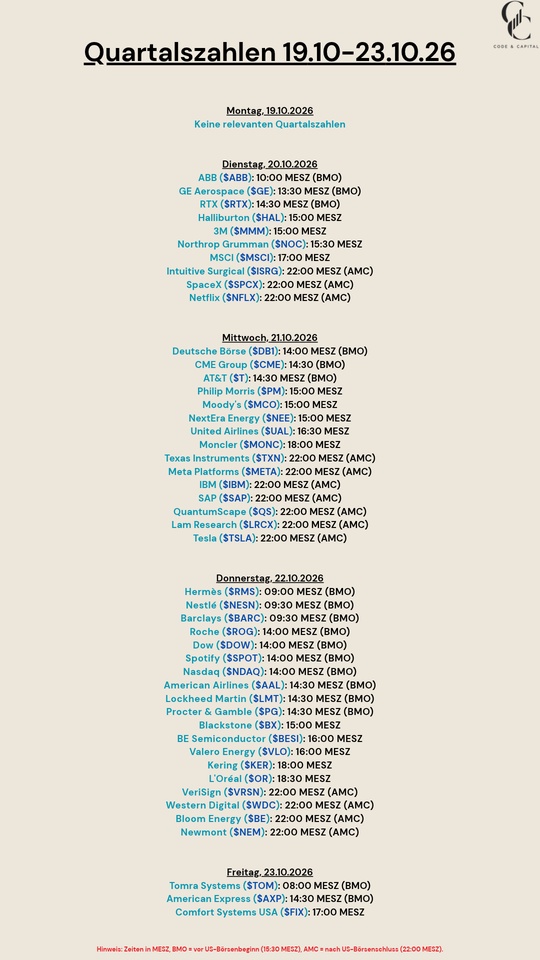
Quarterly Results: Oct. 19–23, 2026
99
2Semana·
Stop Loss
Today was the day—
after 9 months, Intesa Sanpaolo was
was sold off—the stop-loss was hit.
The Italian dividend-paying bank stock that “Raketen Toni” from Denmark
as a “well, sort of” bad AI buy.
This put me in the following situation:
Purchased in January at 5.6 euros
Added to the position in March at 5.1 euros
Dividend: 350 euros
As I said, it’s time to pull the ripcord
since the bank,
despite ECB interest rate hikes
and rising share prices at other European banks, isn’t gaining traction.
Pulling the ripcord was the logical implementation of disciplined risk management:
If the original investment thesis (price upside potential driven by the interest rate environment) isn’t materializing despite the €350 dividend yield, and the stock is showing relative weakness compared to the sector, a stop-loss protects against further capital erosion.
The freed-up capital ends the “dead capital” scenario and is now available for more dynamic stocks, such as
$MCD (+0,3%) Additional purchases
$NOC (-0,08%) Reinvestment
$FRA (+0,83%) Additional purchase
$KRN (+0,27%) possibly, despite the position’s size, achieves a further increase in the PoFo.
Furthermore, $LMT (+0,31%) be sold, as the 10% p.a. return has not been realized here.


6Mês·
Intesa Sanpaolo
Following the sale of some dividend stocks
I bought a 2nd tranche of an Italian bank stock with a dividend:
intesa sanpaolo
Here is a compact fundamental analysis of Intesa Sanpaolo
## 1st P/E ratio (trailing & forward) incl. sector comparison
| Key figure | Intesa Sanpaolo | Typical EU banking sector* |
|----------------------------|-----------------|----------------------------|
| Share price (approx.) | € 5.1 | - |
| P/E ratio trailing (TTM) | 9-11 approx. 8-10 (large euro banks, roughly) |
| P/E ratio forward (estimate) | around 7-9 (derived from high earnings growth and dividend yield) | similar, sometimes slightly higher |
| P/S ratio (price/sales, ttm) | approx. 3.3-4.1 mostly 2-3 |
| P/B ratio (price/book, mrq) | approx. 1.5 often 0.7-1.2 |
Interpretation: The **KGV** is slightly above the pure substance sector (many banks trade below book value), which reflects the high profitability and dividend policy, but is still in the "favorable to fair" range in absolute terms.
## 2. earnings per share (EPS) & trend
- Current EPS (TTM): around € 0.50-0.54 per share.
- Net profit 2024: Record net profit of € 8.7 bn, +12% compared to 2023.
- Profit growth: According to Simply Wall St, on average approx. 28% p.a. over several years, sales growth approx. 11.5% p.a.
The **EPS trend** of the last 3-5 years thus shows clearly above-average growth for a major bank, driven by the interest rate environment, fees and insurance business.
## 3. EBIT & EBIT margin (operating result)
Banks typically report operating profit as "operating income/operating margin" rather than traditional EBIT, but analogously:
- 2024: Very strong operating profitability, driven by interest business, fees and record insurance result; cost/income ratio at record low of 42.7% (one of the best ratios in Europe).
- High net margin: net margin around 36.5% according to analysis platform, ROE around 14.3%.
Conclusion: Operating **earning power** and margins are clearly above the average of major European banks, which justifies the slightly higher valuation level.
## 4. dividend, yield & payout ratio
| Key figure | Value (last) |
|-------------------------------|-------------------------|
| Dividend per share (current) | approx. € 0.34-0.37
| Dividend yield (forward) | approx. 6.4-7.7%
| Dividend payout ratio (payout) | approx. 67%
| Total payout 2024 | € 6.1 billion cash dividends
| Additional planned share buy-back of € 2 billion
The bank pursues a shareholder-friendly policy with a high **dividend yield** plus buybacks; with ~2/3 payout ratio, there is still a buffer for capital expansion and growth.
## 5. share price history & performance
| period | price info / performance* |
|--------------|--------------------------------------------------------|
| 52-W-Range | approx. 3.5-6.2 €
|
| Last price | approx. € 5.1 (March 2026, Milan Stock Exchange) |
| 1-J Performance | approx. +39% (last 12 months) |
| Volatility | Beta approx. 0.8 (below market average)
*Compared to a broad index such as the Euro Stoxx 50 or S&P 500, Intesa Sanpaolo has outperformed very strongly in the last year; exact benchmark figures fluctuate depending on the reporting date, but are well below +39%.
This means that the share has clearly outperformed in the last 1-3 years, but has already seen a double-digit decline since the high (February 2026 at approx. €6.16).
## 6. overall valuation - favorable / fair / expensive?
Points in favor of the share:
- Above-average profit and sales growth combined with very high profitability (ROE, net margin, cost/income).
- High and probably sustainable dividend yield of around 6-7% plus share buybacks.
- Valuation ratios (P/E ratio, P/B ratio) rather in the "cheap to fair" range compared to European peers, considering the high quality.
Risks/observation points:
- Significant share price increase in recent years; some of the improvement is already priced in.
- Cyclical interest rate and credit risk in the banking sector in general (interest rate turnaround, economic situation in Italy/eurozone).
Overall assessment from an investor's perspective: Based on the available key figures, Intesa Sanpaolo currently appears **rather favorably to fairly valued**, especially for income-oriented investors who value stable, high dividends and accept the banking sector risk.
Sources:
[1] Intesa Sanpaolo SpA, ISP:MIL summary - FT.com - Markets data
77
5 Comentários
Keineui@Keineui
2Semana
•
11
•Ver todas as 3 restantes respostas

1Mês·
Northrop Grumman Dividend
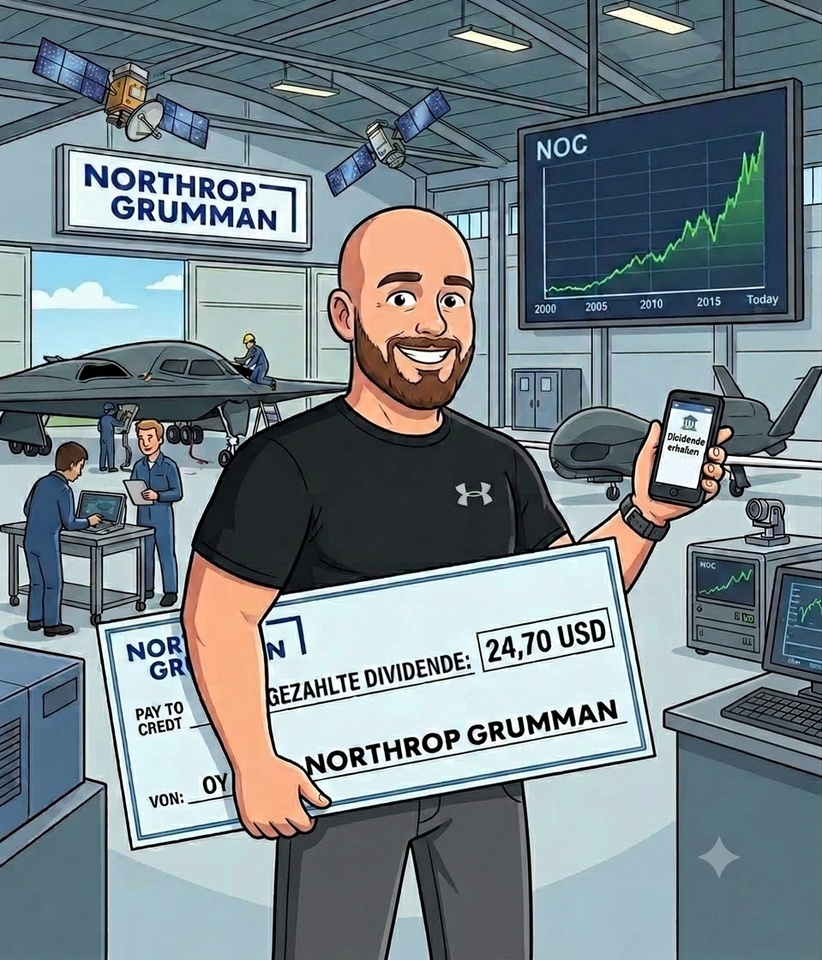
Today, the dividend from the defense giant $NOC (-0,08%) has been credited to the portfolio. Northrop’s order books are so full that, through 2031, the company is more likely to worry about insufficient capacity than about acquiring new customers.
In particular, the B-21 Raider program, nuclear modernization, as well as hypersonic missiles, submarine maintenance, and air defense account for a large portion of the expected revenue.
1515
3 Comentários
1Mês
I can't confirm the price increase in the "green ATH" background!
•
33
•2Mês·
The Defense Industry—Crisis-Proof?
The aerospace and defense sector now accounts for about 8% of my investment capital. Although some companies in the industry are already in the $HMWO (+0,42%) , $TDIV (-0,65%) or the $VHYL (-0,14%) portfolio, they were nevertheless added as individual stocks due to their long-term trends and future prospects.
These are $LMT (+0,31%) , $NOC (-0,08%) , $AVEX and $AVAV (-2,03%)
The defense sector is booming for the first time since 1990 due to global conflicts and looming crises—order books are full, jobs are being created, and new plants are being built. Countries are arming themselves with drones, among other things, as well as other equipment and systems, ever since they’ve seen what these are now capable of. Defense capabilities against drones, cyberattacks, and hybrid warfare also play a massive role and require nations to arm themselves against these threats.
In addition to the current boom, however, this industry is also interesting for another reason: it is quite recession-proof due to its customer base. Furthermore, there are high barriers to market entry, few competitors, and the customers are almost exclusively governments—which also have maintenance and upgrade contracts in place for decades to come—and, last but not least, a certain level of trust among users in the systems’ performance.
Even though one might sometimes get the impression that NATO is falling apart, many systems and pieces of equipment are still compatible with one another—or are intended to become so in the future—which greatly expands the list of potential customers.
Disadvantages of the industry? A high concentration of customers, development risks, export restrictions, political interference—sometimes sensible, sometimes less so—and if a company falls behind technologically, it could very quickly lose ground.
While $LMT (+0,31%) and $NOC (-0,08%) have been established in the industry for years and are growing through scaling, diversification, and expertise, $AVEX and $AVAV (-2,03%) represent, in my view, the future of military development and thus represent a growth bet on nations’ drive to deploy autonomous systems in crisis zones.
My conclusion is this: Anyone who actively chooses to include defense industry stocks in their portfolio accepts an ethical dilemma, but benefits from tremendous predictability, structural tailwinds, as well as technological change and the associated government spending.
Final Thoughts:
If world peace were to break out tomorrow—then, by the way, I would be more than happy and more than willing to pay the price for it in the form of losses!
*contains AI-generated images*



88
2 Comentários

Another drawback of the industry is evident in the Ukrainian Armed Forces’ procurement process:
In a war fought at the highest technological level, the ability to procure equipment quickly and flexibly is crucial throughout. Huge defense contractors simply cannot offer that.
Ukrainian unit and formation commanders order equipment, UAVs, weapons, and accessories through a government website where many small businesses offer their products. This decentralized procurement process provides the armed forces with what they need: Immediately available equipment that can be tested, adapted, discarded, and replaced.
An army’s tactical level is not concerned with long-term contracts, maintenance schedules, or spare parts production lead times—all of which defense contractors try to sell to a government seeking to become a customer in order to earn predictable, long-term profits.
When we talk about major defense projects such as main battle tanks, cruise missiles, frigates, submarines, and fighter jets, the major defense contractors remain in a league of their own. However, it’s important to keep in mind that the following is also evident in Ukraine:
- A €35 million tank can easily be destroyed by a €1,500 drone
- The operational value of a fighter jet is drastically reduced in a war between two evenly matched parties due to a lack of air superiority
- Frigates and submarines can be trapped in ports, as setting sail is too dangerous due to underwater UAVs
- Cruise missiles costing millions are being replaced by inexpensive long-range UAVs, which enable better aerial reconnaissance and more selective target engagement
Defense contractors will not stop making money, especially since countries like Germany continue to rely heavily on conventional warfare, but there are also reasons why what defense contractors offer may not be attractive to an army.
•
88
•2Mês·
SpaceX? No, thanks 🙂↔️
I have to admit, to be honest: I still can't really wrap my head around the hype surrounding SpaceX $SPCX (+0,83%) —even a few weeks after the IPO—I still can’t really wrap my head around it. Maybe I’m missing something, or maybe not. But that’s not what I want to focus on today.
I find another stock much more exciting—one that, in my opinion, has received significantly less attention so far, even though it also went public as recently as May of this year. For me, this company is one of the most interesting alternatives in the entire space sector, and that’s exactly why I’d like to introduce it to you in a bit more detail today.
At this point, I’d also like to say a huge thank you to the best @Get_Rich_or_Die_Tryin 🫶✌️ for the informative discussion about this stock—and, of course, for more!
First, for the sake of transparency: I’m already invested. Nevertheless, I’ll try to outline the opportunities and risks as objectively as possible.
Let’s go! 🚀
🛰️ HawkEye 360, Inc. $HAWK : The West’s Ears in Orbit
While half the investing world is fixated on the $SPCX (+0,83%) SpaceX IPO, another space company went public on the NYSE in May 2026—one that’s fundamentally much more tangible than any rocket hype: HawkEye 360 $HAWK The company is neither a picture-perfect firm like Maxar nor a loss-making space dreamer. It is the global pioneer in commercial, space-based signals intelligence (SIGINT)
The difference is fundamental: Traditional Earth observers (geo-intelligence) take photos or radar images—they show what’s visible—while HawkEye 360 $HAWK captures the invisible: radio frequencies (RF). Radio transmitters, military radar systems, satellite phones, GPS jammers. For intelligence agencies and generals, this is the most valuable source of data of all, because it reveals troop movements before the first tank rolls into the camera’s field of view. And unlike an optical satellite, RF reconnaissance works through clouds and at night—radio waves don’t need light.
1. The Business Model: The Triad of Radio Reconnaissance 🛰️📡🕵️
HawkEye $HAWK controls the entire value chain of commercial space espionage across three stages—a vertically integrated B2G (business-to-government) model that spans from data collection to the final intelligence product.
① The Constellation (Data Collection): HawkEye $HAWK operates a fleet of over 30 active microsatellites in low Earth orbit (~500 km). The technical core: The satellites fly in precise clusters of three (formation flight). This is the fixed Capex component—once in orbit, the capital intensity decreases with each additional customer.
② The software layer (value-added processing): Raw radio signals are worthless. Using its proprietary platforms, HawkEye $HAWK filters out interference and reveals patterns. This is where the real value lies—and, since late 2025, a massively strengthened moat (see the ISA acquisition).
③ Customer retention & scaling: HawkEye $HAWK is breaking the decades-long government monopoly on military spy satellites. It sells data and analytics subscriptions to governments and public agencies. The key lever: Once the constellation is in place, every additional subscriber is nearly pure profit.
2. The Technology: Why HawkEye Sees What Clouds Hide 📐
The unique physical feature is called TDOA—Time Difference of Arrival
When a source on Earth (a ship, a radar, a jammer) transmits a radio signal, the three satellites in a cluster receive the same signal with a minimal difference in transit time. Using these nanosecond-level time-of-flight differences, the algorithms triangulate the exact location of the source—with kilometer-level accuracy, worldwide, regardless of weather or time of day.
Three additional technical points that are often overlooked:
Expansion License: An FCC license allows for expansion to up to 80 satellites (final configuration: 15 clusters). Today’s fleet of over 30 satellites is therefore just the beginning of improvements in coverage and latency.
Global Ground Network: Through partners such as ATLAS Space Operations, a worldwide network of ground stations is connected, reducing the latency between signal detection and actionable intelligence.
The Data Moat: Over more than a decade, HawkEye has built up an archive of RF emitters. Every newly detected signal improves pattern recognition. This is a growing, cumulative advantage that a new entrant cannot catch up to overnight.
3. Key Figures (as of post-IPO May 2026 / Fiscal Year 2025) 📊
Initial Public Offering: NYSE debut on May 7, 2026, under the ticker $HAWK
offering price of $26.00, 16 million shares, ~$416 million in gross proceeds.
The proceeds paid off the expensive acquisition debt (two bank loans, ~$48.6 million total debt) plus a deferred ISA obligation—HawkEye has been operating from a comfortable cash position ever since.
Market capitalization: ~$2.3 billion (at ~$24 and ~93 million shares).
Revenue (FY 2025): $117.7 million, a +74% increase from $67.6 million in 2024.
EBITDA (FY 2025): $24.8 million = ~21% margin. This is among the highest figures in the satellite data sector.
Net Income (FY 2025): $2.7 million—positive for the first time, following a loss of ~$29–31 million in 2024. To be fair: With a ~2% net margin, this is extremely slim; only ~$48,000 remains attributable to common shareholders. The meaningful profitability metric here is EBITDA, not net income.
🚀Order Backlog: $302.7 million—a massive increase of +586% (6.9x) compared to $44.1 million in the prior year. This corresponds to ~2.6x forward revenue coverage and stems from multi-year fixed-price government contracts, not spot business.
Customer mix:
🇺🇸61% U.S. government (NRO, NGA, U.S. Space Force)
🇯🇵16% Japan,
23% other allied nations.
Valuation: ~12x EV/revenue. Gross margins are trending toward software-industry levels.
📉Stock price history: IPO $26 → all-time high $35.73 (May 12) → ~$19 (as of July 27, 2026). The stock has thus fallen nearly 50% from its high and is trading near its 52-week low.
Analysts: Price target range $34–42 (several “Buy” recommendations). Noteworthy: The current price is below the entire analyst range.
Key facts: Founded in 2015, headquartered in Herndon, Virginia, ~395 employees, CEO John Serafini. Next earnings report: ~September 2, 2026.
Competition & Moat ♟️
The Market Landscape:
🥊- Direct RF competitors: Spire Global $SPIR (-1,26%) (larger multi-sensor network; RF is just one of many functions), Unseenlabs from France (focus on maritime RF detection).
😵- A cautionary tale: Kleos Space, a maritime RF specialist from Luxembourg, went bankrupt in 2023. This shows just how capital-intensive and difficult scaling is in this field—and underscores HawkEye’s lead in maturity and scale.
📡- Complementary, not direct: Maxar, Planet Labs $PL (+0,83%) , Capella, and Iceye provide optical and SAR imaging, respectively—a different type of data, often combined with RF.
🪖- Defense contractors (Lockheed $LMT (+0,31%) , Northrop $NOC (-0,08%) ): It would take them years and billions to build a comparable constellation—and they aren’t “space-native” in the RF sector.
HawkEye’s competitive moat in bullet points:
🏰- Largest commercial RF constellation with cluster triangulation
🏰 - Pure play in SIGINT—not diluted by side businesses
🏰- Decade-long RF emitter archive (cumulative data lead)
🏰- Classified algorithms already integrated into the U.S. security architecture (see ISA)
🏰- Unclassified, shareable data model—allies can use it without having to build their own secret infrastructure
🏰- Space-native, persistent global coverage instead of ground- or air-based point solutions
Additional Insider Facts (The “Deep Dive” Bonus) 💡
🚀 The ISA Acquisition – The Key to the Big Budgets.**
Shortly before its IPO (December 2025), HawkEye $HAWK acquired Innovative Signal Analysis (ISA) for $166.5 million. A brilliant strategic move: HawkEye $HAWK collects the unclassified raw data, while ISA provides the classified analysis algorithms—already integrated into U.S. SIGINT programs—plus a universal detection engine that identifies and isolates signals. The formula is: unclassified collection + classified analysis = access to the Pentagon’s largest, secret budgets. In addition, ISA merges space-based data with ground- and air-based sensors.
🚀 The Dark Vessel Hunter (“Custody ID”).
Smugglers, illegal fishermen, and sanctioned oil tankers turn off their AIS (automatic identification system) on the high seas to become invisible. HawkEye $HAWK instead intercepts the radio signals from their onboard radars and continues to track these “ghost ships” using AI—even when the AIS is silent.
🚀 GNSS Interference Detection.
In GPS-denied, contested areas, HawkEye detects and locates GPS jamming—a directly monetizable use case in any active conflict zone.
The PBC structure (both a moat and a shackle).
HawkEye $HAWK is structured as a Public Benefit Corporation (Delaware). Management is *legally obligated* to balance the security of the U.S. and its allies against shareholder interests. When in doubt, national security takes precedence over returns. On the one hand, this creates a trust monopoly with the Pentagon (no competitor with lax governance can come close); on the other hand, however, it can block lucrative deals with “undesirable” third-party countries. This tension is the most important—and often overlooked—aspect of the entire stock.
🚀 New major contracts.
In December 2025, a multi-year international contract worth more than $100 million was announced, followed by additional awards in 2026—so the backlog isn’t just growing from past orders but is actively expanding.
4. Why is this stock particularly exciting right now? 🚀
1. RF warfare is the macroeconomic megatrend.
Modern conflicts are decided in the electromagnetic spectrum. GPS jamming against drones, illegal radar systems in the South China Sea, electronic warfare in Ukraine—HawkEye $HAWK provides the only commercially available, uncensored map of these threats for Western allies.
2. Defense budgets are on the rise.
NATO members have moved toward a spending target of up to 5% of GDP, and the U.S. Space Force is specifically increasing funding for space-based sensors. HawkEye $HAWK is positioned right in the middle of this flow of funds—with a total addressable market (TAM) of ~$24 billion for RF spectrum exploitation alone (not including commercial opportunities).
3. A first mover with a proven track record.
HawkEye $HAWK is the first profitable, publicly traded commercial RF SIGINT pure play. This is exactly where 95% of space startups fail: they make money before they run out of fuel.
4. Operating leverage poised to take effect.
The platform for Tier-1 enterprise customers is in place, and development costs are fixed. Every additional contract contributes disproportionately to the margin. The backlog of 2.6x annual revenue is essentially already-sold scalability.
5. Platform integration into the security architecture.
Instead of delivering in isolation, HawkEye’s RF data stream is integrated into Lockheed Martin’s tactical systems via machine-to-machine integration (as demonstrated, among other instances, during the Talisman Sabre exercise). That is the real “platform” story—deep integration, high switching costs. *(Note: A circulating claim of a Palantir integration could not be substantiated—the verified integration partner is Lockheed Martin.)*
6. Valuation dislocation.
Following the IPO euphoria ($35.73), the stock has corrected significantly to ~$19—the “tech tourists” have cashed out. The price is below every analyst estimate. For a long-term investor, this presents a more attractive entry point than on the IPO day.
5. Risks ⚠️
- ❗️Extreme concentration risk: Over 60% of revenue** comes from the U.S. government. A budget freeze in Congress or cuts to the defense budget would strike a blow to HawkEye’s lifeline.
- ❗️The PBC constraint: The legal priority given to national security can prevent profitable expansion into third-party markets.
- ❗️Launch Vehicle Dependency: The expansion to 80 satellites depends on rideshare launches (primarily SpaceX and Rocket Lab). Launch delays directly slow growth.
- ❗️War in Orbit: In the event of a conflict, SIGINT satellites are among the primary targets for anti-satellite weapons, jamming, and cyberattacks.
- ❗️Margin Compression Due to Product Mix: The larger the partner or contract, the greater its bargaining power. Volume must support the margin.
- ❗️Valuation & Volatility: ~12x EV/revenue is not a bargain, and the stock’s trading history is extremely short. As IPO lock-ups expire, additional selling pressure may arise.
- ❗️FX risk (for EUR investors): Revenues are predominantly in USD; a weak dollar dampens performance when converted to euros.
My Personal Conclusion & Reaper Rating 💀
HawkEye 360 $HAWK is, in my view, one of the most fundamentally compelling space-tech IPOs of recent years—definitely more than $SPCX (+0,83%) ! The company is a profitable pure play in a structurally growing niche, has a strong technological moat, benefits from recurring revenue and a well-filled backlog, and enjoys a near-monopoly in its market segment. It is precisely this combination that makes the investment story extremely attractive to me, at the very least.
Nevertheless, one shouldn’t confuse euphoria with reality. $HAWK The company has only been publicly traded for just under two months and can look back on only about a year of sustained profitability so far. Net income remains at a very low level, and the stock exhibits enormous price volatility—typical for young public companies with a still-limited track record.
In my opinion, the potential is very high, but it’s just as important to honestly assess the risks of a still-young investment story. High quality standards don’t mean that every strength is automatically rewarded with a top rating.
💀Jack’s Verdict :
“HawkEye has achieved what almost every space startup fails at: They’re making money before they run out of fuel. A near-monopoly first mover, a 21% EBITDA margin, and an order book that’s exploded by 586%—that’s not hype, that’s a business. BUT: The stock is about 8 weeks old, is rocking like a fishing boat in a hurricane, and is over 60% dependent on a single government. I don’t buy something like this on day one with both feet in and an 8-out-of-10 rating—I’m biding my time.
My entry price for the first tranches is around $15–$17. If you lock this in for five years, you’re buying a monopoly in commercial space intelligence. If you want to be rich in six months, you’re buying volatility. Know the difference.”
REAPER RATING: 🟡 WATCH
ENTRY PRICE LIMIT: $15
REAPER SCORE: 6/10
@Get_Rich_or_Die_Tryin
@Tenbagger2024
@Raketentoni
@Multibagger
@Stocktective
1919
19 Comentários
LOL, where are the graphics? 🤦🏼♂️
•
33
•
3Mês·
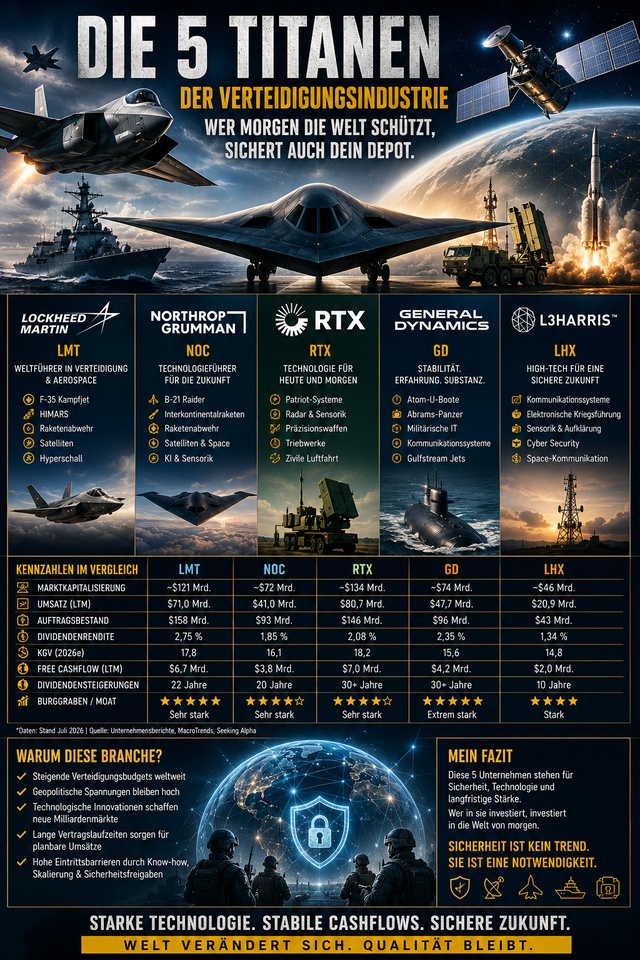
The Titans of the Defense Industry – Who Will Protect the World Tomorrow?
War. Cyberattacks. Space. Artificial intelligence.
The world is changing faster than ever before. While many industries are struggling with economic fluctuations, governments worldwide are investing record amounts in their security.
But which companies will benefit from this in the long term?
I’ve compared five of the most important defense companies in the Western world.
1. Lockheed Martin ($LMT (+0,31%)
) – The undisputed market leader
When you think of modern defense, you can’t ignore Lockheed Martin.
Among other things, the company develops:
- F-35 Lightning II (the world’s most successful fighter jet program)
- HIMARS missile systems
- Missile defense
- Satellites
- Hypersonic technologies
What makes Lockheed special:
• Contracts worth billions over decades
• Enormous barriers to entry
• High free cash flows
• Dividends that have been rising for over 20 years
For many investors, Lockheed Martin is the benchmark for quality across the entire industry.
2. Northrop Grumman ($NOC (-0,08%)
) – The future is taking flight behind the scenes
Northrop is less well-known than Lockheed.
Technologically, however, the company ranks among the absolute world leaders.
Highlights:
• B-21 Raider stealth bomber
• Intercontinental ballistic missiles
• Missile defense
• Satellites
• Space systems
• Artificial intelligence
Northrop has enormous competitive advantages, particularly in the areas of space and strategic deterrence.
3. RTX ($RTX (-0,26%) )– The Invisible Giant
Many people still know RTX as Raytheon.
Yet its technology is embedded in countless defense systems.
Its portfolio includes:
• Patriot air defense
• Radar technology
• Aircraft engines
• Missiles
• Sensors
The major advantage:
RTX generates revenue from both military and commercial aviation.
This diversification makes the company particularly resilient.
4. General Dynamics ($GD (-0,38%)
) – Stability for Decades
General Dynamics manufactures:
• Nuclear submarines
• Abrams tanks
• Military IT systems
• Communications solutions
It also owns Gulfstream, a leading manufacturer of business jets.
For dividend investors, General Dynamics has been one of the most reliable companies in the industry for years.
5. L3Harris ($LHX (-0,68%)
) – The High-Tech Specialist
L3Harris doesn’t develop spectacular fighter jets.
Instead, the company provides the technology without which modern armed forces would be virtually incapable of operating.
This includes:
• Communication systems
• Reconnaissance
• Sensors
• Electronic warfare
• Cybersecurity
Anyone who believes in the digital transformation of defense should keep an eye on L3Harris.
My Comparison
Technology leader: Northrop Grumman
Market Power: Lockheed Martin
Best Diversification: RTX
Most Stable Dividend Payer: General Dynamics
Greatest Future Potential: L3Harris
Why I Find This Sector Exciting
Many investors associate defense companies exclusively with geopolitical conflicts.
In doing so, they often overlook other growth drivers:
✓ Rising NATO defense spending
✓ Cybersecurity
✓ Satellite communications
✓ Space technology
✓ Artificial intelligence
✓ Hypersonic technology
✓ Drones
✓ Electronic warfare
The industry is increasingly evolving into a high-tech sector and is no longer limited to traditional weapons manufacturers.
My Conclusion
I don’t invest based on short-term headlines.
I’m interested in companies with:
• decades of government contracts
• high barriers to entry
• tremendous technical expertise
• solid cash flows
• long-term dividend potential
That’s exactly why, in my view, Lockheed Martin, Northrop Grumman, RTX, General Dynamics, and L3Harris are among the most exciting quality companies in the defense sector.
#Aktien
#Investieren
#Langfristig
#Dividenden
#QualityInvesting
#Defense
#Aerospace
#LockheedMartin
#NorthropGrumman
#RTX
#GeneralDynamics
#L3Harris
#CyberSecurity
#Space
#KI
#ValueInvesting
#Cashflow
#Getquin


4Mês·
Northrop Grumman buy
New position: Northrop Grumman.
My reasoning: In my view, the geopolitical situation will not become more stable in the long term. Many countries are significantly increasing their defense budgets, while at the same time requirements for air defense, satellites, missile defense and modern military technology are increasing.
Northrop Grumman is active in areas such as
- Defense Systems
- Space & Satellites
- missile defense
- Stealth bombers
- High-tech military infrastructure
Investment thesis:
More geopolitical tensions → higher defense spending → long-term increase in demand for modern military technology.
For me, this is more of a long-term addition with a focus on security technology and geopolitical trends rather than a short-term price fantasy.
How do you see defense stocks over the next 10-15 years?
1111
3 Comentários4Mês
In the short term, the high start-up costs are weighing on profitability: adjusted EPS rose by just 1% to USD 26.34 in 2025. In the current financial year, CEO Kathy Warden expects an increase to USD 27.40 to 27.90. At the same time, sales are expected to increase to USD 43.5 to 44 billion (2025: USD 41.95 billion). The extensive multi-year order backlog of over USD 95.7 billion (as at December 31, 2025) provides planning security.
The valuation of the S&P 500 share has now risen to 27 times the expected earnings for 2026 (P/E ratio);
just over twelve months ago, the forward P/E ratio was 15.
This is comparable to Rheinmetall and Renk, which, however, are likely to show significantly higher earnings growth in the coming years.
For investors interested in armaments, the German stocks therefore offer a better risk/reward ratio.
The B-21 Raider stealth bomber, which is considered a strategic component of the US air force, remains at the heart of the growth prospects.
It is due to enter service in the mid to late 2020s and will secure the strategic power of the USA for decades to come.
According to the company, the test program is now progressing better than anticipated. Northrop is currently investing several billion dollars in capacity expansion in order to increase production rates and realize economies of scale.
••

5Mês·
Apr 22 / Time to Buy More Defence?
War is ubiquitous right now. Whether you look at Ukraine, Iran, the Gulf, Pakistan, or not so long ago Venezuela. And that’s despite Trump’s claims that he supposedly ended eight wars since he came into office. While nobody knows which wars he ended, most people definitely know which he has begun. And that’s not to critique the engagement in Iran or Venezuela. Trying to overthrow evil dictators is not an inherently bad cause, however the method might be more than questionable.
At this point, the standoff between Trump and whoever is in charge of Iran seems more like two kids fighting in the playground over who opens the Strait of Hormuz first and finally gives the Gulf nations some breathing space again.
But one thing is undoubtedly clear in all this. The defence sector is booming everywhere. In Europe, the US and Asia, countries are rearming themselves, for very different reasons. Europe because the American security guarantee is no longer completely reliable, with NATO seemingly in question. Asia because China continues to expand its dominance and push to become the leading world power. And the US because it still wants to play “World Police,” even if that might not be the most popular approach domestically anymore. But I guess we’ll find that out in the midterms.
Considering all of this, nobody can doubt the importance of defence companies, and their backlogs are as full as you would expect. The poster child of European rearmament is Rheinmetall, growing at unprecedented rates with order books stretching years into the future. And that is definitely reflected in the stock price. Since the start of the Ukraine War five years ago, the stock has risen by more than 2,200%. Yes, that’s right, if you invested $10k then, they would be worth $220k now.
But we all know that Europe’s defence industry has been historically underfunded, so it’s no surprise that it eventually caught up. What about the US then?
The sector is doing well, as always, but the stock performance hasn’t been as extraordinary. Around 110% over the last five years for the SPDR U.S. Aerospace & Defense ETF is solid, but not exactly record-breaking. So is now the time to invest? After all, Trump did announce a massive hike in the defence budget from currently $901 billion to more than $1.5 trillion.
Whether that actually goes through is a different question, considering the already massive national debt and Trump’s midterm concerns. But we also know he can take a different approach.
Just a few months ago, the President floated the idea of a pay cap for defence executives and even proposed restricting share buybacks and dividends. Our wonderful “businessman” of a president wants to cut incentives for both management and investors. How encouraging.
So ultimately, whether you should invest in defence right now is a matter of opinion. Personally, I think the European sector is overbought, but demand is clearly there, so I wouldn’t be too worried about holding names like Rheinmetall or others. For the US, it seems the market doesn’t fully believe in the trillion-dollar budget, given current valuations and revenue expectations of the major players.
But again, it’s still one of those sectors where you probably can’t go too wrong, and there is definitely still some upside left.
$ITA (-0,25%)
$LMT (+0,31%)
$GD (-0,38%)
$NOC (-0,08%)
$RTX (-0,26%)
$LHX (-0,68%)
$BA (+0,64%)
$AIR (-1,88%)
$RHM (-3,05%)


5Mês·
Sell stop loss
Grumman between armaments boom and ambitious valuation
After lagging behind their European sector colleagues in 2025, the picture has changed this year. American defense stocks are currently unstoppable, and right in the middle of it all: Northrop Grumman.
As unfortunately announced 4 weeks ago.
It is above all the rhetoric and unpredictable behavior of US President Donald Trumpthat has driven the share price (USD 751.09; US6668071029) of Northrop Grumman have risen by over 30% since the beginning of January. Even before the attack on Iran, Trump emphasized that he wanted to increase US military spending to USD 1.5 trillion, around 50% more than the amount budgeted for 2026.
In addition, the "Golden Dome" missile defense system was presented as a central project that is intended to provide a multi-layered missile defense shield over the USA. Although the funds have not yet been fully released, there is a good chance that additional demand for integrated sensor and defense systems will arise in the long term. Northrop's core technologies in the areas of space, hypersonic tracking and orbital sensors play a central role in this.
No performance over the next two years.
The B-21 Raider stealth bomber, which is considered a strategic component of the US Air Force, remains the centerpiece of the growth perspective. It is due to enter service from the mid to late 2020s and will ensure the strategic effectiveness of the USA for decades to come. According to the company, the test program is now progressing better than anticipated. Northrop is currently investing several billion dollars in capacity expansion in order to increase the production rate and realize economies of scale.
In the short term, the high start-up costs are weighing on profitability: adjusted EPS rose by just 1% to USD 26.34 in 2025. In the current financial year, CEO Kathy Warden expects an increase to between 27.40 and 27.90 US dollars. At the same time, sales are expected to increase to USD 43.5 to 44 billion (2025: USD 41.95 billion). The extensive multi-year order backlog of over USD 95.7 billion (as at December 31, 2025) provides planning security.
$LMT (+0,31%) I am STILL invested here
In the meantime, the valuation of the S&P 500-stock has risen to 27 times the earnings expected for 2026 (P/E ratio); just over twelve months ago, the forward P/E ratio was 15. This is comparable to Rheinmetall and Renkwhich, however, are likely to show significantly higher earnings growth in the coming years.
For investors interested in armaments, we therefore see a better risk/reward ratio for the German stocks and realize the profit of around 50% (including dividends) since the initial entry.
Sell Northrop Grumman.

1010
3 Comentários
5Mês
At 450€ or kgv under 16, I'll take a closer look. Is set to price alert.
•
55
•5Mês·
Northrop Grumman confirms revenue guidance of $43.5 billion to $44 billion for 2026 while increasing capital spending
for 2026 to 1.85 billion US dollars for the ramp-up of B-21 production.
Insights from the conference call on the business figures:
Northrop Grumman (NOC) Q1 2026 Management Assessment "First quarter organic sales were up
5% - an excellent start to the year and in line with our expectations for the full year," said Kathy Warden, Chairman and CEO.
She highlighted the agreements reached with customers "to accelerate the Sentinel program, increase the production rate of the
B-21 production rate, become a secondary supplier of solid rocket motors for several programs and increase our production rate for other programs."
Warden made the link between near-term demand and investment in production capacity: "In the last two years, we have opened over
20 new production facilities and added more than
2 million square feet of manufacturing space across the United States," and said the company has invested "more than
2 billion dollars" in solid rocket motor and ammunition capacity in recent years; she added: "Our production capacity for tactical solid rocket motors has already doubled, and we plan additional expansions that will be completed by
will be completed by 2027."
Commenting on the flagship programs, Warden explained that acceleration plans for Sentinel include a Milestone B decision later this year, first flight in 2027 and initial operational capability in the early 2030s.
2030s. She added that the
B-21 had received the order for Lot 4 (LRIP) in the first quarter and an agreement to increase the annual production rate by
25 %. She also highlighted the positive development in the area of missile defense: "Shortly after the end of the quarter, we received an order to accelerate the development of the glide-phase interceptor, which increased the total order value to
increased to 1.3 billion US dollars." "Orders totaled $9.8 billion in the first quarter, and we ended the quarter with an order backlog of
96 billion US dollars," said John Greene, Corporate Vice President & CFO, adding: "Sales in the first quarter amounted to
9.9 billion US dollars, an increase of
4% over the prior year," and "diluted earnings per share for the first quarter were
6.14 US dollars."
Management described the first quarter of 2026 as a demand-supported start to the year and reaffirmed 2026 revenue and cash flow guidance, while increasing 2026 capital spending to support the now finalized B-21 production ramp-up and accelerated Sentinel plans. Key investor-relevant information during the quarter focused on the details of the B-21 agreement (including an aircraft sale that shifted the revenue timing without changing expectations for production volume under the first production phase), the continued timelines for Sentinel (Milestone B in late 2026 and first flight in 2027) and the pressure on the space segment from the GEM 63XL profit adjustment. Added to this was the continued focus on converting international demand and munitions demand into contracted series production.
1010
Títulos em alta
Principais criadores desta semana
Dados tempo real da LSX · Dados financeiros e EOD da FactSet