
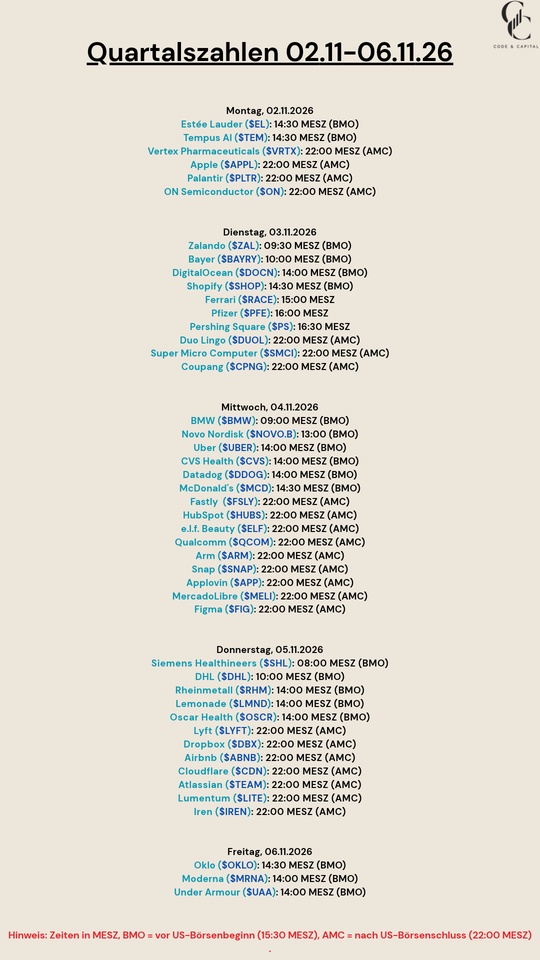
$EL (-4,21%)
$TEM (+13,3%)
$VRTX (-1,3%)
$AAPL (-2,52%)
$PLTR (-0,68%)
$ON (+0,04%)
$ZAL (+1,13%)
$BAYN (-0,88%)
$DOCN (-0,42%)
$SHOP (+1,01%)
$RACE (+1,96%)
$PFE (+0,88%)
$PS (+0,61%)
$DUOL
$SMCI (-5,59%)
$CPNG (+3,25%)
$BMW (+1,68%)
$NOVO B (+1,65%)
$UBER (+2,42%)
$CVS (-2,26%)
$DDOG (-6,64%)
$MCD (+2,08%)
$FSLY (-8,89%)
$HUBS (+2,38%)
$ELF (+0,09%)
$QCOM (-0,3%)
$ARM (-2,27%)
$SNAP (+3,52%)
$APP (+2,17%)
$MELI (+4,22%)
$FIG (+5,24%)
$SHL (+1,97%)
$DHL (+1,25%)
$RHM (-3,2%)
$LMND (-2,69%)
$OSCR (+2,24%)
$LYFT (+3,98%)
$DBX (-0,81%)
$ABNB (+4,86%)
$NET (-4,27%)
$TEAM (-0,18%)
$LITE (-16,85%)
$IREN (-6,1%)
$OKLO
$MRNA (+2,03%)
$UAA (+5,28%)

CVS Health
Azione
Azione
Ticker: CVS
CVS
Price
Discussione su CVS
Messaggi
1121G·
Quarterly Results Nov. 2–Nov. 6, 26
1212

1Mes·
💊 New Position Opened: CVS Health
Yesterday, I opened another long position. I added $CVS (-2,26%) to my Blue Chip Fibonacci Portfolio.
The stock reached yesterdaythe 23.6% Fibonacci retracement level from its ATH, an area I monitor as part of my investment framework.
Beyond the technical picture, CVS Health is a leading healthcare and pharmacy services company, operating across retail pharmacies, pharmacy benefit management, and health insurance. This combination provides exposure to a sector where demand is driven by long-term demographic trends, including an aging population and increasing healthcare needs.
I'm looking forward to seeing how this position performs over the coming months and years.
#trading
#long
#bluechipfibonacci
#cvs
#stocks
#healthcare
#pharma
#usa
#mikeupegui
44
3Mes·
Quarterly Results August 3–7, 2026
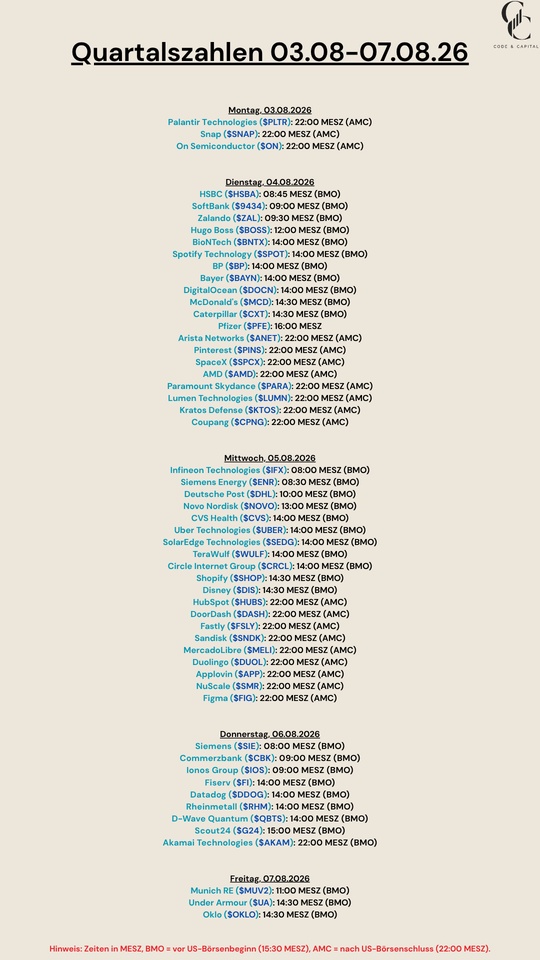
$PLTR (-0,68%)
$SNAP (+3,52%)
$HSBA (+1,06%)
$9434 (-0,15%)
$ZAL (+1,13%)
$BOSS (+0,73%)
$BNTX (-0,44%)
$SPOT (+0,56%)
$BP. (-5,16%)
$BAYN (-0,88%)
$DOCN (-0,42%)
$MCD (+2,08%)
$CAT (-0,95%)
$PFE (+0,88%)
$ANET (-3,35%)
$PINS (+3,46%)
$SPCX (+2,26%)
$AMD (-5,62%)
$PARA (+1,12%)
$LUMN (+1,15%)
$KTOS (-3,12%)
$CPNG (+3,25%)
$IFX (+1,51%)
$ENR (+2,27%)
$DHL (+1,25%)
$NOVO B (+1,65%)
$CVS (-2,26%)
$UBER (+2,42%)
$SEDG (+2,05%)
$WULF (-6,04%)
$CRCL (+1,59%)
$SHOP (+1,01%)
$DIS (+1,87%)
$HUBS (+2,38%)
$DASH (+5,06%)
$FSLY (-8,89%)
$SNDK (-4,13%)
$MELI (+4,22%)
$DUOL
$APP (+2,17%)
$SMR
$FIG (+5,24%)
$SIE (+2,26%)
$CBK (+0,24%)
$IOS (+1,78%)
$FI (+3,58%)
$DDOG (-6,64%)
$RHM (-3,2%)
$QBTS (-3,31%)
$G24 (+1,92%)
$AKAM (-5,15%)
$MUV2 (+0,39%)
$UA (+4,41%)
$OKLO
1313

5Mes·
Quarterly figures 04.05-08.05.26
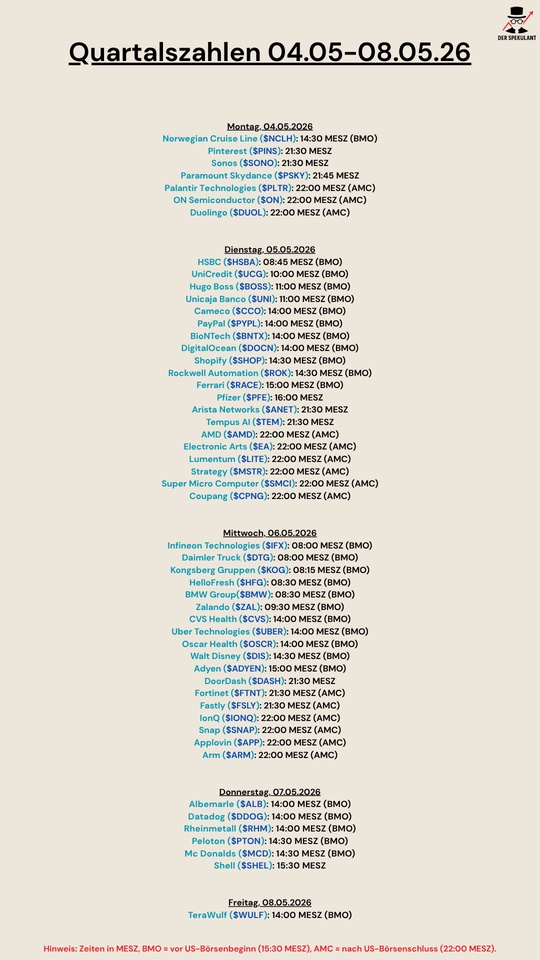
$NCLH (+2,84%)
$PINS (+3,46%)
$SONO (-1,52%)
$PARA (+1,12%)
$PLTR (-0,68%)
$DUOL
$HSBA (+1,06%)
$UCG (+1,82%)
$BOSS (+0,73%)
$UNI (+1,99%)
$CCO (-3,31%)
$PYPL (+2,67%)
$BNTX (-0,44%)
$DOCN (-0,42%)
$SHOP (+1,01%)
$ROK (+1,57%)
$RACE (+1,96%)
$PFE (+0,88%)
$ANET (-3,35%)
$TEM (+13,3%)
$AMD (-5,62%)
$EA
$LITE (-16,85%)
$MSTR (+1,34%)
$SMCI (-5,59%)
$CPNG (+3,25%)
$IFX (+1,51%)
$DTG (+0,14%)
$KOG (-0,45%)
$HFG (+6,74%)
$BMW (+1,68%)
$ZAL (+1,13%)
$CVS (-2,26%)
$UBER (+2,42%)
$OSCR (+2,24%)
$DIS (+1,87%)
$ADYEN (+3,31%)
$DASH (+5,06%)
$FTNT (-5,02%)
$FSLY (-8,89%)
$IONQ (-4,76%)
$SNAP (+3,52%)
$APP (+2,17%)
$ARM (-2,27%)
$ALB (+0,23%)
$DDOG (-6,64%)
$RHM (-3,2%)
$PTON (+3,59%)
$MCD (+2,08%)
$SHEL (-3,47%)
$WULF (-6,04%)
1212

6Mes·
The bull market as camouflage - Why structural problems remain invisible for so long
Reading time: approx. 3 minutes
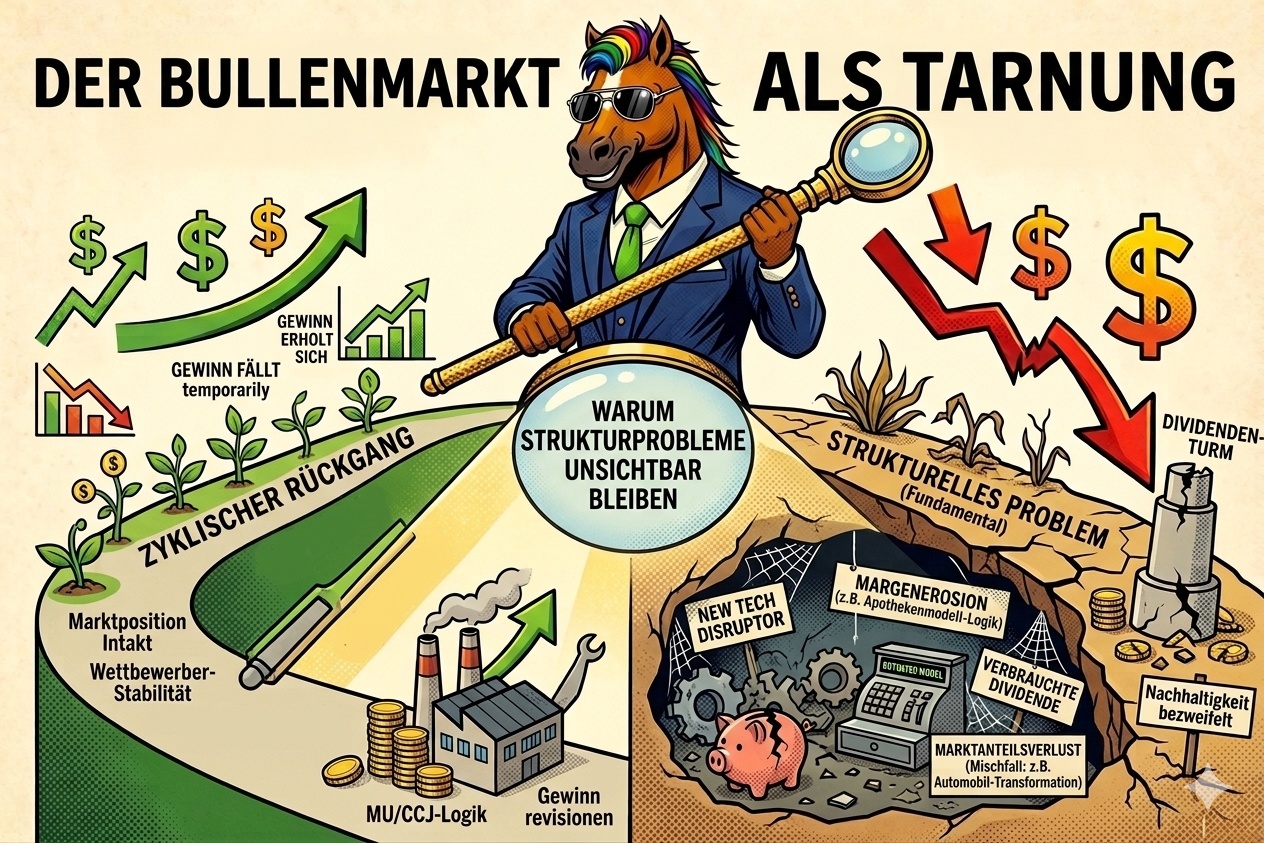
There is one mistake that I consider to be one of the most expensive in investing: confusing a cyclical downturn with a structural problem. Or vice versa. Both cost money, but in very different ways.
The cyclical downturn is temporary. A company earns less because demand is currently weak. The business model is intact, as is the competitive position. Profits recover when the cycle turns. If you sell during this phase, you make a loss and miss out on the recovery.
The structural problem is something else. Here, something fundamental changes in the business model itself. A competitor makes the product redundant, or demand disappears permanently. Profits do not recover because there is nothing to recover. Those who hold on in this phase are waiting for a normalization that never comes.
The difficulty: both look identical on the chart. Price falls, sentiment turns. The difference lies not in the price trend, but in the cause.
I therefore start with a simple question: does the company have a problem, or does the sector have a problem? And if the industry has a problem: Does it resolve itself because it arises from oversupply or temporary weakness in demand? Or is it permanent because a competitor or a technology is changing the basis of the business model?
$MU (-4,76%) Micron Technology is perhaps the most textbook example of the first case. The memory chip market operates in periods of pronounced oversupply and shortage. When prices fall, Micron's numbers look catastrophic. When they rise, profits explode. 2022 was brutal. Demand collapsed, stocks piled up, analysts outbid each other with price target cuts. Anyone who sold back then and bought again in 2023 incurred transaction costs twice and still missed out on the recovery. The core business was never fundamentally called into question.
$CCO (-3,31%) follows a similar logic, with an important overlay. The uranium cycle is slower and politically driven. After Fukushima, it took the market years to separate structural demand from political sentiment. Reactors were shut down and the uranium price collapsed. For many, this looked like a structural problem. But it wasn't. The demand for electricity remained. Nuclear power as a technology remained. What changed was the perception. When that changed, so did the cycle. Those who understood the difference took the reassessment with them.
$CVS (-2,26%) is the counterexample. The pharmacy model has been under pressure for years: pharmacy benefit managers are squeezing margins, bricks-and-mortar retail is losing footfall and the core business is shrinking. CVS is still operating on a large scale and delivering sales. But the market is increasingly pricing in structural margin erosion and regulatory risk, and for good reason. Despite this, CVS was traded as a cheap dividend stock for years. The high dividend yield was seen as a selling point. However, an unusually high dividend yield is often more an indication that the market doubts the sustainability of the payout. This was confirmed in the case of CVS. Anyone waiting for the cyclical recovery was waiting for something that structurally could not come.
$VOW (+0,94%) is the more difficult case, and therefore instructive in another way. The loss of market share in China to BYD and other local manufacturers has a structural core: Chinese suppliers are now competitive in terms of quality and price, this is not a temporary phenomenon. At the same time, a cyclical decline in demand in the premium segment is overshadowing the structural issue in the short term. The two cannot be clearly separated. This makes VW a mixed case: structural core, cyclical overlay. This is not a failure of analysis, this is the reality of many companies in transformation phases. And that is precisely why, in a case like this, I need to at least know which part I attribute to the cycle and which to structural change. Without this separation, a position size can hardly be justified.
What I avoid is holding a cyclical with structural arguments when the cycle is recovering. This is the most common form of self-deception. The story sounds convincing, the share price rises, and at some point you realize that you didn't understand the sector but only participated in the bull market.
The tool that helps me most with this distinction is earnings revisions. That's what the next article is about.
2929
19 Commenti
Thanks, always exciting. I had Micron and also aixtron in my portfolio when nobody wanted the shares. It's nice to see how the PEG is getting smaller and smaller. But let me tell you, the stock market is pricing in the future. I had to wait a long time for investors to rediscover both shares. Micron could even become a non-cyclical. But at the moment I have the impression that a cyclical picture is creeping into the charts of some of our very popular moat stocks. Perhaps an exciting topic for a change.
•
55
•
6Mes·
CVS sold - why I parted with the position
I have decided to sell my position in $CVS (-2,26%) and reallocate the capital elsewhere.
The main reason for me is the increasingly complex business model. $CVS (-2,26%) It combines pharmacy, insurance and healthcare services. Exciting at first glance, but difficult to understand in practice and not quite as transparent as I would like.
In addition, I don't particularly like the development of debt at the moment. After a phase of debt reduction, debt has recently risen again, while free cash flow has stagnated or fallen slightly. In my view, this worsens the financial leeway and increases the risk.
Added to this is the ongoing pressure on margins in the healthcare sector and the regulatory risks in the USA, which should not be underestimated. At the same time, I currently lack a clear growth story that will sustain the case in the long term.
For me, the $CVS (-2,26%) no longer fits in perfectly with my approach, which is more focused on predictable cash flows, clear business models and sustainable competitive advantages. I am therefore using the sale to reallocate capital to companies where I see higher quality and better visibility.

7Mes·
Trip to Miami, USA
Hi folks, I'm going on a trip to Miami in the USA this year. And before one or two people reach for their keyboards in anger: I initiated the trip a while ago under different global political conditions.
As I want to make the best of it, I would be interested to know if anyone has any ideas of what to see or do on site. Of course you are welcome to write me where I can get the best sandwich or whether the Ocean Drive is worthwhile. But I'm also interested in other things specific to the USA that you can take a look at - and because this isn't a travel portal - I'd also like to know which companies and products etc. you can take a look at that simply aren't available in this country.
I definitely have a visit to Walmart on my to-do list $WMT (+2,54%) and I'd like to take a look at the hyped Chipotle $CMG (+2,89%) to take a look. I would also like to try a robotaxi from $UBER (+2,42%) or Waymo $GOOGL (+0,7%)
$GOOG (+0,82%) book. I think it's really exciting to actually ride in one of these, which is simply computer-controlled, whereas here in Germany you're only driven around by Malte Sören on a cargo bike. Maybe I'll have a look at $CVS (-2,26%) take a look. As a German, it seems completely bizarre to be able to buy XXL packs of pills without a well-meaning pharmacist giving you a minute-long monologue about how dangerous medication is and that you should try taking it less stressfully first.
1818
34 Commenti

I would be in favor of you instigating a regime change 👍
•
1010
•8Mes·
CVS Health Q4 2025 figures - strong growth, but concerns in sight
$CVS (-2,26%) has presented its quarterly figures for Q4 2025 and they read well at first glance:
- Revenue (expected): USD 103.63 billion
- Revenue (reported): USD 105.70 billion
- EPS (expected): USD 1.00
- EPS (reported): USD 1.09
Despite these positive results, the market reacted rather cautiously. An indication that investors have concerns for the future beyond the pure figures.
The challenges include:
- Changes in the Pharmacy Benefit Manager (PBM) sector
- Rising prices for branded drugs, which could lead to additional costs of USD 25 billion
- Increased competition in the Medicare Advantage market
For 2026 confirms $CVS (-2,26%) confirms its outlook with an Adjusted EPS range of $7.00-$7.20 and sales of at least $400bn, demonstrating management's continued commitment to long-term growth.
How do you assess the current situation? Is last month's share price decline exaggerated given the solid results? Or are you more concerned about the structural challenges in the healthcare sector?
44

8Mes·
CVS Health Q4’25 EARNINGS HIGHLIGHTS
🔹 Revenue: $105.7B (Est. $103.63B) 🟢; +8.2% YoY
🔹 Adj. EPS: $1.09 (Est. $1.00) 🟢
🔹 Aetna: 95%+ of eligible prior authorizations approved within 24 hours
FY Guide:
🔹 Adj. EPS: $7.00–$7.20 (Est. $7.17) 🟡
🔹 GAAP EPS: $5.94–$6.14
🔹 Cash Flow from Ops: ≥ $9.0B
Financials:
🔹 Q4 Operating Income: $2.112B
🔹 Q4 Adj. Operating Income: $2.597B
🔹 Q4 Net Income: $2.923B
Commentary:
🔸 “Our fourth quarter and full-year results demonstrate the progress we are making in transforming the health care experience with our unique collection of businesses.”
🔸 “...we are well positioned to achieve our ambition to be the most trusted health care company in America.”
33