
BioNTech, the Mainz-based vaccine pioneer, has been stuck in a stubborn sideways trading range on the stock market since mid-2024: On the weekly chart, the stock fluctuates between approximately $80 and $127.65 and was trading at $87.51 (+1.9%) on the Nasdaq on November 6, 2026. This puts it about 81% below its all-time high of $464 reached in August 2021. Operationally, the company is in the midst of transitioning from a COVID-19 vaccine manufacturer to a cancer specialist: Revenue from the COVID-19 vaccine continues to decline; in the third quarter of 2026, consolidated revenue stood at EUR 1.29 billion, down from EUR 1.52 billion in the prior year. Thanks to collaboration revenues from the partnership with Bristol Myers Squibb, the company nevertheless posted a quarterly profit of 184.5 million EUR, and management has raised the midpoint of its 2026 revenue forecast to 1.7 to 1.9 billion EUR. At the same time, founders Ugur Sahin and Özlem Türeci are leaving the company, three German locations are being closed, and several cancer trials have yielded disappointing results. The balance sheet provides a solid foundation: With EUR 16.2 billion in cash and marketable securities, BioNTech covers a large portion of its market capitalization with cash. Analysts’ average target price is around $122. From a technical analysis perspective, I believe the clear strategy is to wait and see: Only a break above $127.65 or a drop below $80 will determine the next major move.
Key Points
- Q3 2026: Revenue of 1,289.2 million EUR (previous year: 1,518.9 million EUR), net income of 184.5 million EUR, adjusted earnings of 1.76 EUR per share
- 2026 Forecast: Revenue of 1.7 to 1.9 billion EUR (previously 1.6 to 1.9 billion EUR); in March, the plan was still for 2.0 to 2.3 billion EUR
- EUR 16.2 billion in cash and securities; a share buyback of up to USD 1 billion is set to run through May 2027
- Promising drug candidate Pumitamig (BNT327) is being tested in seven regulatory trials with Bristol Myers Squibb
- Analysts: Average price target around $122 (dpa-AFX, seven firms), range $86.86 to $140
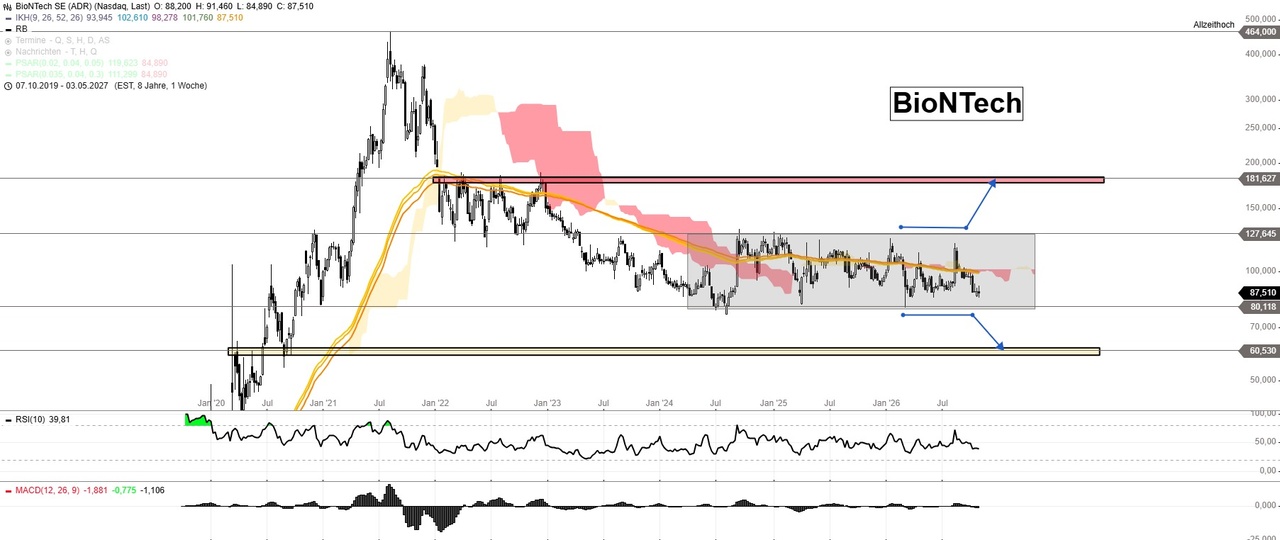
- Chart levels: Range between $80.12 and $127.65, breakout target $181.63, downside target $60.53
What are BioNTech’s current key metrics?
BioNTech stock closed at $87.51 (+1.9%) on the Nasdaq on November 6, 2026, and is thus trading about 29% below its 52-week high of $124.00.
On the Tradegate exchange, the stock was trading at 78.50 EUR at 1:41 p.m. on November 9, 2026. The company’s market capitalization stands at approximately $21.7 billion, compared to cash and marketable securities totaling €16.2 billion. BioNTech does not pay a dividend; instead, the company repurchases its own shares.
What news is currently driving BioNTech’s stock?
Four topics are currently driving BioNTech’s stock: the Q3 earnings report released on November 3, 2026; the setback in mRNA cancer research; the closure of three German sites; and the change in leadership.
Following the earnings release, the stock fluctuated sharply between $86.92 and $90.70, with no clear breakout occurring. On October 13, 2026, the stock slipped by 7.1% after the study of the BNT113 cancer vaccine failed to meet its primary endpoint. In addition, patent disputes surrounding the COVID-19 vaccine continue. My analysis of Bayer Aktie —where courts continue to influence every price fluctuation to this day.
What does BioNTech’s management say about the Q3 figures?
CEO Ugur Sahin sees BioNTech on track to become a diversified company with multiple products by 2030 and points to the growing momentum of combination therapies.
As evidence, he cites the announced first global Phase 3 trial in which pumitamig is combined with an antibody-drug conjugate. CFO Ramón Zapata emphasizes that the third quarter allowed the company to narrow its 2026 revenue forecast to the upper end of the previous range, and that BioNTech is returning capital to shareholders through the share buyback program.
What went well: The quarter yielded a net profit of 184.5 million EUR, following a loss in the prior year. The adapted COVID-19 vaccine for the 2026/2027 season was approved in the EU (July 2026) and in the U.S. (August 2026) and was shipped immediately. In a study of pretreated squamous cell lung cancer, Gotistobart nearly doubled the median overall survival compared to chemotherapy.
The catch: The profit is not a sustainable trend. According to the Q2 report, approximately 613 million EUR in collaboration revenue from the partnership with Bristol Myers Squibb was expected to be recognized in the third quarter; without this one-time effect, the quarter would have looked different. After nine months, the company posted a net loss of EUR 1.17 billion, plus impairment charges of EUR 414 million and restructuring costs of EUR 124.8 million. There were several setbacks in the pipeline: BNT113 failed to meet its trial endpoint; the colorectal cancer trial with autogene cevumeran was terminated early; and the HER2 conjugate BNT323 showed only modest benefit in a breast cancer trial, accompanied by an increase in cases of pneumonia.
Outlook: For 2026, BioNTech expects revenue of EUR 1.7 to 1.9 billion, adjusted R&D expenses of 2.0 to 2.3 billion EUR, and adjusted selling and administrative expenses of 0.7 to 0.8 billion EUR. By 2030, the company aims to have several approved cancer drugs on the market. The figures for the fourth quarter and full-year 2026 will be released on March 2, 2027.
What does BioNTech do—and how does the company make its money?
BioNTech is a biotechnology company based in Mainz that became world-famous for the mRNA vaccine against COVID-19 developed jointly with Pfizer and today generates most of its revenue from this vaccine and collaboration proceeds.
The company employs approximately 7,800 people and is listed on the Nasdaq solely as an ADR. Since the pandemic, BioNTech has been systematically restructuring its business toward cancer medicine; by 2030, it aims to become a company with multiple approved products. In December 2025, BioNTech acquired its Tübingen-based mRNA competitor CureVac, whose facility will now be closed by the end of 2027.
COVID-19 vaccine (Comirnaty): To date, the most important source of revenue. BioNTech shares revenue and gross profit with Pfizer, but demand has been declining for years. In 2025, consolidated revenue was still around 2.87 billion EUR; for 2026, BioNTech expects only 1.7 to 1.9 billion EUR. One reason: Germany will use existing stockpiles during the 2026 season.
Collaborations and Licenses: BioNTech generates revenue through partnerships with major pharmaceutical companies. The most significant deal is the June 2025 alliance with Bristol Myers Squibb for Pumitamig, with a total value of up to $11.1 billion, including a $1.5 billion upfront payment and $2 billion in fixed annual payments through 2028. Development costs and profits are shared. For a program developed with Roche/Genentech, the partner will assume research costs starting in 2027, and BioNTech will receive royalty payments.
Oncology Pipeline: This is where the future lies. The centerpiece is Pumitamig (BNT327), a bispecific antibody targeting PD-L1 and VEGF-A, which is being tested in seven regulatory trials, including for lung and breast cancer. In addition, there is Gotistobart (CTLA-4, Phase 3 for lung cancer), antibody-drug conjugates such as BNT323 with DualityBio, as well as mRNA cancer vaccines such as Autogene cevumeran with Genentech, whose pancreatic cancer trial completed patient enrollment in August 2026.
How BioNTech Makes Money: Today, revenue comes almost exclusively from the vaccine and milestone payments from partners. The company does not yet have its own approved cancer drug with significant sales. Investors are currently witnessing just how sharply a pharmaceutical stock can fall when a single revenue driver falters, as seen with Novo Nordisk Aktie — from market darling to problem child in just a few months.
Fundamental Analysis: What Is the BioNTech Stock Worth After the COVID-19 Boom?
Fundamentally, BioNTech stock is difficult to assess using traditional metrics, as the company posted a loss of 1.17 billion EUR after nine months of 2026—therefore, cash, cost control, and the pipeline are the decisive factors.
There is no meaningful P/E ratio, and according to Aktienfinder, no profit or cash flow metric exhibits sufficient stability for a reliable valuation. The cash flow statement therefore provides a better picture of the business’s health than any valuation metric.
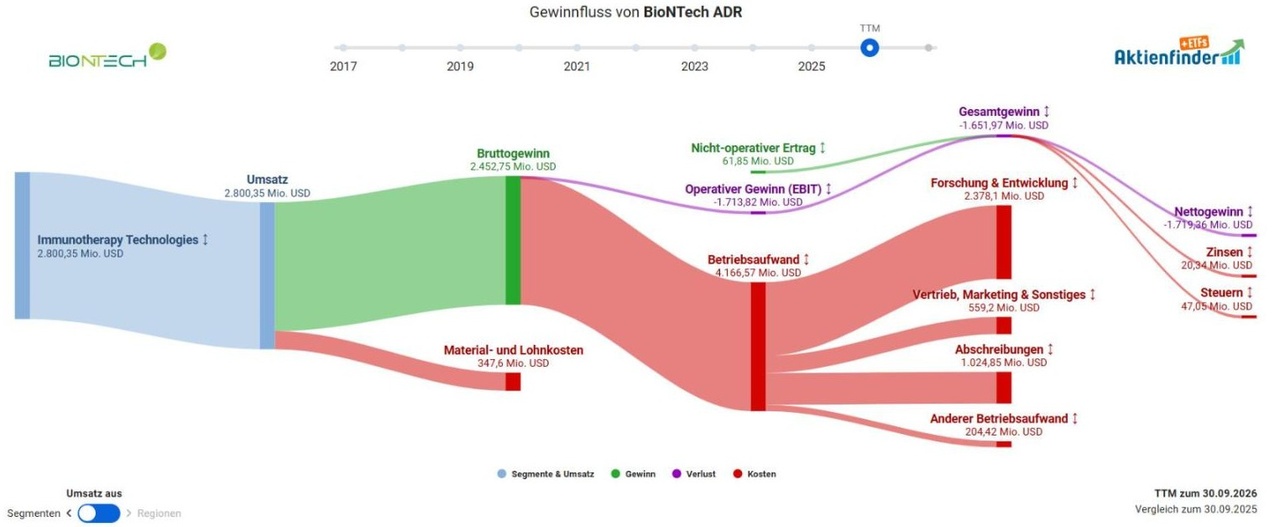
Cash Flow Statement: The chart tracks every dollar of revenue from the last twelve months through September 30, 2026, from left to right. According to Aktienfinder, approximately $2.8 billion in revenue was generated, virtually all of it from the immunotherapy segment—specifically from the COVID-19 vaccine and collaboration revenues. Only about $0.35 billion went toward materials and manufacturing, resulting in a high gross profit of nearly $2.5 billion. After that, the flow reverses: Research and development alone devour about $2.4 billion, plus sales and administration, depreciation, and other expenses. The bottom line is a loss of about $1.7 billion. In short: BioNTech is still making money from the vaccine, but is investing more in cancer research than it is bringing in.
Revenue Trends: The clear growth occurred in the third quarter of 2026. Revenue jumped to 1,289.2 million EUR after just 105.6 million EUR in the second quarter—more than twelve times as much. The main reason is the collaboration with Bristol Myers Squibb: BioNTech had announced that it would recognize approximately EUR 613 million in collaboration revenue for Pumitamig in the third quarter. This left approximately EUR 676 million attributable to the vaccine and other revenue, coinciding with the start of the vaccination season featuring the updated vaccine. Thanks to this boost, the quarter turned a profit of 184.5 million EUR. Year-over-year, however, revenue continues to decline: In the third quarter, it was approximately 15% below the prior-year figure of 1,518.9 million EUR; after nine months, revenue was down by about 23% to 1,512.9 million EUR (prior year: 1,962.5 million EUR). BioNTech attributes this to lower demand for the COVID-19 vaccine. For the full year, management expects revenue of EUR 1.7 to 1.9 billion, having raised the midpoint of the range. Mathematically, this leaves only about EUR 190 to 390 million for the fourth quarter.
Cash as a safety net: As of the end of September 2026, BioNTech had EUR 16.2 billion in cash and marketable securities. With a market capitalization of approximately $21.7 billion (equivalent to about 19.5 billion EUR), investors are paying just around 3 to 4 billion EUR for the entire operating business, including the pipeline. Debt plays virtually no role. However, this cushion is shrinking: As of June 30, 2026, it still stood at 16.6 billion EUR, and additional funds are being channeled into the share buyback program.
Costs and Margins: Research consumes the lion’s share of the budget. After nine months, R&D costs under IFRS totaled 1,856.1 million EUR, significantly exceeding revenue of 1,512.9 million EUR. Selling and administrative expenses rose to EUR 527.1 million, partly due to the integration of CureVac and the establishment of the company’s own sales force for cancer drugs. Restructuring costs and impairment charges are also factoring into this. On the positive side: Cost of sales is low; in the third quarter, it stood at EUR 103.3 million. As soon as new products start generating revenue, the margin can therefore improve rapidly.
Restructuring and Workforce: BioNTech is reprioritizing its pipeline and closing three sites in Tübingen, Marburg, and Idar-Oberstein, affecting approximately 1,800 employees. The Berlin-based subsidiary JPT Peptide Technologies has been sold. My analysis of how a deeply unprofitable company can quickly become a stock market star again if restructuring is successful shows that Siemens Energy Aktie — BioNTech has yet to prove that it can pull off exactly this turnaround.
Legal Proceedings and Patents: The dispute over mRNA patents continues to cost money. In August 2025, BioNTech and Pfizer reached a settlement in the U.S. with CureVac and GSK for a payment of $740 million plus royalties; as a result, the balance sheet for the third quarter of 2025 included 678.5 million EUR in litigation expenses. The dispute with Moderna continues; on March 5, 2025, the Düsseldorf Regional Court ruled that a patent had been infringed. In the third quarter of 2026, litigation costs totaled 13.5 million EUR.
Management Changes: With the departure of founders Ugur Sahin and Özlem Türeci, the scientific heart of the company is leaving. Guido Oelkers, who more than quadrupled revenue during his tenure at the Swedish biotech group Sobi, will become the new CEO no later than February 1, 2027. According to dpa-AFX, Bernstein expects the new CEO to need some time to settle in.
BioNTech Stock Price Targets and Forecast for 2026
On average, analysts see a price target of around $122 for BioNTech stock, representing just under 40% upside potential; however, from a technical analysis perspective, the stock has been stuck in a sideways range between $80.12 and $127.65 since mid-2024.
Following the Q3 results, UBS and Jefferies have reaffirmed their “buy” recommendations, while JPMorgan remains cautious with a target of $86.86. My analysis of Nel ASA Aktie.
Key price levels:
- 52-week high: $124.00 (January 2026)
- Current price: $87.51 (Nasdaq close Nov. 6, 2026, +1.9%), €78.50 on the Tradegate exchange (Nov. 9, 2026, 1:41 p.m.)
- First resistance level: around $100 (Ichimoku cloud and moving averages on the weekly chart)
- Second resistance and upper trigger level: $127.65 (upper boundary of the sideways range)
- Breakout target: 181.63 USD (red resistance zone)
- Critical support level: $80.12 (lower boundary of the range, 52-week low of $79.52 in March 2026)
- Target in the event of a break: $60.53 (yellow support zone)
- All-time high: $464.00 (August 2021)
Analyst price targets:
- Average price target: approx. $122 (average of seven firms from dpa-AFX analyses since August 2026; finanzen.net average: $121.84)
- Berenberg: Buy, $140.00 (October 7, 2026)
- Deutsche Bank: Buy, $140.00 (August 26, 2026)
- Jefferies: Buy, $138.00 (November 4, 2026)
- Goldman Sachs: Buy, $127.00 (September 4, 2026)
- UBS: Buy, $125.00 (November 4, 2026, previously $135)
- Bernstein: Market Perform, $96.00 (August 4, 2026)
- JPMorgan: Neutral, $86.86 (October 27, 2026)
Chart Analysis:
On BioNTech’s weekly chart, the situation is as clear-cut as it is grueling: Following the crash from its all-time high of $464 in August 2021, the stock has been trading in a broad sideways range between $80.12 and $127.65 since mid-2024. Every attempt to break out to the upside has failed so far, most recently in August 2026, when the price shot up to $120.33 following the Moderna data and then collapsed again. Every slide toward $80, on the other hand, has been absorbed.
Currently, the stock is trading at $87.51 in the lower third of the range, below the Ichimoku cloud and below the moving averages around $100. The RSI(10) stands at 39.8, and the MACD is slightly in negative territory. In the short term, the stock is highly volatile; movements of 5 to 7% in a single day are not uncommon, as the days following the Q3 earnings report demonstrated.
For me, the situation is therefore quite clear: wait and see. In the medium term, two trigger levels will determine the next major move. If the stock breaks above $127.65, the range would be broken to the upside, and the next target would be in the red resistance zone at $181.63. If, on the other hand, the stock falls below $80—and thus below the lower boundary at $80.12—the path opens up toward the yellow support zone at $60.53. Both scenarios are marked equally on my chart. Personally, I would neither buy nor sell BioNTech stock at this time, but rather wait until the market clearly breaks through one of these two levels.
Opportunities and Risks of BioNTech Stock
Opportunities:
- ✅ €16.2 billion in cash and securities with a market capitalization of approximately $21.7 billion
- ✅ Pumitamig in seven regulatory trials with Bristol Myers Squibb
- ✅ BMS deal worth up to $11.1 billion, including $2 billion in fixed payments through 2028
- ✅ Gotistobart nearly doubles overall survival in lung cancer
- ✅ Stock buyback of up to $1 billion by May 2027
- ✅ A breakout above $127.65 paves the way to $181.63
Risks:
- ⚠️ Covid-19 revenue continues to decline; 9M 2026 revenue down 23%
- ⚠️ Net loss of EUR 1.17 billion for 9M 2026, R&D costs exceed revenue
- ⚠️ Setbacks with BNT113, autologous cevumeran (colorectal cancer), and BNT323
- ⚠️ Founders Sahin and Türeci are leaving; new CEO not until February 2027
- ⚠️ Patent dispute with Moderna and costs associated with site closures
- ⚠️ A break below $80 opens the way down to $60.53
Conclusion: BioNTech Stock—Breakout or Crash?
When it comes to BioNTech stock, my advice is clearly to wait and see: Only a breakout above $127.65 or a break below $80 will determine the direction of the next major move.
Fundamentally, BioNTech is a special case: €16.2 billion in cash covers a large portion of its market capitalization, partner Bristol Myers Squibb is funding Pumitamig with billions, and the share buyback is supporting the stock price. On the other hand, the COVID-19 business continues to shrink, the founders are leaving, three locations are closing, and several cancer trials have recently been disappointing.
The quarterly profit of EUR 184.5 million is primarily attributable to revenue from BMS. BioNTech has yet to provide concrete proof that it is transforming from a vaccine manufacturer into a cancer specialist—with trial data on Pumitamig and Gotistobart. From a technical analysis perspective, the sideways range reflects precisely this indecision. A breakout above $127.65 would clear the path to the red resistance zone at $181.63. If the stock falls below $80, there is a risk of a slide down to the yellow support zone at $60.53. In the short term, the stock remains highly volatile; personally, I would neither buy nor sell.
Those who prefer predictable earnings and a reliable dividend over binary clinical trial results should read my analysis Münchener Rück Aktie —there, boredom is the recipe for success.
Sources
- BioNTech Press Release: Third Quarter 2026 Financial Results and Corporate Update (November 3, 2026, SEC Form 6-K)
- BioNTech Press Release: Second Quarter 2026 Financial Results and Corporate Update (August 4, 2026, SEC Form 6-K)
- BioNTech Investor Relations: Financial Calendar and Press Releases
- Tradegate Exchange: Euro Price of BioNTech ADR (November 9, 2026)
- Nasdaq Closing Price for BioNTech (BNTX) November 6, 2026: $87.51 (+1.92%), previous day $85.86, 52-week range $79.52 / $124.00 (Alpha Vantage daily/weekly prices and FMP profile, reconciled); Euro exchange rate on Tradegate, November 9, 2026, 1:41 p.m.: 78.50 EUR (verified by finanzen.net)
- dpa-AFX Analyst: Ratings from UBS and Jefferies (November 4, 2026), JPMorgan (October 27, 2026), Berenberg (October 7, 2026), Goldman Sachs (September 4, 2026), Deutsche Bank (August 26, 2026), Bernstein (August 4, 2026), via finanzen.net
- S&P Global Consensus (21 analysts, average $116.25) via stockanalysis.com, as of November 9, 2026
- dpa/Deutsches Ärzteblatt: No Buyers Found—Three BioNTech Plants to Close (September 28, 2026)
- The Motley Fool: Why BioNTech Stock Is Getting Crushed Today (March 10, 2026)
- TIKR: BioNTech stock jumped 22% following another company’s test results (August 2026)
- dpa-AFX/GlobeNewswire: BioNTech Completes Acquisition of CureVac, Including Post-Offer Period (December 18, 2025)
- Bristol Myers Squibb and BioNTech: Global Partnership for BNT327, Up to $11.1 Billion (June 2, 2025, industry media)
- Düsseldorf Regional Court: Ruling in Moderna v. Pfizer/BioNTech (March 5, 2025); Settlement between BioNTech/Pfizer and CureVac and GSK (August 2025, industry media)
- Alpha Vantage: Earnings per share and consensus estimate for Q3 2026; FMP: BioNTech company profile
- Google Trends, Google Ads Keyword Planner (Germany), as of Nov. 9, 2026
- Stock3: Weekly chart for BioNTech SE (ADR, Nasdaq, USD), as of November 9, 2026
- Aktienfinder: Cash Flow Statement (last twelve months through September 30, 2026) and valuation metrics for BioNTech ADR, as of November 9, 2026
This is not investment advice—all information is provided solely for financial education purposes.
What are your current thoughts on $BNTX (+0,9%)?