$NCLH (+3,23%)
$PINS (+3,58%)
$SONO (+0,18%)
$PARA (+5,17%)
$PLTR (+4,44%)
$DUOL
$HSBA (+0,23%)
$UCG (+0,18%)
$BOSS (+0,32%)
$UNI (+0,33%)
$CCO (-1,55%)
$PYPL (+0,92%)
$BNTX (-4,14%)
$DOCN (+5,61%)
$SHOP (+4,61%)
$ROK (+0,1%)
$RACE (-1,42%)
$PFE (-0,87%)
$ANET (+0,84%)
$TEM (+0,27%)
$AMD (+3,41%)
$EA (-0,29%)
$LITE (+10,08%)
$MSTR (+10,06%)
$SMCI (+1,08%)
$CPNG (+3,01%)
$IFX (+0,39%)
$DTG (-0,5%)
$KOG (+2,05%)
$HFG (+4,86%)
$BMW (-1,65%)
$ZAL (+0,54%)
$CVS (-1,3%)
$UBER (+1,28%)
$OSCR (-0,02%)
$DIS (-0,61%)
$ADYEN (+2,39%)
$DASH (+4,35%)
$FTNT (+1,39%)
$FSLY (+10,09%)
$IONQ (+4,51%)
$SNAP (+3,56%)
$APP (+3,32%)
$ARM (+3,05%)
$ALB (-1,25%)
$DDOG (+4,61%)
$RHM (+3,04%)
$PTON (-1,08%)
$MCD (-2,09%)
$SHEL (-0,72%)
$WULF (+1,02%)

BMW
Price
Discussione su BMW
Messaggi
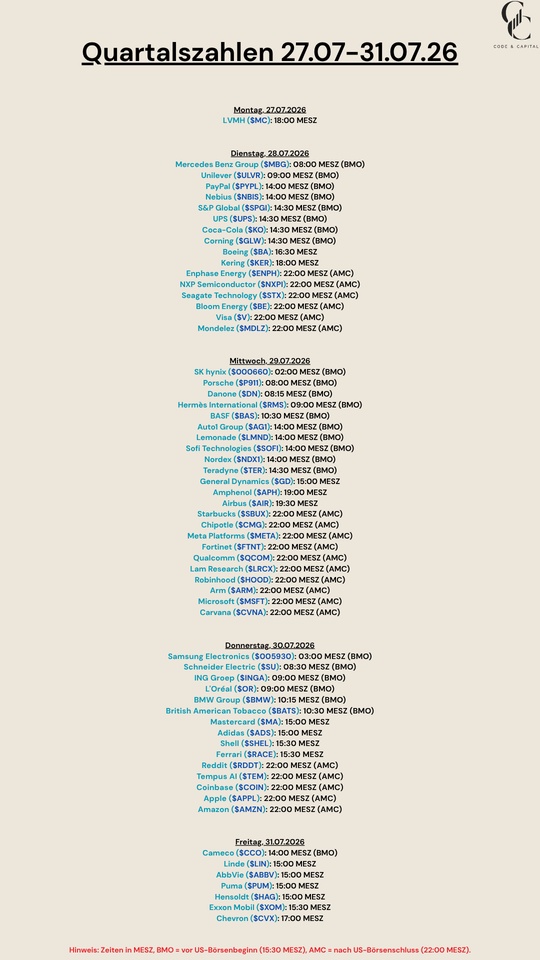
144Quarterly figures 04.05-08.05.26
Strong dividend season ahead💶
15 increases
13 unchanged
7 reductions
Insurance companies
Banks
Utilities
Car stocks
Type here if you like collecting dividends: https://shorturl.at/83W8R
$MBG (-1,42%)
$ALV (-0,93%)
$VOW3 (-1,21%)
$MUV2 (-0,49%)
$BMW (-1,65%)
$AIR (+0%)
$CBK (+0,01%)
$523232
$DTG (-0,5%)
$DHL (-0,78%)
$FME (+0,12%)
$FRE (-0,13%)
$HNR1 (-0,58%)
$MTX (-1,48%)
$RHM (+3,04%)
$SAP (+3,03%)
$ENR (+1,53%)
$BAS (-1,08%)
$BAYN (+1,83%)
$BEI (+0,04%)
$DBK (+0,73%)
$DTE (-1,29%)
$EOAN (-1,27%)
$GEA
$IFX (+0,39%)
$RWE (-2,69%)
$SY1 (+0,84%)
$ZAL (+0,54%)
$ADS (-1,72%)
$BNR (+1,24%)
$HEN (+0,21%)
$MRK (+0,06%)
$SIE (+0,32%)
$SHL (+0,31%)

Dividend season 2026: Records, shifts and new favorites in the DAX
The 2026 dividend season is stronger than expected. Despite economic uncertainties, payouts remain at a high level, many companies are robust and confirm the role of dividends as a key driver of returns.
Around 25 companies in the DAX are expected to increase their dividends. Overall, the level remains attractive, even if the momentum varies from sector to sector and not all sectors are benefiting equally.
The shift within the sectors is particularly striking. While traditional dividend payers from the automotive industry such as$MBG (-1,42%)
$VOW (-0,45%) or $BMW (-1,65%) are paying weaker dividends, other sectors are gaining in importance:
Insurance companies and financial stocks in particular are moving more into focus. Companies such as $ALV (-0,93%) or the $DBK (+0,73%) are among the beneficiaries of this development and could play an increasingly important role for dividend investors. At the same time, there are also individual cases such as$ENR (+1,53%) which are paying dividends again after a break.
For investors, this means that selecting the right sectors is becoming more important than the dividend yield alone.
If you want to understand the most important trends, figures and individual stocks in detail, you can find the complete analysis here in the new Artikel the complete analysis.
This article is part of an advertising partnership with Société Générale
Dividend pearls
Which dividend stocks are of interest to you at the moment? $BMW (-1,65%)
$V (-0,32%)
$PEP (-0,65%)
$MDLZ (-0,02%)
$VNA (-0,09%)
$MBG (-1,42%)
$DHL (-0,78%)

First doubler of a growth share 🫠
Even on days like these, there is always something nice to see in the depot...
...last year shortly after the IPO in Hong Kong $3750 (+3,6%) and expanded further with the first setback, and now, barely a year later, the doubling.
However, I would not take any profits here now and would also like to expand further, because in my opinion there is still room for further upside in the long term, but there should be a small setback first and if not, the position will simply continue to run (long-term runner)...
...nevertheless, CATL is now an integral part of the global energy supply and can no longer be easily replaced in this respect.
In January 2026 alone, the global market share in the EV sector was expanded to a whopping 45.2%, followed by the official inclusion in the HSI (09.03.26) and the business figures from 10.03.26 also speak a clear language...
...there have also been other positive aspects recently, such as a cooperation with $RIO (+0,06%)
$RIO (-0,1%) for the electrification of mining, a deepening of the cooperation with, among others $BMW (-1,65%) in the EV sector, further partnerships and expansion in the area of swap stations and smart cities, the introduction of alternative battery concepts in the EV sector and further progress in the area of solid-state batteries, but the expansion of the maritime sector should also be kept on the radar here.
All in all $3750 (+3,6%) is not only benefiting from its own structures, but is also becoming an integral part of the global energy infrastructure in all areas.
🔋 Company presentation: Contemporary Amperex Technology Co. Limited (CATL) - world market leader for battery technology
Dear Community,
Having recently discussed some exciting companies from future-oriented sectors, today I would like to take a look at Contemporary Amperex Technology Co. Limited - CATL for short $3750 (+3,6%) for short.
The Chinese group is now the world's world's largest manufacturer of batteries for electric vehicles and plays a central role in the global electrification electrification of transportation and in the expansion of energy storage solutions.
_________________________
🏢 Brief description
CATL develops and produces lithium-ion batteries for electric vehicles and energy storage systems.
The company supplies many of the world's largest car manufacturers.
Its most important customers include:
- Tesla ($TSLA (+3,27%) )
- BMW ($BMW (-1,65%) )
- Volkswagen ($VOW (-0,45%) )
- Mercedes-Benz ($MBG (-1,42%) )
- Ford ($F (-1,05%) )
- Hyundai ($005380 )
CATL batteries are now installed in installed in over 17 million electric vehicles worldwide.
_________________________
🏢 1. company data
Foundation: 2011
Founder: Robin Zeng
Head office: Ningde, Fujian (China)
Industry: Battery technology / energy storage / electromobility
Initial public offering: 2018 on the Shenzhen Stock Exchange (Ticker: $300750
)
Employees: ≈ 147,716 worldwide
Business model
CATL develops and produces:
- Lithium-ion battery cells
- complete battery systems for electric vehicles
- stationary energy storage systems
- Battery materials and recycling solutions
The Group covers large parts of the battery value chain from raw materials to integration into vehicles.
_________________________
📈 2. finances & company value
(current company key figures)
Market capitalization: ≈ 205.5 billion €
Turnover (TTM): ≈ 366.9 billion RMB (~46.2 billion USD)
Net result: ≈ 54.2 billion RMB
EPS (earnings per share): ≈ 12.37 RMB
Quarterly profit growth (YoY): +32,9 %
Cash position: ≈ 342.7 billion RMB
💡 Explanation:
The turnover comes mainly from batteries for electric vehicleswhile energy storage solutions are increasingly becoming a second growth driver becoming a second growth driver.
_________________________
📊 3. key valuation figures
P/E ratio (trailing PE): ≈ 26,9
Forward P/E ratio: ≈ 21,2
Price-to-sales (P/S): ≈ 3,3
Enterprise Value: ≈ 180.4 billion €
💡 Explanation:
- P/E RATIO: Ratio of market capitalization to profit
- P/E RATIO (P/S): Stock market value in relation to turnover
For a strongly growing industrial technology group these valuations are considered comparatively moderate.
_________________________
💰 4. profitability & margins
Net margin: ≈ 14,77 %
Operating margin: ≈ 17,44 %
Return on equity (ROE): ≈ 22,2 %
Return on assets (ROA): ≈ 5,08 %
💡 Explanation:
- ROE: Shows how efficiently equity is used
- ROA: shows profitability in relation to total assets
Despite enormous investments, CATL remains profitable and cash flow strong.
_________________________
🛡️ 5. Balance sheet quality & financial health
Total assets: ≈ 896 billion RMB
Equity: ≈ 347 billion RMB
Cash & short-term investments: ≈ 367.5 billion RMB
CATL therefore has a very strong liquidity positionwhich enables large investments in new factories and technologies and technologies.
_________________________
🔋 6. market position & industry key figures
CATL has been the the world's largest manufacturer of EV batteries.
Global market share: ≈ 38 %
This means:
➡️ More than one in three electric car batteries worldwide comes from CATL.
The market is growing rapidly:
- electromobility
- expansion of renewable energies
- Stationary energy storage
_________________________
⚔️ 7. Overview of competitors
The battery market is highly competitive.
The most important competitors include:
- LG Energy Solution ($373220 )
- BYD ($1211 (-1,05%) )
- Panasonic ($6752 (+3,72%) )
- Samsung SDI ($006400 )
_________________________
💡 8. unique selling propositions (USPs)
Why is CATL considered the industry leader?
1️⃣ Technology leadership
CATL invests heavily in research and development.
Important innovations:
- Cell-to-pack technology (CTP)
- Lithium iron phosphate batteries (LFP)
- Fast-charging batteries
2️⃣ Scaling
CATL operates numerous Gigafactories worldwide.
Production capacity was already over 165 GWh and is set to increase further.
3️⃣ Global customer portfolio
The company supplies numerous international car brands and therefore has a broad diversification of demand.
4️⃣ Vertical integration
CATL invests in:
- Raw material extraction
- battery production
- recycling
In the long term, this can reduce production costs can be reduced in the long term.
_________________________
⚙️ 9. Opportunities and risks
🟢 Opportunities
The global battery market is growing strongly.
Drivers:
- Electromobility
- Energy storage for power grids
- renewable energies
CATL is also working on:
- Sodium-ion batteries
- solid state batteries
These technologies could be the next generation of energy storage storage systems.
🔴 Risks
Risks include the following:
- geopolitical tensions between China and Western markets
- Rising commodity prices (lithium, nickel)
- strong competition
- Price wars in the Chinese EV market
In the year 2024, for example, turnover fell by 9.7%, althoughalthough profits continued to rise.
_________________________
📰 Current developments
CATL is currently expanding massively internationally.
Important projects:
- Gigafactory in Hungary
- Battery production in Germany (Erfurt)
- planned battery factory in Spain together with Stellantis ($STLAM (+0,66%)
)
The company also raised more than Hong Kong stock exchange listing to raise over USD 4 billion in capitalto finance its global expansion.
_________________________
🧠 Conclusion
CATL is one of the most important companies in the global energy transition.
The Group combines:
- enormous production capacities
- technological innovation
- a strong market position
Should electromobility continues to grow stronglyCATL is likely to remain a key infrastructure infrastructure player in the global battery industry.
_________________________
Sources:
Investing.com: Contemporary Amperex Technology Co Ltd - Financials & Company Profile
https://www.investing.com/equities/contemporary-amperex-tech-co-ltd-company-profile
MarketScreener: Contemporary Amperex Technology Co, Limited - Company Profile
https://www.marketscreener.com/quote/stock/CONTEMPORARY-AMPEREX-TECH-46551731/company/
SNE Research: Global EV Battery Market Share
https://www.sneresearch.com/en/insight/release_view/195/page/0?utm_source=chatgpt.com
https://cnevpost.com/2026/03/06/global-ev-battery-market-share-jan-2026/
In addition, there are new collaborations such as the recent one with Rio Tinto (mining) or the development in the maritime sector, as well as in the external energy storage business/ecosystems 👍🏻
BYD is once again the clear number 2 here, but is also well ahead in all areas.
All in all, it can be said that there is no way around both CATL and BYD in the field of electrification.
BYD & Co. on the rise - Western car bosses speak of "existential threat" 😅
Leading managers of western car manufacturers $STLAM (+0,66%)
$GM (-0,91%)
$F (-1,05%)
$RIVN (-5,42%) among others, are sounding the alarm in the face of growing competition from China.
From the "Big Three" in the USA to European corporations $VOW (-0,45%)
$MBG (-1,42%)
$BMW (-1,65%) concerns are growing that Chinese manufacturers - including BYD $1211 (-1,05%) - could become an existential threat in the long term.
Ahead of a hearing of the US House of Representatives, the Alliance for Automotive Innovation (AAI), which represents Ford, General Motors and Stellantis, among others, warned: "China poses a clear and imminent threat to the automotive industry in the US."
The association called on Congress to maintain existing import restrictions on certain Chinese technologies, which effectively limit market access for Chinese vehicles.
Rivian CEO RJ Scaringe points above all to the structural advantages of Chinese manufacturers. "It's not that the Chinese cost structure magically works. There are really two things that you can understand very clearly," Yahoo Finance quotes him as saying. Firstly, capital costs are "close to zero in most cases", as factories are heavily subsidized. Secondly, labor costs are only a quarter to a fifth of the US level. Tariffs would currently "even out" these differences, but only temporarily.
Ford boss Jim Farley also warns of the pace of development. "We are a year behind our Chinese competitors. They are now even more present worldwide," he said. In Europe, Chinese brands recently achieved a market share of around 6.1 percent - almost twice as much as in the previous year. Farley repeatedly referred to Chinese vehicles as an "existential threat" and emphasized: "They pose a major threat to the local workforce and receive huge subsidies from the government for their exports." He added: "As a country, we have to decide what is a fair playing field."
》Companies like BYD are exemplary of this rise《
The group is expanding aggressively in Europe and other markets and is benefiting from government support and vertically integrated supply chains, particularly for batteries.
Rivian CEO RJ Scaringe points above all to the structural advantages of Chinese manufacturers. "It's not that the Chinese cost structure magically works. It's really two things that you can understand very clearly," Yahoo Finance quotes him as saying.
Firstly, capital costs are "close to zero in most cases", as factories are heavily subsidized. Secondly, labor costs are only a quarter to a fifth of the US level.
Tariffs would currently "even out" these differences, but only temporarily (as with all other tariffs, mainly to the detriment of US citizens; in Europe, the tariffs already have little to no effect and are being replaced by European factories anyway 🤫😅)
Ford boss Jim Farley also warns of the pace of development. "We are a year behind our Chinese competitors (to put it charitably 😂). They are now even more globally present," he said.
In Europe, Chinese brands recently achieved a market share of around 6.1 percent - almost double that of the previous year. Farley repeatedly referred to Chinese vehicles as an "existential threat" and emphasized: "They pose a major threat to the local workforce and receive huge subsidies from the government for their exports." He added: "As a country, we have to decide what is a fair playing field."
Companies like BYD are exemplary of this rise. The group is aggressively expanding into Europe and other markets, benefiting from government support and vertically integrated supply chains, especially for batteries.
General Motors CEO Mary Barra also criticized Canada's decision to allow up to 49,000 electric vehicles to be produced in China each year. "I can't explain why this decision was made in Canada," she said and warned: "This is becoming a very dangerous development."
Pressure is also growing in Europe. Stellantis CEO Antonio Filosa and Porsche CEO Oliver Blume are calling for CO₂ incentives to be specifically linked to locally produced vehicles. "Europe is currently witnessing the emergence of new geopolitical rivalries," they wrote. "Trade, technology and industrial capacities are being mobilized more than ever to serve national interests. The European Union must choose a path quickly." (clearly they are already building in Europe and then the single market should be taxed 🤷🏻♂️🫣😂👍🏻)
Industry experts expect Chinese manufacturers to further accelerate their expansion in view of the saturation of their domestic market. For Western car manufacturers, this is not just about market share - but about the strategic future of their existence.
》Conclusion《
Whining at the highest level, first they all sleep through everything, then it's all about the money and then they wake up and whine about why nobody woke them up, that's how disenchantment with politics/lobbying works 🤷🏻♂️
The Chinese will literally overrun us, but cheers to the management, lobbying and, above all, the politicians who made this possible in the first place 🤫👍🏻😂

Deutsche Telekom opens Europe's most modern AI data center
Deutsche Telekom $DTE (-1,29%) and the leading AI chip manufacturer Nvidia are $NVDA (-0,11%) are investing billions in Munich. What is behind the plans for the huge AI data center in the English Garden?
Deutsche Telekom wants to enter into the construction and operation of data centers for artificial intelligence (AI) on a grand scale. Group CEO Timotheus Höttges announced the launch of a joint project with the US chip company Nvidia in Munich last November.
Three months later, the time has come. Together with Vice Chancellor Lars Klingbeil (SPD) and Bavaria's Minister President Markus Söder (CSU), the Deutsche Telekom CEO will open the new AI data center.
》How much money is Deutsche Telekom investing in the project?
The cloud data center for artificial intelligence requires an investment of around one billion euros. This will involve the purchase of 10,000 graphics processors from Nvidia.
This puts Deutsche Telekom in the top league of data centers in Germany.
For comparison: Germany's largest supercomputer, Jupiter, which is located at the research center in Jülich, has 24,000 graphics processors.
》Why did only three months pass before the launch?
Telekom is not building on a greenfield site, but is moving into a completely renovated existing data center in Munich, which was previously operated by Hypovereinsbank.
Little can be seen from the outside, as the data center extends over six underground floors. The building is part of the Tucherpark office quarter, which was built in the 1960s directly on the edge of the English Garden.
》What happens to the heat《
It's true: AI chips, especially Nvidia's Blackwell GPUs, get extremely hot. Telekom will use the cold water from the adjacent ice stream for cooling.
The waste heat generated in the data center will not simply be directed into the stream water. There are plans to feed this energy into the local district heating network to heat the surrounding neighborhood in Tucherpark.
》Why Telekom chose the Munich site《
Munich was chosen because it has a high density of potential industrial customers. Telekom customers and partners such as Airbus $AIR (+0%)BMW $BMW (-1,65%)the AI company Perplexity and Siemens $SIE (+0,32%)as well as a number of robotics start-ups such as Agile Robots require low data runtimes (latency) for their applications. By placing the computers in the middle of the city - and not in a remote business park - Telekom can meet the companies' requirements.
》Isn't the competition with large US providers like a battle between David and Goliath?
At first glance, the market position of US giants such as AWS (Amazon) $AMZN (+1,51%), Azure (Microsoft) $MSFT (+0,9%) or Google Cloud $GOOGL (+0,82%) overwhelming.
The large US companies invest many times more each year than Deutsche Telekom can afford.
Nevertheless, Deutsche Telekom still has a chance in the competition and this is due to the fact that the Bonn-based company has chosen a lucrative niche in the cloud business, namely the provision of high-security data centers close to industrial companies.
》Does Telekom benefit from Germany as a business location?
Yes and no. On the one hand, Telekom has to live with higher costs in Germany - especially for the energy supply. On the other hand, it can turn the keyword "data sovereignty" into a business model.
Many German companies are reluctant to store their sensitive data in the clouds of US providers.
Deutsche Telekom offers a "sovereign cloud" in which the data remains physically in Germany and is subject to European and German law. US providers, on the other hand, have the option of access by US authorities, at least in theory, due to laws such as the US Cloud Act.

In my opinion, a lot is happening with the big players in Germany at the moment.
Quarterly figures 02.02-06.02.26
$DIS (-0,61%)
$PLTR (+4,44%)
$SRT (-0,57%)
$NXPI (+0,72%)
$PYPL (+0,92%)
$PEP (-0,65%)
$TER (+2,23%)
$CPRI (+0,74%)
$MRK (+0,06%)
$PFE (-0,87%)
$TTWO (+1,23%)
$EA (-0,29%)
$AMD (+3,41%)
$MDLZ (-0,02%)
$LUMN (+5,65%)
$SMCI (+1,08%)
$7011 (-1,27%)
$6752 (+3,72%)
$6367 (+3,19%)
$UBSG (+0,63%)
$GSK (+0,31%)
$UBER (+1,28%)
$ABBV (-2,42%)
$LLY (+3,04%)
$GOOG (+0,8%)
$ELF (-4,47%)
$QCOM (+0,36%)
$SNAP (+3,56%)
$WOLF (+25,04%)
$ARM (+3,05%)
$VOLCAR B (-1,28%)
$6758 (-0,44%)
$SHL (+0,31%)
$SAAB B (+1,01%)
$5401 (-0,8%)
$MAERSK A (+1,15%)
$R3NK (+2,04%)
$BMY (-2,53%)
$BMW (-1,65%)
$EL (+2,72%)
$ROK (+0,1%)
$PTON (-1,08%)
$KKR (+0,06%)
$LIN (-0,09%)
$RL (+1,03%)
$AGCO (-1,96%)
$RBLX (+5,39%)
$FTNT (+1,39%)
$REDDIT (+0%)
$ILMN (+9,13%)
$WMG (-0,91%)
$IREN (+4,53%)
$MSTR (+10,06%)
$AMZN (+1,51%)
$KOG (+2,05%)
$ORSTED (-0,92%)
$PM (+0,95%)
$WEED (+1,58%)
🌎📈 Mercosur agreement: Mega free trade - opportunities for the stock market & potential profiteers
After more than 25 years of negotiations, the EU and the South American economic alliance Mercosur (Brazil, Argentina, Paraguay, Uruguay) have concluded a historic free trade agreement. This creates one of the largest free trade zones in the world - with over 700 million people and a combined economic area worth around 22 trillion USD.
This agreement could trigger global economic and stock market effects - for companies, industries and investors.
_________________________
🛃🚢 What will happen to the Mercosur agreement?
- Tariffs on up to 91% of EU exports and 92% of Mercosur exports are to be gradually eliminated.
- The aim is to create a larger single market, better market access, simplified rules and more stable trading conditions between Europe and South America.
- Until now, high tariffs have applied to cars (approx. 35%), machinery (14-20%) and chemical products (up to 18%).
_________________________
📊 Possible effects on the stock market
📈 1. industries with strong exports benefit from higher demand
Europe can sell its products more easily in South America:
- 👩🏭 Cars & car parts
- 🏭 Mechanical engineering
- 🧪 Chemicals & pharmaceuticals
- 🪄 Electronics & high-tech
The elimination of customs duties and fewer trade barriers will increase the margins and competitiveness of these industries.
Possible examples of Frofiteurs:
- VW $VOW (-0,45%) BMW $BMW (-1,65%) Daimler $DTG (-0,5%)
- Siemens $SIE (+0,32%)
- BASF $BAS (-1,08%) Covestro $1COV (+0%)
- SAP $SAP (+3,03%) , ASML $ASML (-0,57%)
➡️ Expected share price impetus from higher export revenues and capped production costs.
_________________________
🍖 2. agricultural & food sector in focus
The agricultural business is also becoming more closely networked on both sides:
- Tariffs on wine, oil, cheese, dairy products and luxury foods are being reduced or gradually created.
- EU producers will gain greater market access in South America; conversely, South American agricultural exports (e.g. beef, sugar) will have better access to the EU.
Possible beneficiaries:
- Nestlé $NESN (-0,18%) Danone $BN (-2,96%)
- Heineken $HEIA (-1,34%) AB InBev $ABI (-1,21%)
- FrieslandCampina $FCEPL
⚠️ However, critics point out that price pressure on local farmers* also arises and environmental risks can increase, for example due to cheaper imports.
_________________________
🚗 3. raw materials & energy: medium to long-term effects
Mercosur countries export large quantities of raw materials:
- Soy, sugar, coffee, ethanol, grain
- Brazil is also a major supplier of crude oil and minerals
One of the aims of the agreement is more stable commodity trade with fewer tariffs, which can influence commodity prices and move the shares of commodity and energy companies.
Possible beneficiaries:
- Vale $VALE3 (-0,46%) Petrobras $PETR3 (-0,39%)
- Bunge $BG (-1,87%) , ADM $ADM (-0,16%)
_________________________
🏦 4. finance & services sector
The agreement also facilitates:
- Market access for financial services
- Opening of telecom and transportation markets
- Opening of public procurement to EU suppliers
➡️ This could strengthen banks, insurers and logistics companies that operate across borders.
Possible beneficiaries:
- Allianz $ALV (-0,93%) Deutsche Bank $DBK (+0,73%)
- DHL/Deutsche Post $DHL (-0,78%) Kuehne + Nagel $KNIN (-1,46%)
_________________________
🔄 Short-term market risks
Not everything is automatically positive:
- 🇪🇺 Agricultural protests in Europe show resistance to cheap imports.
- Political uncertainties remain - many parliaments need to ratify.
- Sectors with low competitiveness could come under price pressure.
_________________________
📌 Conclusion
The Mercosur agreement could be an issue with far-reaching effects:
✅ Strong export industry gains new sales markets
✅ Agricultural and luxury food sector gains sales opportunities
✅ Financial and service sector benefits from market expansion
✅ Raw material exporting countries in South America could become more integrated
⚠️ At the same time, there are risks for local producers and price distortions that could have a regional impact on share prices
_________________________
Question for you: What is your opinion on the agreement? And in which sectors or listed companies do you see the biggest winners in the long term?
_________________________
Sources:
- 💶📈 Wirtschaftliche Chancen für EU-Exporteure und Importeure durch Zollerleichterungen
- ⚙️🚗 Branchenanalysen mit Zollabbau-Effekten für Maschinen, Autos, Chemie etc.
- 🌾🥩 Agrar- und Rohstoff-Impakte durch neue Marktchancen und Quotenregelungen