🔬 ASML shares ticked up 0.39% even as Infineon and STMicroelectronics both fell over 1%. ASML’s raised full-year outlook implies 38-49% second-half revenue growth versus H1.

Infineon Technologies
Price
Discussione su IFX
Messaggi
131Infineon Stock in 2026: AI Boom Meets Chip Crash — Who Will Be Proven Right in the End?
Summary:
The analysts, if their latest price target revision is to be believed—and this revision paints a significantly more optimistic picture than it did just two weeks ago. Infineon went through one of the harshest corrections of the year: Triggered by a disappointing revenue forecast from competitor STMicroelectronics on July 24, which dragged down the entire European semiconductor sector, the stock fell well below its all-time high of approximately 87.79–88.70 EUR. However, a clear trend reversal has been emerging since July 31: Driven by strong results from competitors Samsung and Micron, the stock has rebounded strongly—and the consensus estimate for earnings per share (EUR 0.45) has already been revised upward six times in the past 90 days. Eleven analysts have an average price target of 88.70 EUR—well above the current level of approximately 62 EUR. On August 5, 2026, just two trading days from now, we’ll see who is ultimately proven right.
Key points:
- Price: approx. 61.67–62 EUR — well below the all-time high of approx. 87.79–88.70 EUR EPS — consensus 0.45 EUR — revised upward six times in the last 90 days
- Analysts’ average price target: 88.70 EUR (11 analysts) — implied upside potential of over 40% P/E ratio: 43.32 — high valuation premium, typical for cyclical semiconductor stocks
- Q3 results (fiscal year 2025/26): August 5, 2026 — Company currently in the quiet period
- Trigger for the correction: STMicro’s revenue warning on July 24 dragged down the entire sector
- Trend reversal since July 31: Rally driven by strong results from Samsung and Micron; Smart Power Fab Dresden opened (July 2) — EUR 5 billion investment, completed ahead of schedule; AI revenue target: EUR 1.5 billion (FY 2026), EUR 2.5 billion (2027)
- BlackRock is the largest shareholder with a 6.78% stake
Are you buying from $IFX (+0,98%) again?

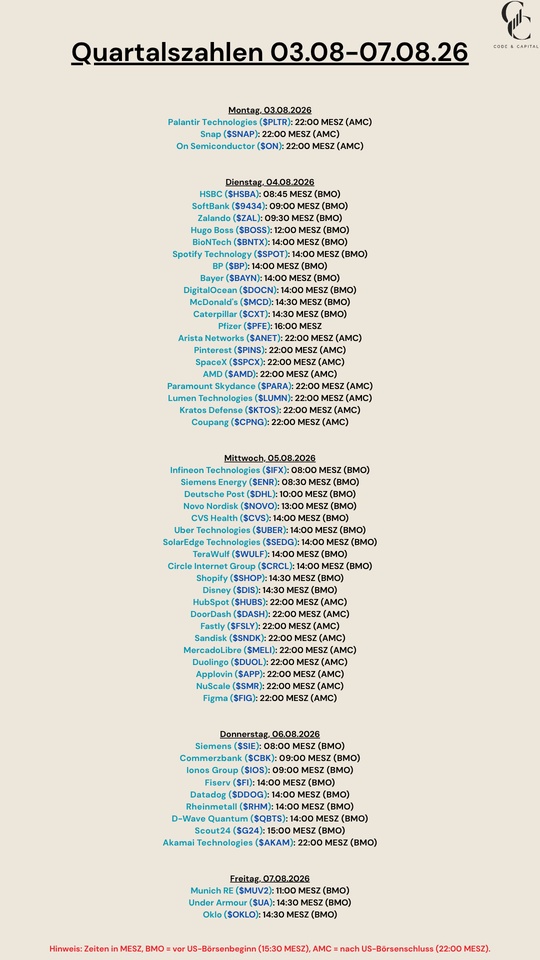
Quarterly Results August 3–7, 2026
$PLTR (-2,33%)
$SNAP (+6,21%)
$HSBA (-0,25%)
$9434 (+2,02%)
$ZAL (+2,53%)
$BOSS (+0,28%)
$BNTX (-0,05%)
$SPOT (+2%)
$BP. (-2,13%)
$BAYN (+1,64%)
$DOCN (+0,63%)
$MCD (-1,56%)
$CAT (-0,09%)
$PFE (+1,92%)
$ANET (+1,04%)
$PINS (+1,25%)
$SPCX (+1,74%)
$AMD (+4,77%)
$PARA (+2%)
$LUMN (+3,49%)
$KTOS (-1,34%)
$CPNG (+1,31%)
$IFX (+0,98%)
$ENR (+2,87%)
$DHL (+0,71%)
$NOVO B (+3,34%)
$CVS (-1,07%)
$UBER (+0,57%)
$SEDG (-0,39%)
$WULF (+5,18%)
$CRCL (+4,13%)
$SHOP (+2%)
$DIS (+0,59%)
$HUBS (-2,4%)
$DASH (+0,97%)
$FSLY (+0,36%)
$SNDK (-1,56%)
$MELI (+2,16%)
$DUOL
$APP (+3,67%)
$SMR
$FIG (-1,91%)
$SIE (+2%)
$CBK (+1,09%)
$IOS (+0,45%)
$FI (-1,2%)
$DDOG (-2,26%)
$RHM (-0,33%)
$QBTS (+3,17%)
$G24 (+5,3%)
$AKAM (-0,35%)
$MUV2 (+0,27%)
$UA (-4,44%)
$OKLO
SolarEdge: From a Company on the Brink of Bankruptcy to an AI Data Center Play? My Opinion ⤵️
Now, following the recent decline, the stock is back in the $50 range. I suspect the weakness is related not only to the broader correction among some high-beta stocks but also to the de-escalation in the conflict between the U.S. and Iran. High oil prices had begun to act as a tailwind for the solar sector, especially in Europe, so the reversal in energy prices has likely dampened some of that short-term euphoria.
This could be my opportunity to at least start a small position and build it up over time as my conviction grows.
For those who aren’t very familiar with the company: SolarEdge was founded in Israel in 2006 and has become one of the leading companies in the solar inverter industry. The original idea was to improve the way solar energy is harvested, converted, monitored, and optimized.
Instead of simply selling traditional inverters, SolarEdge built its platform around power optimizers and smart inverters. The basic idea was to allow each solar panel to operate more independently and efficiently, rather than having the entire system limited by the weakest panel. This improved energy production, safety, monitoring, and system control.
Over time, SolarEdge became one of the leading companies in solar power electronics. The company went public in 2015, benefited enormously from the global solar boom, and, at its peak, was considered one of the premier brands in the sector.
Then everything went wrong.
The solar industry entered one of its worst downturns in years. Higher interest rates put pressure on demand for residential solar systems, especially in the U.S., where financing costs play a major role for homeowners. At the same time, the entire supply chain underwent a brutal inventory correction. Distributors were left with excess inventory, installers scaled back their orders, and companies like SolarEdge were hit by plummeting demand, negative operating leverage, and deteriorating margins.
The stock reflected this pain. From its all-time highs, SolarEdge plummeted by more than 90%, and by early 2025, the market was effectively pricing the company as if the risk of bankruptcy had become a real possibility.
That’s exactly what made the situation interesting.
SolarEdge wasn’t just any run-of-the-mill, low-quality solar company. It was a former industry leader with genuine technology, a global presence, a large installed base, and a business that had already proven capable of generating attractive margins in a healthier solar environment.
The question was whether the company could survive the downturn, streamline its business, and position itself for the next cycle.
At the moment, I think the answer is yes.
Over the past year, the new CEO has focused on stabilizing the company. SolarEdge has sold or divested several peripheral businesses and underperforming divisions, including the tracker business, the Kokam battery manufacturing operation, and the e-mobility division. The goal was simple: simplify the structure, preserve capital, cut costs, and refocus on the core solar and energy storage business.
In my opinion, that was the right move.
The company had expanded into too many areas during good times, and when the cycle turned, this complexity became a burden. By eliminating non-core activities and focusing on the areas where SolarEdge has the strongest competitive position, management is attempting to rebuild the company on a much healthier foundation.
The results have already improved.
Margins have rebounded from deeply negative levels, free cash flow has turned positive, and management has signaled a return to profitability sooner than many investors expected. The stock is no longer a distressed equity story. It has now become more of a turnaround story.
That is the first part of the thesis: the core solar business.
Even if we completely ignore the second part, SolarEdge could still be an attractive investment should the solar cycle improve. Demand has been dampened by high interest rates, inventory drawdowns, and weak sentiment across the entire sector. But these are cyclical factors.
Eventually, interest rates should become less of a headwind, inventory levels should normalize, and demand should recover. Electricity prices remain high in many regions, electricity demand is rising, and energy independence remains an important issue. Solar isn’t going anywhere.
In fact, I think Europe is likely better positioned than the U.S. when it comes to the solar market. The U.S. residential solar market has been hit hard by high interest rates, political uncertainty, changes to subsidies, and net metering pressure in some states. Europe, of course, has its own problems, but structurally, the region has even stronger incentives for energy security, higher electricity prices, and a more urgent need to reduce dependence on energy imports.
That’s one of the reasons why I currently prefer SolarEdge over Enphase $E2NP34.
When comparing the two, I believe that SolarEdge’s core business exposure is more attractive today because it has greater international and European leverage. Should Europe recover faster than the U.S. residential market, SolarEdge could be better positioned to benefit from it.
Then there’s the storage aspect.
SolarEdge is no longer just an inverter company. Batteries are becoming an increasingly important component of solar systems. As battery attachment rates rise, revenue per installation increases, the system becomes more valuable to the customer, and the company can capture greater profitability per project.
This is important because solar plus storage offers a much stronger value proposition than solar alone. Customers don’t just want to generate electricity during the day. They increasingly want emergency power and better control over their energy consumption at home or in commercial settings.
This plays directly into SolarEdge’s architecture.
The DC-coupled system allows solar generation and battery storage to work together more efficiently, with less energy loss from unnecessary conversions. As storage becomes a larger part of the market, SolarEdge could benefit from higher revenue per system and potentially better margins.
So the first level of this thesis is already compelling: a former solar market leader, following a brutal downturn, with a streamlined business, improving margins, free cash flow back in the black, a tailwind from storage, and potential upside driven by a recovery in the solar cycle.
But the second layer makes the thesis even more exciting.
This second layer involves solid-state transformers, or SSTs for short.
This is the part of the thesis that initially made me take the company more seriously. SolarEdge has been working on power conversion for decades, and management believes that a significant portion of the technology required for SSTs is already present in the company’s current capabilities.
As AI workloads scale, data centers are becoming much more power-intensive. The industry is moving toward high-voltage architectures, including 800 VDC systems, because traditional power distribution becomes less efficient as power density increases. Simply put: the more power a data center needs, the more important efficiency becomes.
Every percentage point of efficiency counts.
If a data center can reduce conversion losses, reduce heat, save space, simplify infrastructure, and improve reliability, this can translate into very significant economic benefits. This is precisely where SSTs could come into play.
SolarEdge’s SST concept is designed to replace parts of the traditional power architecture with a more efficient system. Instead of relying on multiple conversion stages between the grid and the data center, the goal is to create a more direct and efficient architecture that can better support future AI infrastructure.
The potential benefits are substantial:
Higher power conversion efficiency
Lower energy losses
Less heat generation
Reduced cooling requirements
More usable space for computing equipment
Better compatibility with 800 VDC data center architectures
Data centers are becoming one of the biggest bottlenecks in AI expansion. Everyone is talking about GPUs, but GPUs are useless without power. As AI infrastructure continues to scale, demand for better power distribution and power conversion is expected to rise dramatically.
Important: SolarEdge is not alone in this. There are several other companies working on SST technology, and this is still an early-stage market. Commercialization is not expected before 2028, and we should not assume success is a given.
But I think SolarEdge could have a real chance.
First: The company began working on this much earlier than most investors realize. This isn’t something that was decided on a whim last quarter just because AI became a hot topic. The company’s history is built around power electronics, DC architecture, and energy conversion. SSTs aren’t a completely foreign change of course. Rather, they’re a natural extension of what SolarEdge has been doing for years.
Second, and perhaps even more importantly: SolarEdge is developing the technology in collaboration with Infineon $IFX (+0,98%) .
Infineon is one of the world’s leading semiconductor companies, particularly in power semiconductors, and a close partner of NVIDIA $NVDA (+1,86%) .
A partner like Infineon lends the project significantly more credibility than if SolarEdge were trying to build everything on its own. In a market where reliability, efficiency, scalability, and customer trust are crucial, the partnership with Infineon could be a significant advantage.
That’s another reason why I prefer SolarEdge over Enphase $ENPH (+0,22%) .
Enphase is also a high-quality power electronics company, but when it comes to the SST opportunity for data centers, I think SolarEdge is better positioned. It has been working on this for longer, the fit with DC architecture seems more natural, and the Infineon partnership gives it a level of industrial and semiconductor-related credibility that I consider very important.
In short, the SolarEdge thesis has two layers.
The first aspect is the core solar turnaround.
The company was battered by the downturn, but the business is stabilizing. Margins are improving, free cash flow has recovered, non-core businesses have been divested, and management is refocusing on profitable growth. Should the solar cycle improve, I believe the stock could see a significant revaluation, even without any contribution from SSTs.
The second layer is the data center SST option.
If SolarEdge can successfully commercialize this technology, it could open up an entirely new line of business tied to one of the strongest infrastructure themes on the market: AI power demand. That would make the company much more than just a solar turnaround. It could become a “picks and shovels” play for the electrical infrastructure needed for next-generation AI data centers.
The difficult part is the valuation.
SolarEdge is not an easy company to value today. First, it is extremely difficult to assign a fair value to the SST opportunity. We’re still talking about a product in a very early stage that hasn’t yet impacted the financials, and it’s unclear how it will do so. The potential market is huge, but we don’t know what adoption will look like, how high the margins might be, what market share SolarEdge can capture, or how quickly the technology will be commercialized.
Second, the turnaround in the core solar business itself is not yet fully clear. Yes, the company has exceeded expectations, margins have improved, and the business appears to be moving in the right direction. But it’s still a turnaround. Solar demand remains cyclical, the market remains difficult to navigate, and we need more quarters of strong execution before we can say with confidence that SolarEdge is fully back on track.
That’s why I don’t think this is a “cheap stock based on the numbers” situation.
It’s more of a momentum-plus-optionality thesis. In other words: I might be willing to accept a certain degree of valuation uncertainty because the upside potential could be significant if both aspects start to come together.
There are, of course, several risks.
Solar remains a cyclical and politically sensitive industry. Competition is intense. The recovery could take longer than expected. Margins may not fully normalize. And the SST opportunity is still in its early stages; significant commercialization is still more than a year away.
First of all, congratulations on your courage and on getting started with 110 units! Your post is exceptionally well-written from a rhetorical standpoint, and the story about the solid-state transformers (SST) in collaboration with Infineon is extremely fascinating.
But if we take off our rose-colored glasses for a moment and examine the hard, current data from the engine room, your thesis unfortunately clashes very painfully with reality. Here are three points where you’re on very thin ice, both mathematically and in terms of the balance sheet:
1. The Margin and Profitability Myth
You write that margins have recovered and free cash flow has turned positive. However, if you look at the raw TTM data (the last 12 months), the opposite is true: SolarEdge has not generated any profits at all in the last 12 months and continues to suffer from extremely low gross profit margins. The profitability rating stands at a disastrous 1 out of 5. An operational turnaround looks different on the books.
2. Financial health remains “Weak”
Your claim that this is no longer a “distressed story” is not supported by the market or the models. The quality check on Investing and other platforms currently and officially rates SolarEdge’s financial position as “Weak.” With a cash flow rating of just 2 out of 5 and moderate debt, the fundamentals remain extremely shaky.
3. You’re paying a massive premium for “hope”
At a current price of around 45.75 EUR, the stock is simply expensive.
The mathematical fair value (based on 12 recognized financial models) is just 34.92 EUR—so you’ve bought in with a downside risk of nearly -24%.
Even the analyst consensus (21 analysts) is significantly below your entry price at 38.96 EUR.
In addition, the system warns of a high P/B ratio.
Conclusion:
Your second tier (SST/AI data centers starting in 2028) is a fantastic story. But that’s exactly what it is right now: a story. Fundamentally, you’re buying an unprofitable company with weak cash flow at a price that’s far above the fair value based on its current earnings power.
As a speculative bet on a distant future, this might fly—but SolarEdge is, unfortunately, still a long way from being a fundamentally sound turnaround at this point.
I’m still rooting for you with those 110 shares, but I’ll be waiting on the sidelines for significantly lower prices that come closer to the fair value of ~35 EUR. 😉
Best regards!
🏗️ Introduction: Euro AI Backbone Wikifolio ⚡⚙️
Dear Community,
To kick off the week, I’d like to introduce you to my “Pick-and-Shovel” wikifolio “Euro AI Backbone” (in German: Backbone). More detailed information will follow; for now, this is just a rough overview.
_________________________
Background
The market’s focus is primarily on the U.S., while Europe often plays a more subordinate role. Yet recent years in particular have made it clear just how dependent Europe is on other countries such as the U.S., Russia, and China.
By the time the “Orange Man” began his second term, it had become clear:
Europe must become more independent —not only in the field of defense but also in the field of AI.
For nearly five years, Goldman Sachs has maintained an index called “EU AI Capex,” which consists of 64 European stocks. This served as the blueprint for my wikifolio.
The wikifolio was launched on June 18, 2026. For the wikifolio to receive “Investable” status, it needs, among other things, 10 bookmarks. So I’d really appreciate it if you could click “Add to Watchlist” on the wikifolio—thanks in advance.
_________________________
The “Pick-and-Shovel” Approach
The wikifolio aims to cover as much of the value chain for operating modern artificial intelligence as possible.
The focus here is primarily on five areas:
- The Shovels: Semiconductors and machinery (e.g., lithography systems, wafer deposition, chip assembly)
- The Gas: Electricity and energy generation (e.g., wind power, hydroelectric power, solar power plants)
- Highways: Networks and cables (e.g., transformers, high-voltage undersea cables, power grid infrastructure, transmission lines)
- The brain: Automation and data center cooling (e.g., liquid cooling, power distribution cabinets, data networks, control systems)
- The Physical Foundation: Construction, emergency power, and security (e.g., construction of the facilities, emergency power generators, cybersecurity)
_________________________
Investment Universe
The portfolio includes European large-, mid-, and small-cap stocks.
Focus: Technology (semiconductor equipment), utilities (electricity, grids), and industrials (automation, specialty cables, data center construction, cybersecurity).
The Core: European market leaders with global monopolies and competitive moats.
The Tech Specialists: Profitable second-tier suppliers as yield boosters.
The foundation: Energy producers, grid operators, and construction specialists for stable cash flows and risk hedging.
Regular rebalancing, which typically takes place at the beginning of each month, prevents concentration risk. While the foundation remains unchanged, the weightings of individual securities may be adjusted. The replacement of individual stocks, the addition of new stocks, or the exclusion of individual stocks can also take place at the beginning of the month.
Initially, the portfolio consists of 37 stocks. There is no cash reserve.
The current allocation of holdings is as follows:
By sector:
- Industrial: 44%
- Utilities: 29%
- Technology: 26%
- Consumer Discretionary: 1%
By country:
- Germany: 24%
- United Kingdom: 14%
- Switzerland: 13%
- Netherlands: 12%
- France: 12%
- Spain: 10%
- Italy: 9%
- Denmark: 2%
- Finland: 2%
- Austria: 2%
Investments are made exclusively in European stocks. None ETFs, no investment certificates, no funds, no leveraged products.
_________________________
Initial Holdings
At the start, the portfolio comprises the following 37 securities, sorted by their current weighting:
Infineon $IFX (+0,98%) , ASML Holding $ASML (+0,17%) , Siemens $SIE (+2%) , Enel $ENEL (+1,46%) , Rolls-Royce $RR. (+1,94%) , Schneider Electric $SU (+1,68%) , Iberdrola $IBE (+1,74%) , ABB $ABBN (+2,24%) , VAT Group $VACN (+1,65%) , Siemens Energy $ENR (+2,87%) , Prysmian $PRY (+1,54%) , ASM International $ASM (+0,44%) , BE Semiconductor Industries $BESI (-4,76%) , STMicroelectronics $STM (+0,47%) , RWE $RWE (+1,29%) , E.ON $EOAN (+1,05%) , Legrand $LR (+2,47%) , National Grid $NG. (+1,02%) , Nokia $NOKIA (+4,33%) , SSE $SSE (+1,61%) , EDP Renovaveis $EDPR (+1,92%) , Hochtief $HOT (+0,9%) , Red Eléctrica de España $RED (+0,76%) , Nexans $NEX (+2,87%) , United Utilities $UUGRY (+0,89%) , Enagas $ENG (+0,96%) , Centric $CENTR , Spirax-Sarco Engineering $SPX (+1,81%) , Soitex $SOI (+1,18%) , Geberit $GEBN (-0,05%) , Aixtron $AIXA (+1,33%) , Orsted $ORSTED (+3,3%) , Verbund $VER (+1,03%) , SAFRAN $SAF (+1,13%) , Thales $THALES (+0,05%) , NKT $NKT (+0,69%) , Andritz $ANDR (-0,55%)
_________________________
Holding Period
Since infrastructure development is likely to continue for several more years, the holding period is clearly geared toward the long term. Short-term trading is avoided.
_________________________
Sources of Information
The following sources of information are primarily used to identify stocks:
Companies’ quarterly reports and financial statements.
Analyst reports and industry studies from global investment banks.
Business media and financial publications.
_________________________
I’m curious to see how the portfolio will perform over the long term. Monthly updates will keep you informed.
Infineon's New Chip Factory
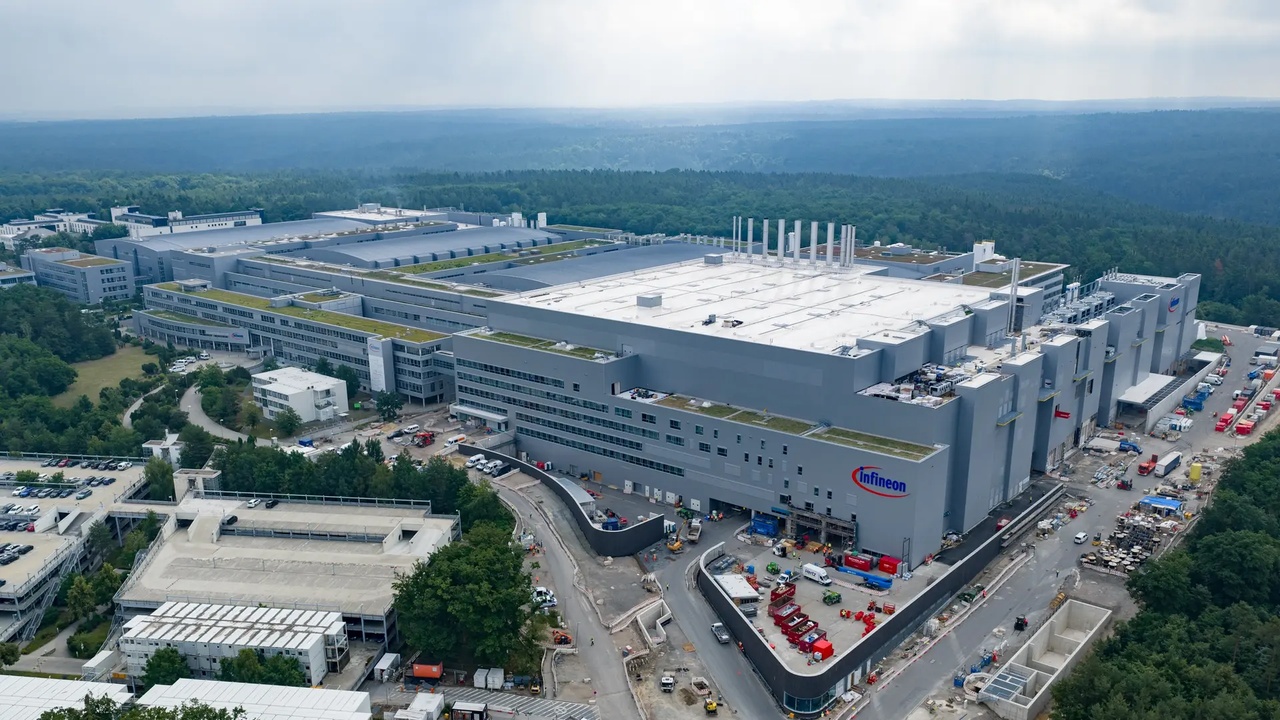
A full three months ahead of schedule, the new chip factory is $IFX (+0,98%) and is thus Europe’s largest power semiconductor plant. Construction is in its final stages.
What are your general thoughts on the choice of location, subsidies, and any potential sales issues? Does this really make “us” independent of Asian and American companies, despite high energy costs?
Best regards, and remember to drink plenty of fluids. Whatever it is 🍻☀️
Johannes
As far as stocks are concerned, it’s starting to look dangerously like a double top if things don’t start moving upward again soon. I think that here, as in the entire semiconductor sector, a major correction is coming soon.
Infineon
Why I Still Consider Infineon One of Europe’s Most Interesting Technology Companies
Many investors still associate Infineon primarily with the automotive industry. In my view, that could be one of the reasons why the company is often underestimated by the market.
When people talk about artificial intelligence, most immediately think of NVIDIA. Yet they often forget that every data center, every AI server, every charging station, every wind turbine, and every modern vehicle requires power semiconductors. It is precisely in this area that Infineon ranks among the global market leaders.
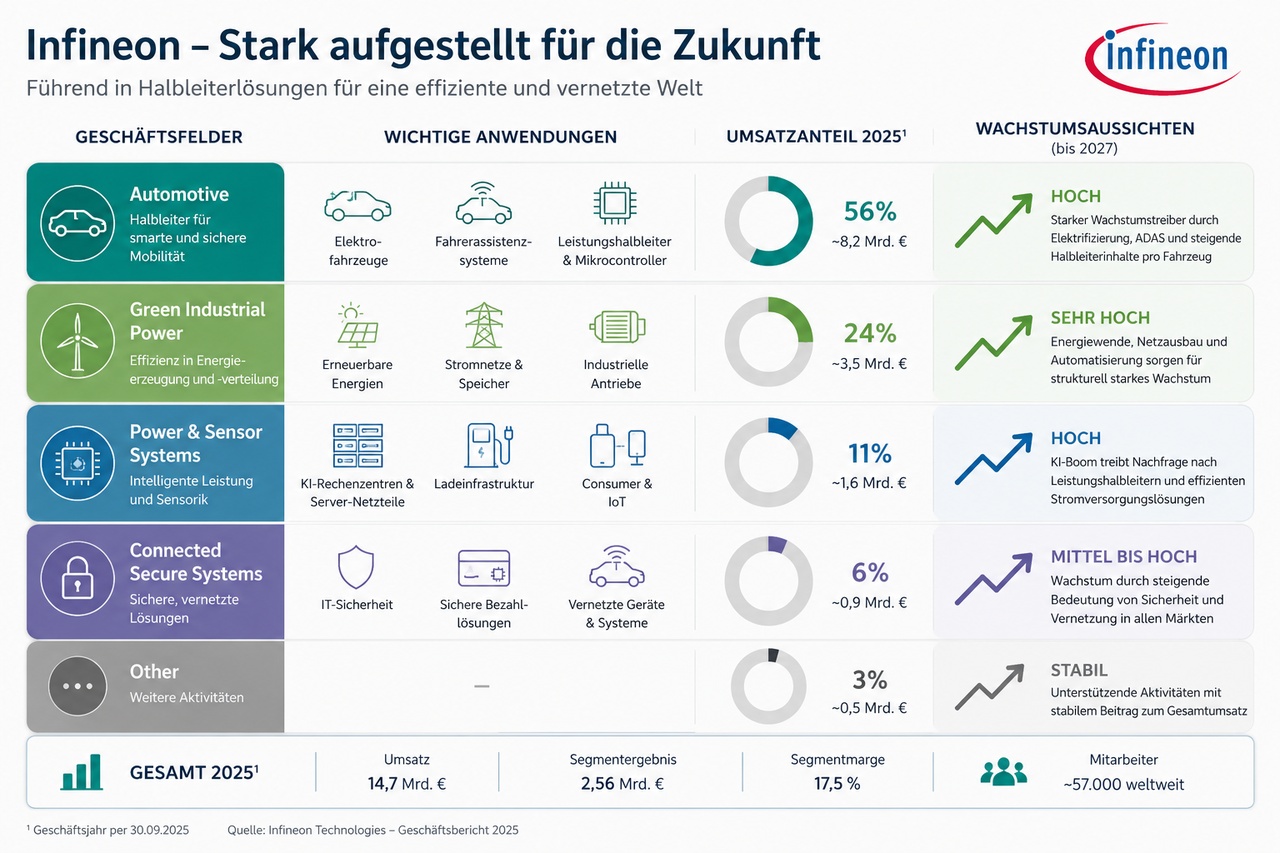
A look at the company’s business segments shows just how broadly diversified it has become:
• Automotive – electrification, driver assistance systems, and autonomous driving
• Green Industrial Power – energy transition, power grids, battery storage, and industrial applications
• Power & Sensor Systems – AI data centers, power semiconductors, and power supplies
• Connected Secure Systems – cybersecurity, digital identities, and connected devices
I find the developments in the AI sector particularly interesting. Management expects revenue from power supply solutions for AI data centers to rise from around €700 million in 2025 to approximately €2.5 billion by 2027. That would represent more than a threefold increase within just a few years.
Key Figures for 2025:
• Revenue: €14.7 billion
• Segment earnings: €2.56 billion
• Segment margin: 17.5%
• Approximately 57,000 employees worldwide
What I like: Infineon is benefiting not from a single trend, but from several megatrends simultaneously.
• Artificial intelligence
• Electrification of transportation
• Expansion of power grids
• Renewable energy
• Industrial automation
• Digitalization and IT security
In my view, the current valuation still strongly reflects the cyclical nature of the automotive industry. The question, however, is whether, in five to ten years, Infineon will still be seen primarily as an automotive supplier or rather as an indispensable technology partner for energy efficiency, AI, and electrification.
For me, the key question isn’t which company develops the best AI chips.
The key question is: Who provides the infrastructure that allows these chips to operate in the first place?
That’s exactly where Infineon fits in.
That’s why I continue to view the stock as one of the most exciting long-term positions in my portfolio.
What do you think? Is the market still valuing Infineon too much as a cyclical semiconductor stock, or is a European compounder for the next 10 years taking shape here?
🏗️🔋Euro AI Backbone - My Bet on Europe's AI Backbone 🎲
Dear Community,
Throughout last year, I found myself repeatedly wanting to focus on the European market as well. But the same old arguments kept dissuading me: The European market doesn’t deliver; Europe doesn’t meet my desire for a growth-oriented, high-yield portfolio, etc.
I also asked myself: Which sectors and industries do I want to cover? Where do I see enough potential to justify taking the risk? To what extent do I want to align my portfolio with this strategy?
In today’s episode, Alles auf Aktien: Fiese Gewinnwarnung bei BMW und Europas KI-Unabhängigkeitsaktien , something caught my attention:
A basket from Goldman Sachs, consisting of 64 European stocks, with the wonderful name: EU AI Capex.
Performance over the past five years: 17.5 percent annualized, including dividends.
_________________________
And which industries are covered?
- Semiconductors
- Machinery
- Electricity
- Networks
- Cables
- Energy
- Automation
Unfortunately, existing ETFs such as the iShares STOXX Europe 600 Utilities UCITS ETF or the iShares STOXX Europe 600 Technology UCITS ETF do not cover all of these sectors.
"Sounds exactly like what I was looking for," I thought to myself, and used my day off today to create an index tailored to my preferences.
Goldman Sachs has listed 12 of the 64 holdings, including their percentage allocations. The remaining 52 holdings appear to be known only to institutional investors, as the index isn’t publicly available.
So I created my own “Pie” through Trading 212. More specifically, a “Pie” is a personalized investment portfolio in which I can invest in multiple stocks and ETFs according to a percentage allocation I set myself and save toward them simultaneously via a single automated savings plan—with no expense ratio and no order fees.
It would go beyond the scope of this post to write about every individual security, which is why I chose this particular one. I didn’t make these decisions entirely on my own. Gemini helped me with this. In the end, we settled on 37 securities.
_________________________
On Selecting the Holdings
Together, we gradually added European market leaders across the entire value chain. We always kept an eye on the sectors—none should be left out.
_________________________
On the Percentage Allocation
It’s important to note upfront that the “pie” will be funded with 150 euros per month going forward. Since the minimum investment amount at Trading 212 is one euro, the smallest weighting in the “pie” must be at least 0.7%:
1.00 euro / 0.70% = 142.85 euro
The percentage allocation was then based on pricing power and global scalability.
More details on this may follow in a later post.
_________________________
About the Stocks
From EU AI Cortex Basket taken over by Goldman Sachs:
- Infineon ($IFX (+0,98%)): 7.10%
- ASML ($ASML (+0,17%)): 6.80%
- Siemens ($SIE (+2%)): 6.00%
- Rolls-Royce ($RR. (+1,94%)): 5.40%
- Enel ($ENEL (+1,46%)): 5.40%
- Schneider Electric ($SU (+1,68%)): 5.40%
- ABB ($ABBN (+2,24%)): 5.00%
- Iberdrola ($IBE (+1,74%)): 4.90%
- Siemens Energy ($ENR (+2,87%)): 4.70%
- ASM International ($ASM (+0,44%)): 3.70%
- Prysmian ($PRY (+1,54%)): 3.60%
- BE Semiconductor ($BESI (-4,76%)): 3.20%
Supplemented by the following stocks:
- VAT Group ($VACN (+1,65%)): 4.50%
- STMicroelectronics ($STM (+0,47%)): 2.50%
- Legrand ($LR (+2,47%)): 2.00%
- RWE ($RWE (+1,29%)): 1.95%
- Nokia ($NOKIA (+4,33%)): 1.90%
- E.ON ($EOAN (+1,05%)): 1.90%
- National Grid ($NG. (+1,02%)): 1.80%
- SSE plc ($SSE (+1,61%)): 1.70%
- EDP Renováveis ($EDPR (+1,92%)): 1.60%
- Red Eléctrica ($RDEIY (+0,99%)): 1.50%
- Nexans ($NEX (+2,87%)): 1.50%
- Hochtief ($HOT (+0,9%)): 1.50%
- Enagás ($ENG (+0,96%)): 1.40%
- United Utilities ($UU. (+0,03%)): 1.40%
- Spirax-Sarco ($SPX (+1,81%)): 1.30%
- Centrica ($CNA (+0%)): 1.30%
- Aixtron ($AIXA (+1,33%)): 1.30%
- Orsted ($ORSTED (+3,3%)): 1.15%
- Verbund AG ($VER (+1,03%)): 1.10%
- Soitec ($SOI (+1,18%)): 1.10%
- Safran ($SAF (+1,13%)): 1.00%
- Thales ($HO (-0,36%)): 1.00%
- Geberit ($GEBN (-0,05%)): 0.90%
- NKT A/S ($NKT (+0,69%)): 0.80%
- Andritz ($ANDR (-0,55%)): 0.70%
The figures $IG (+0,66%) , $SRG (+0,89%) , $TRN (+0,63%) , $ALFA (+1,82%) , $ATCO B (+1,19%) or $AEMMY can unfortunately only be traded via CFDs on Trading 212. Therefore, these securities could not be included.
_________________________
Trading 212 Pie
The Pie now accounts for about 10% of my portfolio, and I’ll be contributing 150 euros to it each month going forward.
I am convinced that Europe will succeed in becoming more independent. However, in my opinion, a self-sufficient Europe without any dependence whatsoever is simply not possible (keyword: globalization).
_________________________
Pie Composition
By country:
- Germany: 24.35%
- France: 15.4%
- Netherlands: 13.7%
- United Kingdom: 12.9%
- Switzerland: 10.4%
- Italy: 9%
- Spain: 7.8%
- Denmark: 1.95%
- Austria: 1.8%
- Portugal: 1.6%
By sector:
- Technology: 32.3%
- Industrial & Capital Goods: 31.5%
- Utilities & Energy Infrastructure: 36.2%
By industry:
- Semiconductors & Data Center Chips: 27.8%
- Energy Equipment & Grid Technology: 25.5%
- Electricity Generators: 16.1%
- Physical Networks & Storage: 10.1%
- Cable Infrastructure: 5.9%
- Vacuum Technology & Components: 6.5%
- Network Technology & Connectivity: 1.9%
- Data Centers & Industrial Construction: 3.1%
- Cyber and Perimeter Security: 3.1%
_________________________
I’m curious to see how the pie chart will develop.
P.S.: You can find the pie chart on Trading 212 under the name Euro AI Backbone GS to copy.
European AI “Independence”
According to Ifo President Clemens Fuest, Europe faces an “existential threat”: Europe uses AI but has virtually no infrastructure. About 75 percent of the world’s high-performance computing capacity for modern AI is located in the U.S., with China accounting for about 15 percent and the EU for less than five percent.
He is therefore calling for an emergency program that includes more data centers, chip factories, energy infrastructure, faster approvals, and, if necessary, special economic zones. Energy is becoming a strategic issue, as AI data centers require enormous amounts of reliable electricity.
A study by the American investment bank Goldman Sachs titled “The Post-Modern Cycle” describes a new investment supercycle: AI, data centers, electricity, chips, defense, and infrastructure. The digital world suddenly needs concrete, cables, transformers, and power plants.
Goldman has created a corresponding portfolio called EU AI Capex.
It comprises 64 components. It is Europe’s publicly traded bet on AI infrastructure. Over the past five years, the index has gained 124 percent including dividends, which translates to an annualized return of 17.5 percent. The Stoxx Europe 600 has only managed 64 percent over the same period—an annualized rate of 10.3 percent.
The largest holdings show what this is all about: Infineon
$IFX (+0,98%) has a weighting of 7.1 percent, ASML
$ASML (+0,17%) stands at 6.8 percent, Siemens $SIE (+2%) accounts for 6 percent, Rolls-Royce $RR. (+1,94%) , Enel $ENEL (+1,46%) and Schneider Electric
$SU (+1,68%) at 5.4 percent. ABB $ABBN (+2,24%) has a weighting of five percent, Iberdrola
$IBE (+1,74%) at 4.9 percent, Siemens Energy
$ENR (+2,87%) at 4.7 percent, ASM International
$ASM (+0,44%) at 3.7 percent, Prysmian $PRY (+1,54%) at 3.6 percent, and BE Semiconductor
$BESI (-4,76%) at 3.2 percent.
This means the index is not purely a tech index, but rather reflects Europe’s physical AI value chain: semiconductors, machinery, electricity, networks, cables, energy, and automation. ASML is Europe’s strategic crown jewel. Fuest even says that ASML is so far Europe’s only truly strategic asset in this sector, because the U.S. also depends on it.
The risk: Europe talks, but doesn’t build. Energy remains expensive, permits take a long time, regulation slows down projects—and in the end, we remain customers of American models.
The opportunity: Europe is waking up. Then digital sovereignty will trigger a capex boom, and stocks will get a new boost. Anyone who wants European AI must definitely buy European infrastructure.
Source: “Welt” (excerpt), June 17, 2026

I have dared
Too bad my text got lost!
I opened a small position today in $IFX (+0,98%) because I've been thinking about it since 60 euros.
But it won't be a long runner, it will probably be short term.
let's see what else happens 👍