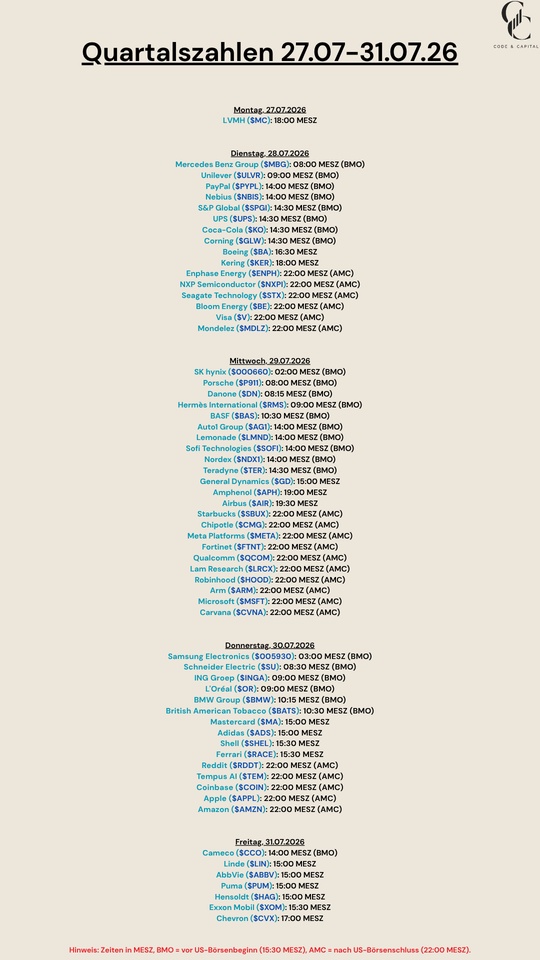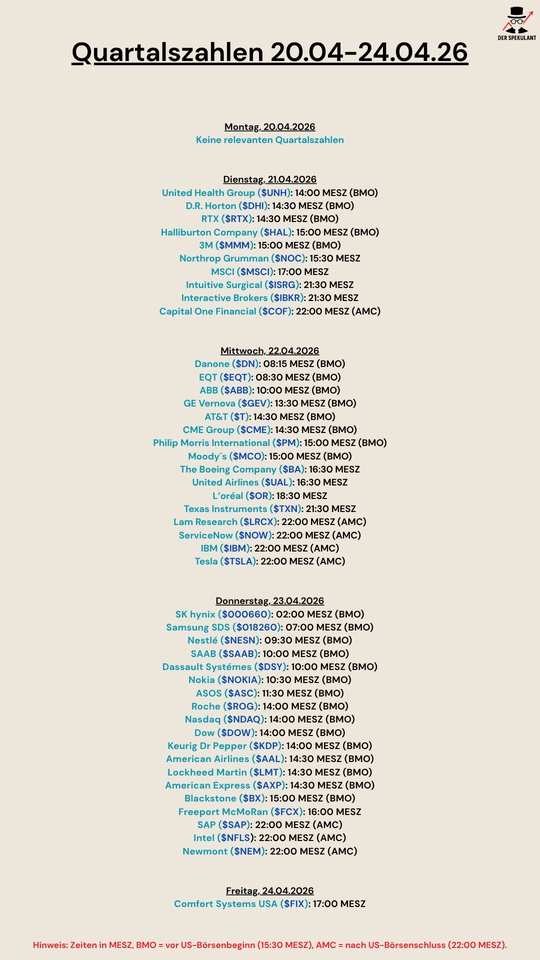
$UNH (+2,72%)
$DHI (-2,42%)
$RTX (+0,84%)
$HAL (-2,44%)
$MMM (-0,27%)
$NOC (+3,65%)
$MSCI (+4,32%)
$IBKR (+7,35%)
$ISRG (+1,47%)
$COF (+1,48%)
$BN (+0,14%)
$EQT (-0,92%)
$ABBN (-2,05%)
$GEV (-2,52%)
$T (-0,71%)
$CME (+4,96%)
$PM (-1,4%)
$MCO (+3,78%)
$BA (+1,71%)
$UAL (-1,66%)
$OR (-0,99%)
$TXN (-0,02%)
$LRCX (-9,59%)
$NOW (+6,84%)
$IBM (+2,46%)
$TSLA (+1,98%)
$000660
$018260
$NESN (-0,35%)
$SAAB B (+0,41%)
$DSY (+3%)
$NOKIA (-2,39%)
$ASC (+10,23%)
$ROG
$NDAQ (+5,51%)
$DOW (-0,92%)
$KDP (+1,49%)
$AAL (+0,07%)
$LMT (+2,95%)
$AXP (+3,16%)
$BX (+2,44%)
$FCX (-3,04%)
$SAP (+3,96%)
$INTC (-7,67%)
$NEM (+0,23%)
$FIX (-5,23%)

Danone
Price
Discussione su BN
Messaggi
19Quarterly figures 20.04-24.04.26
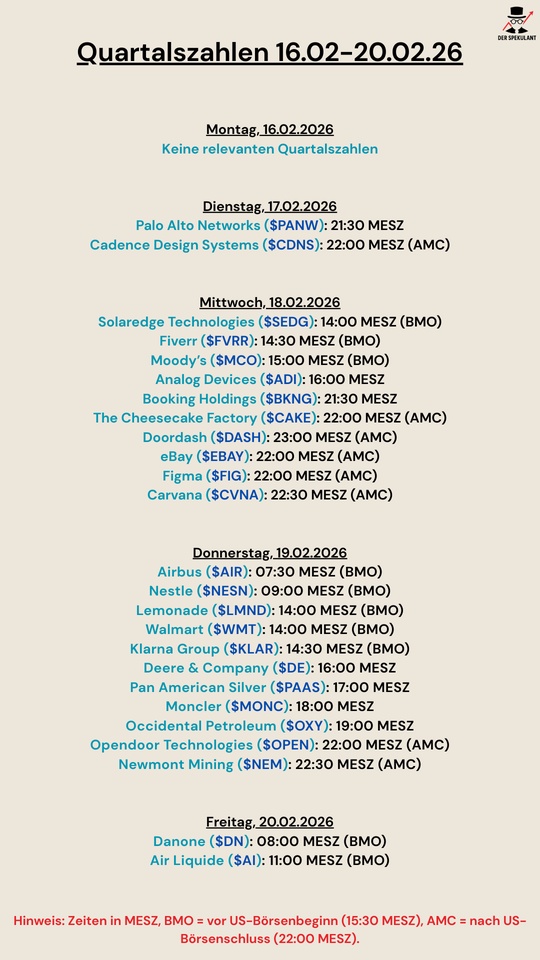
Quarterly figures 16.02-20.02.26
$PANW (+3,66%)
$CDNS (+0,55%)
$SEDG (-3,67%)
$FVRR (+6,68%)
$MCO (+3,78%)
$ADI (-2%)
$BKNG (+2,86%)
$CAKE (+0,11%)
$DASH (+2,27%)
$EBAY (+0,66%)
$FIG (+7,96%)
$CVNA (+4,14%)
$AIR (+1,64%)
$NESN (-0,35%)
$LMND (+9,08%)
$WMT (-3,9%)
$KLAR (+0,79%)
$DE (-0,61%)
$PAAS (-0,81%)
$MONC (+0,82%)
$OXY (-0,94%)
$OPEN (+6,94%)
$NEM (+0,24%)
$BN (+0,14%)
$AI (+1,28%)

🌎📈 Mercosur agreement: Mega free trade - opportunities for the stock market & potential profiteers
After more than 25 years of negotiations, the EU and the South American economic alliance Mercosur (Brazil, Argentina, Paraguay, Uruguay) have concluded a historic free trade agreement. This creates one of the largest free trade zones in the world - with over 700 million people and a combined economic area worth around 22 trillion USD.
This agreement could trigger global economic and stock market effects - for companies, industries and investors.
_________________________
🛃🚢 What will happen to the Mercosur agreement?
- Tariffs on up to 91% of EU exports and 92% of Mercosur exports are to be gradually eliminated.
- The aim is to create a larger single market, better market access, simplified rules and more stable trading conditions between Europe and South America.
- Until now, high tariffs have applied to cars (approx. 35%), machinery (14-20%) and chemical products (up to 18%).
_________________________
📊 Possible effects on the stock market
📈 1. industries with strong exports benefit from higher demand
Europe can sell its products more easily in South America:
- 👩🏭 Cars & car parts
- 🏭 Mechanical engineering
- 🧪 Chemicals & pharmaceuticals
- 🪄 Electronics & high-tech
The elimination of customs duties and fewer trade barriers will increase the margins and competitiveness of these industries.
Possible examples of Frofiteurs:
- VW $VOW (+1,39%) BMW $BMW (+1,5%) Daimler $DTG (-0,08%)
- Siemens $SIE (-2,9%)
- BASF $BAS (+0,07%) Covestro $1COV (-0,33%)
- SAP $SAP (+3,96%) , ASML $ASML (-6,24%)
➡️ Expected share price impetus from higher export revenues and capped production costs.
_________________________
🍖 2. agricultural & food sector in focus
The agricultural business is also becoming more closely networked on both sides:
- Tariffs on wine, oil, cheese, dairy products and luxury foods are being reduced or gradually created.
- EU producers will gain greater market access in South America; conversely, South American agricultural exports (e.g. beef, sugar) will have better access to the EU.
Possible beneficiaries:
- Nestlé $NESN (-0,35%) Danone $BN (+0,14%)
- Heineken $HEIA (+1,25%) AB InBev $ABI (-2,43%)
- FrieslandCampina $FCEPL
⚠️ However, critics point out that price pressure on local farmers* also arises and environmental risks can increase, for example due to cheaper imports.
_________________________
🚗 3. raw materials & energy: medium to long-term effects
Mercosur countries export large quantities of raw materials:
- Soy, sugar, coffee, ethanol, grain
- Brazil is also a major supplier of crude oil and minerals
One of the aims of the agreement is more stable commodity trade with fewer tariffs, which can influence commodity prices and move the shares of commodity and energy companies.
Possible beneficiaries:
- Vale $VALE3 (-0,05%) Petrobras $PETR3 (-0,86%)
- Bunge $BG (-1,13%) , ADM $ADM (+0,66%)
_________________________
🏦 4. finance & services sector
The agreement also facilitates:
- Market access for financial services
- Opening of telecom and transportation markets
- Opening of public procurement to EU suppliers
➡️ This could strengthen banks, insurers and logistics companies that operate across borders.
Possible beneficiaries:
- Allianz $ALV (+0,21%) Deutsche Bank $DBK (+0,32%)
- DHL/Deutsche Post $DHL (+0,75%) Kuehne + Nagel $KNIN (+2,07%)
_________________________
🔄 Short-term market risks
Not everything is automatically positive:
- 🇪🇺 Agricultural protests in Europe show resistance to cheap imports.
- Political uncertainties remain - many parliaments need to ratify.
- Sectors with low competitiveness could come under price pressure.
_________________________
📌 Conclusion
The Mercosur agreement could be an issue with far-reaching effects:
✅ Strong export industry gains new sales markets
✅ Agricultural and luxury food sector gains sales opportunities
✅ Financial and service sector benefits from market expansion
✅ Raw material exporting countries in South America could become more integrated
⚠️ At the same time, there are risks for local producers and price distortions that could have a regional impact on share prices
_________________________
Question for you: What is your opinion on the agreement? And in which sectors or listed companies do you see the biggest winners in the long term?
_________________________
Sources:
- 💶📈 Wirtschaftliche Chancen für EU-Exporteure und Importeure durch Zollerleichterungen
- ⚙️🚗 Branchenanalysen mit Zollabbau-Effekten für Maschinen, Autos, Chemie etc.
- 🌾🥩 Agrar- und Rohstoff-Impakte durch neue Marktchancen und Quotenregelungen
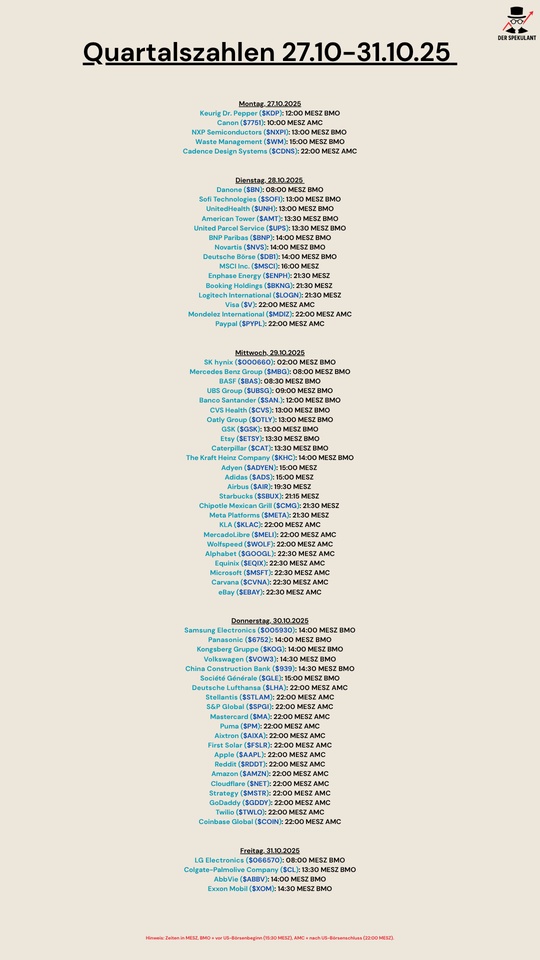
Quarterly figures 27.10-31.10.25
$KDP (+1,49%)
$7751 (-1,15%)
$NXPI (+0,43%)
$WM (+1,03%)
$CDNS (+0,55%)
$BN (+0,14%)
$SOFI (+3,12%)
$UNH (+2,72%)
$AMT (+1,92%)
$UPS (+2,96%)
$BNP (-1,37%)
$NVS (-2,18%)
$DB1 (+0,02%)
$MSCI (+4,32%)
$ENPH (-4,59%)
$BKNG (+2,86%)
$LOGN (+1,24%)
$V (+2,48%)
$MDLZ (+2,88%)
$PYPL (+3,18%)
$000660
$MBG (-0,8%)
$BAS (+0,07%)
$UBSG (+0,67%)
$SAN (-0,23%)
$CVS (+0,79%)
$OTLY (+2,08%)
$GSK (-1,78%)
$ETSY (-2,02%)
$CAT (-5,8%)
$KHC (+5,37%)
$ADYEN (+2,97%)
$ADS (+1,01%)
$AIR (+1,64%)
$SBUX (+0,71%)
$CMG (+3,98%)
$META (+9,46%)
$KLAC (-11,46%)
$MELI (+2,95%)
$WOLF (-7,53%)
$GOOGL (+1,5%)
$EQIX (-2,5%)
$MSFT (+3,47%)
$CVNA (+4,14%)
$EBAY (+0,66%)
$005930
$6752 (+4,29%)
$KOG (+2,88%)
$VOW3 (-0,13%)
$GLE (-1,18%)
$LHA (-2,59%)
$STLAM (+1,34%)
$SPGI (+2,95%)
$MA (+2,66%)
$PUM (+0,75%)
$AIXA (-3,25%)
$FSLR (+0,24%)
$AAPL (+2,14%)
$REDDIT (+0%)
$AMZN (+1,72%)
$NET (+1%)
$MSTR (+8,21%)
$GDDY (+4,07%)
$TWLO (+1,69%)
$COIN (+9,15%)
$066570
$CL (+1,4%)
$ABBV (+0,34%)
$XOM (+0,32%)
The new Nestle boss reorganizes
The new Nestlé $NESN (-0,35%) Group CEO Philipp Navratil wants to make savings and is cutting 16,000 jobs. The manager has increased the savings target from 2.5 billion to 3.0 billion Swiss francs by the end of 2027.
In his first major public appearance, Navratil explained that volume growth was his top priority. "To this end, we have increased our investments in a targeted manner and have already achieved initial results. Now we need to do even more, act faster and accelerate our growth momentum."
A lot of work is needed to get Nestlé back on track. Because when it comes to key indicators such as sales growth and share price performance, the food giant, whose products range from ready meals and frozen products to confectionery, coffee, Vittel water and pet food, is now lagging behind rivals such as Danone $BN (+0,14%) and Unilever $ULVR (+1,61%) are lagging behind.
Source text (excerpt) & graphic: Handelsblatt, 16.10.2025

From my point of view, the quality of the price development corresponds to that of many products.
Stop 🛑 Loss Danone 🥵
Neutral performance after 5 years.
~ 1,000 Euro dividend.
Stop loss undercut
The British investment bank Barclays has lowered its price target for Danone from 85 to 82 euros, but left its rating at "Overweight".
The European food company's business should have held up quite well at home and in Asia, wrote Warren Ackerman in his outlook for the reporting season on Monday. However, currency headwinds are causing headaches and there are more questions about Latin America, for example.
However, the focus is likely to be on US consumer sentiment and the outlook there for the second half of the year.
Earnings summary this morning 👇🏼
$ULVR (+1,61%) | Unilever Q3 2024 Earnings
Rev €15.25B (est €15.398B)
DIV/SHR €O.4396
Underlying Volume 3.6% (est 3.1%)
Underlying Sales 4.5%, (est 4.25%)
Still Sees FY Underlying Sales To 5% (est 4.2%)
Still Sees FY Underlying Oper. Margin At Least 18%
2024 FY Outlook Unchanged
$BARC (+2,51%) | Barclays Q3 2024 Earnings
Pretax Profit £2.23B (est £1.96B)
Net Interest Income £3.31B (est £3.11B)
Investment Banking £594M (est £552.3M)
FICC Rev. £1.18B (est £1.13B)
Sees FY Cost To Income Ratio About
Sees FY UK Net Interest Income About £6.5B
$AAL (+0,07%) | Anglo American Q3 2024 Earnings
Diamond Prod 5.6M Carats (est 5.6M)
Copper Output 181,000 tons (est 181,334)
American Sees Fy Diamond Prod 23M to 26M Carats
De Beers To Continue To Assess Options To Lower Output
PGMS Demerger Is On Track To Complete By Mid 2025
$RMS (-0,61%) | Hermes International Q3 2024 Earnings
Rev €3.70B (est €3.68B)
Sales At Constant FX 11.3% (est 10.5%)
Leather Goods Sales At Constant FX 14% (est 12.8%)
CFO: Sees No Change In Global Trends Early Q4
CFO: China Higher Basket Spend Made Up For Lower Traffic
$005380 | Hyundai reports a 6.5% drop in profits in the third quarter despite an increase in sales, leading to a fall in the Seoul share price of almost 5%. Operating profit falls to 3.6 trillion won, while the operating margin drops to 8.3%.
$BN (+0,14%) | Danone increases its turnover in the third quarter by 4.2% to 6.9 billion euros, exceeding analysts' expectations. Demand is particularly high in North America and Asia.
$RNO (+4,57%) | Renault increases sales by 1.8% to 10.7 billion euros in the third quarter, but falls short of analysts' expectations. Exchange rate effects have a dampening effect on the result, without which a 5% increase in sales would have been possible.
$SY1 (+1,74%) | Symrise raises its forecast for organic growth in 2024 to around 7 % after strong sales growth in the first nine months. Sales rose by 6 % to 3.8 billion euros, driven by petcare and fragrance products.
$WAF (+5,9%) | Siltronic raises 2024 EBITDA margin guidance to 24-26% as acceptance of new Singapore factory is delayed. Third-quarter sales rise 2.3% to EUR 357m, exceeding expectations, while profit falls to EUR 19m.
$BEI (+0,79%) | Beiersdorf records organic sales growth of 6.5% to 7.5 billion euros, but falls short of analysts' expectations. Sales of the luxury brand La Prairie fall by over 7% in China, while the annual targets for 2024 are confirmed.
The market overview for 🇺🇸 & 🇪🇺:
US MARKET🇺🇸
Monday
- PACS Group ($PACS) and UL Solutions ($ULS) have potential IPOs.
- Neel KashkariPresident of the Minneapolis Fed, delivers remarks.
Tuesday
- Release of the NFIB Small Business Optimism Index (March).
- Quarterly reports from WD-40 ($WDFC (-0,52%) ) and Tilray Brands ($TLRY (-0,51%) ).
Wednesday
- Publication of the consumer price index (March).
- Publication of the wholesale stocks (March).
- Publication of the minutes of the March meeting of the Federal Open Market Committee (FOMC).
- Publication of the monthly federal budget of the USA (March).
- Speeches by Austan GoolsbeePresident of the Chicago Fed.
- Quarterly reports from Delta Air Lines ($DAL (-0,23%) ) and Applied Digital ($APLD (-4,33%) ).
Thursday
- Publication of the initial applications for unemployment benefits (April 5).
- Publication of the producer price index (March).
- Speeches by John C. WilliamsPresident of the New York Fed, and Raphael BosticPresident of the Atlanta Fed.
- Quarterly reports from Constellation Brands ($STZ (-4,98%) ), Fastenal ($FAST (-0,19%) ) and CarMax ($KMX (-1,66%) ).
Friday
- Publication of the preliminary Michigan Consumer Sentiment Index (April).
- Speeches by Raphael Bostic, President of the Atlanta Fed, and Mary C. DalyPresident of the San Francisco Fed.
- Quarterly reports from JPMorgan Chase ($JPM (+2,32%) ), Wells Fargo ($WFC (+4,18%) ), BlackRock ($BLK ), Citigroup ($C (+0,7%) ), State Street ($STT (+0,39%) ) and Progressive ($PGR (+3,32%) ).
EUROPEAN MARKET🇪🇺
Monday
- Publication of Industrial Production Index🇪🇺
Tuesday
- ZEW Economic Sentiment🇩🇪 will be published
- Quarterly reports from Ericsson ($ERIC A (-2,15%) )🇸🇪, Beiersdorf AG ($BEI (+0,79%) )🇩🇪, Sika ($SIKA (+1,4%) )🇨🇭, Rio Tinto PLC ($RIO (-1,47%) )🇬🇧
Wednesday
- Release of CPI data🇪🇺
- Quarterly reports from Hays ($HAS (+5,75%) )🇬🇧, Petershill Partners ($PHLL )🇬🇧, Just Eat Takeaway ($TKWY )🇬🇧, Entain ($ENT (-1,12%) )🇬🇧, La Francaise ($FDJ (+1,68%) )🇫🇷, Legal & General ($LGEN (-1,56%) ), Tryg ($TRYG (-1,12%) )🇩🇰, BHP Group Ltd ($BHP (-0,71%) )🇬🇧, ASML Holding ($ASML (-6,24%) )🇳🇱Volvo B ($VOLV B (-1,12%) )🇸🇪, Severstal ($CHMF )🇷🇺
thursday
- Publication of Construction Output🇪🇺
- Quarterly reports from Danone ($BN (+0,14%) )🇫🇷, Nokia Oyj ($NOKIA (-2,39%) )🇫🇮, Tele2 AB ($TEL2 B (-3,29%) )🇸🇪

Yesterday it became known that Russia is taking control of Danone's and Carlsberg's shares in their Russian subsidiaries by presidential decree. This is despite the fact that both companies had announced that they would leave the Russian market because of the Ukraine war. The decree names the Russian state as the temporary administrator of the shares of Danone Russia and Carlsberg's Baltika subsidiary.
Danone said it was reviewing the situation and would take measures to protect its rights as a shareholder in Danone Russia and its business operations. The company had already announced that it would end most of its operations in Russia, retaining only its infant formula business. Danone stresses that Russia's decision will have no impact on Danone's financial targets for 2023. Now that's something to look forward to!
Carlsberg is also affected by the measure. Its Baltika subsidiary is a leading brewer in Russia. Carlsberg had already announced that it would cease its operations in Russia and find a buyer. The presidential decree now probably brings uncertainty into the sales process.
I didn't know that a country could take over shares in foreign companies by decree. Did you know that? How do you think the situation will develop for $BN (+0,14%) and $CARL A (+0%) in Russia continue to develop? I checked stock prices earlier and both stocks dropped after the presidential decree. 📉
Water – Chemistry in Everyday Life
Today’s topic has been in the spotlight, largely due to Nestlé $NESN (-0,35%) has been in the spotlight over the past few months. But even on hot summer days, there’s constant discussion about this essential element of life and the business behind it.
What’s the story with Nestlé?
Nestlé is almost constantly the subject of criticism. I expressly ask that you refrain from commenting on the company’s activities or expressing personal opinions in the comments section below this post. The “Nestlé Waters” division operates production facilities in approximately 34 countries, for example, for the bottled water brand “Pure Life.” The criticism centers on production sites in areas where water is traditionally scarce, and where pumping further lowers the groundwater level. I’ll leave it open as to whether Nestlé should bear primary blame in this regard. In any case, it’s important to keep in mind that water licenses are officially sold to Nestlé in all of these countries. Nevertheless, some YouTubers have now realized that they can generate a lot of attention—and thus money—by denouncing international corporations. I hope, at least, that they’ll keep this in mind in the future when they’re enjoying their Wagner pizza or KitKat during live streams. Otherwise, that would amount to a double standard…
Whatever one’s stance on the matter may be. There is certainly a risk of nationalization in the event of water shortages at private water utilities. For that reason, I would generally rule out investing in such companies. However, the private sector is indispensable when it comes to drinking water treatment. The individual products have such a wide range of applications that they cannot be used specifically for water.
But what is the situation in Germany?
Based on the Food Act, Germany has the Drinking Water Ordinance. The ordinance’s goal is to protect human health and ensure quality and purity. Since the 2012 update, it has also addressed issues related to Legionella. Water utilities are responsible for compliance.
The details are defined more precisely in the annexes to the Drinking Water Ordinance itself. https://www.gesetze-im-internet.de/trinkwv_2001/BJNR095910001.html
But how do I go about making water usable?
Of course, this depends primarily on your region. Water always falls into different quality classes and must be treated accordingly. According to the Federal Environment Agency, just under 63% of drinking water is sourced from groundwater. However, there are significant differences, particularly when comparing the east and west. The unregulated and reckless planned economy of the former GDR has left its mark on the environment even today. However, there is generally significant contamination along the lines of major industrial centers. While the Saale, Oder, Ruhr, and Ems rivers in particular bear the marks of industrialization, the soils surrounding the chemical industrial sites in central Germany remain severely degraded. I have drawn these findings from the Water and Soil Atlas.
But why this lengthy introduction?
Both the air and the soil contain countless contaminants and even toxic particles. Rain washes these away, causing them to seep into the soil and ultimately into the groundwater.
As a result, we must now find suitable methods to maintain the quality of our drinking water.
We therefore have the option of selectively removing these substances from the water using mechanical, thermal, or chemical methods.
How does that work?
Due to differences in regional water quality, drinking water treatment must, of course, always be considered on a case-by-case basis. Nevertheless, the first step generally involves chemical treatment with ozone. Through mechanical separation stages—such as sedimentation and filtration—as well as chemical separation processes involving flocculation and pH regulation, the treated drinking water enters the public water supply. The authorities regularly take samples, which are then tested in independent laboratories.
But who actually benefits from drinking water treatment?
From a personal perspective, I view the plant as a private drinking water producer, such as Nestlé or Danone, $BN (+0,14%) as risky. There is too great a risk of being criticized in the public eye, which makes it all the more likely that bottled water sales could be halted. Furthermore, especially in countries experiencing water shortages, one can certainly expect the nationalization of production and treatment facilities.
Beyond that, there are lucrative and promising opportunities to invest in suppliers.
An investment in drinking water treatment is inevitably linked to wastewater treatment as well.
The most prominent private-sector players in this field are American Water Works $AWK (+0,54%) , known as the “Dividend King.” Its direct competitor—if one can even call it competition in geographical terms—is Essential Utilities $WTRG (-1,15%) , as well as United Utilities $UU. (-0,62%) in the United Kingdom.
Incidentally, Veolia $VIE (-1,87%) , with its subsidiary Veolia Water, holds a dominant position. It holds countless stakes in municipal utilities and water companies. According to its own website, the company supplies approximately 5 million people in Germany with drinking water and treats their wastewater.
Even beyond direct drinking water treatment, there are highly lucrative suppliers of drinking water solutions and quality assurance services. The best-known example is probably Xylem $XYL (-0,72%) . In addition to fluid technology—which includes pump manufacturing and other equipment—the analytics division is a bright spot for investors. Its broad portfolio covers the entire spectrum of water analytics. Thus, investors benefit not only from municipal water systems but, above all, from industrial customers who are subject to regulatory requirements. It is nearly impossible to identify a direct competitor with such a broad presence in this segment.
If one were to try nonetheless, KSB’s pump division $KSB (-1,09%) is a prime example in Europe. In the U.S., however, IDEX $IEX (+0,05%) can offer an alternative in the field of technical pumps.
Several companies have also specialized in the field of chemical water and wastewater treatment.
Ecolab $ECL (+0,62%) , better known for cleaning and disinfecting agents, has been owned by Nalco Water since 2011. Its focus here is on water and wastewater treatment additives, which are also integral to any drinking water treatment process. Notable among these are slime inhibitors for biocides and Legionella, as well as corrosion inhibitors and hardness stabilizers.
Another notable competitor is DuPont $DD (-2,27%) , specifically its “Water & Protection” division. Its focus is on special resins that can adsorb and filter specific substances from the water. Depending on the application, this extends into the nanofiltration and ultrafiltration ranges. Ion exchangers can also be used to ensure a higher level of water purity.
Have you used water today? If so, you’ve probably already come into contact with one of these products.