
Unfortunately, modern defense will become increasingly important in the future. $ASWC (-1,58%)
HanETF Future of Defence ETF
ETP
ETP
ISIN: IE000OJ5TQP4
Ticker: ASWC
IE000OJ5TQP4
ASWC
Price
Discussão sobre ASWC
Postos
19

2Mês·
I'd appreciate your opinion
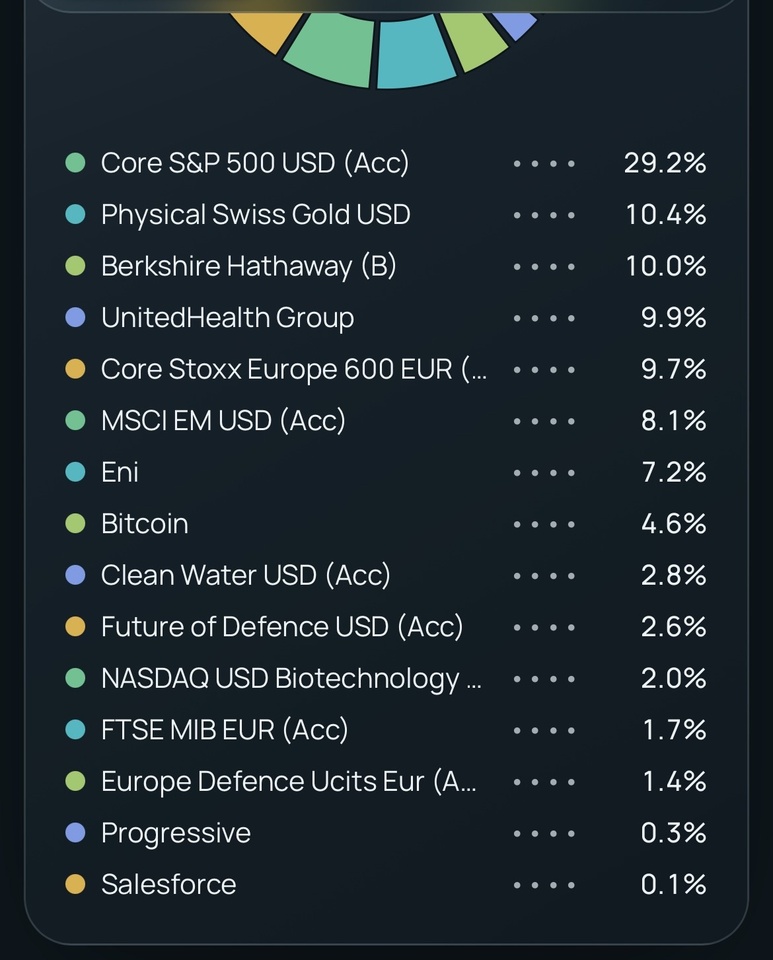
Hi everyone, I'm rebalancing my portfolio and adding new assets. Is this a good strategy for a medium- to long-term investment? The goal is to generate returns without compromising too much on capital preservation.
Any suggestions?
$$CSPX (-0,59%)
$UNH (-0,49%)
$SGBS (+0,56%)
$EXSA (+0,27%)
$EIMI (-0,57%)
$ENI (+1,24%)
$BTC (-3,11%)
$GLGG (-0,54%)
$ASWC (-1,58%)
$BTEC (-0,36%)
$ETFMIB (+0,42%)
$EUDF (-0,31%)
$PGR (+0,49%)
$Salesforce
66
1 Comentar
2Mês
I would suggest deleting the EM ETF since it has literally no real performance since 2012 and the one it has only because of TSMC, SK Hynix and Samsung Electronics.
Also I do not see a reason behind a Clean Water ETF, if you wanna put your money in something good, send your dividend money to charity.
But no clean water ETF
Also I do not see a reason behind a Clean Water ETF, if you wanna put your money in something good, send your dividend money to charity.
But no clean water ETF
•
33
•
9Mês·
Future of Defence
Amidst ongoing geopolitical re-evaluation, the defense sector continues to present a compelling case for strategic portfolio allocation. I have maintained a position in $ASWC (-1,58%) for several months, with results significantly outperforming broader market benchmarks during this period.
The thesis rests on sustained global demand for modernization, cybersecurity, and strategic autonomy. However, thorough investment analysis requires challenging one's own convictions.
I am seeking further due diligence perspectives: Are there underlying risks or sector rotations I may be underestimating? What are the primary bear cases for dedicated defense ETFs/managers in the current macro environment?
Genuinely interested in thoughtful, fundamental analysis from other investors tracking this space.
#DefenseStocks
#Investing
#PortfolioAllocation
#ETFs
#Finance
#Geopolitics
22

10Mês·
Feedback wanted on new investment strategy for 2026
Hi dear community!
ith 2026 just starting and a great 2025 investment wise, this year I want to change my investment strategy slightly compared to last year.
1. Goal & Strategy
The primary goal for 2026 is to structurally outperform the World Index (FTSE All-World / VWCE) over a multi-year horizon. This is pursued by deliberately accepting a higher risk profile than the market, provided that this risk is taken in areas with a structurally higher expected return.
The chosen approach is a core–satellite strategy:
- The core ensures global market participation and stability.
- The satellites aim to generate alpha through thematic ETFs and a limited number of carefully selected individual stocks.
The focus is on long-term structural growth trends (AI, semiconductors, cybersecurity), rather than cyclical or opportunistic themes.
2. Portfolio Allocation
Core (±50%)
$VWCE (-0,39%) – ±30%
- Global diversification and the foundation of the portfolio.
$VUSA (-0,57%) – ±20%
- Additional exposure to the US as the primary engine of earnings
growth and innovation.
Thematic ETFs (±35%)
$SMH (-3,99%) - Semiconductors ETF – ±17,5%
- Structural growth driven by AI, cloud computing, automation, and industrial applications.
$LOCK (-1,2%) - Cybersecurity ETF – ±12,5%
- A defensive growth sector with high margins and recurring revenues.
Individual Stocks (±20%)
$CRWD (-2,26%) - CrowdStrike – ±5%
- Core holding within the cybersecurity segment.
$AMD (-9,49%) - AMD – ±5%
- Exposure to AI and data centres, with a deliberately limited weight due to overlap.
$RKLB (-5,57%) - Rocket Lab – ±5%
- An asymmetric growth play with a long investment horizon.
$ASRNL (+0,94%) - ASR Nederland – ±4%
- A defensive stabiliser within the equity allocation.
$IREN (-8,54%) - IREN – ±1%
A speculative satellite position focused on optional upside.
$AIR (-0,46%) and $ASWC (-1,58%) will be fully sold.
3. Investment Plan
- Monthly contribution: €500
- Execution: transactions every two months (€1,000 per cycle)
Approach:
- Core positions remain largely unchanged
- New capital is primarily allocated to thematic ETFs and selected stocks
Reallocations (AMD, NATO, Airbus) are executed gradually.
Cost control: limited number of trades per cycle with a fixed structure
The plan prioritises consistent capital deployment, not market timing.
4. Risk Assessment
- Market risk: heavy exposure to growth and US equities leads to higher volatility.
- Sector concentration risk: semiconductors and cybersecurity carry significant weight
- Stock-specific risk: individual holdings may temporarily underperform materially
- Speculative risk: IREN and Rocket Lab can experience severe drawdowns
- Behavioural risk: temptation to react to volatility, mitigated through predefined rules
Drawdowns of −30% to −45% during market stress are explicitly accepted.
5. Expectations
Expected average annual return: approximately 12–15%, based on historical data and allocation
- Outperformance objective: beat the World Index over multiple years, not necessarily every calendar year
- Volatility: higher than VWCE, but with superior long-term return potential
Performance is evaluated over a full market cycle rather than short-term intervals.
6. Mental Rules
- No new positions without a clear structural investment thesis
- No impulsive trades outside the scheduled execution moments
- ETFs provide structure; individual stocks provide conviction
- Positions with significant overlap are intentionally capped
- Speculative holdings remain small and controlled
- Time in the market matters more than timing the market
11Posições
€ 80.144,11
17,33%
1212
10Mês·
2025
Hello everybody,
I’ve been active in the markets since 2024, focusing on finance, healthcare, and IT. I strongly value gold as a defensive cornerstone and believe in clear, disciplined, long-term strategies.on #getquin Id to like share straightforward analyses, concrete decisions, and transparent results, aiming to grow together, exchange ideas, and discuss the best investment opportunities.
$CSPX (-0,59%)
$SGBS (+0,56%)
$UNH (-0,49%)
$BRK.B (+0,84%)
$ENI (+1,24%)
$ASWC (-1,58%)
$ETFMIB (+0,42%)
$AAPL (+1,1%)
$AMZN (-0,52%)
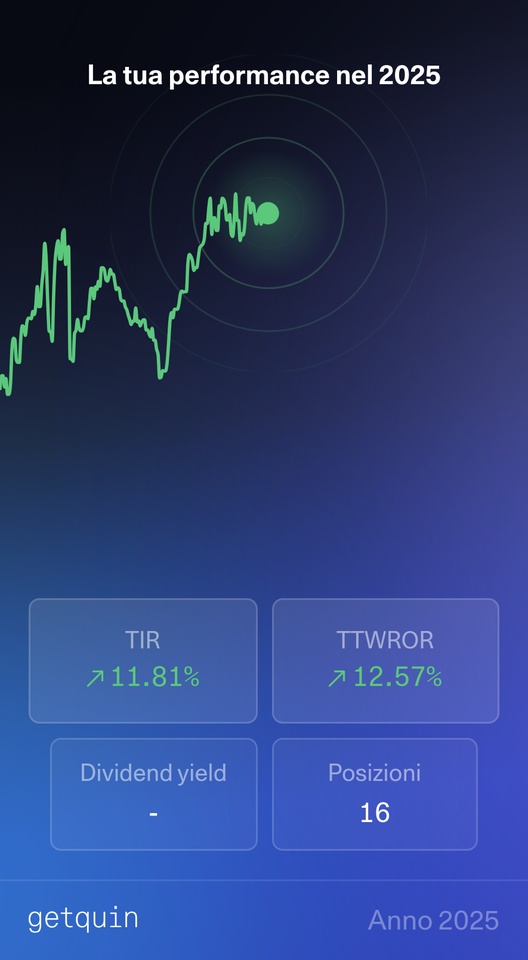
Here are my results for this year:
77


1Ano·
Savings plan for my wife
I wanted to refresh my wife's portfolio and not just put it into an MSCI World or FTSI World. So I asked ChatGPT how I can set up a savings plan with the following conditions:
Individual positions < 10%
Individual stocks: Siemens AG, Microsoft, BTC and gold
Defense industry
Construction and infrastructure sector
Momentum
Robots sector
AI sector
Nuclear industry
The following constrellation came out at 2x200€/month:
Individual stocks: 32%
8% Siemens AG $SIE (-0,38%) 2x16€ =32,00 €
8% Microsoft $MSFT (+0,81%) 2x16€ =32,00 €
8% Bitcoin $BTC (-3,11%) 2x16€=32,00 €
8% Gold $WGLD (+0,55%) 2x16€=32,00 €
ETFs 68%:
20% multifactor ETF $IBCZ (-0,39%) 2x 40€ = 80€
12% Robotics ETF $AAKI (-1,6%) 2x 24€ = 48 €
12% AI ETF $INTL (-2,53%) 2x24€ = 48 €
12% Nuclear ETF $NUKL (-3,87%) 2x24€ = 48 €
7% Infrastructure ETF $EXV8 (-0,19%) 2x14€ = 28 €
5% Defense ETF $ASWC (-1,58%) 2x10€ = 20 €
Why all this:
The selection offers better access to momentum in the short, medium and long term and less vola in the overall picture. A total of 570 companies are included and 2 assets.
I would be very happy to receive feedback or suggestions. Thank you!
22
16 Comentários

1Ano
I think the amounts are too small. I would spread the 400 euros over a maximum of 4 positions
•
44
•
1Ano·
Presentation of multifactor portfolio
estimated reading time: 4 minutes
Twenty years ago, the new market crash wiped out my first stock market money and my ego. I swore off the stock market, but my pension certificate showed me that ducking out has an expiry date.
So the first attempts to start again followed. Here on Getquin, I have learned from positive critical voices from e.g. @DonkeyInvestor and @Epi that there is more to it than "just picking something". Since my last post 6 months ago, this was followed by extreme late-night brooding, Excel monsters, AI research, reading Kommer and countless "new agains".
I have tried to read up on modern optimization models such as Mean-Variance, Black-Litterman and Fama-French etc. and implement them in the best possible way.
The result was this portfolio!
As thoroughly tested as you can in a private garage, and coupled with the insight that we only have to leave the uncontrollable to chance.
And one thing first. I am convinced of this and will not change it.
I just want to share my thoughts and ideas about the direction with you. It's difficult to really explain every detail here, I'm sure I could do it better in a conversation, but that's not possible here. I can assure you that the selection and combination definitely makes sense - at least for me and the construct. Among other things, it was important to me to be able to control individual regions separately. I think I have achieved that.
Global (30%)
- SPDR MSCI All Country World, $SPYY (-0,47%)
- L&G Global Equity UCITS ETF, $LGGG (-0,93%)
- iShares Edge MSCI World Momentum, $IS3R (-1,76%)
- Xtrackers MSCI World Value, $XDEV (-0,69%)
- Invesco Global Active ESG Equity, $IQSA (-0,69%)
- VanEck World Equal Weight Screened, $TSWE (-0,4%)
- VanEck Morningstar Developed Markets Dividend Leaders, $TDIV (+0,72%)
USA (31.5%)
- L&G US Equity, $LGUG (-0,63%)
- iShares MSCI USA Mid-Cap Equal Weight, $IUSF (-0,05%)
- JPMorgan BetaBuilders US Small Cap Equity, $BBCS (-0,38%)
- SPDR MSCI USA Small Cap Value Weighted, $ZPRV (+0%)
Europe (17.5%)
- HSBC EURO STOXX 50, $H50A (+0,23%)
- L&G Europe ex-UK Quality Dividends Equal Weight, $LDEG (+0,62%)
- SPDR MSCI Europe Small Cap Value Weighted, $ZPRX (+0,33%)
Emerging markets (19%)
- iShares Edge MSCI Emerging Markets Value Factor, $5MVL (-0,68%)
- UBS LFS MSCI Emerging Markets ETF, $EMMUSA (-0,69%)
- L&G Emerging Markets Quality Dividends Equal Weight, $LDME (+0,1%)
- SPDR MSCI Emerging Markets Small Cap, $SPYX (-0,55%)
Japan (2%)
- L&G Japan Equity UCITS ETF, $LGJG (+0,04%)
Ø TER = 0.25%
In summary, this gives the following breakdown
Regional breakdown
- USA (North America) ~ 48%
- Asia ~ 22%
- Europe ~ 22%
- UK ~ 3.6%
- Japan ~ 4.4%
Market capitalization
- Large Cap ~ 52%
- Mid Cap ~ 26%
- Small Cap ~ 22%
The portfolio deliberately allocates its capital to the regions and - where possible - to all capitalization classes. The world building blocks provide the global beta; value, momentum and quality satellites add factor premiums. In the USA, a complete large/mid/small stack provides a pronounced size bias, while Europe receives a value bias via quality and small value ETFs. The emerging layer combines large-cap value stocks, quality leaders and a small-cap module - a diversification anchor beyond the developed markets.
Due to the almost equal weighting of the 18 positions, the Herfindahl index of ETF weights falls to ~633; indirectly, the portfolio contains several thousand individual stocks. The weighted TER is ≈ 0.25 % p. a., spreads below 0.1 %. This means that, compared to a $GERD (-0,42%) a favorable multifactor portfolio myself.
The factor tilts (value 42 %, size 35 %, quality/div ≈ 12 %, momentum ≈ 8 %) increase the expected volatility moderately to 18-20 % p.a.; however, historical data on small and value indices indicate 1-2 percentage points additional return over long horizons. Large caps remain present at around 52 %, mid caps at 26 % and small caps at 22 % support the size premium .
With my "multi-factor all-cap portfolio", I combine global market coverage with five proven premiums, without cost or concentration ballast. Of course, I will have to endure additional fluctuations, but I believe that I have created a robust source of returns over the long term.
I have tried to consider everything and leave nothing to chance, except the uncontrollable.
Anyone who has made it this far. Thanks for reading.
I'm looking forward to your feedback.
PS:
YES, I have Bitcoin😉 and also two themed ETFs. They just stay like that.
- ARK AI & Robotics ETF, $AAKI (-1,6%)
- HanETF Future of Defense ETF, $ASWC (-1,58%)
- ETC GROUP CORE BITCOIN, $BTC1 (-3,11%)
---
no investment advice; DYOR
Thanks also to @VPT , @Mister_ultra , @Ph1l1pp , @ShrimpTheGimp , @MoneyISnotREAL , @Staatsmann and @Smudeo for commenting and providing approaches.
2121
117 Comentários
Completely overengineered in my view, but that's how you want it 🤷🏻♂️ You might get a little factor bonus, but that's it. You don't have any effective protection against heavy crashes or years of dry spells, for example. It wouldn't be worth the effort for me.
•
2525
•
1Ano·
Strategy update
Hi all
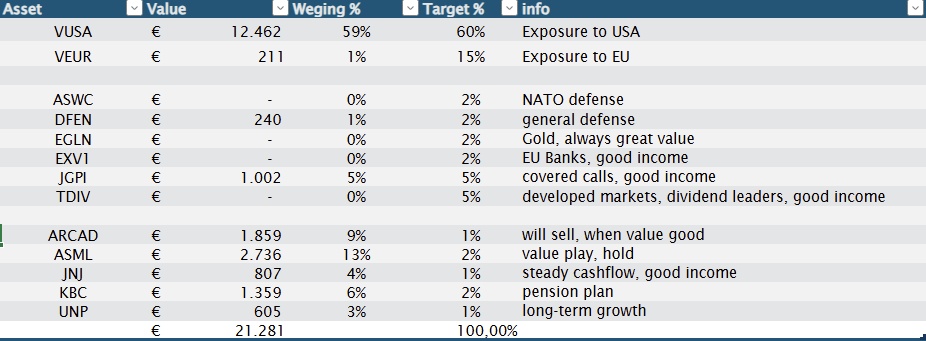
here's some info on my strategy, it's core-satellite method
ETF's is the biggest part with
Core:
$VUSA (-0,57%) & $VEUR (+0,45%)
Satellite:
$ASWC (-1,58%) & $DFEN (-0,98%) as Defense investing, due to EU pulling 5% of GDP with 2030 target
$IGLN (+0,55%) for the gold exposure, minimizing downtrend when markets drop
$JEGP (+0,09%) to make use of market volatility as source of income
$TDIV (+0,72%) past performance is great, dividends of 3-4% always nice income
Individual stocks: mostly dividend stocks as we can deduct €240-region of dividend income of those indidual stocks, sadly not of ETF's.
$$KBC (+0,78%) is marked as pension plan. I do work for KBC and once a yearn i can buy stocks and deduct some of it from my taxes, also buying on cheaper prices.
$UNP (+0,44%) will be a good long-term hold as america is still the biggest, and with trump it should have some long-term growth in it.
$ARCAD (+0,8%) is a value play, aiming to sell around €58, but in meantime, giving dividend to deduct taxes.
$JNJ: (+1,26%) always good to have this one, great long-term hold and steady source of dividends
$ASML (-1,18%) : love this stock, it's a monopoly and is growing strongly, keeping this as long as i like the progress

1Ano·
That's me! 🙋🏽♂️
Hello everyone,
My name is Antonio, I'm almost 27 years old and I'm from Bremen. I currently work as a train manager at Deutsche Bahn. Anyone who knows the job knows that chaos is almost guaranteed here. If a train is on time, everyone wonders what's going wrong. Delays, strikes, unforeseen events - you get used to the fact that nothing goes as expected. And that's exactly how I felt on the stock market: constantly chasing hypes, always on the lookout for quick profits, and in the end I never knew whether the train was still on the right track. I experienced just as much chaos on the markets as I did in my day-to-day work - but fortunately I've learned from it and am now looking for a fresh start where everything is a bit more orderly and predictable.
I've made a lot of mistakes on the stock market in the past. And not too few - unfortunately. Like many of you, I had the idea that the stock market would make me a quick buck. I let myself be led by hypes, trends and the desire for immediate results. I wasn't interested in investing for the long term or building a solid foundation for the future, I was only ever interested in making a quick profit. Leveraged products, knock-out certificates - it was all there. It felt like a casino where the loss was usually the only "win". And so it came as it had to: I not only lost money, but also confidence in my own decisions and the markets.
But today, in 2025, I have realized that it is time for a fresh start. I have learned from my mistakes. It's been a long road and I've thought a lot about why I was so quick to go for the quick buck instead of investing patiently and focusing on long-term success. I learned the lessons I needed to become a better investor. Patience, diversification and a long-term perspective are now my principles. I want to create something tangible, not just a portfolio full of numbers, but also a solid, long-term strategy that will help me to continuously build my wealth.
My portfolio: A solid foundation
The portfolio I have now built up is a mix of different asset classes and asset classes. My aim is to diversify broadly and not miss out on potential growth opportunities, while spreading risk across different sectors and regions. Here is an overview of what my investment strategy looks like:
ETFs (€1000/month)
I have deliberately opted for a broad diversification and invested in different geographical regions and markets. This diversification should ensure that my capital benefits from the markets that have the greatest potential in the coming decades.
- IE00BMTX1Y45 ( $I500) (-0,58%)
- LU0908500753 ( $MEUD (+0,28%) )
- IE00BYXVGY31 ( $FUSA (-0,2%) )
- IE00BD1F4M44 ( $IUVF (-1,08%) )
- IE00BKM4GZ66 ( $EIMI (-0,57%) )
- LU1681041973 ( $CD9 (+1,25%) )
- LU0486851024 ( $D5BL (+0,44%) )
- IE00BYQCZN58 ( $DXJZ (+0,4%) )
- IE00BF4RFH31 ( $WSML (-0,21%) )
- IE00BG0SKF03 ( $5MVL (-0,68%) )
- IE00B652H904 ( $SEDY (+0,9%) )
- LU2089238385 ( $PRAJ (+0,05%) )
- DE000A0H0744 ( $EXXW (-0,14%) )
- IE00BFXR5W90 ( $LGAG (-0,24%) )
- LU0779800910 ( $XCHA (-0,58%) )
- HANetf Future of Defense UCITS ETF ($ASWC (-1,58%) )
So many ETFs? Does he still have all his wits about him?
Some people will think exactly that when they look at my ETF list. And yes, I admit that the portfolio is pretty broadly based - perhaps too broad for some. But that's exactly my goal. I don't want to catch the one sector or the one region that is going through the roof. I want to have everything! If a market explodes somewhere in the world, then I want to be there. Be it through large caps, small caps, growth, value, technology or emerging markets, my approach is not to miss out on potential opportunities and at the same time not to put all my eggs in one basket. Some call it overdiversification, I call it my personal "all-world approach"
The idea behind the selection of these ETFs is that I want to focus on global markets and growth regions without missing out on important sectors such as technology, healthcare and energy. The USA (with over 55% of my portfolio) remains the central component due to its economic importance and innovative strength. At the same time, I am also focusing on Europe, Asia, China and emerging markets, which are increasingly among the growth markets of the future. Small caps also play a key role for me, as they often have the potential to grow faster and offer opportunities that are often overlooked by the large institutions.
Cryptocurrencies (€100/month in Bitcoin ( $BTC (-3,11%) ) €50/month in Ethereum ($ETH) (-3,44%)
I also invest in Bitcoin and Ethereum as I am convinced of the future of these digital currencies. Even if the volatility is high, I see the long-term potential of these technologies. For me, it is an opportunity to participate in the development of a new financial world.
Gold (50 €/month EUWAX Gold ($DE000EWG0LD1 (+0,03%) )
In uncertain times, I have realized how important it is to have conservative assets such as gold. The last few years of inflation and economic fluctuations have made me realize that gold can have a stabilizing effect, especially in times of crisis.
Individual stocks - My dividend strategy
I have also selected a few individual stocks that should not only offer me security, but also regular income through dividends. The reason for this is simple: I need something tangible, something visible. It's not just the pleasure of seeing the portfolio grow, but also the dividend that gives me the feeling of actively participating in the companies and benefiting from their success.
- 3M Co ($MMM (-0,33%) )
- Allianz ($ALV (+1,28%) )
- BioNTech ($BNTX (+0,29%) )
- Booking Holdings( $BKNG (-1,04%) )
- Coca-Cola ($KO (+1,92%) )
- LVMH ($MC (-0,03%) )
- MSCI Inc ($MSCI (+1%) )
- NextEra Energy($NEE (-0,45%) )
- Philip Morris ($PM (+0,66%) )
- Realty Income($O (-0,05%) )
BioNTech in particular, as a company that has promising potential not only during the pandemic but also beyond, is a long-term winner for me. Likewise NextEra Energy, which plays a key role in the renewable energy sector, and Booking Holdings, which should benefit from the global tourism trend. These companies not only pay dividends, but also show that you can benefit from a company's success with a long-term perspective.
Pension fund
I also invest in the DEVK pension fund (DE000A2PT1X3) through my employer $DE000A2PT1X3 . This fund is particularly important to me because of the generous contributions made by my employer and the solid returns. Even though the costs are somewhat higher, I see it as a long-term addition to my strategy.
Why this portfolio?
I built my portfolio this way because I believe in the potential of long-term global diversification. Rather than chasing short-term gains, I am looking for continuous value growth over many years. I want to support the right companies, benefit from promising markets and at the same time have a regular source of income through dividends.
I am no longer interested in making a quick buck. I have learned that true success in wealth accumulation lies in patience. And that's what it's all about: I want to create a solid foundation for the future - for myself, for my pension and perhaps for a house in a few years' time.
What do you think?
I'm really looking forward to hearing from you. What do you think of my strategy? Do you see any areas where I could diversify even more? Are there any asset classes or ETFs missing from my portfolio that would make sense for me? I am very keen to hear your opinions and advice.
Thank you for taking the time to read my story and strategy! I look forward to your feedback.
Best regards,
Antonio
3131
23 Comentários
Hey, thanks for sharing. To say it up front: you are probably well diversified with your etfs and will probably achieve more with them and your savings rate than the average person.
First of all, individual stocks: you can do that. Personally, I've said goodbye to it, as my selection of individual securities has rather slowed me down. But I can understand the need for control.
Crypto and gold: why not. My weighting is smaller, but it depends on my personal risk affinity. risk affinity.
On the ETFs:
First, the presentation method: Please include the percentage weighting. Then you can better evaluate what you are doing. It would also have been nice if I didn't have to click on each one to see what's behind it.
On diversification, you may have overdone it a bit. While you're probably solidly diversified depending on your weighting, your approach has quite little method in my view. You walked through the supermarket, said please everything once and got 3 different packs of toilet paper, bought peppers and pointed peppers. You should consider whether you could have achieved your goal more easily with an MSCI World and emerging markets and small caps variants. Then you have a few value and dividend etfs, which are probably okay. If you actually had a value tilt in mind. But then, in my opinion, you should rather take value ETFs instead of dividend ETFs, as these are also available as accumulating ETFs. But in neither case are you really more diversified if you have several US big caps ETFs.
Europe is similar. You have the Stoxx Europe and MSCI Europe, a Europe Imi and Europe Value (if I have seen this correctly)
Maybe you could do the same with a
MSCI World, MSCI World Value, MSCI World small caps. If necessary, you can then overweight a region with an additional ETF or 2.
It should be similar with EM.
The advantage: with EM and World you could do without the Pacific and have a similar country diversification.
•
99
•Títulos em alta
Principais criadores desta semana
Dados tempo real da LSX · Dados financeiros e EOD da FactSet