Source
Brown & Brown
Ação
Ação
Ticker: BRO
BRO
Price
Discussão sobre BRO
Postos
17



8Mês·
Brown & Brown
My price alert at $BRO (-0,92%) has just been triggered. Currently 70 USD. There is strong downward resistance at USD 52... A new price alert has been set and will continue to be monitored.
Maybe interesting for one or the other. Especially the dividend hunters
66
6 Comentários
8Mês
Before the 45% 📉 it was a quality stock 😂 now it looks like I've invested in a bunch of crap 😂
•
55
•
9Mês·
Portfolio reconstruction 2026
I have now decided to restructure my portfolio in the coming days. It will then consist of these stocks.
Core:
1) the MSCI World $IWDA (+0,47%)
2) the MSCI EM IMI $EIMI (+0,96%)
3) the VanEck Morningstar $TDIV (-0,76%)
4) Bitcoin $BTC (+0,02%)
Satellites:
1) Microsoft $MSFT (+1,14%)
2) Amazon $AMZN (+5,26%)
3) Nvidia $NVDA (+1,48%)
4) MasterCard $MA (+0,55%)
5) Adobe $ADBE (+1,02%)
6) Ferrari $RACE (-0,59%)
7) Novo Nordisk $NOVO B (-0,52%)
8) Realty Income $O (-0,72%)
9) Wolters Kluwer $WKL (+3,57%)
10) Brown & Brown $BRO (-0,92%)
11) Inditex $ITX (-0,67%)
12) Uber $UBER (-0,02%)
13) Main Street Capital $MAIN (-0,75%)
14) Vici $VICI (-1,67%)
15) PayPal $PYPL (-0,18%)
In addition to my core of the 3 ETFs and Bitcoin, I think this mix of growth & dividend-focused stocks is really good. What do you guys think about this long term portfolio? Should be held for a long time, 20+ years... I don't think much of the short term. Of course, profits are taken from time to time, but nothing is sold completely and in the event of corrections we buy more! 🤑🔥🙏
I look forward to your suggestions / criticism.
Wishing you a Merry Christmas 🌲☺️

2828
5 Comentários
•
1212
•9Mês·
Less is more, or what was that?
Hi everyone,
I would really appreciate your opinion on my portfolio.
Briefly about me:
I am 38 years old and unfortunately only started my Trade Republic portfolio about 2 years ago. I have been investing regularly since then. I can currently invest around €350 per month - I work in a gym 🥲, and unfortunately you don't earn very well there, you could almost call it a pittance.
In addition, I have my Bitcoin and Altcoin portfolio on Bitvavo... I can't share it here, too many errors in the coins and you can still change it somehow. I then deleted the connection again.
I played soccer until I was 32 (including 3rd league, mostly 4th league for many years) and was able to save up some capital during this time, which I later invested.
My long-term core consists of:
Dividend / cash flow portfolio
I also have a portfolio with a focus on cash flow, the aim is to hold around 15 stocks with a solid dividend yield and ideally dividend growth.
Currently included are:
$O (-0,72%) Realty Income
$RACE (-0,59%) Ferrari
$PEP (+2,12%) Pepsi
$MAIN (-0,75%) Main Street Capital
$NOVO B (-0,52%) Novo Nordisk
$ASML (+0,84%) ASML
$ITX (-0,67%) Inditex
$1211 (-0,5%) BYD
$ZTS (+0,51%) Zoetis
$BRO (-0,92%) Brown & Brown
$SBUX (+0,71%) Starbucks
$ITH (-1,62%) Ithaca Energy PLC
This brings my current total to 12 shares, so there is still room for one or two additions.
One of the stocks on my watchlist is Vonovia $VNA (-1,36%) with a dividend yield of just under 5%. However, the dividend growth doesn't look particularly good. As my wife will be starting work there soon, I've become more aware of the company for the first time ☺️
Other stocks on my watchlist:
Allianz
Vici
Linde
Microsoft
Waste Management
UnitedHealth Group
Mastercard
Visa
Texas Roadhouse
Nintendo
Enbridge
NextEra Energy
Wolters Kluwer (exciting sector, also corrected over 50% from ATH)
Amazon (for the yield/growth portfolio)
Maybe one or the other is missing $KO (-0,05%) or $MCD (+0,25%) but I had opted for $PEP (+2,12%) and $SBUX (+0,71%) and I don't want any more consumer stocks.
Pure growth portfolio
I also have a separate portfolio with a focus on share price growth:
$NVDA (+1,48%) Nvidia
$NKE (+0,48%) Nike
$MARA (-2,37%) Mara Holdings
$BITF (+1,49%) Bitfarms
$TTD (-0,18%) The Trade Desk
$CRCL (-0,85%) Circle Internet Group
$ADBE (+1,02%) Adobe
$COIN (-2,3%) Coinbase
$SMHN (+0,72%) Suess Microtec
$PYPL (-0,18%) PayPal
$HUT (+1,26%) Hat 8
$DRO (-0,61%) DroneShield
$LXS (-2,74%) Lanxess
$PLTR (+4,83%) Palantir
$WEED (+0%) Canopy
$UBI (-1,15%) Ubisoft
$MSTR (-0,38%) Strategy
I am aware that I have built up a lot of positions over the last two years. I am therefore also planning to sort out some of them and concentrate more on selected stocks.
I am grateful for any assessment, criticism, tips or suggestions.
Best regards
Chris
39Posições
8,53%
66
4 Comentários
Private question 😀 Did you play in the B youth under Christian Ovelhey in Bochum by any chance? I played there and we also had a Chris in the team 😀 year fits yes
•
22
•
1Ano·
Brown & Brown: Crashed dividend aristocrat
Brown & Brown is a long-term outperformer and a dividend aristocrat. Reason enough to take a closer look at the company - all the more so as the share has recently been noticeably underperforming.
Three pillars in a fragmented market
Brown & Brown is one of the five largest insurance brokers in the USA.
The company operates in a stable, fragmented market with high barriers to entry. Brown & Brown's (BRO) market share is around 6 %, so there should be more than enough room for further growth.
The company acts exclusively as an intermediary between policyholders and insurance companies and does not bear any underwriting risk of its own.
BRO serves three central segments:
Retail Brokerage comprises direct sales to commercial and private customers in the so-called "Admitted Market". Standardized, state-regulated insurance policies are brokered here.
Wholesale Brokerage comprises trading in the "Excess & Specialty" market, in which special risks that are difficult to insure are placed. This area is higher-margin, as prices and contract terms are freely negotiable.
Finally, there is the Programs & Services segment, which comprises specialized insurance programs for specific industries or risk profiles.
Recurring crisis-proof income
BRO sells insurance policies on behalf of insurers, predominantly to small and medium-sized companies, and typically receives a commission of around ten percent on the annual insurance premiums due.
The business model is based on recurring, commission-based income. Many insurance policies - for example for liability, buildings, vehicles or employees - are required by law or are essential for operations.
This business model offers stability, scalability and high cash flow quality. Insurance premiums are generally paid even in times of crisis, which means that the business is easy to plan and comparatively crisis-proof.
Around three quarters of revenue is directly dependent on the level of insurance premiums, which means that Brown & Brown's business is effectively protected against inflation. Rising prices (inflation) lead to rising insurance premiums and therefore to higher income for BRO.
This factor almost "automatically" leads to organic growth at the level of inflation.
This makes Brown & Brown unique
All of this applies to direct competitors such as Marsh McLennan, Aon and Arthur J. Gallagheralso apply.
However, Brown & Brown is leaner and relies on a decentralized organizational structure. While large competitors are highly centralized, Brown & Brown's individual subsidiaries operate largely independently and with considerable entrepreneurial autonomy.
This structure promotes entrepreneurship, customer proximity and fast decision-making processes. It allows the company to retain local expertise while at the same time benefiting from the economies of scale of a national platform.
Another success factor is the consistent use of the strong free cash flow for acquisitions.
Brown & Brown regularly acquires smaller, profitable brokers with clear regional or sector-specific niches. These are integrated into the existing structure, which strengthens the negotiating position with insurers. As a rule, this significantly increases the profitability of the subsidiaries.
Enough fine words
With its focus on small and medium-sized corporate clients, Brown & Brown also differs from other industry giants, as they generally concentrate heavily on major clients.
In addition to fine words, Brown & Brown also offers solid figures. In the last ten years, turnover has almost tripled from USD 1.66 billion to USD 4.71 billion.
At the same time, profitability has improved somewhat. Most recently, the operating margin was 29%, so Brown & Brown could justifiably be described as highly profitable.
During this period, earnings climbed from USD 0.85 to USD 3.84 per share. Although Brown & Brown has made a number of acquisitions during this time, the number of shares outstanding has remained virtually unchanged. Aktien shares outstanding remained virtually unchanged and only rose from 276 to 282 million within a decade.
Outlook and valuation
The positive trend has continued consistently in the current financial year. In the last quarter, earnings of USD 1.03 per share were well above expectations of USD 0.98. With sales of USD 1.30 billion, analysts' estimates of USD 1.28 billion were also exceeded.
For the year as a whole, this corresponds to a 9.1 % increase in sales and a 10.8 % jump in profits.
This does not seem to be enough for investors at the moment. After the jump in profits in the two previous years, the current situation is being classified and labeled as "declining growth momentum".
Those who think in absolute terms will probably come to a different conclusion. Brown & Brown currently has a forward P/E of 22.7.
If profits rise by 13% in the coming year as expected, the P/E would fall to 20.
As Brown & Brown has enjoyed double-digit growth rates for a long time, the P/E has hovered around 25
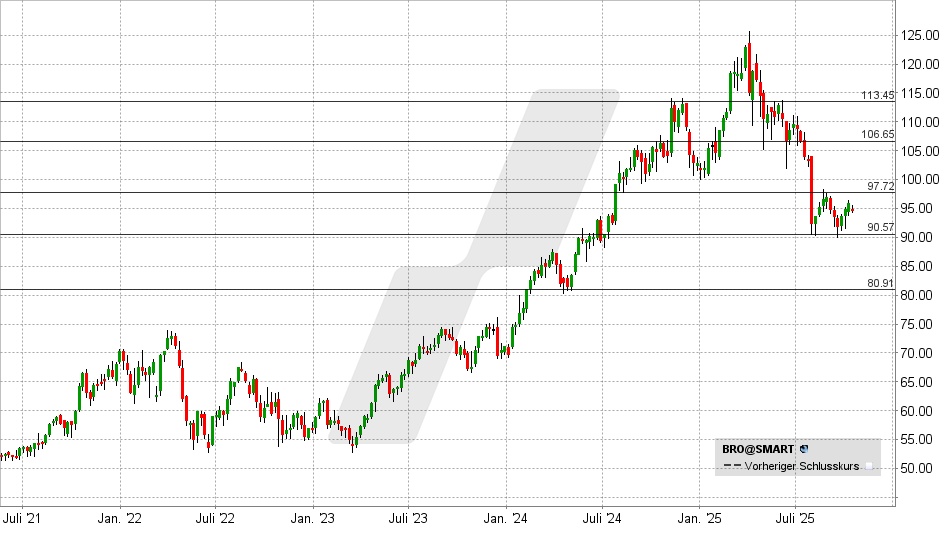
Brown & Brown share: chart from 14.10.2025, price: USD 94.48 - symbol: BRO | source: TWS
An attempt to form a bottom is currently underway. If a breakout above USD 98 now succeeds, a procyclical uptrend will ensue. Kaufsignal with possible price targets at USD 100 and USD 105-106.66.
Above this, the path towards USD 113.50 would be clear.
If, on the other hand, the share falls below USD 90, the bulls will have lost their chance for the time being and price losses to USD 87.50 or USD 81 are to be expected
Source
1515
10 Comentários

1Ano
What makes you think that this is a dividend aristocrat?
•
11
•
1Ano·
UPDATE PORTFOLIO September 2025
A lot has happened in my portfolio again in recent weeks. In addition to a few sales (including $GOOGL (+1,38%) and $NVDA (+1,48%)) from hot sectors, I have built up cash and diversified further ($CMG (+0,09%)
$SNPS, (+0,81%)
$BRO (-0,92%)
$AMGN (-0,95%)
$LSEG (-1,13%)). Further acquisitions and new entries (e.g. $INTU (+0,37%)
$ADP (-0,4%)
$WM (+0,57%)
$CTAS (-0,4%)
$RMS (+0,41%)) are planned. As short- to medium-term trades, I have invested in $Adobe (+1,02%) and $TTD (-0,18%) as short to medium-term trades. I mainly invest for the long term, but a correction (technology, cloud) including sector rotation (consumer, pharma, software) seems inevitable to me. I am therefore taking a wait-and-see approach and, if necessary, I will reenter $GOOGL (+1,38%) and $NVDA (+1,48%) again at the appropriate time.
Please let me know what you think.
I will probably share future updates with you every two months at the beginning of the month (November, January,...).
I wish you all a successful time.
30Posições
€ 86.799,73
7,18%
1212
4 Comentários
Hey, there are a lot of stable, large companies in your portfolio. That's a good way to make money. So far so good.
I don't know whether Google and Nvidia are already hot. It's also possible that you're missing out on a lot of price gains and the party isn't over yet.
In general, you have to ask yourself where you want to go. The All World is a very small part of your portfolio. Should it become your core? Or would you rather try to beat the All World with individual stocks? And what about Bitcoin and gold? Can increase returns and reduce risk.
Basically everything is great. But can you tell us more about your strategy and why you are focusing 95% on individual stocks?
•
22
•
1Ano·
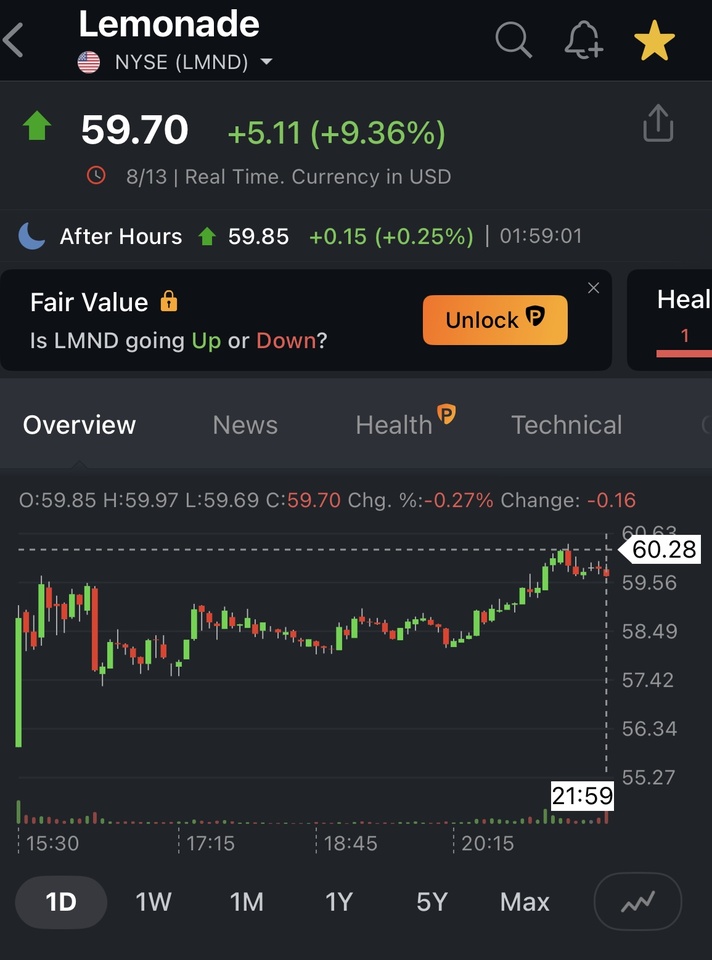
Lemonade trades above 60$ - FOMO is slowly emerging
- over 90% in the last 3 months
- just under 50% in the last month
Short quota just under 30% 🫣
The market is slowly recognizing the potential, momentum continues
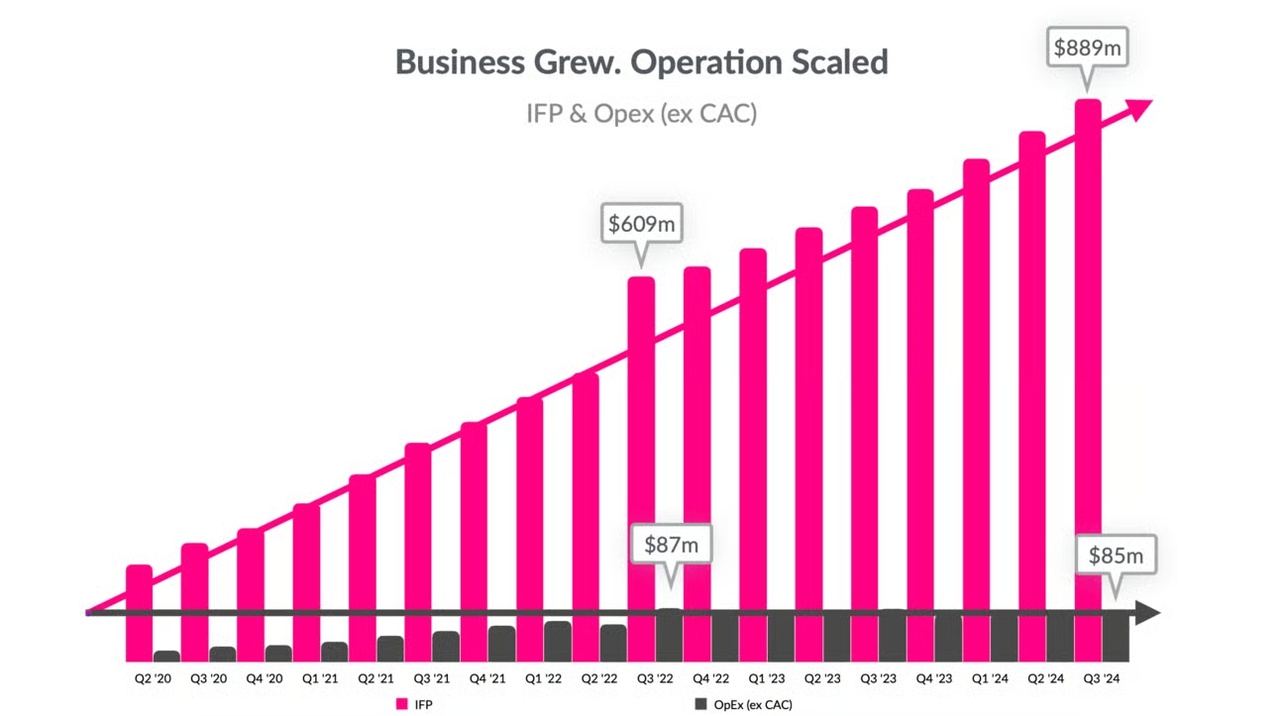
Currently, 98% of all onboarding and 55% of all claims processing is handled by native AI agents without human interaction
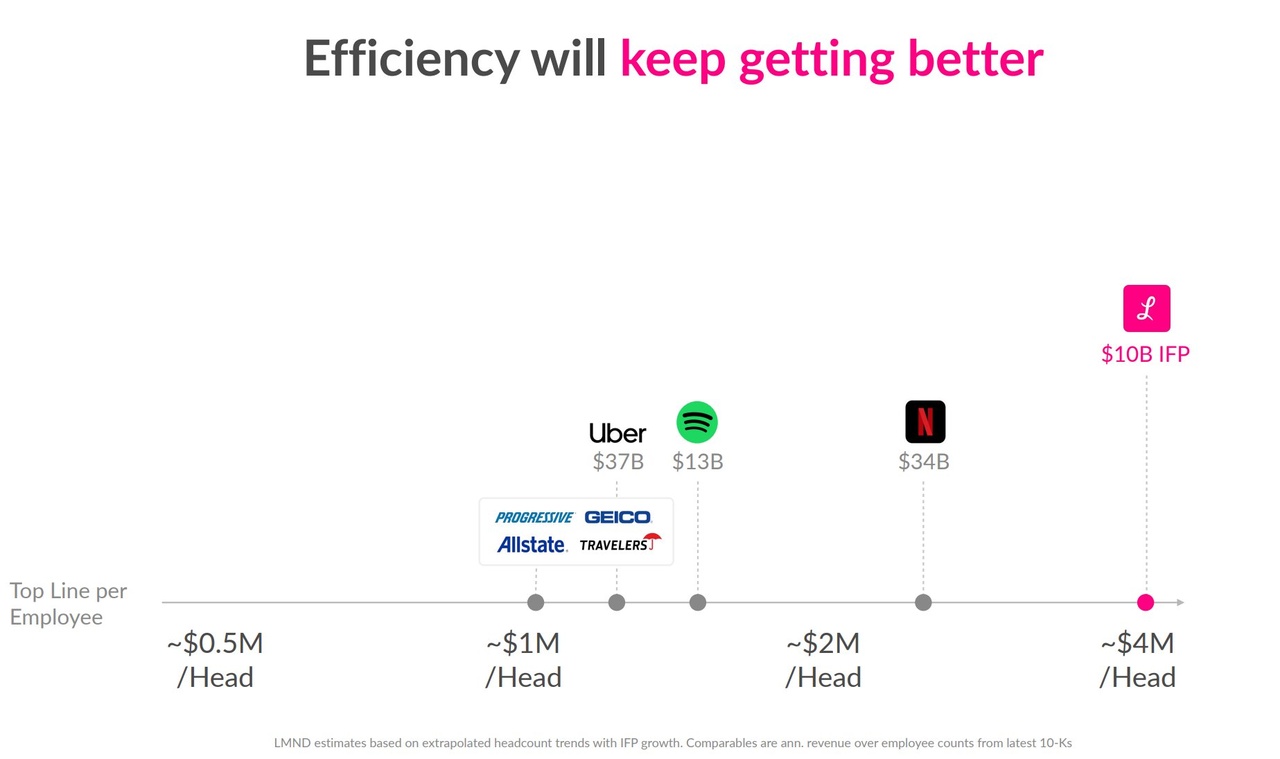
This means that scaling is possible without an increase in personnel.
This means an increase in efficiency and operational leverage.
AI-centric design also reduces costs.
The majority of costs in the insurance industry arise from claims settlement.
This is because humans used to be heavily involved in this.
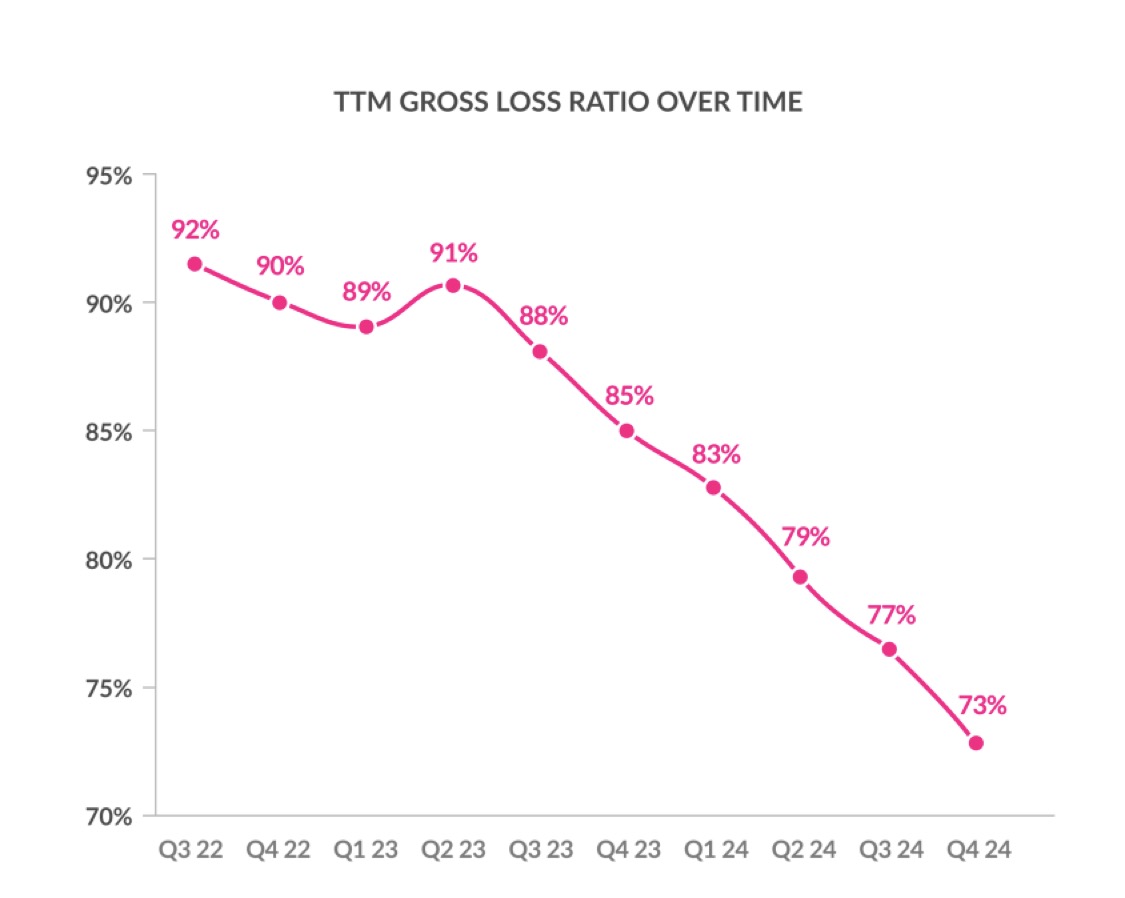
As $LMND (-1,56%) now handling this with the help of AI, their loss ratio is also falling.
Lower costs lead to lower prices.
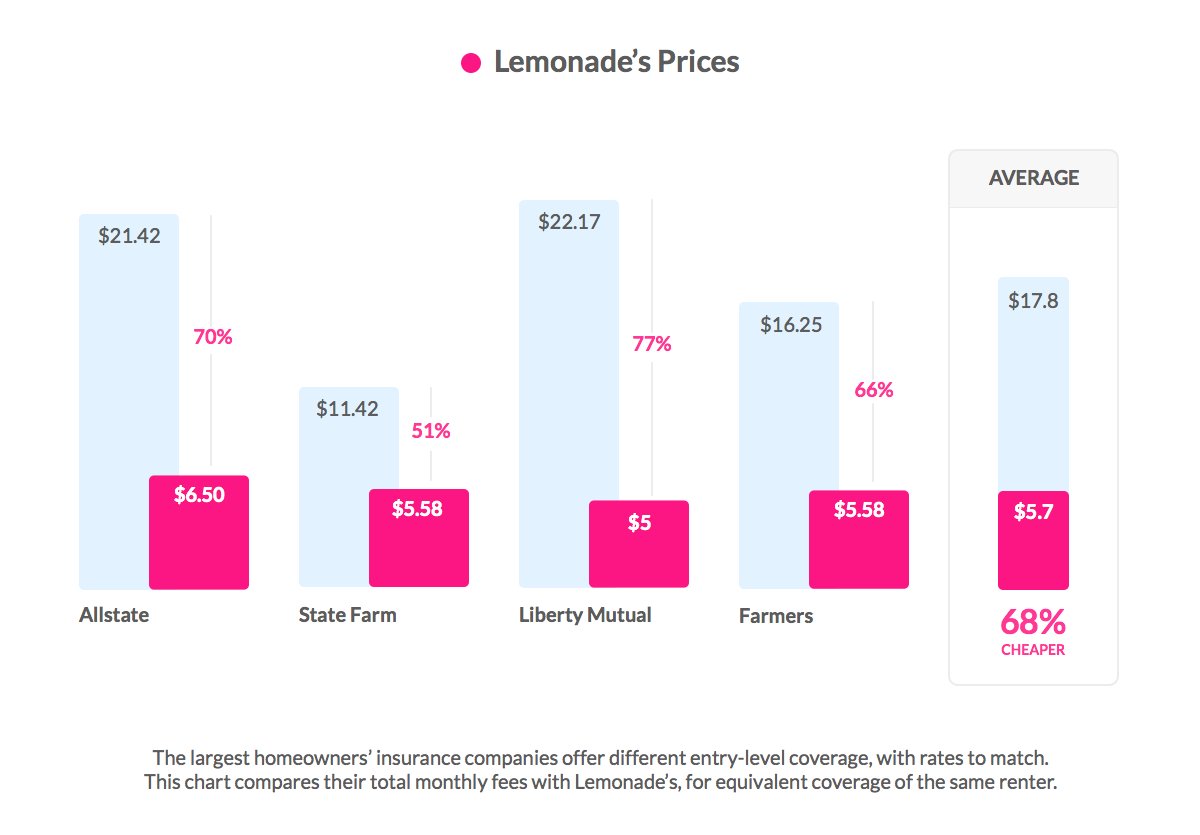
Some of these cost savings are passed on to customers in the form of lower prices.
Currently, prices are on average 68% lower than those of the competition.
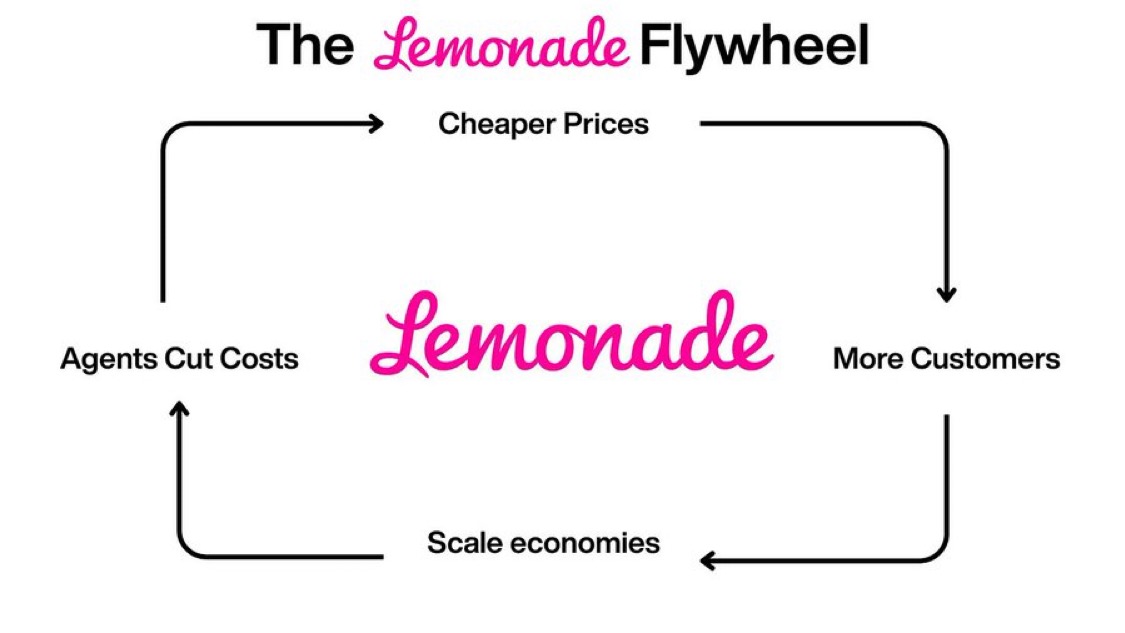
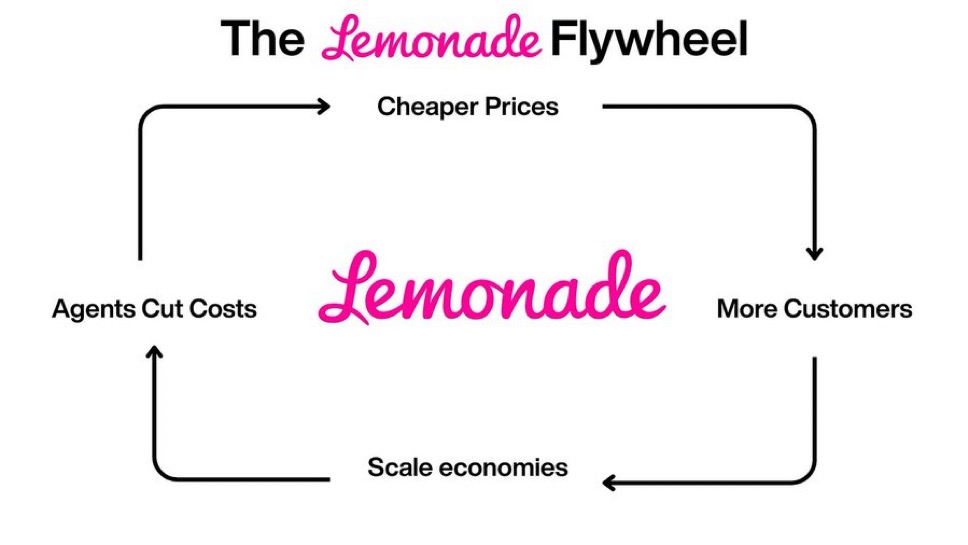
This creates a positive feedback cycle:
- Operating leverage reduces costs.
- Reduced costs increase efficiency.
- This allows $LMND (-1,56%) charge lower prices.
- Lower prices attract more customers.
- Larger scale increases operating leverage again.
A cycle of growth 🚀
$ALV (-1,57%)
$MUV2 (-0,51%)
$ALL (-0,16%)
$PGR (+0,54%)
$BRO (-0,92%)
$ZURN (+1,34%)
$CS (-1,71%)
$BRK.B (+0,32%)
+ 1
1Ano·
Lemonade Potential 🚀- Disruption in the insurance industry ? Brief company presentation
History:
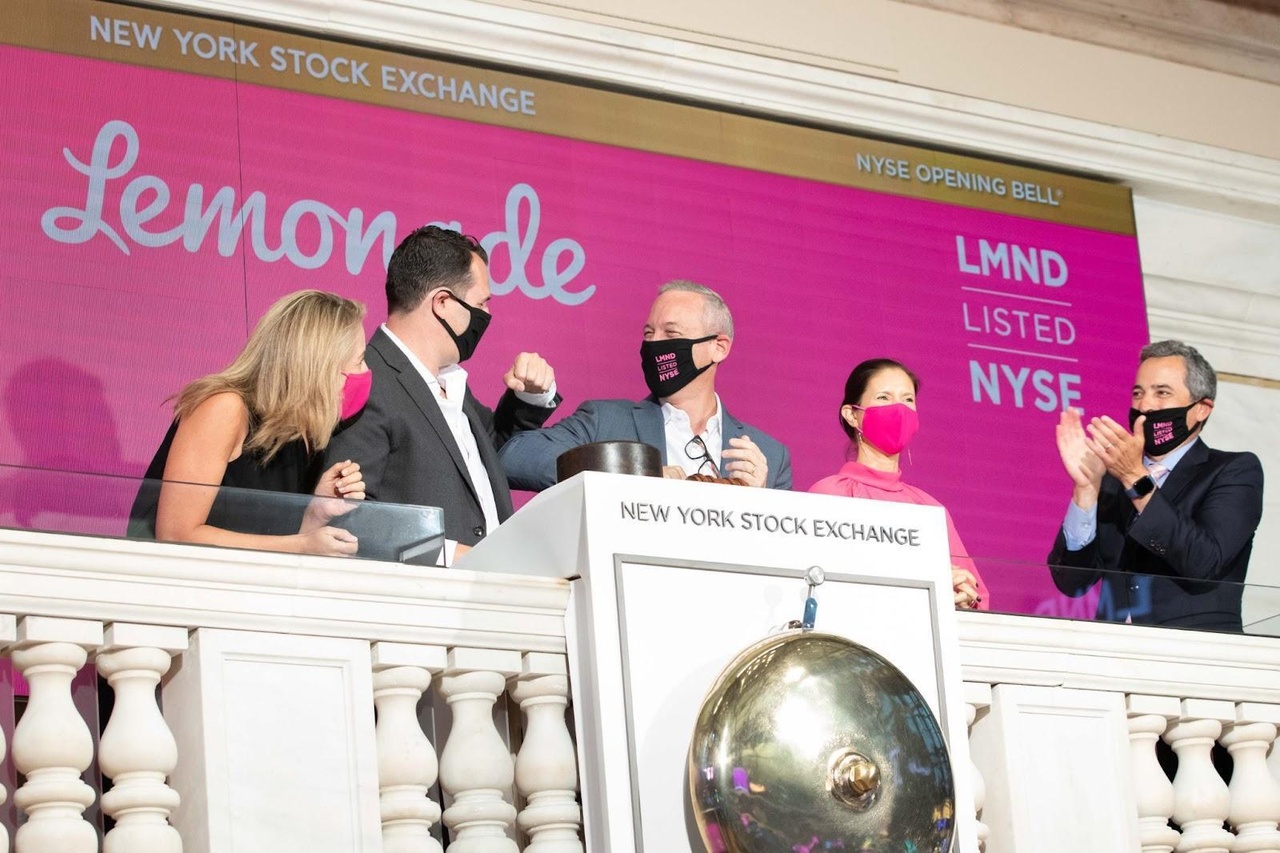
$LMND (-1,56%) is an insurance company that was founded as a public benefit corporation and has its headquarters in New York and its European branch in Amsterdam. Lemonade has been traded as a public company on the New York Stock Exchange since July 2020.
$LMND (-1,56%) Insurance was founded in 2015 by Daniel Schreiber and Shai Wininger with the goal of revolutionizing the insurance industry through technology. The company started by providing home insurance and relies heavily on artificial intelligence and chatbots for claims processing and customer service.
$LMND (-1,56%) has experienced rapid expansion, including an IPO in 2020 and expansion into Germany
business model:
Lemonade, Inc. offers renters, homeowners, auto, pet and life insurance.
Current market capitalization 3 billion
The company's full-stack, artificial intelligence-powered insurance carriers in the United States and European Union replace brokers and bureaucracy with bots and machine learning. The company's digital substrate enables it to integrate marketing and onboarding with underwriting and claims processing, and to collect and utilize data.
Its technology includes Data Advantage,
AI Maya, AI Jim, CX.AI, Forensic Graph, Blender and Cooper.
AI Maya, the onboarding and customer experience bot, uses natural language to assist customers in the onboarding process.
AI Jim, the claims reporting bot, receives the customer's first claim and pays the claimant or rejects the claim without human intervention.
The company offers pet insurance policies that cover diagnoses, procedures, medication, accidents or illnesses. Even the basic pet insurance covers blood tests, urinalysis, laboratory tests and CT scans.
What is the Lemonade $LMND (-1,56%)
Giveback?
Giveback is at the heart of Lemonade. This core element of the business model enables customers to use their Lemonade insurance policies to support causes that are close to their hearts.
Since 2017, Lemonade has $LMND (-1,56%) donated over 10 million US dollars to help build new homes, provide clean water, improve education, promote animal rights and much more.
Here's how it works:
When a customer purchases a $LMND (-1,56%) renters, homeowners, auto or pet insurance, charges a flat fee to cover $LMND (-1,56%) a flat fee to support and grow the business. A portion of the premiums goes towards claims settlement and the balance goes directly to one of their Giveback Partners - non-profit organizations selected by our customers.
$LMND (-1,56%) is a non-profit corporation:
$LMND (-1,56%) is a Public Benefit Corporation and a certified B Corp, which means they are legally committed to making a positive social impact. B Corp certification is awarded to companies that demonstrate that they balance profit and purpose while putting people and the planet at the center.
Every three years, they undergo a comprehensive assessment of their entire organization.
Number of employees: 1 258 (end of 2024)
Profitability:
$LMND (-1,56%) Approaching a turning point, possibly offering a promising investment opportunity.
Profitability increases with size, as costs do not rise due to additional premiums, as is normally the case with conventional insurance companies.
Management expects EBITDA profitability in 2026 and net profit profitability in 2027.
They see an extremely clear path to profitability:
They also have a clear path to profitability :
- Loss ratio from 92% to 73
- Net profit margin -123% to -20.2%
- Continued increase in sales growth rates
Growth:
Growth is currently still controlled, but the real growth is yet to come, with sales growth rates continuing to rise in the last two quarters.
They have been able to achieve these growth rates without an expansive expansion (both in existing and additional potential states) of automobile insurance, which represents a huge opportunity for $LMND (-1,56%) represents a huge opportunity.
Car insurance
$LMND (-1,56%) currently has around 2.3 million customers who use renters, pet and other insurance products. These customers use $LMND (-1,56%) for one reason: favorable price and convenience.
The share of car insurance is currently still very small and has a lot of room for expansion, so if we were to assume that only 30% of them become car insurance customers with an average annual turnover of USD 1,800, that would be an additional USD 1.24 billion in turnover per year ... just by cross-selling 30% (without any other new customers)
Pet insurance:
The pet insurance market was a $5 billion market in the US last year. It is expected to reach 6 billion dollars in 2025 and 15.7 billion dollars by 2030, growing by 22% annually.
$LMND (-1,56%) - Total annual premiums recently surpassed the $1 billion mark. So if you were to capture 50% of the pet insurance market, premiums would increase eightfold in just five years (800% assuming the projected growth above)
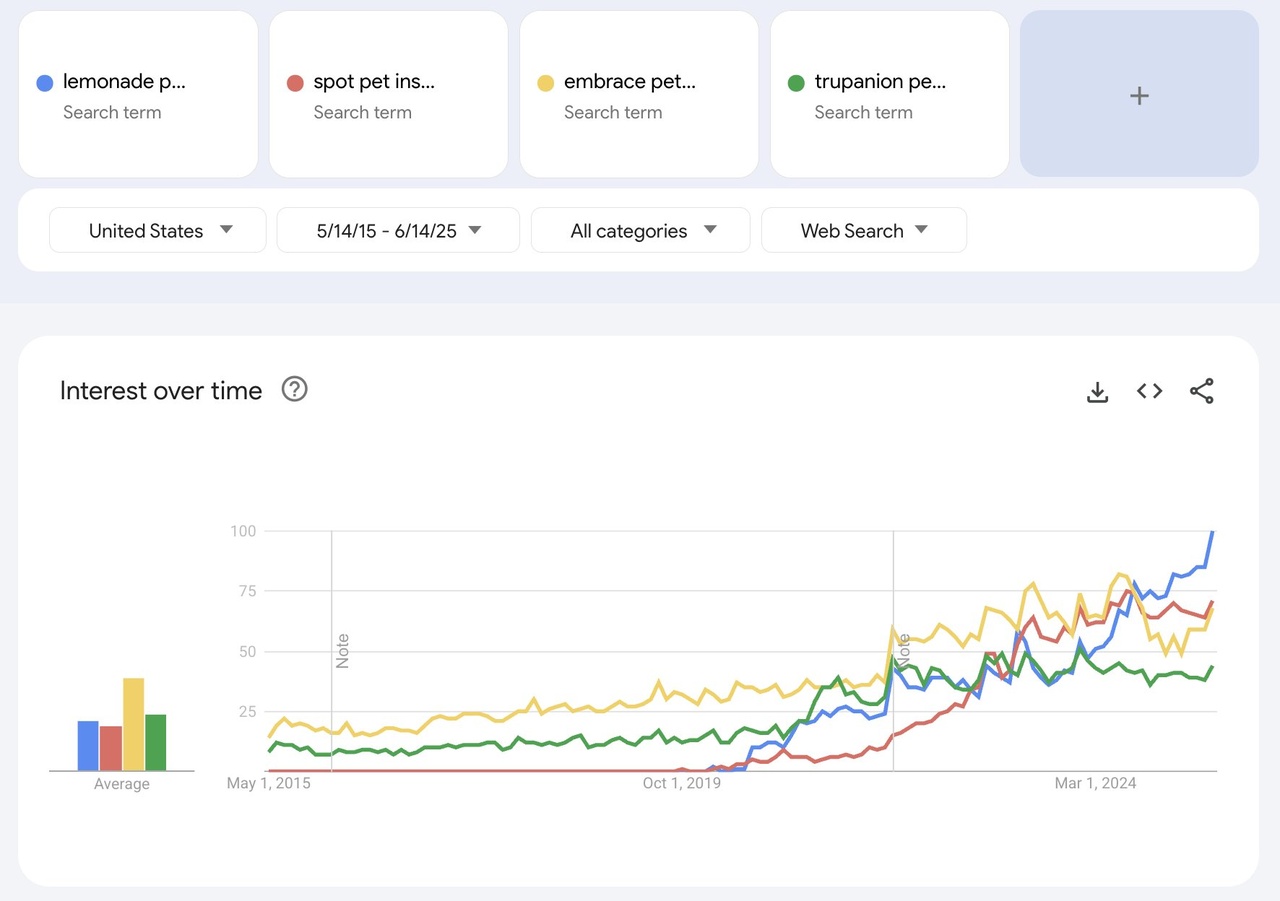
Trupanion (green line) has a 25% market share today. $LMND (blue line) is around 5%.
However, the search trend will continue to have a positive effect for $LMND (-1,56%) especially as it is only just beginning to expand further into all states. (This also applies to the other insurance segments)
Opportunities/long-term potential:
I think the future possibilities and opportunities for $LMND (-1,56%) a supposedly boring industry are enormous.
The insurance market has one of the largest TAMs of all.
The global insurance market was worth around USD 8 trillion in 2024. The USA and China are the largest insurance markets worldwide, with the USA leading the way with a market share of around 45% and China with around 10%.
- Slight international expansion (online)
- Product expansion (additional lines)
- Enormous cross-selling potential
- Decreasing dependence on reinsurance
- Simple and fast premium calculation, conclusion and claims settlement (through AI)
- Already tested/calculated in-house: https://www.lemonade.com
- 10-fold sales opportunity
$ALV (-1,57%)
$MUV2 (-0,51%) , $HNR1 (+0,26%) , $PGR (+0,54%) , $GEC , $ALL (-0,16%) , $AIG (+2,29%) , $UNH (+1,88%) , $CVS (+0,69%) , $UQA (-1%) , $G (-1,24%) , $VIG (+0,15%)
+ 3

1Ano·
Lemonade launches buildings insurance in the UK
$LMND (-1,56%) introduced an independent buildings insurance policy in the UK this week.
Lemonade EU is growing by around 200% year-on-year and customer acquisition costs are less than half those in the US.
"We are delighted to complete our product offering for homeowners in the UK," said Sarvesh Ramachandran, Head of Lemonade UK. "Lemonade has quickly become the preferred choice for the next generation of UK insurance buyers."
https://www.reinsurancene.ws/lemonade-introduces-standalone-buildings-insurance-for-uk-homeowners/
- 7 consecutive quarters of sales growth
- 7 consecutive quarters with improvements in the claims ratio
- No increase in fixed costs
- Car scales quickly
- Rapid international scaling
- EBITDA profitable next year
🚀
$BRO (-0,92%)
$PGR (+0,54%)
$ALV (-1,57%)
$MUV2 (-0,51%)
$CS (-1,71%)
$HNR1 (+0,26%)
$ALL (-0,16%)
1Ano·
Lemonade Potential 🚀- Disruption in the insurance industry ? Brief company presentation
History:
$LMND (-1,56%) is an insurance company that was founded as a public benefit corporation and has its headquarters in New York and its European branch in Amsterdam. Lemonade has been traded as a public company on the New York Stock Exchange since July 2020.
$LMND (-1,56%) Insurance was founded in 2015 by Daniel Schreiber and Shai Wininger with the goal of revolutionizing the insurance industry through technology. The company started by providing home insurance and relies heavily on artificial intelligence and chatbots for claims processing and customer service.
$LMND (-1,56%) has experienced rapid expansion, including an IPO in 2020 and expansion into Germany
business model:
Lemonade, Inc. offers renters, homeowners, auto, pet and life insurance.
Current market capitalization 3 billion
The company's full-stack, artificial intelligence-powered insurance carriers in the United States and European Union replace brokers and bureaucracy with bots and machine learning. The company's digital substrate enables it to integrate marketing and onboarding with underwriting and claims processing, and to collect and utilize data.
Its technology includes Data Advantage,
AI Maya, AI Jim, CX.AI, Forensic Graph, Blender and Cooper.
AI Maya, the onboarding and customer experience bot, uses natural language to assist customers in the onboarding process.
AI Jim, the claims reporting bot, receives the customer's first claim and pays the claimant or rejects the claim without human intervention.
The company offers pet insurance policies that cover diagnoses, procedures, medication, accidents or illnesses. Even the basic pet insurance covers blood tests, urinalysis, laboratory tests and CT scans.
What is the Lemonade $LMND (-1,56%)
Giveback?
Giveback is at the heart of Lemonade. This core element of the business model enables customers to use their Lemonade insurance policies to support causes that are close to their hearts.
Since 2017, Lemonade has $LMND (-1,56%) donated over 10 million US dollars to help build new homes, provide clean water, improve education, promote animal rights and much more.
Here's how it works:
When a customer purchases a $LMND (-1,56%) renters, homeowners, auto or pet insurance, charges a flat fee to cover $LMND (-1,56%) a flat fee to support and grow the business. A portion of the premiums goes towards claims settlement and the balance goes directly to one of their Giveback Partners - non-profit organizations selected by our customers.
$LMND (-1,56%) is a non-profit corporation:
$LMND (-1,56%) is a Public Benefit Corporation and a certified B Corp, which means they are legally committed to making a positive social impact. B Corp certification is awarded to companies that demonstrate that they balance profit and purpose while putting people and the planet at the center.
Every three years, they undergo a comprehensive assessment of their entire organization.
Number of employees: 1 258 (end of 2024)
Profitability:
$LMND (-1,56%) Approaching a turning point, possibly offering a promising investment opportunity.
Profitability increases with size, as costs do not rise due to additional premiums, as is normally the case with conventional insurance companies.
Management expects EBITDA profitability in 2026 and net profit profitability in 2027.
They see an extremely clear path to profitability:
They also have a clear path to profitability :
- Loss ratio from 92% to 73
- Net profit margin -123% to -20.2%
- Continued increase in sales growth rates
Growth:
Growth is currently still controlled, but the real growth is yet to come, with sales growth rates continuing to rise in the last two quarters.
They have been able to achieve these growth rates without an expansive expansion (both in existing and additional potential states) of automobile insurance, which represents a huge opportunity for $LMND (-1,56%) represents a huge opportunity.
Car insurance
$LMND (-1,56%) currently has around 2.3 million customers who use renters, pet and other insurance products. These customers use $LMND (-1,56%) for one reason: favorable price and convenience.
The share of car insurance is currently still very small and has a lot of room for expansion, so if we were to assume that only 30% of them become car insurance customers with an average annual turnover of USD 1,800, that would be an additional USD 1.24 billion in turnover per year ... just by cross-selling 30% (without any other new customers)
Pet insurance:
The pet insurance market was a $5 billion market in the US last year. It is expected to reach 6 billion dollars in 2025 and 15.7 billion dollars by 2030, growing by 22% annually.
$LMND (-1,56%) - Total annual premiums recently surpassed the $1 billion mark. So if you were to capture 50% of the pet insurance market, premiums would increase eightfold in just five years (800% assuming the projected growth above)
Trupanion (green line) has a 25% market share today. $LMND (blue line) is around 5%.
However, the search trend will continue to have a positive effect for $LMND (-1,56%) especially as it is only just beginning to expand further into all states. (This also applies to the other insurance segments)
Opportunities/long-term potential:
I think the future possibilities and opportunities for $LMND (-1,56%) a supposedly boring industry are enormous.
The insurance market has one of the largest TAMs of all.
The global insurance market was worth around USD 8 trillion in 2024. The USA and China are the largest insurance markets worldwide, with the USA leading the way with a market share of around 45% and China with around 10%.
- Slight international expansion (online)
- Product expansion (additional lines)
- Enormous cross-selling potential
- Decreasing dependence on reinsurance
- Simple and fast premium calculation, conclusion and claims settlement (through AI)
- Already tested/calculated in-house: https://www.lemonade.com
- 10-fold sales opportunity
$ALV (-1,57%)
$MUV2 (-0,51%) , $HNR1 (+0,26%) , $PGR (+0,54%) , $GEC , $ALL (-0,16%) , $AIG (+2,29%) , $UNH (+1,88%) , $CVS (+0,69%) , $UQA (-1%) , $G (-1,24%) , $VIG (+0,15%)
+ 3
2323
10 ComentáriosMega, thanks to you I became aware of it 💪👌currently +22%
•
33
•Títulos em alta
Principais criadores desta semana
Dados tempo real da LSX · Dados financeiros e EOD da FactSet