
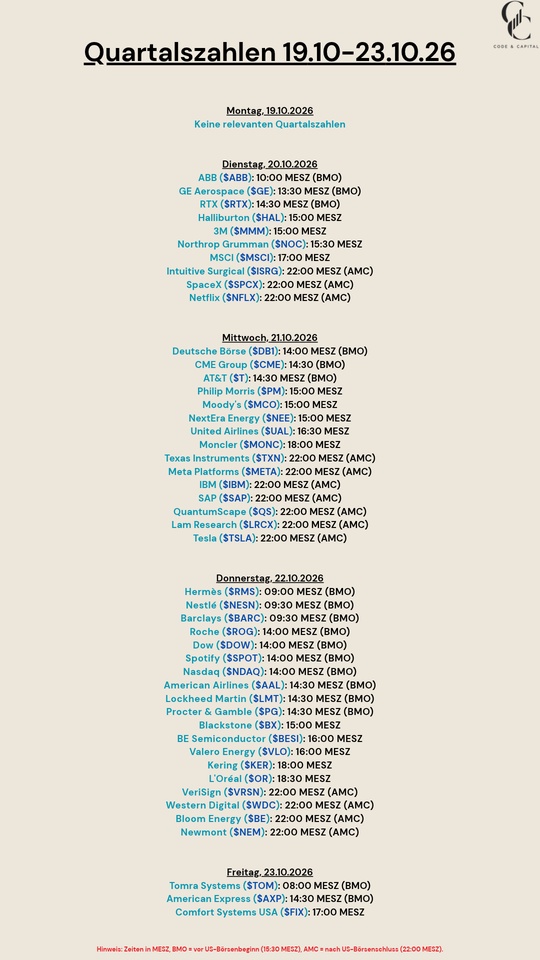
$ABBN (+2,86%)
$GE
$RTX (-1,16%)
$HAL (+1,33%)
$MMM (-0,06%)
$NOC (-2,23%)
$MSCI (-2,13%)
$ISRG (-0,92%)
$SPCX (+1,41%)
$NFLX (-1,46%)
$DB1 (-0,67%)
$CME (-4,15%)
$T (+1,02%)
$PM (+0,75%)
$MCO (-1,96%)
$NEE (+0,54%)
$UAL (+4,21%)
$MONC (-1,55%)
$TXN (+2,59%)
$META (-1,29%)
$IBM (-0,74%)
$SAP (-0,08%)
$QS (+7,74%)
$LRCX (+1,51%)
$TSLA (+4,58%)
$RMS (+0,08%)
$NESN (-0,09%)
$BARC (+1,12%)
$ROP (+0,47%)
$DOW (-0,23%)
$SPOT (-3,39%)
$NDAQ (+0,21%)
$AAL (+3,39%)
$LMT (-0,81%)
$PG (-0,08%)
$BX (-1,22%)
$BESI (+4,5%)
$VLO (-9,15%)
$KER (+0,12%)
$OR (-0,92%)
$VRSN (-1,1%)
$WDC (+5,15%)
$BE (+6,31%)
$NEM (+2,62%)
$TOM (+0,54%)
$AXP (+0,02%)
$FIX (+3,58%)

Moody's
Azione
Azione
Ticker: MCO
MCO
Price
Discussione su MCO
Messaggi
331Settimana·
Quarterly Results: Oct. 19–23, 2026
99


1Settimana·
Milestone 400k
Hello, friends of joyful investing,
I’d like to share another milestone with you—one that came sooner than expected:
The portfolio has surpassed the 400k mark.
First off: This is just a snapshot. Markets aren’t a one-way street, and things can easily swing back in the other direction. Still, I’m happy about it and am consciously savoring the moment.
My strategy: Quality Growth with a strong moat
I continue to follow a quality growth approach. I look for companies with
• a strong, hard-to-attack moat (network effects, switching costs, technology leadership, market standards),
• high and stable margins that demonstrate the business model’s pricing power,
• high return on equity and the ability to profitably reinvest earnings,
• tailwinds from global megatrends such as AI, the cloud, cybersecurity, the digitization of payments, and healthcare.
My goal is actually quite simple: to invest in outstanding companies and then watch them grow as compounders over the years. Trade less, hold more.
Deliberately Concentrated
The concentration in the portfolio is intentionally high. I am convinced that companies like $NVDA (+1,03%), $GOOGL (+1,83%) , $MSFT (+0,67%) , $META (-1,29%) , $AMZN (+2,32%) , $AVGO (+3,11%) , $CRWD (+2,72%) , $ANET (+5,24%) and $ASML (+3,28%) will continue to benefit significantly from these megatrends in the future. This is complemented by high-quality companies with near-monopoly positions such as $V (-1,98%) , $MA (-0,18%) , $SPGI (-0,12%) , $MCO (-1,96%) and $CTAS (-4,55%) , which consistently deliver high margins.
Conclusion
Patience and conviction pay off when you invest in the right companies.
I’m sticking to my strategy and seeing how things play out.
What do you think: focus on quality, or is a broad diversification better? I look forward to hearing your thoughts!
17Posizioni
414.369,47 €
126,30%
4747
21 Commenti
Epi@Epi
1Settimana
•
1010
•Visualizza tutti 11 ulteriori risposte
3Mes·
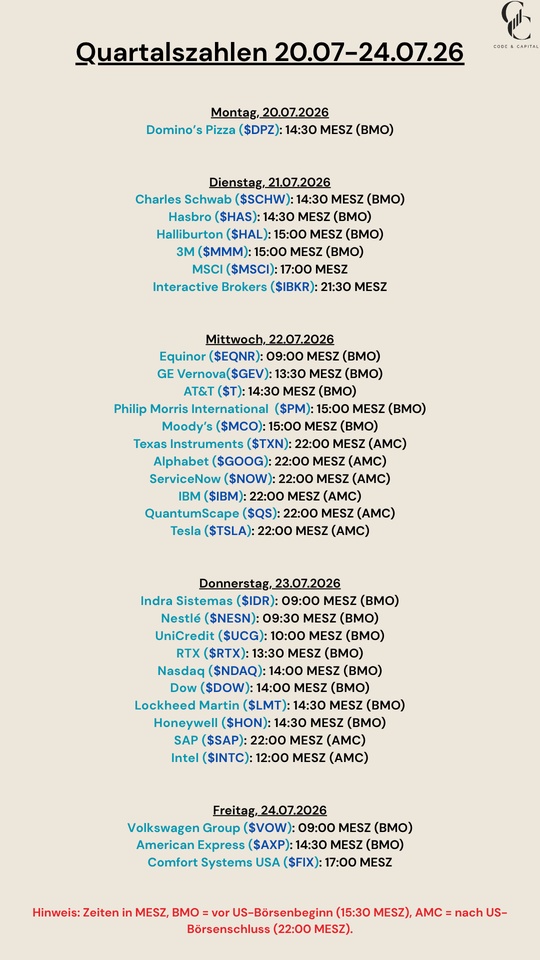
Quarterly Results: July 20–24, 2026
$DPZ (+1,08%)
$SCHW (-0,16%)
$HAS (+0,31%)
$HAL (+1,33%)
$MMM (-0,06%)
$MSCI (-2,13%)
$IBKR (+2,62%)
$EQNR (-2,07%)
$GEV (+5,12%)
$T (+1,02%)
$PM (+0,75%)
$MCO (-1,96%)
$TXN (+2,59%)
$GOOG (+1,62%)
$NOW (-1,18%)
$IBM (-0,74%)
$QS (+7,74%)
$TSLA (+4,58%)
$IDR (+1,9%)
$NESN (-0,09%)
$UCG (+1,72%)
$RTX (-1,16%)
$NDAQ (+0,21%)
$DOW (-0,23%)
$LMT (-0,81%)
$HON (+0,16%)
$SAP (-0,08%)
$INTC (+3,13%)
$VOW (-0,83%)
$AXP (+0,02%)
$FIX (+3,58%)
1010
6Mes·
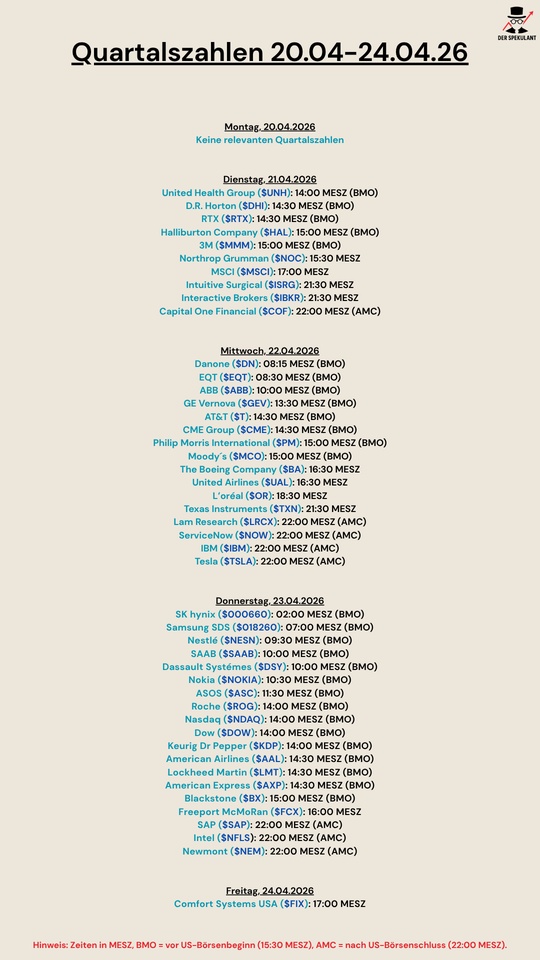
Quarterly figures 20.04-24.04.26
$UNH (+0,52%)
$DHI (+0,61%)
$RTX (-1,16%)
$HAL (+1,33%)
$MMM (-0,06%)
$NOC (-2,23%)
$MSCI (-2,13%)
$IBKR (+2,62%)
$ISRG (-0,92%)
$COF (+1,69%)
$BN (-1,84%)
$EQT (+2,46%)
$ABBN (+2,86%)
$GEV (+5,12%)
$T (+1,02%)
$CME (-4,15%)
$PM (+0,75%)
$MCO (-1,96%)
$BA (-10,26%)
$UAL (+4,21%)
$OR (-0,92%)
$TXN (+2,59%)
$LRCX (+1,51%)
$NOW (-1,18%)
$IBM (-0,74%)
$TSLA (+4,58%)
$000660
$018260
$NESN (-0,09%)
$SAAB B (+0,34%)
$DSY (-0,1%)
$NOKIA (+3,89%)
$ASC (+2,21%)
$ROG
$NDAQ (+0,21%)
$DOW (-0,23%)
$KDP (+0,42%)
$AAL (+2,63%)
$LMT (-0,81%)
$AXP (+0,02%)
$BX (-1,22%)
$FCX (+1,64%)
$SAP (-0,08%)
$INTC (+3,13%)
$NEM (+2,62%)
$FIX (+3,58%)
1212

7Mes·
Rising bond yields - are there "hidden" profiteers?
Due to the current developments surrounding geopolitical tensions and rising uncertainties (e.g. the Iran conflict), I have stumbled across an exciting thesis:
What actually happens if government bond yields continue to rise significantly?
The direct effects are well known. Pressure on equities, problems with highly indebted companies, etc. But I find the question of the downstream profiteers much more exciting. When interest rates rise, a lot happens in the background:
- Companies have to refinance or restructure their debt
- Bond markets become more attractive again
- Trading volumes and volatility increase
In my opinion, the following companies, among others, could benefit from this in the medium term:
- $MCO (-1,96%) & $SPGI (-0,12%) = more bond issues means more rating requirements
- $$DB1 (-0,67%) = more trading volume in fixed income
- BlackRock = capital could flow back into bonds & bond ETFs
So it's not so much the interest rates themselves, but the activity around rising interest rates that is being monetized. My thought, perhaps there is currently an exciting investment case here with the companies that benefit from the subsequent movements.
What do you think? Do you think there are other "hidden beneficiaries" of rising bond yields? Or is this ultimately too indirect to derive a clear investment case?
~ No investment advice ~


8Mes·
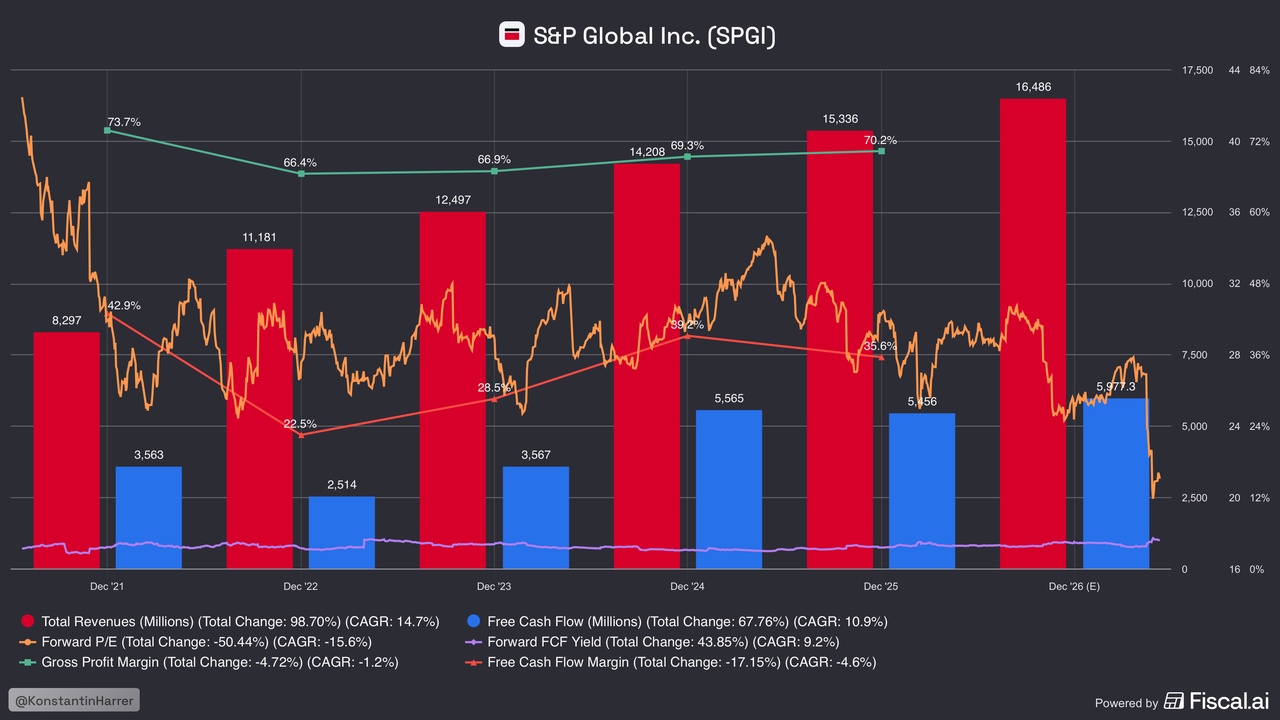
Feb 11 / S&P Global — AI Panic or Real Threat?
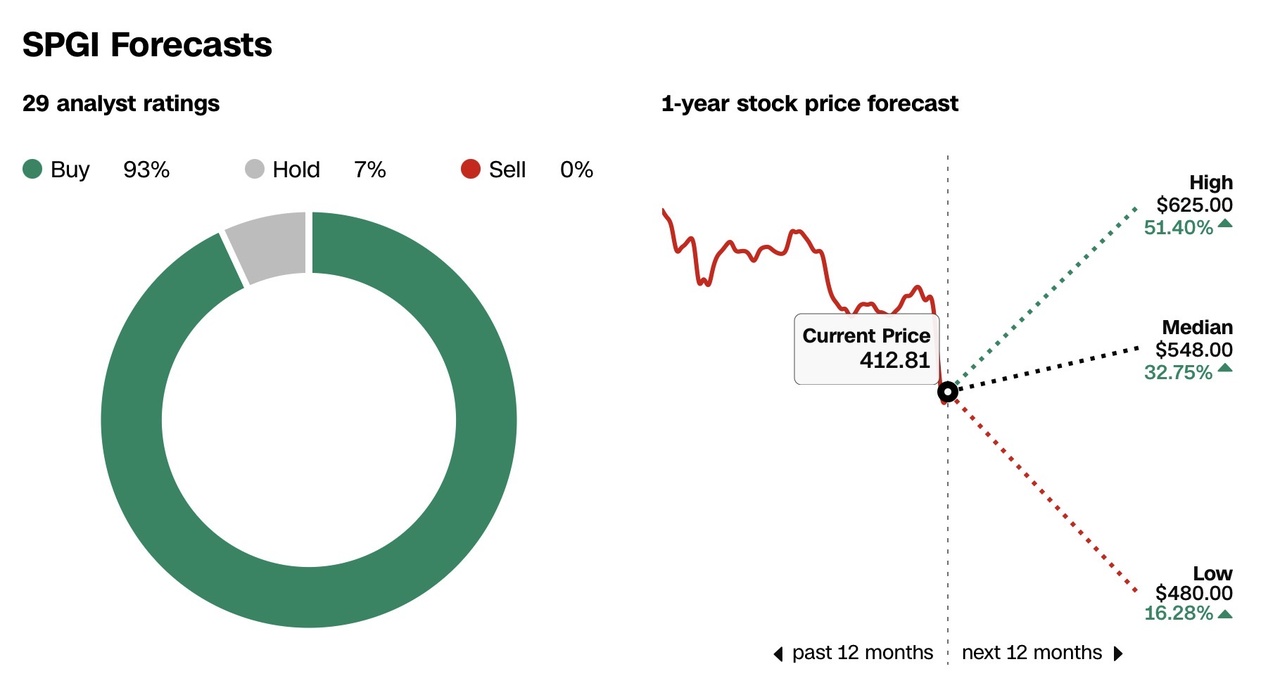
I’m sure Dev Kantesaria and Chris Hohn, two of the most respected investors out there, must have had a rough week. S&P Global dropped 28% in ten days. Moody’s fell 22%. These were supposed to be safe havens. Businesses protected by proprietary data, decades of reputation, regulatory frameworks, and structural moats.
Now that same data advantage suddenly seems to be the perceived weakness. The market appears worried that AI models, especially Anthropic, could replace the legacy credit ratings and data business model. Even earnings that were broadly in line with expectations did nothing to stop the selloff.
Luckily, I sold my S&P Global position just before the major nosedive. That was not genius timing. I simply saw better opportunities in software and cybersecurity and redeployed capital there. But now, at these levels, I am seriously considering reopening the position.
The valuation premium has evaporated. We went from mid-30s P/E multiples to low 20s. That is a significant reset for a business that was long considered untouchable. And the AI disruption narrative feels massively exaggerated.
Most of the core data S&P Global and Moody’s operate with is not publicly accessible. It is deeply embedded in regulatory processes and institutional frameworks. You cannot just “AI” your way into the credit ratings oligopoly. There are legal barriers, compliance hurdles, and decades of trust built into the system. This market is controlled by a handful of entrenched players, and it is not easily penetrated.
What is far more likely, in my view, is that legacy players partner with platforms like Anthropic to improve efficiency rather than being replaced by them. Banks and institutional investors do not want “pretty good.” They require 100% reliability and accountability. AI is powerful, but it is still flawed and probabilistic. In credit markets, that margin of error is unacceptable.
My only real concern with S&P Global is growth. Top-line expansion has slowed and is projected to remain in the high single digits. That makes margin expansion critical. An AI-driven efficiency boost through partnerships could become the key driver of the next leg higher.
With valuation compressed into the low 20s on a forward P/E basis, the stock is becoming very interesting again. I am monitoring closely and seriously considering reopening a position in the mid-$300s.
66

8Mes·
Sold off for no reason? Moody's counters with record figures
At the Börse strange things keep happening, but the current phase has a different dimension. Is it now coming to Moody's a reversal?
Madness reigns
It's nothing new that the craziest things happen on the stock market. However, what is currently happening has a whole new dimension.
The frequency of completely senseless price movements has probably never been higher - at least not in my almost two decades on the stock market.
Aktien Stock prices suddenly collapse for no apparent reason and vice versa. Moody's is certainly not an extreme example, but the events are significant.
The share has been trending sideways for months Volatilität sideways. The last quarterly figures were published in October and there has been no significant news since then.
Therefore, the Seitwärtsbewegung was easy to understand, especially with regard to the major indices. Today, the S&P500 is still trading at the same level as in October last year and has barely moved in the meantime. In some cases, the Indexeffectively stood still for weeks.
As a result, traders seem to be blindly pouncing on any stock that moves. The main thing is to be able to play any trend. The direction doesn't seem to matter at all.
The trend is your friend
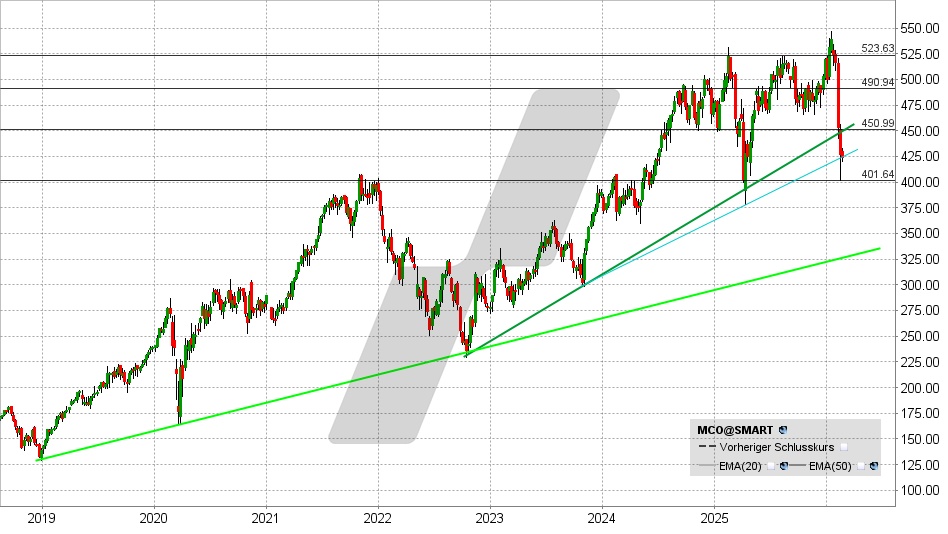
This was also the case with Moody's. In mid-January, share prices slowly crumbled and at the beginning of February the share then temporarily went into free fall. Within a very short space of time, the share price plummeted from USD 546 to USD 402.
Twenty-five billion dollars in market capitalization vanished into thin air.
Of course, you can find reasons for this if you look for them. The competition presented poor figures or a disappointing outlook. And then there's also KI. So you always have an argument for everything.
And, of course, the banks and research houses are not to be missed. There was no news or even quarterly figures from Moody's, but if S&P has a weak quarter and Moody's share price has already fallen, then of course a downgrade will follow.
It's just stupid when Moody's comes around the corner and clearly exceeds the forecasts.
Surprise
As we have known for a few hours now, fourth quarter earnings of USD 3.64 per share were well above expectations of USD 3.46. With sales of USD 1.90 billion, analysts' estimates of USD 1.88 billion were also exceeded.
For the year as a whole, this corresponds to a 13% increase in sales and a 39% jump in profits.
However, this would now be an embarrassing affair if Moody's had been downgraded for no reason last week and the Kursziel from USD 574 to USD 471. Fortunately, nobody did that, or did they?
This is all the more true as Moody's growth momentum has recently increased. For the financial year as a whole, sales growth was 9%, but in the third quarter it was 11% and in the final quarter 13%.
If the company were really in trouble, things would look different.
If you look at things in more detail, this picture is reinforced. On pages 3 and 4 of the Quartalsberichts (Link), the Group's eight individual segments are broken down in detail.
In fact, 8 out of 8 Group divisions recorded growth in the last financial year and also in the final quarter.
Outlook and valuation
On the bottom line, Moody's was able to increase earnings by 20 % to USD 14.94 per share in the 2025 financial year.
The company is also optimistic about the future. Costs are expected to increase in the mid-single-digit percentage range and thus at a slower rate than sales, which are expected to grow in the high single-digit percentage range.
In plain language, this means that profitability will increase.
Earnings are expected to rise from USD 14.94 to USD 16.40 - 17.00 per share and free cash flow from USD 2.57 billion to USD 2.80 - 3.00 billion.
In turn, USD 2.00 billion of this is to be invested in share buy-backs, and the remainder is likely to be largely distributed as dividends. Dividende be distributed.
Moody's thus arrives at a forward P/E of 25.3, which is justifiable in view of the company's double-digit growth rates, high profit margins and global position.
Over many years, the P/E has hovered around 28.8. In the last five years, the P/E has averaged 34
Moody's share: chart from 18.02.2026, price: USD 423.22 - symbol: MCO | Source: TWS
The surprisingly strong quarterly figures and the outlook could now trigger a recovery towards USD 450. However, clear positive signals only emerge above USD 450.
However, if Moody's falls below USD 425, further price losses towards USD 400 must be expected. Below this level, the chart picture would become even gloomier, which could result in downside potential to USD 378 or USD 368.
Business model
The business is divided into two core areas: Moody's Investors Service assesses the creditworthiness of countries, companies and financial instruments, while Moody's Analytics provides data, software and models that help financial players to understand and manage risks.
The two divisions are in turn divided into eight lines of business, all of which deal with analysis, data and risk in different ways. Risiko data and risk management.
In addition to traditional rating services, these include risk management software, economic research, regulatory solutions for banks and insurers, financial market data, training and consulting.
In addition, services for portfolio management and tools for evaluating complex financial products.
Each division provides a building block to enable investors to make well-founded decisions and manage risks efficiently
Source
1616
1 Commento
8Mes
The 10.2 will have been a day for a very good entry price, in view of the last two years!
•
11
•8Mes·
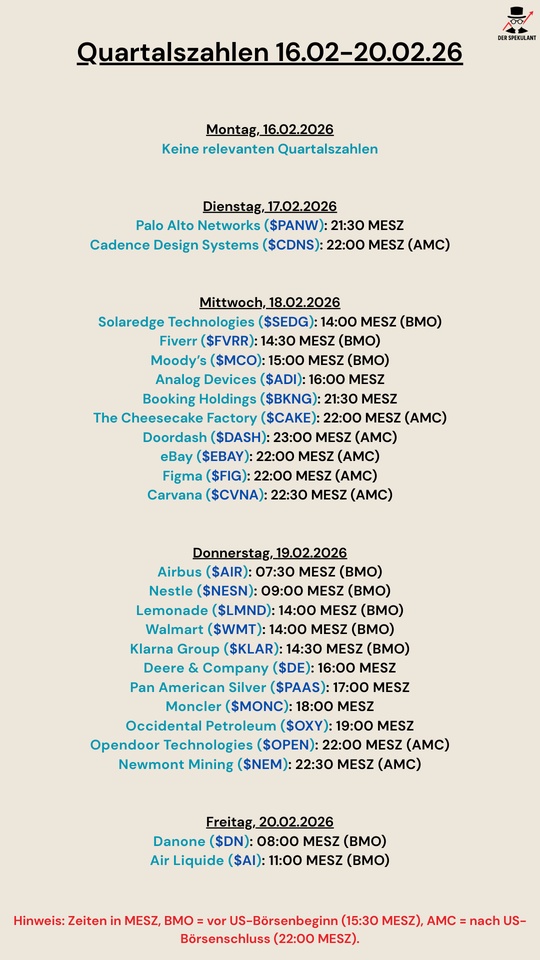
Quarterly figures 16.02-20.02.26
$PANW (+3,46%)
$CDNS (+5%)
$SEDG (-3,25%)
$FVRR (-1,28%)
$MCO (-1,96%)
$ADI (+2,44%)
$BKNG (-1,28%)
$CAKE (-4,05%)
$DASH (+2,32%)
$EBAY (-0,96%)
$FIG (-1,44%)
$CVNA (+4,54%)
$AIR (-0,44%)
$NESN (-0,09%)
$LMND (+1,96%)
$WMT (-0,27%)
$KLAR (+0,62%)
$DE (-0,35%)
$PAAS (+4,44%)
$MONC (-1,55%)
$OXY (-1,71%)
$OPEN (+1,16%)
$NEM (+2,58%)
$BN (-1,84%)
$AI (-0,03%)


8Mes·
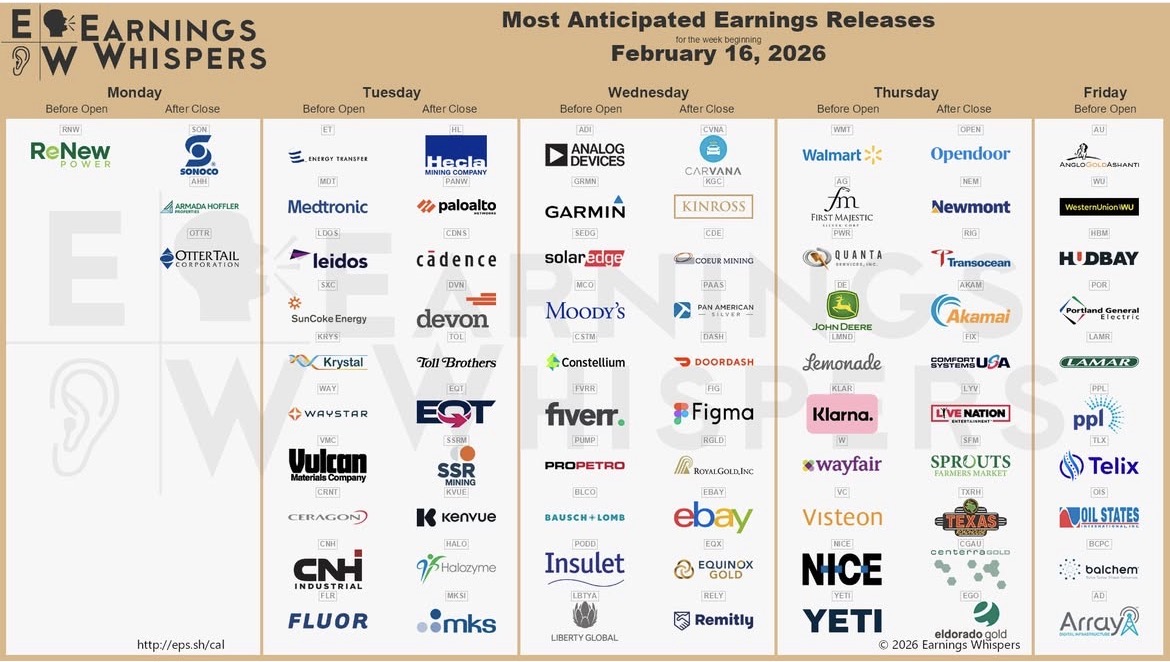
A little quieter next week
$SON (+0,48%)
$MDT (-0,06%)
$LDOS (+0,24%)
$PANW (+3,46%)
$CDNS (+5%)
$KRYS (+0,43%)
$HL (+5,26%)
$TOL (+1,51%)
$KVUE (+0,06%)
$DEVON
$ADI (+2,44%)
$GRMN (-0,38%)
$SEDG (-3,25%)
$MCO (-1,96%)
$FVRR (-1,28%)
$PODD (+0,8%)
$CVNA (+4,54%)
$DASH (+2,32%)
$FIGX
$EBAY (-0,96%)
$RELY
$WMT (-0,27%)
$PWR (+2,29%)
$DE (-0,35%)
$LMND (+1,96%)
$KLAR (+0,62%)
$W (+0,79%)
$NICE
$YETI (-2,56%)
$OPEN (+1,16%)
$NEM (+2,62%)
$AKAM (+1,4%)
$SFM (-2,44%)
$TXRH (+1,42%)
$BCPC (+0,43%)
$BKNG (-1,28%)
88
11 Commenti
I hope the suffering has now come to an end
•
55
•8Mes·
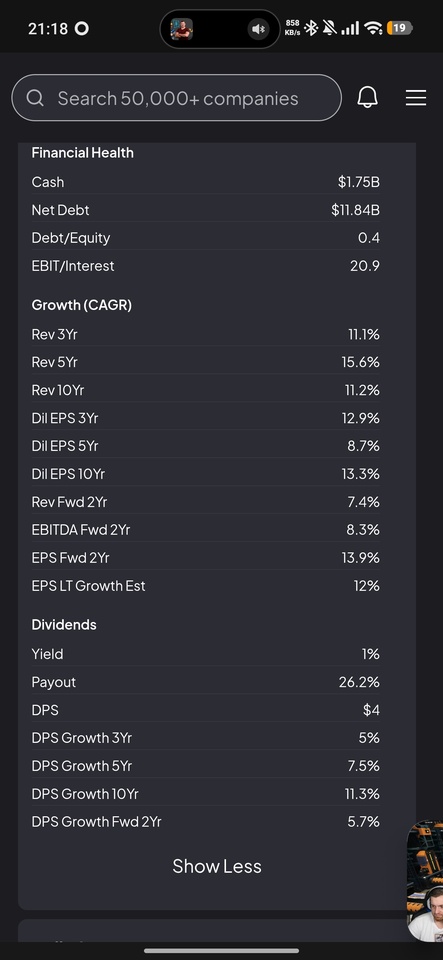
S&P Global. Do I go all in?
Small text from my side. I increased a few positions extremely quickly due to the current market dynamics and the S&P went from zero to 6% in one week.
So why now of all times, especially when $MCO (-1,96%) already make up 6% of my portfolio.
1.
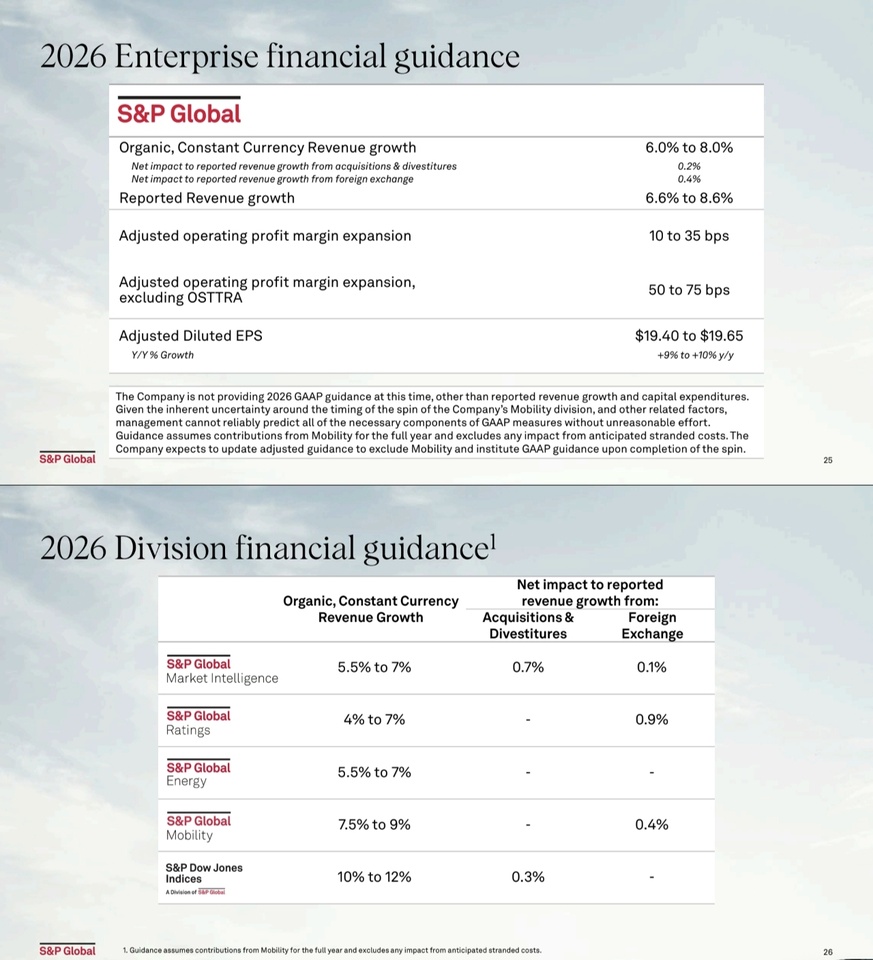
But the spin-off situation. Spin-offs are my thing, especially if they are successful. Here it can make sense. Mobility LS margins profile and future prospects are extremely good, but still far below the portfolio. Above all, it has little to do with finance. The rest is market related.
2.
The valuation is extremely good for the situation you are in. Margin profile and other data are very good and only getting better.
3.
Guidance is good and promising with upside potential. Mainly due to the spin-off there is uncertainty in the market but also in the guidance, which makes us lift the crumbs.
4
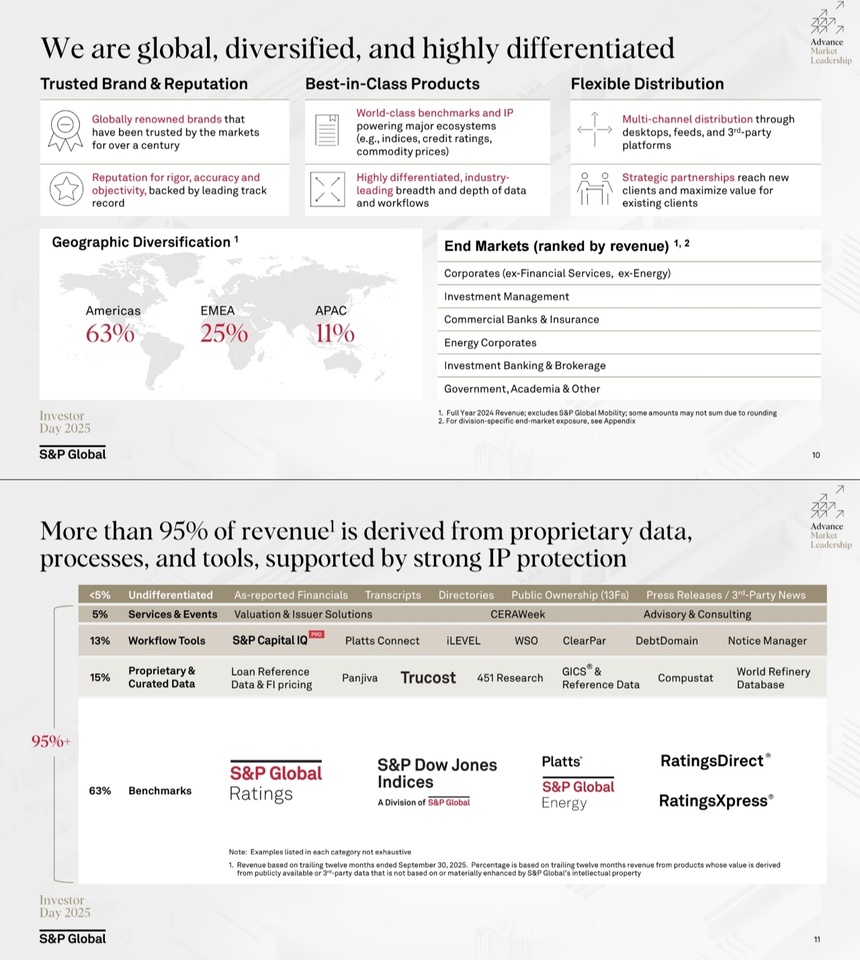
S&P is extremely well positioned in the AI transition. The Kensho acquisition is paying off extremely well and is laying the foundations for the current situation. You can get a lot out of your own platform and your own business, but not from outside. Much of the data is unique to the platform and this is precisely what customers want to access. A lot of cross-selling can also be done with the underlying business.
In my opinion, it is therefore a buy, which I am happy to accept. The management is well prepared for the current situation and there is a lot of AI potential in such a data business, which strengthens rather than weakens the business. The productivity can be passed on to the customer as costs.
In short: the share can gain up to 10% in my portfolio if it continues to fall every day. The same applies to a few other stocks that are currently falling to 3-5 year lows
+ 2
1010
19 Commenti
The 95% unique data may be true, but my assumption is that only 55% to 65% can be replicated with difficulty. However, this is nothing unusual and, above all, very high compared to other companies.
•
11
•