
Alphabet Inc. Class C
Price
Discussione su GOOG
Messaggi
447





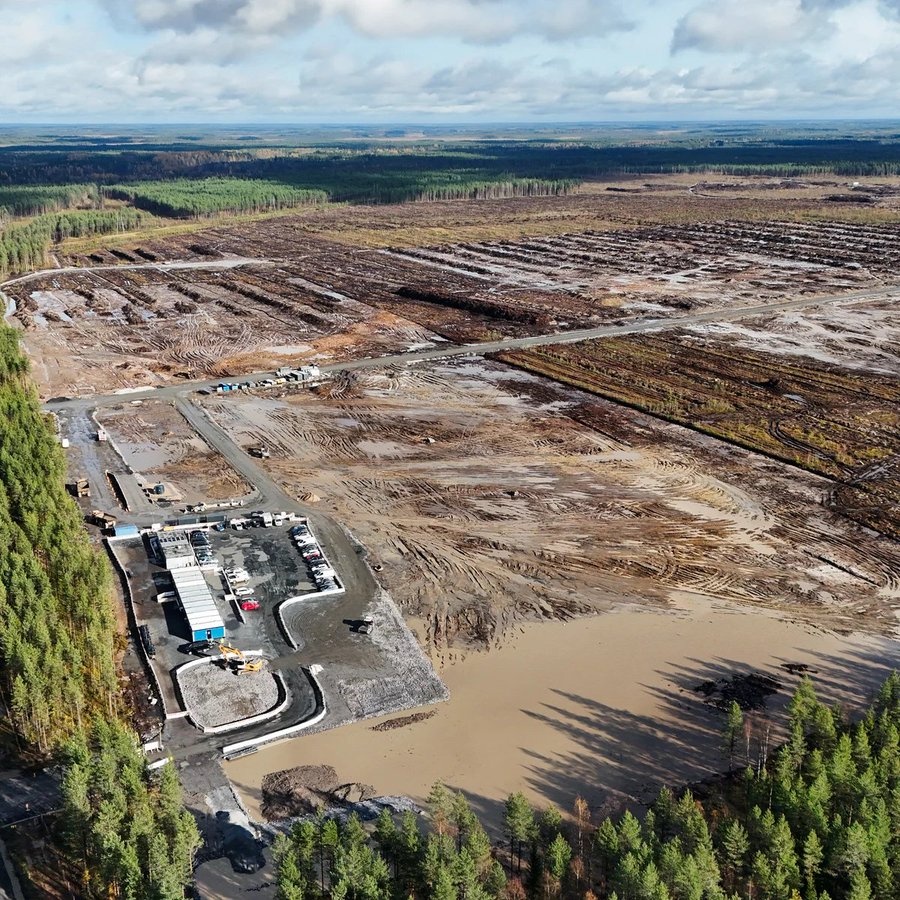
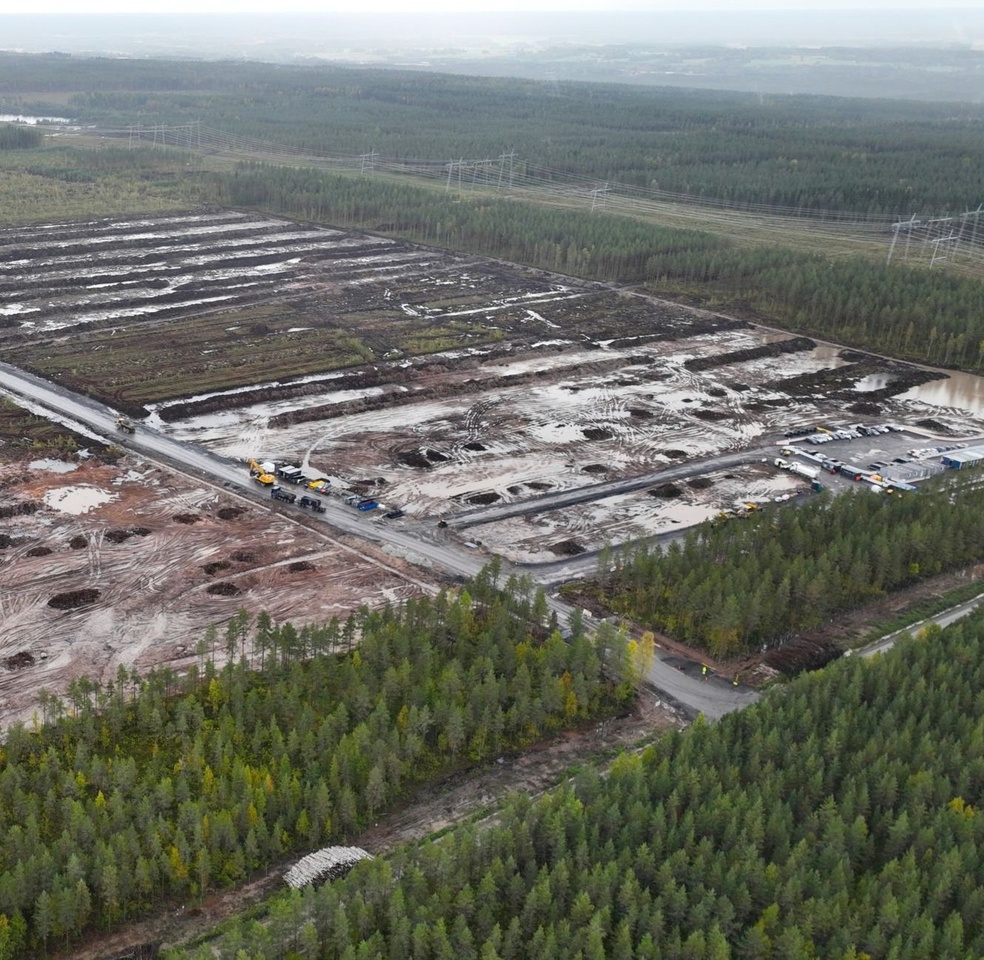
Google forced to halt work in Finland after illegally clearing 250,000 trees for a new data center, according to the Guardian
Wolves reportedly enter Finnish villages after Google clears 1,300 acres of forest for AI data centers The large scale clearing has raised concerns about the impact on local wildlife, with residents reporting wolf sightings near populated areas.
Every tree that occupied the 815-acre site just a few months ago is now gone.
The Finnish Licensing and Supervision Authority (LVV) has ordered Google to stop work on the Muhos and Otanmäki sites after it cut down the trees before the environmental impact assessment was completed.
Google’s Finland manager, Antti Järvinen, has apologized but says they were acting on "the best understanding we had of the legislation at the time."
Muhos and Otanmäki are a $17 billion Google AI project. President Trump has criticized Google for taking the projects overseas instead of investing in the United States.
Should data centers fly? They need space, which is available there.
People don't live in hell anymore. Accept the future!

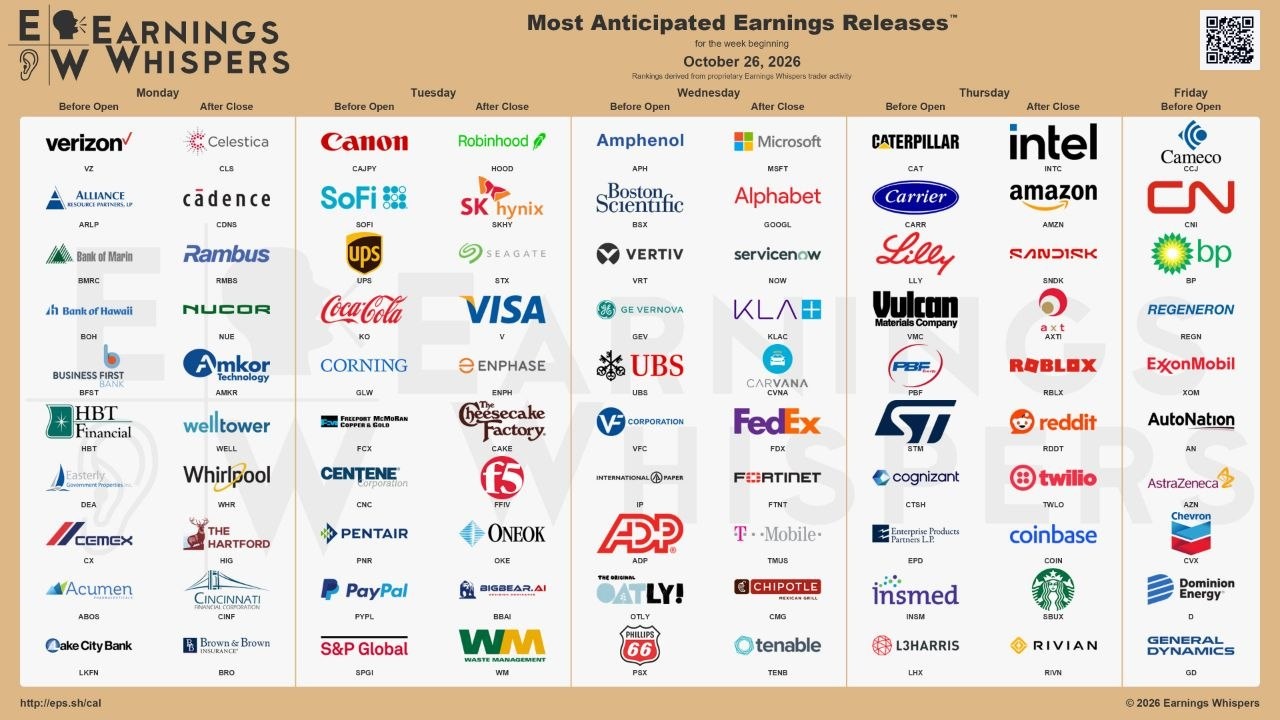
The Week Ahead
Monday, Oct. 26
🇩🇪 10:30 a.m. – Germany: ifo Business Climate Index (Oct.)
🇺🇸 1:30 p.m. – U.S.: Chicago Fed National Activity Index (Sept.)
🇺🇸 3:30 p.m. – U.S.: Dallas Fed Business Index (Oct.)
Tuesday, Oct. 27
🇪🇺 10:00 a.m. – Eurozone: M3 Money Supply & Lending (Sept.)
✈️ 12:30 p.m. – U.S.: Boeing (Q3 Earnings)
🇺🇸 1:30 PM – U.S.: Durable Goods Orders (Sep.)
🇺🇸 2:00 PM – U.S.: FHFA House Price Index (Aug.)
🇺🇸 3:00 PM – U.S.: Conference Board Consumer Confidence (Oct.)
🇺🇸 3:00 PM – U.S.: New Home Sales (Sep.)
🪶 10:00 PM – Robinhood (Q3 earnings)
Wednesday, Oct. 28
🇩🇪 8:00 AM – Germany: GfK Consumer Climate (Nov.)
🇨🇦 2:45 PM – Canada: Bank of Canada Interest Rate Decision
🇺🇸 7:00 PM – US: Fed Interest Rate Decision (FOMC) 🌶
🇺🇸 7:30 PM – U.S.: Fed press conference (Kevin Warsh)
🤑 9:00 PM – U.S.: Alphabet & Microsoft (Q3 earnings)
Thursday, Oct. 29
🇪🇺 11:00 a.m. – Eurozone: Economic and Industrial Confidence (Oct.)
🇺🇸 1:30 p.m. – U.S.: Q3 2026 GDP (1st estimate) & Personal Consumption
🇺🇸 1:30 PM – U.S.: Initial Jobless Claims
🇪🇺 2:15 PM – Eurozone: ECB Interest Rate Decision 🌶
🇪🇺 2:45 PM – Eurozone: ECB press conference (Christine Lagarde)
💵 9:00 PM – U.S.: Amazon & Intel (Q3 earnings)
Friday, Oct. 30
🇯🇵 12:30 a.m. – Japan: Tokyo CPI & Unemployment Rate
🇩🇪 10:00 a.m. – Germany: Q3 2026 GDP (1st estimate)
🇪🇺 11:00 a.m. – Eurozone: Q3 2026 GDP (1st estimate) & Unemployment Rate
🇩🇪 2:00 p.m. – Germany: CPI Inflation (Oct., preliminary)
🇺🇸 2:45 PM – U.S.: Chicago Purchasing Managers’ Index (Oct.)
🇺🇸 8:30 PM – U.S.: CFTC Commitments of Traders (COT Report)
$HOOD (-2,89%)
$BA (+2,61%)
$MSFT (-6,52%)
$INTC (-23,14%)
$SKHY (-3,14%)
$V (+2,27%)
$CCO (-0,15%)
$GOOG (-3,13%)
$GOOGL (-3,28%)
$SNDK (-6,48%)
$XOM (+0,88%)
$CVX (+1%)
$SNDK (-6,48%)
$VZ (+1,03%)
$COIN (-3,57%)
$SBUX (-1,03%)
$7751 (+0,21%)
$BP. (+1,4%)
$CAT (-9,89%)


Alphabet is sending AI chips into space on a SpaceX rocket
I’m also keeping Alphabet in my 2036 portfolio.
Investing.com – Alphabet plans to launch its artificial intelligence (AI) chips into Earth’s orbit on Thursday using a SpaceX Falcon 9 rocket. This is part of efforts to build data centers in space.
The launch is scheduled for 11:15 a.m. PT from Vandenberg Air Force Base in Santa Barbara County, California.
As part of the uncrewed Transporter-18 mission, SpaceX will transport satellites from Planet Labs, including a solar-powered prototype equipped with Google’s Tensor Processing Units (TPUs). The mission marks the first in-orbit test for Alphabet’s “Project Suncatcher,” an initiative the company first announced in November 2025.
According to Alphabet, “Project Suncatcher” aims to investigate whether space can host an infrastructure for machine learning. The company plans to develop a solar-powered AI computing infrastructure designed for continuous operation in space.
Alphabet holds a stake in SpaceX valued at over $82 billion.
In low Earth orbit, Alphabet says, satellites can access nearly constant sunlight and generate up to eight times more solar energy than on Earth. The company expects to eventually network multiple satellite constellations to handle larger AI workloads in orbit.
Alphabet has already tested its Tensor Processing Units, which execute AI workloads, at a facility at the University of California, Davis. However, it remains unclear how the chips will perform under the conditions of low Earth orbit.
SpaceX has announced plans to build and launch its own orbital data centers based on satellite swarms developed in Redmond, Washington. The satellites are to be equipped with graphics processing units and solar panels that SpaceX plans to produce in collaboration with Tesla.
Earlier this year, Elon Musk stated that data centers in space would become the most cost-effective method for AI training within two to three years. Gwynne Shotwell, SpaceX’s chief operating officer, said at an event in September that the company would deploy supercomputing capabilities in space by 2027.
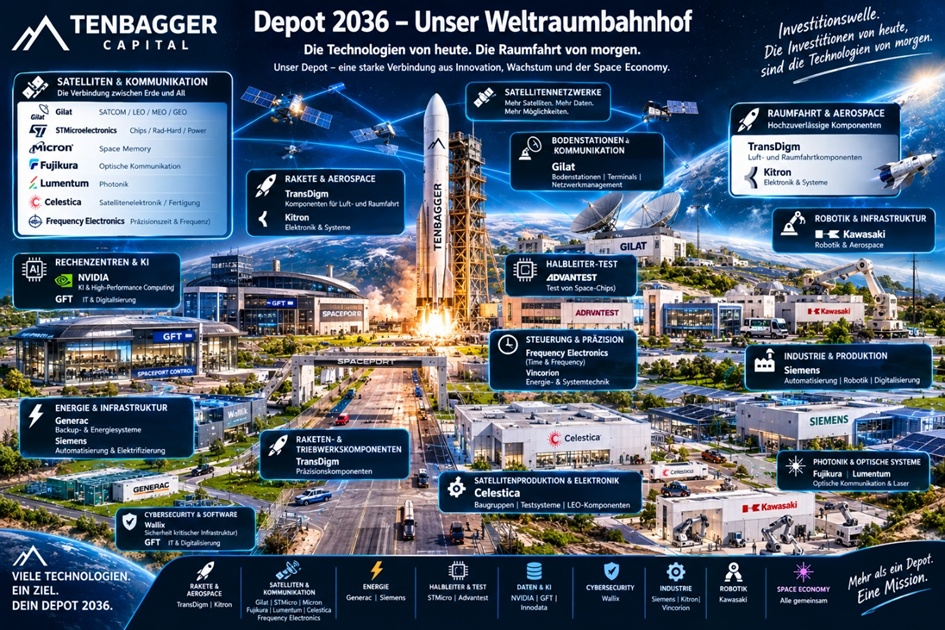
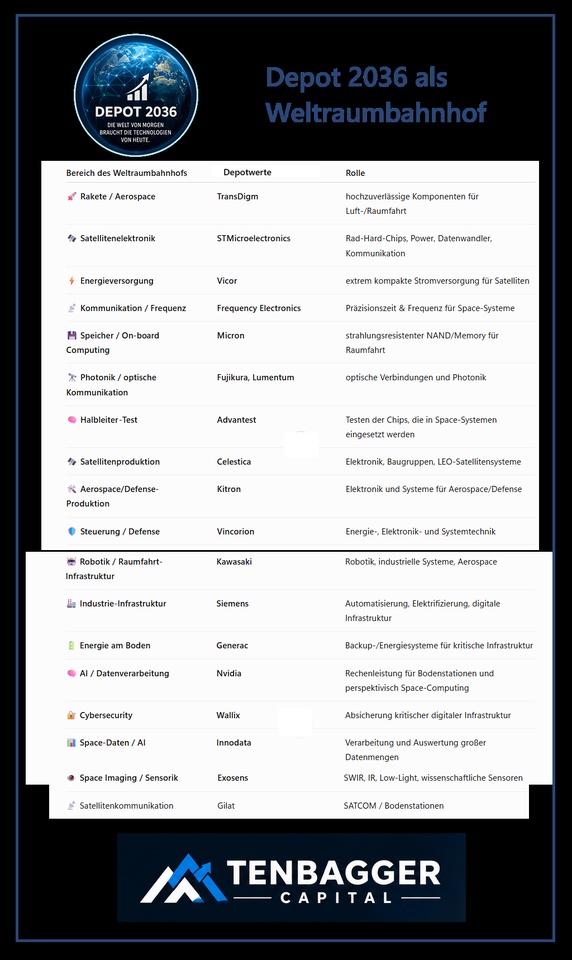
Our Spaceport, Depot 2036
Hello, everyone,
We’ve already looked at my Depot 2036 portfolio from the perspective of humanoids and data centers in growth markets.
Today, we’ll focus on the growth market of space technology.
Some of you have already invested in SpaceX.
I’m not taking that route with Portfolio 2036 because SpaceX is too big a gamble for me.
Anyone who knows me should already know that I tend to seek out the beneficiaries—namely, the suppliers of the necessary equipment.
If we look at the Portfolio 2036 as a spaceport , the structure actually becomes quite exciting: A spaceport needs not only rockets, but also energy, power electronics, semiconductors, storage, communications, optical data transmission, precision timing, control systems, test technology, and rugged electronics.
And that’s exactly where my portfolio has a surprising number of points of connection. Global space activity is growing rapidly: According to the OECD, there were 329 launches and approximately 4,900 objects sent into space in 2025; by mid-2026, there were nearly 15,000 active satellites in orbit.
🚀 The 2036 Portfolio as a Spaceport
1. STMicroelectronics – the spaceport’s chip supplier
The connection to space here much stronger than one might think at first glance.
ST itself now refers to LEO as a highly scalable communications and computing platform and expects cumulative more than $3 billion in space revenue. The company also supplies radiation-hardened components for satellites, including data converters, logic, and power products.
This fits perfectly with my Depot 2036 thesis:
More satellites → more electronics → more semiconductors → more ST.
And particularly interesting: In addition to communications and direct-to-cell, ST even sees orbital computing as a potential additional area of development.
https://newsroom.st.com/media-center/press-item.html/f0021.html?utm_source=chatgpt.com
Space significance: 🔥🔥🔥🔥🔥
2. Vicor – the power supplier in orbit
For me, this is one of the most exciting space-related holdings in the portfolio.
Vicor explicitly offers radiation-tolerant power supply modules for LEO/MEO satellites. For example, the modules efficiently convert the satellite’s voltage to the voltages required for processors and other components.
And this is particularly interesting right now: At the end of September 2026, Vicor presented solutions for space power systems at the European Space Power Conference.
Even more exciting for the 2036 vision:
The more computing power satellites gain, the more important efficient power supply becomes.
Vicor is already describing space AI systems in which power supply for high computational loads becomes a decisive factor.
Space significance: 🔥🔥🔥🔥🔥
3. Celestica – the Space Manufacturing Plant
This is where it really becomes tangible.
Celestica explicitly refers to Space explicitly as its own market and produces, among other things:
- satellite communications electronics
- circuit board assemblies
- optical systems
- Cables/harnesses
- reaction wheels
- Test systems
- LEO Satellite Components
- https://www.celestica.com/our-expertise/markets/aerospace-and-defense?utm_source=chatgpt.com
This means:
As the space industry transitions from individual projects to industrial mass production, Celestica could find itself right at this intersection.
And it is precisely this scaling that is one of the major differences between traditional spaceflight and New Space.
Space Significance: 🔥🔥🔥🔥🔥
4. Micron – Memory for Satellites
Micron also fits surprisingly well into the picture.
Micron now has a space-qualified memory portfolio and offers radiation-tolerant NAND memory for space applications.
https://www.micron.com/markets-industries/industrial/aerospace-defense?utm_source=chatgpt.com
This becomes particularly interesting as satellites process more and more data directly in orbit.
In other words:
Camera/Sensor → Memory → AI/Compute → Decision → Communication
instead of
Camera → send everything to Earth → process there.
Micron is therefore not a traditional “space player,” but rather a supplier to the digital space industry.
Space relevance: 🔥🔥🔥🔥
5. Frequency Electronics – a small-cap stock, but with an extremely specialized connection to space
I find FEIM particularly interesting in this context.
Frequency Electronics supplies precision time and frequency for ground, air, sea, and space platforms as well as for government and military systems.
https://frequencyelectronics.com/about/?utm_source=chatgpt.com
Why is this important?
Satellites must be synchronized with extreme precision.
In:
- satellite communications
- Navigation
- Radar
- military systems
- satellite networks
time accuracy is a fundamental part of the infrastructure.
FEIM is therefore more like the “timekeeper of the spaceport”.
Space significance: 🔥🔥🔥🔥
6. Gilat Satellite Networks—a central hub between satellites and Earth
Gilat is a more direct space-related stock. Gilat develops satellite communication solutions for GEO, MEO, and LEO, including ground stations, terminals, and network management.
Particularly relevant to the Depot 2036 narrative: By 2026, Gilat will already have over $20 million in SkyEdge orders from a major satellite operator by 2026. In addition, the planned acquisition of Comtech’s space and satellite business is expected to significantly strengthen Gilat’s position in the space and defense communications .
Gilat is essentially the communications bridge from space back to Earth. 🌍↔️🛰️
7. Exosens — definitely fits into the space narrative
Exosens is known for its predecessor, Xenicsand Photonistechnology in the field of high-precision image sensors, SWIR/IR, and low-light imaging . Exosens explicitly cites space exploration explicitly as an application area.
https://www.exosens.com/applications/scientific?utm_source=chatgpt.com
🛰️ Direct evidence of space applications
Of particular interest is the Xenics Bobcat SWIR sensor system:
- Xenics/Exosens collaborates with the DLR on the NASA/JPLVERITAS mission.
- The sensor is intended for use on the Venus mission.
- The ESA mission EnVision is also mentioned.
- The sensor is specifically designed for extreme conditions, including space exploration .
https://www.exosens.com/news/veritas-mission?utm_source=chatgpt.com
So this isn’t just a theoretical “space might become interesting someday” story.
And Exosens has another interesting aspect: Its imaging ranges from UV through visible light and SWIR to LWIR. This means it’s not just about traditional cameras, but about “seeing” in spectral ranges that are important for scientific and military applications.
https://www.exosens.com/product-types/image-intensifier-tubes?utm_source=chatgpt.com
And Exosens currently has a strong defense/sensor driver: In the first half of 2026, revenue rose by 15.3%, with Detection & Imaging growing by 24.3%. The company specifically cites defense imaging, drones, and counter-drone applications as growth drivers.
https://www.exosens.com/news/h1-2026-exosens-results?utm_source=chatgpt.com
🛰️ And then there’s Lumentum + Fujikura
Here, I’d like to tie in the previous photonics theme .
Fujikura is already conducting research on radiation-resistant optical fibers for communication between satellites.
https://www.fujikura.co.jp/en/research/technical-report/no055.html?utm_source=chatgpt.com
This is extremely interesting for a world with thousands or tens of thousands of satellites:
Satellite ↔ Satellite ↔ Satellite ↔ Ground Station
instead of each satellite communicating exclusively with a single ground station.
Lumentum, on the other hand, I would currently view more as a photonic/data center beneficiary with an additional space option . Lumentum’s current operational momentum stems primarily from AI and data center optics; however, the company is fundamentally deeply positioned in optical communications technology.
My key point for the 2036 portfolio
The exciting thing is notthat my portfolio is suddenly turning into a “space portfolio.”
What’s much more interesting is:
These companies are selling the infrastructure that makes a rapidly growing space industry possible in the first place.
The aerospace industry is increasingly becoming a combination of:
🚀 Aerospace + 🛰️ Satellites + ⚡ Energy + 🧠 Semiconductors + 💾 Storage + 📡 Communications + 🔭 Photonics + 🤖 Robotics + 🔐 Cybersecurity + AI
And it is precisely this combination that is already found surprisingly often in the 2036 portfolio.
My Space Matrix for the 2036 Portfolio
Direct Space Leverage
- 🥇 STMicroelectronics
- 🥇 Vicor
- 🥇 Celestica
- 🥇Gilat
- 🥈 Frequency Electronics
- 🥈 TransDigm
- 🥈 Micron
- 🥈 Fujikura
- 🥈 Exosens
Indirect Space/Infrastructure Leverage
- Lumentum
Kitron
Advantest
Kawasaki
Vincorion
Siemens
Nvidia
Generac
Digital Level
- Wallix
Innodata
GFT
This gives the Depot 2036 adds the following to its existing pillars humanoids, data centers, AI, cybersecurity, defense, and energy :
🚀 SPACE ECONOMY
And the best part is: You don’t necessarily have to own a pure-play space stock to benefit from it. I already own several companies that could profit from the technological bottlenecks in the space industry.
I find the following chain particularly strong: STMicro → Vicor → Celestica → Micron → Fujikura → Frequency Electronics. It covers chips, power, manufacturing, storage, communications, and synchronization.

Google on Time | Everyday and Everything
Google "Birthday on September" , makes
frame time in history and always get story for next season. 28 years get to growth up with platform and on stock market could be more sharp get to performance and level market position.
• $GOOG (-3,13%) , $GOOGL (-3,28%) on stock market with 0.21% turnover still good makes more high market position next years with market cap. 🎉💫✅️


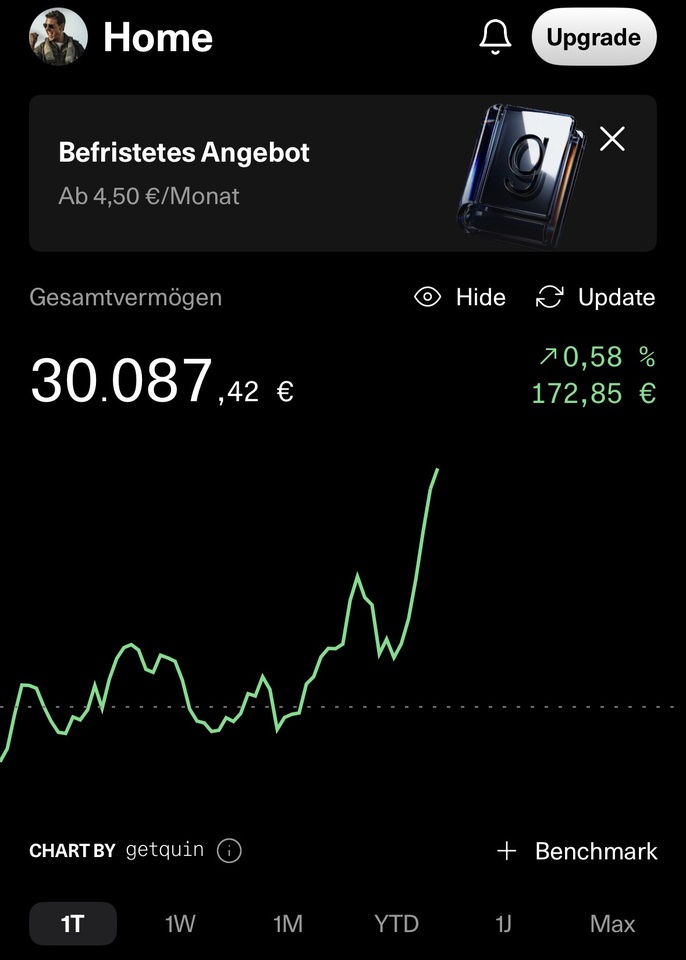
Hit 30k🤌🏻💪🏼 On to 50k🤑🤑
Let’s go—I finally hit the next 10k milestone.
I’ll repost when I hit 50k (hope it doesn’t take too long😃).
My DCA is currently at 800€ + reinvested dividends.
$VWRL (-0,6%) 400€
$VHYL (+0,17%) 100€
$GOAI (-1,84%) €25
The rest goes into my satellite funds.
$GOOG (-3,13%) €35
$AMZN (-10,47%) 35€
$O (+0,54%) 25€ + dividend
$MAIN (+1,76%) €15 + dividend
and a few more😃

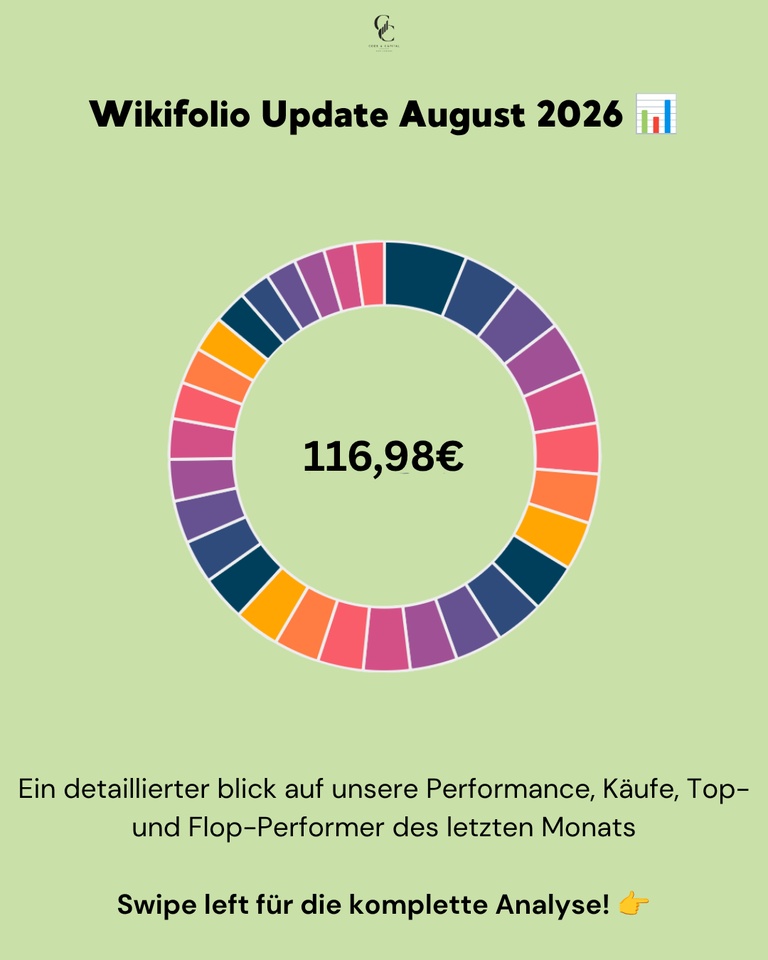
📊 Wikifolio Update August 2026
SanDisk $SNDK (-6,48%) up 28 percent, Western Digital $WDC (-2,11%) down 18 percent. Both in the same sector, in the same month. My model didn’t react to either of these movements, yet at the end of the month it was still up 3.03 percent.
August had two sides. At the beginning of the month, mild inflation data was released, and the S&P 500 hit an all-time high of 7,816 points on August 13. After that, sentiment on the bond markets shifted. The 30-year U.S. yield rose to its highest level in nearly twenty years, and U.S. gross debt exceeded forty trillion dollars. At the end of the month, Nvidia reported $NVDA (-2,27%) quarterly revenue of 96.2 billion, an increase of 106 percent. The next day, Fed Chairman Warsh signaled a pause in Jackson Hole, and the market priced in an interest rate hike in September.
📊 Monthly performance: +3.03%
📊 Max. Performance: 16.1%
📊 Price as of Aug. 31: €116.85
📊 Next Rebalancing: October 1, 2026
Performance & Comparison 🚀
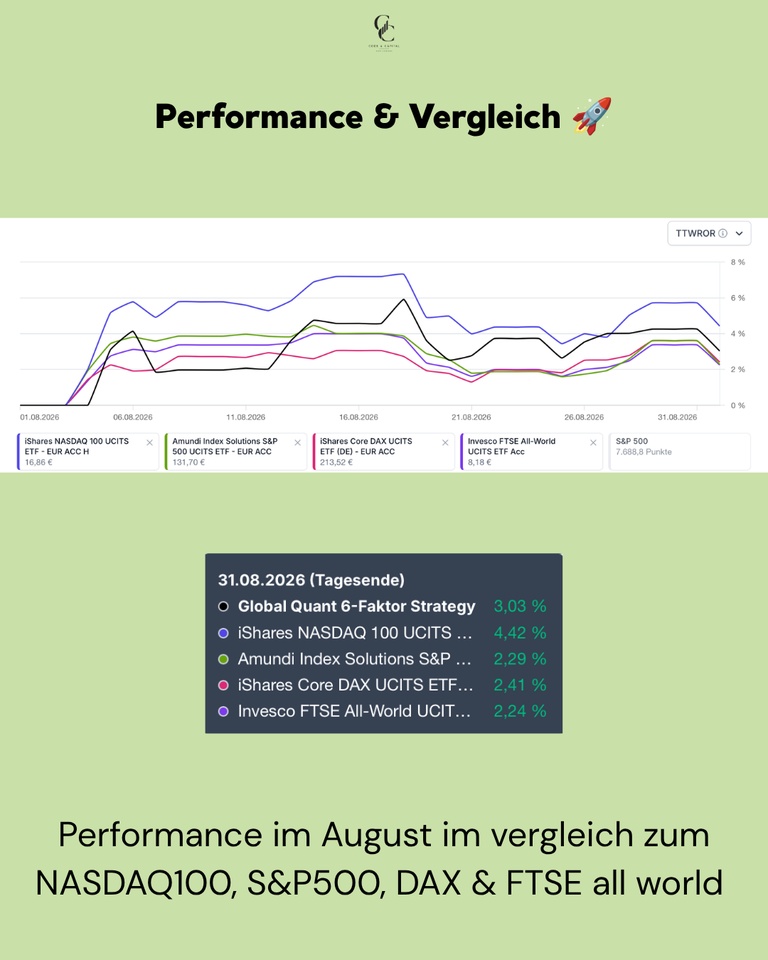
August was a positive month for all major indices. The Nasdaq led the way, driven by Nvidia. The model performed in the middle of the pack and outperformed the broad indices.
Performance Comparison (August 1–August 31, 2026, end of day):
Global Quant 6-Factor: +3.03%
NASDAQ 100: +3.57%
S&P 500: +2.74%
FTSE All-World: +2.27%
DAX: +2.03%
Purchases & Sales 💶
None. The model trades only quarterly; the last rebalancing took place on July 1. Nothing happens between those dates, even if individual positions diverge significantly. That is precisely the point of the rules. The next rebalancing is scheduled for October 1, when a larger portion of the portfolio will be replaced.
Top Movers in August 🟢
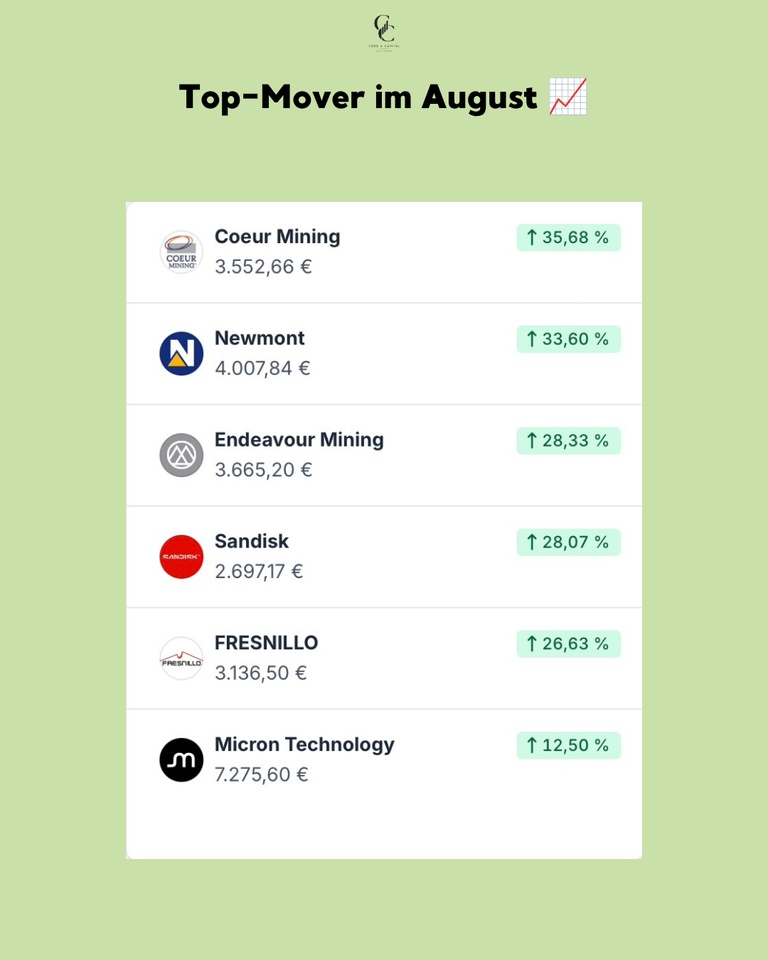
The month belonged to gold mining stocks. Over the course of the month, gold rose at times to nearly $4,700, reaching its highest level since May. By the end of the month, it had given back some of those gains. The move was driven by a weaker dollar combined with ongoing central bank purchases. Mining stocks react to this with leverage because their margins rise disproportionately. Coeur Mining $CDE (-2,87%) topped the list with +35.68%, followed by Newmont $NEM (-2,49%) at +33.60% and Endeavour Mining at +28.33%. Fresnillo $FRES (-1,67%) rose +26.63%. All four have been in the portfolio since the spring. In addition, the storage stocks performed well. SanDisk $SNDK (-6,48%) rose by +28.07%, and Micron $MU (-6,84%) by +12.50%.
August’s Biggest Losers 🔴
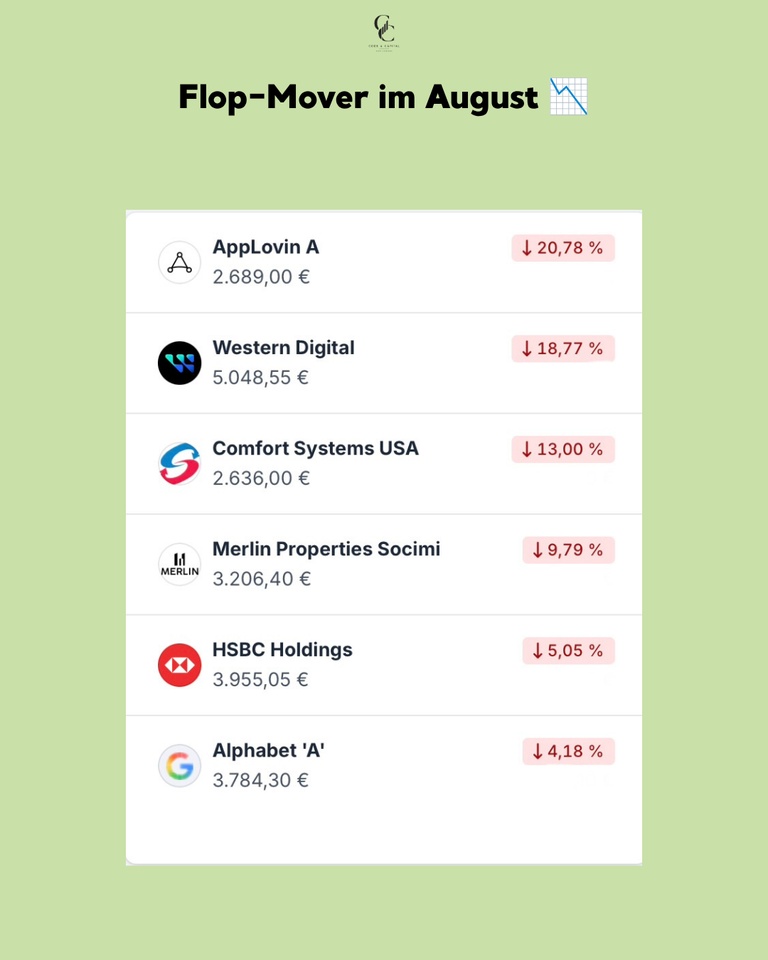
AppLovin $APP (-2,7%) suffered the biggest loss at -20.78%. Western Digital $WDC (-2,11%) fell -18.77%, while SanDisk gained nearly thirty percent over the same period. Comfort Systems $FIX (-5,24%) fell by -13.00%, and Merlin Properties $MRL (+0,39%)
-9.79%. Among financial stocks, the decline was limited; HSBC $HSBA (+0,43%) lost -5.05%. Alphabet $GOOG (-3,13%) fell -4.18%.
Conclusion 💡
August demonstrated the value of a diversified portfolio. While technology stocks diverged and AppLovin fell 20 percent, gold mines carried the month. None of these positions are in the portfolio based on personal opinion; they’re there because the ranking placed them at the top. October 1 will be interesting because a large portion of the commodity stocks are on the sell list.
❓ Question for the Community
Did the volatility in August make you get cold feet, or did you stubbornly hold onto your positions? And how much gold do you currently have in your portfolio?
👇 Let us know in the comments!
➡️ Every month, you’ll find the full Wikifolio update here, along with research from the model in between.
🗞️ Newsletter: codeandcapitalquant.beehiiv.com
📈 Wikifolio: https://www.wikifolio.com/de/de/w/wf0gquant6
+ 1

🚨 Anthropic vs. OpenAI: Is the AI House of Cards Shaking?
In the latest episode of the Doppelgänger Tech Talk podcast (588), there was an extremely intriguing theory about Anthropic’s upcoming IPO and the potential ripple effects for OpenAI.
Here’s a summary of the key points from the discussion (written by Claude, reviewed by me 🤓):
1. Anthropic’s IPO Move
Anthropic is reportedly aiming for an IPO with a valuation of up to $2 trillion. Whether that figure is realistic remains to be seen—but the timing is strategically extremely clever. Anthropic is in a cleaner position structurally and financially (or has at least disclosed fewer unprofitable, dead-weight structures) than OpenAI.
If they go public as the first pure-play AI-SaaS company, they’ll set the valuation benchmark for the entire sector.
2. The Trap for OpenAI
For OpenAI, this move could become a problem:
- Hard numbers instead of hype: An IPO forces transparency (S-1 filing). Once the actual margins, capital expenditures (CapEx), and massive losses of model providers are exposed on the public market, OpenAI will have to be judged against these realities.
- Sales Struggles: OpenAI is already struggling with commercial execution (it recently replaced its second head of sales within a year).
- Valuation Setback: If OpenAI fails to meet the astronomical valuation expectations in its own IPO, the foundation of its equity fundraising will crumble.
3. The Domino Effect: Data Centers & CapEx
OpenAI has massive infrastructure commitments and data center projects (including within the Nvidia ecosystem and with Microsoft) in the pipeline.
If raising capital through the capital markets doesn’t go as hoped, there simply won’t be enough money for hardware, energy, and computing power. Without computing power, training the next generations of models will stall—and the technological lead threatens to melt away.
--- End of Claude ---
💬 Question for the group:
If OpenAI actually finds itself in a fundamental funding crisis because its cost structures are too unprofitable for the public market and the billion-dollar infrastructure promises become unaffordable due to a) no IPO or b) no more funding rounds—Anthropic comparison... fresh off the press: $NVDA (-2,27%) cuts funding commitments from 250 billion to 120 billion
Is this a realistic scenario, and if so, are we facing the “dot-com moment” of the AI markets, will the CapEx bubble surrounding Nvidia & Co. burst, or will the Big Tech cash flow giants like $META (-0,2%)
$MSFT (-6,52%)
$GOOG (-3,13%) take the helm? Will $AAPL (+1,68%) just buy OpenAI from the sidelines?
Let’s take a look into the crystal ball 🔮
