
On July 1, the second rebalancing of my Wikifolio took place—a rule-based portfolio with 30 equally weighted positions that has been running since March 13. Nine positions out, nine in. I had expected this to shift the structure. When I checked the numbers, almost everything was the same as before.
A quick note on how it works
A Python scanner evaluates approximately 845 stocks from 14 indices daily based on six factors. Those that make it into the top 25 are purchased. Those that fall below rank 40 are removed. Quarterly adjustments, no sector allocation, no discretion.
What was dropped:
- 4 tech stocks: Applied Materials $AMAT (-0,41%) (+92%), KLA-Tencor $KLAC (-0,54%) (+90%), Broadcom $AVGO (-0,35%) , Amphenol $APH (+0,22%). Not because of earnings, but because the valuation could no longer keep up with the share price and the stock’s ranking plummeted.
- 5x Finance: ING $ING (+0%), Jyske Bank $JYSK (-1,41%), Unicaja $UNI (+0,12%), Baader Bank $BWB (+1,66%), Nu Holdings $NU (+0,57%).
New additions:
- ASML $ASML (+1,14%), Alphabet $GOOG (+0,56%), SanDisk $SNDK (-1,52%), Investor AB $INVE B (+0,05%), BBVA $BBVA (+0,51%), UniCredit $UCG (-0,06%), Monte dei Paschi $BMPS (+0,14%), Banca Mediolanum $BMED (-1,01%), Swedbank $SWED A (-0,49%).
The interesting part
Micron $MU (-0,97%) stayed in the portfolio, up over 100 percent. The score held, and the ranking remained higher. A system that sells based on profit would have kicked Micron out first. The model treated these three big winners completely differently because it doesn’t know the purchase price at all.
And on the other hand:
SanDisk $SNDK (-1,52%) was added that same evening, at 1,820 euros. The stock had already been on the buy list in April but wasn’t tradable at the time. Today, the position is down about 50 percent. The timing could hardly have been worse.
The sector breakdown before and after
Technology fell from 30 to 23.3 percent, financials rose from 36.7 to 40. Materials remained at 16.7.
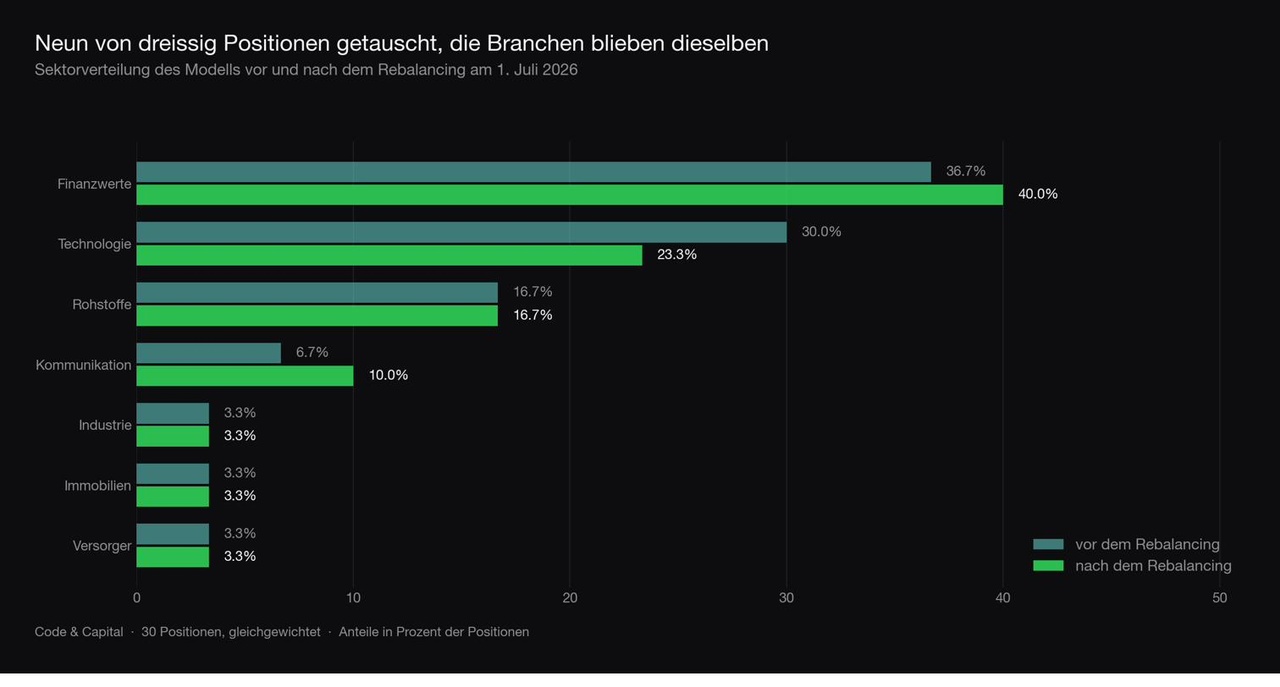
A factor model does not distinguish between sectors. It sorts by score, and stocks in the same sector often receive similar scores because they are influenced by the same drivers. If one falls below rank 40, there is a high probability that another from the same sector is ready to take its place in the top 25. The model captures gains and returns to the same sector, just with different names.
My Conclusion
One quarter doesn’t prove anything. I don’t have a sector cap in the model because my backtest doesn’t have one either.
Next rebalancing: October 1.
Who among you uses a rule-based approach and has a sector cap in place?
I’m curious to know what percentage cap you use.
