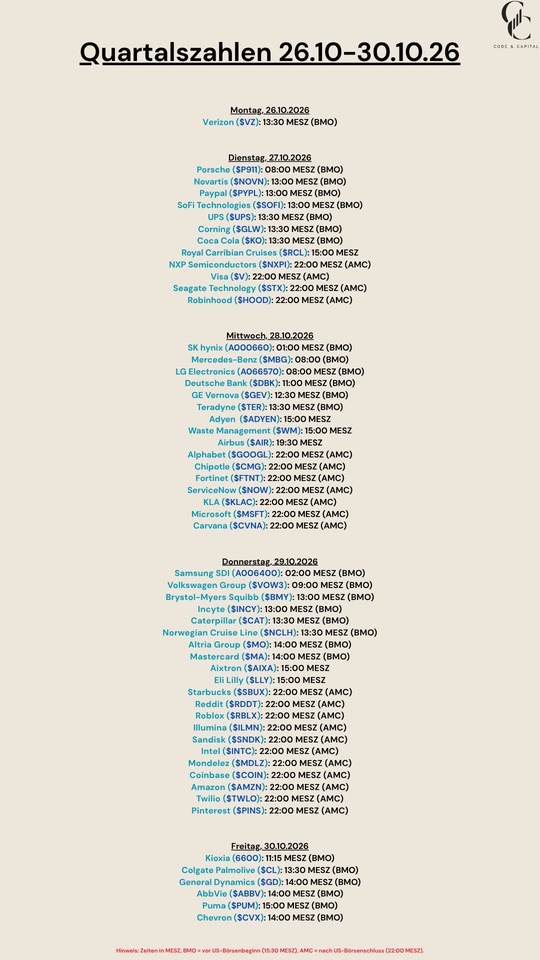
$VZ (-0,39 %)
$P911 (+4 %)
$NOVN (-0,44 %)
$PYPL (-1,01 %)
$SOFI (+0,33 %)
$UPS (-0,13 %)
$GLW (+1,84 %)
$KO (-0,63 %)
$RCL (-0,95 %)
$NXPI (-0,77 %)
$V (+0,15 %)
$STX (+3,19 %)
$HOOD (+2,22 %)
$SKHY (+7,31 %)
$MBG (+0,49 %)
$DBK (+4,19 %)
$GEV (-0,02 %)
$TER (+2,97 %)
$ADYEN (-13,71 %)
$WM (-2,68 %)
$AIR (+0,1 %)
$GOOGL (+0,59 %)
$CMG (+0,5 %)
$FTNT (-1,59 %)
$NOW (-1,73 %)
$KLAC (+1,59 %)
$MSFT (-0,55 %)
$CVNA (-0,45 %)
$006400
$VOW3 (+2,2 %)
$BMY (-0,77 %)
$INCY (+2,19 %)
$CAT (+2,4 %)
$N1CL34
$MO (-0,43 %)
$MA (-0,11 %)
$AIXA (+2,55 %)
$LLY (-0,7 %)
$SBUX (-0,38 %)
$RDDT (-1,62 %)
$RBLX (-1,02 %)
$ILMN (-0,88 %)
$SNDK (+4,29 %)
$INTC (+1,57 %)
$MDLZ (-0,65 %)
$COIN (-0,74 %)
$AMZN (-0,34 %)
$TWLO (-0,07 %)
$PINS (-2,13 %)
$285A (+9,95 %)
$CL (-0,42 %)
$GD (+0,16 %)
$ABBV (-0,43 %)
$PUM (-0,72 %)
$CVX (+0,59 %)

Bristol-Myers Squibb
Price
Debate sobre BMY
Puestos
92Quarterly Results: Oct. 26–30, 2016


Pathos AI teams up with Bristol Myers and Tempus AI to advance drug development
Anbei habe ich euch 2 kleine Artikel kopiert, für alle $BMY (-0,77 %)
$TEM (-0,05 %) oder $AZN (-0,44 %) Investoren.
Ich bin selber in $BMY (-0,77 %) investiert und bin gespannt was die Zukunft bringt.
1.
23 —> Pathos AI said on Friday it had entered into a collaboration with Bristol Myers Squibb $BMY (-0,77 %) and Tempus AI $TEM (-0,05 %) to develop artificial intelligence tools for drug development in Alzheimer's disease and other neurological disorders.
Pathos AI also raised $237 million in a Series E funding round led by Bristol Myers that valued the New York-based company at about $3 billion, with participation from existing investors.
Here are some other details:
- Tempus will build a dataset from hundreds of thousands of patients with neurological disorders to help track outcomes and speed research into disease biology
- Pathos will license the data from Tempus under a five-year, $55 million agreement
- Pathos will apply its AI platform, Pathos Foundry, to study the dataset at scale, generate and test hypotheses on disease biology, and inform the design of more targeted, adaptive clinical trials
- Bristol Myers will gain non-exclusive strategic access to Pathos Foundry across its broader portfolio, as well as three-year exclusive rights to use the platform for its neuroscience development programs
- Proceeds from the financing will be used to further scale the Foundry platform's capabilities and accelerate development of its AI-driven pipeline, including advancing experimental cancer drug, JSKN016
- The funding will help advance development of other cancer programs including an AstraZeneca $AZN (-0,44 %) partnered experimental breast cancer drug.
2.
Oct 23 —> Bristol Myers Squibb $BMY (-0,77 %) and partner SystImmune said on Friday their experimental breast cancer treatment slowed disease progression compared to standard chemotherapy in a late-stage study.
The drug, izalontamab brengitecan, reduced the risk of disease worsening or death by 59% in patients with advanced hormone-receptor-positive, HER2-negative breast cancer — the most common form of breast cancer — who had failed at least one prior line of chemotherapy.
Izalontamab brengitecan belongs to a class of treatments known as antibody-drug conjugates, often called "guided missiles". It targets two specific proteins, EGFR and HER3, to deliver a cancer-killing payload directly to tumor cells.
In the study, which enrolled 383 patients, those treated with the drug lived for a median of 8.2 months without their cancer growing, compared to four months for the participants on standard chemotherapy.
About 40.5% of patients on iza-bren saw their tumors shrink, compared to 20.2% on chemotherapy. The response lasted a median of 6.9 months, versus 4.2 months for chemotherapy.
Data on overall survival, how long patients lived in total, was not yet mature at the time of the interim analysis. The full results will be presented at the European Society for Medical Oncology congress in Madrid.
Bristol Myers had partnered with SystImmune, a unit of Chinese drugmaker Sichuan Biokin Pharmaceutical, in an up to $8.4 billion deal announced in 2023 to develop and commercialize the drug outside mainland China.
Its side effects were manageable and no new safety concerns emerged, Bristol Myers said. Only 1.6% of patients stopped treatment because of side effects, while two patients developed mild-to-moderate lung inflammation.
Liebe Grüße 🌊
is it time to buy more Bristol-Myers?
Bristol-Myers Squibb: time to add?
Hi everyone! I'm a long-term dividend investor and I hold 37 shares of BMY. The stock has dropped to about $56.82, roughly 16% below its August levels, and the yield is back around 4.4%.
The bull case: growth portfolio up 15%, raised 2026 guidance, strong free cash flow.
The risk: the 2027 Eliquis patent expiry, plus pipeline readouts (milvexian, Cobenfy). Earnings are due October 29.
Would you add now, wait for earnings, or stay out? I'd love to hear your thoughts, especially from other BMY holders. Thanks!

Two Successful Phase 3 Trials for Bristol Myers Squibb
Bristol Myers Squibb stock $BMY (-0,77 %) rose 6.5% on Monday after the company announced positive topline results from two separate Phase 3 clinical trials. These trials evaluated targeted therapies for neuroendocrine tumors and idiopathic pulmonary fibrosis.
Best regards 🌊



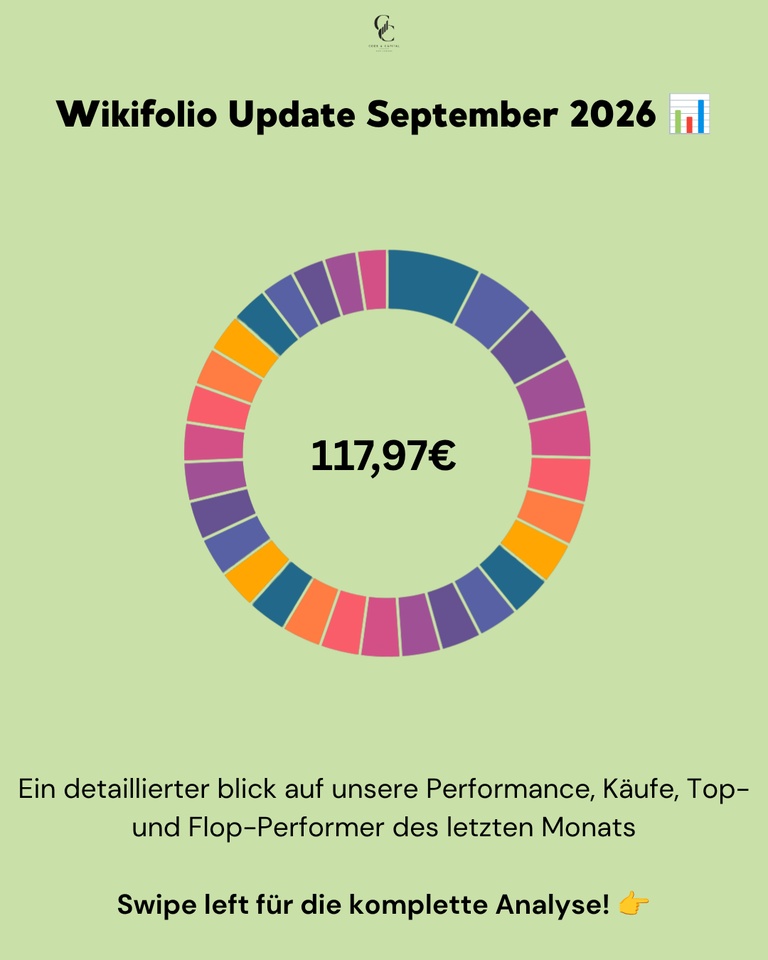
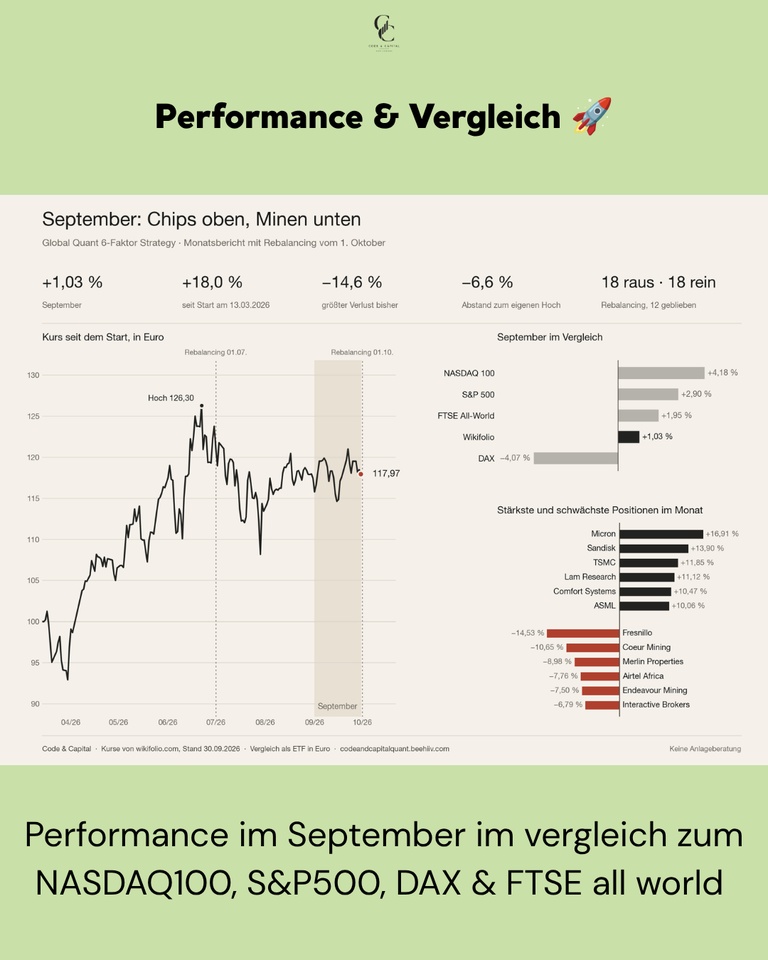
📊 Wikifolio Update September 2026: up 1.03%, tech stocks up, mining stocks down, and 18 of 30 positions swapped on October 1
In August, gold mines were the market's top performers. In September, they were the most expensive. Fresnillo
$FRES (-1,26 %) down 15 percent, Micron
$MU (+3,26 %) up 17. At the end of the month, the Wikifolio was up 1.03 percent, and one day later, I swapped out 18 of 30 positions.
September was all about interest rates and oil. Brent rose above $100 in the second week and, following a Saudi pipeline outage, briefly hit $110. U.S. inflation stood at 3.4 percent in August. On September 16, the Fed raised the benchmark interest rate by a quarter point to 3.75 to 4.00 percent, for the first time since July 2023. The 10-year U.S. yield subsequently climbed to 5.19 percent, a level last seen in 2007. This hardly bothered tech stocks. The Nasdaq hit a record high on September 21, and AMD has been worth one trillion dollars ever since. The situation was different in Europe. German inflation jumped to 3.3 percent, and the DAX lost about four percent over the month.
📊 Monthly performance: +1.03%
📊 Price as of September 30: €117.97
📊 Largest loss since inception: −14.6%
📊 Max performance: +18% (since March 13, 26)
Next rebalancing: Early January 2027
Performance & Comparison 🚀
The U.S. indices posted clear gains when calculated in euros, with the Nasdaq leading the way. The Wikifolio did not keep pace. It lagged behind the Nasdaq, S&P 500, and FTSE All-World, and outperformed only the DAX.
Performance Comparison (September 1–30, 2026, end of day):
Global Quant 6-Factor: +1.03%
NASDAQ 100: +4.18%
S&P 500: +2.90%
FTSE All-World: +1.95%
DAX: −4.07%
You can see what caused this in the two lists below. Tech stocks delivered, while mining stocks and a few individual stocks ate up a good chunk of those gains.
Purchases & Sales 💶
None in September itself. The model trades only on four dates per year, and the third was on October 1. What happened then is detailed in its own section below.
Top Movers in September 🟢
The month belonged to semiconductors and memory stocks. Midway through the month, Intel’s CEO said the company could currently only meet about half of the demand for processors. After that, the entire industry picked up steam. Micron
$MU (+3,26 %) topped the list with +16.91%, followed by SanDisk
$SNDK (+4,29 %) at +13.90% and TSMC
$2330 at +11.85%. Lam Research
$LRCX (+1,8 %) rose +11.12%, ASML
$ASML (+1,11 %) +10.06%. In between is Comfort Systems $FIX (+4,19 %) , a stock that has nothing to do with chips, up 10.47%. In August, Comfort Systems was still among the losers.
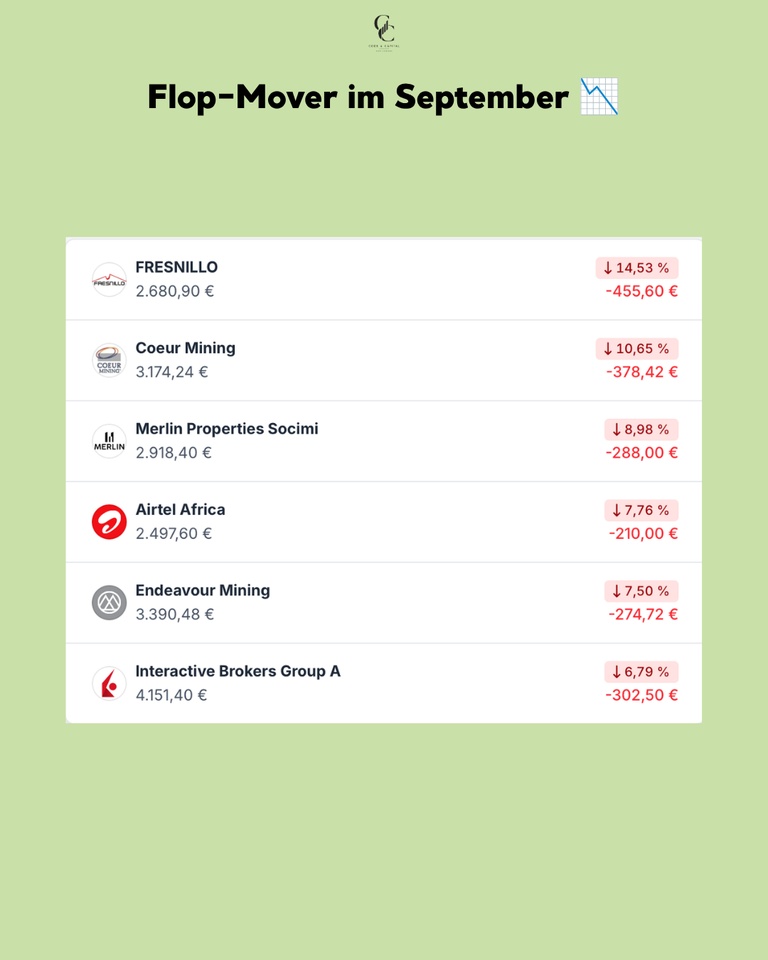
September’s Big Losers 🔴
Gold and silver declined in September, with silver falling much more sharply. Rising yields and a stronger dollar weighed on prices. Mining stocks followed suit. Fresnillo
$FRES (-1,26 %) lost −14.53%, Coeur Mining
$CDE (-0,8 %) −10.65%, and Endeavour Mining $EDV (-0,08 %) -7.50%. In August, all three were still on the other list with gains of over 25 percent. Merlin Properties fell −8.98%, Airtel Africa
$AAF (-0,15 %) down 7.76%, and Interactive Brokers
$IBKR (+1,03 %) fell by 6.79%.
Rebalancing on October 1 🔄
On October 1, the third rebalancing since the start took place. I swapped out 18 of 30 positions—more than ever before. In July, it was nine.
All nine banks are out: Bankinter
$BKT (+0,09 %) , CaixaBank
$CABK (-1,25 %) , BBVA
$BBVA (+0 %) , UniCredit
$UCG (-0,05 %) , BPER
$BPE (-0,34 %) , Monte dei Paschi $BMPS (-0,51 %) , Banca Mediolanum
$BMED (-0,46 %) , Swedbank$SWED A (+0,79 %) and HSBC
$HSBA (+0,61 %) . In addition, Interactive Brokers $IBKR (+1,03 %) , Antofagasta $ANTO (+0,48 %) , Coeur Mining
$CDE (-0,8 %) , AppLovin
$APP (-2,47 %) , Airtel Africa
$AAF (-0,15 %) , Merlin Properties and Solaria
$SLR (-0,21 %) . Investor AB
$INVE B (+0,53 %) and Pershing Square
$PSH (+0,89 %) are also no longer in the portfolio. So four of the six underperformers listed above are no longer in the portfolio.
Six stocks from the healthcare sector were added: Eli Lilly
$LLY (-0,7 %) , Bristol-Myers
Squibb
$BMY (-0,77 %) , Vertex $VRTX , Incyte
$INCY (+2,19 %) , Illumina
$ILMN (-0,88 %) and WuXi AppTec
$603259 . Five are from the semiconductor and storage sectors: Seagate
$STX (+3,19 %) , Marvell
$MRVL (+1,53 %) , Applied
Materials
$AMAT (+1,55 %), Teradyne
$TER (+2,97 %) and KLA
$KLAC (+1,59 %) . The rest is split among Fortinet
$FTNT (-1,59 %) , CF Industries
$CF (+0,14 %) , Marathon Petroleum
$MPC (+1,97 %) , APA
$APA (+1,16 %) , Pop Mart $9992 (+7,5 %) , Hong Kong Exchanges
$388 (-0,57 %) and Lion Finance
$BGEO (+1 %) .
Twelve remain: SanDisk, Micron, Western Digital, Nvidia, Lam Research, TSMC, ASML, Alphabet, Comfort Systems, Fresnillo, Endeavour and Newmont. All six of September’s top movers are included.
Two names stand out. Applied Materials and KLA I sold on July 1, up 92 and a gain of 90 percent. Now both are back in my portfolio. The model doesn’t remember what it has sold in the past. It only looks at where a stock stands in the ranking today.
Conclusion 💡
The portfolio looks different after October 1 than it did before. In September, about 41 percent was still in financial stocks; now there are two positions out of 30. Instead, 12 out of 30 are in semiconductors and memory, and six are in the healthcare sector. There’s no sector limit; the model sorts by score, not by industry. Trading won’t resume until early January.
How was your September? And did you hold onto your stocks after the pullback, or did you sell them? 👇
➡️ Every month, you’ll find the complete Wikifolio update here, along with research in between.
📈 Wikifolio $DE000LS9V052 (+1,22 %)

+ 1

Final portfolio, at least up to 100-120k for now
Dear Community,
I’d like to present my portfolio once again.
The core of my portfolio is the $VWRL (+0,1 %) which I contribute to monthly.
I also hold a few dividend-paying stocks such as $ALV (+0,1 %)
$MCD (-0,58 %)
$BMY (-0,77 %) and $TTE (+0,53 %) these stocks are my “dividend stocks”—to be honest, I don’t expect much in the way of returns from them, but they might still surprise me. As for $BMY (-0,77 %) I’m not quite sure yet whether I should hold onto this stock or focus more on growth in the healthcare sector— $SYK (-1,05 %) For example, looks interesting right now—it might even be my new employer in the future 😜.
Then I also have a bit of growth with dividends, though that’s not my main focus $TSM (+0,06 %)
$AVGO (+1,67 %)
$SU (+0,91 %) and $8001 (-2,02 %) Itochu is sort of a middle ground.
Last but not least, of course, $BTC (-0,2 %) to cover crypto.
Once I’ve adjusted the positions under $MCD (-0,58 %) the top holdings—with a target of about 5,000€ per stock for now and BTC at 3,000€—I plan to add new holdings in the form of $VST (+1,4 %)
$XYL (-1,35 %) and maybe again $RKLB (-0,85 %) , though other holdings are of course possible until then.
Thanks for your support, opinions, suggestions for improvement, etc.
Best regards and have a great start to the weekend,
Florian

Not a single one of those individual companies outperformed your ETF??
Past performance isn't an indicator of future results when it comes to investing, but...you can see that for yourself, right?
Best,
🥪

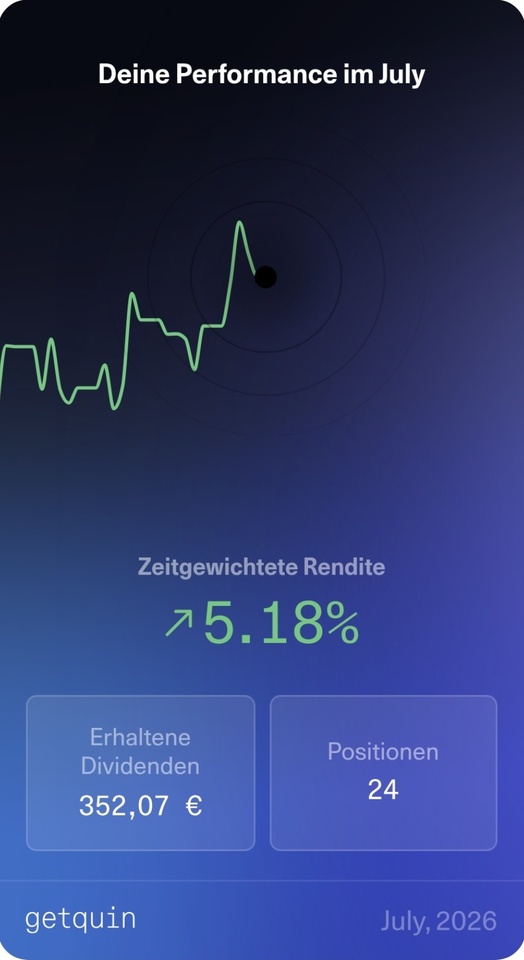
Wow, another green month 🫢
My biggest drivers of price movements in July were $ACN (-0,76 %)
$MSFT (-0,55 %)
$BMY (-0,77 %)
in the past few months I have aggressively invested $MSFT (-0,55 %) and tried to drawdown to my advantage. I closed out several positions and invested in MSFT . It remains to be seen whether I made the right move.
The stock is trading following the earnings at around €16,500 , and I feel very good about it.
What do you think after the results from $MSFT (-0,55 %) ?

Bristol Myers Dividend and Alleged Merger with AstraZeneca🦠💊💉
Rumors of an alleged merger between $BMY (-0,77 %) and $AZN (-0,44 %)
Both companies are in the oncology industry .
A merger of the two companies would create a company with a market value of $400 billion . This would also make it the 4th largest pharmaceutical manufacturer.
- Bristol Myers is facing impending patent expirations for blockbuster drugs such as Eliquis and Opdivo. A merger would significantly strengthen the pipeline of cancer therapies strengthen.
Skepticism at Astrashareholders: Many analysts are wondering whether AstraZeneca can handle this huge and complex undertaking at all, both financially and strategically.
At the moment, nothing is set in stone , but discussions are underway.
What is your opinion of Bristol and AstraZeneca shareholders?


It's an intriguing prospect, but I can't quite picture it happening right now.

Company Profile: Adaptive Biotechnologies
No frills 😬
Today we’ve got another post about your health 🤧
Let’s go!
Today we’re talking about the biotech company:
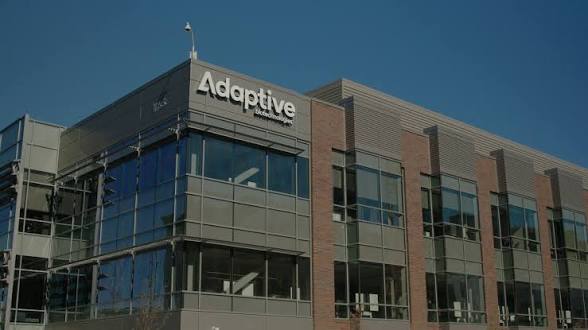
🧬 Adaptive Biotechnologies $ADPT (-0,32 %) : The indomitable immunological eye of cancer medicine
Adaptive Biotechnologies $ADPT (-0,32 %) is not a traditional biotech company that searches for new molecules on a whim. It is the global technological pioneer and infrastructure monopolist in the field of immune sequencing (the precise mapping of the human immune system). While pharmaceutical giants like Bristol Myers Squibb $BMY (-0,77 %) develop cancer therapies, Adaptive—with its flagship product clonoSEQ—provides the critical, high-precision “monitoring eye” that proves the success of these therapies in the first place.
They control the leading system for detecting minimal residual disease (MRD) in blood cancers—this is the ultra-detailed checkpoint that the oncology of the future cannot bypass.
1. The Business Model: Unleashing the MRD Monopoly 🔬⚙️📈
Adaptive $ADPT (-0,32 %) controls the market through a radically scalable, proprietary tech platform:
The clinical checkpoint (clonoSEQ): When a patient with multiple myeloma or leukemia is undergoing treatment, doctors want to know: Is the cancer really gone? Conventional methods miss one in 10,000 cancer cells. clonoSEQ detects one in a million cells.
The switching costs for oncologists and clinics are extremely high: Once a patient has been profiled with clonoSEQ and is under monitoring, the doctor cannot switch systems without destroying the historical comparability of the data.
“Design-in” protection in pharmaceutical trials: When approving new cancer drugs, the FDA increasingly requires proof of “MRD negativity.” Pharmaceutical companies use Adaptive as the standard endpoint for their clinical trials (such as the groundbreaking CEPHEUS trial). Once a regulatory trial has integrated clonoSEQ, Adaptive is firmly established as the exclusive diagnostic partner for the entire global lifecycle of that drug.
The monumental breakthrough in 2026 (focus on margins): For years, the stock suffered due to the Immune Medicine division (early-phase research with Microsoft), which devoured millions as a cash burner. In mid-June 2026, management dropped a bombshell: The unprofitable research segment will be completely spun off or partnered out separately by the end of the year. What remains starting in 2027 is a clean, highly profitable, extremely fast-growing pure-play diagnostics company (Pure-Play MRD).
2. Key Figures (As of Q1/Q2 2026 / FY Trend) 📊
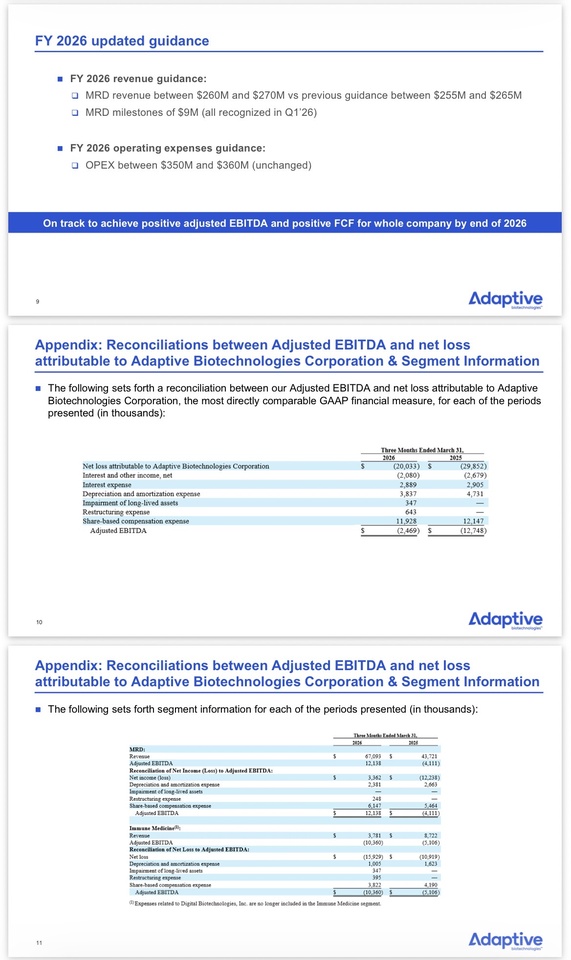
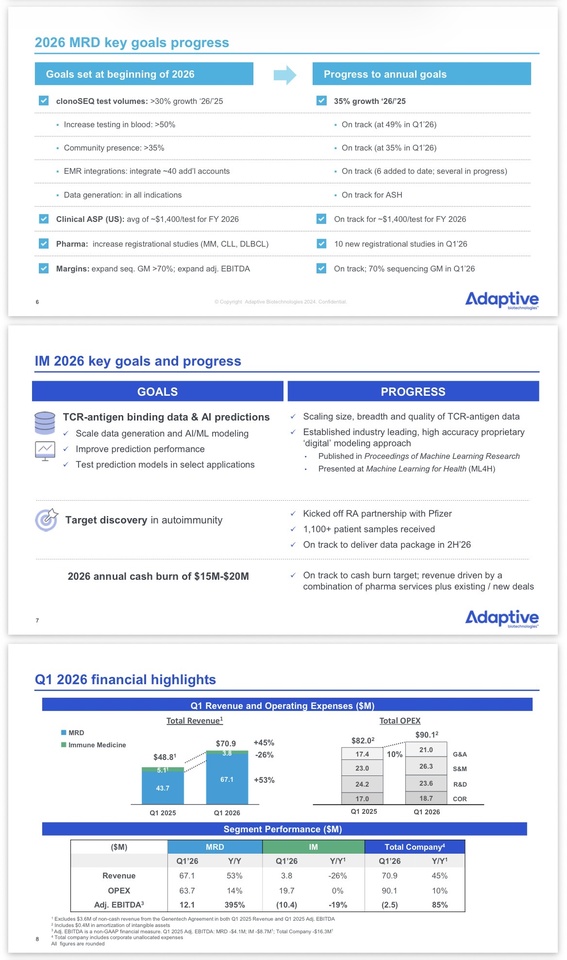
Revenue Base & Beat: Total revenue in the current Q1 2026, at $70.9 million, smashed analyst estimates by a massive 16.4%. For the full year, a core MRD forecast of $260 million to $270 million is on the table.
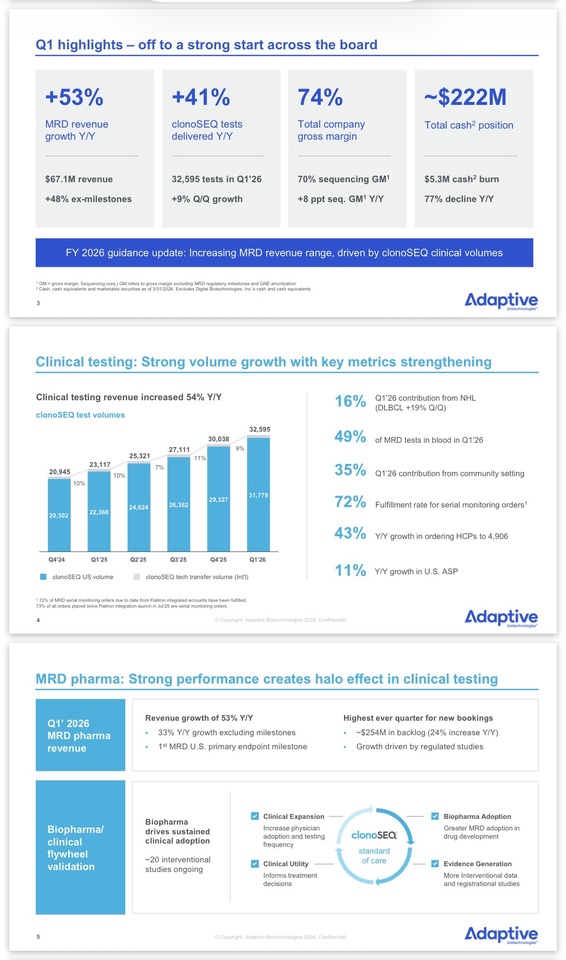
🚀Growth Explosion: The core MRD business is growing completely independently of economic conditions. In Q1 2026, MRD revenue surged by +53% year-over-year, driven by a +67% increase in volume for cancer tests in the U.S. private practice sector.
🚀Massive Software Margins: The sequencing gross margin climbed to a phenomenal 70.0% (+8% YoY) thanks to massive scaling. Once the labs are up and running, nearly every additional dollar of revenue flows through the income statement as pure profit.
🚀The Break-Even Point: At the corporate level, the loss has been almost completely eliminated (adjusted EBITDA in Q1 was a mere -$2.5 million). The MRD unit alone is already highly profitable (+$12.1 million in EBITDA). With the breakup set to be completed by the end of 2026, the company will become a highly profitable cash flow machine starting in 2027.
The $500 Million War Chest: With approximately $237 million in net cash from operations plus a $300 million convertible bond strategically placed in June 2026 (at a 0% coupon!), management possesses an impregnable financial fortress. Shareholder dilution is off the table for the next 10 years.
3. Why is the stock so exciting right now? 🚀
1. The catalyst for the breakout: The market is still valuing ADPT at a discount due to its past cash-burn periods. Once the spin-off of Immune Medicine is formally completed at the end of 2026, Wall Street will be forced to revalue the remaining 50% growth business using the premium multiples of high-end SaaS/diagnostics companies.
2. The Pharma Backlog Leverage: The contractually secured order backlog with pharmaceutical giants surpassed $254 million in the first half of the year (+24% YoY). This provides exceptional visibility into revenue for the next 36 months.
3. The Reimbursement Wave: More and more private and government U.S. health insurers (including Medicare) are adding clonoSEQ to their standard coverage for an increasing number of cancer types. This opens the floodgates to the mass market beyond high-end clinics.
4. Risks ⚠️
❗️Concentration risk in approval studies: If several major pharmaceutical partners were to unexpectedly halt their cancer studies, short-term data and sample revenue in the B2B segment would suffer
❗️FDA Regulatory Requirements: The FDA is currently tightening controls on so-called Lab-Developed Tests (LDTs). Adaptive is ideally positioned here thanks to its already extremely high level of clinical validation, but regulatory delays will cost time
❗️One-time restructuring costs: The physical and accounting separation of the two parts of the group will weigh on the remainder of 2026 with one-time effects
5. Reaper Rating 💀
Jack’s Verdict:
“Adaptive Biotechnologies $ADPT (-0,32 %) is the perfect example of a high-yield cash cow that was buried under a convoluted corporate structure. Anyone buying ADPT now is buying the undisputed cancer-monitoring monopoly of the future at the very moment of its great breakthrough.
Forget the classic biotech gamble, where you hope a Phase 2 pill doesn’t fail. Buy the device that everyone must use to prove the pill’s success. For years, Adaptive Biotechnologies $ADPT (-0,32 %) was, for years, the stock about which people said, “Brilliant product, but the cash burn is killing me.” With the radical M&A breakup in June 2026, management has blown away precisely that millstone. They raised $300 million via a zero-percent-interest convertible bond and spun off the unprofitable division. What remains is a flawless cancer-testing business with a 70% margin and over 50% growth. At prices around $21, the stock is simply undervalued given what it will represent starting in 2027. This is the entry point before the major institutional revaluation.”
Reaper Rating: 🔥 STRONG BUY (Diagnostics Growth / Strategic Breakup Winner)
Reaper Score: 8.4/10 (Justified by the breathtaking 70% product margin, 53% core growth, and the complete elimination of balance sheet risk through the $300 million zero-coupon refinancing in June).
@Get_Rich_Or_Die_Tryin @Raketentoni
@Tenbagger2024
@Stocktective
@schlimmschlimm
@Multibagger and, of course, all other users are warmly invited! 🫶✌️