Hello, everyone,
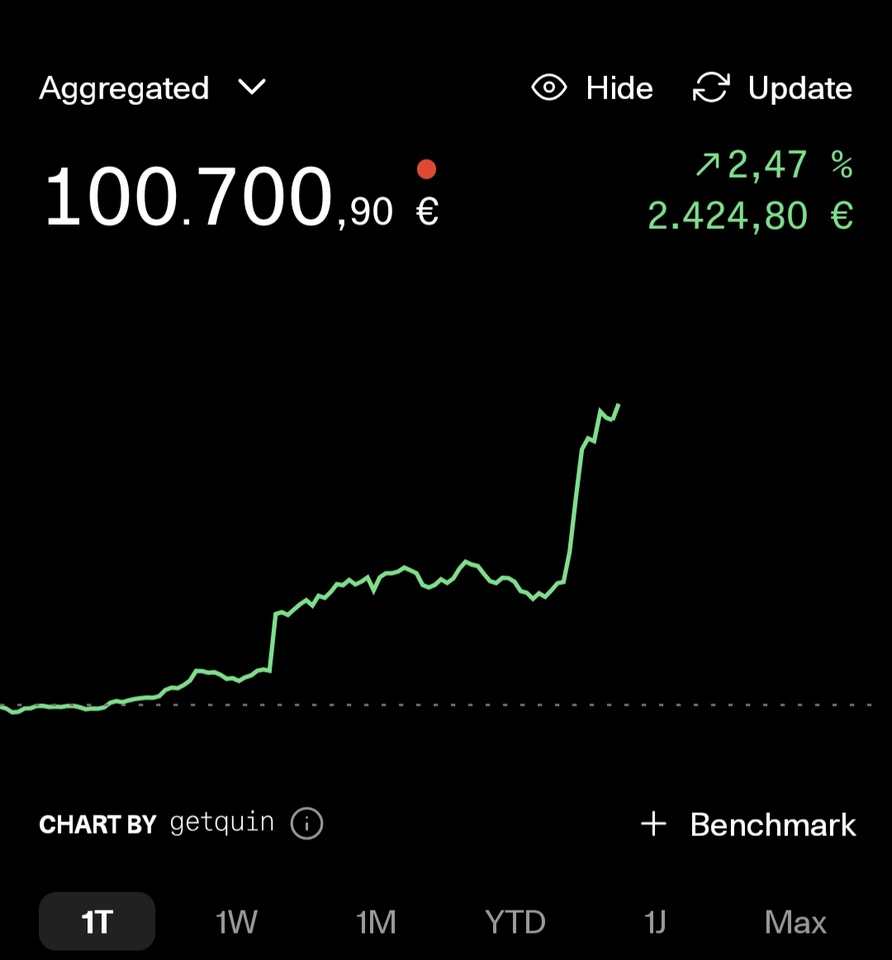
In my last post, I explained my investment strategy for the 2036 portfolio, focusing on technology and humanoids.
Today, I’ll explain exactly why I’m invested 50% in this sector—and which other sectors I have equally high expectations for.
I’ll try to explain this using the investment wave .
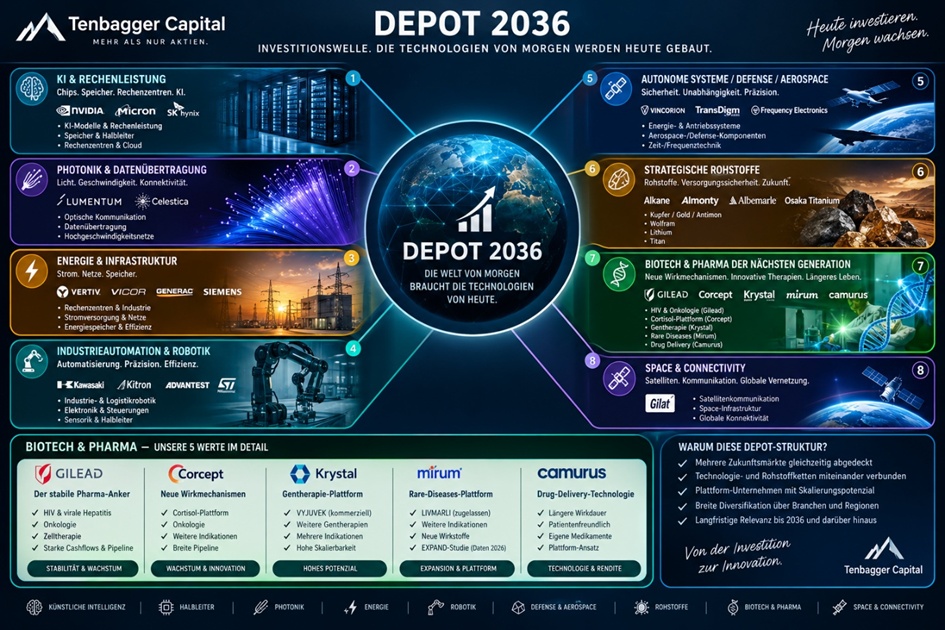
INVESTMENT WAVE 2036
The technologies of tomorrow aren’t just emerging tomorrow.
They’re being built today.
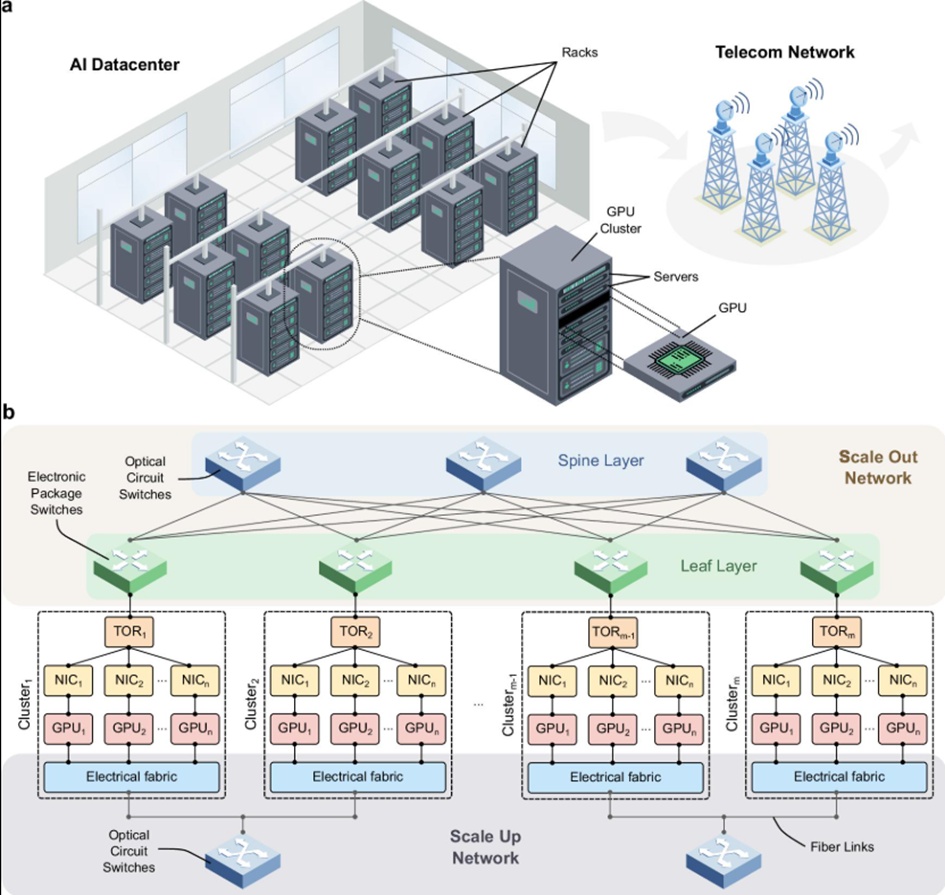
Data centers.
Semiconductor factories.
Power grids.
Energy storage.
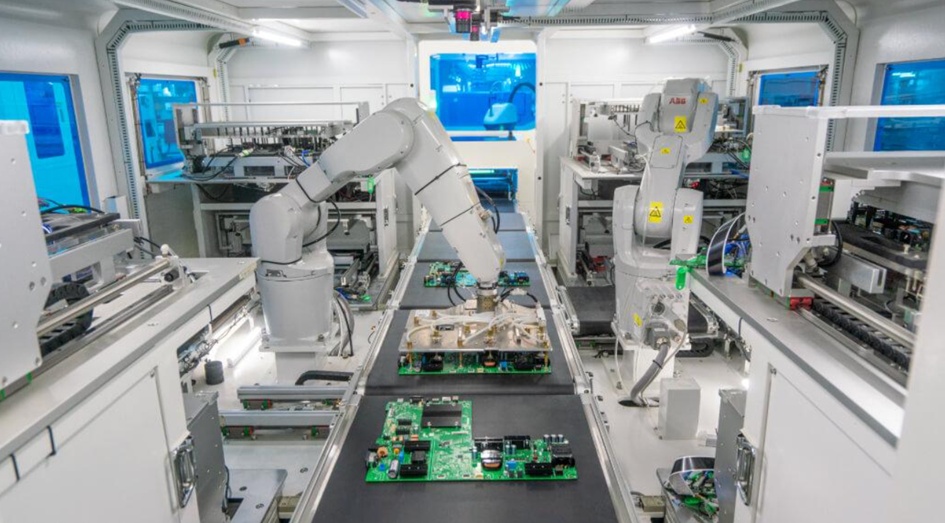
Robotics.
Photonics.
Water infrastructure.
Strategic raw materials.
Today’s investments are tomorrow’s technologies.
And that’s exactly where we want to invest:
Not just in the finished products—
but in the infrastructure, components, raw materials, and technologiesthat make their development possible in the first place.
Depot 2036—investing before the future comes into view.
If we apply this to my investment horizon, which extends to around 2036 , I wouldn’t just look at individual sectors, but at the major structural waves of investment. I find these areas particularly interesting:
Sector
Growth Drivers
2036 Potential
🤖 Robotics & Physical AI
Humanoids, industrial/logistics robots, autonomous systems
🔥🔥🔥🔥🔥
🧠 AI & Data Centers
AI models, inference, cloud, agents
🔥🔥🔥🔥🔥
⚡ Power Grids & Energy Infrastructure
Data centers, electrification, grid expansion
🔥🔥🔥🔥🔥
🔬 Semiconductors & Semiconductor Equipment
AI, Robotics, Autos, Industry
🔥🔥🔥🔥🔥
🌐 Photonics / Optical Communications
Data transmission within and between data centers
🔥🔥🔥🔥🔥
🛡️ Cybersecurity & Digital Identity
AI agents, cloud, increasing attacks
🔥🔥🔥🔥
🧬 Biotech / Innovative Pharmaceuticals
New mechanisms of action, precision medicine
🔥🔥🔥🔥
🛰️ Autonomous Systems / Defense Tech
Drones, Sensors, Navigation, Electronic Systems
🔥🔥🔥🔥
🔋 Energy Storage
Grid expansion, renewable energy, data centers
🔥🔥🔥🔥
🏭 Industrial Automation
Skilled Labor Shortage, Productivity, Reshoring
🔥🔥🔥🔥
🔩 Strategic Raw Materials
Growing demand, but at the same time significant concerns about supply
🔥🔥🔥🔥
💧 Water / Wastewater
Applications range from semiconductor factories to batteries and
specialty metals to power plants and data centers.
🔥🔥🔥🔥
The most important connection for me
I would even view these topics view them as a single, large investment chain :
AI
→ requires data centers
→ require chips
→ require Photonics
→ require an enormous amount of electricity
→ require grids & storage
→ and more and more automation/robotics.
And that’s exactly why my portfolio is structured this way: I’ve already covered many of these sectors.
🦾 Particularly exciting: Robotics + AI
In my opinion, Physical AI could become one of the next major expansions of the AI wave.
Today:
AI → Software → Screen
Tomorrow, increasingly:
AI → Robots → Real World
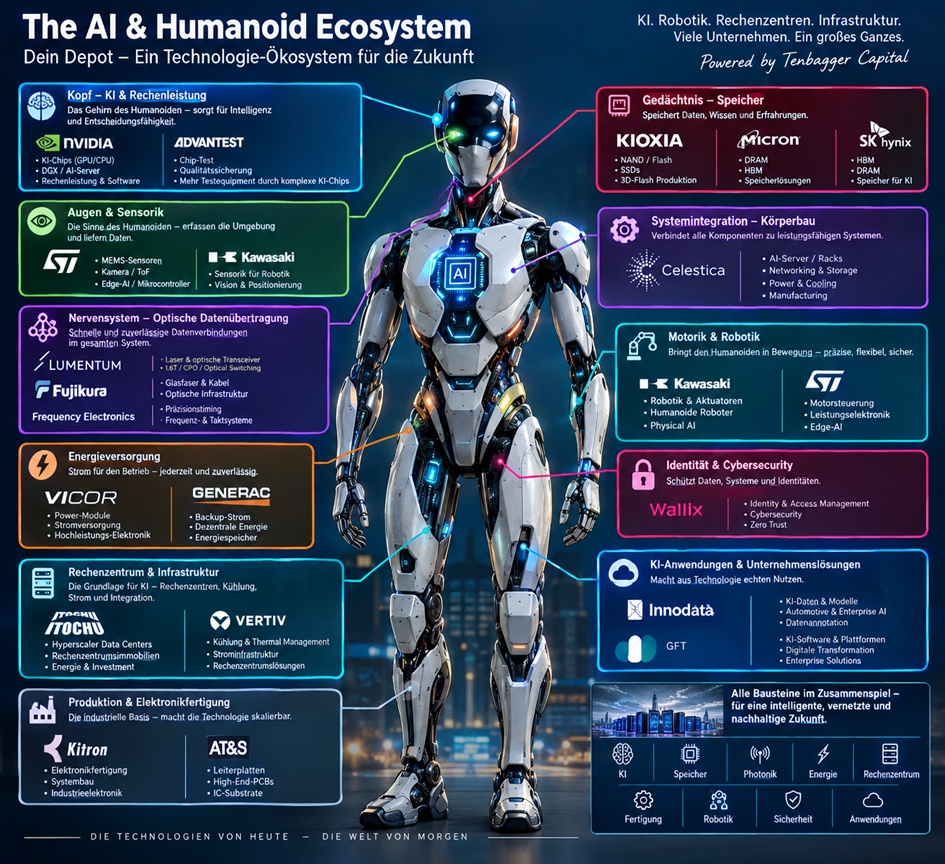
Then companies will become interesting—not necessarily those that build humanoid robots themselves, but rather motors, sensors, cameras, semiconductors, control systems, power supplies, communication chips, and manufacturing electronics .
For example, in my portfolio I currently hold I hold Advantest, STMicroelectronics, Lumentum, Kitron, Celestica, and Vicor in various parts of the value chain.
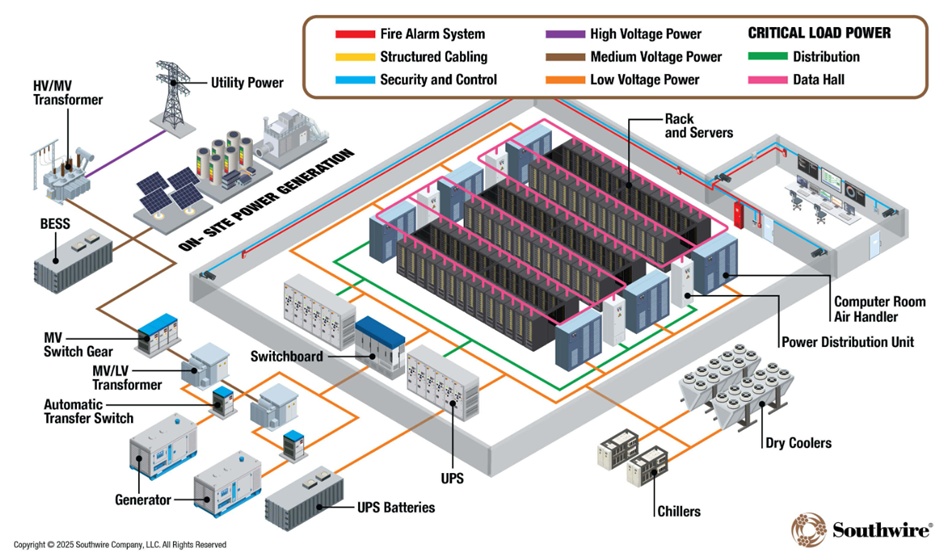
⚡ And one area is, in my opinion, often underestimated: electricity
The AI boom is generating a somewhat unusual second boom:
more AI
→ more computing power
→ more data centers
→ more electricity consumption
→ more generators
→ more storage
→ more grid technology
→ more power electronics.
That’s why you’ll find, for example, Generac, Vertiv, and Vicor in my portfolio—not just as individual companies, but as parts of this overarching trend.
🔬 My long-term “growth pyramid”
When I look at my portfolio from this perspective, I’ve structured it roughly as follows:
1. AI / Computing Power
Nvidia · Micron · SK Hynix · Advantest
2. Photonics / Data Transmission
Lumentum · Celestica
3. Energy for AI Infrastructure
Vertiv · Vicor · Generac · Siemens
4. Robotics / Physical AI
Kitron · Advantest · STMicroelectronics · Celestica
5. Cybersecurity / Digital Identity
Wallix
6. Biotech / New Drugs
Mirum · Corcept · Krystal · Camurus · Gilead ·
7. Commodities
Alkane Resources · K92 · Almonthy ·
8. Emissions Control, Filtration, Water Treatment, Fluid Handling, and Acoustic Solutions.
CECO
9.
Autonomous Systems / Defense Tech
Vincorion · TransDigm · Frequency Electronics
My commodity stocks:
Stock
Commodity Exposure
My Outlook for 2036
Alkane Resources
🥇 Gold + Copper + Antimony
⭐⭐⭐⭐⭐
K92 Mining
Gold
⭐⭐⭐⭐
Almonty Industries
Tungsten
⭐⭐⭐⭐⭐
Osaka Titanium Technologies
Titanium
⭐⭐⭐⭐
🥇 I find alkanes particularly interesting
When it comes to alkanes , you get several resource themes at once:
Gold → monetary/geopolitical hedging
Antimony → strategic/defense-related raw material
Copper → Electrification, power grids, data centers, robotics
And especially copper is an excellent fit for the rest of my portfolio.
S&P Global, for example, expects that demand for copper from data centers alone will rise from approximately 1.1 million metric tons in 2025 to 2.5 million metric tons in 2040 . At the same time, the IEA emphasizes that copper is one of the more problematic critical minerals when it comes to supply security.
For Alkane, this means:
AI → data center → electricity → copper → Alkane/Boda-Kaiser
This is a very interesting connection to my previous portfolio thesis.
🥈 Almonty – also very exciting to me
Almonty is not a traditional copper/gold stock, but rather tungsten.
And I view tungsten as an interesting strategic commodity for the long term because it’s used, among other things, in hard metals, tooling, industrial applications, and defense .
This gives my portfolio a different kind of commodity exposure than alkanes do.
Alkane = Gold/Copper/Antimony
Almonty = Tungsten
This diversifies my commodities portfolio quite well.
🥉 K92 Mining
K92 is essentially my gold component.
It’s less directly tied to my AI/robotics growth story, but gold can serve a different purpose in the portfolio. The World Gold Council continues to expect strong investment demand and sustained central bank purchases through 2026; at the same time, mining supply responds only relatively slowly to high prices.
I would therefore view K92 more as a gold/commodity and diversification component than as a beneficiary of AI.
And then there’s Osaka Titanium
I find that quite interesting because titanium represents a completely different growth trajectory :
Aviation + High-Tech + Defense + Industrial Applications
This gives me a strategic material in addition to energy and electrification raw materials.
This covers several structural themes:
🖥️ AI
↓
⚡ Electricity & Grids
↓
🟠 Copper
↓
🏭 Industry / Robotics
↓
🛡️ Defense
↓
🔩 Strategic raw materials
And that’s exactly why I don’t see raw materials in my 2036 portfolio as anything less than a priority . In some cases, they even form the “bottom layer” of my entire future-technology thesis.
I find the combination of Alkane + Almonty + Osaka Titanium particularly interesting, because with this combination I’m not making the same commodity bet three times over, but rather combining copper/gold/antimony + tungsten + titanium .
💧 Water / Wastewater
Among other things, CECO provides emissions control, filtration, water treatment, fluid handling, and acoustic solutions. Applications range from semiconductor factories to batteries and specialty metals to power plants and data centers.
Of particular interest: data centers
This is where I see the connection to my Depot-2036 particularly clearly.
In 2025, CECO received an order worth over $135 million for a large natural gas power plant in Texas that supports the expansion of data centers. The company explicitly identifies data centers as an attractive growth market.
https://investors.cecoenviro.com/news-releases/news-release-details/ceco-environmental-secures-record-order-exceeding-135-million?utm_source=chatgpt.com
🔩 And now the connection to my commodity stocks
This is where CECO becomes even more interesting to me.
For example, I hold:
Alkanes → Copper / Gold / Antimony
Almonty → Tungsten
Osaka Titanium → Titanium
These companies supply materials.
CECO, on the other hand, is one step further up the industrial value chain:
Raw materials → Processing → Factory → Environmental/water/emissions systems → End product
According to its own reports, CECO serves, among others, specialty metals as well as aluminum and steel production and other energy-intensive industries.
This means that if, between 2030 and 2036, there are more semiconductor factories, data centers, power plants, battery facilities, and metal processing plants are built worldwide, we will not only need chips and raw materials—we will also need the infrastructure to ensure these facilities are permitted and able to operate at all.
This would make CECO in my portfolio a sort of bridge company between AI, energy, industry, and raw materials.
And it’s precisely these kinds of companies that I find interesting for a 2036 portfolio: not the obvious winner of the trend, but a supplier that can benefit from several waves of investment at the same time.
🛰️ Autonomous Systems / Defense Tech
/ Aerospace
Portfolio holdings:
Vincorion - ⚡ Power, propulsion, and stabilization for military platforms
TransDigm - ✈️ Highly specialized aerospace and defense components
Kawasaki - 🤖 Robotics + autonomous systems + aerospace/defense
Kitron - 🔌 Electronics / System Integration / Autonomous Systems
Frequency - 📡 Precision time and frequency technology for critical systems
Gilat - 🛰️ Space / Connectivity / Satellite Communications
Vincorion is particularly interesting in this regard
Vincorion is not just a traditional defense supplier. The company develops energy and mechatronics systems for defense platforms, including power supplies, propulsion systems, and stabilization systems. These systems are used, for example, in the Leopard 2, Puma, and Boxer.
Even more exciting for my autonomous vehicle thesis: Vincorion is working on mobile energy systems that can also power drones and unmanned ground vehicles . At the 2026 Eurosatory exhibition, for example, power systems were showcased alongside an unmanned ground vehicle.
And the company’s operational performance is currently remarkable: In the first half of 2026, revenue rose by 42.4%, and order intake rose to €330.2 million , and the order backlog to approximately €1.2 billion. Vehicle Systems (+72%) and Power Systems (+41.1%) posted particularly strong growth.
https://vincorion.com/vincorion-steigert-umsatz-und-ergebnis/?utm_source=chatgpt.com
TransDigm is a little different
At TransDigm , I see less of a direct “autonomy” story and more of:
Aerospace + Defense + highly specialized components + long-term platform commitment.
TransDigm develops and manufactures a very wide range of components and subsystems for military and civilian aircraft—from actuators and control systems to pumps, valves, avionics, and safety systems. According to the company, there is at least one TransDigm product on nearly every commercial or military aircraft in service.
This makes TransDigm, in my view, more of an aerospace/defense compounder within the infrastructure chain, whereas Vincorion is more strongly focused on the energy, mechatronics, and platform sectors .
🧬 My Biotech/Healthcare Stocks
Company
2036 Thesis
Opportunity
Main Risk
Krystal Biotech
Gene therapy platform → multiple products
🚀🚀🚀🚀🚀
Clinical failures / Pipeline
Mirum Pharma
Rare Diseases → multiple indications
🚀🚀🚀🚀🚀
Focus on a few active ingredients
Corcept
Cortisol platform + oncology
🚀🚀🚀🚀
Approval / Pipeline / Valuation
Camurus
Long-acting drug delivery + proprietary drugs
🚀🚀🚀🚀
Competition / PipelineG
Gilead
HIV + Oncology + Cell Therapy + Additional Pipeline
🚀🚀🚀
1. 🥇 Krystal – in my view, the strongest “platform bet”
I see a unique feature here that will be key for 2036 .
With VYJUVEK and is building a pipeline of genetic drugs based on it. In Q2 2026, VYJUVEK revenue totaled $119.2 million; at the same time, the company had approximately $1.1 billion in cash and investments. Several other programs are expected to deliver clinical data in 2026.
So the key question is not just:
“How big can VYJUVEK get?”
but rather:
“Can Krystal adapt its gene therapy platform to treat multiple diseases?”
If that works, the investment story changes fundamentally.
2036:
VYJUVEK → additional gene therapies → multiple indications → platform company
That is exactly the kind of scalable technologythat fits my “Today’s investments → Tomorrow’s technologies” thesis.
2. 🧬 Mirum—perhaps the most underrated of my biotech holdings
I like Mirum for 2036 primarily because of the expansion of an existing platform.
LIVMARLI is already approved, and at the same time, Mirum is working on other rare liver diseases. The Phase 3 EXPAND trial has completed patient enrollment; topline data are expected in Q4 2026.
In addition, Volixibat and Brelovitug. At the 2026 EASL Congress, Mirum reported, among other things, positive data on these programs.
This results in:
existing drug
↓
additional indications
↓
new active ingredients
↓
Larger rare disease platform
To me, this is an attractive 2036 mechanism.
3. 🧪 Corcept – an extremely interesting development
Corcept is now much more than a single-product story.
In 2026, Lifyorli was added to its oncology portfolio. In the second quarter, Corcept generated $256.1 million in revenue (+32%), of which $47.6 million came from Lifyorli sales. The 2026 revenue forecast was raised to $1.1–1.2 billion .
And the pipeline is quite broad: it includes Cushing’s syndrome, various cancer indications, ALS, and MASH.
It’s also interesting that Corcept resubmitted the NDA for Relacorilant for Cushing’s syndrome in June 2026, after the FDA had requested additional analyses.
So here’s my take on CORT:
Cortisol research
→ Endocrinology
→ Oncology
→ Neurology
→ Metabolism
This is a rather interesting mechanism-of-action platform.
4. 💊 Camurus – a different approach
I wouldn’t primarily view Camurus in the 2036 portfolio as a “new drug per disease.”
What sets it apart is its drug delivery technology —that is, the ability to administer drugs in a way that maintains efficacy longer and is more patient-friendly.
This can be strategically interesting because the technology isn’t necessarily tied to a single active ingredient.
For me, Camurus is therefore more of a:
pharma + technology platform
rather than a traditional biotech bet.
5.🏛️ Gilead Established pharma/biotech core
Gilead brings something to my portfolio that smaller biotech companies don’t offer to the same extent:
cash flows + established drugs + a large research pipeline.
Gilead is particularly strong in HIV and viral hepatitis and is expanding its oncology division through cell therapy and other therapeutic agents. As a result, I view GILD in my 2036 portfolio more as a stabilizing pharmaceutical anchor, whereas Krystal, Mirum, and Corcept are more dependent on individual pipeline successes.
This gives me, within the healthcare sector, various technological approachesrather than betting five times on the same biotech play.
And when it comes to biotech, I’d always keep the downside in mind: A good platform does not protect against clinical failures. That’s precisely why the combination of already commercialized products (Krystal, Mirum, Corcept) and different mechanisms of action/technologies is relevant for risk assessment.
The exciting thing about this is: I don’t just own AI stocks. I also own parts of the infrastructure behind AI, robotics, and electrification.
If your goal is also 2036 , I would therefore focus less on the next “hot” individual trend and more on companies that can benefit from several of these growth chains at the same time.
My friends,
please let me know in the comments how you like my 2036 portfolio.
And feel free to share your strategy for the future as well.