
$SDIP (-0,93%) It's fallen nearly 5% today—is this a buying opportunity? (In my opinion, the Brazilian market seems to be the cause.) The question is, is the outcome of the presidential election really that decisive, or is this an overreaction?

Global X SuperDividend ETF
ETP
ETP
ISIN: IE00077FRP95
Ticker: SDIP
IE00077FRP95
SDIP
Price
Discussão sobre SDIP
Postos
22
4Mês·
Trying to balance growth and dividend investing.
I'm trying to find the right balance between ETFs and individual stocks.
My long-term goal is to build wealth steadily over the next 20–30 years, while still owning a handful of individual companies that I believe in.
Over time, I'd also like to shift my portfolio towards a stronger dividend focus, without sacrificing too much long-term growth.
Looking at this portfolio:
- Is there anything that stands out to you?
- Are there any positions you think are unnecessary, overweight, or missing?
I invest €3,500 every month through my ETF savings plan:
$VWRL (-0,34%) = 800 euro
$WSML (+0,57%) = 300 euro
$PRAM (-0,18%) = 300 euro
$JEGP (+0,07%) = 325 euro
$STHE (+0,13%) = 325 euro
$BTCE (+0,06%) = 100 euro
$SDIP (-0,93%) = 300 euro
$WINC (-0,59%) = 350 euro
$LDGL (+0,15%) = 350 euro
$TDIV (+0,02%) = 350 euro
What would you change first, and why?
Always interested in constructive feedback.
31Posições
€ 43.967,56
8,59%
55
3 Comentários
Poor Dad@PoorDad
4Mês
•
11
•
7Mês·
February update
Almost forgot about the february update.
Starter looking more into dividend growth stocks and changed a bit of my persepective on my portfolio. Decided for the long-run this is (I think) more efficient for me. So I bought a lot of dividend growth stocks and ETF's and sold some of the high-dividend ETF's/Stocks:
Bought:
$SEL (+0,49%)
$EUHD (+0,2%)
$FUR (+3,91%)
$WINC (-0,59%)
$AGN (+0,08%)
$INRG (+2,12%)
Sold:
$SDIP (-0,93%)
$PNL (+2,16%)
$RWS (+1,05%)
$PETR3 (-5,41%)
Dividends received this month: €35,09
Dividends per montly average: €45,43
See you next month!
77
9Mês·
January update
Actually invested a lot this month. Not only focussing on the dividend part, but also diversifying my portfolio with some ETF's in other sectors.
Bought: $SDIP (-0,93%)
$CVC (+6,93%)
$IH2O (+1,28%)
$MO (-1,27%)
$DEFS (+0,37%)
$HDRO (+0,18%)
$VWCE (-0,37%)
Increasing my monthly dividend from €28,67 to €37,25

9Mês·
Global X SuperDividend ETF
SDIV delivered an impressive 23.70% total return in 2025—combining 12.87% price appreciation plus consistent monthly dividend payments totaling $2.305/share.
Why It Stands Out:
✅ Monthly payouts averaging $0.19–$0.20 per share
✅ Attractive 10.83% dividend yield
✅ Globally diversified across 100 high-yield stocks—70% non-US exposure
✅ Efficient at just 0.45% expense ratio
✅ Strong price momentum throughout the year
Important Note:
Dividend distributions declined slightly vs 2024 ($2.336→$2.305), which is normal in high-yield markets. This works best as part of a broader dividend strategy rather than a standalone holding.
The Verdict:
Solid capital gains paired with reliable monthly income—exactly what you want from a dividend ETF. Strong execution in 2025.
Currently holding SDIV or thinking about it? Share your thoughts below.


10Mês·
Savings plan and strategy for 2026+ adjusted
Hi, I've already told you about my savings plan strategy in the last few days, but I've now adapted it a bit after devouring some interesting books on the subject of savings plans and ETFs over the past few days.
My plan is now as follows: I will invest 122 euros per week in the following components via weekly savings plans (due to the cost-average effect):
$SDIP (-0,93%) with EUR 5
$CSCO (-2,67%) with 5 EUR
$NOVO B (+0,83%) with 10 EUR
$ALV (+0,41%) with 10 EUR
$SAP (-0,91%) with 10 EUR
$TDIV (+0,02%) with 12 EUR
$ESE (-0,61%) with 15 EUR
$VHYL (+0,01%) with 25 EUR
$VWRL (-0,34%) with 30 EUR
This is a mixture of distributing and accumulating dividends, most of which will be reinvested (as planned). I did a bit of math (assuming that I don't increase the savings flow, i.e. thinking defensively) and calculated the worst case (i.e. only the savings installments without reinvesting the dividends paid out) and the best case (on the basis). This then resulted in an additional pension (tax-adjusted according to current assumptions) of between 300 and 700 euros when you retire... It's your own fault if you start late with something like this, but otherwise it's better than nothing.
In addition, there will probably be increases in the savings plan over the years (through salary increases and the like) as well as one-off investment injections through, for example, tax refunds on income tax or other "special payments" that are not integrated into the monthly income, so that the path here is probably a little over the 700 euros... Oh yes, the income is now the pure dividends that come from retirement - no sales proceeds are included.
Personally, I'm quite happy with this as a basis on which to build... Together with the Riester pension, company pension and possibly the state pension (if it still exists in 17 years' time), this should hopefully be enough to survive :-)
66
14 Comentários
Of course, you can (and should) do whatever you like when investing.
But please, please tell us what you read in which book that led you to invest in $SDIP?? 😳
Greetings
🥪
But please, please tell us what you read in which book that led you to invest in $SDIP?? 😳
Greetings
🥪
•
1414
•
10Mês·
Enabling attractive dividend pensions with shares and ETFs
Making wise use of saved capital during retirement requires careful planning—especially if you intend to draw regular income from it to secure or enhance your quality of life in your later years.
Financial advisors often recommend a pension plan based on a lump-sum payment, often referred to as an “immediate annuity.”
With a normal life expectancy, the return is usually not very high, because insurers typically invest very conservatively. In addition, the insurance company’s costs and profit margins further reduce the return. Consumer advocates point out that you generally have to live to age 94 or older before you recoup your initial investment through guaranteed annuity payments.
It’s often more profitable to park that money in a money market account.
One alternative is investments with regular distributions. Investors are spoiled for choice among several thousand dividend-paying equity funds.
What are the key selection criteria? Quality and cost structure.
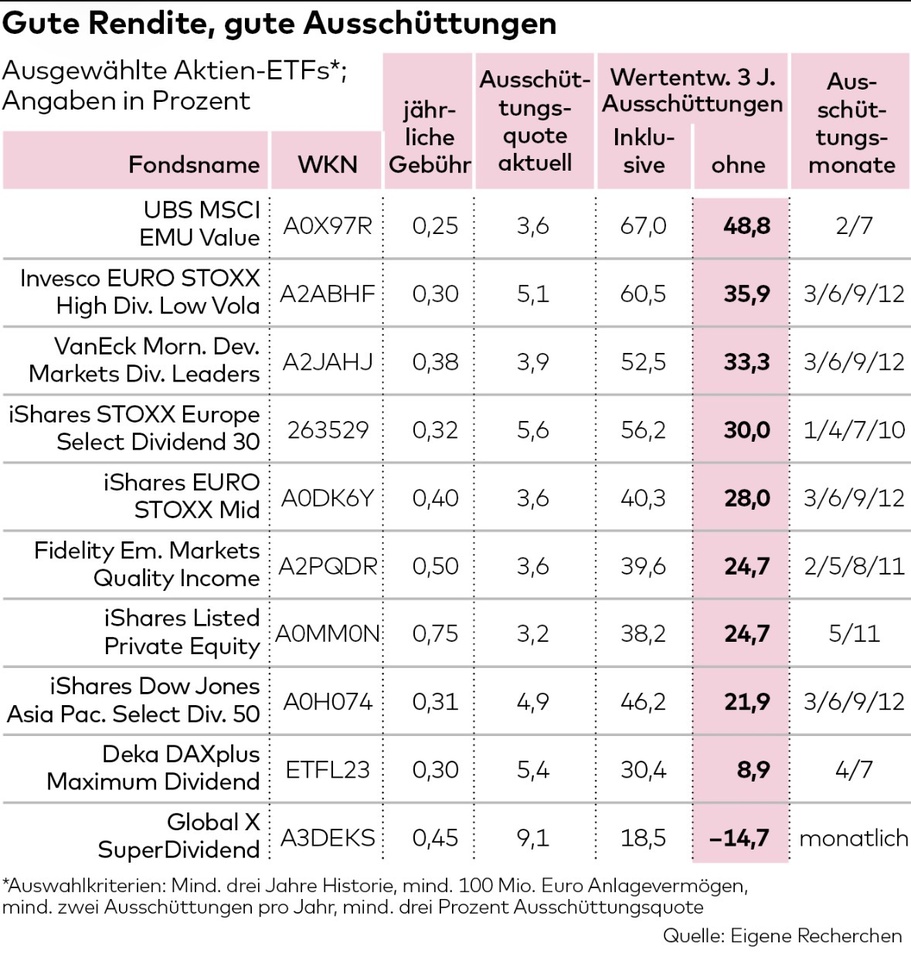
For some, the amount of the distributions may also be an important selection criterion. But caution is advised here: For example, the payout ratio of the Global X Super Dividend ETF $SDIP (-0,93%) currently stands at over nine percent. With an investment of 100,000 euros, this results in a monthly income of at least around 750 euros, before taxes.
This is possible because the ETF invests exclusively in the 100 companies with the highest dividends worldwide, without taking into account the sustainability of these payouts or the quality of the companies.
Consequently, the ETF has generated a return of zero over a one-year period and even a negative 14 percent over three years, excluding dividends. Investors thus received high regular payouts, but their principal has decreased significantly in the meantime.
Savers should therefore definitely pay attention to how the ETF invests. There are various positive counterexamples, such as the Invesco Euro Stoxx High Dividend Low Volatility ETF $EUHD (+0,2%). While this ETF also focuses on high-dividend companies, it additionally selects them based on qualitative criteria. Result: Although the payout ratio is currently “only” 5.1 percent per year—which amounts to about 425 euros per month, before taxes, on an investment of 100,000 euros—
In addition, the ETF has achieved growth of just under 36 percent over the past three years; including distributions, the return was actually over 60 percent. Similarly strong ETFs are also available for various other investment regions or sectors.
Bond ETFs, on the other hand, are rarely a viable alternative for retail investors. While they can also yield distribution rates of four or five percent, this is ultimately only possible through high-risk bonds or U.S. securities with corresponding currency risk. Furthermore, it is rare to achieve a positive return beyond the distribution itself.
A (potentially riskier) alternative is investing in individual high-dividend stocks. Here, however, quality is even more critical. “We prioritize companies with a strong balance sheet that are characterized by a high equity ratio as well as above-average returns on equity and sales,” says Franz Kaim of Kidron Asset Management in Stuttgart.
Furthermore, consistency is important. “The so-called dividend aristocrats are the gold standard for income-oriented investors,” says Rainer Laborenz, managing partner at Azemos Vermögensverwaltung in Offenburg. “Companies that have increased their dividends for at least 25 consecutive years are admitted to this select group.”
There are currently around 150 dividend aristocrats worldwide, 117 of which are from the U.S. and 33 from the rest of the world. Among the best-known names are Coca-Cola $KO (+1,48%), Procter & Gamble $PG (+1,16%) and Johnson & Johnson $JNJ (-1,6%) from the U.S., and from Germany, Fresenius $FRE (+2,27%) and Unilever $ULVR (+1,94%) from the United Kingdom.
Other attractive dividend stocks recommended in a WELT survey of ten leading asset managers include, for example, Allianz $ALV (+0,41%), BASF $BAS (+0,09%), Beiersdorf $BEI (+1,35%), Deutsche Post $DHL (+1,28%) and Munich Re $MUV2 (+0,44%).
In other European countries, they are focusing on companies such as BAT $BATS (+0,75%), BP $BP. (-4,91%), Nestlé $NESN (+1%), NN Group $NN (-0,69%), Shell $SHEL (-3,31%) , and Swiss Life $SLHN (+0,65%).
In the U.S., these include companies such as Altria $MO (-1,27%), Chevron $CVX (-3,18%), Cisco $CSCO (-2,67%), Coca-Cola, Kimberly-Clark $KMB (+0,4%) , McDonald’s $MCD (+2,27%) , and Pepsi $PEP (+1,84%).
Source: Text (excerpt) & table: Welt, Dec. 5, 25
2626
9 Comentários
10Mês
If the contribution of investment income outside of an insurance cover with the pension fund is introduced, this will all be a waste of time. I'm surprised that everyone under 50 isn't setting fire to the Chancellery.
When the Commission puts its (Bärbel Bas) cards on the table at the end of Q2, the Union will slip below 18%.
When the Commission puts its (Bärbel Bas) cards on the table at the end of Q2, the Union will slip below 18%.
•
1414
•1Ano·
Global X SuperDividend
What do you think about the dividend of Global X SuperDividend ETF (SDIV) ?
I've been holding this ETF since January this year, and it has been providing me with a steady cash flow from monthly dividends. Plus, I've gained about €2,000 in capital appreciation along the way thanks to the right entries.
However, I keep reading mixed opinions online:
- Some say “It’s perfect for passive income with over 10% yield!”
- Others warn “A big part of the dividend is return of capital, so you might be losing actual principal!”
I’m genuinely interested—what’s your experience or view?
- I want opinions with real motivations and reasons behind them.
Let’s share strategies and insights!
#GlobalXSuperDividend
#SDIV
#DividendInvesting
#PassiveIncome
#ETFInvesting
#FinanceDiscussion
#InvestmentStrategy
77
9 Comentários
I think all ETFS with Super Divi in their name are super garbage, total return totally scary. Look at the price performance, the dividend doesn't save anything.
•
33
•1Ano·
The new one from Global X - European, monthly distributing!
#etfs
$EUSD (-1,73%)
$SDIP (-0,93%)
Do you know the $EUSD (-1,73%) already?
Another monthly distributing fund from Global X. This time limited to the European market.
What is your opinion, especially in comparison to the $SDIP (-0,93%)

1Ano·
New weekly update

Títulos em alta
Principais criadores desta semana
Dados tempo real da LSX · Dados financeiros e EOD da FactSet