
This and WINC gives already around 9€ monthly dividend so I can pay MyInvestor premium and keep cash at 2.6% Year interest rate

Global X S&P 500 Covered Call ETF
ETP
ETP
ISIN: IE0002L5QB31
Ticker: XYLP
IE0002L5QB31
XYLP
Price
Discussão sobre XYLP
Postos
19


2Mês·
Covered Call ETFs—Pros and Cons
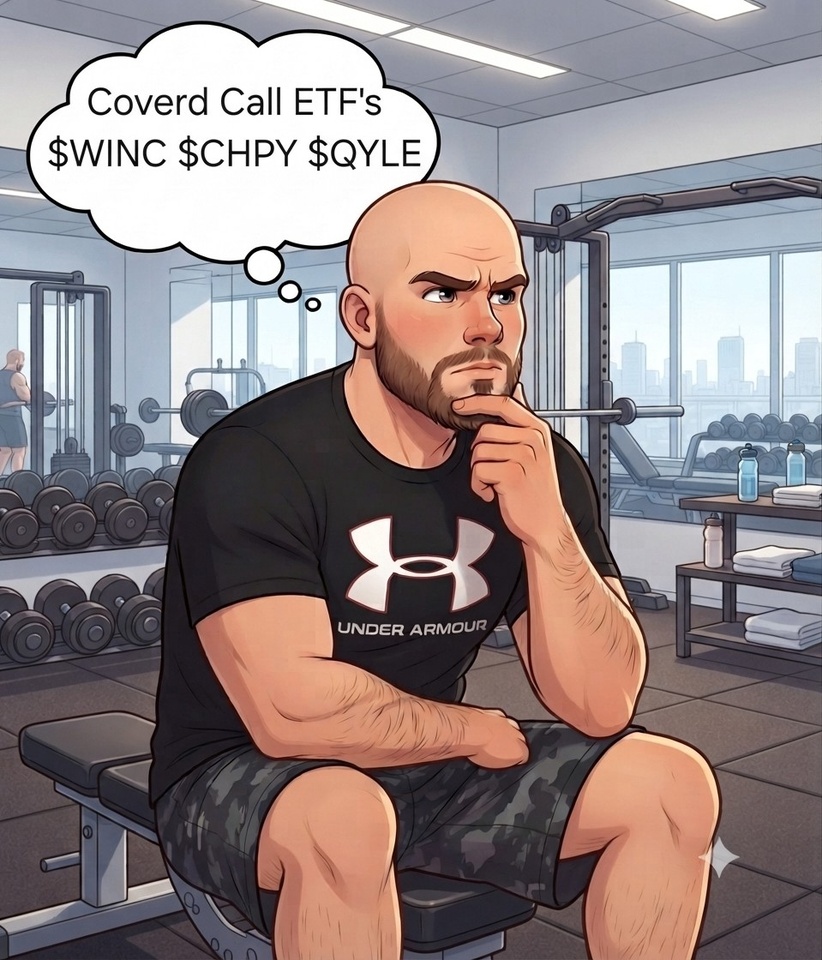
Lately, I've been reading more and more about so-called covered call ETFs.
There are countless examples of these, such as $WINC (+2,79%) , $CHPY (+10,95%) , $QYLE (+3,49%) , $XYLP (+2,63%) , $SXYD (+2,11%) , which attempt to track specific indices and use options.
These ETFs entice investors with high payout ratios—usually starting at 7–8%, sometimes even 11–12%.
In a recent post, the author @Dividendenopi already wrote about the fact that you shouldn’t underestimate the risks.
It was during a break between sets at the gym that this got me thinking, so I did some research on my own. Dear @Testo-Investo —no, of course I didn’t do the research on the bench press, but later. Not that I’d want to block the machine and get pelted with your Bitcoin…
I’d like to share the results of my research with you here and also encourage discussion. I’m sure we’ll need an informed comment from @Epi , and a less qualified one from @DonkeyInvestor :D plus a few more like @Tenbagger2024 , @Multibagger , @Simpson and @PoorDad let’s mark those too :) @MozartsGeist And @Solitair I’m sure you have an opinion on this, too, and @NichtRelevant and has an extremely relevant opinion on the matter.
- Limited upside potential — here, I’d like to invite you to click on a covered call ETF of your choice and use Get Quin’s benchmark feature. During the recent “Orangeman” protests, the markets dipped, in some cases significantly. But while the indices recovered significantly and even reached new all-time highs, the covered call ETFs lagged significantly behind. The reason for this is a cap, since—to put it simply—in the underlying options trade, the ETF only profits up to the option’s strike price. In other words, you’re trading massive price gains for option premiums.
- Risk of a Crash —even in terms of “crash performance,” the ETF does not fare well. It’s a misconception that the option premiums collected cushion a crash. They merely offer a buffer during minor pullbacks or sideways markets. So if a bear market or crash does occur… just take another look at the benchmark comparing the NASDAQ to $QYLE.
- Higher Costs and Tax Disadvantages – another factor that shouldn’t be underestimated is the ongoing costs. While some global ETFs boast an incredible 0.07% expense ratio, a covered call ETF typically comes in at over 0.40%. That’s more than four times what you’re trading off in exchange for underperformance relative to the market. Additionally, distributions are fully taxable once you exceed the €1,000 tax-free allowance, whereas with a reinvesting ETF, you only pay the flat-rate withholding tax. Not a good trade-off, in my opinion.
- Erosion of Net Asset Value —last but not least, it’s also evident that some ETFs attempt to achieve an extremely high monthly distribution. If the option premiums and dividends aren’t enough to cover this, the fund essentially distributes part of its own net asset value. This can cause the fund’s price to fall over the long term—it’s cannibalizing itself. To me, that sounds more like a disease than an investment.
Given all these negative aspects, one naturally wonders why anyone would buy this fund at all. There are actually a few reasons:
- Cash flow —if the focus isn’t on long-term wealth accumulation but rather on a regular inflow of income, then this can be a reason to hold a covered call ETF. It might be of interest, for example, to a retiree who wants to finance their standard of living this way. However, retirees should probably still avoid going all-in.
- Sideways Moves in the Markets – During sideways phases, when an index treads water for months on end, covered call ETFs really show their strength. Since prices do not rise sharply—and thus do not present missed upside potential—nor do they plummet dramatically—and thus do not present downside risk that needs to be managed—sold options still generate a profit that can even outperform the broader market. In addition, the premiums they generate help reduce volatility.
- Psychological Component – Regular distributions give many investors the satisfaction of still making money even during bear markets or sideways phases. This can help avoid panic-driven “Fear of Missing Out” (FoMo) actions and encourage investors to stay invested overall.
Conclusion: It can make sense to have a covered call ETF in your portfolio. However, I doubt it would make sense for most people here on Get Quin, since the majority are not currently in the payout phase of their lives. When it comes to the psychological aspect—the regular distributions—I believe you should still try to achieve this with a distributing global ETF. Of course, the dividend yields here are nearly ten times lower, but at least you’re generating sustainable price growth, which is far more important over decades than high short-term distributions.
What’s your take on this, and more importantly: have I forgotten anything important?
Your FinanzMechaNik
*AI-generated image*
2525
29 Comentários
I think the criticism of covered call ETFs is, in principle, entirely justified. In particular, the issues of limited upside potential, a lack of genuine protection against market crashes, higher costs, and the potential for erosion of net asset value should definitely not be ignored.
For me, however, the key question is **what role the ETF is supposed to play in my overall portfolio**.
I don’t view WINC as a substitute for an MSCI World ETF, and certainly not as a tool for achieving maximum long-term price returns. My portfolio is deliberately divided into different categories.
In my **main portfolio**, the focus is on long-term wealth accumulation. Broad-based growth components like the MSCI World and S&P 500 are accordingly important there. My goal is to capture as much of the market’s return as possible over the long term.
In addition, however, I have a **leveraged portfolio with a completely different purpose**: It’s meant to generate ongoing cash flow to cover a specific monthly interest/financing expense. And that’s exactly where I see the value of WINC.
With WINC, I’m consciously trading off a portion of potential future price gains for a high level of ongoing cash flow. For me, this isn’t a strategic mistake, but rather **the actual purpose of this investment component**.
So the key difference is:
**I’m not buying WINC because I believe it will outperform the MSCI World Index in the long term. I’m buying WINC because I need the cash flow.**
At the same time, I don’t want covered calls to become the dominant component of my overall portfolio.
That’s also why, for example, I’m not currently expanding my JEPQ position. The combination of concentration and limited upside potential makes it too unattractive for my long-term wealth accumulation. However, the existing position still serves its purpose because it helps cover the monthly interest expense.
With WINC, I see it somewhat differently, because the underlying stock universe is much broader and the ETF has a clearly defined function within my overall portfolio.
However, there is a limit here as well: WINC now accounts for about 50% of my leveraged portfolio. That’s why I wouldn’t aggressively increase my position in it right now. Instead, new savings allocations should diversify the portfolio through other components, such as dividend and quality ETFs, and dilute the relative share of WINC over the long term.
So, I actually see your post as more of a confirmation of my strategy:
Covered-call ETFs have clear drawbacks—and that’s exactly why they should be used selectively and in moderation.
For someone looking to maximize wealth accumulation over 30 years, I wouldn’t consider a covered-call ETF a core investment either.
For someone who, on the other hand, needs a specific, ongoing cash flow, such an ETF can certainly make sense—as long as you understand what you’re giving up in return.
So, to put it simply, my strategy is:
Growth with traditional ETFs.
Cash flow with income-generating components.
No unnecessary focus on covered calls.
And no illusion that high distributions automatically mean high total returns.
For me, this separation of roles is the crucial point.
•
2222
•7Mês·
New dividend
Another month and another dividend I can reinvest. Total this month will be around 1275€ so my capital is compounding at a nice rate.
1010
20 Comentários
Let me ask you a question, why would you buy a product that gives you an almost guaranteed lower return for the same risk?
Just buy a distributing S&P500 ETF like $IUSA...
https://extraetf.com/de/etf-comparison?products=IE0002L5QB31-etf,IE0031442068-etf,LU0255640731-fund
If you want regular payouts, you can also add a high-yield bond fund to your portfolio, which offers similar returns with lower volatility.
For example $NKCT2F
•
11
•
1Ano·
Opinions on the XYLP
Good morning everyone. What is your opinion on the subject of covered calls and the $XYLP (+2,63%) ? Buy or stay away
22
6 Comentários
I have 4% price increase this year so far so it also depends on when you invest in this product to experience price growth. Add the 10% dividend and guess how I feel about this CC ETF.
•
11
•
1Ano·
New weekly update

1Ano·
Bought !!!!
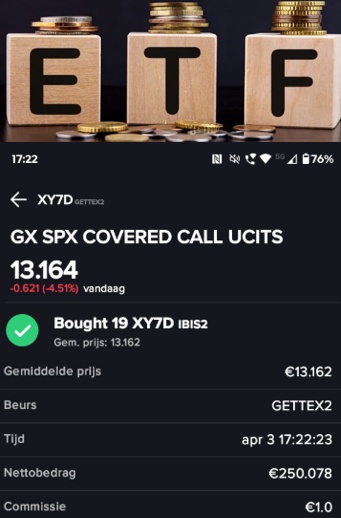
Bought another 19 shares of XY7D ( $XYLP (+2,63%) ) today.
This ETF can be found on #getquin under the ticker $XYLP (+2,63%) .
I currently own 106 shares, these shares give me +- €143 dividend per year.
33
1Ano·
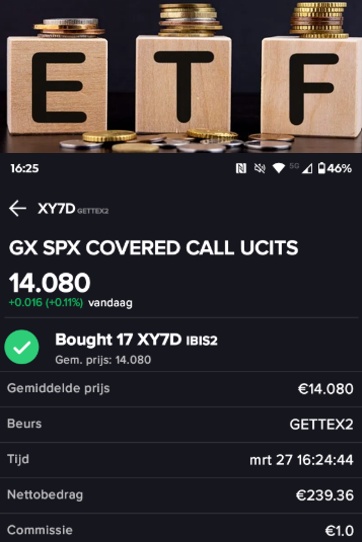
Bought another 17 shares of XY7D
Bought another 17 shares of XY7D ( $XYLP (+2,63%) ) today.
This ETF can be found on #getquin under the ticker $XYLP (+2,63%) .
I currently own 87 shares, these shares give me +- €117 dividend per year.
#dividends
#dividend
#growth
#investing
#investment
#finance
#getquin
11
1Ano·
Short Update of the past week
Short Update of the past week, we discuss the purchase / Discuss the price targets / dividends received
#dividends
#dividend
#invest
#investing
$XYLP (+2,63%)
$VUSA (+4,65%)
44
1Ano·
S&P500 Covered call Etf
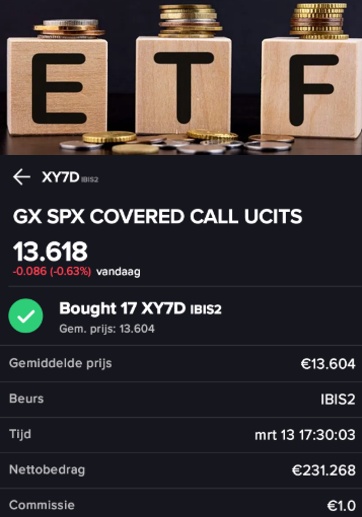
Bought another 17 shares of XY7D ( $XYLP (+2,63%) ) today.
This ETF can be found on #getquin under the ticker $XYLP (+2,63%)
I currently own 70 shares, these shares give me +- €86 dividend per year
22
Títulos em alta
Principais criadores desta semana
Dados tempo real da LSX · Dados financeiros e EOD da FactSet