Making wise use of saved capital during retirement requires careful planning—especially if you intend to draw regular income from it to secure or enhance your quality of life in your later years.
Financial advisors often recommend a pension plan based on a lump-sum payment, often referred to as an “immediate annuity.”
With a normal life expectancy, the return is usually not very high, because insurers typically invest very conservatively. In addition, the insurance company’s costs and profit margins further reduce the return. Consumer advocates point out that you generally have to live to age 94 or older before you recoup your initial investment through guaranteed annuity payments.
It’s often more profitable to park that money in a money market account.
One alternative is investments with regular distributions. Investors are spoiled for choice among several thousand dividend-paying equity funds.
What are the key selection criteria? Quality and cost structure.
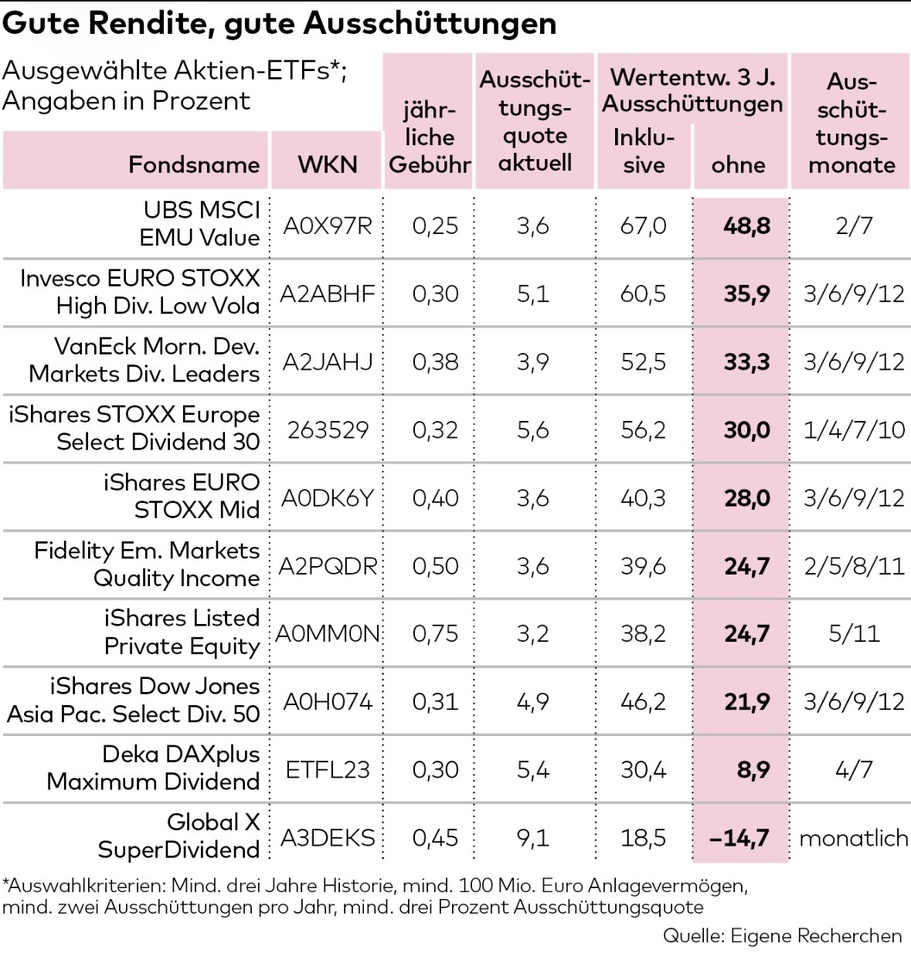
For some, the amount of the distributions may also be an important selection criterion. But caution is advised here: For example, the payout ratio of the Global X Super Dividend ETF $SDIP (-0,68%) currently stands at over nine percent. With an investment of 100,000 euros, this results in a monthly income of at least around 750 euros, before taxes.
This is possible because the ETF invests exclusively in the 100 companies with the highest dividends worldwide, without taking into account the sustainability of these payouts or the quality of the companies.
Consequently, the ETF has generated a return of zero over a one-year period and even a negative 14 percent over three years, excluding dividends. Investors thus received high regular payouts, but their principal has decreased significantly in the meantime.
Savers should therefore definitely pay attention to how the ETF invests. There are various positive counterexamples, such as the Invesco Euro Stoxx High Dividend Low Volatility ETF $EUHD (-0,18%). While this ETF also focuses on high-dividend companies, it additionally selects them based on qualitative criteria. Result: Although the payout ratio is currently “only” 5.1 percent per year—which amounts to about 425 euros per month, before taxes, on an investment of 100,000 euros—
In addition, the ETF has achieved growth of just under 36 percent over the past three years; including distributions, the return was actually over 60 percent. Similarly strong ETFs are also available for various other investment regions or sectors.
Bond ETFs, on the other hand, are rarely a viable alternative for retail investors. While they can also yield distribution rates of four or five percent, this is ultimately only possible through high-risk bonds or U.S. securities with corresponding currency risk. Furthermore, it is rare to achieve a positive return beyond the distribution itself.
A (potentially riskier) alternative is investing in individual high-dividend stocks. Here, however, quality is even more critical. “We prioritize companies with a strong balance sheet that are characterized by a high equity ratio as well as above-average returns on equity and sales,” says Franz Kaim of Kidron Asset Management in Stuttgart.
Furthermore, consistency is important. “The so-called dividend aristocrats are the gold standard for income-oriented investors,” says Rainer Laborenz, managing partner at Azemos Vermögensverwaltung in Offenburg. “Companies that have increased their dividends for at least 25 consecutive years are admitted to this select group.”
There are currently around 150 dividend aristocrats worldwide, 117 of which are from the U.S. and 33 from the rest of the world. Among the best-known names are Coca-Cola $KO (+0,3%), Procter & Gamble $PG (+0,25%) and Johnson & Johnson $JNJ (+0,34%) from the U.S., and from Germany, Fresenius $FRE (+1,57%) and Unilever $ULVR (+0,49%) from the United Kingdom.
Other attractive dividend stocks recommended in a WELT survey of ten leading asset managers include, for example, Allianz $ALV (-0,12%), BASF $BAS (+0,68%), Beiersdorf $BEI (-0,02%), Deutsche Post $DHL (+0,12%) and Munich Re $MUV2 (+0,15%).
In other European countries, they are focusing on companies such as BAT $BATS (+0,54%), BP $BP. (+1%), Nestlé $NESN (+1,38%), NN Group $NN (+0,28%), Shell $SHEL (+0,66%) , and Swiss Life $SLHN (-0,51%).
In the U.S., these include companies such as Altria $MO (-0,03%), Chevron $CVX (-0,52%), Cisco $CSCO (+0,4%), Coca-Cola, Kimberly-Clark $KMB (+0,27%) , McDonald’s $MCD (+0,25%) , and Pepsi $PEP (+0,13%).
Source: Text (excerpt) & table: Welt, Dec. 5, 25