
Depot-Core has been further expanded.

Fidelity Global Quality Income ETF
ETP
ETP
ISIN: IE00BYXVGZ48
Ticker: FGEQ
IE00BYXVGZ48
FGEQ
Price
Discussão sobre FGEQ
Postos
1363Mês·
Finally 18—what now?
Hey everyone, I turned 18 last week and am now thinking about how I want to invest my money in the future. My strategy is mostly $VWRL (-1,18%) and $FGEQ (-0,27%) I’d like to keep doing it this way.
I’ve been investing about €150 a month since 2024. I have around €3,000 in my money market account.
The only thing I’m thinking about is which provider to use—I’m currently with comdirect but would like to switch because they’re always having issues. I’d also like to open a money market account; at comdirect, I’m currently only getting 0.75% per year.
So I wanted to ask, based on your experience, which brokerage account and/or money market account you use. Scalable has caught my eye, but I’m a bit unsure about the deposit insurance for their money market account; for that, Chase looks pretty good to me.
I’d appreciate some feedback or tips.
Have a nice evening, everyone :)
12Posições
€ 5.479,45
21,37%
2222
14 Comentários

Hey, first of all: It’s great that you’re taking steps to secure your financial future. You’re already further along than I was at your age (back then, I had neither the capital, the perseverance, nor people around me who encouraged me to invest in stocks). Is that 3k your “rainy-day fund”? If so, I’d keep it as accessible as possible and put the interest earnings on the back burner… unexpected expenses always pop up when you don’t have the money readily available.
•
44
•
3Mês·
No sooner said than done! 🛒
Now the first of the two new ETFs is in my portfolio: I took advantage of today’s dip and opened an initial position in $FYEQ (-2,64%) . The position is still small, but I plan to build it up steadily over the long term.
The $FGEQ (-0,27%) will have to wait a bit longer for now, but it’s still firmly on my watchlist.
How about you? Are you taking advantage of today’s prices to buy more, or are you sitting tight?
~ Rendite Rudin
#ETF
#FYEQ
#FGEQ
#DipKaufen
#AssetAllocation
#Langzeitinvestor
#RenditeRudin
1111
8 Comentários
3Mês
•
66
•4Mês·
New ETFs in the Spotlight – Are You Betting on Asia? 🌏
I'd like to add a new ETF to my$VHYL (+0,16%) portfolio. Now I'm considering adding two more ETFs: the $FYEQ (-2,64%) and the $FGEQ (-0,27%)
I find the inclusion of Asian markets particularly exciting. Of course—these regions aren’t among the absolute top performers right now. But I’m very curious to see what the future holds. If these countries experience strong growth in the coming years, I see enormous long-term potential there, despite all the current turmoil surrounding China and others.
Do you perhaps have these two ETFs in your portfolio, or do they not really fit into your strategy?
What’s your general take on this: Are you invested in Asia and emerging markets—whether through ETFs or even individual stocks? Or are you staying completely out of them?
I’m looking forward to hearing your opinions and strategies!
~ Rendite Rudin
#ETF
#Asien
#Schwellenländer
#vhyl
#FYEQ
#FGEQ
#AssetAllocation
#Langzeitinvestor
#RenditeRudin
77
11 Comentários
Good morning, @RenditeRudin. I started investing in the $D05 DBS Group at the beginning of the year. I was looking for a reliable dividend stock with an “Asian flair” without too much exposure to China. However, an ETF like $FYEQ is much more broadly diversified.
Best regards from the “Pott,” Markus
Best regards from the “Pott,” Markus
•
33
•
5Mês·
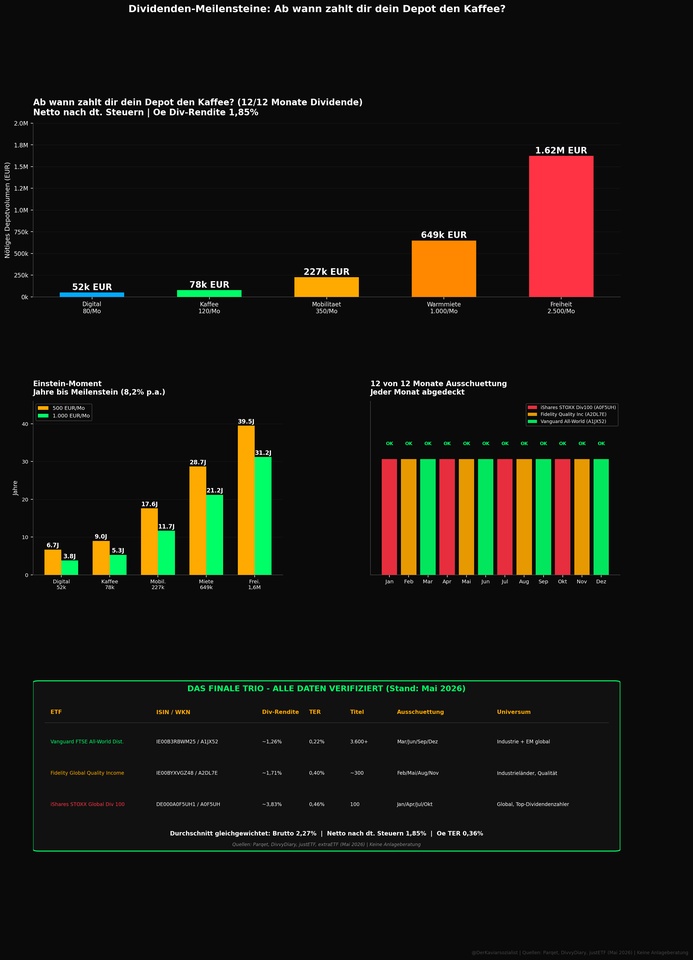
☕ When does your depot start paying for your coffee? Every month.
Three ETFs. Twelve months. Not a month without a distribution.
Dividends feel different from price increases. A price gain is paper. A distribution is money in the account. This is not a discussion about optimization, this is psychology.
The trio:
🟢 Vanguard FTSE All-World Dist. (A1JX52) 3,600+ stocks, developed and emerging markets, ~1.26% div yield, TER 0.19% Distribution: March / June / September / December
🟡 Fidelity Global Quality Income (A2DL7E) Quality focus on industrialized countries, ~1.71% div yield, TER 0.40% Distribution: February / May / August / November
🔴 iShares STOXX Global Select Dividend 100 (A0F5UH) 100 top dividend payers from Europe, North America and Asia-Pacific, ~3.83% div yield, TER 0.46% Distribution: January / April / July / October
Together: 12 out of 12 months.
The milestones (net after German taxes, Ø 1.85% net dividend yield):
📱 Digital lifestyle Netflix/Internet/mobile phone
80€/mo: 52,000€
Depot → €500/mo: 6.7 years | €1,000/mo: 3.8 years
☕ Daily coffee
120€/mo: 78,000€
Deposit → €500/mo: 9.0 years | €1,000/mo: 5.3 years
🚗 Mobility leasing and insurance
350€/mo: 227.000€
Depot → €500/mo: 17.6 years | €1,000/mo: 11.7 years
🏠 Warm rent
1,000€/mo: 649,000€
Deposit → €500/mo: 28.7 years | €1,000/mo: 21.2 years
🎯 Financial freedom
€2,500/mo: €1.62 million deposit → €500/mo: 39.5 years | €1,000/mo: 31.2 years
An important note that many people forget:
Dividends are not free money. On the ex-dividend date, the share price is reduced by exactly the amount distributed. The money is transferred from the securities account value to the account, not added to it. If you don't know this, you might wonder why your securities account falls slightly on the distribution date.
Honest classification:
This strategy is optimized for monthly cash flow and motivation, not maximum final return. An accumulating MSCI World benefits from tax deferral and almost always outperforms in the long term. But if you need the monthly confirmation in your account to keep going, you are doing absolutely everything right here. Discipline beats optimization.
PS: Why these three ETFs?
Yes, there are dividend ETFs with 4, 5 or 6% distribution yields. Yes, there are individual stocks that pay 8% or more. That's not the point of this post.
This trio was chosen because it does three things at once: pay out every month, be broadly diversified and not take extreme cluster risks. If you want higher yields, you take more concentrated stocks and bear more risk. Both are legitimate, both are a conscious decision. The aim here was to provide an example that works for as many people as possible as a starting point.
The TER correction:
The TER of the Vanguard FTSE All-World Dist. (A1JX52) is correctly 0.19% p.a., not 0.22% as stated in the chart. My mistake, thanks to anyone who reports it. The average of the trio thus drops minimally to approx. 0.35% TER. Nothing significant changes in the milestone calculations.
Sources: Parqet, DivvyDiary, justETF, extraETF (as of May 2026). Taxes: 30% partial exemption, 26.375% capital gains tax. No investment advice.
What is your next milestone? 👇
$VWRL (-1,18%)
$FGEQ (-0,27%)
$ISPA (+0,02%)
#getquin
#dividenden
#etf
#passiveseinkommen
#finanziellefreiheit
#investieren
#finanzen
#börse
#ausschüttend
#msciworld
1919
10 Comentários

5Mês
This also worked for me until AllWorld's payday shifted from the end of one month to the beginning of the following month and there are now two payouts in these months, one at the beginning and one at the end. 😑
•
44
•
9Mês·
Strategy shift from tech-growth to "monopoly" dividends: Flawed thinking or sensible plan for the withdrawal phase?
Hello everyone,
I'm currently thinking a lot about my long-term strategy and would like to hear your opinion on whether I'm making a mistake or whether the plan is sound.
1. my current situation
I am currently invested very "classically" to tech-heavy.
- ETFs:
- Scalable MSCI AC World $SCWX (-1,22%) 6.300 € (currently 200 € savings rate)
- Xtrackers MSCI World IT $XDWT (-3,06%) 8.000 € (currently 400 € savings rate)
- Individual shares:
- Allianz $ALV (-0,36%) : 2.900 €
- Nvidia $NVDA (-4,41%) : 3.900 €
- TSMC $2330 : 1.700 €
I realize that the IT ETF plus Nvidia/TSMC gives me an extreme tech lump risk.
2. my consideration / the "why"
I am considering changing my strategy from "accumulation/growth" to "distribution/dividend growth".
My main thought concerns the later withdrawal phase (in about 25 years):
If I save purely accumulating, I will have to sell units when I get older to get money. If there is then a bear market, I will eat up my assets much more quickly (sequence of return risk).
With a dividend strategy - according to my theory - I don't touch the substance, but live off the cash flow. I also think it is psychologically easier to stay invested in crises if dividends are still regularly paid into the account....and of course dividends are reinvested during the savings phase.
3. the new strategy: "wide moat" / monopolies
I want to invest specifically in companies that have a de facto monopoly or oligopoly. The idea is that where there is (and can be) no competition, pricing power is high and dividends are (more) secure.
I am thinking of sectors that are "inescapable":
- Railroads: Canadian National Railway ($CNR (+2,51%)). No one is building new railroad tracks across North America. It is physically and legally almost impossible to build a competing railroad across Canada and the United States.
- Waste: Waste Management ($WM (+4,32%) ) - Getting landfills approved is nearly impossible.
- Infrastructure/Gases: Air Liquide - not only US? Air Liquide often build gas plants (oxygen, nitrogen, hydrogen) directly on the premises of their customers (steelworks, chemical parks). A change of supplier is extremely expensive for the customer and logistically a nightmare ($AI (-0,32%) ) or American Tower ($AMT (+2,37%) ) They own the physical framework of the communication towers. When 5G or 6G is rolled out, AT&T or Verizon will need space on these towers. The leases are long-term and inflation-linked.
- Financial infrastructure: Visa/Mastercard ($V (+1,53%) / $MA) (+1,93%). Very low dividend but a monopoly/duopoly?
4. the plan
My savings rate should initially be 600 € later also 700€, ...800€).
I am considering stopping the old savings plans (AC World & IT) and dividing the new money as follows:
- Core: A quality dividend ETF (e.g. Fidelity Global Quality Income ($FGEQ (-0,27%) ) for the base.
- Satellite: 2-3 of the above "monopoly stocks" direct savings.
My questions to you:
1. Errors in thinking when taking the sample?
Is the assumption that I will be better off with a dividend portfolio in a crash than by selling ETF shares valid? Or is it "left pocket, right pocket"?
2. Dealing with legacy assets:
What do I do with the big tech block (IT ETF + Nvidia)? Leave it as a "growth booster" or reallocate to immediately reduce the cluster risk (pay attention to taxes)?
3. Stock selection:
Do stocks like Canadian National Railway or Waste Management fit my logic? Are there other "monopolists" that I am overlooking?
4. Is the savings rate sufficient?
Does it make sense to divide €600 into ETF + individual shares, or will I get bogged down by the fees/units?
Are there any general suggestions for improvement?
PS: The tax-free amount is €2000 as I am married.
I look forward to your input and critical opinions!
Thank you.
11Posições
€ 33.192,60
17,52%
88
10 Comentários9Mês
I don't think the idea of shifting into distributing ETFs or dividend stocks is wrong in principle, even if you still have a very long time until the payout phase and are therefore certainly in no hurry. At some point, however, it certainly makes sense to make the switch, as otherwise you could actually be forced to sell at poor prices during the payout phase, while the distributions should also be made during these phases. Due to the advance lump sum, the compound interest effect with accumulating ETFs is no longer quite as great as it used to be, but it is still there. However, I wouldn't put everything into dividend stocks just yet, as you have certainly achieved good results with growth stocks. I would let that continue and not fragment the portfolio too much. And nobody knows whether the stocks you have suggested will dominate their respective markets in the long term and develop positively.
•
22
•
9Mês·
Quiet days, turbulent markets: my December review
While the world outside was drifting into the Christmas hustle and bustle and I was consciously spending more time with my parents, little dramas were unfolding at the markets. My class leader $AVGO (-3,58%) lost value, as did the main share portfolio. But honestly? I only really noticed this at the end of the year. The second half of December had long since cast its spell over me, especially Christmas and the time between the years when everything slows down a little. Instead of rushing around, I reflected and did some soul-searching. Meanwhile, the automated systems continued to do their job. Savings plans were running and dividends were flowing.
At the end of the year $LTC (+2,66%) Properties was the last buy of the year. Alongside $O (+2,86%) and $MAIN (+1,94%) this monthly payer should continue to grow. The business model has a future and I am building something here step by step.
And now enough of the quiet, time for a review.
Overall performance
It was business as usual as I enjoyed the end of the year. Negative effects passed me by, that's just part of it.
My key performance indicators for my overall portfolio at a glance:
- TTWROR (month under review): -0.46% (previous month: +1.40%)
- TTWROR (since inception): +79,52%
- IZF (month under review): -5.23% (previous month: +18.54%)
- IZF (since inception): +10,81%
- Delta: -401.91€
- Absolute change: +616.54€
Performance & volume
$AVGO (-3,58%) gives up 15% and also pulls ahead of other tech stocks such as $NFLX (+3,04%) and $GOOGL (-3,06%) my main stock portfolio down. The other portfolios rise, but cannot compensate for this. That's part of investing. When I look at the top 5, I notice that defensive stocks such as $BAC (+0,64%) and $WMT (+3,17%) are rising slightly again. I like that, it's a stinking boring business model, which isn't sexy at all, but provides me with steady share price growth and a nice cash flow.
The five red lanterns naturally go to the same weakening candidates (by performance). Well, if something is going well, something must be going badly.
Size of individual stock positions by volume in the overall portfolio:
Share of equities (%) in the total portfolio (and associated securities account):
$AVGO (-3,58%) 3.06% (main share portfolio)
$WMT (+3,17%) 1.76% (main share portfolio)
$GOOGL (-3,06%) 1.51% (main share portfolio)
$BAC (+0,64%) 1.50% (main share portfolio)
$NFLX (+3,04%) 1.38% (main share portfolio)
Smallest individual share positions by volume in the overall portfolio:
Share (%) of the total portfolio (and associated securities account):
$NOVO B (+0,86%) 0.48% (main share portfolio)
$BATS (+2,35%) 0.54% (main share portfolio)
$GIS (+7,62%) 0.55% (crypto follow-on deposit)
$MDLZ (+4,1%) 0.56% (main share portfolio)
$CPB (+8,23%) 0.58% (main share portfolio)
Top-performing individual stocks
Shares with performance since initial purchase (%) (and the respective portfolio):
$AVGO (-3,58%) : +328% (main stock portfolio)
$NFLX (+3,04%) +101% (main share portfolio)
$GOOGL (-3,06%) +115% (main share portfolio)
$WMT (+3,17%) +91% (main share portfolio)
$BAC (+0,64%) + 81% (main share portfolio)
Flop performer individual stocks
Shares with performance since initial purchase (%) (and the respective portfolio):
$NKE (+1,65%) : -35% (main stock portfolio)
$GIS (+7,62%) -34% (main share portfolio)
$TGT (+3,91%) : -33% (main share portfolio)
$CPB (+8,23%) : -30% (main share portfolio)
$NOVO B (+0,86%) -24% (main share portfolio)
Asset allocation
Equities and ETFs currently determine my asset allocation.
ETFs: 41.7%
Equities: 58.2%
Crypto: 0.0%
P2P: less than 0.01%
Investments and subsequent purchases
In December, I slightly increased the savings plans from my net salary and reinvestment. I invested the following amounts in savings plans:
Planned savings plan amount from the fixed net salary: €1,040 [previously: €1,030]
Planned savings plan amount from the fixed net salary, incl. reinvested dividends according to plan size: €1,060 [previously: € 1,040]
Savings ratio of the savings plans to the fixed net salary: 50.24% [49,75%]
In addition, there were the following additional investments from returns, refunds, cashback, etc. as one-off savings plans/repurchases:
Subsequent purchases/one-off savings plans as cashback annuities from refunds: €40.00
Subsequent purchases/one-off savings plans as a cashback annuity from bonuses: € 0.00
Subsequent purchases from other surpluses: € 108.23
Automatically reinvested dividends by the broker: €7.03 (function is only activated for an old custody account, as I otherwise prefer to control the reinvestment myself)
Unscheduled purchases were made on various securities accounts outside the regular savings plans:
Number of unscheduled purchases: 9
40.00€ for $FGEQ (-0,27%)
56.94€ for $ULVR (+3,64%)
88.72€ for $LTC (+2,66%)
After the Magnum spinoff at Unilever, I sold the booked position a few days too late in order to shift it into Unilever with some cash. It was sold:
37,43€ from $MICC (+2,49%)
Magnum Ice Cream is neither in my freezer nor in my portfolio.
Passive income from dividends
I received € 132.75 in dividends (€ 152.20 in the same month last year). This corresponds to a change of -12.78% compared to the same month last year. The reason for the decline is that distributions from my three large Vanguard ETFs no longer arrived on time. Further key figures:
Number of dividend payments: 32
Number of payment days: 16 days
Average dividend per payment: €4.15
average dividend per payday: €8.30
The top three payers in the month under review were:
My passive income from dividends (and some interest) mathematically covered 7.94% of my expenses for the month under review. Acceptable for a weak month with medium-high expenses (by my standards).
Crypto performance
I am currently completely on the sidelines here. It will be a while before I get back in.
Performance comparison: portfolio vs. benchmarks
A comparison of my portfolio with two important ETFs shows the TTWROR in the current month (and since the beginning):
My portfolio: -0.46% (since I started: +79.52%)
$VWRL (-1,18%) +0.06% (since my start: 66.12%)
$VUSA (-1,03%) +1.00% (since my start: 63.76%)
After outperforming the ETFs last month, I am underperforming this time. 2026 will catch up. 🤗
Key risk figures
Here are my risk figures for the month under review:
Maximum drawdown: YTD: 17.17% (month under review: 1.56%)
Maximum drawdown duration: 702 days [since inception] (reporting month: 26 days)
Volatility: YTD: 12.00% (in the month under review: 1.33%)
Sharpe Ratio: YTD: 0.48 (in the month under review: -3.92)
Semi-volatility: YTD: 9.35% (in the month under review: 0.98%)
The maximum drawdown of 702 days since the beginning is still reminiscent of the tough phase 2022-2023, before the year-end rally started at the end of 2023. In December itself, the decline of 1.56% was marginal and a sign that the major turbulence of the year was over.
My Sharpe Ratio has improved to 0.48 YTD, showing that for every unit of risk, I get almost half a unit of return above the risk-free rate. Volatility has fallen from a wild 28% over the course of the year to a reassuring 12% YTD, while semi-volatility is down to just 9.35%. That shows: My portfolio does fluctuate, but the risk of loss is lower than the overall volatility would suggest. December was particularly quiet with a semivolatility of 0.98%.
What remains? Confirmation of my strategy: think long-term, keep calm and buy when things get cheap. 2025 ends solidly despite weakness.
Outlook
Back in the November review, I announced my investment of the Christmas bonus. Of course, I wasn't talking about money from my employer, but simply what I received for Christmas plus a few pennies I had lying around at home. I posted the reinvestment on the same day in the week between the years.
I also donated a few dividends, the fourth and final donation was made in December. You can read more about this in the Instagram Story. I think donations are important, because those who have should also give something.
I'll end this review with another personal point, which I already covered in the August and November reviews.
Loyal readers of my reviews will know that in the summer I was diagnosed with an aneurysm of the ascending aorta near my heart as a result of a bicuspid and insufficient aortic valve. It was an accidental finding that took some of the danger out of this ticking time bomb thanks to close monitoring, but it is still ticking. When I look back on the year 2025, I realize how this thing has permanently changed my thinking and my approach. Of course, it's an ongoing process, but I'm less likely to fall back into old patterns. Even though the cardiology appointment in December found that the thing hasn't grown any further, which will give me a little more time before surgery, I know the day will come. It's unclear when, but like a meteoroid hurtling towards the earth, there is something on the horizon. You just don't know when it's going to hit. The fact that the 43-44mm has remained stable (and no more) is a gain of time for me that I want to use. I have a lot of plans to develop new sources of income, significantly expand my social media presence, implement new habits, continue to work on my fitness and focus on life and the positive. Despite the diagnosis, 2025 will be a great year for me. And I'm going to go one better in 2026.
Thank you for reading. I wish you all the best for 2026!
👉 You can also read my portfolio review for December on Instagram from January 8, 2026 (and budget review from 9.1.26).
📲 In addition to the portfolio and budget review, there are currently three posts a week: @frugalfreisein
!!! Please pay close attention to the spelling of my alias. Unfortunately, there are too many fake and phishing accounts on social media. I have already been "copied" several times. !!!
👉 How was your month in the portfolio? Do you have any tops & flops to report? Leave your thoughts in the comments!
5252
10 Comentários
Thank you for your review. Above all, I wish you health success for the New Year. You can and will influence everything else so that you feel good.
•
33
•
10Mês·
Shifting but how with regard to taxes?
Hi @ll,
First of all, I am no longer saving but relaxing. In order not to pay too much tax, I have invested about 50% of the sum in distributing ETFs and 50% in accumulating ETFs. Depending on how much I need, I may withdraw around 3.5% per year from the latter.
Now I want to muck out and throw out the ETFs that pay too little dividend and have too little overall performance.
Now comes the big BUT.
If I sell, the tax is due immediately and increases my annual income on "paper", which means that I can no longer get it back on my income tax return (which is otherwise always the case).
But since it's just a shift and I don't actually consume the money, I don't think it's fair. The state only spends it on things that I don't want to help pay for anyway.
What would you do to avoid unnecessary taxes and still get things in order? 🙏🏻
44
8 Comentários
10Mês
There is currently no good solution for this. In Germany, we need a system similar to the American 401k, where you can trade tax-free and only withdrawals are taxed.
What you can do:
Relax the unwanted ETFs over the coming years first. 🤷♂️
What you can do:
Relax the unwanted ETFs over the coming years first. 🤷♂️
•
44
•
10Mês·
Nice dividend
Nice little dividend from $FGEQ (-0,27%) arrived yesterday.💸
And a nice weekend to you all.
1010
20 Comentários
Due to the "nice little dividend", I cleaned out the ETF last week.
•
1414
•10Mês·
Depot realignment
My ETF strategy: 3 ETFs as the core for long-term success
After a lot of thought, I have decided to make some changes. I have decided to split my monthly investments into three ETFs that offer a mix of growth, stability and income potential. From now on, I will invest €1000 per month in these three ETFs, with all dividends being automatically reinvested to maximize the compound interest effect.
1.
Fidelity Global Quality Income $FGEQ (-0,27%)
This ETF focuses on high-quality companies worldwide that pay stable dividends. It provides regular income streams and is less volatile than growth stocks. As I am looking for solid passive income over the long term, this ETF is an important part of my portfolio. All dividends from this ETF are reinvested to further grow the capital.
2.
VanEck Developed Markets Dividend $TDIV (+0,41%)
Similar to the Fidelity ETF, this one invests in high-dividend companies, but focuses on developed markets. The VanEck ETF helps me to diversify my portfolio even more broadly and ensures regular distributions, which are also reinvested. This allows me to use the dividends as a growth driver without them weighing on the portfolio.
3.
Nasdaq 100 ETF $CSNDX (-2,92%)
The Nasdaq 100 is my growth driver. It invests in the largest technology and growth companies in the US, which gives me strong leverage to the technology and innovation sector. While the Nasdaq 100 is more volatile than the S&P 500, the potential returns from the tech sector can be very rewarding over the long term. Again, all dividends are automatically reinvested to further increase the growth rate.
My strategy
With this combination of dividend and growth ETFs, I am aiming for a balanced portfolio that offers both stable income and long-term growth. I focus on a long-term investment strategy that grows regularly with monthly investments of €1000. The automatic reinvestment of dividends is intended to maximize the compound interest effect and thus allow the portfolio to grow continuously over the years.
Asia and emerging markets via individual shares
As I want to invest specifically in the Asian and emerging markets, I plan to cover the corresponding proportion via individual shares. I want to focus on high-quality companies that are growing strongly in these regions and offer good long-term earnings opportunities. My favorites: $6861 (-0,18%)
$TKOMY
$1211 (-4,33%)
$FLXI (-0,17%)
Individual shares - focus on quality
I currently own a lot of individual shares (some bought without a plan) and plan to reduce these to a maximum of 20 strong quality shares. I want to consolidate my portfolio and only invest in companies that have high growth and earnings potential and are robust enough to perform well even in difficult market phases.
Conclusion:
With this strategy of the 3 ETFs as core and a careful selection of 20 strong individual stocks, I want to build a well-diversified portfolio that not only provides stable income, but also benefits from global growth in the long term. By regularly investing €1000 per month and reinvesting all dividends, I aim to continuously grow my portfolio and achieve long-term financial security.
I would be delighted to hear your thoughts on my new strategy!
Have a great evening and a successful start to the new week!
LG your Max
2525
47 Comentários
I have similar thoughts in my portfolio and a similar strategy. But remember that you should somehow get EM into your portfolio, albeit underweighted. I think this is where the biggest growth music will be played in the long term and it would be a shame if you were only on the sidelines.
•
22
•Títulos em alta
Principais criadores desta semana
Dados tempo real da LSX · Dados financeiros e EOD da FactSet