
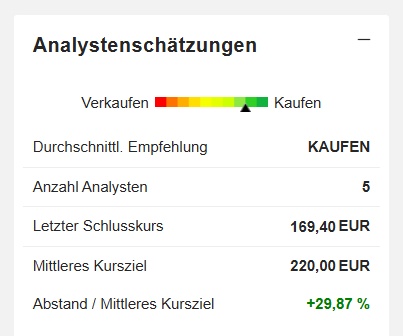
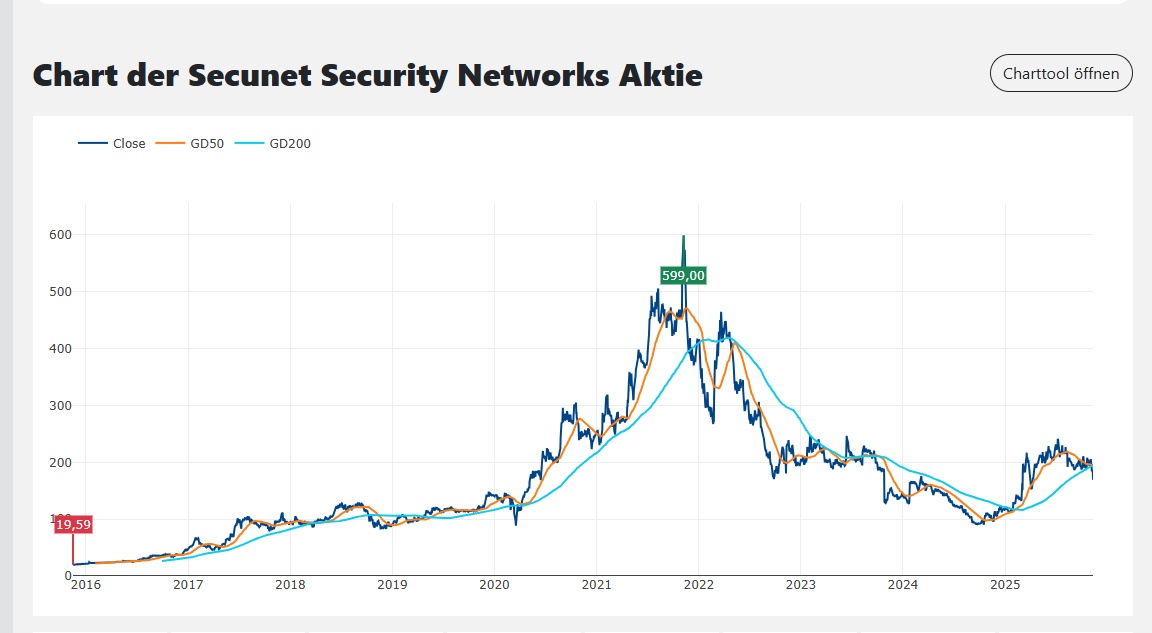
First purchase of Secunet. I wanted us to take profits at the high of €246 with momentum. That’s now been done. I have no problem if the stock drops again—I’d even welcome it if it falls back toward the €200 mark. I’d then place a second tranche of orders, as long as we don’t slide further down with strong momentum.

Secunet
Stock
Stock
ISIN: DE0007276503
Ticker: YSN
DE0007276503
YSN
Price
Debate sobre YSN
Puestos
39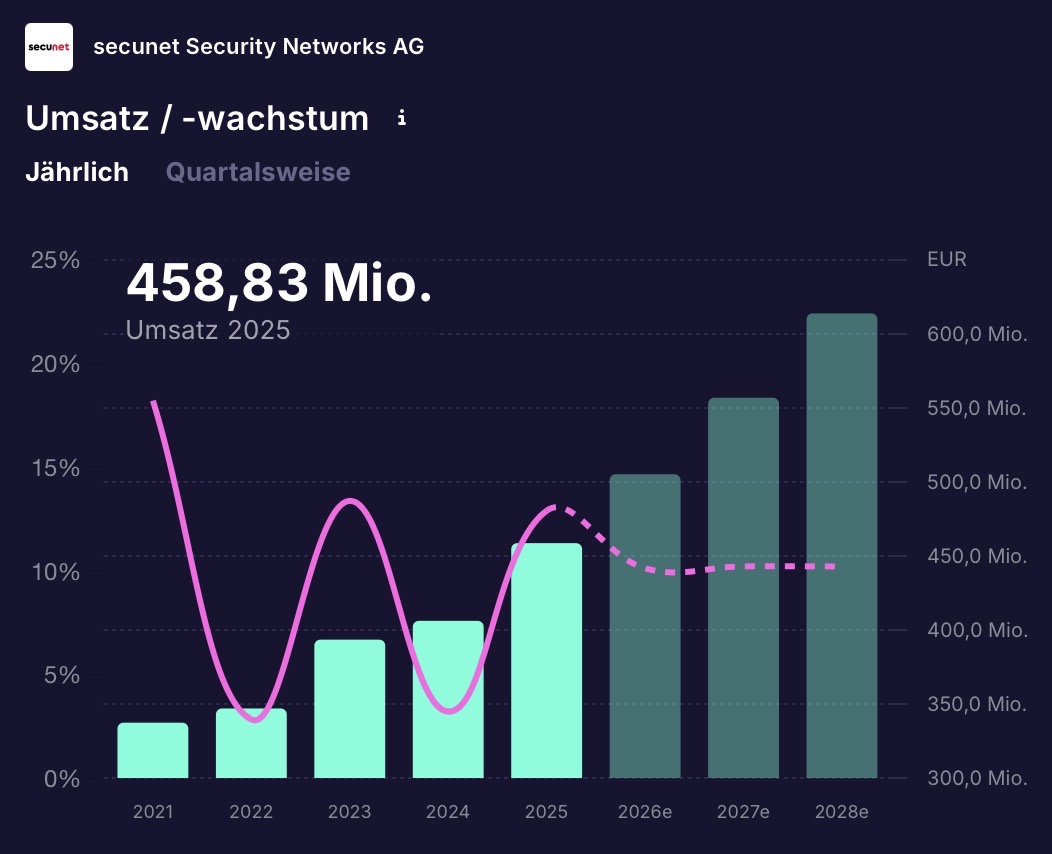



5Lun·
𝐬𝐞𝐜𝐮𝐧𝐞𝐞𝐭: 𝐀𝐮𝐟𝐭𝐫𝐚𝐠𝐬𝐛𝐨𝐨𝐦, 𝐌𝐚𝐫𝐠𝐞𝐧𝐝𝐫𝐮𝐜𝐤, 𝐀𝐮𝐬𝐛𝐥𝐢𝐜𝐤 𝐛𝐞𝐬𝐭ä𝐭𝐢𝐠𝐭
📊 𝐄𝐫𝐠𝐞𝐛𝐧𝐢𝐬𝐬𝐞
- Turnover: €81.8M (previous year €78.3M)
- EBITDA: €1.4M (previous year €6.6M)
- EBIT: -€4.0M (previous year €1.8M)
- Incoming orders: €143.0M (previous year €75.0M)
- Order backlog: €337.7M
⠀
🎯 𝐏𝐫𝐨𝐠𝐧𝐨𝐬𝐞
- Turnover 2026: €460-500M
- EBIT: €53-58M
- EBITDA: €76-84M
⠀
📌 𝐖𝐢𝐜𝐡𝐭𝐢𝐠𝐬𝐭𝐞 𝐏𝐮𝐧𝐤𝐭𝐞𝐭𝐞
- Incoming orders almost doubled (+91%) due to strong demand from authorities
- Moderate sales growth (+4%) driven by the public sector
- Earnings significantly weaker due to increase in headcount and special effects
- EBIT temporarily negative due to higher cost base and hardware share
- Public Sector (Defense & Security) clear growth driver
- Business segment weak (-49%) due to lower hardware sales
- Significant increase in order backlog as basis for further growth
⠀
💬 𝐌𝐚𝐧𝐚𝐠𝐞𝐦𝐞𝐧𝐭-𝐀𝐮𝐬𝐬𝐜𝐚𝐠𝐞𝐞
"The significant increase in incoming orders shows that our growth drivers are intact and that we are on track for our annual targets."
66


8Lun·
Part 9 - Fiscal policy, debt and markets
The state as a market player
When debt is problematic - and when it enables growth. Classification beyond simple debt ratios
Reading time: approx. 5-6 minutes
Fiscal policy is not a side issue for the markets in 2026. It is a valuation factor. Budget deficits, special funds, defense budgets, industrial policy - all of these have a direct impact on yields, valuation multiples and sector rotations. If you only look at debt ratios, you miss the point. The decisive factor is the ratio of growth to interest rates - in short: g to r.
g stands for the nominal growth of an economy, i.e. real growth plus inflation. r stands for the average effective interest rate at which a state refinances itself. The sustainability of debt depends largely on how these two variables relate to each other.
The key correlation is as follows: as long as the nominal growth of an economy is higher than the average financing rate of its debt, the debt ratio stabilizes or decreases relative to GDP - even in the case of moderate primary deficits. Formally: If g > r, time works for the debtor. If r > g, time works against him.
Why is this the case? Government debt is measured in relation to economic output. If GDP grows faster than interest costs, the economy "grows" relatively into debt. The ratio falls or remains sustainable. If the ratio reverses, interest expenditure increases relatively more than the economy's income. This creates fiscal pressure.
This logic is not new. It can already be found in classical debt arithmetic and has often been linked to the inequality formula r > g from the work of Thomas Piketty in more recent discussions. It is important to classify it correctly: there, r > g describes the relationship between return on capital and growth in the context of wealth concentration. The mechanics are similar for public finances, but the focus is different - it is about debt sustainability. The mathematical core is related, but the economic application is different.
Applied to 2026, this means that in a world of structurally higher interest rates, the difference between g and r will become the decisive macro lever.
The German government debt ratio is currently around 63-65% of GDP. Internationally, this is moderate. However, the decisive factor is momentum. Nominal growth has recently been roughly in the region of 2-4 %, depending on the quarter. At the same time, new issue yields for ten-year German government bonds are in the range of around 2.5-3 %. Germany is therefore in a borderline zone. g and r are close to each other. A clear growth advantage no longer exists automatically as in the zero interest rate regime.
This makes the quality of fiscal spending crucial. If additional debt has a primarily consumptive effect, the ratio rises faster than economic output. If, on the other hand, it flows into infrastructure, digitalization or defence capacities, it potentially increases trend growth - i.e. g - and shifts the equation in favour of sustainability.
Rising defense budgets have a direct impact on $RHM (+3,32 %) (Rheinmetall AG). Infrastructure and industrial projects increase the order base at $SIE (-1,5 %) (Siemens AG). Grid investments stabilize regulated cash flows at $EOAN (+1,33 %) (E.ON SE) and $RWE (-0,75 %) (RWE AG). Digital modernization strengthens providers such as $SAP (+0,8 %) (SAP SE) or security providers such as $YSN (-2,95 %) (secunet Security Networks AG). These are concrete fiscal transmission channels in sales, cash flow and margins.
But every additional issue also has an impact on the bond market. Higher supply can cause yields to rise. Higher yields increase discount rates - particularly relevant for long-dated growth cash flows. Fiscal policy therefore generates two forces: profit impetus through demand and valuation pressure through higher capital costs. Which one prevails depends on the market framework.
In the US, the government debt ratio is significantly higher - roughly in the range of 115-125% of GDP. At the same time, nominal growth is more robust than in Europe. As long as nominal growth is in the range of around 4-6% and long-term Treasury yields are below or only slightly above this level, the debt dynamic remains manageable. It becomes critical when interest expenditure rises faster than the nominal income of the economy.
Industrial policy programs have a direct impact on individual sectors. Semiconductor investments stabilize investment cycles at $INTC (-2,87 %) (Intel Corporation) and $NVDA (-1,99 %) (NVIDIA Corporation). Defense spending supports $LMT (+0,14 %) (Lockheed Martin) and $NOC (-0,03 %) (Northrop Grumman). Infrastructure programs have an impact on $CAT (-2,54 %) (Caterpillar Inc.). Tax incentives in the energy sector stabilize cash flows at $NEE (+0,15 %) (NextEra Energy). Fiscal policy becomes a sector-specific source of income.
The historical US post-war example illustrates the dynamics. After the Second World War, the debt ratio was over 100 %. It fell significantly in the following decades. Strong nominal growth played a central role. At the same time, financial repression, regulated capital markets and phases of unexpected inflation had a debt-reducing effect because they reduced real interest burdens. g was greater than r for a longer period of time - partly also influenced by politics.
Conversely, the European sovereign debt crisis showed what happens when r > g and confidence wanes. Rising risk premiums increased interest costs, growth stagnated and the debt ratio turned negative.
For investors, this means that debt is not a moral judgment, but a mathematical and institutional issue. The decisive factors are growth, interest rates and confidence. If you only look at the debt ratio, you ignore the dynamics behind it.
In 2026, it is precisely these dynamics that will be decisive. In an environment without a zero interest rate buffer, fiscal policy is no longer an automatic growth lever. It can enable growth - if it is used productively and g is stable above r. However, it can also generate valuation pressure if r rises above g in structural terms.
The state is therefore one of the largest allocators of capital in the world. Its budget decisions act like an additional investment fund in the trillions. If you want to understand markets, you have to read this dynamic in the valuation framework - not in isolated percentages.
The next part will conclude the series: Part 10 - Why key figures fail without a valuation framework. There I will bring the entire series together with the key figures series - and show why classification is more important than mathematical precision.



11Lun·
Favorable security value in stormy times
Hello my dears,
On the occasion of today's quarterly figures, I would like to remind you of Secunet.
Perhaps an underestimated value due to the increasing threats.
Feel free to share your opinions in the comments.
At the request of @Iwamoto just a short analysis.
Facts and figures
secunet Security Networks AG consists of five divisions: eHealth, Homeland Security, Industry, Public Sector and Defense & Space. Our customers include federal ministries, federal and state authorities, several DAX companies as well as international authorities and organizations. We are an IT security partner of the Federal Republic of Germany and a partner of the Alliance for Cyber Security.
secunet was founded in 1997, is listed on the stock exchange and generated sales of around 406 million euros in 2024. Our main shareholder is Giesecke & Devrient GmbH.
Secunet Security: a potential winner of Federal Interior Minister Dobrindt's cyber plan? The risk of cyberattacks from Russia is growing!
Secunet Security wants to become the leading provider of sovereign cyber security in Europe.
The company specializes in border controls, cryptography, secure mobile workstations and connectors for the healthcare sector.
The company already ensures that its products are "post-quantum cryptography ready" and cannot be circumvented through the use of quantum computers. Secunet Security is one of the few companies that work for the state.
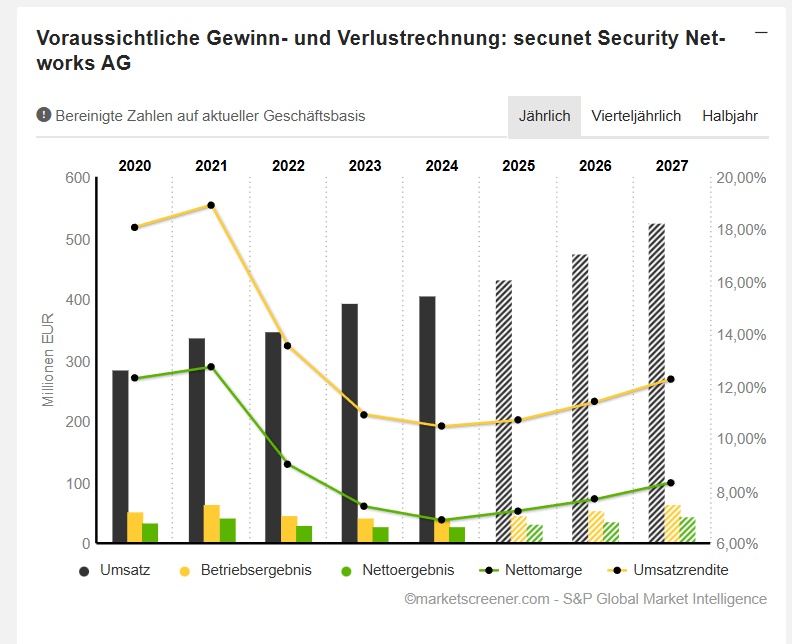
Key valuation figures /estimates in million Eur.
Year Turnover Change
2025 432,4 6,41 %
2026 475,1 9,86 %
2027 525,4 10,58 %
Year EBIT change
2025 46,28 8,84 %
2026 54,15 16,99 %
2027 64,55 19,22 %
Year Net result Change
2025 31,31 12,02 %
2026 36,49 16,53 %
2027 43,73 19,85 %
Year Net debt
Free cash flow
Capex
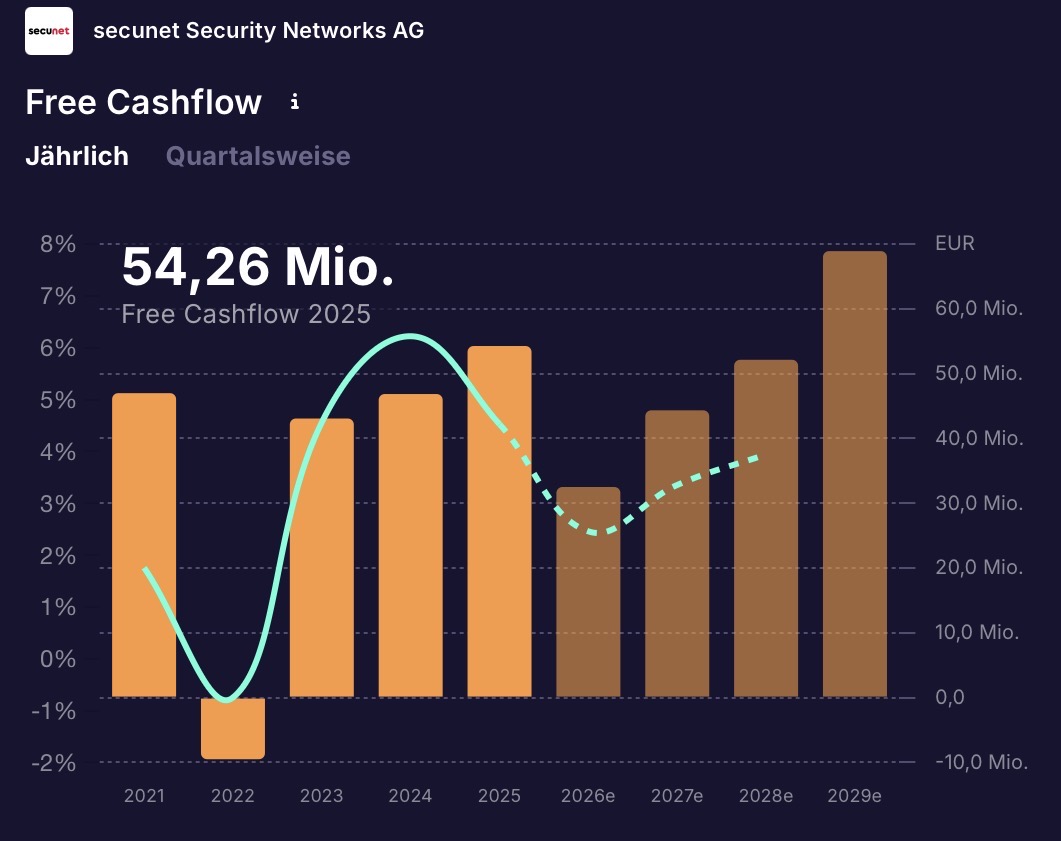
2025 -56,1 32,04 16,32
2026 -79,5 43,3 14,55
2027 -106 48,03 15,57
(@Liebesspieler still healthy)
Year EbiT Margin
ROE
2025 10,7 % 19,48 %
2026 11,4 % 19,28 %
2027 12,29 % 19,72 %
Year Enterprise Value P/E ratio
PEG
2025 1.040 35,1 3
2026 1.016 30 1,8
2027 989,9 25,1 1,3
Current multiples
Palo Alto P/E 137.65 PEG 5.56
CrowdStrike P/E ratio 1576.82 PEG 7.56
Secunet Security: Sales and margins increase - full order books overshadow slump in international business
ESSEN (IT-Times) - The cybersecurity company Secunet Security secunet Security Networks today published its results for the third quarter of financial year 2025 and recorded a small increase in revenue.
The turnover of the secunet Security Networks AG (ISIN DE0007276503) reached 113.1 million euros in the third quarter of 2025, an increase of 2.4 percent compared to the same period of the previous year.
In the same period, the company's EBITDA reached EUR 22.5 million (up 11.6%) and EBIT EUR 17.7 million (up 9.1%). The EBIT margin thus improved to 15.6% (previous year: 14.7%).
secunet Security Networks achieved a net result of Euro 12.2m, an increase of 2.8% on the previous year. The operating cash flow amounted to Euro 14.5m (minus 15.7 percent).
"We are very satisfied with the results for the first nine months and believe we are well on the way to achieving our targets for the year," says Marc-Julian Siewert, CEO of secunet Security Networks AG.
"Incoming orders increased significantly once again in the third quarter, which shows that our growth drivers remain intact. The market for cybersecurity continues to grow strongly, making our technical solutions increasingly important for customers from both the public sector and private companies."
NATO is considering including cybersecurity in the new 5% spending target - Secunet Security would be a winner!
The key figure with the highest stability for the secunet Security Networks share is the reported profit, which is used below for the valuation. The P/E ratio (price/earnings ratio) calculated from this key figure is 34.30, which is 2.78 points below the historical average of 37.08 for the last 10 years. From this perspective, the secunet Security Networks share appears to be favorably valued.
+ 1
1Año·
What the EU is planning with its "drone wall" / Dobrindt announces drone defense center / Austria discusses drones & drone defense
Hello my dears,
as I was shocked to discover while watching today's "Presseclub". The EU, and Germany in particular, is very poorly positioned when it comes to critical infrastructure, cyber attacks and drone defense. The plan here is to improve security at all costs.
Dear all, which companies do you think should benefit from this?
$DRO (-6,85 %)
$AVAV (-1,82 %)
$ESLT (+3,14 %)
$EOS (-7,77 %)
$YSN (-2,95 %)
$LMT (+0,14 %)
$RTX (+0,67 %)
$HAG (+2,43 %)
$AXON (-0,95 %)
$FLT (+0 %)
$FQT (+0,46 %)
$RHM (+3,32 %)
Following airspace violations in Denmark and Eastern Europe, the European Union is pushing ahead with the construction of a "drone wall". What is known about the project so far.
Following several mysterious drone overflights in Denmark and repeated airspace violations by Russian drones in Eastern European countries, the EU wants to better protect its eastern flank. At the heart of the plans is a so-called "drone wall" - a defense system designed to detect, track and intercept unmanned aerial vehicles. What exactly the EU is planning, who is involved and how quickly the wall could be built: the most important questions and answers.
Who is building the drone wall?
The plans for the drone wall were presented at a video conference of EU defense ministers. The conference was mainly attended by Eastern European EU states, Bulgaria, Estonia, Latvia, Lithuania, Poland and Romania, as well as Finland. EU High Representative for Foreign Affairs Kaja Kallas, several representatives of the NATO defense alliance and the current Danish EU Council Presidency also took part. Conspicuously absent from the meeting was Germany - although security experts in this country have long warned of serious gaps in drone defense.
The EU wants to use its own financing instruments to fund this. EU Defense Industry Commissioner Kubilius spoke of a "protective shield for the eastern flank that will benefit the whole of Europe". At the same time, national defence budgets and the European defence industry are to be mobilized.
When will the drone wall be in place?
EU Defense Industry Commissioner Kubilius said in an interview with the news website Euractiv that the drone wall could be built within a year. However, EU officials do not expect the development of a comprehensive sensor network to improve airspace surveillance to be completed until the end of 2026. The development of an interception system is likely to take even longer. In the short term, additional sensors are to be installed first.
With material from the news agencies dpa and AFP
Dobrindt announces drone defense center
Following numerous drone sightings in Europe, the German government wants to introduce countermeasures. Interior Minister Dobrindt classifies the threat as "high" and is planning a drone defense center.
The German government wants to set up a drone defense center. This is Interior Minister Alexander Dobrindt's response to the numerous sightings of missiles of unknown origin. The CSU politician said that there was a threat that could definitely be classified as "high".
Detecting, intercepting and shooting down drones are the basis for drone defense. Repositioning is an urgent project, explained Dobrindt.
Pooling expertise
According to him, the drone defense center should bundle the competencies of the federal police, the Federal Criminal Police Office and the police authorities of the federal states. Dobrindt said he wanted to bring together expertise and initiate new research projects.
New technology for fighting drone against drone
Fighting drones with nets or by so-called "jamming" (interrupting radio signals) has limited effect, according to Dobrindt. The Minister of the Interior is focusing on developing new technologies for drone-on-drone combat: "We can't wait for others to make this available".
According to the Interior Minister, the new drone defense center is the first part of a two-pillar strategy. As the second pillar, Dobrindt announced a new version of the Aviation Security Act in order to regulate the legal basis for defense measures.
DroneVation in Vienna - Austria discusses drones & drone defense. $RHM (+3,32 %)
Appropriate systems are needed for defense. The Austrian head of armaments was accordingly proud to announce that he was the first customer for Rheinmetall's Skyranger system. He was in Zurich just last week and was able to see the progress of the procurement. "I can tell you that the 3.5 cm cannon systems will arrive on time and on schedule."
Painful for the German Bundeswehr - it will have to wait longer than planned for its new Skyrangers. Austria will receive its 36 air defense turrets earlier. The German Armed Forces have selected the Pandur Evo from GDELS as the carrier platform, as the vehicle is also available in other functions in the troops.
https://defence-network.com/1-dronevation-oesterreich-diskutiert-drohnen/
AeroVironment: Step by step towards becoming a defense tech group
One of the biggest beneficiaries of the drone trend has traditionally been the US company AeroVironment from Arlington in the US state of Virginia. Founded in 1971, the company once made a name for itself with aircraft innovations and has been taking off as a drone supplier since the 2000s. AeroVironment primarily manufactures small and medium-sized reconnaissance drones and unmanned ground vehicles. Until 2025, AeroVironment was mainly known as a drone specialist, but in May the company bought defense technology provider BlueHalo for USD 4.1 billion as part of a share swap. Thanks to this acquisition, the company is now a diversified defense company with capabilities in space, drone defense, cyber, laser weapons and satellite technology. At the end of the third quarter of the 2025 financial year, the order backlog reached a record high of USD 764 million.
While AeroVironment is valued at around USD 10 billion on the stock exchange, the Canadian drone specialist Volatus Aerospace, which has also been active for many years, only has a valuation of around EUR 200 million. Despite the significant difference in valuation, Volatus has also already proven that it is compatible with NATO standards. In 2025, Volatus landed NATO contracts in the areas of education and training as well as for the delivery of reconnaissance drones. Analyst Rob Goff from Ventum Capital sees these successes as indications of further potential for NATO contracts. Media reports repeatedly refer to Volatus' bulging order pipeline.
In addition to the military sector, Volatus also offers civilian solutions, for example for monitoring infrastructure such as bridges or pipelines, through to the Condor XL transport drone, with which the company intends to carry out test flights from the end of the year to test its use in the areas of logistics and forestry. Military use of such transport drones is also conceivable in principle.
Airborne lasers - the next generation of drone defense
While the ground-based laser weapon developed in Israel has already proven its effectiveness against drones, efforts to develop an airborne system have been intensified. The airborne laser program is being led by the Israeli company Elbit Systems. Meanwhile, the lasers developed as a defensive weapon are also being considered for offensive use.
https://defence-network.com/luftgestuetzte-laser-drohnenabwehr/
Israeli drone defense for German warships?
https://marineforum.online/israelische-drohnenabwehr-fuer-deutsche-kriegsschiffe/
Drone defense: Bundeswehr receives first interceptor drones from Argus Interception
https://www.hartpunkt.de/drohnenabwehr-bundeswehr-erhaelt-erste-fangdrohnen-von-argus-interception/
https://argus-interception.com/de/
$FQT (+0,46 %) Frequentis
$AXON (-0,95 %) (my dears, perhaps the Kassel-based company has a good chance)
US group Axon buys Kassel-based company Dedrone
The company Dedrone discovered a gap in the market for itself with the defense against approaching drones. With great success. Now it is being taken over by an American security company. The company site in Kassel is also set to benefit from this.
https://esut.de/2025/08/meldungen/62305/eos-liefert-100-kw-laser-drohnenabwehr/
Echodyne launches the EchoShield Rapid Deployment Kit on the market
With the proliferation of drones in the airspace, the need to quickly deploy situational awareness zones that detect, track, identify and contain threats is increasing. The RDK is designed for quick and easy deployment of four radars for robust, high-precision hemispheric coverage. The addition of the RDK to the EchoShield portfolio creates leading positions in all areas - from fixed sites to mobile deployments (OTM) to rapidly deployable temporary missions.
About Echodyne. $NOC (-0,03 %)
Echodyne, the radar platform company, is a U.S. designer and manufacturer of advanced commercial radar systems for defense, government and commercial market applications. The company combines the patented Metamaterials Electronically Scanned Array (MESA®) architecture with powerful software and machine learning to deliver highly accurate situational awareness data that locates airborne and ground-based activity with unmatched speed, accuracy and precision. Echodyne's products are proven and trusted by military, government, integrators and critical infrastructure around the world. They set a new standard for radar quality. The privately held company is headquartered in Kirkland (WA, USA) and is backed by Bill Gates, NEA, Madrona Venture Group, Baillie Gifford, Northrop Grumman and Supernal, among others. See Radar in action at Echodyne.com.
Rohde & Schwarz presents new multi-band jammer for drone defense.
(Rohde & Schwarz GmbH & Co. KG is a privately held company and therefore has no shares,)
www.zeit.deDa ist etwas schiefgelaufen


1Año·
📊 Portfolio Update - September 2025 (beginning of month)
🛒 New purchases
- R3N SME shares (fraction)$R3N493
Secunet (cybersecurity 🇩🇪)$YSN (-2,95 %)
Atoss Software (HR software 🇩🇪)$AOF (+0,46 %)
Novo Nordisk (healthcare 🇩🇰)$NOVO B (+0,71 %)
Capgemini (IT services 🇫🇷)$CAP (+0,53 %)
🔄 Movement
- Sale of Infineon Technologies (semiconductors 🇩🇪), to reallocate to other sectors.$IFX (-6,06 %)
🎯 Quick summary
Early September rhymes with :
The strategy remains the same: build a portfolio balanced between growth and dividendsby gradually adding solid companies.
- Dividends falling steadily 💵
- Strengthening in health + tech
- A small rotation with the exit of Infineon
55

1Año·
Listed niche companies in the European cyber security sector.
Executive Summary
Analysis of the European cyber security market reveals a limited but strategically interesting selection of listed companies focusing on specialized niches. The search for public players in this segment is challenging, as innovative European market leaders such as Darktrace and Sophos have been acquired and delisted by well-funded US private equity firms in recent years.
This report identifies and analyzes three relevant, publicly traded European niche companies: the secunet Security Networks AG (Germany), the NCC Group plc (United Kingdom) and Yubico AB (Sweden). Each of these companies occupies a unique position in the market, which is characterized by specific business models and the regulatory and technological framework conditions in Europe. secunet benefits from its position as a reliable partner for government high-security solutions, the NCC Group from its diversification into professional services and software escrow, and Yubico from its pioneering role in the field of hardware-based authentication.
Market growth in Europe is largely driven by increasing cyberattacks, which are also fueled by geopolitical tensions, and by strong regulatory impulses such as the EU directives NIS2 and DORA. This creates a specific demand that differs from the primarily innovation-driven markets in the US.
The financial and strategic analysis shows that the companies are going through different phases of development. While secunet demonstrates robust and profitable growth, Yubico is in a challenging transition from a one-time sales to a recurring subscription model. The NCC Group is faced with the task of successfully implementing its strategic transformation to increase profitability. This dynamic provides a nuanced picture for investors exposed to the European cybersecurity sector.
Chapter 1: The European cybersecurity ecosystem - framework conditions and market dynamics
1.1 Market trends and growth drivers
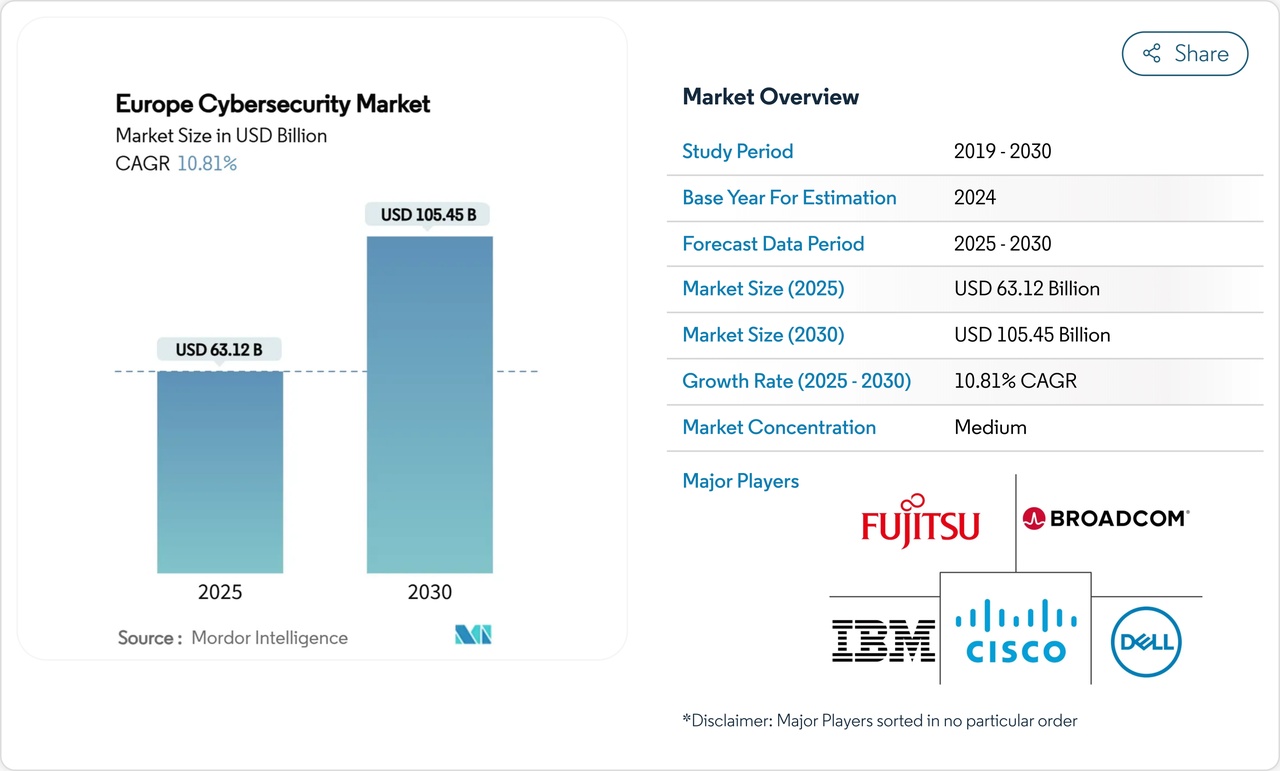
The European cybersecurity market is in a phase of significant growth. The market size has been estimated at USD 63.12 billion in 2025 and is expected to grow to USD 105.45 billion by 2030, representing a compound annual growth rate (CAGR) of 10.81%.1 Other estimates see similar growth rates.2 This growth is driven by a number of interrelated factors resulting from both the changing threat landscape and the regulatory environment.
A key catalyst is the increasing frequency and sophistication of cyberattacks. In 2024, ransomware attacks on European organizations increased by 30%.1 These threats are often exacerbated by geopolitical tensions, as demonstrated by the Russia-Ukraine conflict, which has led to the weaponization of cyberattacks by state-sponsored actors.1 This escalating threat landscape is not just a passive phenomenon, but a direct cause of the growing demand for robust cybersecurity solutions. Businesses and public sector organizations are realizing that robust cyber defenses are no longer an optional IT expense, but a fundamental operational necessity.1 The causal chain is clear: geopolitical tensions are leading to an increase in sophisticated attacks, which in turn is leading to increased and mandatory investment in cyber defenses.
Within the market, the services segment is experiencing the fastest growth, with an expected CAGR of 13.8% by 2030.1 This indicates a shift from pure product sales to comprehensive solutions such as Managed Detection and Response (MDR), consulting services and outsourcing of day-to-day security operations. This trend is fueled by a significant shortage of qualified cybersecurity professionals in Europe, estimated at over 299,000 unfilled positions.1
1.2 Regulatory landscape and its impact
The dynamics of the European market are fundamentally different from those in the US, where demand is often driven by technological innovations such as zero trust or cloud solutions.4 In Europe, the main drivers of cybersecurity spending are the EU NIS2 and DORA (Digital Operational Resilience Act) directives.1 These regulations force companies, particularly in the financial sector (BFSI), to adhere to strict security standards and formalize the monitoring of service providers and the conduct of emergency drills.1
Strict compliance with these requirements is not just a cost factor for European cybersecurity companies, but a decisive competitive advantage. Companies that are positioned as reliable partners for managing governance, risk and compliance (GRC) requirements can build a stable and sustainable business model from this development. This creates a kind of "regulatory moat" that makes access more difficult for less specialized or international competitors and creates a specific market niche for EU-based and compliant providers.1
1.3 Definition of "niche" and selection criteria
For the purposes of this report, a "niche company" is defined as a company that focuses on a specific market segment or specialized technology that differentiates it from the broader offerings of global technology giants such as Cisco, IBM or Broadcom.2 The research therefore focuses on companies whose business models specialize in high-security government solutions, professional services or hardware authentication.
It is important to clarify the status of two former European market leaders that are no longer listed on the stock exchange:
- Darktrace: The UK company, a pioneer in AI-powered cybersecurity with its "self-learning AI" 10, was acquired by US private equity firm Thoma Bravo for USD 5.3 billion in October 2024 and delisted from the London Stock Exchange.12
- Sophos: Another well-known British provider specializing in endpoint security was also acquired by Thoma Bravo back in March 2020 and delisted from the stock exchange.14
The repeated takeover of prominent European players by the same US investment firm illustrates a key market dynamic: innovative European technology companies are attractive takeover targets for well-funded investors, which reduces the number of publicly traded companies in the European technology sector. This report focuses on the remaining independent players listed on European stock exchanges.
The niche companies that are analyzed in detail later in the report:
secunet Security Networks AG; $YSN (-2,95 %)
Germany
High security solutions for the public sector
NCC Group plc; $NCC (-2,16 %)
United Kingdom
Professional services & software escrow
Yubico AB; $ACQ SPAC (-2,85 %)
Sweden
Hardware-based authentication
Chapter 2: Analysis of listed niche companies in Europe
2.1 secunet Security Networks AG (Germany)
Company profile & niche:
secunet is a leading German cyber security company and is considered the IT security partner of the Federal Republic of Germany. The company serves a critical niche by providing highly secure software and hardware solutions for customers with particularly sensitive data, including government agencies, ministries, police and defense sectors. The company's success is based not only on its technological solutions, but also on its status as a reliable national partner. The geopolitical situation and the increasing need for sovereign, trustworthy solutions that do not come from foreign providers create a gap in the market that global, often US-based companies cannot fill. This protects secunet from direct international competition in its core segment.
Financial performance & outlook:
The company recorded a strong financial performance in the first half of 2025. Revenue increased by 19% to € 171.7 million and EBIT improved remarkably from € 1.4 million to € 7.2 million.16 This momentum is a strong indicator of the robust business strategy and high demand in the target market. The company has maintained its forecast for the year with sales of EUR 425 million and an EBIT margin of between 9.5% and 11.5%.16
Share performance:
The market's confidence in the business model is reflected in the share performance. In the last 52 weeks, the secunet share achieved a return of 89.0%, outperforming the benchmark index by 62.0%.
2.2 NCC Group plc (United Kingdom)
Company profile & niche:
NCC Group plc is a UK-based global cyber security and software resilience company listed on the London Stock Exchange. NCC Group's niche lies in the provision of comprehensive professional services such as penetration testing, incident response and compliance consultancy, complemented by its software escrow business. This enables companies to protect their software assets and minimize legal risks.
Financial performance & strategic change:
The report for the first half of the 2025 financial year shows a mixed financial picture. While revenue in the Software Escrow segment (Escode) increased by 1.8% on a constant currency basis, the core business area of cyber security recorded a decline of 5%. The company is undergoing a strategic change to move away from a pure volume strategy in the cyber security segment and instead focus on "strategic customer relationships". The management expects that this change will lead to a slight decline in sales in the short term, but should improve profitability and the quality of customer relationships in the long term. The decline in sales is therefore a direct, short-term result of the strategic realignment and not necessarily an indicator of declining demand.
2.3 Yubico AB (Sweden)
Company profile & niche:
Yubico AB is a pioneer in the field of hardware-based authentication and is listed on Nasdaq Stockholm. The company's YubiKey products offer a physical form of multi-factor authentication (MFA), which is considered one of the most secure methods of securing digital identities. The company's niche lies in providing highly secure, easy-to-use hardware solutions for businesses and consumers.
Financial performance & business model transition:
The quarterly report for Q2 2025 shows a complex financial situation that marks the company in a crucial transition. Net sales decreased by almost 19% year-on-year to SEK 499 million. At the same time, bookings for the newly launched subscription model (YubiKey-as-a-Service) increased by 41%. This apparent discrepancy can be attributed to the strategic transformation of the business model. Yubico is moving away from one-off hardware sales towards a recurring subscription business. This change inevitably leads to a short-term decline in revenue, as income is now spread over the term of the subscriptions. The true strength of the company therefore lies not in its declining quarterly revenue, but in the strong growth of its subscription-based revenue base, which provides a more stable and valuable foundation for future business development.
Chapter 3: Status of former European market leaders - acquisitions and the consequences for the market
3.1 Darktrace (United Kingdom)
Darktrace was an innovative player in the European cybersecurity market, listed on the London Stock Exchange. The business model was based on an AI-powered "Enterprise Immune System" technology that uses machine learning to learn the normal "behavioral pattern" of a network to detect unknown threats in real time. This pioneering work positioned Darktrace as a key player in the European technology market.
In April 2024, Darktrace announced that it had agreed to be acquired by US private equity firm Thoma Bravo in a deal valued at USD 5.3 billion. The acquisition was completed in October 2024 and the company was delisted from the stock exchange. The acquisition of one of Europe's most innovative and fastest-growing companies demonstrates a key market dynamic: successful and leading European technology companies are attractive acquisition targets for well-funded US investors seeking access to cutting-edge technologies and new markets. This reduces the number of available investment opportunities in the European public tech sector.
3.2 Sophos (United Kingdom)
Sophos was a prominent provider of endpoint security and cyber resilience solutions and was also listed on the London Stock Exchange. The company was acquired by Thoma Bravo in March 2020 and delisted. Since the acquisition, Sophos has continued its expansion strategy as a private company, as demonstrated by the acquisition of US company Secureworks for USD 859 million in 2025. The repeated acquisition of well-known European players by the same US investor underlines the dynamics of the shakeout and the erosion of the European stock market segment in this sector.
Chapter 4: Comparative analysis and outlook for investors
4.1 Comparison of strengths, weaknesses and market positioning
Each of the companies analyzed has a unique profile that is derived directly from its niche positioning.
- secunet: The company is strongly anchored in the public sector and critical infrastructure. Its dependence on German government business provides stability and a "regulatory moat" that protects it from international competitors, but could limit the pace of growth on a global scale.
- NCC Group: The company's strength lies in its diversification into professional services and software escrow. However, the current strategic shift carries the risk of short-term financial losses before the potential long-term benefits materialize in the form of improved margins and customer relationships.
- Yubico: As a pioneer in hardware-based authentication, the company has a strong brand name and a technological leadership position. The biggest challenge is to successfully manage the transition to a subscription-based business model, which will lead to revenue pressure in the short term but promises a more stable and better valued revenue stream in the long term.
4.2 Conclusion and outlook for investors
The choice of listed niche companies in the European cyber security sector is limited, but the remaining players offer interesting profiles. Dynamic market consolidation, driven by takeovers by US investors, is eroding the European public tech landscape, making the remaining companies particularly relevant for investors looking to invest directly in European technology.
secunet represents a robust and proven investment opportunity that benefits from stable business with the German state and EU regulatory requirements. The company has proven its ability to deliver profitable growth. Yubico, on the other hand, offers an investment opportunity with higher risk and greater potential. The short-term decline in sales is an inevitable consequence of the strategically important transition to a recurring revenue model. In the long term, this change could create a much more stable and valuable base. The NCC Group must prove that its strategic turnaround is successful in order to regain investor confidence and improve profitability.
For investors, a differentiated view is essential, taking into account the respective niche positioning, the strategic direction and the specific risks and opportunities of each company.
List of relevant but non-European cyber security companies
The global cybersecurity market is dominated by a number of large companies, mostly listed on US stock exchanges. Although these companies are not the subject of this report, they are relevant to understanding the broader market environment:
- Palo Alto Networks Inc (WKN: A1JZ0Q): Leading provider of network security platforms.
- Fortinet Inc (WKN: A0YEFE): Network security specialist.
- CrowdStrike Holdings Inc (WKN: A2PK2R): Market leader in cloud-based endpoint protection.
- Zscaler Inc (WKN: A2PSFR): Market leader in zero trust and cloud security.
- Cyber-Ark Software Ltd (WKN: A12CPP): Specialist in enterprise IT security and a leader in identity security.
- Okta Inc (WKN: A2DNKR): Pioneer in identity and access management.
- Check Point Software Ltd (WKN: 901638): Provider of cloud-based security platforms.8
- Datadog Inc (WKN: A2PSFR): Monitoring service for cloud applications.
References
Europe Cybersecurity Market Size, Share, Analysis, Trends - Mordor Intelligence, accessed September 1, 2025, https://www.mordorintelligence.com/industry-reports/europe-cybersecurity-market
Europe Cyber Security Market Size & Outlook, 2024-2030, accessed September 1, 2025, https://www.grandviewresearch.com/horizon/outlook/cyber-security-market/europe
Europe Cybersecurity Market Size, Competitors & Forecast, accessed September 1, 2025, https://www.researchandmarkets.com/report/europe-it-security-market
Cybersecurity Stocks: The Best Picks for 2025 - Investing.com, accessed September 1, 2025, https://de.investing.com/academy/stock-picks/cybersecurity-aktien-2025/
Best Cybersecurity Stocks & Funds of 2025 | The Motley Fool, accessed September 1, 2025, https://www.fool.com/investing/stock-market/market-sectors/information-technology/cybersecurity-stocks/
ENISA NIS360 2024 report: A comprehensive look at cybersecurity maturity and criticality of NIS2 sectors, accessed September 1, 2025, https://www.enisa.europa.eu/news/enisa-nis360-2024-report
Relevant information for our investors - secunet Security Networks AG, accessed September 1, 2025, https://www.secunet.com/en/about-us/investors
Cybersecurity | Cybersecurity Stocks | finanzen.net, accessed September 1, 2025, https://www.finanzen.net/anlagetrends/cybersecurity
The best cybersecurity stocks - justETF, accessed September 1, 2025, https://www.justetf.com/en/how-to-stocks/cyber-security-stocks/
Top AI Cyber Security Company | About Darktrace, accessed September 1, 2025, https://www.darktrace.com/company
Cyber AI: Augment your security team and stop novel threats - Darktrace, accessed September 1, 2025, https://www.darktrace.com/cyber-ai
Darktrace announces formal completion of its acquisition by Thoma Bravo, accessed September 1, 2025, https://www.darktrace.com/news/darktrace-announces-formal-completion-of-its-acquisition-by-thoma-bravo
Darktrace | Jefferies.com, accessed September 1, 2025, https://www.jefferies.com/emea-case-studies/darktrace/
Sophos - Wikipedia, accessed September 1, 2025, https://en.wikipedia.org/wiki/Sophos
Sophos Completes Secureworks Acquisition, accessed September 1, 2025, https://www.sophos.com/en-us/press/press-releases/2025/02/sophos-completes-secureworks-acquisition
Secunet Security Networks AG Reports Half-Year Growth and Maintains Yearly Forecast, accessed on September 1, 2025, https://www.webdisclosure.com/article/secunet-security-networks-ag-reports-half-year-growth-and-maintains-yearly-forecast-B09ZNgGeKnC
Secunet Security Networks Share: Real-time Price & Analysis (727650 | YSN), accessed on September 1, 2025, https://aktie.traderfox.com/visualizations/DE0007276503/LS/secunet-security-networks-ag
NCC Group plc - AnnualReports.com, accessed September 1, 2025, https://www.annualreports.com/Company/ncc-group-plc
Network Penetration Testing Services - NCC Group, accessed September 1, 2025, https://www.nccgroup.com/technical-assurance/network-infrastructure-architecture-container-security/network-penetration-testing-services/
Penetration Testing Services | NCC Group, accessed September 1, 2025, https://www.nccgroup.com/technical-assurance/penetration-testing-services/
NCC Group plc Unaudited interim results for the period ended March 31, 2025, accessed September 1, 2025, https://www.nccgroupplc.com/media/nqfb2xsl/ncc_group_rns_h1_fy25.pdf
The share - Yubico Investor Relations, accessed September 1, 2025, https://investors.yubico.com/en/investors/the-share/
Revenue model - Yubico Investor Relations, accessed September 1, 2025, https://investors.yubico.com/en/what-we-do/revenue-model/
Business model - Yubico Investor Relations, accessed September 1, 2025, https://investors.yubico.com/en/what-we-do/business-model/
Yubico AB Investor Relations - Alpha Spread, accessed September 1, 2025, https://www.alphaspread.com/security/sto/yubico/investor-relations
Darktrace: Pioneering AI in the Cyber Security Space - Summit Partners, accessed September 1, 2025, https://www.summitpartners.com/resources/darktrace-pioneering-ai-in-the-cyber-security-space
Darktrace to See Continued Revenue Momentum, Slower Customer Acquisition Rate, accessed September 1, 2025, https://visiblealpha.com/data-snapshot/darktrace-to-see-continued-revenue-momentum-slower-customer-acquisition-rate/
Sophos Group PLC (LON:SOPH) - Share Price - Intelligent Investor, accessed September 1, 2025, https://www.intelligentinvestor.com.au/shares/lon-soph/sophos-group-plc/share-price
www.mordorintelligence.comEurope Cybersecurity Market Size, Share, Analysis, Trends
66
1Año·
Analyst updates, 22.11.
⬆️⬆️⬆️
- WARBURG RESEARCH raises the price target for SYMRISE from EUR 115 to EUR 116. Hold. $SY1 (+1,18 %)
- HAUCK AUFHÄUSER IB upgrades SECUNET from Hold to Buy and raises target price from EUR 102 to EUR 123. $YSN (-2,95 %)
- CITIGROUP raises the price target for ALSTOM from EUR 22 to EUR 26. Buy. $ALO (-0,95 %)
- BERENBERG upgrades BRENNTAG from Hold to Buy. Target price EUR 76. $BNR (-1,52 %)
⬇️⬇️⬇️
- WARBURG RESEARCH lowers the price target for PROSIEBENSAT.1 from EUR 8 to EUR 6.50. Hold. $PSM (+0,28 %)
- WARBURG RESEARCH lowers the price target for RTL from EUR 40 to EUR 34. Buy. $RTLL (+0,76 %)
- LBBW lowers the price target for LANXESS from EUR 29 to EUR 28. Buy. $LXS (+0,48 %)
- HAUCK AUFHÄUSER IB lowers the price target for CTS EVENTIM from EUR 107 to EUR 105. Buy. $EVD (+2,25 %)
- HAUCK AUFHÄUSER IB lowers the price target for BEFESA from EUR 38 to EUR 35. Buy. $BFSA (-0,65 %)
- BERENBERG lowers the target price for RENK from EUR 35 to EUR 33. Buy. $DE000RENK730 (+2,19 %)
- UBS lowers target price for RWE from EUR 49 to EUR 45. Buy. $RWE (-0,75 %)
11
1Año·
Analyst updates, 15.11. 👇🏼
⬆️⬆️⬆️
- JEFFERIES raises the price target for ASML from EUR 760 to EUR 840. Buy. $ASML (-1,96 %)
- RBC raises the price target for TESLA from USD 249 to USD 313. Outperform. $TSLA (-1,98 %)
- JPMORGAN raises the price target for WALT DISNEY from USD 125 to USD 128. Overweight. $DIS (+0,49 %)
- JPMORGAN raises the price target for SIEMENS from EUR 215 to EUR 230. Overweight. $SIE (-1,5 %)
- BARCLAYS raises the target price for SIEMENS ENERGY from EUR 21 to EUR 35. Equal-Weight. $ENR (-6,03 %)
- LBBW raises the target price for EON from EUR 13.80 to EUR 13.90. Buy. $EOAN (+1,33 %)
- HAUCK AUFHÄUSER IB raises the target price for ADESSO from EUR 80 to EUR 85. Hold. $ADN1 (-2,01 %)
- DEUTSCHE BANK RESEARCH raises the target price for BURBERRY from GBP 7.40 to GBP 8.60. Hold. $BRBY (+1,37 %)
- BERENBERG raises the price target for TALANX from EUR 76.20 to EUR 91.10. Buy. $TLX (+1,21 %)
- BERENBERG raises the price target for HAPAG-LLOYD from EUR 163 to EUR 169. Hold. $HLAG (-0,77 %)
⬇️⬇️⬇️
- JPMORGAN lowers the price target for BAYER from EUR 34 to EUR 25. Neutral. $BAYN (+0,53 %)
- SANTANDER downgrades SHELL from Neutral to Outperform and lowers target price from GBP 30.50 to GBP 30. $SHEL (+0,1 %)
- WARBURG RESEARCH lowers the price target for SECUNET from EUR 216 to EUR 210. Buy. $YSN (-2,95 %)
- METZLER lowers the price target for SIXT-STÄMME from EUR 105 to EUR 95. Buy. $SIX2 (+1,22 %)
- ODDO BHF lowers the target price for MERCK KGAA from EUR 187 to EUR 176. Outperform. $MRK (+1,44 %)
- METZLER lowers the price target for SMA SOLAR from EUR 20 to EUR 16. Hold. $S92 (-3,31 %)
- DEUTSCHE BANK RESEARCH lowers the price target for GRENKE from EUR 28 to EUR 24. Buy. $GLJ (+0,69 %)
- BERENBERG lowers the target price for K+S from EUR 15.70 to EUR 14.70. Buy. $SDF (+1,3 %)
- BERENBERG lowers the price target for AUMANN from EUR 17 to EUR 14.50. Hold. $AAG (-2,33 %)
- BERENBERG lowers the price target for DERMAPHARM from EUR 58 to EUR 50. Buy. $DMP (+0,65 %)
- BARCLAYS lowers the price target for SYMRISE from EUR 123 to EUR 115. Equal-Weight. $SY1 (+1,18 %)
77

2Año·
Hello everyone,
I would also like to introduce myself and my portfolio briefly and concisely.
I've been a silent reader for a few months now. Now it's time to reveal a bit about myself.
About me:
My name is Sebastian, I'm 30 years old and I live in Bavaria. I live with my girlfriend in a house I inherited from my parents. I work in the business world as a mechanical engineer.
I can't say exactly when I started investing. I probably started about 4-5 years ago by participating in share bonus programs through my work. Otherwise, my investments have been steadily increasing since the coronavirus era. I was mainly triggered by Finfluencer. There are good and bad things about that. Good: I started investing. Bad: I bought a lot of things stupidly/blindly. I'm now trying to straighten that out and no longer follow such people.
Monthly savings rate approx. 2.5 to 3.0 k€.
I am not fully invested. I have and will continue to have a good cash position.
About the portfolio:
The aim is to create a healthy mix of growth, dividends (growth) and a stable, healthy basis. The dividends also serve somewhat as a "bonus".
As mentioned above, I have (or had) some stocks in my portfolio that I was/am not satisfied with and which I have therefore recently cleaned out and reallocated the freed-up capital. The reorganization process is still ongoing. Roughly speaking, I would generally like to have fewer individual stocks in my portfolio and will shift the weighting to ETFs.
About the individual stocks in the portfolio:
- $IUIT (-1,36 %) This is a pillar of my portfolio. It runs with a monthly savings plan for €1000. The idea behind it is an ETF that gives me a good return and ideally outperforms "world ETFs". Sure, it's an ETF from one sector, but I think that's fine. The savings plan will continue to run.
- $HMWO (-0,63 %) Also a pillar of my portfolio. Runs with a monthly savings plan for €1000. My selected "World ETF". Savings plan will continue to run.
- $XAIX (-1,79 %) I am unsure about this. Also a sector ETF. Runs with a savings plan of €250 per month. Also technology-heavy. I'm thinking about cashing it out to compensate for the losses and to take profits from the current tech hype.
- $SHL (+0,46 %) Largest single share position. Created through the share program mentioned above. 250€ monthly savings installment. The shares are sold selectively as soon as all the conditions of the program have been met and I have received maximum bonuses. I then switch directly to other stocks so that the SHL position does not become too large.
- $KO (+0,42 %) It has recently become a pillar of my portfolio. Dividend growth, acceptable share price growth, few fluctuations. I like it. Will not be expanded for the time being.
- $MCD (+0,28 %) See CoCa Cola. Has recently become a pillar of my portfolio. Dividend growth, acceptable share price growth, few fluctuations. I like it. I also see the share as strong in the real estate sector. Falling interest rates could trigger another good move here. Will not be expanded for the time being.
- $GOOGL (-1,81 %) difficult. It has performed well, but is now considering realizing profits. Through my ETFs. I already have this stock indirectly in my portfolio. However, I have deliberately increased the weighting of this individual stock in my portfolio. Rather than buying more, I would rather take profits. However, I would add to it again after a correction.
- $MC (+2,1 %) To be further expanded. Target 10k in the portfolio. I used the last small price slide as an additional purchase. Long-term investment. Will be bought at the next opportunity.
- $AMZN (-1,92 %) See Google. I already have this stock indirectly in my portfolio. However, I have deliberately increased the weighting of this individual stock in my portfolio. Rather than buying more, more profit-taking. However, I would add to it again after a correction.
- $JNJ (+1,19 %) To be further expanded. Target 10k in the portfolio. Dividend growth, acceptable share price growth, few fluctuations. I like it.
- $PG (+0,58 %) Recently added to the portfolio. This stock should give the portfolio further stability. Target of €10k in the portfolio.
- $V (+0,43 %) Recently added to the portfolio. This value should give the portfolio further stability. Target of €10k in the portfolio.
- $NKE (+0,42 %) Difficult position. The recent dip was hard. Outlook also not good, if not bad. As things stand, I would like to sell this share. But I am reluctant to sell with a loss of just under € 1k. I will probably hold on for a while and then decide objectively. I had invested a little here after the dip in order to take advantage of a potential countermovement. I could have saved myself the trouble...
- $BLK and $TROW (+0,24 %) same segment. I would like to decide on a share here and then expand it into a pillar of my portfolio. But which of the two...?
- $SBUX (+0,91 %) Doesn't really fit into the portfolio anymore. The outlook isn't great either. I will probably sell it at +-0€ and shift the capital into a position to be expanded.
- $MPW (+0,04 %) Legacy and memorial! Will continue untouched for now.
Of course, there have also been some failures so far, some of which have depressed performance considerably.
Any examples?
$YSN (-2,95 %) : -36,80%
$PLUG (-3,67 %) : -61,58%
$PYPL (-0,14 %) : -14.68% (good luck for bad luck...)
$NKE (+0,42 %) and $MPW (+0,04 %) can probably be counted as well.
That's it. It has become a smaller wall of text. Sorry for that.
Feel free to give me feedback on my thoughts and the portfolio.
Have a nice weekend everyone!
17Puestos
172.333,28 €
17,15 %
6363
26 Comentarios
Great portfolio presentation. Others can take a leaf out of your book 👍
•
1717
•