I reallocated capital from the $SPYD (-0,3 %) has been reallocated.
In addition, I have switched the savings plan from $VWRL (+0,3 %) to the Global All-Cap—effective starting in November.

Postes
165I reallocated capital from the $SPYD (-0,3 %) has been reallocated.
In addition, I have switched the savings plan from $VWRL (+0,3 %) to the Global All-Cap—effective starting in November.


October was the month of big decisions and consistent adherence to the plan! While the crypto market was still euphorically looking upwards, I think I recognized the signals: The bull market came to an end around October 21, For me it was time for an exit from this asset class. With the exception of a small holding of a few euros in $BTC (-0,12 %) as a souvenir, I am completely out of crypto. Everything was shifted to my crypto successor portfolio. Sure, there was a brief tingling sensation and I wondered whether I was getting out too early.
But there are plans precisely for scenarios like this. To conquer emotions that jeopardize profits and let discipline prevail. And how am I feeling now after the exit? Pure relief! Finally no longer sitting there hoping that things will rise to my desired level or stay there. I'll reveal in detail what happens next for me in the coming year.
At the same time, the half-year bonus was added to the portfolio, the dividend base was broadened and I was able to relax and let it all sink in while hiking in the autumn air. My portfolios continued to do their job. The cash flow is flowing. Time for a review of a month that shows that a strategy beats FOMO.
Overall performance
October brought another boost for me in some assets, while others consolidated somewhat. Perhaps this is already a sign that stocks are positioning themselves for the year-end rally? I am firmly convinced that the current shutdown in the US administration will not act as a brake here. My key performance indicators for my overall portfolio at a glance:
Performance & volume
$AVGO (-0,56 %) is still my largest single position, but is losing momentum this month. However, its distance to the other positions is large enough, no one in the portfolio can hold a candle to my +337% share. But $NFLX (+0,88 %) and $GOOGL (-1,39 %) and others are trying hard to get there. Alphabet is now in the top 5 by volume and performance. I like the company. With YouTube and Cloud Services, they have good cash cows that enhance traditional search. And this is now also being upgraded with Gemini integrated into search. And Nano Banana ... wow.
Google is not always the leader, but it is always catching up. The competition between the tech giants is a spectacle that I love to watch.
And yet I prefer to rely on the more stable industries. Even the $BAC (+0,18 %) and $WMT (-0,33 %) continue to cut a good figure. Boring, but still good businesses that generate income. That's what I want! These are really two sectors that I have become very fond of. Nevertheless, the red lantern once again goes to $TGT (-1,45 %) which continue to have a hard time. But I'm sticking with it and buying more. Because $TGT (-1,45 %) is systemically relevant and will not go to the dogs. They just have problems with theft and competition.
Size of individual share positions by volume in the overall portfolio:
Share (%) of the total portfolio and associated securities account:
$AVGO (-0,56 %) 3.14% (main share portfolio)
$NFLX (+0,88 %) 1.72% (main share portfolio)
$WMT (-0,33 %) 1.65% (main share portfolio)
$BAC (+0,18 %) 1.48% (main share portfolio)
$GOOGL (-1,39 %) 1.41% (main share portfolio)
Smallest individual share positions by volume in the overall portfolio:
Share (%) of the total portfolio and associated securities account:
$NOVO B (-0,44 %) 0.45% (main share portfolio)
$BATS (-0,42 %) : 0.50% (crypto follow-on portfolio)
$GIS (-2,49 %) 0.55% (main share portfolio)
$TGT (-1,45 %) 0.58% (main share portfolio)
$MDLZ (-2,58 %) 0.60% (main share portfolio)
Top-performing individual stocks
Shares with performance since initial purchase (%) and the respective portfolio:
$AVGO (-0,56 %) : +337% (main share portfolio)
$NFLX (+0,88 %) +151% (main share portfolio)
$GOOGL (-1,39 %) +99% (main share portfolio)
$WMT (-0,33 %) +77% (main share portfolio)
$BAC (+0,18 %) + 74% (main share portfolio)
Flop performer individual stocks
Shares with performance since initial purchase (%) and the respective portfolio:
$TGT (-1,45 %) : -35% (main share portfolio)
$GIS (-2,49 %) -34% (main share portfolio)
$NKE (-1,01 %) : -32% (main share portfolio)
$NOVO B (-0,44 %) -28% (main share portfolio)
$CPB (-1,76 %) : -27% (main share portfolio)
Asset allocation
Due to my crypto reallocation, the ETF share is increasing. My asset allocation is as follows:
ETFs: 41.5%
Equities: 58.4%
Crypto: less than 0.01%
P2P: less than 0.01%
Investments and subsequent purchases
I have invested the following amounts in savings plans:
Planned savings plan amount from the fixed net salary: €1,030
Planned savings plan amount from the fixed net salary, incl. reinvested dividends according to plan size: €1,140
Savings ratio of the savings plans to the fixed net salary: 49.75%
In addition, there were the following additional investments from returns, refunds, cashback, etc. as one-off savings plans/repurchases:
Subsequent purchases/one-off savings plans as cashback annuities from refunds: € 73.00
Subsequent purchases/one-off savings plans as a cashback annuity from bonuses: € 894.97
Subsequent purchases from other surpluses: €31.00
Automatically reinvested dividends by the broker: €2.76 (function is only activated for an old custody account, as I otherwise prefer to control the reinvestment myself)
Additional purchases from crypto sales: €1,604.86
Additional purchases were made in various custody accounts outside the regular savings plans:
Number of additional purchases: 9
124.97€ for $SPYD (-0,3 %)
770,00 $JEPQ (+0,13 %)
28.00€ for $JEGP (+0,14 %)
45,00€ for $GGRP (-0,24 %)
477,77€ for $DXSA (+0,12 %)
252,51€ for $EXX5 (-0,2 %)
270,99€ for $SHEL (-0,03 %)
102,97€ for $HSBA (+1,54 %)
445.58€ for $BATS (-0,42 %)
Passive income from dividends
My income from dividends amounted to € 148.90 (€ 81.32 in the same month last year). This corresponds to a change of +82.43% compared to the same month last year. The strong increase is due to the fact that my large Vanguard ETFs postponed the distribution to the reporting month. Further key data on the distributions follows:
Number of dividend payments: 26
Number of payment days: 10 days
Average dividend per payment: €5.73
average dividend per payment day: €14.89
The top three payers are:
My passive income from dividends (and some interest) mathematically covered 16.05% of my expenses in the month under review.
Crypto performance
My crypto portfolio is distorted by the sell-off and will not be calculated again until I get back in. That will now take quite a while. I got out later than I wanted to, but still made a good profit. Only the Oracle of Delphi knows whether I am right with my approach. My key figures:
Performance in the reporting period: -
Performance since inception: -
Proportion of holdings for which the tax holding period has expired: 100%.
Crypto share of the total portfolio: less than 0.001%
Now it's time for the same thing as last crypto winter. Learning and understanding. And the current crypto winter hasn't even started yet. However, I think that prices will fall less sharply than in previous cycles and that the decline will be more orderly due to institutional adaptation. That's a good thing right now, as it makes it easier to get back in.
Performance comparison: portfolio vs. benchmarks
A comparison of my portfolio with two important ETFs shows:
TTWROR (current month): +1,39%
$VWRL (+0,3 %) : +4,66%
$VUSA (+0,2 %) : +2,76%
I am lagging behind the ETFs. 🤷🏼♂️
Risk ratios
Here are my risk figures for the month under review:
Maximum drawdown: 1.94% (YTD: 17.17%)
Maximum drawdown duration: 13 days (YTD: 702 days)
Volatility: 2.51% (YTD: 28.02%)
Sharpe ratio: 7.03 (YTD: 0.39)
Semi-volatility: 1.69% (YTD: 20.82%)
A drawdown of only 1.94% in October? That's exactly how it should be. While the markets trended sideways to slightly upwards, my portfolio remained frighteningly boring. And in the best sense of the word. The volatility of 2.51 % and the semi-volatility of 1.69 % confirm that my crypto exit has increased the stability of my portfolio. No more wild swings, just solid growth. The Sharpe ratio of 7.03? Brutally good. Maybe Trump's China deal helped the markets, maybe it was just my perfect timing. No matter! The figures speak for themselves: strategy beats chaos.
Outlook
Thanks for reading, this time I want to keep the outlook deliberately short. I'm glad that you're honoring the several days of work in front of the computer in the evenings when others are chilling with Netflix with your lifetime. I don't have anything else for the miscellaneous category this time. If you want to know what else is on my mind, please refer to the August review. I'll have something to say about that next December, I think. Stay safe and sound!
👉 Would you like to see my review as an Instagram Carousel post?
Then follow me on Instagram:
📲 In addition to the portfolio and budget review, there are currently three posts a week: @frugalfreisein
Please pay close attention to the spelling, unfortunately there are too many fake and phishing accounts on social media. I have also been "copied" several times now.
👉 How was your month in the portfolio? Do you have any tops and flops to report?
Leave your thoughts in the comments!
Thanks to @gloinvest for the hint. @lawinvest brings a second calculation for US shares:
Example for US shares:
For the ETF in Ireland:
So there is a 4.31% advantage here with direct investment in US shares via an Irish ETF
For countries with higher withholding tax (e.g. Switzerland 35%, France 25%, Italy 26%) it is much more complicated, because the credit is often capped and you have to get the rest via refund procedures.
ETFs often have better withholding tax efficiency because large fund companies can sometimes carry out refunds/reclaims that you would not be able to do as a private investor.
📊 Taxing dividends cleverly - ETF vs. individual share?
( Does this apply to D, other countries too? in AT, funds are taxed at a flat rate ( KEst) in CH there is wealth tax ..... )
You have Colgate in your portfolio and wonder why the dividend of 26,36 % while the same dividend via a dividend ETF is only taxed at 18,46 % is charged? Here is the explanation - and a smart tip for all dividend fans!
💡 The difference: partial exemption for ETFs
Benefit in Germany equity ETFs benefit from the so-called partial exemption:
Individual shares such as Colgate, on the other hand, are subject to full withholding tax - despite partial crediting of the US withholding tax.
🧾 Conclusion
🔹 Individual shares = full tax but deduction of withholding tax
Dividend ETFs = tax-optimized, particularly interesting for non-US equities with higher withholding tax. Important for broad diversification!
🔹 Partial exemption = compensation must be calculated to determine whether it is worthwhile.
Can it be an ADVANTAGE in the long term? According to the above calculation, the advantage lies in direct investment for pure US equities, otherwise ETF is simpler and more profitable.
Here are a few examples:
🌍 Global dividend ETFs
🇩🇪 Dividend ETFs on German equities
🇺🇸 US dividend ETFs with good withholding tax structure
Which ETF do you have in your portfolio? Or why individual shares?
P.S. Before everyone says, it's common knowledge. You can never give out information like this too often. Maybe I heard it 5 years ago, but I haven't thought about it now. Surely others will feel the same way, right?

Midsummer should be in full swing in July, but summer prefers to take a breather. While the temperatures outside were rather cool for most of July, which fortunately didn't keep me from swimming and hiking, it was hot in the depot. Time for a look back.
Overall performance
In July, the portfolio made a significant leap upwards, possibly due to further crypto adoption, good labor market data, robust quarterly reports and a further decline in inflation in a positive environment. The big icing on the cake is of course the continued incoming cash flow from dividends and distributions. My key performance indicators are:
Performance & volume
Size of individual share positions by volume in the overall portfolio:
Smallest individual share positions by volume in the overall portfolio:
Top-performing individual stocks
Flop performer individual shares
Asset allocation
My asset allocation is as follows:
Investments and subsequent purchases
Here is a small overview of what I have invested via savings plans according to my fixed planning.
In addition, there were the following additional investments from returns, refunds, cashback, etc. as one-off savings plans/repurchases:
Additional purchases were made:
If you want to know how my cashback pension tops up my share and ETF pension, please let me know.
Passive income from dividends
My income from dividends amounted to € 222.47 (€ 93.27 in the same month last year). This corresponds to an increase of +138,52 % compared to the same month last year. The following are further key figures on the distributions:
The top payers are:
My passive income from dividends (and some interest) mathematically covered 27.12% of my expenses in the month under review.
Crypto performance
My crypto investments have also moved:
Crypto remains exciting for me. Due to many external influences (ETF inflows, treasury companies, Genius and Clarity Act, ...), the question arises as to whether the cycle theory is beginning to falter. Or not? Will it be different this time?
Performance comparison: portfolio vs. benchmarks
A comparison of my portfolio with two important ETFs shows:
Outlook and conclusion
Crypto remains exciting for me. Due to many external influences (ETF inflows, treasury companies, Genius and Clarity Act, ...), the question arises as to whether the cycle theory is beginning to falter. Or not? Will it be different this time?
👉 You want my review as an Instagram post?
Then follow me on Instagram:
📲 In addition to the portfolio and budget review, you'll also find regular posts there: @frugalfreisein
👉 How was your July at the depot? Do you have any tops & flops to report?
Leave your thoughts in the comments!

I would like to reduce the size of my portfolio and thought I would take a look at my ETFs. $SUSW (+0,5 %)
$SPYD (-0,3 %)
$WQDS (+0,08 %)
$OG70 (+0,75 %) and invest in $VWRL (+0,3 %) or $IWDA (+0,23 %) and reallocate. Is this the right move in the long term?

$GS (+2,09 %)
$CSPX (+0,21 %)
$VUSA (+0,2 %)
$VUAG (+0,22 %)
$SPYL (+0,33 %)
$SPYD (-0,3 %)
$ISP6 (-0,24 %)
$SPXS (+0,21 %)
Goldman Sachs forecasts that the rally in the S& P 500 is likely to continue over the next few weeks before losing momentum in August. Historically, July is the strongest month for the S& P with an average gain of 1.67% since 1928, and the first two weeks are usually the best.
It remains exciting ✌️🚀
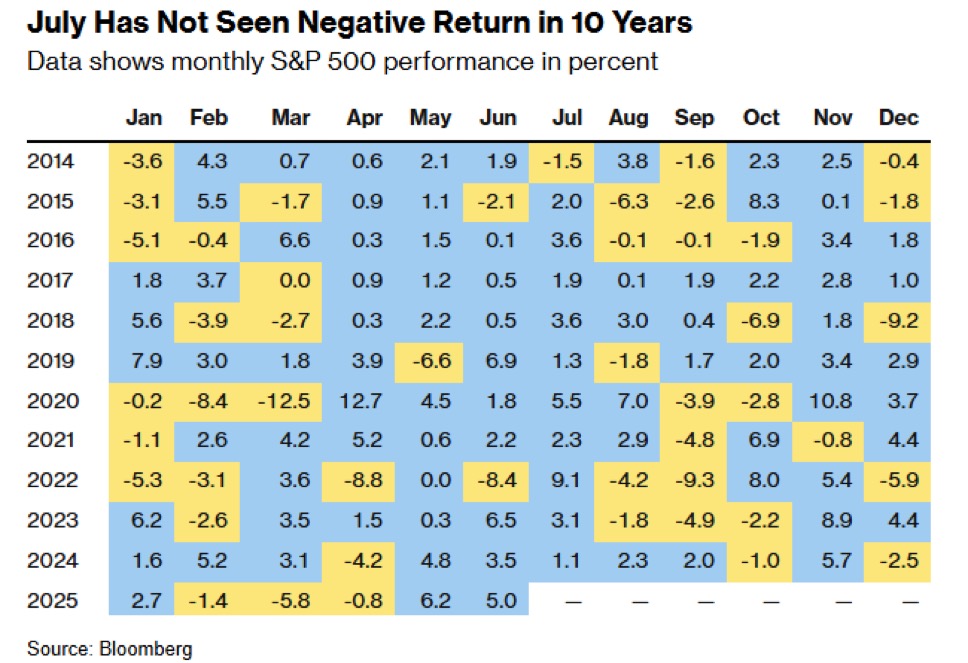
$SPYD (-0,3 %) I don’t understand why in this etf the dividend doesn’t growth in five and ten years only small percent increase , the dividend aristocrats stock increase their dividend consecutively from 25 year.

The first quarter of 2025 is over. In March, real assets recorded declines, both in equities and ETFs and especially in cryptocurrencies. The markets have become increasingly volatile. While many are panicking, I have been enjoying the first signs of spring, hiking and continuing to winter bathe diligently.
For the past month of March 2025, I present the following points:
➡️ SHARES
➡️ ETFS
➡️ DISTRIBUTIONS
➡️ CASHBACK
➡️ AFTER-PURCHASES
➡️ P2P CREDITS
➡️ CRYPTO
➡️ AND OTHER?
➡️ OUTLOOK
➡️ Shares
There was a considerable setback in March, and not just in equities. The reason for this is the customs issue, on which I have already formulated my thesis, which many believe to be correct. To summarize briefly: Markets are being depressed to get investors into bonds, which lowers bond yields and allows US debt to be refinanced at a lower interest rate. After the refinancing of short-term US government bonds, the tariffs are put into perspective and the next upswing follows, which Trump can boast about. Whether this assumption is correct remains to be seen. However, it would make sense in the long term to slash US spending. Even if the D.O.G.E. does a good job, you can't cut everything without incurring the displeasure of the population.
A look at the depot shows the front-runner $AVGO (-0,56 %) and its companion $NFLX (+0,88 %) both currently only 150% up, despite a significant setback. I am unimpressed by this development, as the capital market is always facing worse times, which will be followed by better ones. According to André Kostolany, it is now the "shaky hands" that are significantly triggering the sell-off. Yes, change your perspective: the red sign in your portfolio is irrelevant, now is the time to buy more. Enormous overvaluations in tech stocks have been reduced and they may now be available at a fairer price. There are also attractive defensive value stocks on offer, ideal for a dividend portfolio.
Second and fourth place in my individual share portfolio are still occupied by $WMT (-0,33 %) and $SAP (+4,73 %) . Walmart can now prove that it acts as a stable anchor in the portfolio even in bad times. In sixth place is a stock that I did not expect to be in the top 10. Like me, many of you have shares in $WM (-0,78 %) but the stock I am looking for is its competitor: $RSG (+3,77 %) . I have been watching the rise of this stock even before the pressure from Trump and I am happy about it. This is an example of a defensive stock. Garbage collection is necessary and Republic Services, like Waste Management, will literally turn garbage into gold for shareholders 50 years from now. Anyone complaining about their portfolio being down 50% probably has too much tech and too little defensive. My overall portfolio currently stands at around -12%. That's OK in the current macro environment.
Which brings us to the subject of performance: $NKE0 (-0,7 %) and $DHR (+6,1 %) returned around -39% at the end of March.
➡️ ETFs
They are also recording significant losses. It is important to remain calm and continue investing. Such phases are part of the game. I will not repeat further details.
➡️ Distributions
In March, I received 31 distributions on 15 payout days. I am grateful for this additional income stream. Everyone should build up such additional income.
This time, the distributions from my three large ETFs were not made on March 31, but in the first few days of April. This means that there should theoretically be 34 distributions. Numerous corrections and cancellations of dividends from REITs were not taken into account. With $O (-1,62 %) , $OHI (-2,1 %) , $LTC (-1,36 %) and $STAG (-0,31 %) there were therefore some cancellations and new dividend distributions. Although this was a major bureaucratic effort, it was usually a cause for celebration. This is because the REITs initially distribute dividends from current net income. If there are then corrections in the following year, it is determined that a distribution is also made from the already taxed retained earnings. This subsequently reduces the company's tax burden and I have noticed that I pay less capital gains tax and solidarity surcharge. So more cash in my pocket for reinvestment.
➡️ Cashback
In March, I received a small amount of income from an expense report, which I invested directly in my custody account. More on this under subsequent purchases.
➡️ Subsequent purchases
The additional purchases were financed from the expense report and, above all, from the bonus paid out by my employer. I am grateful for this, as my employer is not doing well at the moment.
I made numerous additional purchases in several ETFs that are in my small old portfolios. I invested smaller sums $GGRP (-0,24 %) , $JEGP (+0,14 %) , $SPYW (+0,16 %) , $FGEQ (+0,07 %) and $SPYD (-0,3 %) and bought a larger sum in shares of the $IWDP. On the last Friday in March, I checked my portfolio and realized that, despite careful use of the surplus, there was more cash left than I had expected. I therefore made a small additional purchase in the $VNA (+0,41 %) . For me, Vonovia (like the REITs) is a kind of hedge against my own rising rent.
➡️ P2P loans
With my last P2P platform, Mintos, there were no interest or redemption payments. I still intend to withdraw all funds where released. I would even accept a full write-off to get out of the platform. The remaining amount is no longer relevant to me.
➡️ Crypto
Crypto investors continued to experience significant volatility in March. The double top predicted by some does not seem to be materializing and the indicators do not currently point to a steep rise. I am studying the charting and the macro environment for crypto, although I still have a lot to learn here. Patience and calm are still required. I am sticking to my cycle strategy, the macro situation confirms me, so there is no need for me to take any action.
➡️ And what else?
I'm currently deepening my knowledge of AI. The posts on my Instagram channel that I published in March (and others that will follow in April) were created with the help of AI. I explained my approaches, beliefs about finance and the frugal lifestyle, and my goals to AI. The AI then created suggestions for Instagram posts, including prompts and allowing for a week break at the end of the month.
There is still a lot for me to learn. I am using AI more and more intensively and deeply in my professional and private life. While colleagues are happy that an AI can write emails for them, I use it much more extensively, for example to have technical content and its effects on departments and companies explained to me at work or to have economic relationships explained to me in my private life. In addition to ChatGPT, I particularly like Grok by X, as this AI always asks questions and thus enables a fluid conversation. The AI doesn't just reproduce facts, but also evaluates my ideas and classifies them, for example whether I should already use part of my nest egg to buy more quality stocks at favorable prices. Her suggestion was perhaps to wait until after the refinancing of short-term US government debt, when there might be less downward volatility in the market. This recommendation is based on my thesis mentioned above.
March was also a month of fasting for me, not for religious reasons, but because I want to and always intend to. I like to use the time after fasting to change my habits, adjust my diet and vary my sports units and routines. For me, this is particularly easy after fasting - the time afterwards generally feels like a new beginning.
➡️ Outlook
In April we will continue to see negative signs in the portfolio. I have now placed a limit order, which I hope will be triggered. The annual electricity bill is also due. I'm curious to see how much will be returned, the refund will certainly go into the custody account. It will also become clear whether I will increase my discount due to higher electricity costs. Until then!
Links:
Social media links can be found in my profile, you can also take a look at the Instagram version of my review.

Meilleurs créateurs cette semaine