

PLEASE DO NOT ALWAYS DELETE THE TEXT🥲 In short: all that glitters is not gold $IGLN (+3,86 %)
$GOLD
GOL
Other Global X Physical Gold
ETP
ETP
ISIN: AU00000GOLD7
Ticker: GOLD
AU00000GOLD7
GOLD
Price
Debate sobre GOLD
Puestos
27


1Lun·
While gold falls: Bitcoin shows new crisis strength
$BTC (+0,11 %) continues to hold its own as a surprisingly robust crisis winner. Since the escalation in Iran at the end of February, the cryptocurrency has risen by around 23%, while stock markets fell and $GOLD and trended significantly weaker. Bitcoin gained a further 4.5% this week alone.
Institutional investors also remain committed: Products for digital assets recently attracted around one billion US dollars in fresh capital. Blockchain shares are also in particularly high demand, with record inflows this month.
Additional tailwinds could come from the USA. The focus there is on the Clarity Act, which is intended to provide clear rules for the crypto market. If passed, it would make it easier for banks and large investors in particular to enter the market. (Author James Butterfill, CoinShares' Head of Research)
22
2Lun·
Bitcoin vs. gold: market reactions during the crisis
Between February and April $GOLDwhile $BTC (+0,11 %) rose - contrary to typical crisis patterns. $BTC (+0,11 %) The euro benefited from reduced speculative surpluses, institutional inflows and its growing role as a hedge outside traditional financial systems.
#gold suffered from rising real interest rates and inflation expectations.
The short-term ceasefire in the Middle East provided relief #bitcoinHowever, should the crisis flare up again, volatility remains likely - but $BTC (+0,11 %) could nevertheless prove more robust than traditional risk assets.
44

2Lun·
📊 Gold falls, Bitcoin rises - is gold losing its status as a crisis currency?
Dear Community,
Yesterday a user said that Bitcoin had replaced gold as a crisis currency.
(No, it is not @Klein-Anleger meant 🙄)
Justification: Currently rising $BTC (+0,11 %) while $4GLD (+3,01 %) falling.
I have a different (outdated?) opinion on this and would like to explain below why I cannot agree with this statement.
I look forward to your opinions. Because maybe I'm the one living under the moon. 🤷🏼♂️
_________________________
🥇 1. why gold is historically the number one crisis currency
Gold has established itself over decades (actually millennia) as the ultimate store of value.
The reasons:
- 🌍 Independent of states & currencies
- 🏦 No counterparty risk (no issuer, no payment default)
- 📉 Inflation protection
- ⚖️ Limited supply
👉 In real crises (2008 financial crisis, Corona 2020, geopolitical tensions), capital traditionally flows into gold
💡 Important:
Gold is not a "trade", but an anchor of confidence in the global financial system.
_________________________
📉 2. why gold is still falling at the moment
The current decline has nothing to do with a loss of confidence, but is primarily macro-driven:
1️⃣ High interest rates (Fed policy)
- Gold does not yield interest
- Rising yields make bonds more attractive
👉 Capital moves out of gold in the short term
2️⃣ Strong US dollar
- Gold is traded in USD
- Stronger dollar = gold more expensive for other countries
- Demand falls
3️⃣ Profit taking after rally
- Gold had a strong high before
- Short-term correction is normal
_________________________
🪙 3. why Bitcoin is currently rising
Bitcoin is currently benefiting from other factors:
- 📈 Speculation of monetary policy easing
- 💡 Narrative as "digital gold"
- 🏦 Institutional demand (ETFs etc.)
- 🌐 Short-term use as a "liquidity parking lot"
👉 Important:
Bitcoin is currently more of a risk asset with momentum, not a classic safe haven.
_________________________
⚖️ 4. The crucial difference: gold vs. bitcoin
Gold ($IGLN (+3,86 %) ):
- defensive
- stable
- proven in real crises
Bitcoin ($BTC (+0,11 %) ):
- volatile
- heavily dependent on liquidity
- often parallel to tech stocks
💡 Observation:
In real stress phases (e.g. liquidity crises), Bitcoin often falls first, while gold remains stable or rises.
_________________________
🧠 5 Why the current decline is not a warning signal
The most important point:
👉 Gold reacts more strongly to interest rates than to crises in the short term
Meaning:
- rising interest rates = short-term pressure
- Real systemic crisis = long-term rise
➡️ The current decline is therefore more of a macro effect, not a structural break.
_________________________
📊 6. what would have to happen for gold to rise again
Gold should benefit significantly again if:
- 📉 Interest rates fall
- 💵 the US dollar weakens
- 🌍 geopolitical risks continue to escalate
- 📉 Confidence in the financial system declines
👉 Then capital typically returns to traditional safe havens
_________________________
🧠 Conclusion
The current market seems contradictory:
- Gold is falling
- Bitcoin rises
👉 But this is not a paradigm shift.
Gold remains:
- the most stable store of value
- the classic crisis currency
Bitcoin is up to date:
- a liquidity-driven momentum asset
📌 In short:
👉 Gold is not losing importance -
👉 it is only overshadowed by macro factors in the short term.
1313
14 Comentarios
Your reasons for gold apply 1:1 to BTC - only Bitcoin fulfills these points better than gold🙃
Gold is the crisis currency and the safe haven not only because of these characteristics, but because gold has played this role for thousands of years and enjoys the corresponding trust. Bitcoin still has to earn this.
Gold is the crisis currency and the safe haven not only because of these characteristics, but because gold has played this role for thousands of years and enjoys the corresponding trust. Bitcoin still has to earn this.
•
1414
•2Lun·
📉 Gold price falls below USD 5,000 - Fed & strong dollar put precious metal under pressure
After a strong rally, gold is currently undergoing a correction. The price has fallen below the psychologically important USD 5,000 per ounce mark - and there are clear reasons for this.
$IGLN (+3,86 %)
$GLDA (+2,77 %)
$4GLD (+3,01 %)
$GOLD (+7,89 %)
$GOLD
$DE000EWG0LD1 (+2,98 %)
_________________________
📊 1. current development
- Gold price most recently at around USD 5,019
- Previous all-time high: USD 5,420
- Decline: around -3% within a short period of time
💡 Classification:
After the strong rally, this is a classic technical correction - but with fundamental triggers.
_________________________
🏦 2nd main reason: Fed & interest rates
The most important driver at the moment:
👉 Uncertainty ahead of the interest rate decision by the US Federal Reserve (Fed)
- Markets are waiting for signals on interest rate cuts
- Interest rates remain high → negative for gold
- Why is that? Gold yields no interest and becomes less attractive with high yields
➡️ The Fed meeting is seen as a decisive turning point for future developments
_________________________
💵 3. strong US dollar as a burden
Another key factor:
- The US dollar is gaining strength
- This makes gold more expensive for international buyers
- Demand falls → price comes under pressure
👉 Classic correlation:
Stronger dollar = weaker gold price
_________________________
📉 4. important brands at a glance
Currently decisive:
- 🧱 Support: approx. 4,900 USD
- 🧠 Psychological mark: USD 5,000
➡️ A sustained break below this level could trigger further selling.
_________________________
⚖️ 5. Paradoxical situation on the market
Despite:
- geopolitical tensions
- inflation
- global uncertainty
... gold is currently weakening.
💡 Background:
Macro factors such as interest rates and the dollar are overshadowing safe-haven demand in the short term.
_________________________
🧠 Conclusion
The fall below USD 5,000 shows:
👉 Gold is currently not a sure-fire success
👉 Macro (Fed + dollar) dominates the market
Short term:
- High volatility
- Focus on Fed decision
Medium term:
- Gold could benefit strongly again if interest rates are cut
_________________________
🔗 Source
www.ad-hoc-news.de
2121
2 Comentarios
If the oil price falls again, gold will also go up
•
55
•
3Lun·
March 2026 Monthly Portfolio Update - – Navigating Volatility
March has started off as one of the most challenging periods in global markets in recent memory.
The ongoing escalation between the United States, Israel, and Iran has driven widespread risk-off sentiment across equity markets, with oil and energy prices surging and stock indexes under pressure.
As a result, my portfolio is currently down around -2.5% for the month. This reflects the broader market reaction, where indices like the S&P 500 and Nasdaq have shown volatility and downside pressure as geopolitical tensions impact investor sentiment and inflation expectations.
Strategic Adjustments
In response to this environment, I’ve made several tactical adjustments:
Reduced exposure in some positions and closed others to secure partial liquidity
Currently holding approximately 10% in cash, which provides flexibility and optionality
Diversified further across new positions — (e.g., $TCL (+1,62 %)
$LOV (-0,38 %)
$APA (+5,56 %) , and from Swiss market $UBSG (+2,38 %) )
These recent additions reflect my focus on quality names with strong fundamentals, diversified geographies and sectors rather than simply chasing index performance.
What this means for Copiers
We’re in a risk-off market regime, not a bear market per se — volatility is a natural response to major geopolitical uncertainty.
Panic selling is rarely the best course of action — losses can be locked in permanently, whereas disciplined investors can find opportunities in dislocations.
The current cash buffer gives us dry powder to scale into positions at more attractive prices if the market continues to sell off.
Broader Market Backdrop
The current sell-off is driven by the escalation of conflict involving the US, Israel and Iran, which has:
Pressured global equity markets and raised inflation and risk aversion concerns
Pushed oil prices sharply higher amid fears of supply disruptions
Increased demand for safe-haven assets such as gold and the US dollar
Led to broad risk-off behaviour across major benchmarks in Asia, Europe and the US
Moneycontrol
No one can predict with certainty how this geopolitical situation will unfold, or how markets will react in the short term. But history shows that volatility tends to be temporary, and well-selected exposures often recover and outperform when clarity returns.
Final Thought
This isn’t a time to exit the market, but rather a time to reassess where capital can be deployed most effectively, balancing risk with long-term opportunity. I’ll continue adjusting positions as conditions evolve and will keep transparency front and centre.
Let’s stay calm, focused, and strategic.
😎 𝗗𝗶𝘀𝗰𝗹𝗮𝗶𝗺𝗲𝗿: This is my personal opinion and is for informational purposes only. You should not interpret this information as financial or investment advice
$NVDA (+2,16 %)
$CSPX (+1,41 %) $$GOLD
$TSLA (+3,99 %)
$AAPL (+0,87 %)
$PLTR (+1,36 %)
22
3Lun·
Geopolitical shockwaves shake the markets - crypto as a safe haven?
In the face of escalating tensions in the Middle East, the price of oil rose by 10% and $GOLD gained 3.5%, confirming its traditional role as a safe haven - but Bitcoin is defying expectations, remaining stable and even attracting inflows. Investors appear to be using the correction as both an entry point and a hedge, pointing to a potentially growing role for cryptocurrencies in times of geopolitical uncertainty and volatile markets.
Geopolitics drives oil and gold higher
Geopolitics once again dominated the markets over the weekend after President #trump used Saturday to further escalate tensions. The withdrawal of British embassy staff from Iran had already indicated rising risks, so markets were not completely unprepared. The crucial question is not only whether the #iran can be contained, but also how quickly potential disruptions could spread. Iran controls the Strait of Hormuz, one of the world's most important energy routes. Withdrawals by insurers and visible congestion of tankers indicate that the situation is already operationally relevant and not just rhetorical. Drone activity and signals of support from Hezbollah and the Houthi militia increase the likelihood that the conflict will escalate. The 10% rise in the oil price reflects this fragility, while gold is fulfilling its traditional role as a safe haven with a gain of 3.5%.
Bitcoin defies uncertainty - inflows return
Even more remarkable is the reaction of Bitcoin. Historically, Bitcoin, as the only liquid asset that is also traded at the weekend, has usually reacted negatively in phases of forced risk reduction. This time, however, the cryptocurrency remained stable and even rose despite increasing uncertainty. The lack of significant liquidations despite rising yields and geopolitical tensions suggests that positioning is more balanced compared to previous episodes. Over the past five months, major market participants have turned over around USD 30 billion and technical and fundamental lows have already been reached. Last week, inflows returned: USD 1 billion flowed in after USD 4 billion had previously flowed out over five weeks, and a further USD 500 million was added on Monday alone. This suggests that investors see the correction as both an entry opportunity and a hedge in the current geopolitical situation.
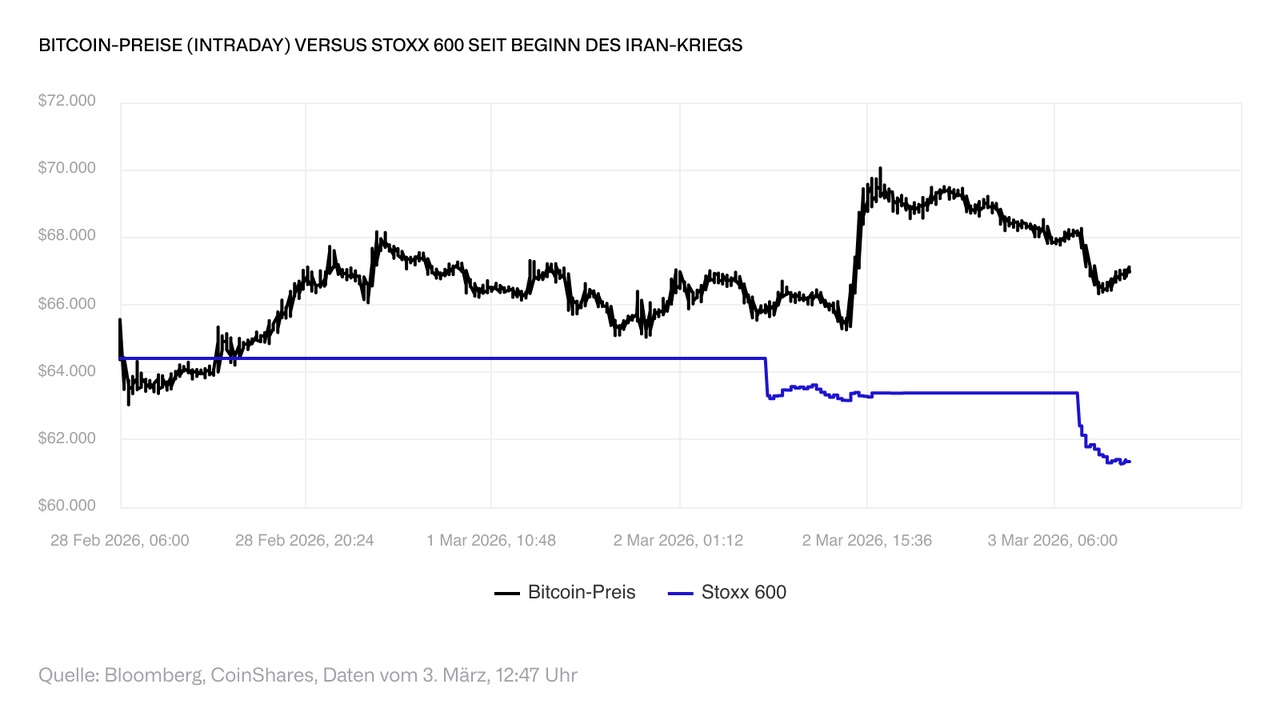
The chart shows the intraday price development of $BTC (+0,11 %) from the start of the conflict at 6:15 GMT on February 28 to the current time, as well as the relative price performance of the Stoxx 600, illustrating the significant outperformance of Bitcoin since the outbreak of the conflict. The flat sections in the equity index reflect periods when exchanges were closed, highlighting the liquidity constraints of equities compared to continuously tradable Bitcoin.
Macroeconomics tighten financial conditions
The macroeconomic environment is making the situation even more difficult. The Producer Price Index rose by 0.5% month-on-month, above the expected 0.3%, while the core rate reached 0.8%, mainly driven by trade-related services. With energy prices now rising sharply, rate cut expectations are likely to be postponed further, tightening financial conditions compared to a few weeks ago. If energy-driven inflation delays monetary easing, traditional risk assets could come under pressure. However, if geopolitical tensions intensify and confidence in global financial and trade structures - particularly along critical routes such as the Strait of Hormuz - erodes further, scarce and non-government assets such as Bitcoin could benefit in the medium term.
Via the CoinShares Bitcoin ETP $BITC (+2,82 %) you can also invest in Bitcoin.
22
3Lun·
🌍 Middle East escalation moves the markets - capital flees to security & defense
The military escalation between the USA, Israel and Iran is causing strong market movements worldwide. Investors are shifting out of cyclical sectors and into security, energy and defense.
_________________________
Bitcoin $BTC (+0,11 %) shows surprising stability
- 📈 In the meantime +8,1 %
- 💰 Just over 70,000 dollars
- Stabilization at around 69,000 dollars
Despite geopolitical risks, Bitcoin is apparently being used as a liquidity parking lot in the short term. At the same time, volatility remains high - further escalations could trigger new spikes.
_________________________
🛢 Oil prices up significantly
- Brent: + just under 6 %
- WTI: + a good 5 %
- In the meantime even +13 %
According to the report, the USA is currently no release from the strategic oil reserve. The market is still considered to be supplied, but the situation remains tense.
_________________________
🏦 Banks under pressure
The European banking index loses around 3,5 % - sharpest decline since April 2025.
Particularly affected:
- HSBC - $HSBA (+5,23 %)
- Barclays - $BARC (+3,97 %)
- Standard Chartered - $STAN (+7,84 %)
- Deutsche Bank - $DBK (+3,44 %)
- BNP Paribas - $BNP (+2,03 %)
- BBVA - $BBVA (+3,85 %)
- Commerzbank - $CBK (+0,4 %)
In the USA also weaker until the US opening:
- Bank of America - $BAC (+0,68 %)
- Citigroup - $C (+2,98 %)
Reason: Strong Middle East business of many institutions and general risk aversion of investors.
_________________________
✈️ Travel industry collapses
High oil prices and uncertainty weigh heavily on tourism stocks:
- TUI - $TUI1 (+3,28 %) (-11 %)
- Lufthansa - $LHA (+2,55 %) (-11 %)
Flights to the region are canceled, travel offers suspended. Investors fear rising costs and falling booking figures.
_________________________
💎 Luxury stocks clearly in the red
The European luxury index loses almost 4 %.
Strongly affected:
- Richemont - $CFR (+5,24 %)
- Swatch - $UHR (+4,57 %)
- LVMH - $MC (+2,87 %)
- Hermès - $RMS (+3,07 %)
- Kering - $KER (+4,39 %)
- Brunello Cucinelli - $BC (+1,79 %)
- Moncler - $MONC (+3,43 %)
- Ferragamo - $SFER (+4,79 %)
Background:
Luxury is heavily dependent on global travel. Capital flows out of cyclical stocks.
_________________________
🛡 Defense stocks as clear winners
Geopolitical tensions drive up defense stocks:
- BAE Systems - $BA. (+0,98 %)
- Lockheed Martin - $LMT (+4,08 %)
- RTX - $RTX (+2,22 %)
- Kratos - $KTOS (+6,63 %)
- Hensoldt - $HAG (+1,74 %)
- Leonardo - $LDO (+3,55 %)
- Renk - $R3NK (-3,15 %)
- Rheinmetall - $RHM (+3 %)
Partial price increases of 3-6 %.
The focus is particularly on missile defense systems and possible increases in defense budgets.
_________________________
🚢 Shipping companies benefit
Transport values increase due to detour (avoidance of Hormuz, Suez Canal & Bab al-Mandab):
- Maersk - $MAERSK A (+3,47 %)
- Hapag-Lloyd - $HLAG (+1,32 %)
- Torm - $TRMD A (-2,44 %)
- Frontline - $FRO (+1,7 %)
- Hoegh Autoliners $HAUTO (+5,61 %)
Reason: Shortage of transport capacity and speculation on rising freight rates.
_________________________
🥇 Gold in demand
- Gold price: +2,5 %
Profiteers in mining stocks:
- Evolution Mining - $EVN (+7,76 %)
- Northern Star - $NST (+3,67 %)
The sector has been showing relative strength for several days.
$4GLD (+3,01 %)
$GOLD
$GOLD (+7,89 %)
_________________________
📊 Market logic clearly recognizable
Winner:
🛡 Armaments
🚢 Shipping companies
🥇 Gold
₿ Bitcoin (short-term)
Losers:
🏦 Banks
✈️ Travel
💎 Luxury
_________________________
🔎 Conclusion
The market reaction follows the classic pattern of geopolitical crises:
- Risk is reduced
- Capital seeks security
- Energy prices rise
- Defense stocks benefit
The decisive factor remains whether the situation eases diplomatically - or escalates further.
_________________________
Source:
Reuters: Anleger greifen bei Bitcoin als "Fluchtvehikel" zu (Via TradingView)

de.tradingview.comAnleger greifen bei Bitcoin als "Fluchtvehikel" zu
2222
2 Comentarios
Nice summary of the trading day. $HAUTO is also one of the winners of the last few days.
•
44
•
5Lun·
🇻🇪 Venezuela quake on the oil market - Who are the profiteers of the upheaval? 🛢️🚀💰
Good morning everyone and a green start to the first full trading week of 2026!
The year is barely five days old and there have already been numerous events around the world.
Probably the most eventful event (can you write it like that? 🤔) is the one at the weekend surrounding Maduro's arrest.
While the oil price remains volatile due to the global oversupply, clear winners are emerging today (05.01.2026) from the US intervention.
1. the "top dog": Chevron $CVX (-2,41 %)
🏗️
Chevron is the clear favorite today. As the only US company to remain operational in the country, they have the "first mover" advantage.
If the sanctions are lifted, the billions will flow into repairs first.
_________________________
2. the service giants: SLB $SLB (-0,58 %)
& $HAL (-0,12 %)
🛠️
No matter who is producing: The plants in Venezuela are dilapidated. Schlumberger is currently benefiting massively from speculation on major technology contracts.
Without Western know-how, Venezuela will not be able to significantly increase production.
_________________________
3. the US refineries: Marathon Petroleum $MPC (-1,23 %)
& Valero $VLO (-2,28 %)
⛽
The US Gulf Coast specializes in "heavy" crude oil from Venezuela. A return of this oil improves the margins of Marathon Petroleum and Valero massively, as expensive import alternatives are eliminated.
_________________________
4. US defense: Lockheed Martin $LMT (+4,08 %)
🛡️
Instead of European second-line stocks, the industry leader Lockheed Martin is moving into focus. The US intervention underlines the military presence in the region. very Such geopolitical tensions secure the group's long-term political backup for defense budgets.
_________________________
5. the "safe haven" effect: gold breaks records 🏆✨
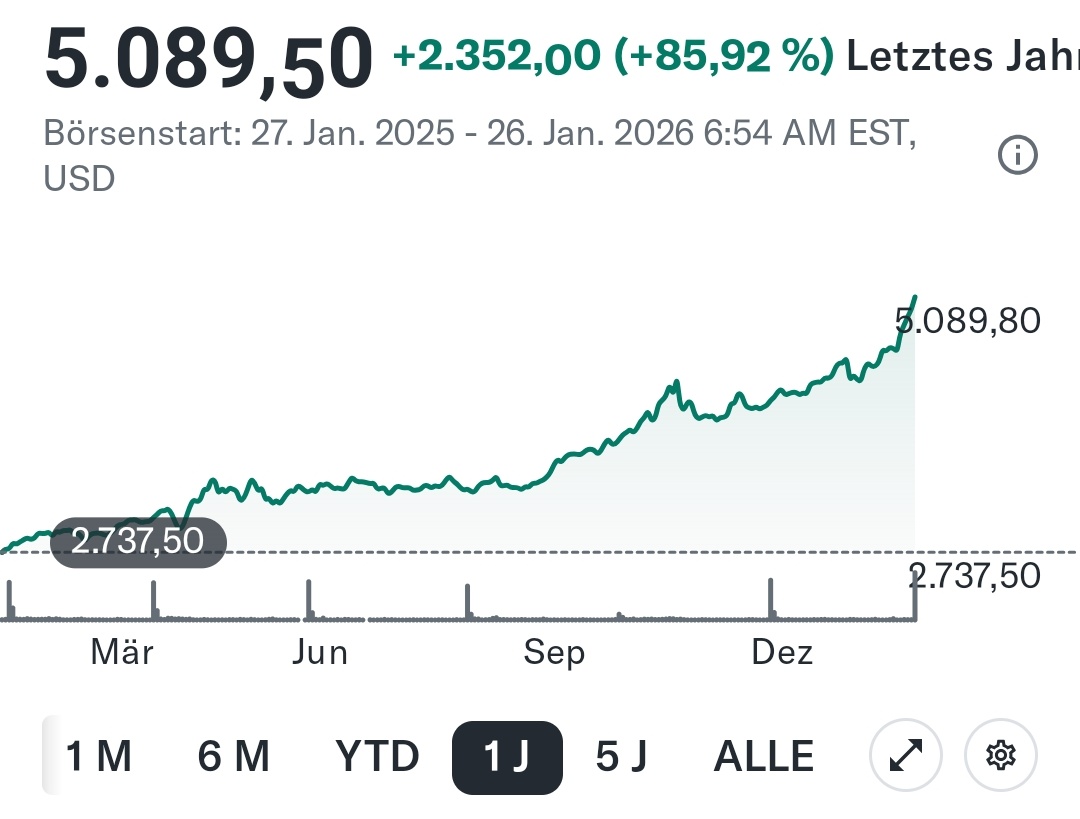
Gold is the absolute rock in the surf today. Due to the uncertainty, the spot price fell by over 2 % upwards this morning and has passed the 4,420 USD per ounce!
- Barrick Gold $ABX (+5,05 %)
& Newmont $NEM (+4,66 %)
: Mining stocks rally strongly.
- Background: Venezuela is sitting on gold reserves worth around USD 22 billion - the question of who will have access to them is also driving speculation.
_________________________
What's your situation? Have you already invested in one of the stocks? Or are you planning to?
