
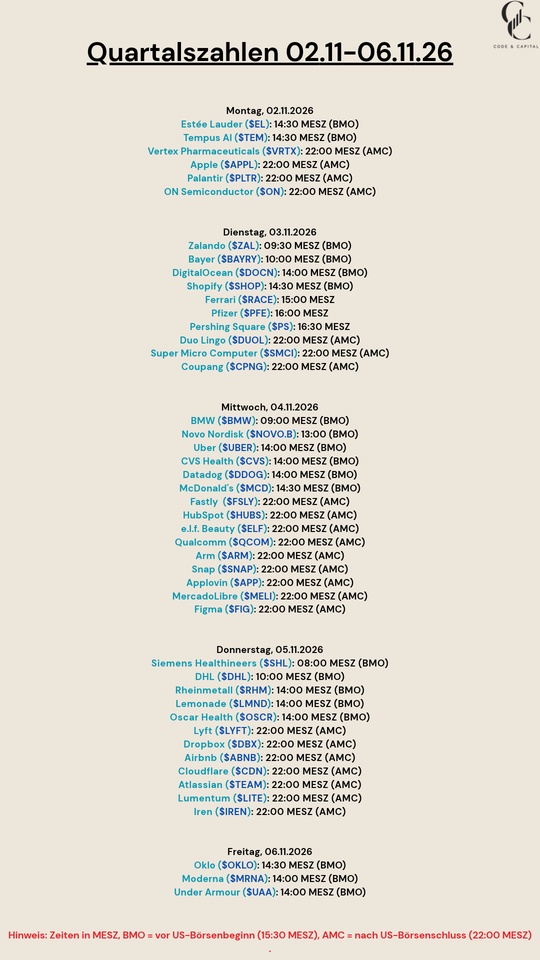
$EL (+2,78 %)
$TEM (-5,74 %)
$VRTX (+1,64 %)
$AAPL (-1,58 %)
$PLTR (-5,23 %)
$ON (-2,2 %)
$ZAL (-0,52 %)
$BAYN (+5,27 %)
$DOCN (-5,9 %)
$SHOP (-4,87 %)
$RACE (-1,38 %)
$PFE (+1,26 %)
$PS (-6,99 %)
$DUOL
$SMCI (-1,07 %)
$CPNG (-0,37 %)
$BMW (-0,05 %)
$NOVO B (+2,56 %)
$UBER (+0,57 %)
$CVS (-0,26 %)
$DDOG (-8,43 %)
$MCD (+0,02 %)
$FSLY (-6,41 %)
$HUBS (-0,47 %)
$ELF (-0,64 %)
$QCOM (-7,5 %)
$ARM (-2,74 %)
$SNAP (-3,64 %)
$APP (-9,25 %)
$MELI (-1,4 %)
$FIG (-1,23 %)
$SHL (-0,43 %)
$DHL (-0,71 %)
$RHM (-2,1 %)
$LMND (-5,38 %)
$OSCR (-1,31 %)
$LYFT (-1,37 %)
$DBX (+0,03 %)
$ABNB (-1,92 %)
$NET (-6,48 %)
$TEAM (-3,76 %)
$LITE (-5,35 %)
$IREN (-4,1 %)
$OKLO
$MRNA (-0,09 %)
$UAA (-0,89 %)

Palantir Tech
Stock
Stock
Ticker: PLTR
PLTR
Price
Debate sobre PLTR
Puestos
77911H·
Quarterly Results Nov. 2–Nov. 6, 26
99


2Semana·
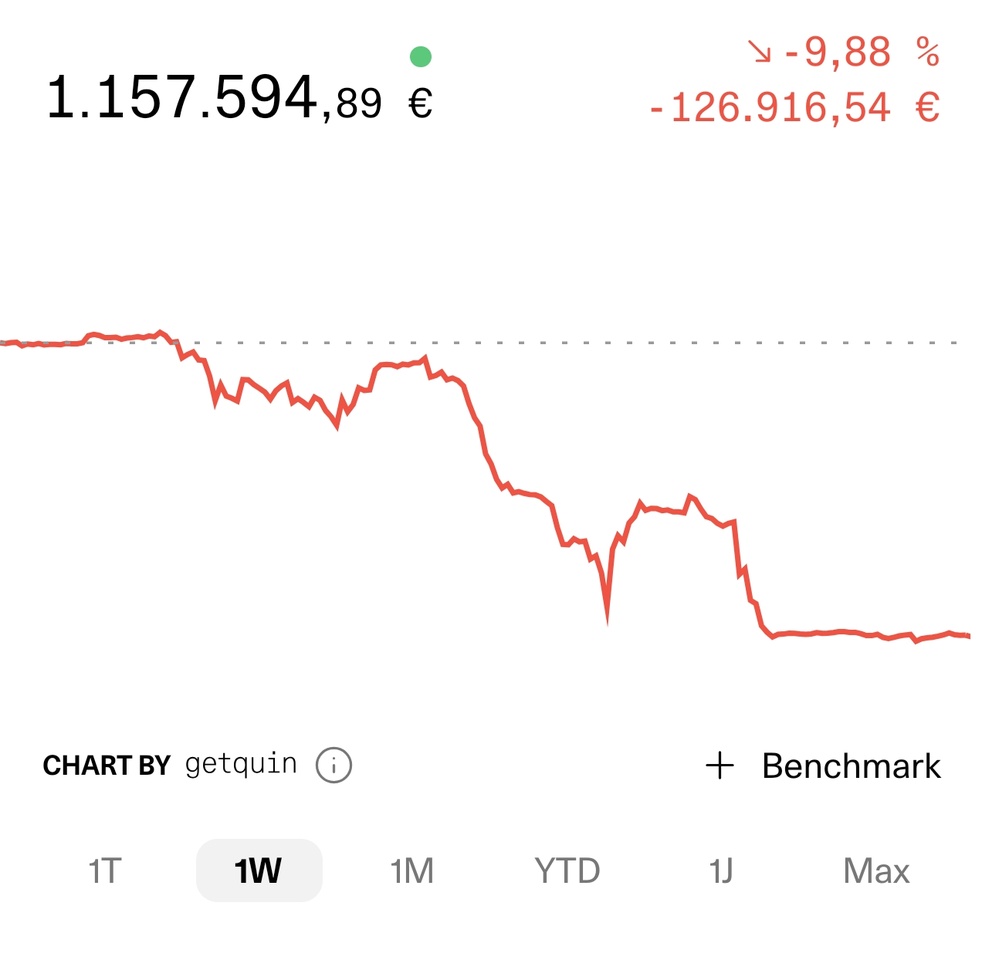
It was certainly a very red week
It was certainly a very rough week, but the portfolio had reached a new all-time high just 11 days ago. Just normal volatility.
Year-to-date performance is +30% overall, but it was already at +40% 11 days ago. How did the week and the year go for you so far? $AMD (-5,15 %)
$PLTR (-5,23 %)
$BTC (+0,35 %)
2121
7 ComentariosMax@Maximilian1
2Semana
•
55
•Mostrar respuesta

2Semana·
What 4.5 years of not touching my portfolio would have done
So, since it's been so long since I touched my account, it's interesting to look back at it and actually see the difference between what if I just left my account like I did here vs. what actually transpired (spoiler alert: I didn't let my $NVDA and $PLTR run).
Most important findings:
- Frozen getquin portfolio: €504,764. My actual accounts: €290,261. That’s a €214k gap.
- $NVDA (-2,63 %) : getquin still thinks I own 1,300.83 shares, bought for €23,798. Today that’s €266,605 (+1,020%). So yes, Nvidia alone covers the entire gap and then some.
- $PLTR (-5,23 %) : 150 shares at €19.97, now €27,897 (+831%).
- The ones I was right to dump: $CRSR (-52%) and $BABA (-26%).
Time to sync this account with reality.
1212

3Semana·
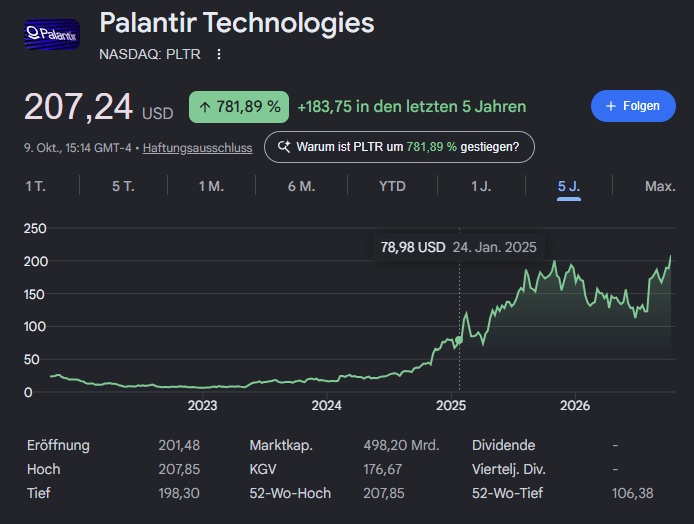
PLTR hit a new all-time high today at $207.85!
$PLTR (-5,23 %) The catalyst was essentially a combination of two recent analyst upgrades:
- Goldman Sachs has raised its rating from Neutral to Buy (target price $230) and sees significant potential, particularly in the area of sovereign AI . I also found it interesting that they noted Palantir is scaling much more efficiently from an operational standpoint than before, because it requires fewer “on-site solutions engineers.”
- Barclays also rates it a Buy ($265 target) and justifies this primarily with the strong free cash flow growth rates and high margins.
On top of that, AIP continues to be extremely well-received by companies and is further driving growth in the commercial sector. After the stock lagged somewhat behind other AI stocks at times, it’s now making up for lost ground.
How are you handling this after the breakout? Are you sticking with your investment, taking initial profits at >$200, or would you rather wait for a pullback to make your next entry?
For now, I’m staying relaxed and holding on to the shares. Karp definitely has the potential $PLTR (-5,23 %) to become a $1T company.


1Lun·
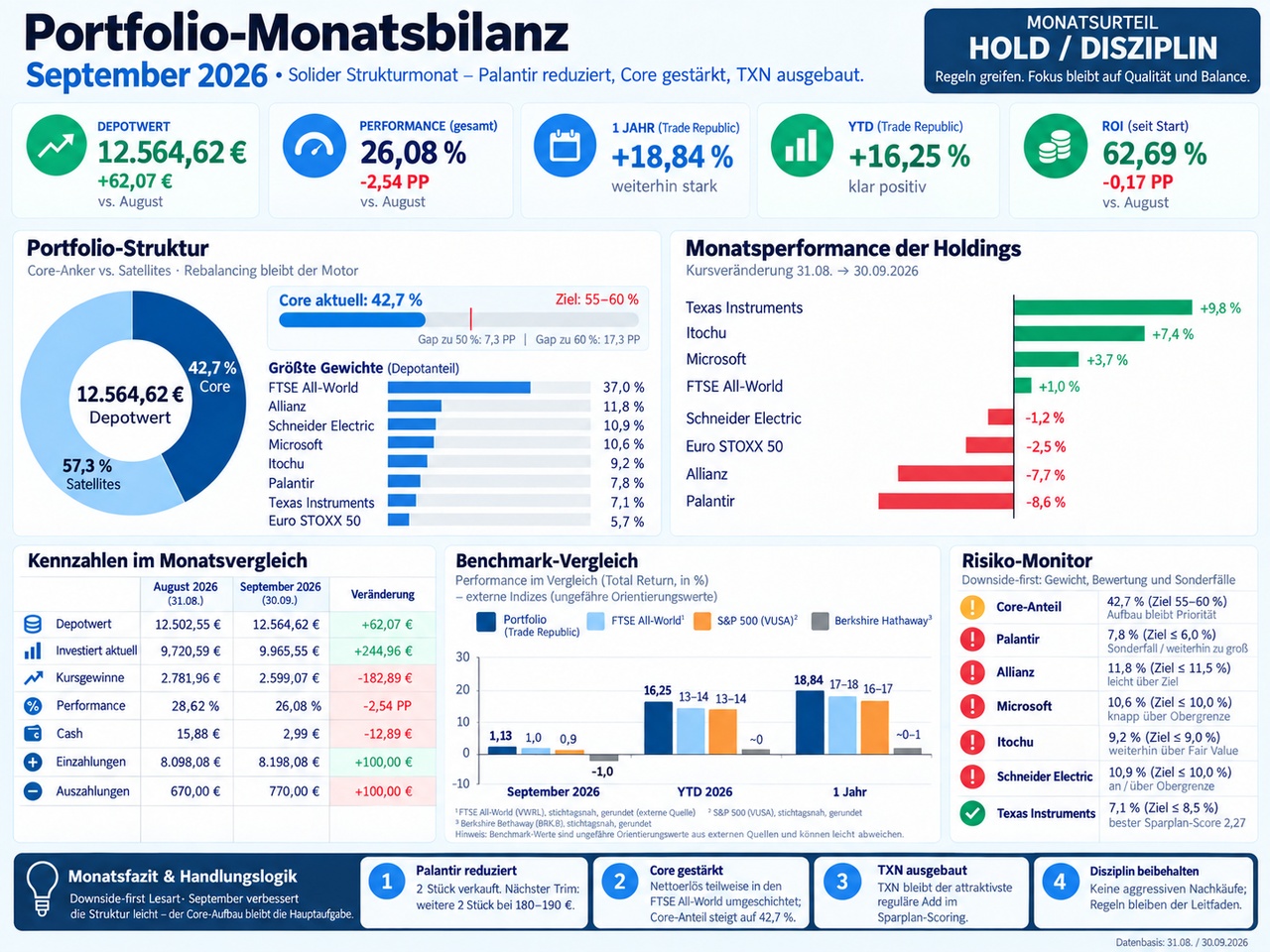
Stable and Disciplined as We Head into Fall
In September $PLTR (-5,23 %) I’ll reduce the price by another 2 units, as outlined in the exit plan. The next 2 at €180–190 🍂 After that, I’ll just let the remaining 4 sit.
77
2 Comentarios
3Semana
I'm still holding onto my 500 PLTR shares that I bought for €13.50 😇
•
33
•
1Lun·
💍 OURA IPO (four times oversubscribed): A valuation of $14 billion, an AI ecosystem, and the Trump administration—what do you think?
Oura Health, the pioneer of smart rings, is preparing for its stock market debut on Wall Street. In an extremely strong market environment, the company—founded in 2013—aims to raise up to $2.2 billion. By issuing 50 million shares at $40 to $44 each, Oura is targeting a market capitalization of approximately $14.1 billion.
But the investment case involves more than just a piece of titanium for your finger. Business model and political entanglements:
The Business & Ecosystem
- Strong Market Position: Oura currently controls about two-thirds of the North American smart ring market. Last year alone, over 3 million rings (with premium models costing up to $500) were sold.
- From Tracker to AI Platform: The hardware collects the data (sleep, cardiovascular health, physical activity), but the Oura membership keeps users in the ecosystem.
- Growing Subscription Base: Over 5 million subscribers now use premium metrics for fertility and conception planning, medication tracking, and the AI-based “Oura Advisor.”
The Political Dimension & the Palantir Controversy
- Massive lobbying: Since 2024, Oura has ramped up its U.S. lobbying budget from $40,000 to over $1 million.
- The Military as a Major Client: In 2025, Oura secured a contract with the U.S. Department of Defense, which uses the rings as a benefit for civilian and military personnel.
- Palantir ($PLTR (-5,23 %)
& Data Protection): The partnership sparked rumors of surveillance. Oura strongly denies sharing health data for such purposes and emphasizes its compliance with the GDPR and U.S. privacy laws. - The “MAHA” Movement: The smart rings have become extremely popular among members of the Trump administration and the “Make America Healthy Again” movement. Prominent advocates such as U.S. Secretary of Health Robert F. Kennedy Jr. (whatever you may think of him...) view wearables as a key tool for early disease detection and for relieving pressure on the federal healthcare system.
What do you think of this investment case, or is it not for you?
The Valuation: Is $14.1 billion justified for a hardware company that, while building an extremely strong software ecosystem, is facing increasing competition from Samsung (Galaxy Ring) and potentially Apple?
The Palantir and Politics Connection: Do you see the massive government contracts and support from the U.S. Department of Health and Human Services as a formidable moat, or does the potential PR risk related to data privacy (think Palantir) put you off?
Your strategy: Is the OURA stock a direct buy for you at the IPO, are you going to watch from the sidelines for now, or are you staying away from it entirely?
cc @Tenbagger-Capital
@Raketentoni
@Multibagger
@EpsEra
@Get_Rich_or_Die_Tryin
@Max095
@Aktienhauptmeister
33
7 Comentarios
I'm a bit cautious about IPOs. Because in the past, some were really overvalued. And they lost a lot of value after the IPO.
•
88
•1Lun·
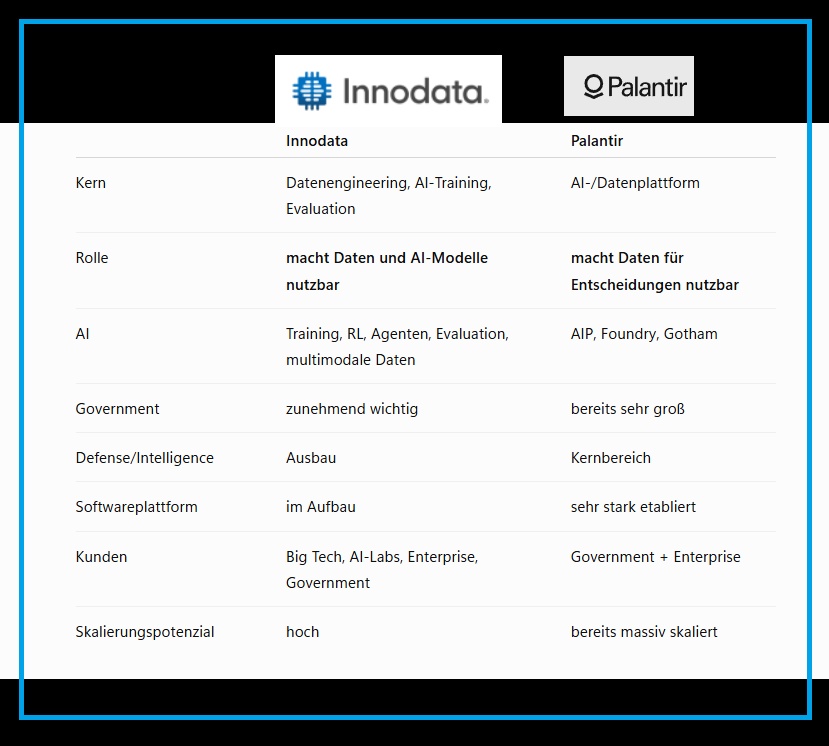
Is Innodata the "little Palantir"?
Yes— but with one important caveat: I would describe Innodata more as a “small Palantir in the data/AI backend” rather than a mini-Palantir in terms of its actual business model.
In my view, the comparison is particularly interesting precisely because of Innodata’s recent developments:
The key point
is that Innodata is one level below Palantir .
Palantir, for example, takes corporate or government data and builds operational decision-making and AI systems from it.
Innodata, on the other hand, ensures that the data, training datasets, evaluations, and AI workflows actually meet the necessary quality standards.
This becomes particularly clear through a remarkable connection:
Innodata is itself a supplier to Palantir.
Palantir has selected Innodata for data engineering, annotation, and multimodal data processing—including computer vision, video, image, document, and sensor data.
I find this strategically very interesting.
And Innodata is continuing to evolve
The company is no longer just a traditional “data processor.”
In Q2 2026:
- Revenue +58%
- Adjusted EBITDA +92%
- Gross margin 49%
- Largest customer now only 37% of revenue, down from 56% in Q1
- New major Frontier AI customer
- Activities at Agentic AI / Reinforcement Learning
- AI cyber training
- Data for Robotics / Physical AI
- Expansion of evaluation and observability for AI agents.
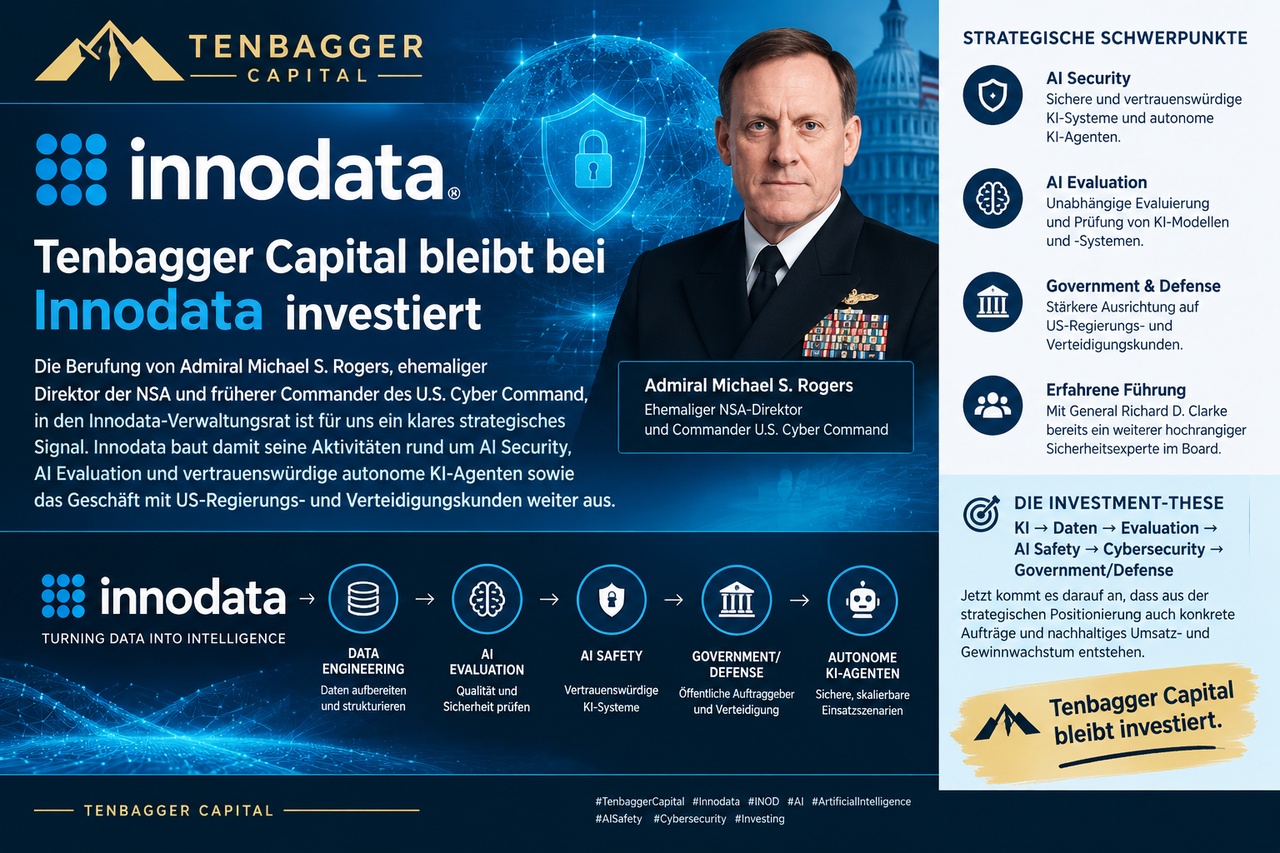
Innodata – Innodata meldet Rekordergebnisse für das zweite Quartal 2026
Even more interesting: In Q1, a Evaluation & Observability Platform was introduced in Q1, designed to function as a kind of control layer for agent-based AI systems.
So I would put it this way:
Palantir = AI operating system for businesses and governments
Innodata = data/AI infrastructure and quality layer upon which such systems can be built
And that’s exactly where I see the exciting investment story at Innodata.
Because as AI agents, physical AI, robotics, defense AI, and government AI grow rapidly, the demand increases not only for computing power and models—but also for high-quality data, evaluation, security, and continuous training.
That is precisely the layer on which Innodata is increasingly focusing. The company now expects at least 40% revenue growth.
For the tenbagger thesis
I would therefore not simply buy Innodata as a “mini-Palantir”, but rather frame the thesis a bit differently:
“Innodata is a potential ‘picks-and-shovels’ beneficiary of the Palantir/AI revolution.”
And to me, that’s actually the more interesting thesis.
After all, Innodata doesn’t have to become the dominant AI platform itself. It’s enough if more and more AI companies and government organizations require high-quality data, agent training, evaluation, and secure AI workflows .
The fact that Palantir is already an Innodata customermakes this theory particularly plausible.
2727
20 Comentarios
It's actually a better stock than $PLTR. I'm going to pick up a few shares before the earnings report, too. But more as a trade, really.
•
1212
•
1Lun·
Cleaning Out Your Portfolio: Should You Sell Off Small Holdings (< 5%) or Keep Them? 🧹📊
Hi, everyone!
I'm currently doing some spring cleaning in my portfolio and have come across a classic question—I'd love to hear your thoughts and experiences on this: How do you handle very small positions?
I currently have three holdings, each of which accounts for less than 5% of my total portfolio:
Alphabet $GOOGL (+0 %) ~ 2.7%
Nvidia
$NVDA (-2,63 %) ~ 3.3%
Palantir $PLTR (-5,23 %) ~ 3.9%
My thoughts on this:
Nvidia and Alphabet are already heavyweights in the FTSE All-World ETF, which I’m using as a core holding. Plus, Big Tech and U.S. stocks already take up a lot of space in my portfolio through individual stocks (Amazon, Microsoft, Meta).
Selling these positions and rebalancing into the All-World ETF would make the portfolio easier to manage—after all, with a 2–3% portfolio weighting, a single stock hardly affects the overall return anyway. I’m still wavering on Palantir—whether to keep it as a “high-growth addition” or to sell it as well.
I’d be interested in hearing about your strategy:
1. Do you consistently sell off such small positions to reduce complexity?
2. At what percentage of your portfolio does a single stock even “pay off” for you?
3. Would you simply hold onto Nvidia and Alphabet despite the high overlap with ETFs?
44
7 ComentariosIn a global portfolio, a single stock might not account for 5%—does that mean it doesn’t make sense? No, it’s just a different strategy than trying to beat the market with a maximum of 12 individual stocks. If you put the money from those individual positions into the ETF, your portfolio will actually get smaller, not bigger. You just need to be clear about your strategy and the effects that can result from diluting it...
•
44
•
1Lun·
Amodei's call for a "pause" targets the wrong part of the AI value chain
Slows down Dario Amodeis Is the call for a slower pace in AI now hampering the industry’s growth? The Anthropic CEO called for this over the weekend in his essay “We Must Pace the Frontier”—to deliberately slow the advancement of AI model capabilities— OpenAI CEO Sam Altman and xAI CEO Elon Musk publicly agreed within hours.
Amodei’s core argument: Recursive self-improvement and security incidents such as the OpenAI Hugging Face incident showed that the models’ capabilities are growing faster than the ability to control them. His three-step plan begins with independent auditors working directly within the companies. By this, he means not
halt to training, but rather more time for safety work to proceed in parallel with progress.
Why many see this as a brake on growth
Within the community, the call is being interpreted as a warning sign regarding the AI industry’s high growth rates. A slower pace in the release of new models could dampen demand for fresh computing power and thus weigh on the valuations of AI companies and Neoclouds. Coinciding with the announcement, market prices for Anthropic and OpenAI shares fell.
Why this misses the actual driver of growth
Amodei’s appeal targets the training of new models—and it is precisely this part of the AI value chain that is now the smaller and shrinking segment. According to Deloitte, by 2026, around two-thirds of global AI computing power will be directed toward inference (the ongoing operation of already trained models).
And it is precisely this demand for inference that is growing faster than ever before:
- $GOOGL (+0 %)-Cloud order backlog: from $240 billion to $460 billion within one quarter
- Tokens processed by Google: 16 billion per minute, an increase of 60% compared to the previous quarter
- $MSFT (-0,97 %): AI order backlog increased more than twelvefold
- GPU rental prices have grown from ~10 million/MW in early 2026 to as much as ~40–50 million/MW today
So the real bottleneck remains computing power itself, not the political will to slow things down. Microsoft and Google each have investment budgets of around $180–190 billion just to meet demand at all. Training pacing is unlikely to make much of a difference to this scarcity as long as current models are already so powerful for users that demand for their use continues to grow.
Overall , the appeal seems more like a shift in priorities—away from a pure race for capabilities and toward greater safety and control. In my opinion, it is wrong to believe that this will act as a brake on the entire AI value chain.
The largest and fastest-growing part of it—inference—remains virtually untouched by the debate.
This announcement could also come at a strategically opportune time: Training new frontier models costs a great deal of money (tens of billions per model). A deliberately slowed pace would alleviate precisely this cost burden and improve the profitability of Anthropic and OpenAI, just before both are set to make potential IPOs . This safety call—which, incidentally, protects their own balance sheets—comes at just the right time for the model providers.
What are your thoughts on this?
$IREN (-4,1 %)$NBIS (-4,09 %)$NVDA (-2,63 %)$AMZN (+4,71 %)$AMD (-5,15 %)$WULF (-4,36 %)$ORCL (-2,97 %)$CSNDX (-1,83 %)$AVGO (-2,31 %)$SPCX (-4,17 %)$PLTR (-5,23 %)$META (-0,98 %)$CRWV (-4,87 %)$DELL (-3,96 %)$BE (-2,67 %)$MU (-1,97 %)
Sources:
https://darioamodei.com/post/we-must-pace-the-frontier
https://www.deloitte.com/global/en/about/press-room/2026-tmt-predictions.html
darioamodei.comDario Amodei — We Must Pace the Frontier
88
1 ComentarioIt's really starting to pick up steam! If a bit of euphoria and FOMO kicks in, we might even see four-digit prices. It's also noticeable that it's being traded pretty heavily—up and down—which means there's a lot of speculation involved.
••
1Lun·
Nebius is given a distribution channel as a gift
What does an infrastructure provider gain by becoming the preferred partner of $PLTR (-5,23 %) ?
Access:
$NBIS (-4,09 %) It gains access to an existing corporate customer base without having to sell its own products—and does so precisely in markets where control over data and models is already a purchasing criterion.
Palantir provides the trust layer; Nebius provides the computing power.
Of particular interest are the planned modular data centers at locations with existing power connections: Those who already have a grid connection can deliver capacity faster than any new construction project.
Overall, this opens up a new source of demand for Nebius that would have been significantly more expensive to tap into on its own. The volume and timeline of the deal remain to be determined.
What’s in it for Palantir?
In the future, Palantir will be able to offer its customers sovereign AI, including computing power, from a single source, without having to build data centers itself or tie up capital for that purpose. In my view, the impact on revenue remains unclear—the company is still selling software, and without specific figures, it’s impossible to assess whether this will result in new customers or merely serve as an additional selling point.
2020