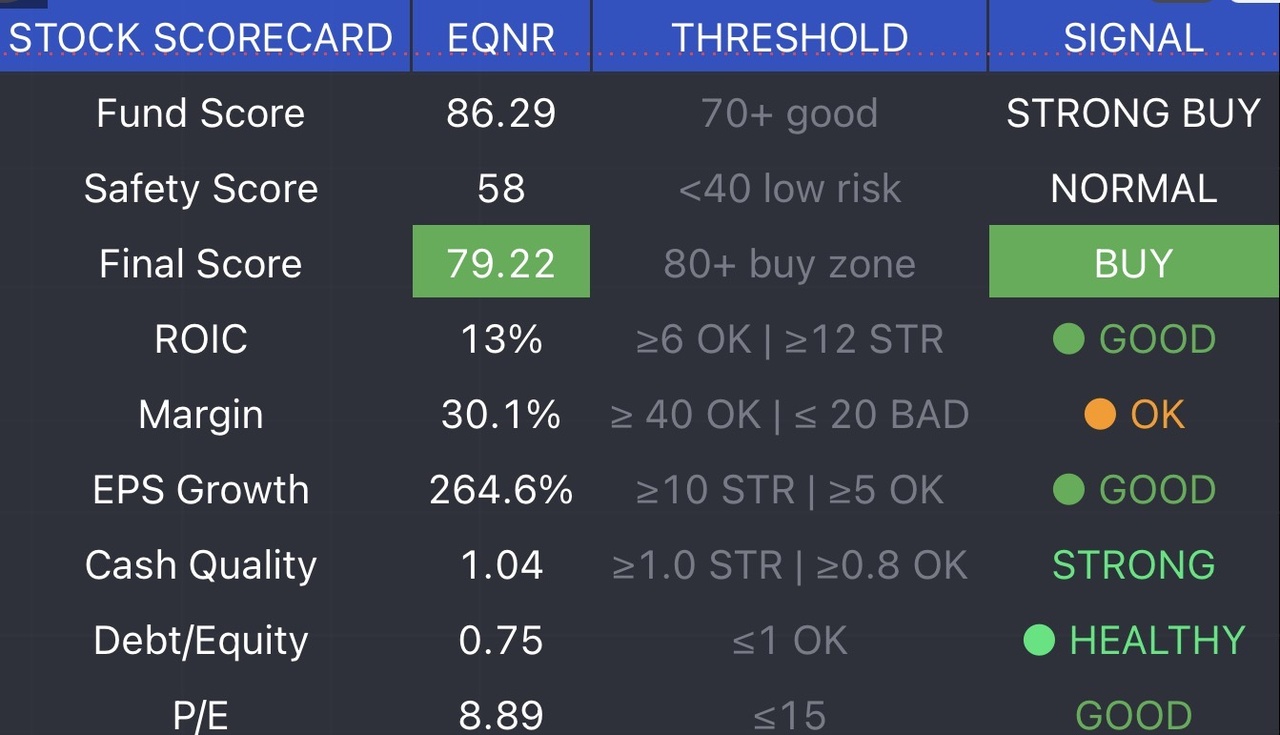
$EQNR (+1,18 %) EUR 2.99 quarterly dividend on February 27 ??? You too? What's going on at getquin?

Equinor
Price
Debate sobre EQNR
Puestos
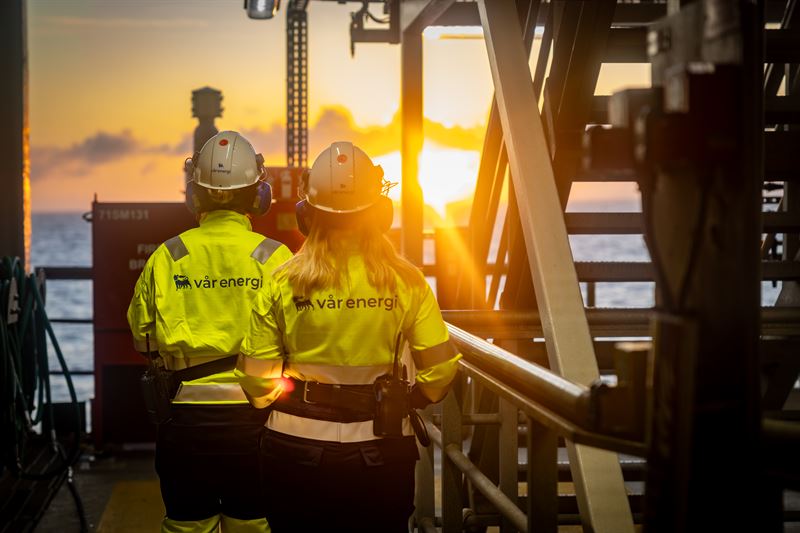
41Vår Energi delivers successful well test results at Goliat Ridge
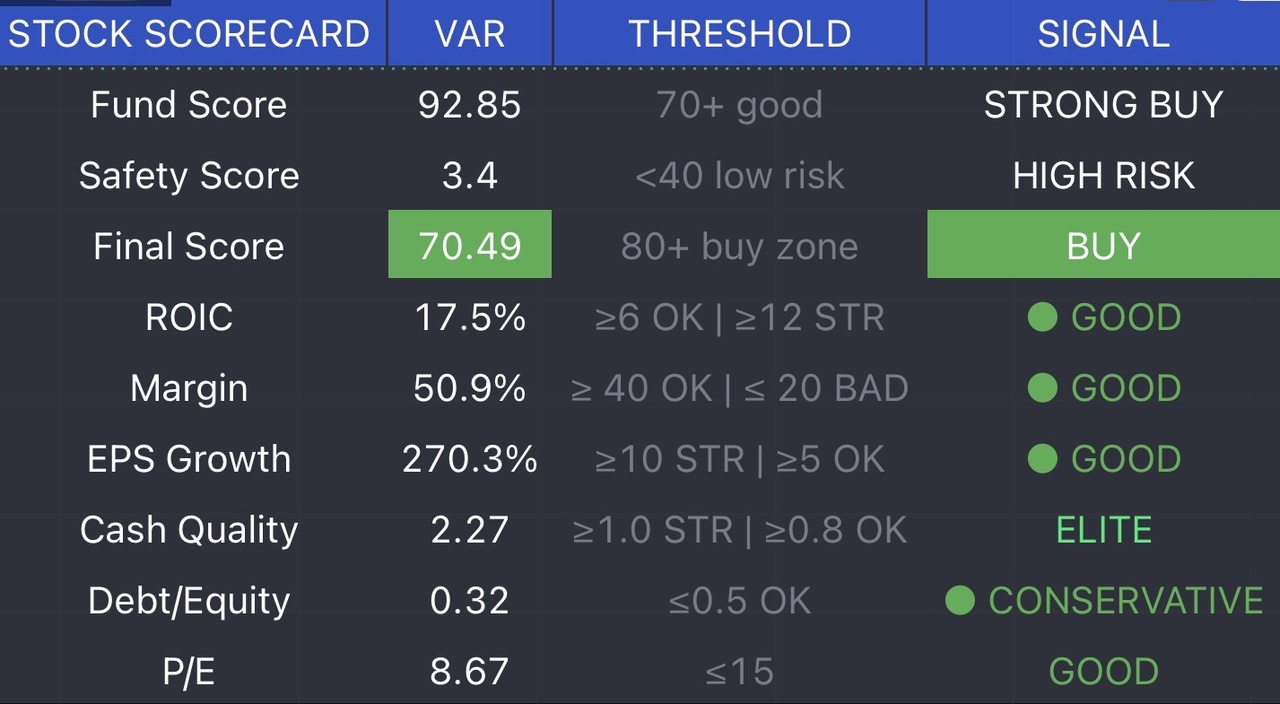
Vår Energi $VAR (+0,08 %) announces the completion of the appraisal well with two production tests on the Zagato structure in the Goliat Ridge field in the Barents Sea, confirming the quality of the reservoir and increasing the recoverable volumes.
confirmed the quality of the reservoir and increased the recoverable volumes.
The well was drilled approximately seven kilometers northeast of the Goliat field operated by Vår Energi. The production tests confirmed the good quality of the reservoirs and an oil quality similar to that of the Goliat field.
The most recent well tested two intervals, each with maximum flow rates of more than 4000 barrels of oil per day, confirming the quality of the reservoir.
confirming the quality of the reservoir.
Torger Rød, COO of Vår Energi, said:
This success reinforces our confidence in the potential of the Goliat Ridge discovery and we see an opportunity to add significant additional resources
as tie-back projects to Goliat. The recent discoveries reinforce Vår Energi's position as a leading exploration company on the Norwegian Continental Shelf (NCS) and further strengthen our ability to sustain high-quality production of 350-400 thousand barrels of oil equivalent per day beyond 2030.
Vår Energi and its license partner Equinor $EQNR (+1,18 %) have drilled a total of five wells and one sidetrack well in the area. Including the latest well, the Goliat Ridge
is estimated to contain a total of 35 to 138 million barrels of oil equivalent (mmboe) of discovered recoverable resources, with additional potential resources increasing the total potential to over 200 mmboe.
A tie-in to the nearby Goliat FPSO is planned, with first production targeted for 2029.
production is targeted for 2029.
Vår Energi was recently awarded a license for an area adjacent to the Goliat field as part of the 2025 Awards in Predefined Areas (APA), which provides
additional prospects in line with the Goliat Ridge discovery.

Dividendenopi inside (Part 1 )..... Dividendenopi Rewind2025
A little later, but not too late, I'll also have my say at the end of the year, together with an insight into the goings-on of the Opi before @Tenbagger2024 , @SAUgut777 and some others get impatient, as you know, old people are a bit slower. I would also like to take this opportunity to thank and appreciate all those who contribute here on GQ with great analyses and strong contributions, critical comments and a wonderful exchange. I'm deliberately not naming any individuals now, otherwise I won't be able to finish. All of you together are great, whether you're a veteran or a newcomer. The community is alive and I am happy to be a part of it. Thanks also to @christian and the Getquin team, who make this possible by maintaining the platform, even if things sometimes don't run smoothly. The Bavarian says: Basst scho
The year 2025 was exciting and, from my point of view, successful in terms of my expectations. If you don't feel like evaluating a boring dividend strategy, don't want to read about overnight and fixed-term deposits, aren't interested in certificates and don't like the Sparkasse, you are welcome to leave here after Rewind 2025. Many thanks to everyone else for reading and, if necessary, commenting.
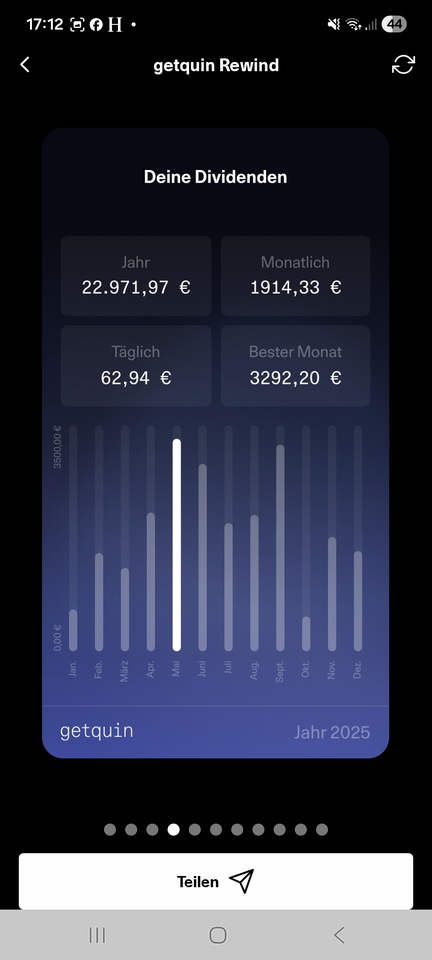
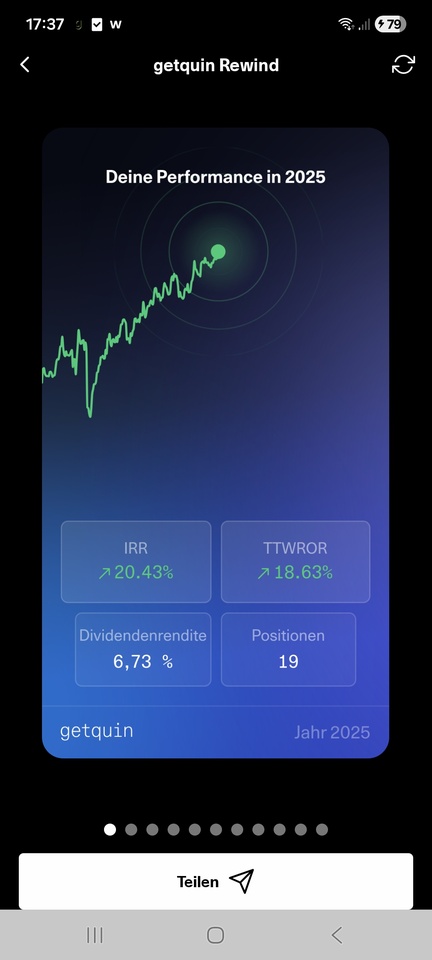
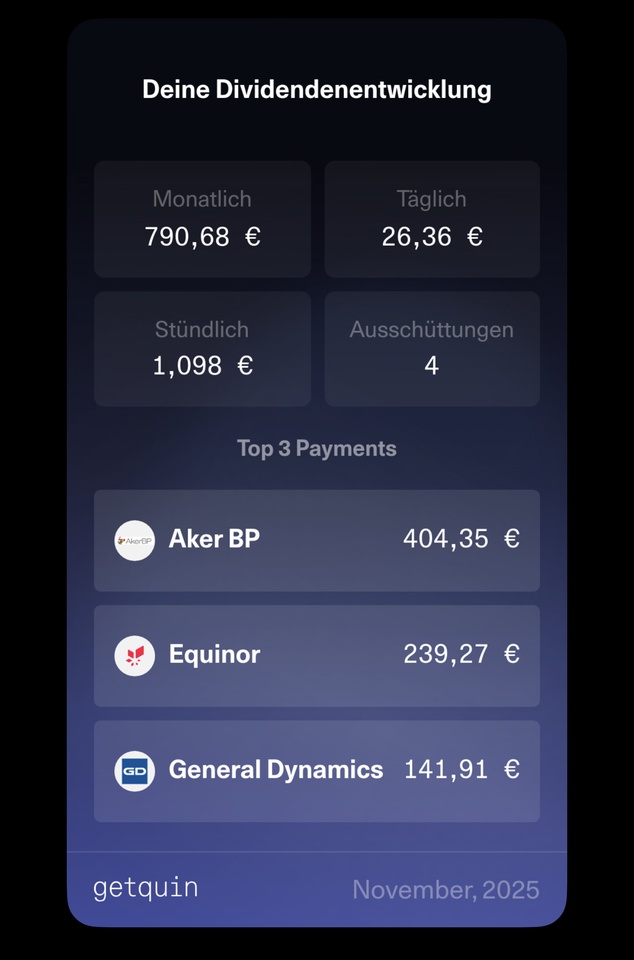
At least as far as the majority of shares are concerned, I am known to be invested in dividend stocks in order to generate the highest possible cash flow. I am now almost 62 years old and do not value excessive performance but would like to make a living from the income from my assets and decided to stop working at the beginning of the year when the company where I was employed was dissolved. I see myself as a buy and hold a while. Nothing lasts forever, especially with high-dividend shares. There are regular reallocations without getting into an operational frenzy. In 2025, for example $TRMD A (-0,69 %) and a large position $HAUTO (-2,86 %) had to leave the portfolio, the high dividend expectations were significantly reduced. The $QYLE (+1,2 %) has not recovered from April, $EQNR (+1,18 %) and $VICI (+0,84 %) led to the brink of capital loss despite respectable dividends and had to give way, as did $MUX (-0,62 %) with its inconsistencies. New additions were $NN (+0,25 %) , $PFE (+0,36 %) , $DTE (-4,19 %) and a first position at the end of the year $ARCC (+0,69 %) You can see the composition in my profile. I generally try to limit myself to +/- 20 positions and weight them according to purchase. A maximum of 20k per position is invested. This results in the calculation of my dividends and expected income. In its current composition, the portfolio shown here has a value of just over € 340,000 as at 31.12.2025 and has generated gross dividends of just under € 23,000 this year. This corresponds to a dividend yield of 6.73%
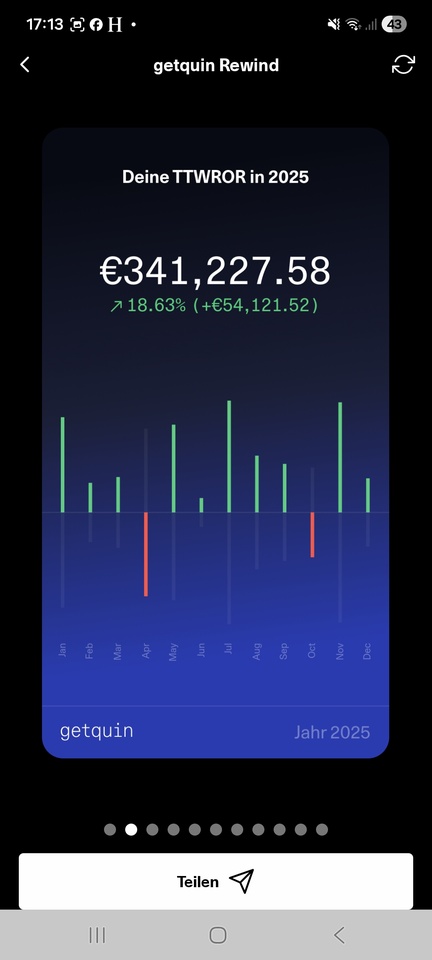
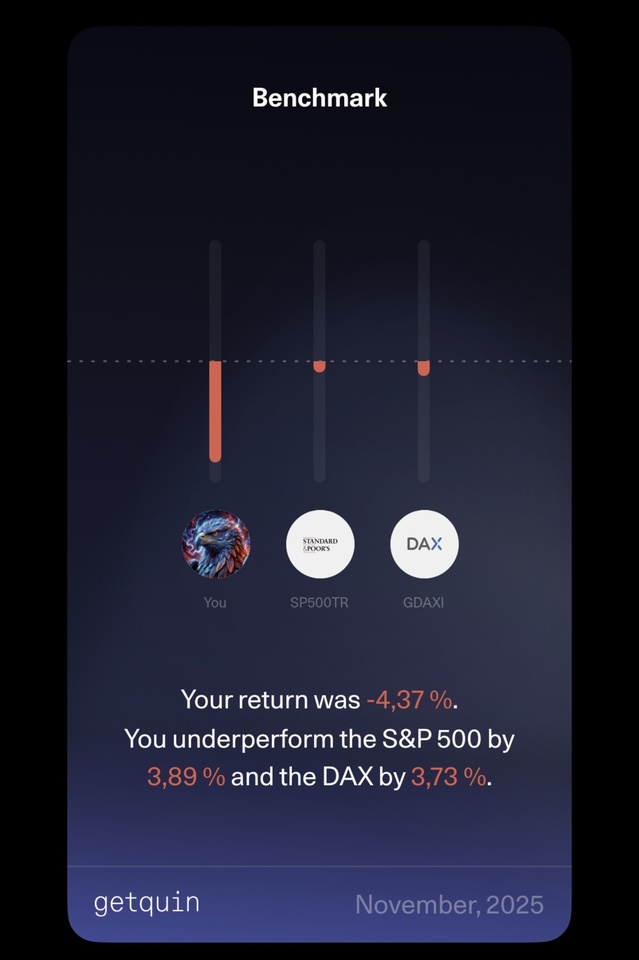
The time-weighted yield was 18.63% and therefore well above average, at least better than 67% of the getquin community. I wasn't able to beat the DAX, but at least I outperformed the S&P500 and beat the relevant MSCI World index by some distance. Even on a 5-year view I am on a par. Tobacco stocks did very well $BATS (+0,59 %) , $IMB (+0,6 %) and $MO (+0,7 %) , $HSBA (+1,04 %) , and $RIO (+1,56 %) and of course $965515 (+0,55 %) that I physically hold and the $EWG2 (+0,68 %) .
That's all there is to the part of my investments shown here in GQ. What follows is a piece of my life story and the first part inside Dividendenopi.
As I said, I now live off my assets. This amounts to just under € 1.2 million in all the forms of investment I hold. Is that enough for a carefree life? For me in any case. Because on top of that, I have a debt-free, owner-occupied property (a single-family home with a large garden in a quiet rural location near a city of 600,000 inhabitants) and a rented two-family home, appropriately enough, as a neighboring property. Partly financed, rent surplus after installment to the bank a good € 700 per month, flows completely into the maintenance reserve. Claims from BAV, life insurance, building society savings contracts will be added on top in the next few years, but are not taken into account here. There's even a savings account with €18,000..... half of which belongs to my wife and she doesn't want to close it.
My wife (still) works and has a decent income despite working part-time and has other liquid assets in the lower six-figure range. She does it herself, the stock market is the devil's work. Her story is not included here either.
So I / we are doing pretty well after all. It wasn't always like that, anyone who is or was self-employed knows that. But consistent financial planning is important, no matter what the situation, as is sticking to your savings rate. I started investing in real estate at the beginning of the 1990s and have been liquidating it over the last few years. In conjunction with my own wealth accumulation and an inheritance, I am now in a comfortable situation for me.
What do I do with the rest of the money outside the getquin portfolio? A good € 500,000 is (still) in call money and fixed-term deposit accounts. Interest rate hopping on call money and fixed-term deposits from 2 years ago yields around 3% on call money and over 4% on fixed-term deposits. The remaining capital is invested in certificates. Mainly in fixed-coupon express certificates with quarterly payout and partly in bonus certificates with CAP and barrier.
My investments currently generate a net monthly cash flow of € 4000, which is enough for me to live on. Plus € 800 ALG on top until the beginning of 2027.... But before the company closed, I only worked 16.5 hours a week. With my wife's income, that's a good €6500, which is bearable. You can certainly do more with your assets, depending on your needs. We live rather modestly, don't have any children and aren't the consumer type.
How am I invested outside of dividends, why certificates and which broker, where and how overnight and fixed-term deposits? I thought that would go beyond the scope of this article, so I'll come back to it in a second part. Thanks for your participation so far and see you soon

Significantly, you can see here that not having children is now the best provision for old age. Not an accusation, just an observation. 🤷♂️
Equinor, Vår Energi and Petoro approve investment for Isflak development at Johan Castberg
Vår Energi ASA$VAR (+0,08 %) and
and its partners have approved the first follow-on development to extend plateau production
from the Johan Castberg field in the Barents Sea until 2030.
The Equinor $EQNR (+1,18 %) operated Johan Castberg license has made a final investment decision
for the Johan Castberg-Isflak development.
The partnership also plans to
six new Increased Oil Recovery (IOR) wells and a development of the Drivis-Tubåen discovery.
The projects bring total reserves of 27 million barrels of oil equivalent (mmboe) net to Vår Energi and have a strong break-even price
and a high return on investment.
The Isflak development is expected to commence production in the fourth quarter of 2028 and consists of two wells and a subsea template that will be tied back to the existing subsea infrastructure in the Johan Castberg field.

Quellensteuerrückerstattung Norwegen, Teil 2
Der zweite Beitrag zur Rückerstattung der Quellensteuer von norwegischen Aktien. Den ersten Teil mit Hinweisen und den Vorbereitungen bei der Anmeldung bei den norwegischen Behörden findet ihr hier: , Quellensteuerrückerstattung Norwegen Teil 1 . Nochmal die Anmerkung, dass diese Beantragung nur für in Deutschland steueransässige Personen möglich ist.
Als Platzhalter $EQNR (+1,18 %) , $HAUTO (-2,86 %) , $VAR (+0,08 %) , $MOWI (-5,18 %) , $MPCC (-2,46 %) , $TEL (-1,25 %) , $AKRBP (-0,54 %) , $TOM (+0,6 %)
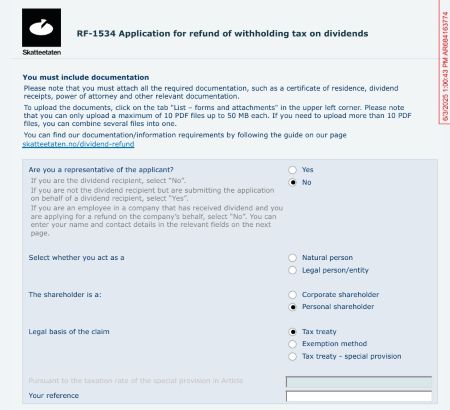
Öffnet die Startseite Altinn – Start - die Sprache auf Englisch und wenn Ihr den automatischen Google-Übersetzer aktiviert habt geht Ihr es sogar auf Deutsch – logg in, geht auf International, danach Einloggen ohne Sozialversicherungsnummer/D-Nummer, gebt Benutzername und Passwort ein und anmelden. Um das richtige Formular zu finden in die Suche RF_1534 eingeben, danach öffnet sich das Formular Antrag auf Rückerstattung der Quellensteuer auf Dividenden. Ihr habt auf der linken Seite eine Art „Menüfeld“ über das Ihr zu den einzelnen Seiten des Formulars wechseln könnt.
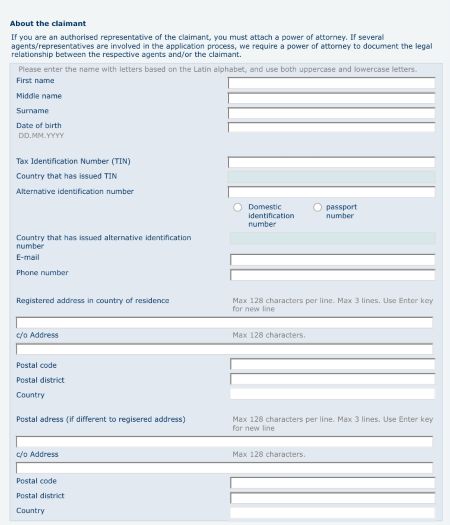
Füllt die beiden Seiten zum Antragsteller aus. Auf keinen Fall die Steuer ID ( Tax Identification Number ) vergessen, ist aber sowieso ein Pflichtfeld. In das große Feld Registered address in country of residence nur die Straße und Hausnummer eintragen.
Ihr benötigt nun die Dividendenbelege aus denen der Quellensteuerabzug hervorgeht.
Im Anschluss öffnet Ihr das Formular Dividenden. Dort seht Ihr drei Zeilen für Eure Eingaben die je nach Bedarf erweitert werden können.
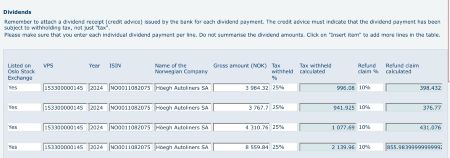
Grundsätzlich ist im ersten Feld zur Frage der Börsennotierung in Oslo ein Ja anzugeben. Dies ist der Fall wenn die ISIN Eurer Aktie mit NO... beginnt. Im zweiten Feld ist die VPS-Nummer der Verwahrstelle Eurer Aktien einzugeben. Das ist clearstream, die zur Zeit gültige Nummer ist 153300000145. In einigen Foren ist noch die alte Nummer beginnend mit 05 zu finden. Ins dritte Feld tragt Ihr das Jahr ein für das Ihr die Rückerstattung beantragt, bis zu 5 Jahre rückwirkend sind möglich. Danach die ISIN Eurer Aktie so wie Ihr sie dem Dividendenbeleg entnehmen könnt und den Namen der Gesellschaft entsprechend Beleg. Ins sechste Feld die laut Beleg erfolgte Dividendenzahlung! in Norwegischen Kronen. Die Zahlenformatierung erfordert für das Setzen des Kommas die Eingabe mittels Punkt! Danach gebt Ihr den prozentualen Steuerabzug ein, in diesem Fall 25 %. Beim Rückerstattungsanspruch / Refund claim könnt Ihr unterschiedliche Prozentsätze wählen. Nehmt hier 10%! Auch wenn die Eingabe von den vollen 25% reizvoll ist, geht zwar aber wird spätestens bei der Prüfung des Formulars als Fehler angezeigt. Wiederholt das Ganze sooft, bis Ihr jede einzelne Dividendenabrechnung eingetragen habt. Also nicht die Dividenden aus einem Jahr zusammenzählen, jede Zahlung ist einzeln anzugeben.
Das ist eigentlich die Hauptarbeit wenn man mehrere Aktien aus Norwegen im Depot hat. Wenn dies erledigt ist weiter auf die Seite Zahlungsdetails. Bei der Kontoart / Account Type klickt Ihr sonstiger Bericht / Other account an, gebt als Währung Euro ein, außer Ihr habt ein entsprechendes Fremdwährungskonto bei Eurer Bank. Dann die IBAN und sicherheitshalber noch die BIC und den Namen der Bank.
Falls Ihr sonst noch irgendetwas zum Antrag mitteilen möchtet, habt Ihr unten auf der Seite noch die Möglichkeit etwas anzumerken.
Das war es fast schon. Oben links über der Formularbezeichnung geht Ihr jetzt auf den Menüpunkt Liste – Formulare und Anhänge. Hier könnt Ihr jetzt alle Dividendenabrechnungen hochladen. Nochmal der wichtige Hinweis: Ihr könnt maximal 10 PDF´s á 50 MB anhängen. Ein PDF ist die Ansässigkeitsbescheinigung. Solltet Ihr dann noch mehr als 9 Einzelbelege haben, fasst diese nach Gesellschaft in einem PDF zusammen und hängt es an.
Geschafft, auf überprüfen klicken und wenn alles ok ist wird das Dokument versendet und Ihr erhaltet eine Bestätigung in Eurem Account.
Abschließend noch ein paar Anmerkungen:
Passt auf das Zeitlimit im Formular auf, nicht dass es endet und alle Eingaben wieder von vorne eingetippt werden müssen.
Es gibt – wenige – Broker in Deutschland die Euch diese Arbeit gegen Gebühr abnehmen. Dort müsstet Ihr einen Antrag auf Vorabbefreiung von der Quellensteuer stellen. Definitiv macht das nach meinen Recherchen, und auch schriftlich bestätigt, die DKB. Es handelt sich allerdings nur um eine Teilbefreiung, eben um diese 10%. Die restlichen 15% sind über die Steuererklärung zurück zu holen.
Die Antragstellung durch Euch direkt bei den Norwegischen Steuerbehörden ist kostenlos.
Falls Ihr den von mir beschriebenen Weg gehen möchtet, dann besorgt Euch schnell noch Eure Bescheinigung vom Finanzamt und stellt gleich zu Beginn des neues Jahres den Antrag. Die Erfahrung hat gezeigt, dass innerhalb kurzer Zeit der Bescheid und die Erstattung möglich ist. Später im Jahr sind Wartezeiten von mindestens 6 bis 9 Monaten üblich. Freundlicherweise gibt es bei längerer Bearbeitung durch die Behörden sogar noch Zinsen auf den zu erstattenden Betrag. Die Überweisung der Rückerstattung kann bei einigen Banken kostenpflichtig sein, erkundigt Euch bei Eurem Broker, wie hoch diese ausfallen.
Ich hoffe Euch damit ein wenig die Scheu vor der Erstattung genommen zu haben und für Fragen nutzt gerne die Kommentarfunktion. Es grüßt Euer Opi 😉😇


November Performance…
Bitcoin hat für eine deutliche Korrektur im Portfolio gesorgt, was bei der hohen Gewichtung nichts außergewöhnliches ist.
Zukäufe gabs im November verstärkt im Energiesektor ($EQNR (+1,18 %)
$AKRBP (-0,54 %)
$CNQ (+1,16 %) )
Bei $RHM (+0,7 %) habe ich auch den Abverkauf genutzt und halte jetzt 15 Stücke.
Meine Gesamtallokation übergewichtet neben Bitcoin nach wie vor die Sektoren KI, Verteidigung, und Energie (Öl/Gas).
Cash ist bei ~16%, Tendenz sinkend.
Das war’s auch schon!
Ich wünsche euch einen relaxten Dienstag Abend 🍻

Quellensteuerrückerstattung Norwegen... kurzer Zwischenbericht
Ich weiß, ich schulde noch den zweiten Teil und arbeite schon am dritten Teil.... und bitte um Nachsicht. Je mehr Rückfragen kommen, umso mehr Infos sammle ich und umso mehr möchte ich teilen. Als Platzhalter $HAUTO (-2,86 %) , $VAR (+0,08 %) , $EQNR (+1,18 %) .....
Nachdem zuletzt immer wieder die Sprache auf eine Vorabbefreiung von der norwegischen Quellensteuer kam um sich den - in den Augen einiger - mühseligen Weg der Beantragung in Norwegen und beim deutschen Finanzamt zu ersparen habe ich mich mit der von @SAUgut777 in diesem Zusammenhang ins Spiel gebrachten DKB intensiver auseinandergesetzt.
Die vorgeschaltete KI ist wirklich hartnäckig, nachfrageresistent und am Ende genauso unfreundlich wie meine Fragen 😂😂👍, Aber immerhin durfte ich dann die Konversation in einem von der KI ausgefülltem Kontaktformular das alle relevanten Punkte beinhaltete 👌👌an die DKB senden. Und von da an hatte ich es mit, zwar wechselnden aber sehr freundlichen und kooperativen, echten Menschen zu tun. An dieser Stelle ein großes Lob an den Kundenservice der DKB und die schnellen Reaktionen, ich war mehr als positiv überrascht!!!
Endergebnis ist, dass die DKB als bisher einzige Bank bei meinen Anfragen diesen Service anbietet, allerdings der Kernsatz :
"Sehr geehrter Herr Wxxxxx,
eine Vorabbefreiung wird nicht angeboten. Es handelt sich um eine Vorabreduzierung. Gemäß des DBA zwischen Norwegen und Deutschland wird der norwegische Quellensteuersatz von 25% auf 15% reduziert.
Ich wünsche Ihnen einen angenehmen Tag."
Das heißt für Depotinhaber bei der DKB, dass sie die 10%, den die norwegischen Steuerbehörden über den von mir beschriebenen Weg erstatten, für Euch zurückholen. Gemäß der Gebührenübersicht bei der DKB fällt hierfür eine Gebühr von € 30 an. Die verbleibenden 15% müssen somit weiterhin über die Anlage KAP beantragt werden.
Jetzt kann jeder für sich entscheiden, ob er die Gebühr investieren möchte oder sich selbst die Mühe macht. Schneller wird es auch über die DKB nicht gehen, Die norwegischen Finanzbehörden sind ganz schön überlastet mit den Anträgen. Ich habe eine kurze Mitteilung bekommen dass es bis zu 15 Monaten dauern kann im Moment....
Seid Euch also bewusst, trotz der teilweise sehr attraktiven Dividenden in Norwegen, dass ihr erstmal weniger als 50% netto auf dem Konto habt und danach etwas Arbeit aufwenden müsst um zumindest die Hälfte der Einbehalte zurück zu bekommen.
In diesem Sinne werde ich doch recht schnell einen verkürzten zweiten Teil veröffentlichen und einen dritten Teil folgen lassen, der die steuerlichen Aspekte und brokerspezifischen Besonderheiten berücksichtigt.

Energy shares - focus on Canada & Norway
The world's hunger for energy is increasing and, according to the latest estimates, "peak oil" is further in the future than previously thought.
High geopolitical risks, artificially limited supply and robust demand = (in my opinion) a structurally bullish oil outlook.
Today I would like to introduce you to 3 stocks from the "hated" 🛢️Öl and natural gas sector.
Stock 1:
Canadian Natural Resources $CNQ (+1,16 %)
📍Overview of the company:
Canadian Natural Resources is a leading Canadian energy company primarily engaged in the production and processing of crude oil and natural gas.
Its business model includes the mining of bitumen oil sands and their processing into synthetic crude oil, conventional oil and NGL production as well as major natural gas production in Western Canada and selected offshore locations.
Geostrategically, CNQ benefits from a relatively stable regulatory environment in Canada and owns long-term, long-life production assets.
Analysts value the stock at a fair value of around $54-55, which suggests a moderate upside potential of close to +15-20% from the current price of around $47, assuming commodity prices and operating conditions remain stable.
💰Dividend yield (TTM): 5.187%
📈Notes on the chart:
What I like here is that $CNQ (+1,16 %) has clearly broken the weekly downtrend to the upside.
The price is also above the volume POC, which should now form a support.
I am already invested and plan to buy on setbacks.
Share 2:
Suncor Energy $SU (+0,57 %)
📍Overview of the company:
Suncor Energy is one of Canada's largest integrated energy companies, making its money primarily from oil sands production, processing into synthetic crude oil, and downstream operations such as refineries and a large Canadian service station network.
Thanks to its strong presence in the politically stable regions of Alberta and Ontario, Suncor is considered to have a relatively secure geostrategic position, as Canada is one of the most reliable oil supply countries and oil sand reserves can be extracted over an extremely long period of time.
Risks arise primarily from North American regulation and ESG pressure, rather than from geopolitical conflicts.
Analysts currently generally see the fair value of SU shares at around C$70-75, while the price on the TSX chart is around C$62 - this results in a moderate expected upside potential in the low double-digit percentage range, depending on oil prices and operating performance.
💰Dividend yield (TTM): 3.816%
📈Notes on the chart:
$SU (+0,57 %) had a long sideways phase in which the price first consolidated at the ~C$47.2 resistance and for the entire past year at around ~C$55.
Now it looks as if the price has broken out of this range to the upside.
The next price target is the ATH from May 2008 (~C$73).
Here, too, I am already invested and continue to buy.
Share 3:
Aker BP ASA $AKRBP (-0,54 %)
📍Overview of the company:
Aker BP ASA is one of the largest independent oil and gas producers in Norway and makes its money mainly through the production of crude oil and natural gas on the Norwegian Continental Shelf.
The company operates several large fields such as Johan Sverdrup, Skarv, Valhall and Alvheim and is characterized by low production costs and high operational efficiency.
Geostrategically, Aker BP is considered very secure, as Norway is politically stable, has reliable regulation and the North Sea assets are not dependent on conflict zones - a clear advantage over many global producers.
Analysts are largely positive on Aker BP; consensus estimates see a fair value slightly above the current price level, supported by robust cash flows, high dividends and expected production increases.
Overall, Aker BP is seen as a high-quality, geostrategically stable oil stock whose valuation depends primarily on the long-term oil price.
💰Dividend yield (TTM): 10.05%
📈Notes on the chart:
Aker BP has successfully broken out of the downtrend since 2022 and is currently consolidating just above the long-term volume POC.
I am invested and will continue to buy if possible.
💬 Closing words
As of today, I am invested in the energy sector with 8.2% of my portfolio.
In addition to the stocks presented, I am also invested in $CVX (+0,37 %) , $EQNR (+1,18 %) , $OXY (+0,02 %) , $TTE (-1,31 %)
Do you have an "insider tip" from the energy sector that you would like to share? 🤔
First purchase TotalEnergies
In order to expand my share of the energy sector in Europe, I made my first purchase today. $TTE (-1,31 %) bought today.
This means that the share of the energy sector in my portfolio is now just under 7%.
The last purchases were:
New dividend portfolio
I would like to start a completely new portfolio that will primarily revolve around dividends.
As a core I was thinking of $TDIV (+0,12 %)
Would you say this is a good core?
If not I would add $VHYL (+0,32 %) add.
Additionally I would like to have a CC ETF as a kind of support, probably $JEGP (+0,26 %) and or $SXYD (+0,64 %)
I would like to represent the NASDAQ with $EQQQ (+0,41 %) but I will represent it with $ASML (+2,07 %) and $2330 will be added.
Allianz $ALV (+0,79 %) and Munich Re $MUV2 (+0,02 %) I definitely want to include, but they are too expensive for me financially, so I was thinking of the $EXH5 (+0,51 %)
Oil shares are represented by $VAR (+0,08 %) and one more.
Do you have any recommendations?
I am thinking about $CVX (+0,37 %)
$EQNR (+1,18 %) and $PETR4 (-0,05 %)
I would also like renewable energies, but I'm not familiar with them.
Do you have any suggestions?
Becoming a defensive company $ULVR (-1,12 %)
$D05 (-0,78 %)
$O (-0,32 %) and of course $NOVO B (+0,97 %) Being.
$BATS (+0,59 %) I already have in a portfolio, would it be too much of a lump to add $MO (+0,7 %) to add to it?
I still have $KHC (+0,24 %) on the watchlist but the split is not going so well, would it be wise to start with a savings plan?
Apart from that $RIO (+1,56 %)
$NKE (+0,41 %)
$1211 (-1,2 %)
$SOFI (+0,67 %) and $HAUTO (-2,86 %) will be represented with smaller positions.
What is your opinion?
Would you improve anything?
What else would you add, especially in EE and defensive stocks?
Feedback is very important to me here, so far I have just been wandering aimlessly around the stock market without a fixed plan and strategy.
This is my first attempt to build something serious.
Greetings to all Getquins out there!