I added a little something today at $UUUU (-10,63%) and $UEC (-7,19%)
It’s really tasty—anyone with a 200-week moving average fetish will get their money’s worth.

Messaggi
28I added a little something today at $UUUU (-10,63%) and $UEC (-7,19%)
It’s really tasty—anyone with a 200-week moving average fetish will get their money’s worth.
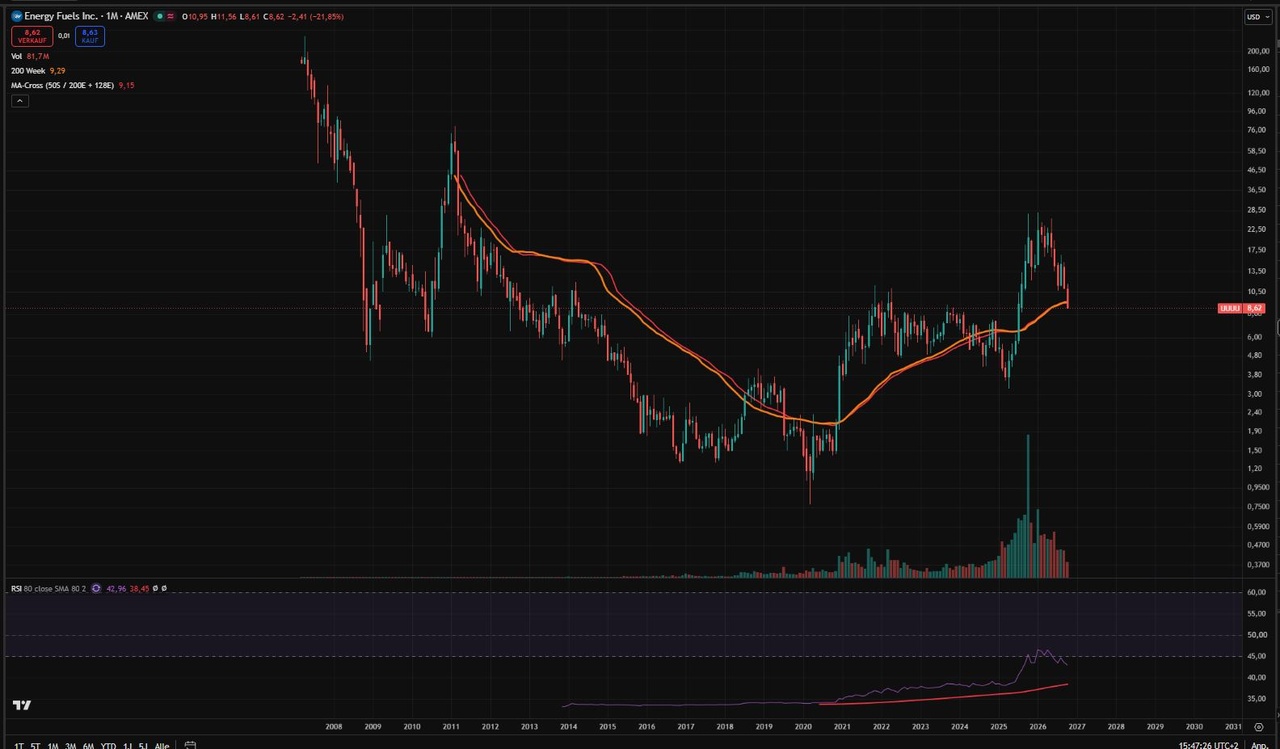
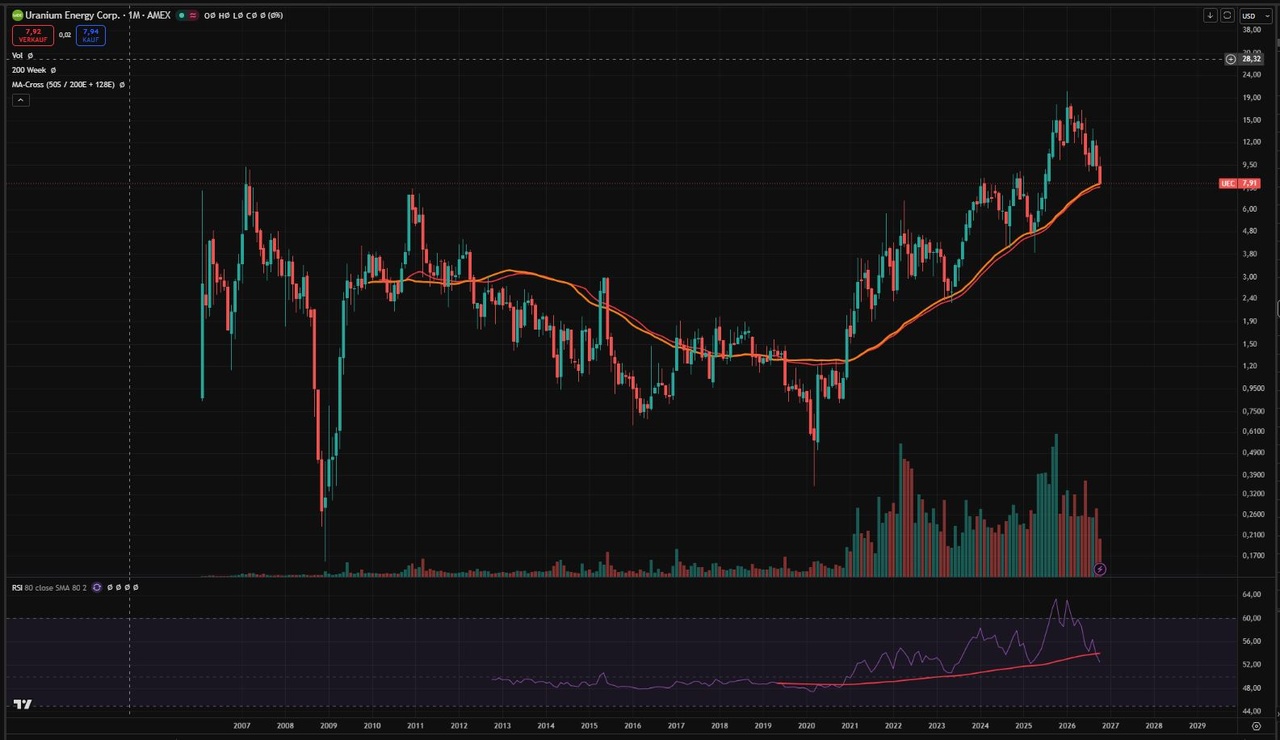
Another one from the speculative corner. The volatility in the uranium sector alone isn’t for the faint of heart. Constant surges of hundreds of percent, followed by 50% corrections within just a few months. Still, the monthly charts look more than promising if these stocks correct another 20% now and touch the 200-week line next time. Also note the monthly RSI levels, which are particularly noteworthy for $UUUU (-10,63%) and $URA (-4,28%) show just how much room there still is to run. Most stocks, such as $UEC (-7,19%)
$UUUU (-10,63%) as well as ETFs such as $URA (-4,28%) , broke out of a 15-year bear market in 2020.
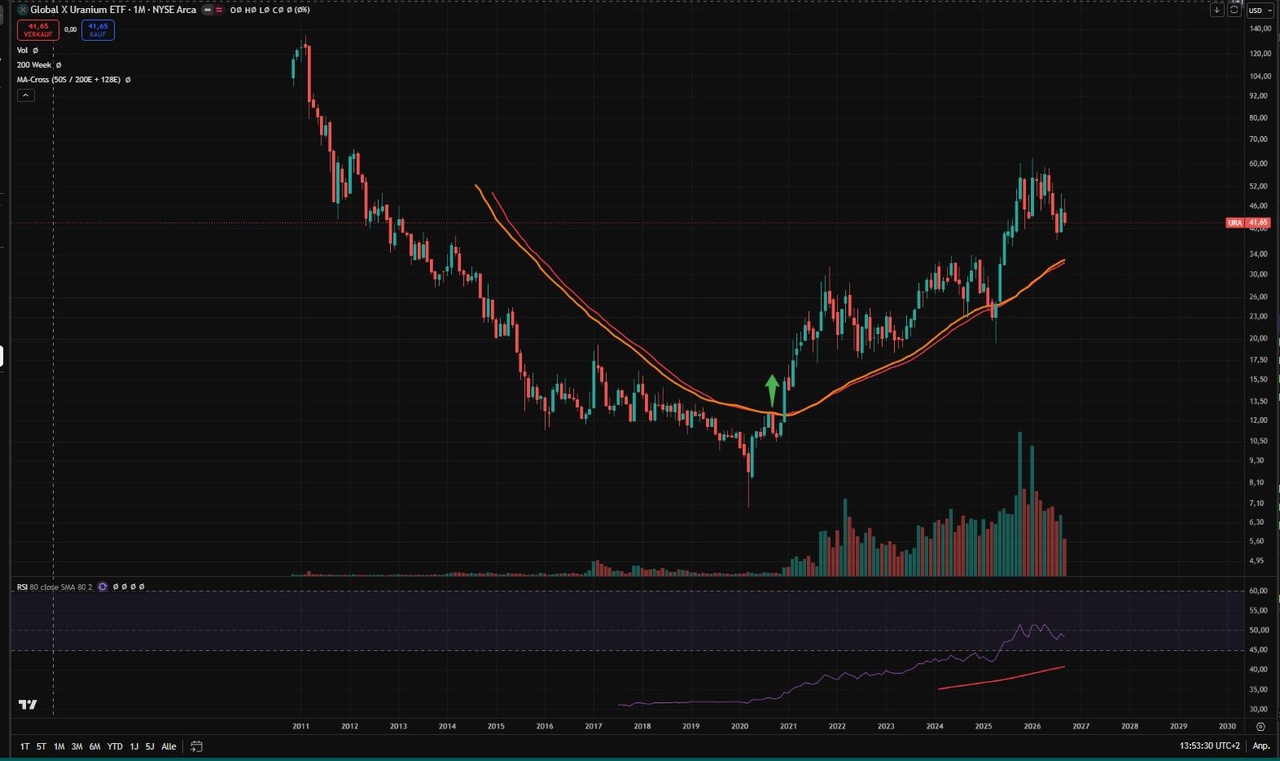
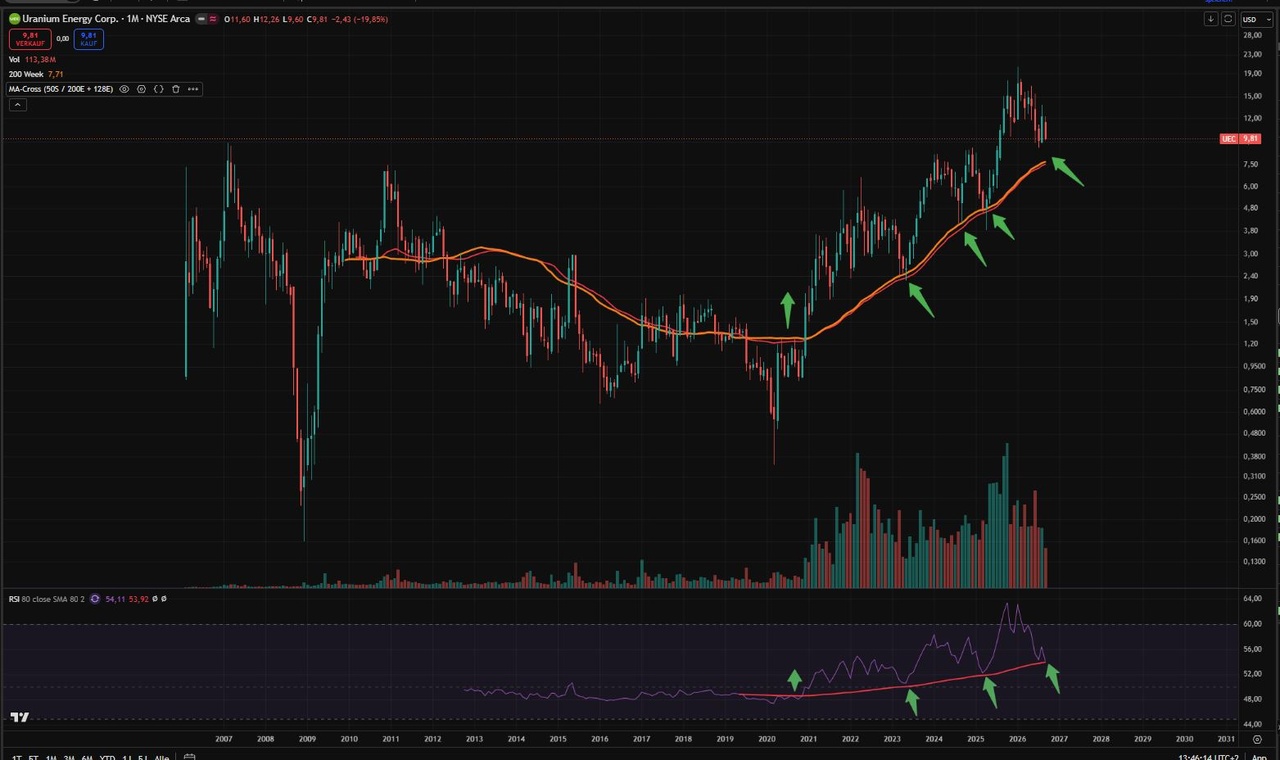
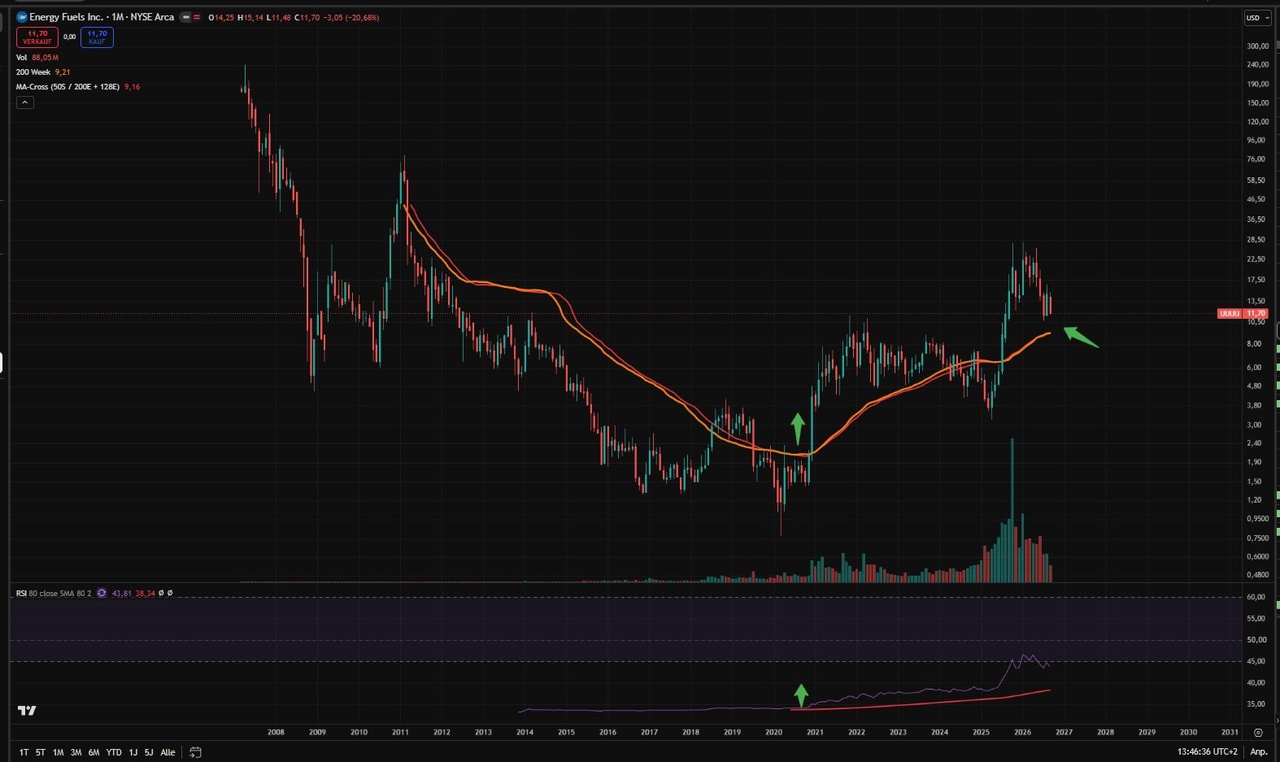
Another one from the speculative corner. The volatility in the uranium sector alone isn’t for the faint of heart. Constant surges of hundreds of percent, followed by 50% corrections within just a few months. Still, the monthly charts look more than promising if these stocks correct another 20% now and touch the 200-week line next time. Also note the monthly RSI levels, which are particularly noteworthy for $UUUU (-10,63%) and $URA (-4,28%) show just how much room there still is to run. Most stocks, such as $UEC (-7,19%)
$UUUU (-10,63%) as well as ETFs such as $URA (-4,28%) , broke out of a 15-year bear market in 2020.
$MAR (+0,59%)
$KRYS (+1,52%)
$PLTR (-1,56%)
$STRL (-6,66%)
$SNAP (-3,72%)
$WHR (-4,38%)
$CLX (+0,61%)
$BWXT (-0,75%)
$ON (-4,51%)
$VRTX (+2,61%)
$PFIZER
$CAT (-2,42%)
$MCD (+0,83%)
$HUT (-11,17%)
$WIX (+1,4%)
$W (-1,67%)
$BP. (+1,14%)
$SHLS
$AMD (-5,08%)
$SPCX (-1,52%)
$ANET (-3,71%)
$ALAB (-4,64%)
$OPEN (-5,03%)
$ZETA (-3,63%)
$BKNG (+1,4%)
$KTOS (-1,3%)
$HL (-6,81%)
$LLY (+4,78%)
$SHOP (-1,36%)
$UBER (-2,68%)
$DIS (+0,79%)
$RIOT (-8,47%)
$CIRC
$NOVO B (+1,03%)
$U (-8,88%)
$SNDK (-3,04%)
$APP (-1,89%)
$WDC (-1,93%)
$ELF (+0,39%)
$MELI (-1,95%)
$AXON (-1,59%)
$TTMI (-7,17%)
$RDW (-5,13%)
$QBTS (-7,61%)
$DDOG (-2,97%)
$CLA
$FI (-0,6%)
$LNG (-0,24%)
$UUUU (-10,63%)
$HIMX (-4,85%)
$ABNB (+1,26%)
$RGTI (-7,36%)
$TTD (-2,53%)
$AAOI (-10,42%)
$TXG (+3,65%)
$INOD (-6,95%)
$OUST
$MP (-6,12%)
$OKLO
$VST (-5,95%)
$TTWO (+1,79%)
$ACMR (-4,58%)
$WEED (-5,36%)
$UAA (-0,91%)


17 chemical elements
Strategic metal age
Scarcity as a political factor
Lynas Rare Earths
Iluka Resources
Arafura Rare Earths
MP Materials
Energy Fuels and others
Solactive Rare Earths Index
Link: https://shorturl.at/KPyWG
$LYC (-1,41%)
$ILU (-0,17%)
$ARU (-0,22%)
$MP (-6,12%)
$UUUU (-10,63%) $
In light of escalating Iran tensions, I've rebalanced the portfolio by trimming a small Eni (ENI.MI) position, selling off Salesforce (CRM) and Nike (NKE) - those growth bets just weren't delivering. Instead, I've boosted exposure to Energy Fuels (UUUU) for the uranium play, Leonardo DRS (DRS) riding defense tailwinds, the STOXX Europe 600 ETF for broader European exposure, and Intesa Sanpaolo (ISP.MI) banking on higher rates. Eyes on energy resilience and Euro financials amid geopolitical volatility. Happy investing - may your rotations capture the alpha!
$DRS (+0,32%)
$ISP (-1,46%)
$CRM (-0,92%)
$NKE (-0,53%)
$MEUD (+0,16%)
$ENI (+0,6%)
$UUUU (-10,63%)

Dear Community,
Where the hunger for energy is being met by nuclear power and the new generation of Small Modular Reactors (SMRs), a massive growth market for downstream services is inevitably emerging.
This applies above all to nuclear waste disposal, the professional dismantling of old plants and the recycling of fuels and water.
Since there is currently no pure "nuclear waste ETF" (at least that I am aware of), we investors must focus on specialized individual stocks that are global leaders in the disposal of uranium and contaminated components (including water).
1. the operational heavyweights for dismantling and disposal
2 The fuel cycle: Cameco and Westinghouse
Cameco ($CCO (-4,67%)
) is primarily known as a uranium producer, but together with Brookfield Asset Management holds a majority stake in Westinghouse Electric Corporation (electrical engineering). The company thus covers the entire cycle:
Energy Fuels ($UUUU (-10,63%)
): This company occupies a strategic niche. In its White Mesa Mill they recover uranium from residual materials and waste from other industries. This positions Energy Fuels as a pioneer in "uranium recycling", which reduces dependence on primary extraction and makes waste streams economically viable.
3. specialty materials and water technology
In the nuclear industry, water is not only a coolant, but often also a transport medium for contaminants. This is where the technology leaders come into play:
The new generation of reactors: SMR specialists in detail
When it comes to direct energy supply for the AI sector, two companies are in the spotlight:
Strategic conclusion
If you want to bridge the gap between water cooling and waste disposal, you will find in Veolia the most stable connection.
Jacobs Solutions and Perma-Fix are the most direct options for physical dismantling.
Energy Fuels offers an exciting bet on the recycling of uranium residues, while Xylem and Danaher provide the indispensable technological basis for water management in a nuclear renaissance.
However, the decisive strategic winner of the current nuclear renaissance could be the team of Cameco & Westinghouse ($CCO) (-4,67%) could be:
By merging uranium mining and reactor technology, they have created a vertically integrated business model. They not only profit from the sale of the fuel, but also control the entire downstream value chain via Westinghouse - from the purification of the process water to the final storage preparation.
As a result, Cameco has risen from a pure mining player to an indispensable infrastructure partner for the energy and AI economy.
In addition, the 80 billion dollar agreement with the US government agreed at the end of 2025 is likely to have cemented Cameco's long-term market leadership in the West (https://de.marketscreener.com/boerse-nachrichten/westinghouse-electric-cameco-und-brookfield-starten-80-milliarden-dollar-offensive-fuer-atomkraft-in-ce7d5ddcd88cf127).
Risk analysis
The nuclear renaissance is more real today than it was ten years ago, but as investors we need to look at two sides of the coin:
Opportunities through regulatory certainty: Waste disposal and dismantling are not "optional services", but permanent tasks prescribed by law. Financing is often already secured by existing provisions of the groups, which makes the service providers (Veolia, Jacobs, Perma-Fix) crisis-resistant.
Risks: Political risks remain. A change of government can delay approval processes for final storage facilities. In addition, the sector is highly emotional; ESG ratings often (still?!) determine how much capital actually flows into the shares.
Could water and waste management technology end up being the safer investment than the actual SMR builders, because it makes money from every technological outcome? How do you see the risk/reward ratio?
Best regards and thank you very much for the positive response and all the feedback on my previous and very first post ✌🏼
Anderlé

$SYENS (+0,09%)
$UUUU (-10,63%)
Everyone talks about mining Rare Earths to decouple from China. Few talk about refining them.
That’s where most retail investors get it wrong: the extracted rock is worthless without the complex chemistry to separate it.
Here is why $SYENS is on my radar (and why it should be on yours):
1. The European Tech Monopoly 🇪🇺
While the EU pushes the Critical Raw Materials Act, Syensqo holds the only industrial asset in Europe capable of separating rare earths at scale: the La Rochelle plant.
It’s not a bet on "if they find resources." It’s a bet on "whatever they find must pass through here."
2. Going "Heavy" 🏋️
The real alpha isn't just in standard Neodymium. The game changer is the upgrade to refine Dysprosium and Terbium.
Without these elements, permanent magnets fail at high temperatures.
Translation: No fighter jets, no high-performance EVs.
Syensqo is becoming a National Defense asset, not just a chemical stock.
3. The "New CEO" Factor 👔
As of Jan 1st, Mike Radossich has taken the helm. The market sees the stock as "flat" (€70-73 range), but I see an accumulation phase before the real execution kicks in. Less hype, more industrial margins.
📉 My Thesis:
I prefer owning the process technology (the "Refiner") over pure mining risk. In a fragmented world, whoever controls the chemistry commands the premium.
How are you positioning for the Supply Chain reset?
🇪🇺 Team Refiners ($SYENS)
⛏️ Team Miners ($UUUU / $MP)
⚖️ Or Both? (Owning the full value chain)
#Investing #RareEarths #Syensqo #StockMarket #Europe #Geopolitics #EV #Defense #ValueInvesting #uuuu
For me $UUUU (-10,63%) a value with a lot of potential in the rare earths and uranium sector.
The company Energy Fuels Inc. (NYSE:UUUU) (TSX:EFR) announced on Tuesday that it has reached an agreement to acquire Australian Strategic Materials Limited (ASX:ASM) to acquire UUUU. The transaction, valued at $299 million, aims to create what the company claims will be the largest, fully integrated rare earths producer outside of China. ASM brings strong financial performance to the transaction, with revenue growth of 58% over the last twelve months and a "VERY GOOD" overall financial health rating according to data from InvestingPro.
Under the terms of the agreement, ASM shareholders will receive 0.053 shares of Energy Fuels or CHESS Depository Interests and a non-tax advantaged special dividend of up to A$0.13 per share. This represents a total implied value of A$1.60 per ASM share. The acquisition comes at a time when ASM shares have delivered a remarkable 540% return over the past year and are currently trading close to their 52-week high of $7.09.
The acquisition will combine Energy Fuels' rare earth oxide production capacity at the White Mesa Mill in Utah with ASM's Korean metals plant. This plant currently produces rare earth metals and alloys, including neodymium-praseodymium, dysprosium and terbium metals.
The transaction also includes ASM's planned US metals plant and the Dubbo rare earths project in New South Wales, Australia. This expands Energy Fuels' development portfolio, which already includes projects in Australia, Madagascar and Brazil.
Mark S. Chalmers, CEO of Energy Fuels, stated that the acquisition will allow the company to "offer an expanded range of rare earth products" by combining US production of rare earth oxides with downstream metals and alloys production capacity.
ASM's Board of Directors has unanimously recommended that shareholders vote in favor of the transaction. This includes the Company's largest shareholder, Non-Executive Chairman Ian Gandel, who holds approximately 13.6% of ASM's issued shares.
The transaction is subject to the approval of ASM shareholders, the Federal Court of Australia and the Australian Foreign Investment Review Board. Completion is expected by the end of June 2026.
According to the press release, Energy Fuels is being advised by Goldman Sachs & Co. LLC, while ASM is being advised by MA Moelis Australia and Moelis & Company LLC.

Hello my dears,
I have now also realized that there is a lot of potential for the future in uranium energy and that there are some opportunities in the field of SMR mini-reactors. Since I want to invest more broadly in the field of uranium and do not want to and cannot deal with countless shares and areas of uranium, you are in demand.
Do you see more potential in the pure uranium mining or producer sector or would you diversify?
I have picked out several ETFs that I can trade on TR (please no hate for the platform😅).
My goal will be to invest 10k in the sector over the year, which is about 7% of my portfolio as of today.
I would also have the funds to invest in one go, but I sleep better if I spread it out over the next few months, or do you see so much potential in 2026 that you would invest it directly yourself?
Here is the selection of ETFs:
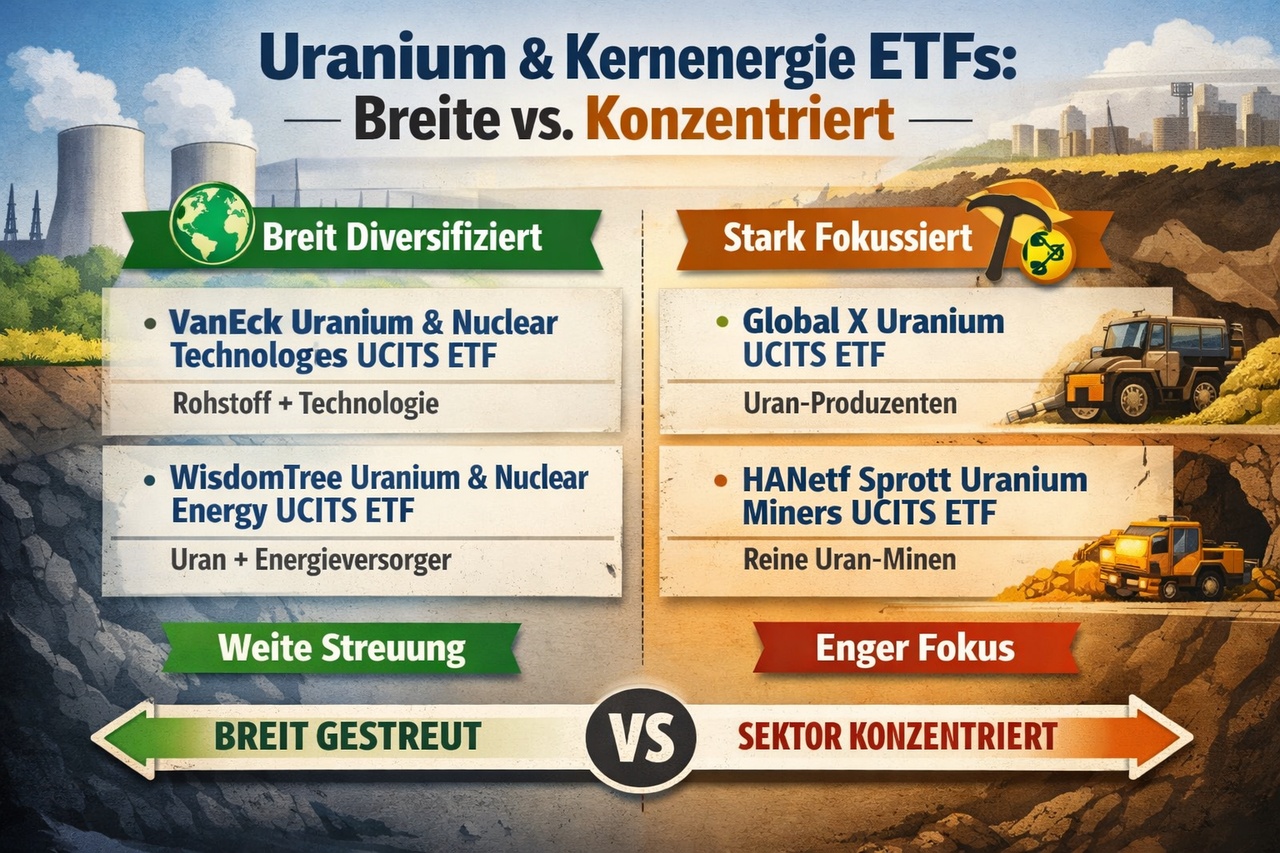
1. VanEck Uranium and Nuclear Technologies UCITS ETF
➡️ Broad thematically in the uranium/nuclear energy sector
👉 Mix of uranium producers, nuclear technology and energy/component companies → More diversification across sub-sectors
2nd Global X Uranium UCITS ETF
➡️ Commodity/producer-centric
👉 Strong focus on uranium mining, exploration and supporting components → More concentrated on commodity/producer sector
3rd HANetf Sprott Uranium Miners UCITS ETF
➡️ Very specialized in uranium miners
👉 Sector segment with a focus on mining and exploration companies → High concentration risk in one sector
4 WisdomTree Uranium and Nuclear Energy UCITS ETF
➡️ Broad across the nuclear energy ecosystem
👉 Includes mining, utilities, suppliers and technology → Broad diversification across different industries in the nuclear sector
$OKLO$CCO (-4,67%)
$UUUU (-10,63%)
$3842
$UEC (-7,19%)
$NXE (-4,34%)
$BWXT (-0,75%)
$CEG
$LEU (-7,95%)