$INOD (-1,59%) bought some since fundamentals look good!
everyone can have a bad day

Messaggi
88$INOD (-1,59%) bought some since fundamentals look good!
everyone can have a bad day
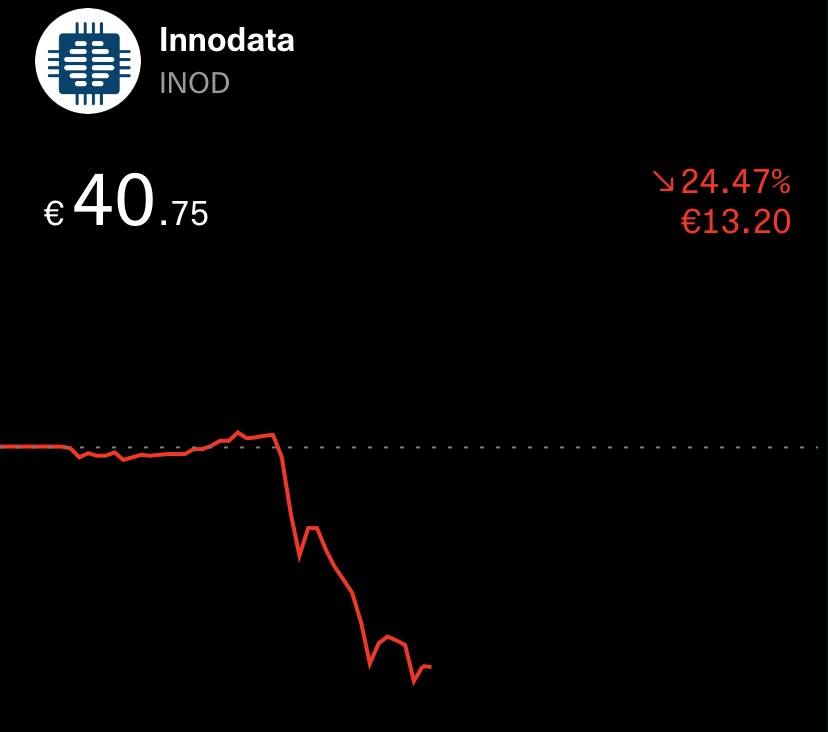

Innodata abruptly laid off hundreds of employees at key development and data annotation sites, such as India (approximately 550 affected employees) and the Philippines.
Reason: According to termination letters and employee reports, a major AI client has drastically reduced its business volume (“business assignment”) with Innodata.
Why this is dangerous: Innodata is already suffering from a very high concentration of customers (a large portion of its revenue depends on a few tech giants or hyperscalers). A loss or reduction in orders from a key client directly impacts its earnings.

$INTC (-11,42%) if reaches 72€ 15x shares more
$QYLE (-1,39%) start position if reaches 14.52€
$INOD (-1,59%) start position if reaches 43 €
$NVDA (-3,56%) same if reaches next support approx 8 to 9% below current price
no more cash flow this year except upcoming dividends since I’m saving to buy a new car
🤖 Innodata Opens Its Own Physical AI/Robotics Lab
On September 30, 2026 , Innodata opened a new motion-capture AI lab in New Jersey . The lab was established in collaboration with Vicon and is capable of tracking human and robotic movements with submillimeter accuracy .
The key point:
Why I find this particularly interesting for the 2036 portfolio
This changes Innodata’s story somewhat.
Until now, the investment story has primarily been:
Generative AI → Training data → Data preparation → AI models
Now another layer is being added:
Physical AI → Robots → Real-world motion data → Training → Evaluation → Safe autonomous systems
This fits directly with the Depot 2036 theme “Humanoid / Autonomous Systems”.
And even more interesting: Innodata appears to be attempting to cover the entire data cycle:
Real-World Data → Training → Model Evaluation → Performance Validation
Strategically, this sets it apart from being merely a traditional data labeling provider.
📈 And its operational foundation is also very strong at the moment
The Q2 figures were already exceptional:
Q2 2026 Innodata
Revenue
$92.1 million
Growth
+58% YoY
Adjusted EBITDA
$25.4 million
EBITDA growth
+92%
Adjusted Gross Margin
49%
The company also had, as of the end of June, $250.4 million in cash, including short-term investments, which included significant customer prepayments.
Innodata – Innodata meldet Rekordergebnisse für das zweite Quartal 2026
My Depot 2036 Conclusion:
The new robotics motion capture initiative is not a side issue. It is a concrete step from “AI data” toward “physical AI data infrastructure” —and that is precisely why I will be following this development very closely during Innodata’s upcoming earnings call.
The connection between Innodata and Meta Muse is currently very interesting, but has not yet been officially confirmed.
Ist Muse ein Gewinn für Innodata?
This is not yet a confirmed contract for Muse, but it’s a remarkable chain of circumstantial evidence. If it’s later officially confirmed that Innodata is indeed involved in Muse or its training/further development, that would be a major development for Innodata’s “AI Picks & Shovels” story about Innodata fundamentally relevant.
And one more important point: Hunterbrook has disclosed a long position in Innodata. The report should therefore be viewed as a well-researched thesis involving a conflict of interest, rather than as corporate confirmation.
For Tenbagger Capital, that’s exactly what’s interesting right now: Not just “Innodata is landing AI contracts,” but potentially Innodata is at the table with one of the largest AI investors of all time in the development of agent-based AI.


Yes— but with one important caveat: I would describe Innodata more as a “small Palantir in the data/AI backend” rather than a mini-Palantir in terms of its actual business model.
In my view, the comparison is particularly interesting precisely because of Innodata’s recent developments:
The key point
is that Innodata is one level below Palantir .
Palantir, for example, takes corporate or government data and builds operational decision-making and AI systems from it.
Innodata, on the other hand, ensures that the data, training datasets, evaluations, and AI workflows actually meet the necessary quality standards.
This becomes particularly clear through a remarkable connection:
Innodata is itself a supplier to Palantir.
Palantir has selected Innodata for data engineering, annotation, and multimodal data processing—including computer vision, video, image, document, and sensor data.
I find this strategically very interesting.
And Innodata is continuing to evolve
The company is no longer just a traditional “data processor.”
In Q2 2026:
Innodata – Innodata meldet Rekordergebnisse für das zweite Quartal 2026
Even more interesting: In Q1, a Evaluation & Observability Platform was introduced in Q1, designed to function as a kind of control layer for agent-based AI systems.
So I would put it this way:
Palantir = AI operating system for businesses and governments
Innodata = data/AI infrastructure and quality layer upon which such systems can be built
And that’s exactly where I see the exciting investment story at Innodata.
Because as AI agents, physical AI, robotics, defense AI, and government AI grow rapidly, the demand increases not only for computing power and models—but also for high-quality data, evaluation, security, and continuous training.
That is precisely the layer on which Innodata is increasingly focusing. The company now expects at least 40% revenue growth.
For the tenbagger thesis
I would therefore not simply buy Innodata as a “mini-Palantir”, but rather frame the thesis a bit differently:
“Innodata is a potential ‘picks-and-shovels’ beneficiary of the Palantir/AI revolution.”
And to me, that’s actually the more interesting thesis.
After all, Innodata doesn’t have to become the dominant AI platform itself. It’s enough if more and more AI companies and government organizations require high-quality data, agent training, evaluation, and secure AI workflows .
The fact that Palantir is already an Innodata customermakes this theory particularly plausible.

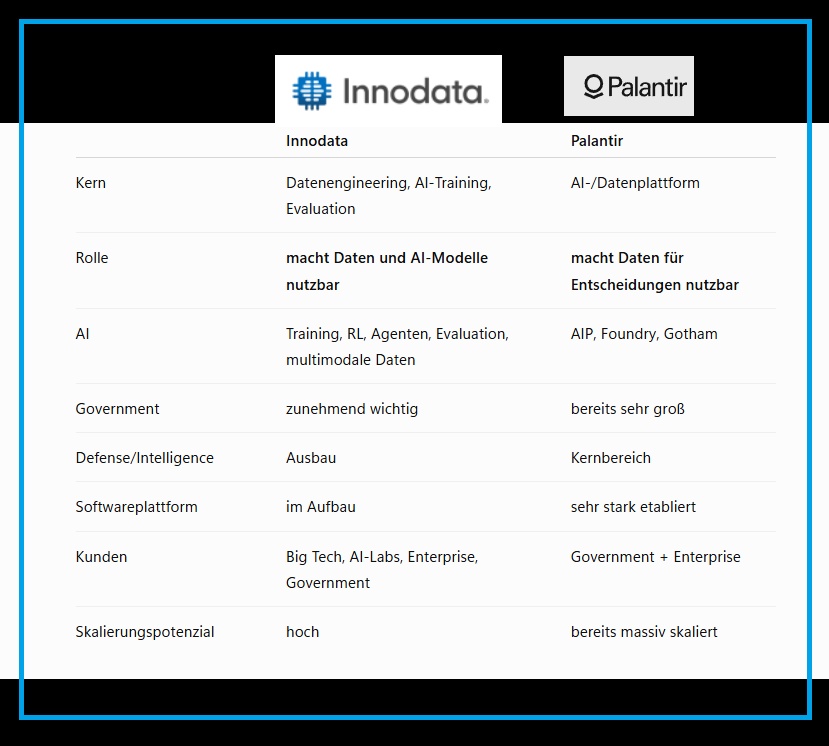

My friends, this makes Innodata even more exciting to me than it already is. That’s why I’m staying invested.
Summary
Innodata announced on September 15, 2026, appointed Admiral Michael S. Rogers to its board of directors. Rogers served as 2014 to 2018, he served as Director of the NSA and concurrently as Commander of U.S. Cyber Command.
His role is not operational but primarily strategic: Innodata aims to expand its activities with U.S. federal agencies, defense and security clients, and in the field of secure AI systems .
Why is this interesting?
1. Innodata is positioning itself more strongly as an “AI Security” company
The company is not only working on data preparation for AI but is increasingly developing services for evaluation, security, and trustworthiness of AI systems and autonomous AI agents.
2. Access to the U.S. government market
Innodata will have its so-called Federal Practice in 2025. This practice focuses on data engineering, model evaluation, and AI enablement for U.S. government and defense-related applications.
The appointment of a former NSA/Cyber Command chief therefore aligns very closely with this strategy.
3. This is apparently part of a larger plan
Rogers is not the first high-ranking security expert to join the board. Previously, General Richard D. Clarke, former commander of U.S. Special Operations Command, had already joined the board. In this way, Innodata is strategically building expertise in the areas of government, defense, cybersecurity, and AI security .
🚀 For Innodata’s investment story
I would therefore view this announcement less as “a new board of directors” and more as strategic signal:
Data Engineering → AI Evaluation → AI Safety → Government/Defense → autonomous AI agents
The last point in particular is exciting. Innodata argues that companies and government agencies will deploy autonomous AI agents on a larger scale in the future and will require independent evaluation and safety assessments . Rogers’ experience in cyber defense is expected to help with this.
Important: The announcement contains no new revenue or profit forecasts, nor any major contract with specific figures. The financial impact is therefore not directly quantifiable at this time.
https://investor.innodata.com/news/news-details/2026/Innodata-Appoints-Admiral-Michael-S--Rogers-Former-NSA-Director-and-Commander-of-U-S--Cyber-Command-to-Its-Board-of-Directors/default.aspx?utm_source=chatgpt.com

I’m currently considering investing some spare capital in Innodata. I think the numbers are really strong—over 50% revenue growth, improved margins, and, most recently, results that were once again well above expectations. The AI angle is also quite exciting.
What’s holding me back a bit is the valuation, the reliance on a few large customers, and the upcoming CEO change. What’s your take on INOD right now? Opportunity or wait-and-see?
$INOD (-1,59%) The price dropped below €50, and my stop-loss kicked in. Overall, it’s a very volatile stock, but I’m confident in it and believe it has plenty of room for growth in the coming years.

Innodata Delivers an Extremely Strong Second Quarter of 2026—Record Revenue, Massive Margin Growth, Enormous Cash Position, and a Significant Leadership Transition.
📌 Key points of the page – summarized concisely
1. Record quarter with strong growth
2. Cash reserves skyrocket
3. Significantly broader customer base
4. Research is becoming a growth driver
5. Outlook remains very optimistic
6. Significant leadership transition
7. Financial Data at a Glance

Hello, everyone—I’m staying involved here, too.
Innodata is releasing the first phase of its AI cyber training suite to enable AI coding agents to write—and fix—secure code.
NEW YORK, NY / ACCESS Newswire / August 4, 2026 / INNODATA INC. (Nasdaq:INOD) today launched the first phase of its AI Cyber Training Suite —twelve datasets and evaluation systems that train AI coders to write code that avoids known security vulnerabilities, introduces new ones, and fixes existing vulnerabilities in software systems already in operation. The suite now addresses a key hurdle to trust in AI-written code: the risk that an agent, while adding a feature or modernizing a legacy system, might inadvertently create a security vulnerability. The AI Cyber Training Suite works across the entire stack of coding agents—the models, harnesses, and tools—to ensure that the code they generate is not only functional but also secure. It is available today for model builders and enterprises.
The suite is based on thousands of real-world security vulnerabilities discovered over the past decade in Python, TypeScript, JavaScript, Rust, C, Go, and other languages, and covers a wide range of platforms and service integrations, including Linux, macOS, Android, Windows, AWS, GCP, and many others. Each vulnerability was manually dissected by Innodata’s cybersecurity engineers and reconstructed using a targeted attack in a sealed, offline copy of the vulnerable software. This approach makes the suite unusually rigorous: it measures an AI’s ability to fix a vulnerability by verifying that the original attack against the patched code is no longer successful, while simultaneously confirming that the software continues to function as intended. The result is data and metrics that both train coding agents to avoid vulnerabilities from the outset and test their ability to fix existing vulnerabilities.
"For model builders, these evaluations and datasets enable the coding agents—the models, harnesses, and tools—to ensure that the code they generate is not only effective but also secure,” said Yonatan Brander, who leads the cybersecurity data engineering team at Innodata. "And for companies, they offer something equally important: the confidence that when teams refactor, add features, or modernize legacy systems with AI agents, they won’t reintroduce the very vulnerabilities they had already avoided or patched."
For companies, this means they can use AI to modernize legacy systems while minimizing the risk of security vulnerabilities and leveraging AI to fix identified vulnerabilities.
Innodata tested the ability of ten leading AI models and agents to fix verified security vulnerabilities and found that the best Openweight AI models fixed at most 23% of these verified flaws—even when they were shown exactly where each one was located. However, after a single round of fine-tuning using a subset of the suite’s data, the model’s ability to fix vulnerabilities without being prompted more than doubled to 41.2%—rising from 18.4% to 41.2%.
“AI is now writing a growing share of the world’s code, and the agents writing it must ensure that this code is secure,” said Jack Abuhoff, CEO of Innodata. “Otherwise, companies cannot rely on AI-generated code without a professional security team reviewing everything that is produced—and that is a real barrier to AI adoption. The Cyber OTS Suite helps companies confidently deploy agent-generated code into production.”