

And on we go with $XPEV (-2,82%) and $9868 (-2,57%)

Xpeng
Ação
Ação
ISIN: KYG982AW1003
Ticker: 9868
KYG982AW1003
9868
Price
Discussão sobre 9868
Postos
35



1Mês·
Robotics / Physical AI—the next big thing?
In my opinion, robotics and physical AI will be among the most significant fields of the future in the coming years. I’d like to follow this trend with my own portfolio of stocks, which I’ve carefully put together. (It contains only a few stocks from this sector—unfortunately, I can’t invest in everything.)
The focus is deliberately on higher-risk, opportunity-driven stocks—rather than on large, defensive names. Below, I’ll briefly outline the stocks I’ve already invested in or plan to invest in, and I’ll also highlight a few other alternatives.
I’d be very interested to know what stocks in this sector you’ve already invested in or plan to invest in.
I’ve decided on:
Nabtesco (rotary gearboxes)
THK (linear actuators)
Allegro (sensor technology)
UBTECH (high risk, ready-to-use robots)
Xpeng
Overview of the stocks + additional alternatives:
(Of course, there are many more. This is just a small selection of possible stocks.)
$6324 (-9,41%)
Harmonic Drive Systems (Japan)
• Global market leader in precision strain-wave gearing, an alternative to Nabtesco’s cycloidal gears
• Extremely common in robot joints, where low weight and high precision are required
• One of the companies that has already benefited the most from the robotics boom
Nabtesco (Japan)
• Global market leader in precision reduction gears (especially cycloidal gears)
• Found in the majority of industrial robot arms worldwide
• Highly focused business closely tied to robotics
THK (Japan)
• Inventor and market leader in linear guides and ball screws
• Enables precise, linear motion in robots, machine tools, and factory automation
• More diversified than pure gear manufacturers, with a strong presence in traditional mechanical engineering as well
Schaeffler (Germany)
• Traditional automotive supplier (rolling bearings, drivetrain technology)
• Has been strategically positioning itself toward robotics since 2025/26, including with a planetary gear actuator for humanoid robots
• The existing core automotive business drives the stock; robotics is an additional option
Allegro Microsystems (U.S.)
• Manufacturer of sensor technology, primarily magnetic sensors for engine control
• Crucial for precise motion control in robotic joints and the automotive sector
Ambarella (USA)
• Develops edge AI chips for image processing and computer vision
• Increasing focus on robotics and autonomous systems rather than just traditional surveillance cameras
Teradyne (U.S.)
• Originally a manufacturer of semiconductor test equipment
• Through acquisitions, owns Universal Robots (market leader in collaborative robots/cobots) and Mobile Industrial Robots (MiR, autonomous transport robots)
• Thus, a diversified approach to investing in commercial robotics applications without being a pure-play robotics company
UBTECH Robotics (China)
• Builds complete humanoid robots (e.g., Walker S); not a pure supplier
• Already undergoing initial industrial trials
• Listing in China introduces additional regulatory/geopolitical risk
Rainbow Robotics (South Korea)
• Korean manufacturer of humanoid and collaborative robots
• Samsung Electronics is the largest shareholder and is driving the integration into its own manufacturing operations
• A small, highly volatile small-cap stock with significant price movements since Samsung’s investment
Doosan Robotics (South Korea)
• Part of the Doosan Group, a manufacturer of collaborative robots (cobots)
• Focus on industrial applications such as welding, palletizing, and food service automation
• Listed on the stock exchange since 2023; still a relatively new listing
XPeng (China)
• Primarily an electric vehicle manufacturer, but also operates a robotics division (humanoid robots) and is developing air taxis (XPeng AeroHT)
• The stock price depends largely on the low-margin core EV business; the robotics potential has had little impact so far
Nvidia (U.S.)
• Provides the computing platform behind Physical AI: Jetson chips and the Isaac platform for robot control and training
• A key “enabler” for virtually all robotics players, but itself a massive, broadly diversified chip company—no pure-play robotics exposure
Tesla (U.S.)
• Electric car manufacturer with its own humanoid robotics program (Optimus)
• Optimus is not yet in large-scale commercial use; it remains a growth opportunity alongside the core business
Hyundai Motor Group (South Korea)
• Core business is traditional automotive manufacturing; has held a majority stake in Boston Dynamics since 2021
• Boston Dynamics unveiled the new humanoid robot Atlas at CES 2026; mass production is planned to begin at the new U.S. factory in Georgia starting in 2028
• Here, too, robotics is a supplementary option alongside a large, established automotive business
Nidec (Japan)
• The world’s largest manufacturer of electric motors, ranging from micromotors to industrial drives
• Investing heavily in actuators specifically for humanoid robots—a gap that THK/Schaeffler (linear actuators) and Nabtesco/Harmonic Drive (gearboxes) have not yet filled
• Complements the drive chain with the missing core component: the actual motor
Cognex (U.S.)
• Global market leader in machine vision systems for manufacturing automation
• Considered “the eyes” of modern robotic cells in factories—detects, inspects, and positions components
Classification by Field
Gearboxes
Harmonic Drive, Nabtesco
Actuators / Linear and Drive Technology
THK, Schaeffler
Sensors / Chips / AI Computing Platform
Allegro Microsystems, Ambarella, Nvidia
Automation Equipment / Cobots (Close to suppliers, but diversified)
Teradyne
Pure-play or specialized robot manufacturers
UBTECH, Rainbow Robotics, Doosan Robotics
Large conglomerates with robotics as a secondary business (core business in auto/mobility)
XPeng, Tesla, Hyundai Motor Group
What do you think of this stock selection? Do you have any additions?
@Multibagger
@Tenbagger-Capital
Generated using AI. Not investment advice.
1818
15 Comentários

Thank you—this is a very interesting topic. I think it will become increasingly important in the defense sector. Yes, there are a lot of exciting companies. Take, for example, $JBL —they’re already building robots that build other robots.
•
66
•1Mês·
Xpeng News 🍾
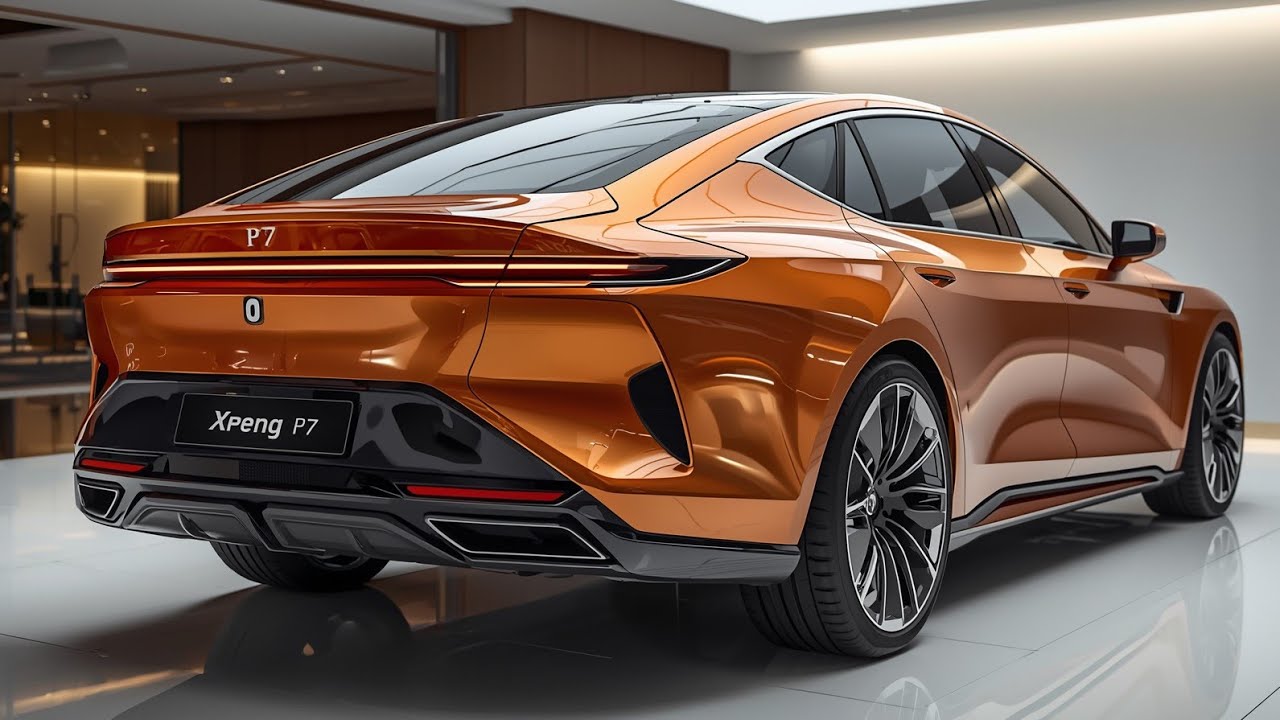
A few months ago, I also pointed out in a comment that Xpeng $9868 (-2,57%) and $XPEV (-2,82%) could offer its technology to other foreign automakers beyond Volkswagen. Now the time has come, and Xpeng has already contacted potential partners. No names have been mentioned yet. But it seems that the path to profitability is now open. Licensing fees and the like will certainly help.
The offering is said to include electrical and electronic architectures, cockpit systems, Turing AI chips, driver-assistance software, robotaxi solutions, as well as robotics and other technologies for physical AI.
In the second quarter, revenue from services and other activities nearly doubled, while the segment margin rose from 53.6% a year ago to 75.1%; Xpeng has formed its own marketing team to pursue further technology partnerships.

1111
5 Comentários
Thanks for sharing. Great news. Now we just need to see that news reflected in the stock price. 😀
•
44
•1Mês·
China is preparing humanoid robots for combat deployment
China’s humanoid robots are already running, boxing, and dancing in front of audiences at competitions. Now the military is planning to use them for patrols, attacks, and operations inside buildings.
China is preparing humanoid robots for potential combat missions. Military researchers are designing scenarios for urban combat, reconnaissance, and operations behind enemy lines.
This is according to a report by the Reuters news agency, based on an analysis of more than 100 tenders, studies, patents, and government documents. According to the report, the work gained significant momentum in 2025 and 2026. So far, however, there is no evidence that armed humanoid robots are already being deployed in active units of the Chinese army.
Humanoid Robots for Urban Combat and Patrols
As early as August 2025, researchers at the National University of Defense Technology in Xi’an described an urban combat scenario involving six “combat robots.” Humanoid machines, robot dogs, and unmanned vehicles were to work alongside soldiers to clear an occupied building room by room. The authors believed such technology would be available within five to ten years.
In July 2025, the Chinese military newspaper “PLA Daily” wrote that the deployment of humanoid robots could evolve “from combat support to primary combat.” The article also mentioned attacks on live targets, provided a human had previously confirmed the target.
Two days after the World Humanoid Robot Games in Beijing, the newspaper also called for new technology to be moved more quickly from laboratories to military training grounds. At the games in Beijing, humanoid robots ran sprint races, boxed, and danced in front of spectators.
Tests for Operations Behind Enemy Lines
Military interest began to grow as early as 2024. At that time, the National University of Defense Technology and the Academy of Military Sciences hosted a forum on military applications of humanoid systems. This was followed in June 2025 by a competition in which robots were tasked with infiltrating enemy lines, mapping an area, and locating targets.
Railway tenders also confirm this direction. In May 2025, the People’s Liberation Army sought a humanoid robot, including installation and training. According to Reuters, in June 2026 the military budgeted the equivalent of approximately 260,000 euros for a system that collects and analyzes camera, radar, and motion data for such machines.
Many Technical Hurdles Remain
The state-owned defense contractor Norinco presented material on its humanoid robot, Fuxi, in August. The system is designed to perform guard duty, conduct reconnaissance in all weather conditions, and carry out dangerous tasks. It can be remotely controlled.
Such machines are still considered vulnerable. They consume a lot of energy and often perform unreliably outside of controlled demonstrations. According to Reuters, robotics expert Dennis Hong of UCLA said, “Going to places where we don’t want to send humans is one of the most compelling reasons to develop robots in the first place.” Analyst Malcolm Davis does not expect practical weapons systems to be available today. “But in five to ten years, they very well could be,” he said.
1Mês·
Not Enough Recruits: South Korea's Navy Puts Robots at the Helm
Hello, everyone,
As a growth investor, I naturally also look at future scenarios.
Or rather, what’s already possible today.
My dear @EpsEra has already reported on several times.
And we can see that some of this is slowly becoming a reality.
Especially in the defense sector, I foresee enormous growth in the field of autonomous systems and robotics over the next few years.
This may also explain why I joined $V1NC (-2,82%) Vincorion.
However, this won’t just be about the companies that build these systems and robots. It’s about the entire value chain, starting with raw materials.
Unfortunately, this doesn’t necessarily make the world any safer, and we can already see that a supposedly weaker opponent isn’t so weak after all.
This will mean:
The next arms race will be about who has the most autonomous systems and robots.
But the best AI will also be crucial.
The battle for raw materials has already begun.
My friends, let’s discuss this. I look forward to your comments.
Zu wenig Rekruten: Südkoreas Marine stellt Roboter ans Ruder
The South Korean Navy has released video footage showing the deployment of a humanoid robot: PIBOT. It was used in a simulator for a test that took place back in July. The Navy typically uses this simulator to train recruits who will serve on Sejong the Great-class destroyers.
In addition to its human-like robotic hands, PIBOT was fitted with a device strapped to its chest for the experiment that is connected to the steering wheel . The robot received commands shouted by a human supervisor and executed them via speech recognition . Using several cameras , it can not only keep an eye on its surroundings but also read the instruments and nautical charts.
In addition, it has the instructions and technical descriptions for the simulated ship, as well as a database full of up-to-date nautical charts. According to the Korea Advanced Institute of Science and Technology (KAIST), which built the robot, it thus has more specialized knowledge at its disposal—and can access it more quickly—than a human.
A Robot for Every Occasion
PIBOT is about 160 cm tall and weighs 65 kg. The idea is that it can not only operate ships but also drive cars and fly airplanes. So instead of going to the trouble of retrofitting warships, trucks, and fighter jets with autonomous control systems, you can simply put PIBOT at the controls.
The robot is thus intended to bridge the gap until new military equipment—which already has such autonomous systems built in—is ready for deployment. It could also help make up for the shortage of recruits. Over the past 6 years, the South Korean armed forces have shrunk by 20 percent , berichtet der Guardian.
This is not due to defense budget cuts, but rather to one of the lowest fertility rates in the world, ranging from 0.72 to 0.76 children per woman. Depending on the statistics, only Taiwan has a lower rate, at about 0.70. If this trend continues, the population could fall from its current level of approximately 51 million, could shrink to 36.2 million , according to projections by the South Korean government.
PIBOT only needs electricity, not sleep
(which brings $V1NC (-2,82%) comes into play again)
Robots like PIBOT could take some of the strain off the system here. Because, assuming a sufficient energy supply, they can theoretically 24 hours a day , they could, for example, replace several sailors at the ship’s helm who would normally be on watch in shifts.
However, there are no plans for an entire army of PIBOTs to go to war anytime soon. For now, the robot is intended to work alongside humans , such as on a ship’s bridge, as a co-pilot in an airplane, or with a human passenger in a truck. KAIST does not, however, rule out the possibility that PIBOTs might one day be at the helm alone, receiving their orders via radio, just as a human soldier would.
Zu wenig Rekruten: Südkoreas Marine stellt Roboter ans Ruder

futurezone.atZu wenig Rekruten: Südkoreas Marine stellt Roboter ans Ruder

4Mês·
Byd 🥴
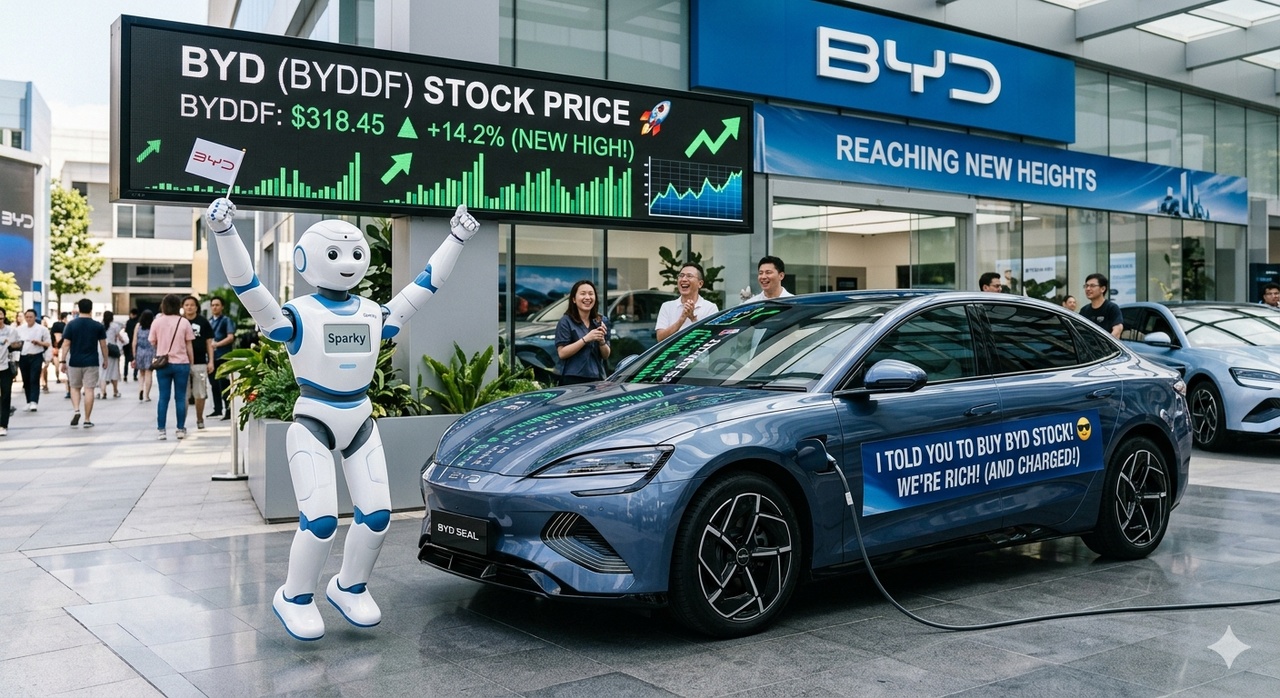
$1211 (-4,33%) It's not going as well as I'd hoped, but I still firmly believe that the company will soon be valued more in line with what it's actually worth. Still, the market is always right.
What do you guys think of BYD?
To me, it's similar to $9868 (-2,57%) a Tesla from China 🇨🇳
66
15 Comentários
Is there actually any automaker whose stock price is looking good?
Excluding Tesla, that is
Excluding Tesla, that is
•
88
•5Mês·
XPeng Inc. (NYSE: XPEV | HKEX: 9868): The Paradox
New episode. Content in the video.
XPeng Inc. (NYSE: XPEV | HKEX: 9868): The Paradox
The Physical AI Evolution Navigating the 2026 Growth Pivot — From Smart EVs to a Global Robotics & Software Powerhouse (April 2026 Analysis)
⚠️ Disclaimer: This content is provided for informational and educational purposes only and does not constitute investment, financial, legal, or tax advice. The information presented does not take into account the specific investment objectives, financial situation, or particular needs of any individual. This content may include speculative analysis and forward-looking statements that are subject to change and may not materialize. Past performance is not indicative of future results. Nothing in this content should be construed as a personal recommendation or an inducement to buy, sell, or hold any financial instrument. Financial markets involve risk, including the potential loss of capital. Viewers are strongly encouraged to conduct their own independent research and, where appropriate, seek advice from a qualified professional authorized and regulated under applicable local regulations. The creator of this content accepts no liability for any direct or indirect losses or damages arising from any reliance placed on the information provided.
www.youtube.comXPeng Inc. (NYSE: XPEV | HKEX: 9868): The Paradox
66
1 Comentar
2Mês
Very good analysis. I think these 3 companies along with BYD and $175 will be game changers in the next months. Huge opportunity. At least in Spain I see every month more and more Chinese autos. And the fact is that they cost half of an European auto and have the same or even better quality in some cases.
•
11
•
6Mês·
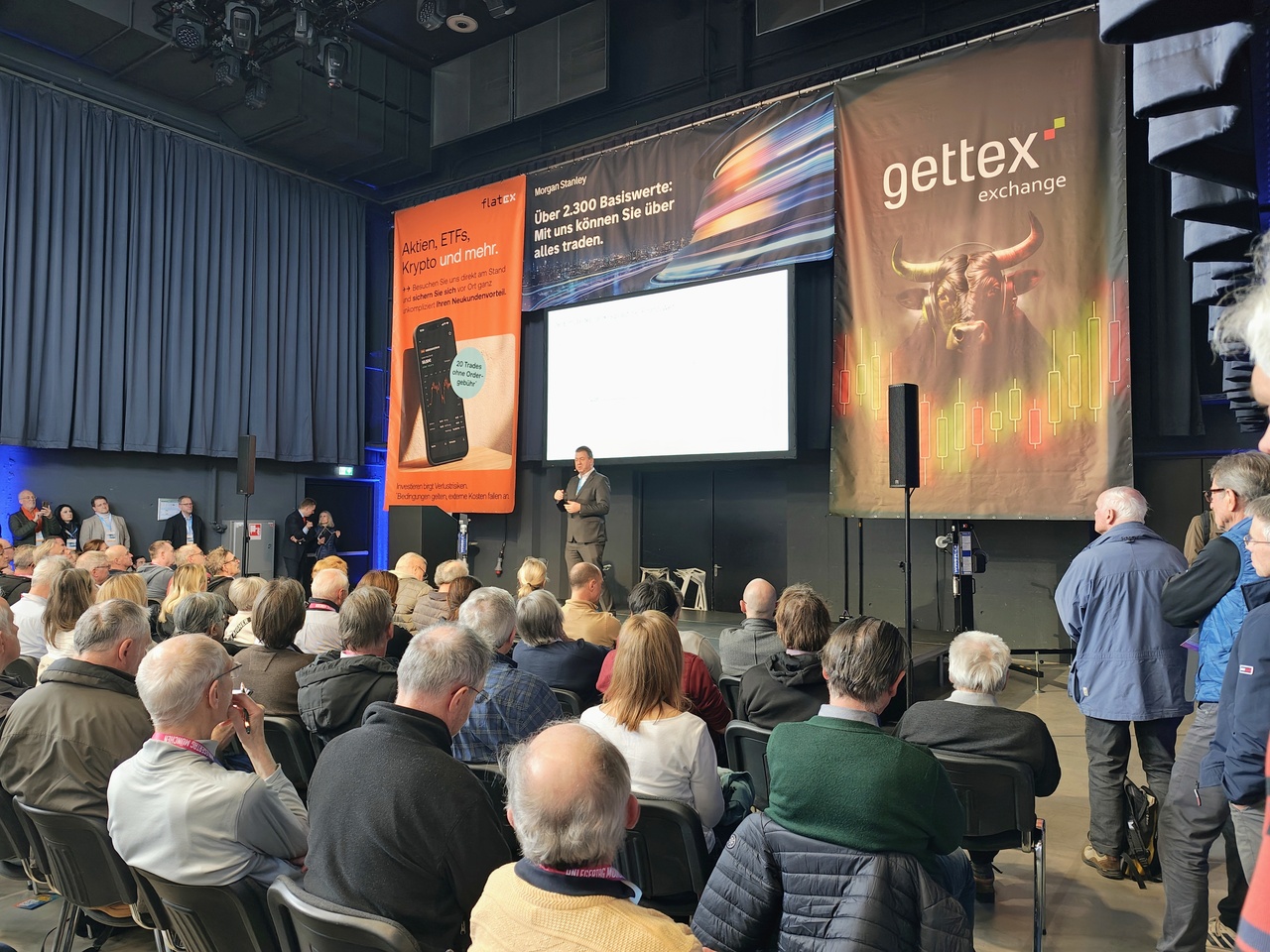
Summarizing stock exchange trade fair
Yesterday was an exciting day at the trade fair -
The rejuvenation of the audience in particular is an interesting signal for the equity culture.
The fact that the crypto stage is less popular with the older generation fits in with the picture of classic value orientation.
Here are the most frequently discussed stocks of yesterday:
High-Growth & Tech (US & International)
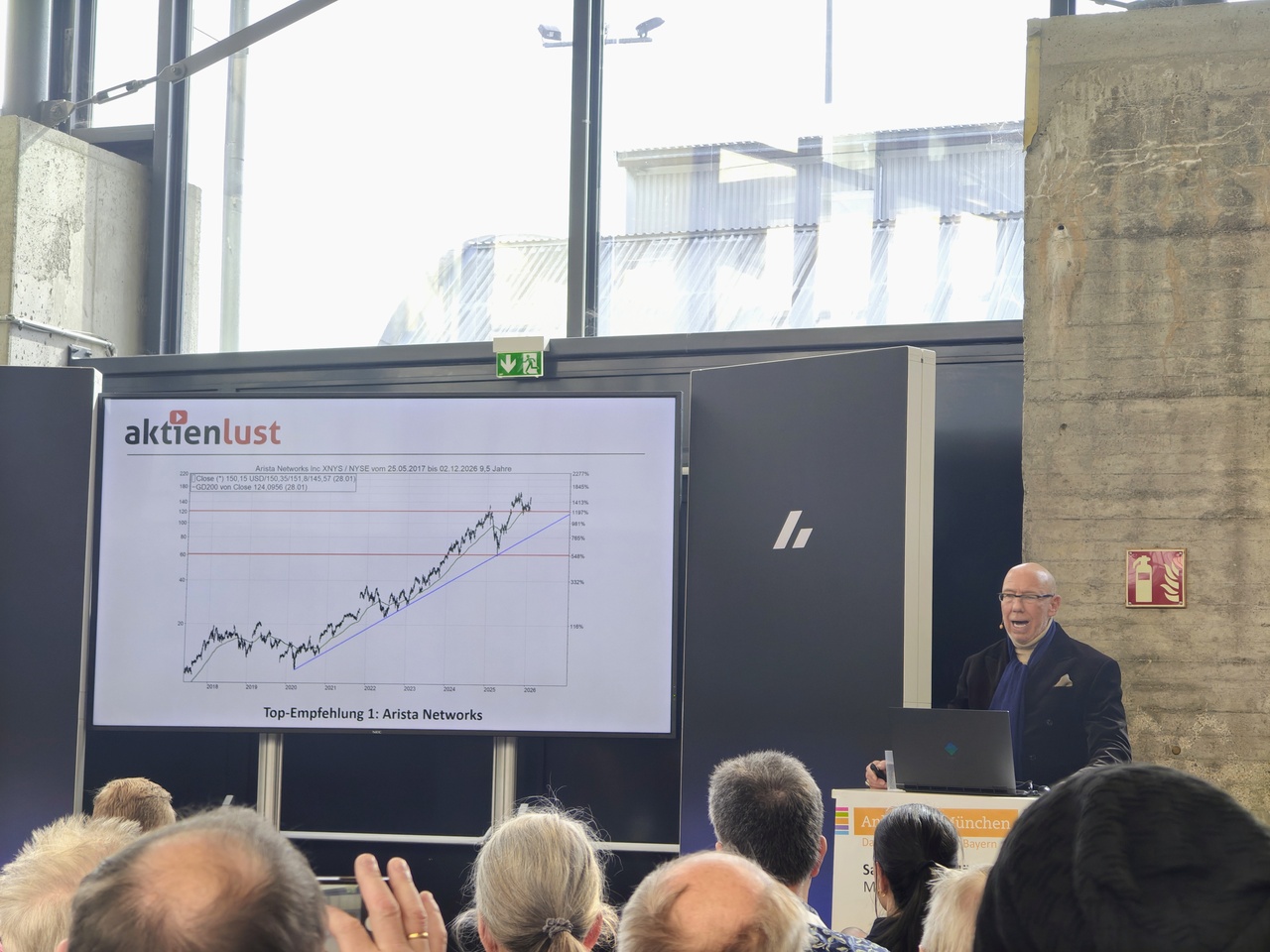
$ANET (-7,81%) Networks
* Value: Leading provider of cloud networking solutions, benefits massively from the expansion of AI infrastructure.
* P/E ratio: Valued at a rather sporty 48, but reflects the high growth.
* Chart: Shows strong relative strength; first attempts to break out of the consolidation above the 50-day moving average visible.
* Conclusion: A clear beneficiary of the "shovel seller" principle in the AI boom.
$$TTWO (+0,46%) Interactive
* Value: Gaming giant (GTA VI anticipation). Strong strategic position, but high development costs.
* P/E ratio: Currently negative or extremely high due to special effects/investments; adjusted (forward) at approx. 56.
* Chart: In a correction phase since the all-time high in fall 2025; currently looking for a bottom at approx. 150-160 USD.
* Conclusion: A bet on the release of GTA VI - for patient investors with strong nerves.
* Value: Market leader in cloud-based cybersecurity. "Best-in-class platform approach.
* P/E ratio: Very high (over 80 forward), as growth comes before profit maximization.
* Dividend
* Chart: Medium-term trend currently negative, struggling with the USD 400 mark.
* Conclusion: Quality share in the security sector, but valuation leaves little room for disappointment.
(China corner)
* Value: Cyclical China stocks. JD (e-commerce) fundamentally cheap, Xpeng (EV) technologically strong but in a price war.
* P/E ratio: JD very favorable (approx. 8), Xpeng negative (loss zone).
* Chart: Both volatile; strongly dependent on the economic measures from Beijing.
* Conclusion: Only suitable as a speculative portfolio addition.
Established stocks & DAX stocks
* Value: Europe's cloud heavyweight. The transformation to a subscription model is bearing fruit.
* P/E ratio: approx. 25, which is historically fair for the current profitability.
* Dividend: Reliable payer, yield approx. 1.2 % to 1.6 %.
* Chart: Long-term upward trend intact, recently slight profit-taking at a high level.
* Conclusion: The "basic investment" in the European tech sector.
* Value: Restructuring case with legal risks (glyphosate) and high debt.
* P/E ratio: Visually low (single-digit on a cash flow basis), but distorted by losses.
* Chart: In free fall or bottomless mode; no clear trend change in sight.
* Conclusion: Only for turnaround speculators with extreme staying power.
$P911 (+0,35%) (P911)
* Value: Luxury sports car manufacturer, struggling with the transition to e-mobility and weak demand in China.
* P/E ratio: approx. 10-12, which looks cheap but prices in falling margins.
* Dividend: Currently approx. 6% (note: analysts expect cuts!).
* Chart: Very weak, trading near all-time lows.
* Conclusion: The brand is worth its weight in gold, but the market environment is currently difficult.
Brief check of the remaining stocks:
Both in the "dog sector" (solar/biotech) - fundamentally under pressure, chart technically in the basement.
$6758 (+4,38%) Solid value/entertainment mix, P/E ratio approx. 15, fairly valued.
$TSLA (-3,55%) Remains the polarizing vehicle between AI hype and weakening sales figures.
sales figures.
$9880 (-5,71%) robotics :
Highly speculative niche themes (AI infrastructure/robotics), more for the gambler's portfolio.



7Mês·
Buy?
What do you think of the share $9868 (-2,57%)?
Would you invest or do you already own it?
55
4 Comentários
Personally, I have moral problems investing in China.
About the share: Has corrected through and has just shown the first higher high, i.e. you should wait a few more days, so from HKD 70 an entry would be slowly interesting, from HKD 60 quasi mandatory.
Good luck :)
About the share: Has corrected through and has just shown the first higher high, i.e. you should wait a few more days, so from HKD 70 an entry would be slowly interesting, from HKD 60 quasi mandatory.
Good luck :)
•
55
•
7Mês·
Xpeng
You just have to get the right analyst in the car haha, Handelsblatt was also very positive by HB standards after the test drive.
55
11 Comentários
Digga everything I want to buy pumps me out of it first $HIMS and wege xpeng also makes the move.
I don't get my salary until thursday 😭💩
The prices are still buyable but who knows what will happen
I don't get my salary until thursday 😭💩
The prices are still buyable but who knows what will happen
•
55
•
8Mês·
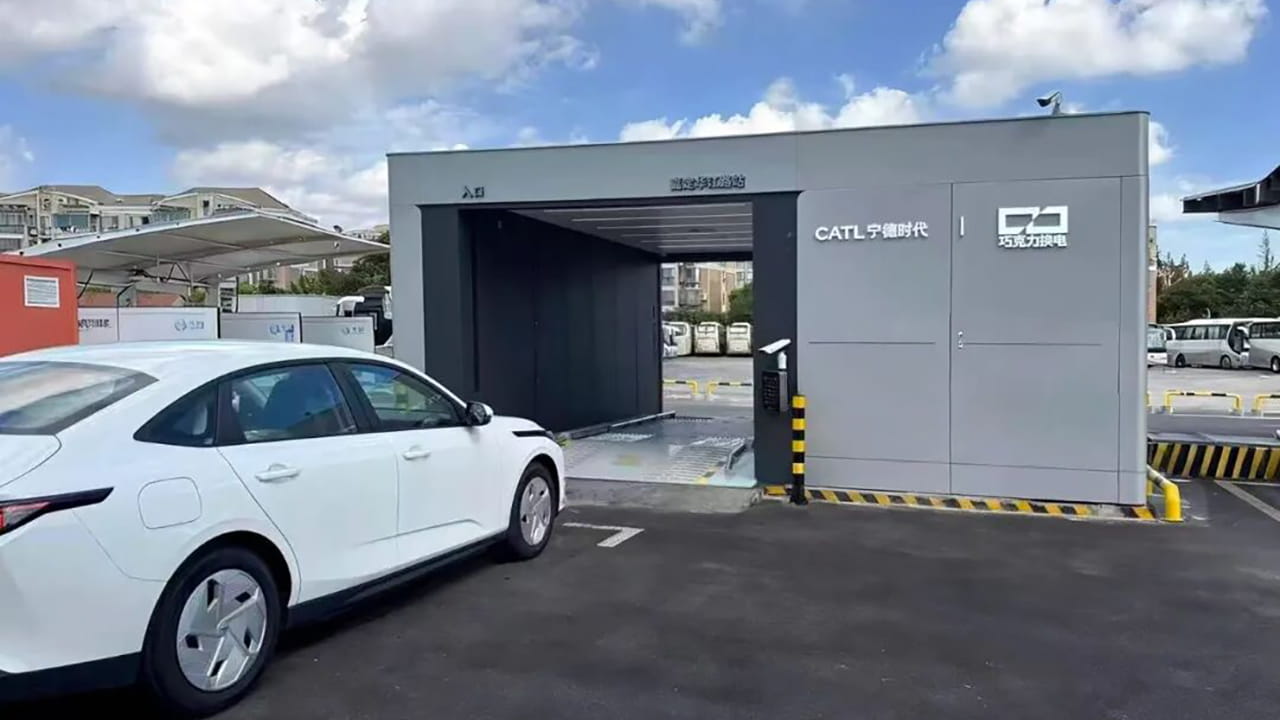
CATL is aiming for the next growth phase in the field of battery changing stations with additional partners
》CATL subsidiary Era Electric is becoming the next important player after Nio《
At the end of January, Contemporary Amperex Technology $3750 (-7,01%) held its annual partner conference "Choco-Swap" in Xiamen.
The event went off without much media coverage or an extensive press campaign. However, in footage released later via the official video channel, familiar names appeared among the participants: Sinopec, Gresgying Digital Energy and Xiaoju Charging from Didi.
In purely formal terms, some of these companies appear to be competing with CATL's subsidiary Era Electric Service Technology, but on the ground, executives shook hands, smiled and made plans for collaboration in the coming year.
In China's new energy sector, competition and cooperation often overlap, and CATL is expanding its partner network to create a shared energy ecosystem rather than operating in isolation.
CATL has continued to build its electric vehicle traction battery business and the next target is charging infrastructure, although the company seems to recognize that it cannot achieve this alone.
》The plan is taking shape《
At the end of 2024, CATL's subsidiary Era Electric began the mass construction of Choco Swap stations. By the end of 2025, over 1,000 stations in 45 cities were already in operation.
By comparison, China has more than 100,000 filling stations nationwide. CATL has set itself the long-term goal of building 30,000 battery swap stations across the country.
Now that the first 1,000 stations are in operation, the pace is accelerating. Era Electric plans to open a further 2,000 Choco Swap stations in 2026, bringing the total number to over 3,000.
》What does 3,000 stations mean in concrete terms《
Nio $9866 (-1,43%)the car manufacturer most closely associated with battery swapping, currently operates around 3,700 such stations.
Building this network, which underpins the brand's premium positioning with a tank-like user experience, has required almost a decade of continuous investment.
Era Electric aims to reduce this timeframe to around a quarter.
》The infrastructure is complex《
Site selection, approvals and construction require time and capital. Qu Guojun, Head of Energy Development at Era Electric, explained that even the selection of suitable sites was a major challenge. "Over the course of 2025, we examined over 10,000 plots of land and ultimately secured around 1,000 sites," he said.
Charging and swapping infrastructure has become a focus for electric vehicle manufacturers. Tesla $TSLA (-3,55%), Li Auto $LI (-0,49%) and Xpeng $9868 (-2,57%) have each set up their own large-scale fast charging networks.
Nio, for example, has invested massively in exchange stations and, in addition to financial and human capital, such projects require outstanding implementation.
The construction of 1,000 Choco-Swap stations within a year demonstrates a high level of operational efficiency and organizational capability in this context.
Internally, this enabled Era Electric to establish mature operating systems and teams on site. Externally, it signaled commitment and removed doubts among industry partners, car manufacturers and consumers.
At CATL's 2024 Choco Swap Ecosystem Conference, Yang Jun, General Manager of CATL's battery swap business and CEO of Era Electric, outlined a phased plan: CATL would finance the first 1,000 stations and later work with partners to build 10,000 more. In the long term, the aim is to reach 30,000 stations through broader industry participation.
CATL wants to prove two things with Choco-Swap: that battery swapping is feasible on a large scale and that a shared ecosystem can be successful.
According to Deng Xu, Vice President of Era Electric, partnership requests are increasing and more and more vehicle models are compatible with Choco-Swap.
1212
5 Comentários
Can they maybe stop delivering good news for a few weeks? I would like to get in... 😂
•
22
•Títulos em alta
Principais criadores desta semana
Dados tempo real da LSX · Dados financeiros e EOD da FactSet