The following shares are history:
$PANW (-5,15%)
$TEAM (+0%)
$175 (-0,75%)
$PYPL (-18,99%)
$RDC (-0,7%)
New:
Increased:
Let's see if this change is worth it!
Postos
7The following shares are history:
$PANW (-5,15%)
$TEAM (+0%)
$175 (-0,75%)
$PYPL (-18,99%)
$RDC (-0,7%)
New:
Increased:
Let's see if this change is worth it!

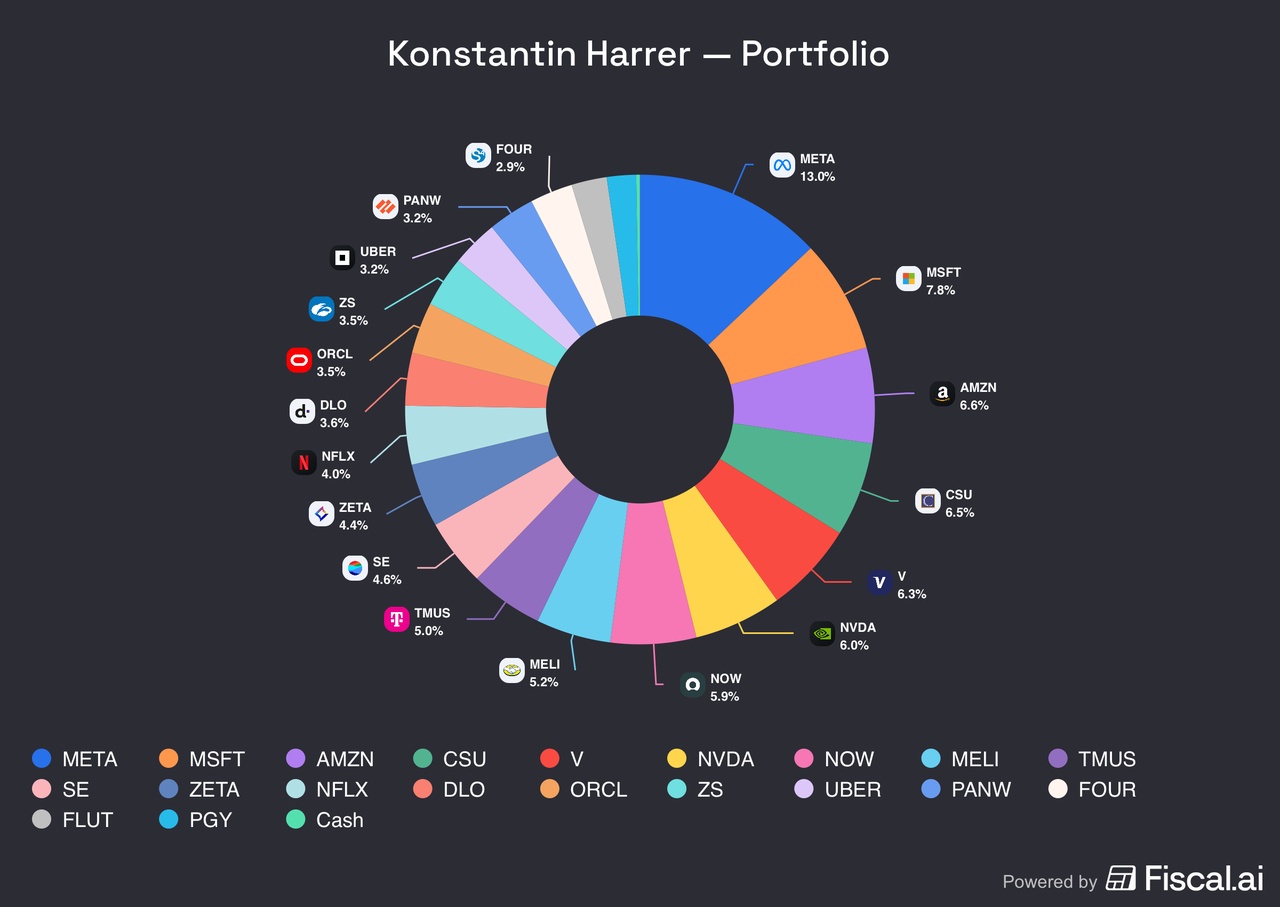
Back from my two-week winter break, I’ll start with a brief portfolio recap of last month. December was a much quieter month for me compared to previous ones, fitting with the holiday season. Portfolio activity was limited, with only a handful of buys and a lot more observation than execution. The only real macro event was the widely expected 25bp rate cut at the beginning of the month, followed by a slow but constructive Santa rally. Overall, December was about positioning and re-evaluating conviction, not trading.
Testament to that is the fact that my first trade was only executed on December 10th, when I opened a position in Sea around $125. I won’t go into too much detail here, as I’ve covered the company extensively over the past months. In short, Sea offers one of the cleanest growth setups in global e-commerce right now. The company benefits from rising income levels and improving infrastructure across Southeast Asia — a far more favorable backdrop than mature markets like South Korea. Revenue growth is projected north of 20–30% annually through 2027, cash flow is expanding at a similar pace, the balance sheet holds nearly $8B in cash with no debt, and the stock was down close to 40% from its YTD highs. At a ~5% FCF yield, it’s not dirt cheap, but more than fair given the growth. I’m very comfortable with Sea here, alongside MercadoLibre as my emerging markets exposure.
The next addition was Microsoft. I bought 10 shares at $475, making it a relatively small position below 3% of my portfolio. Microsoft is not a screaming buy, but it’s the kind of company I’d happily hold for a decade without even looking at the stock price. You could call it a typical “Buffett buy”: a wonderful company at a fair price. The forward P/E sits around 30, dropping into the mid-20s on FY27 estimates. Free cash flow is temporarily distorted by heavy and necessary AI CapEx, but the underlying business remains close to perfect: deeply entrenched ecosystems, massive switching costs, recurring revenue streams, and Azure as the rapidly growing #2 player in the cloud market. Still, while Microsoft is an incredible business, it isn’t my favorite Mag7 right now. That crown still belongs to Meta, and second place, in my view, goes to the stock I bought a week later.
That stock was Nvidia, which I added around $170. Nvidia puts me in a dilemma. Long term, I do see risks: extreme customer concentration, hyperscalers with the resources to build their own chips, and early cracks showing as companies like Meta explore alternatives. But in the short to medium term, the setup was simply too compelling to ignore. The stock was down 15–20% from ATHs, AI demand fears were eased after Micron’s blowout earnings, and on FY27 earnings Nvidia trades at a P/E of roughly 25. I’m highly confident Nvidia will rebound from these levels and make new highs in the coming months, even if I’m less convinced about its dominance five to ten years out.
On the same day, I also bought Uber. Similar story: not a forever-hold in my view given advances in autonomy (Waymo in particular), but at ~20% below ATHs and trading at a P/E of ~10, the risk/reward looked asymmetric. Cooler inflation, a stabilizing macro backdrop, and renewed confidence in the broader market created a favorable short-term setup. Adding to that, recent readings from the Atlanta Fed’s GDPNow model pointed to surprisingly strong U.S. growth momentum into Q4, which supports a more constructive outlook beyond just the AI narrative. I can easily see 30–50% upside from these levels, even if Uber isn’t a core long-term conviction.
December was also strong relative to my benchmark. The MSCI World was essentially flat for the month, while my portfolio gained around 5.6%. I started this portfolio in July 2025, and performance has been broadly in line with the MSCI World so far. For 2026, however, my goal is clear: visible outperformance through deliberate stock picking, generally focusing on quality-growth compounders. Alongside my core holdings (e.g. Meta, Visa, S&P Global), I’ll mix in selective high-risk, high-reward satellite positions where I see significant upside potential over the next few years (e.g. Zeta, Duolingo, Shift4).
Return since inception: +13%
$SE (-5,28%)
$MSFT (-2,54%)
$NVDA (-2,51%)
$UBER (-2,75%)
$META (-1,16%)
$CSU (-6,79%)
$SPGI (-8,56%)
$ZETA (-3,3%)
$NVO (-1,1%)
$NOVO B (-1,07%)
$V (+0,13%)
$MELI (-1,93%)
$INPST (+1,24%)
$EFX (-8,31%)
$TEAM (+0%)
$DLO
$CRM (-6,44%)
$FLTR (-3,63%)
$FOUR (-0,03%)
$NFLX (-1,77%)
$DUOL
🔹 Revenue: $1.433B (Est. $1.40B) 🟢; UP +21% YoY
🔹 EPS: $1.04 (Est. $0.84) 🟢
🔹 Cloud Revenue: $998M; UP +26% YoY
🔹 Operating Margin (Non-GAAP): 23%
🔹 Free Cash Flow: $115M
Guidance:
🔹 Q2 Revenue: $1.535B–$1.543B
🔹 Q2 Margins GM: ~87% Non-GAAP
🔹 FY26 Growth: Total Rev ~+20.8% YoY; Cloud ~+22.5% YoY
Other Metrics
🔹 RPO: ~$3.3B; UP +42% YoY
🔹 Customers >$10K Cloud ARR: 53,017; UP +13% YoY
CEO/CFO
🔸 “AI adoption is accelerating—3.5M+ monthly AI users, up 50% QoQ.”
🔸 “Strong enterprise execution and migrations support durable growth.”
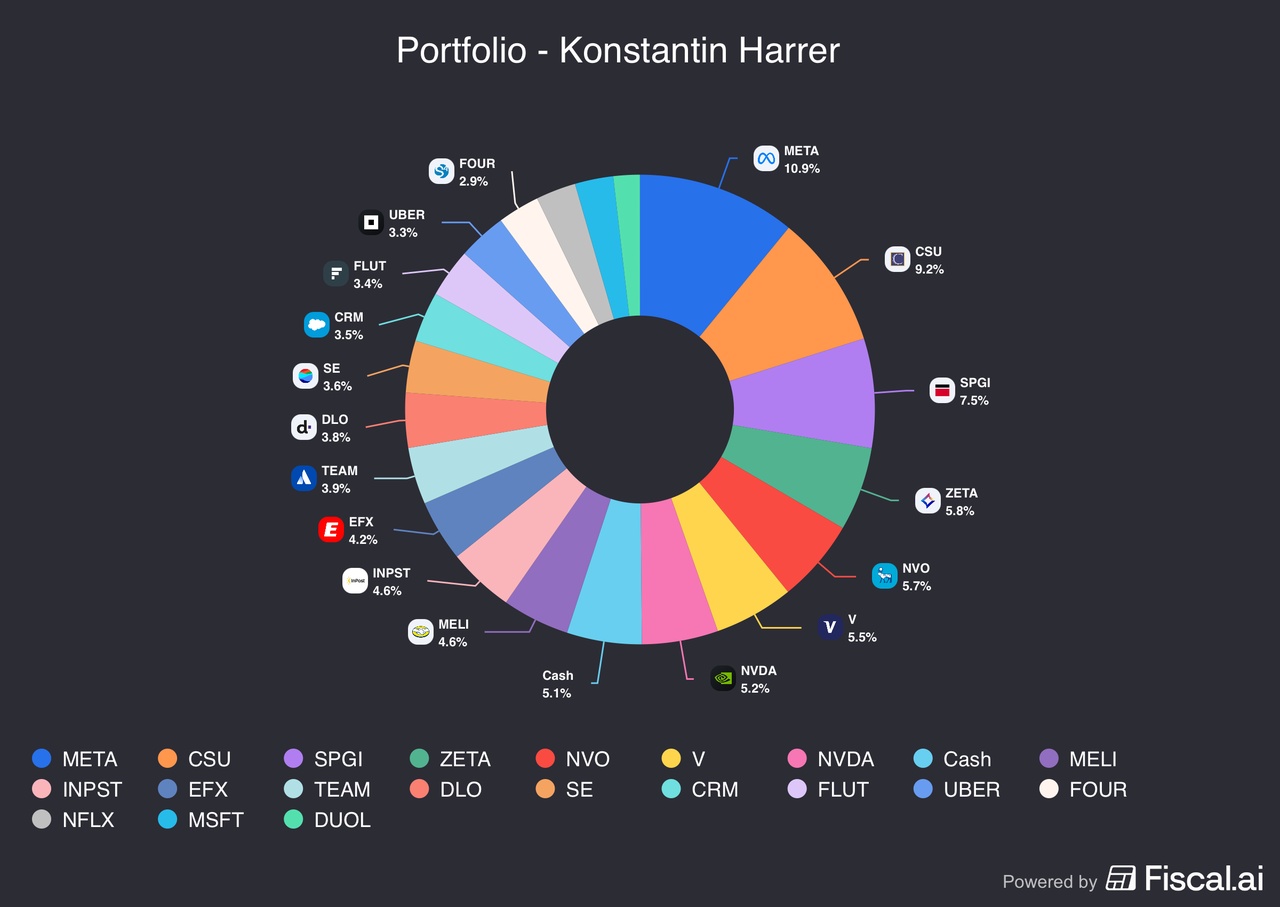
I would be interested in your opinion: I still have 40k cash on hand.
I wanted to use the money for the Black Swan event but the dip doesn't come, the market runs away and FOMO kicks in. À la April lows at the tariff announcement of USA against the whole world.
My current PORTFOLIO ALLOCATION can be viewed in my profile, it is public.
Actually
I'm in a pretty solid position (my opinion) and would be happy to give you my opinion.
Would you stick to the plan or DCA into interesting stocks?
On my watchlist: $UNH (-0,92%) ; $TTD (-5,72%) ; $ADYEN (-6,41%) ; $TEAM (+0%) ; $UPST (-0,73%) & $MNDY (-7,43%)
What do you have on your watchlist and what would you advise me to do? Stick to the plan and wait for the big dip or go in in tranches?
🔹 Total Revenue: $1.36 B (Est. $1.29 B) 🟢; +14 % YoY
🔹 Non-GAAP EPS: $0.97 (Est. $0.78) 🟢
🔹 Subscription Revenue: $1.27 B; +19 % YoY
🔹 Cloud Revenue Growth: +25 % YoY
🔹 Non-GAAP Operating Income: $348 M;
🔹 Free Cash Flow: $638 M; FCF margin 47 %
🔹 Cash & Marketable Securities: $3.0 B
Q4'25 Guidance
🔹 Total Revenue: $1.349 B – $1.359 =B
🔹 Cloud Revenue Growth YoY: ≈ 23 %
🔹 Data Center Revenue Growth YoY: ≈ 16.5 %
🔹 Marketplace & Other Revenue Growth YoY: ≈ flat
🔹 Non-GAAP Gross Margin: ≈ 84.5 %
🔹 Non-GAAP Operating Margin: ≈ 22 %
Operational & Customer Metrics
🔹 Customers with >$10 K Cloud ARR: 50,715; +14 % YoY
🔹 Cash Flow from Operations: $653 M
Strategic / Product Updates
Team ’25 launches:
🔸 Rovo for All – AI search, chat & agents now included in Premium/Enterprise tiers of Jira, Confluence & Jira Service Management
🔸 Teamwork Collection (Jira + Confluence + Loom + Rovo agents) to cut context-switching
🔸 Strategy Collection (Focus, Talent, Jira Align) for enterprise planning
🔸 Customer Service Management – AI-powered support app
🔸 Expanded Cloud Offerings: FedRAMP-authorized Government Cloud & new Isolated Cloud option
🔸 Williams Racing F1 partnership as official title & technology partner
Management Commentary
🔸 CEO Mike Cannon-Brookes: Long-term Cloud platform investments are “advancing the Atlassian System of Work” and placing AI at the center of human-AI collaboration.
🔸 CFO Joe Binz: Committed to “balancing operational discipline with focused investment” in enterprise, AI, and the platform.
Recognition & Governance
🔸 Named to Fortune “100 Best Companies to Work For” (7th straight year)
🔸 Karen Dykstra (ex-VMware/AOL CFO) appointed to Board to bolster enterprise expansion.
$TEAM (+0%) | Atlassian Q1'25 Earnings Highlights:
🔹 Adj EPS: $0.77 (Est. $0.54) 🟢
🔹 Revenue: $1.19B (Est. $966.1M) 🟢; UP +21% YoY
🔸 New $1.5B share repurchase program approved
Q2 FY25 Guidance:
🔹 Revenue: $1.233B-$1.241B (Est. $1.232B) 🟢
🔹 Cloud Revenue Growth YoY: ~25.5%
🔹 GAAP Operating Margin: ~ (10%); Non-GAAP Operating Margin: ~21%
FY25 Full-Year Guidance:
🔹 Revenue Growth YoY: 16.5%-17.0%
🔹 Cloud Revenue Growth YoY: ~24.0%
🔹 GAAP Operating Margin: (5.5%)-(5.0%); Non-GAAP Operating Margin: 22%-22.5%
Other Q1 Metrics:
🔹 Subscription Revenue: $1.13B; UP +33% YoY
🔹 GAAP Operating Margin: (3%); Non-GAAP Operating Margin: 23%
🔹 Free Cash Flow: $74M; Free Cash Flow Margin: 6%
Strategic & Operational Highlights:
🔸 Launched AI-powered Rovo for enterprise knowledge-sharing
🔸 Introduced Atlassian Focus for aligning organizational goals
From all-time high to all-time high - time to take a look in my cellar 📉
The stock markets only know one direction at the moment and even September, generally the worst month on the stock markets, is heading for a clear green result.
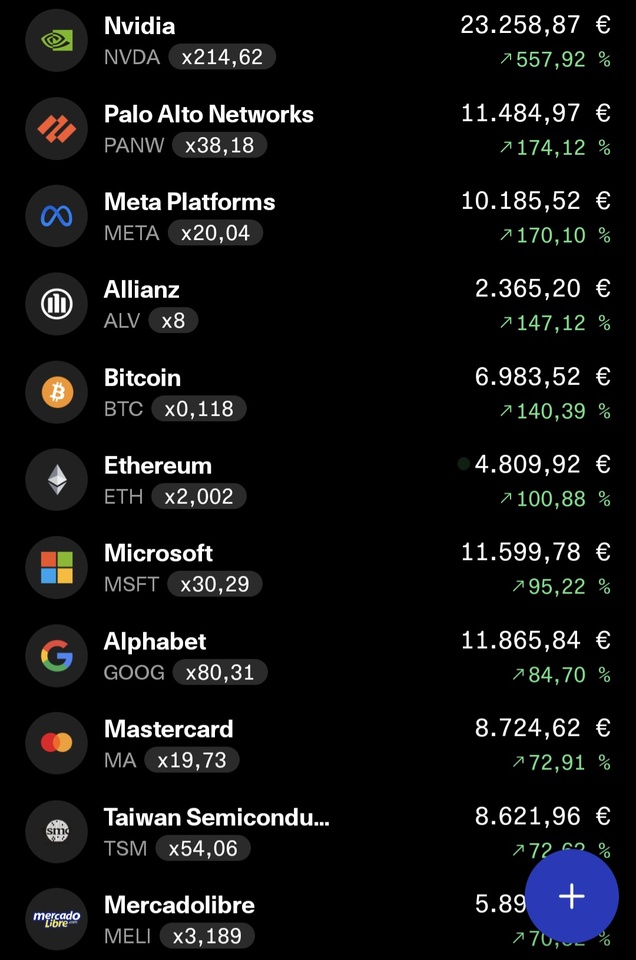
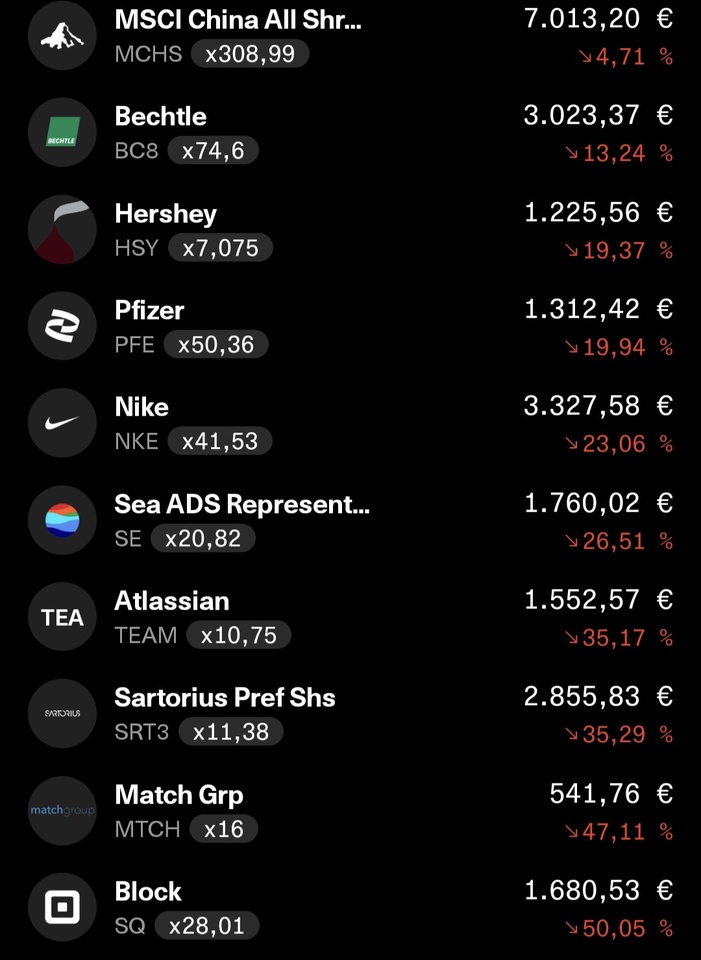
Of course, this can also be seen in my portfolio in the following picture. What I find much more exciting in such situations, however, is always the view to the very bottom, where it turns red and which is generally not shown here.
Now it turns red and negative:
Even though many things are going well, some things are not going well. For the most part, these are still the former corona winners like Pfizer $PFE (-3,5%) Sea $SE (-5,28%) Block $SQ (-4,5%) or Atlassian $TEAM (+0%)
However, Pfizer's overall performance is not quite as bad, as there has of course been a lot of dividend growth over the last few years.
Nike $NKE (-0,12%) and Hershey $HSY (+1,82%) are also not doing themselves any favors at the moment, but are still in the savings plan. Just like Bechtle $BC8 (-2,55%)
My China ETF is currently the phoenix from the ashes, I was surprised myself that it has almost reached 0 😂
Towards the end of the year, I will analyze the losers again. Will they get another year of probation? Or will one stock or another be thrown out?
I usually look at this between Christmas and New Year's Eve.
What's your situation? What are your skeletons in the closet doing?
Principais criadores desta semana