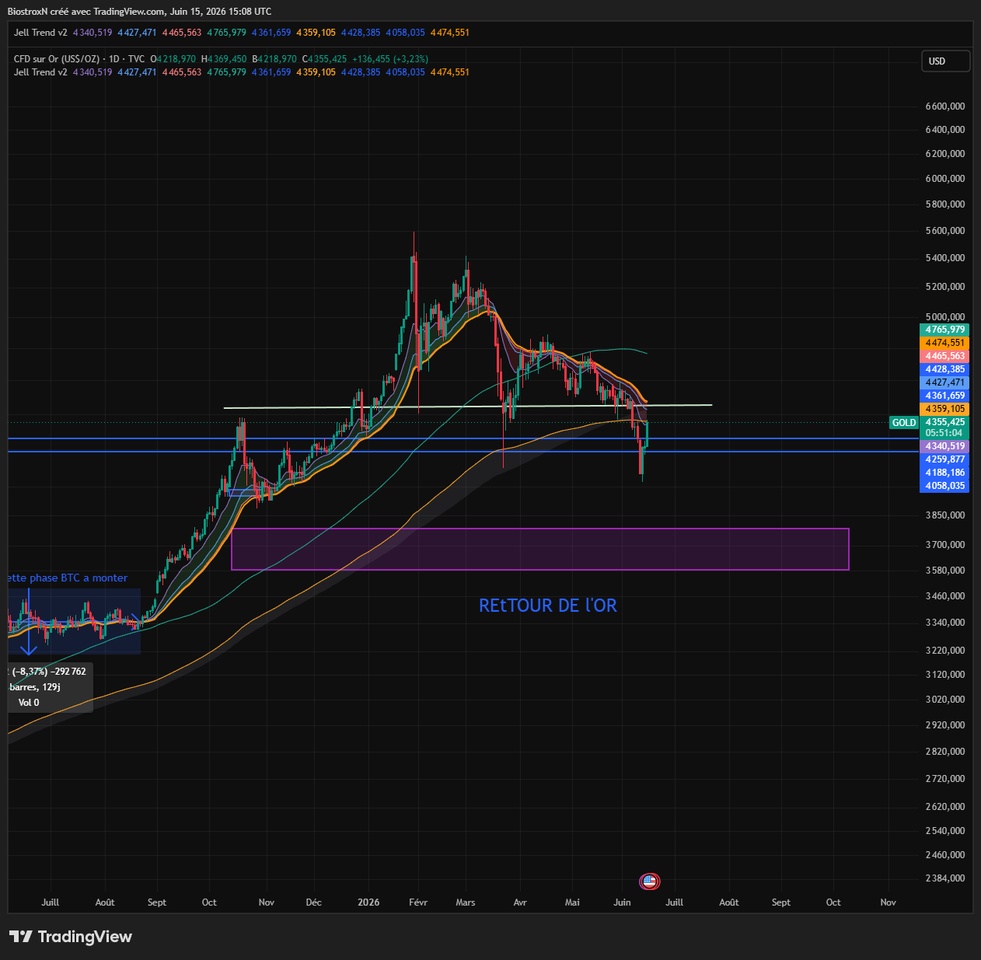
The story is intact, nothing changed between last week and today. This sell-off is driven by emotions.
As a long term investor, I see the fundamentals unchanged, so I just buy more at a discount !
Postes
73WOW, a very good morning I would say 🌅
that's what I call a start to February. Makes me immediately happy when I see it 😇
all the price alerts have exploded and robbed me of my sleep
Let's see what the week has in store...
$BTC (+0,16 %)
$PHAG (-6,85 %)
$4GLD (-5,36 %)
$CSNDX (-0,82 %)
$ETH (-1,3 %)
$VUSA (-0,58 %)
In recent days, markets around the world have experienced strong fluctuations: price slumps in precious metals such as gold (-7.5%) and silver (-14%) led to panic-like sell-offs in equities, cryptocurrencies and derivatives - particularly in Asia and then globally.
At the same time, supervisory authorities such as BaFin recently expressed concerns about rising risks on the financial markets, citing excessive risk appetite, political uncertainty and euphoria surrounding certain sectors (such as AI).
And even if corporate balance sheets remain solid overall, many investors are currently more focused on geopolitical risks, interest rate and political signals than on fundamentals.
In short, we are not seeing a sudden global "economy Armageddon", but a classic market exaggeration and correction process triggered by technical factors, sentimental overreactions and political uncertainties.
Why it's crashing right now: causes in detail
Several simultaneous drivers are typical for market phases like this:
1. increase in risk and volatility
Investors flee risk assets as soon as nervousness dominates. Panic selling then intensifies the downward pressure.
2. geopolitics and uncertainties
Political news (tariffs, geopolitical tensions, central bank decisions) is currently having a disproportionate impact on the markets.
3. high expectations vs. reality
Many tech and AI stocks had previously risen sharply. As soon as earnings and valuation levels fall short of expectations, sentiment quickly changes. This is not a crash signal, but a valuation reset.
4. sentiment momentum
Market participants have learned to think in terms of trends. When the masses sell, this drives prices down further in the short term - regardless of whether the fundamentals are weak or not.
This is not an apocalyptic revelation, but simply market dynamics.
Corrections are not a bug, they are a feature
There is no straight line upwards on the stock market, and the fact that prices fall is not a technological defect - it is part of the system. Corrections and even crash-like movements are part of the normal functioning of capital markets.
Historically, the biggest gains for investors have often come not in calm periods, but after periods of high volatility. Investors who only invest when everything looks great often miss out on the return drivers of the next few years.
Why such days should be encouraging
1. buy the dip is not a meme, it is a statistic.
In the past, investors who bought at lower prices often profited more than average because the average price was lowered and future recoveries have a stronger impact on the portfolio.
2. emotions are not a good investment mechanism.
Panic causes investors to sell when others are buying. And in the long term, the best returns have been achieved by those who bought and held on the dip - not those who got out on every bad day.
3. time in the market beats timing the market.
No one can predict exactly how deep a dip will go or when it will end. But those who stay invested for the long term and buy on dips tend to see better returns than those who try to time the perfect entry. This is simply because you have more time in the market where the returns are generated.
What really counts now
✔ Long-term thinking over short-term fear
✔ Keep positions or even expand them at a favorable price
✔ Really use diversification, don't just preach it
✔ Reduce emotions, increase plans
Crash-like days always feel bad. But they are not a disaster - they are opportunities to achieve returns that you would otherwise have missed.
If you take a long-term view and stay disciplined, such days are the friends of your returns, not their enemies.
$BTC (+0,16 %)
$MSFT (-0,8 %)
$SAP (+0,92 %)
$IREN (-4,39 %)
$MSTR (-6,76 %)
$ETH (-1,3 %)
$NVDA (-1,54 %)
$CSU (+1,03 %)
$4GLD (-5,36 %)
$SSLN (-7,78 %)
#börse
#aktien
#crash
#geopolitik
If there is a military escalation or a direct attack by the US in Iran (or in the Middle East in general), three sectors tend to react most strongly: armaments (defense), energy (oil/gas) and safe havens (gold/precious metals).
1. defense industry (defense & aerospace)
This sector benefits directly from the expectation of government orders for ammunition, missile systems, drones and logistics. The focus here is on US companies, but European stocks also often move up.
ETF option (broad diversification):
iShares US Aerospace & Defense ETF (focus on US defense):
VanEck Defense UCITS ETF.
VanEck Defense ETF: WKN: A3D9M1 / ISIN: IE000YYE6WK5
2. energy sector (oil & gas)
Iraq is a major oil producer. A conflict in this region immediately fuels fears of supply shortages or blockades (e.g. Strait of Hormuz). The oil price (Brent/WTI) usually rises sharply, which increases the margins of the major oil companies (Big Oil).
Certificates on the oil price:
If you want to bet directly on the commodity price (Brent Crude Oil), you often use ETCs (Exchange Traded Commodities).
WisdomTree Brent Crude Oil: WKN: A1N49P/M/N / ISIN: JE00B78CGV99
3. safe havens (gold & dollar)
In times of military uncertainty, capital flees from risky investments (such as tech stocks) into so-called "safe havens".
Gold: Considered the number 1 crisis currency.
US dollar: Often appreciates as it is considered the most stable currency, which in turn burdens export-oriented US companies, but can benefit dollar holders.
Important risk warnings
"Sell the news": Markets often price in conflicts before the first shot is fired. As soon as the attack actually takes place, it can paradoxically happen that prices (e.g. oil, gold, silver)
prices (e.g. oil, gold, silver) fall because the uncertainty has disappeared ("sell on good news, buy on bad news" - or vice versa).
Overall market reaction: While armaments and oil rise, broad indices such as the DAX or the S&P 500 often fall initially, as transportation costs rise (bad for airlines such as Lufthansa) and consumer sentiment falls.
Political intervention: If the oil price is too high, the USA often intervenes in strategic oil reserves, which can quickly reduce the price pressure on energy stocks.

Gold and silver are often presented as if they were:
In practice, they react:
The difference: with precious metals, volatility is simply called "patience".
"Gold is stable in value"
Yes, in the very long term.
A savings book was also nominally stable for decades - but unfortunately worthless in real terms.
If you buy gold, you buy:
But the hope that someone else will buy it later at a higher price.
That's not an accusation - it's simply the model.
Silver - the eternal little brother
Silver is at the same time:
A bit of everything - but nothing really.
When it rises, it is "the new gold".
When it falls, it was suddenly "cyclical anyway".
Very convenient.
And then there's Bitcoin
Not a metal. No myth. No storage costs.
No opening hours. No central storage. No arbitrary expansion.
A firmly defined range.
An open, verifiable system.
An asset that nobody controls and everyone can check.
But of course: far too risky.
It's interesting how often "security" is confused with "familiarity".
Conclusion
Gold and silver have their role.
What they are not: infallible, without alternative or morally superior.
Anyone who pretended last week that there was only one truth,
is learning once again that markets know no dogmas.
Perhaps the fault lies not in the asset -
but in the need to always want to be right.
$4GLD (-5,36 %)
$IGLN (-3,82 %)
$GLDA (-4,88 %)
$SGLD (-5,17 %)
$SSLN (-7,78 %)
$PHAG (-6,85 %)
$BTC (+0,16 %)
$MSTR (-6,76 %)
$3350 (-3,12 %)
#bitcoin
#silver
#gold

$4GLD (-5,36 %)
$PHAG (-6,85 %) kiss and greetings to @stefan_21 👑
$4GLD (-5,36 %) / $SSLN (-7,78 %)
No more words are needed! Simply crazy!
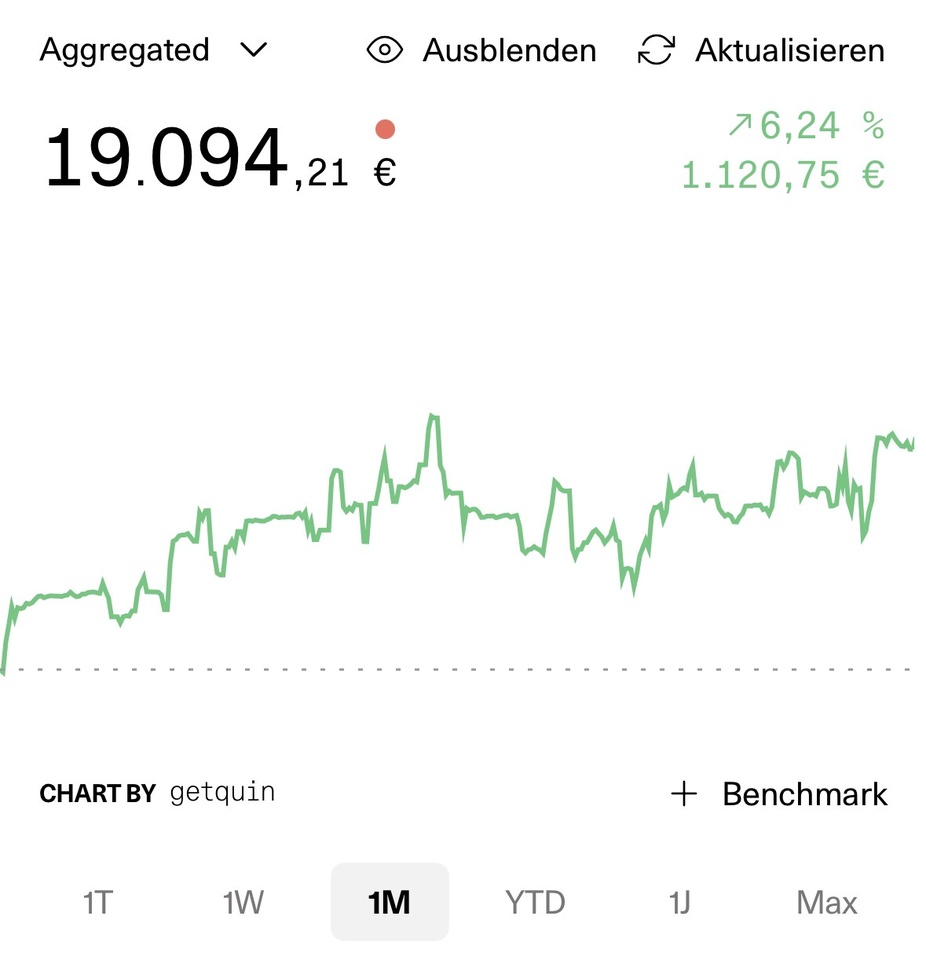
I would never have thought that my portfolio value would double from €10,000 to €20,000 in just five months. This rapid increase surprised me and prompted me to take a closer look at my investment strategy.
I follow a classic buy-and-hold strategy, as it is ideal for my long investment horizon of 30-40 years as a 20-year-old. My focus is on growth and steady dividends.
As a core, I have the $VWCE (-0,64 %) which should always make up between 30-40% of the portfolio in order to reflect the broad market and capture the average return. I build individual quality stocks with a broad moat around this core, which serve as a yield booster and stability anchor. I also focus on dividend stocks with stable cash flows, dividend growth and growth potential.
As an Austrian $OMV (-0,99 %) my local high-dividend stock in the portfolio, which not only provides me with a nice home bias, but above all a decent dividend cash flow. As the position is currently still very small, I will definitely be adding to it in the near future.
As a small hedge in uncertain times, I have 5% $4GLD (-5,36 %) in the portfolio, not as a yield generator, but as a buffer in times of crisis.
With $ONDS (-1,81 %) I have a small speculative share in the portfolio, which doesn't really fit into my investment strategy and has already become very large. I have already realized the first partial profits and taken out the risk, but due to the outstanding performance I am now simply letting the rest of the position continue to run at a relaxed pace. If it continues to rise, I will again realize partial profits.
The current development of my portfolio confirms that I should remain invested for the long term, even if I am aware that such market phases are not the rule.
I am open to suggestions and questions about my portfolio or my investment strategy.
Meilleurs créateurs cette semaine