iShares Physical Silver ETC
Price
Discussion sur SSLN
Postes
21The problem with FIAT money and possible solutions
Moin moin,
Lately I have been reading more and more content on the problem of fiat money. If you would like to come across it again, you are welcome to read Stefan's article. Especially at the beginning, the actual problem is discussed. Here is the link:
But now to the actual content. The problem of fiat money is not unknown, but I have always had problems finding concrete recommendations for action and have therefore had ChatGPT carry out a comprehensive analysis (with backchecking).
I set the following priorities:
- How likely is a stock market crash as a result of a loss of confidence in the fiat system? (Short-term and long-term)
- How would such a crash affect different asset classes?
- Which asset classes should be considered in order to get through such times well?
Now the answer is based on various sources + my own arrangement:
Probability of a global currency collapse
Historical perspective:
Since the end of the gold standard (Bretton Woods system) in the 1970s, all major currencies have been based on fiat money - i.e. money with no intrinsic value, backed only by trust . Historically, however, fiat currencies do not have a perfect long-term track record: in the long term, all unbacked currencies have tended to depreciate or fail. From an Austrian (economic theory) perspective, collapse is even inevitable: "History has shown that fiat money fails 100% of the time. It is only a question of time" . Some currencies only survive for years or decades, even previously stable currencies such as the pound or US dollar have lost most of their value over time. This happens because governments tend to create more and more money (e.g. to finance wars, social programs or bank bailouts) - ultimately eroding confidence in purchasing power . In short, excessive monetary expansion and debt undermine any unbacked monetary system in the long term, often resulting in high inflation or currency reforms .
Current warning signalsIn recent years, many industrialized countries have driven their debt to record levels. Global government debt is around USD 102 trillion - a historic high, driven by massive deficits even in good economic times . The major central banks (Fed, ECB, etc.) bought enormous amounts of government bonds and other securities, which greatly increased the money supply. As a result, inflation shot up to multi-decade highs in 2021-2023 (over 8% in the US and Europe). Although the Federal Reserve and ECB are now trying to counteract this (by raising interest rates), some of the damage to confidence has already been done: Global currency reserves, for example, are already diversifying away from the fiat system. Central banks bought over 1,100 tons of gold in 2022 - a record since 1967 . In 2022, 2023 and 2024, gold purchases by central banks exceeded 1,000 tons in each year, more than double the average for 2010-2021 . Remarkably, for the first time in 40 years, central banks now hold more gold than US government bonds in their reserves . This behavior of central banks shows a dwindling confidence in unlimited paper money promises - gold is seen as a stable "safe haven" without default risk . Even if no immediate collapse of the US dollar or euro is to be expected, experts speak of a creeping erosion of confidence in all major fiat currencies . Daniel Lacalle, for example, writes: "This does not mean an imminent collapse of the US dollar or a complete de-dollarization, but an undisputed loss of confidence in fiat currencies as a whole - from the euro and pound to the yen and dollar" .
"Gradually, then suddenly" - difficult to predictCurrency crashes typically occur unpredictably quickly after problems have been brewing for a long time. To paraphrase Ernest Hemingway, such crashes happen "gradually then suddenly". Imbalances (over-indebtedness, loss of confidence) often build up over years until a trigger (e.g. political crisis, interest rate shock or banking crisis) brings the house of cards crashing down. Conclusion on probability: In the short term, many analysts consider a total collapse of the world reserve currency, the US dollar, to be rather unlikely, as the dollar is still dominant and is backed by enormous economic strength. The US, for example, accounts for ~58% of global currency reserves and the majority of international trade settlements . It would take a chain of catastrophic events to completely shake this position . In fact, Investopedia emphasizes: "The collapse of the dollar remains highly unlikely. At best, higher inflation seems realistic. Important trading partners (China, Japan) do not want the dollar to collapse, as the USA is too important a sales market" . A sudden total collapse of the euro or yen is also not in line with the base scenario - the established economies have instruments at their disposal to dampen temporary crises of confidence (e.g. interest rate hikes, interventions). Nevertheless, the long-term stability of the fiat money system is fragile in the face of exponential debt. Even the major central banks are behaving as if they have to make provisions for an emergency (e.g. record gold purchases). Many experts believe we are already in the final stage of the debt and paper money cycle: "The monetary system has been in its final phase for years. Monetary reform is becoming more and more likely" . No one knows exactly when the tipping point will come - it could be years away or it could happen very quickly due to external shocks ("faster than most people think"). Investors should therefore be prepared, but not panicked.
Effects of a currency collapse on equities and traditional investments
One key question is: what happens to shares if money itself becomes questionable? After all, shares are valued in money - if money rapidly loses value, share prices seem to rise nominally to infinity, but their real value is uncertain. Historical extreme examples can help here:
- Weimar hyperinflation 1921-1923 (Germany):
During this phase, the mark lost virtually all of its value. Although share prices in paper marks rose nominally, they were unable to keep pace with inflation. In fact, German shares were dirt cheap at the height of hyperinflation: "During hyperinflation, German shares were often extremely cheap. In November 1922, Daimler's market capitalization was equivalent to the value of just 327 of its cars" . Due to the rapid devaluation of money, share prices were volatile, but tended to fall in real purchasing power. A historical share index fell from 1913 = 100 to just 2.7 points in October 1922 - a real loss in value of ~97 % . Only after currency stabilization (Rentenmark) did the stock markets recover along with the economy. Gold, on the other hand, exploded: a gold price of 170 marks/ounce in 1919 was quoted at 87 trillion marks in November 1923. Gold rose 1.8 times faster than prices - i.e. gold owners increased their purchasing power by a factor of almost 2! Those who held gold saw their assets through the hyperinflation, while cash savers were expropriated. This example shows: Shares are not perfect protection in an acute currency hyperinflation - confidence in companies can suffer, economic activity falters (recession despite inflation, so-called stagflation), and tangible assets such as gold, tangible goods or real estate are temporarily valued more highly than company shares.
- Currency reform in 1948 (Germany):
The Reichsmark was converted to the D-Mark overnight. Monetary assets lost massive amounts of value - bank deposits were converted at a ratio of 10:1, later even 100:6.5 by law (corresponds to ~93.5 % devaluation of savings). Nominal claims of all kinds (savings, bonds, insurance policies) were the big losers; savers and creditors were effectively expropriated. Shares and tangible assets, on the other hand, proved to be relatively robust: although shareholders had little joy in the short term - in the chaotic first post-war years there were hardly any dividends and share prices were low - shares participated in Germany's "economic miracle" after the reform. In the long term, company values rose sharply, so share owners more than recouped their losses. Real estate retained substantial value, but was subject to special levies (equalization of burdens: 50 % compulsory mortgage on real estate assets over DM 5,000). Nevertheless, real estate remained a real asset - houses and land were still in demand (living space, use). However, gold owners were the biggest winners: gold was converted into the new currency very quickly after the reform and a profit of 1,438 % was realized. By comparison, savings account holders lost ~95.5 % . Precious metals therefore offered the best value retention in this currency crisis.
Lessons for stocks and bondsFrom such cases it can be deduced: Although shares embody productive capital and tangible assets (machines, patents, etc.), share prices can temporarily suffer greatly in an acute currency and confidence crisis. When the population is struggling to survive and monetary chaos reigns, there is a lack of "speculative capital" for shares. Companies can also suffer operationally as a result of the crisis (collapse of trade, payment system), which jeopardizes their substance. Good shares (robust companies, possibly with foreign business) nevertheless retain a residual value - after the reorganization of money, they can flourish. So those who own solid shares and are able to weather the crisis have historically often been in an advantageous position after the reset. Bonds and bank deposits, on the other hand, are extremely risky in such a scenario: they are nominal claims in the old currency - if this is devalued or reformed, the claims are virtually worthless . In Weimar Germany, for example, a 20-year life insurance policy ended up being worth only the equivalent of a loaf of bread. Government bonds and savings books were also brutally devalued in 1948. The same applies to cash: Anyone holding large amounts of physical money can lose everything in the event of hyperinflation - cash tends towards zero, as the famous image of the wheelbarrow full of worthless banknotes shows.
Conclusion:
Real assets (including shares) beat nominal investments in the long term, but nothing is immune to losses in the short term. Equities can temporarily collapse dramatically (in real terms) before a new currency or stabilization takes effect. Bonds, savings and insurance claims would be the worst off in a real currency collapse - virtually certain loss as they are denominated in old money. Equities would have a good chance of appreciating again at some point, but you would have to have the patience and liquidity to get through this phase. Land/real estate retains intrinsic value (utility value, scarcity), but could be subject to government levies . Precious metals have historically proved to be an immediate value saver - they often rise steeply in value in parallel with currency devaluation and can be easily exchanged for the new currency after the crisis
Asset classes in the event of a crisis - what protects value and enables profit?
In view of the above findings, the practical question arises: How do you invest to protect or even increase assets in a potential fiat collapse? - Here are some asset classes and their suitability:
- Gold and silver (precious metals): These classic crisis currencies have historically been the most reliable stores of value. In almost every currency crisis in recent centuries, gold has at least held its value and often outperformed the rate of inflation. Central banks themselves trust gold (see the huge purchases in 2022-24) - a clear signal. Gold has no counterparty risk, cannot be multiplied at will and is accepted worldwide. Silver is similar to gold, but fluctuates more. Kiyosaki, for example, calls silver "the best and safest" and predicts sharply rising prices.
Disadvantage: Precious metals do not generate any regular income. In stable times, they can lag behind productive capital. But they shine during systemic crises: in 1948, for example, the value of gold in Germany rose by over 1400% and during the Weimar inflation it rose faster than all prices. Tip: Physical gold/silver (coins, bars) is preferable to bank deposits, as it can be held outside the financial system in extreme cases. However, storage/security should also be considered.
- Shares (company holdings)Shares should not be written off despite all the short-term risks. They represent real assets - factories, technologies, brands - that can outlast a new beginning. If diversified (across different sectors and countries), equities offer potential inflation protection, as companies can adjust prices and own real assets. Defensive or global companies in particular could come through a currency crisis better. Investopedia recommends as a hedge, for example, shares of companies with large international business or commodity exposure. These have income in hard foreign currencies or from rising commodity prices. Please note: In an acute crisis, stock exchanges could close or capital controls could be introduced. Equities should therefore be seen more as a long-term component: Anyone holding quality shares today has a good chance of these values being representative again in the new money after a currency reform (as they were after 1948, when shares became the foundation of the new upswing ). However, dividend losses and price volatility must be taken into account. Short strategies before the crash (e.g. short selling or put options on indices) may offer short-term profit opportunities, but these are risky and sensitive to timing - more for professionals. For the average investor, it is more a case of holding solid shares, not investing too much in credit (avoid leverage, as debt can be dangerous in a crisis) and being able to sit out lean periods.
- Real estate and tangible assetsReal assets in general are to be preferred, as they have an intrinsic value outside the monetary system. Real estate, for example, offers utility value (housing, agriculture) and has limited availability. In currency crises, real estate prices tend to rise in real terms or at least maintain their value. However, the state can intervene here (equalization of burdens, compulsory mortgages - as happened in 1948). Real estate is also illiquid: it cannot be sold or divided quickly in an emergency, and transactions could be frozen. Nevertheless, a debt-free house or piece of land retains a tangible substance, which is particularly reassuring when paper money is falling apart. In addition to real estate, other tangible assets such as art, precious stones, antiques, infrastructure (e.g. stakes in utilities) etc. also count - they could all increase in value if money is devalued. But these markets are often specialized and less liquid.
- Commodities and resourcesIn addition to gold/silver, other commodities should also be mentioned. Oil, gas, industrial metals, agricultural commodities - these are all real things that will always have value. It is difficult to directly store barrels of oil or tons of copper, but you can invest in commodity ETFs, mining stocks or commodity funds. In a currency devaluation, commodity prices (in the devalued currency) tend to rise sharply. So if you hold shares in a gold mining company, an oil producer or an agricultural land fund, for example, you indirectly own an inflation-resistant asset. The same applies here: volatile in the short term, real value in the long term.
- Cryptocurrencies (Bitcoin & Co.)A modern alternative are decentralized cryptocurrencies, above all Bitcoin. These are considered by some to be "digital gold" - with a limited quantity (BTC maximum 21 million) and independent of central banks. Crypto has shown mixed results in recent crises (e.g. Turkey, Venezuela) - some value preservation, some strong fluctuations. However, Kiyosaki explicitly recommends Bitcoin and Ethereum alongside gold and silver to protect against the big crash. The attraction lies in the fact that cryptocurrencies exist outside the fiat system; they are not subject to currency reform by the government. So if trust and liquidity were to flee into the crypto system, coins could rapidly increase in value. However, they are still too volatile to be considered a safe haven and their success depends on enough people actually using them in an emergency. It is more of a speculative addition than a safe haven like gold. Nevertheless, in the wake of fiat skepticism, institutional investors are also increasingly turning to cryptocurrencies. In an "everything is broken" scenario, Bitcoin could indeed gain in importance - or be stopped by governments. Opinions differ here, so a moderate allocation would be advisable.
- Cash (fiat) and bonds: These should be kept as low as possible in a crisis scenario. Cash is guaranteed to lose value during inflation; in the event of a collapse, it could become worthless or be forcibly exchanged (as in 1948). A small reserve in cash can be useful if banks close at short notice - but this should really only be a nest egg (and possibly split into different currencies if one of them remains more stable). Government and corporate bonds in your own currency are highly vulnerable - they would either be devalued by inflation or forcibly converted in the event of currency reform (with creditor losses). Even inflation-indexed bonds (TIPS etc.) do not help in the event of hyperinflation, as the debtor could default or the indexation could lag behind the actual currency devaluation. Foreign currency bonds could be better (e.g. Swiss franc, if it remains stable), but in a global crash this is not a safe haven, but at best a relative play. Conclusion: avoid nominal values.
I don't see the current situation as overly dramatic, but everyone should be aware of this problem to some extent.
Have a nice day ✌️
My gut feeling is that if you use the term FIAT or BTC as an abbreviation (i.e. the crypto community's wording) GPT is also more likely to tap into these sources and argue in favor of Bitcoin. And with GPT in particular, you always have to be a little careful with this kind of thing. GPT likes to confirm its own views. But I also sometimes use it for brainstorming.
2026 - Outlook
Dear Getquiner
2026 is already starting with some news and headlines going around the world - both positive and negative.
My year starts with lumbago... man, that shit hurts...
Well, that's not the issue.
I would just like to ask about your outlook for 2026 - how do you see it (crystal ball)?
I'm very curious to see whether the precious metal rally will continue and whether we'll see more pumps.
In addition, this year, after buying property, I will be focusing very strongly on the $TDIV (-0,04 %) as this ETF is simply top in my opinion.
The main aim is also to increase my savings rate to 25% so that my portfolio can grow again.
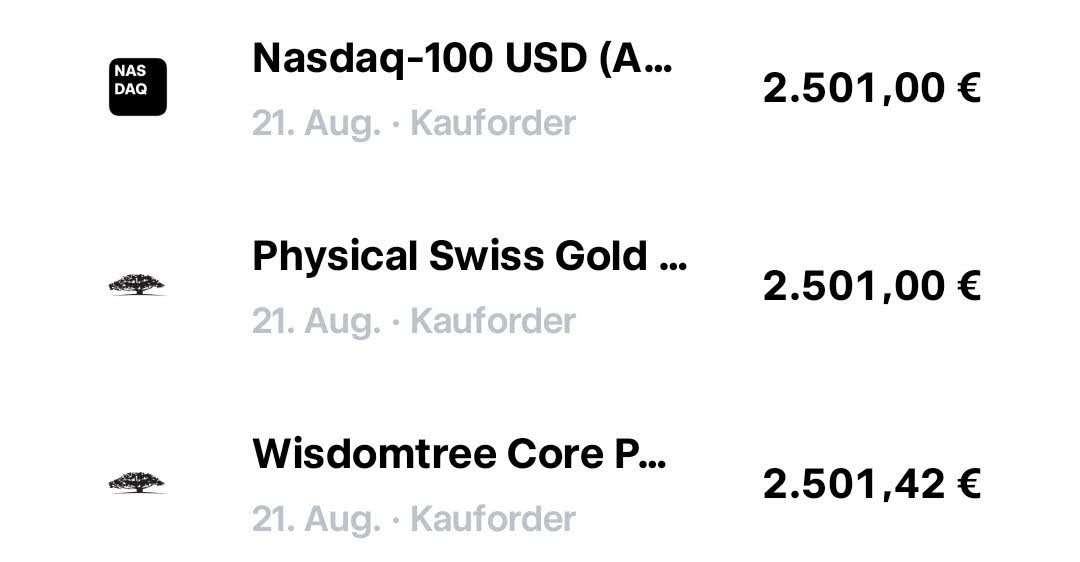
So I can say: I'm trying to rebuild my portfolio calmly and with a "boring" ETF, with equally steady small acquisitions of $GOLD (+8,56 %) & $SSLN (+6,63 %) .
Nobody knows how 2026 will develop - but it doesn't matter to me, as the big picture (40-50 years, God willing) is my time horizon.
What will you buy in 2026?
What are you looking forward to in 2026?
~ The collector
Why Copper isn’t an Immediate Kill Switch for Silver
The most common pushback against the bullish silver thesis is: “Don’t worry, solar will just switch from silver to copper.” How plausible is that?
Alexander Campbell (ex Head of Commodities at Bridgewater) frames it this way:
🔻Demand destruction threshold
• He puts the “break-even / where demand destruction even begins” around $134/oz (not a price target, but the level where the squeeze starts to bite).
⏳ The bottleneck is time (not money)
• Rough math: ~300 factories worldwide, ~1.5 years to convert each to copper plating, and ~60 factories/year parallel capacity --> ~4 years minimum to reach 50% copper adoption.
💸 Even if economics scream “do it”…
• Around $125/oz, payback drops below 1 year, but “deciding tomorrow” still doesn’t compress the industrial timeline (physics/operations > incentives)
🛠️ Not plug-and-play
• Switching to copper isn’t a simple input swap; it requires process/design changes, manufacturing workflow changes, and retraining/qualification.
🔁 The mix effect (PERC → TOPCon → HJT)
• While copper is discussed, the tech mix shift can increase silver intensity on average (he cites ~13.5 mg/W in 2025 vs ~15.2 mg/W in 2030).
✅ Bottom line
Copper may be the long-term “end state”, but it’s unlikely to be an immediate kill switch. Silver can move faster than the PV supply chain can retool.
https://www.campbellramble.ai/p/10-silver-days-of-christmas
$SSLN (+6,63 %)
$SILG (+2,29 %)
$PHAG (+6,29 %)
$XAD6 (+6,14 %)
$SIVR (+5,72 %)
$SLV (+5,69 %)
$SIL (+2,64 %)
$SILJ
$PAAS (+4,57 %)
$AG (-1,18 %)
$EDR (+3,46 %)
$SVM (+4,2 %)
$MAG
$HL (+1,46 %)
$SAMG
$AYA (+7,11 %)

silver
$SSLN (+6,63 %) How do you display physical purchased #silber (bars / coins) here in Getquin? To track it?
🚫NO SILVER LEFT🚫
Rising industrial demand, rigid supply and a market in continuous deficit since 2020.
⚡ The photovoltaic boom isn’t slowing down: total silver demand is expected to reach between 48,000 and 54,000 tonnes per year, with the solar sector alone accounting for up to 40% of global consumption.
⚒️ On the supply side, 72% of silver is produced as a byproduct, and any new primary mine takes nearly a decade to come online. Supply elasticity is almost zero.
Even after factoring in more recycling and lower silver intensity per solar cell, the model shows that by 2030, supply would cover at best 70% of demand — leaving a gap that someone will have to fill… or that prices will eventually correct for.
https://www.sciencedirect.com/science/article/abs/pii/S0921344925004392
$SSLN (+6,63 %)
$SILG (+2,29 %)
$PHAG (+6,29 %)
$XAD6 (+6,14 %)
$SIVR (+5,72 %)
$SLV (+5,69 %)
$SIL (+2,64 %)
$SILJ
$PAAS (+4,57 %)
$AG (-1,18 %)
$EDR (+3,46 %)
$SVM (+4,2 %)
$MAG
$HL (+1,46 %)
$SAMG
$AYA (+7,11 %)

You seem to look into mining companies. What makes minimg companies better that a direct investment in silver?
Podcast episode 121 "Buy High. Sell Low" Subscribe to the podcast to keep Silver and Rheini shooting.
00:00:00 Silver $SSLN (+6,63 %)
00:44:00 Becoming a trader
00:48:40 Rheinmetall $RHM (+3,33 %)
01:38:40 DroneShield $DRO (-3,57 %)
Spotify
https://open.spotify.com/episode/7qh4ye7hYPVwZxw0VEky8P?si=4RsSxQT4ROuOc8FVziuCxw
YouTube
https://openyoutu.be/7-m6Hvf58ic
Apple Podcast
Ps: no hate am myself in the #PLTRgang and patreon since nem year
Portfolio allocation
This will be my future portfolio allocation and is almost already like this, only small changes need to be made.
ETFs (75%)
$VWCE (-0,22 %) (85%)
$TDIV (-0,04 %) (10%)
$EIMI (-0,08 %) (5%)
Crypto (20%)
Commodities (5%)
________________________________________
I will also pick out a few individual stocks. But I'll only track them separately and see how they perform in a few years. I will probably opt for the following, which are already very popular in the community. $IREN (+8,63 %) , $RKLB (+0,66 %) , $TTI (-4,17 %) , $WM (-0,27 %) , $INT , $SOFI (-2,05 %) , $NU (-0,83 %) and $DRO (-3,57 %) . I will invest a total of around €5K in these shares.
What do you think of the portfolio?

Long on silver 🥈
After the long on gold reached 100% yesterday, I decided today to add another long on silver to the portfolio as part of the hedge...
Due to the low supply of silver, I still see significantly higher prices beyond € 70/80
What are your price targets for silver and gold? ✌️
Long on gold...🌟
If you are not interested in warrants, just keep scrolling.
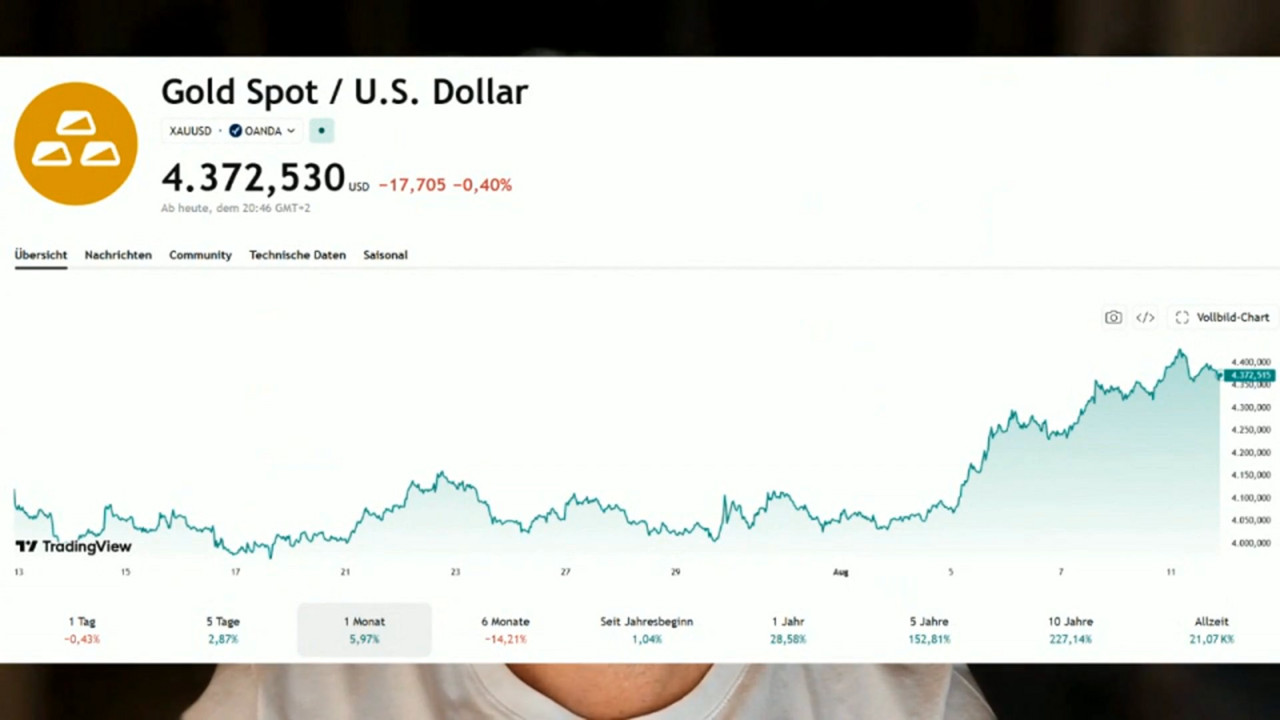
The warrant has a leverage of 10, if everything goes smoothly the warrant will be held until gold cracks the $4000 mark. I also bought a 10 long on silver a month ago, but the warrant currently only has a leverage of around 6 and is up around 125% -> should be the same for gold... (The leverage on my capital invested in the silver long is still 10, just to clarify😉 )
@Multibagger You asked about my inliners... I haven't used inliners for a long time because the last ones were too small for me 🛼... xD Joking aside: I sold my inliners on ThyssenKrupp and Zalnado with gains of 70% and 120% respectively. I bought an inliner on Commerzbank DE000PJ71ZF1, on MTU DE000PJ715U4 and Siemens DE000VH3ZBV0. The inliners on CoBa and MTU are both clearly in the plus, the one on Siemens clearly in the minus, and the money is actually written off because the spread is so bold that I'm now either letting it run KO or taking the 500/600% with me. In the meantime, I also had some on Deutsche Telekom and Deutsche Börse, but both of these have been taken out via stop loss. I also added a normal long on NVIDIA...
HG KleinAnleger ✌️
Titres populaires
Meilleurs créateurs cette semaine