

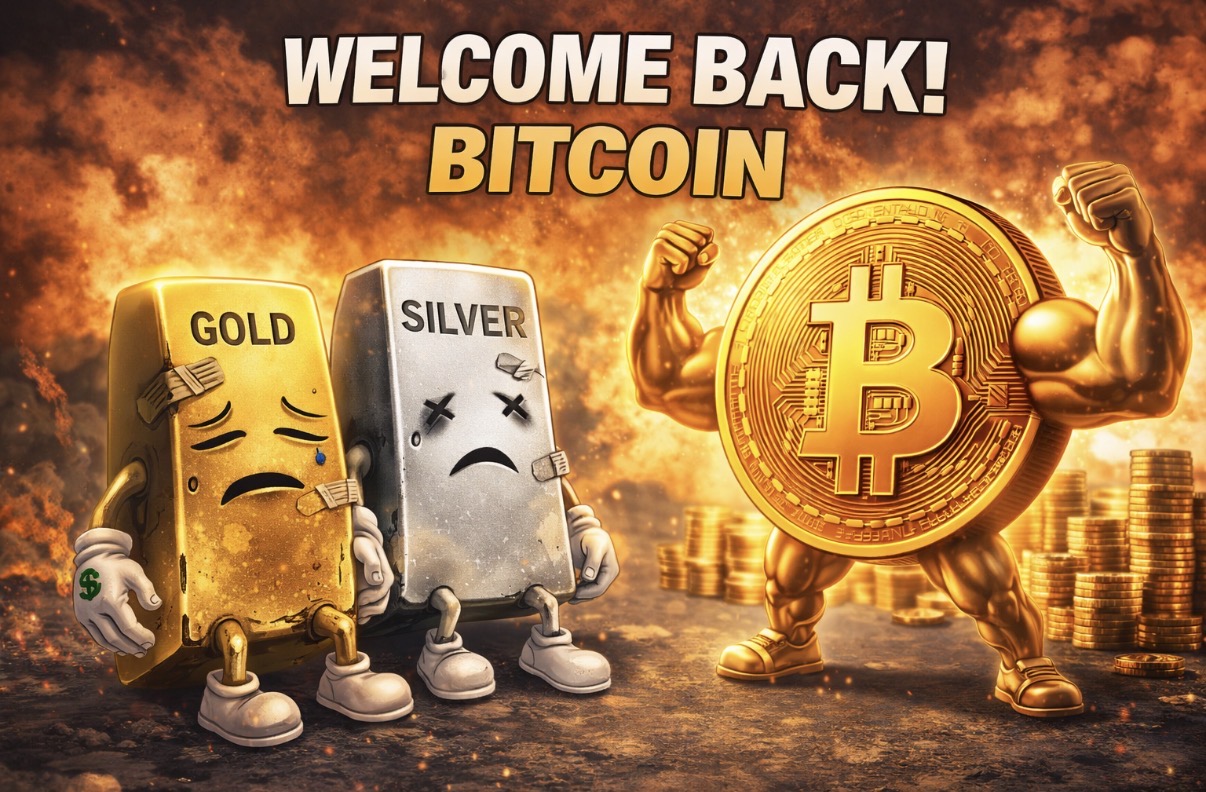
Gold and silver are often presented as if they were:
- immune to interest rates
- independent of monetary policy
- free from sentiment
In practice, they react:
- sensitive to real interest rates
- brutally to dollar strength
- and just as emotional as everything else
The difference: with precious metals, volatility is simply called "patience".
"Gold is stable in value"
Yes, in the very long term.
A savings book was also nominally stable for decades - but unfortunately worthless in real terms.
If you buy gold, you buy:
- no cash flow
- no growth
- no innovation
But the hope that someone else will buy it later at a higher price.
That's not an accusation - it's simply the model.
Silver - the eternal little brother
Silver is at the same time:
- Store of value
- industrial metal
- economic indicator
A bit of everything - but nothing really.
When it rises, it is "the new gold".
When it falls, it was suddenly "cyclical anyway".
Very convenient.
And then there's Bitcoin
Not a metal. No myth. No storage costs.
No opening hours. No central storage. No arbitrary expansion.
A firmly defined range.
An open, verifiable system.
An asset that nobody controls and everyone can check.
But of course: far too risky.
It's interesting how often "security" is confused with "familiarity".
Conclusion
Gold and silver have their role.
What they are not: infallible, without alternative or morally superior.
Anyone who pretended last week that there was only one truth,
is learning once again that markets know no dogmas.
Perhaps the fault lies not in the asset -
but in the need to always want to be right.
$4GLD (+1,22 %)
$IGLN (+1,39 %)
$GLDA (+1,51 %)
$SGLD (+1,38 %)
$SSLN (+0,91 %)
$PHAG (+1 %)
$BTC (+1,3 %)
$MSTR (+0,52 %)
$3350 (+1,48 %)
#bitcoin
#silver
#gold


