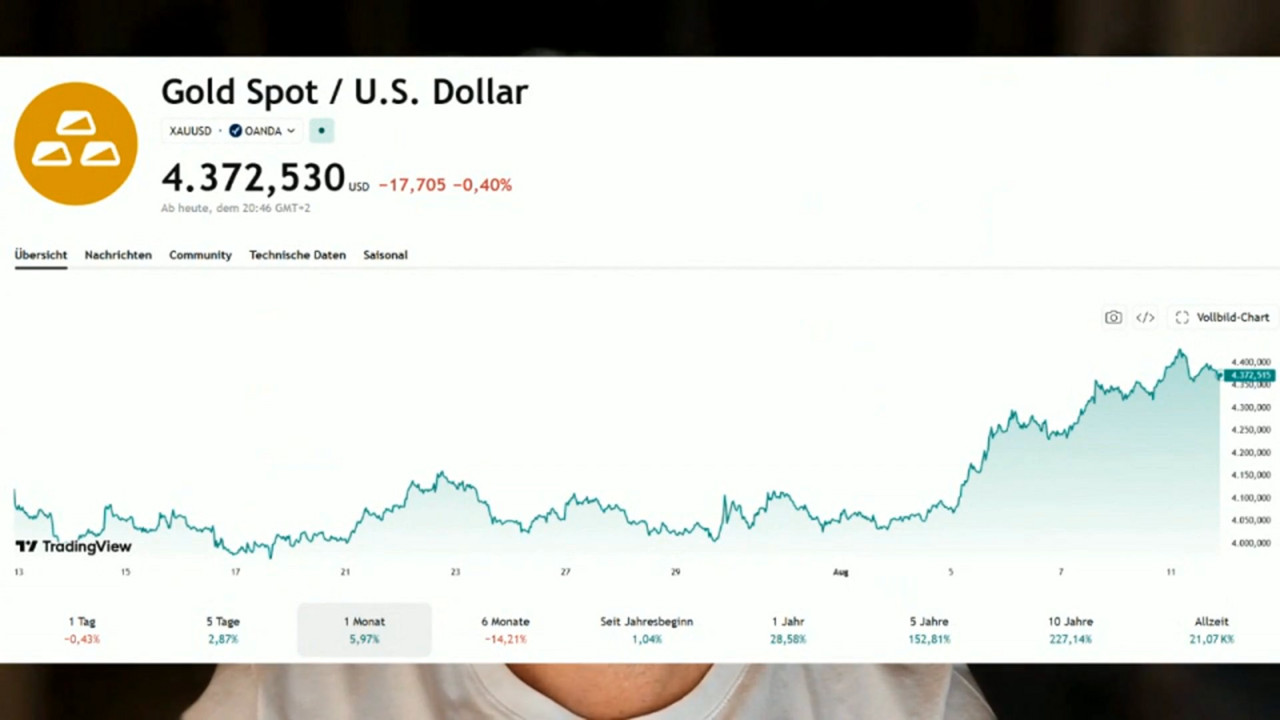
iShares Physical Gold ETC
Price
Discussion sur IGLN
Postes
79Podcast Episode 159: "Buy High. Sell Low." We bought gold and silver—retiring rich.
Subscribe to the podcast so that gold and silver can break new all-time highs.
Spotify
https://open.spotify.com/episode/3K5LRl3gTl0OlxaA12xPob?si=ojJydfKPSHWpsW2Hw4etJA
YouTube
https://openyoutu.be/toPK81dp6cA
Apple Podcasts
$I (-0,22 %)$4GLD (-0,22 %)
$IGLN (-0,22 %)
$GLDA (-0,15 %)
$GOLD
$GOLD (-1,14 %)
$SSLN (-0,95 %)
$SILVER
$PHAG (-1,02 %)
$COPX (-0,33 %)
$COPA (+0,2 %)
$GOLD3
#rente
#vorsorge
#etf
#etfs
#etc#edelmetalle
#rohstoffe
#commodities
#altersvorsorge
Weekly Purchases 💹
For usual transparency, last week and this week, we reinforced several positions as follows :
- 5 $ASML (-1,07 %) shares @ $1,653 for $8,265 on June 8
- 30 $SAF (+0,04 %) shares @ $337.59 for $10,110 on June 10
- 20 $AMAT (-0,32 %) shares @ $490.78 for $9,800 on June 10
- 50 $IGLN (-0,22 %) shares @ $81.28 for $4,064 on June 12
- 15 $SNPS (+2,83 %) shares @ $448.61 for $6,729 on June 16
- 10 $LHX (-0,28 %) shares @ $305.89 for $3,058 on June 16
- 40 $NOW (-1,82 %) shares @ $101.99 for $4,079 on June 16
- 85 $D05 (-0,57 %) shares @ $49.84 for $4,236 on June 16
This makes a total of $50,341 invested in 8 assets.

The Biggest Gold Scandals 💸📉
Hey, dear Getquiner readers!
As you know, I’m personally not a big fan of gold. As expected, the comments section got pretty heated after my last post: Opinions are very divided on this—one side sees physical gold as the ultimate safeguard in times of crisis, while the other shares my skepticism and prefers to stay away.
To back up my perspective with a few historical facts, today we’ll take a look at three of the most notorious scandals in the history of gold. They illustrate quite well why, in my opinion, the market is far less transparent than many believe:
1. The "Fake Gold" in the Vault: The Wuhan Kingold Scandal (2020) 🇨🇳🧱
One of the biggest frauds in recent financial history: The Chinese company Wuhan Kingold Jewelry took out loans worth billions and deposited seemingly flawless gold bars with banks as collateral.
- The wake-up call: When a creditor wanted to liquidate the collateral and melt down the gold, the truth came to light: The bars were essentially made of gold-plated copper!
- In total, there were 83 tons of counterfeit gold —which at the time amounted to a good 4% of China’s total gold reserves. When even large institutions fail to verify the goods, it simply shows how high the risk can be with physical assets behind the scenes.
2. The Promises on Paper: The Republic New York Scandal (1999) 🏦🕵️♂️
This involved a large investment scheme centered around the company Princeton Economics International and Republic New York Bank. Japanese investors were assured that their money would be backed one-to-one by physical gold and kept safe.
- The reality: The gold did not exist in that quantity at all. The funds were used for other purposes, and the account balances on paper were simply fabricated. In the end, the losses amounted to over $1 billion.
- The lesson: This confirms the problem we discussed in the last post: You’re often just buying a third party’s promise that the gold is somewhere. You usually don’t realize if it’s really there until it’s too late.
3. The Price Game: Libor & Fixing Manipulations 📊📉
Gold is often portrayed as a completely independent, honest safe haven. But the price has long since ceased to be determined solely by physical supply and demand. For years, the gold price was set daily by a small group of major banks during the so-called “London Gold Fixing.”
- The problem: Traders used digital chat rooms to coordinate their actions shortly before the price was set. Through targeted fake orders (“spoofing”), the price was artificially manipulated to make their own trading positions profitable. Several banks had to pay billions in fines for this.
- The reality of modern markets: Let’s not kid ourselves—today, almost every major asset, whether gold, stocks, or even Bitcoin, is massively influenced in the short term by derivatives, leveraged products, and Wall Street. The difference, however, is this: With gold, pure paper trading determines the price of an asset whose physical inventory in the background is virtually impossible for the average investor to independently verify.
My conclusion: Even gold does not protect against market risks ⚡️
Whether it’s counterfeit bars, a lack of transparency in custody, or the manipulation of derivatives: to me, gold is not an untouchable system outside the financial sector. It is heavily dependent on the big banks.
While with digital assets you can mathematically verify every transaction and scarcity in real time on a public blockchain and store them yourself, with gold you ultimately always remain dependent on trust in third parties (auditors, dealers, banks). And for me, that trust is precisely the crux of the matter.
Now I’d love to hear your thoughts: Do such historical incidents change your view of the precious metal, or does physical gold remain your number one hedge despite everything? Feel free to share your thoughts in the comments and leave a follow! 👇😉
$IGLN (-0,22 %)
$4GLD (-0,22 %)
$DE000EWG0LD1 (-0,11 %)
$NEM
$GLDA (-0,15 %)
$ABX (-2,89 %)
$FNV (-0,37 %)
$AEM
$BTC (-0,24 %)
#gold
#goldpreis
#edelmetalle
Gold
PLEASE DO NOT ALWAYS DELETE THE TEXT🥲 In short: all that glitters is not gold $IGLN (-0,22 %)
$GOLD
Newbie investor
Hello everyone, I’m new to investing and I’d like some advice for anyone who is willing and has some free time. Right now I’m considering removing the 10% I have in a dividend ETF and reallocating that into individual stocks. My core portfolio will stay around 70% in $VWCE (-0,13 %) , but I’m thinking of increasing my individual stock allocation to about 25%, mostly focused on tech — companies like AMD, Intel, Amazon, I might add some stuff later. I’d appreciate your thoughts on whether this shift makes sense.
My current portfolio:
70% in $VWCE (-0,13 %)
10% in a dividend ETF
15% in individual stocks
2% in $ETH (+0,44 %)
3% in $IGLN (-0,22 %)
New portfolio:
70% $VWCE (-0,13 %)
25% Individual stocks (mostly tech)
Beside Tech, I would add Emerging markets, but if you want to gamble, go with stocks in other trendy sectors e.g. Lockhead Martin, Maersk, Alibaba, Hercules Capital, Coinbase etc
Titres populaires
Meilleurs créateurs cette semaine