
📉 Cisco Systems and Coherent both fell despite Cisco CEO Chuck Robbins saying "all areas of our business have tailwinds right now."

Coherent PA
Stock
Stock
Ticker: COHR
COHR
Price
Debate sobre COHR
Puestos
13


2Lun·
+++ Photonics: Earnings Provide New Signals +++
I haven't written much here in the past few weeks. Not because nothing has been happening in the markets—quite the opposite, actually. But sometimes work just takes up all my time. And things aren't getting any better right now. That makes what's happening at Photonics .
I’ve been following this topic for a while now; I’ve written a few posts about it. The current earnings season is now providing some pretty concrete indications that Photonics, as a bottleneck within AI infrastructure.
1. Demand is outpacing capacity
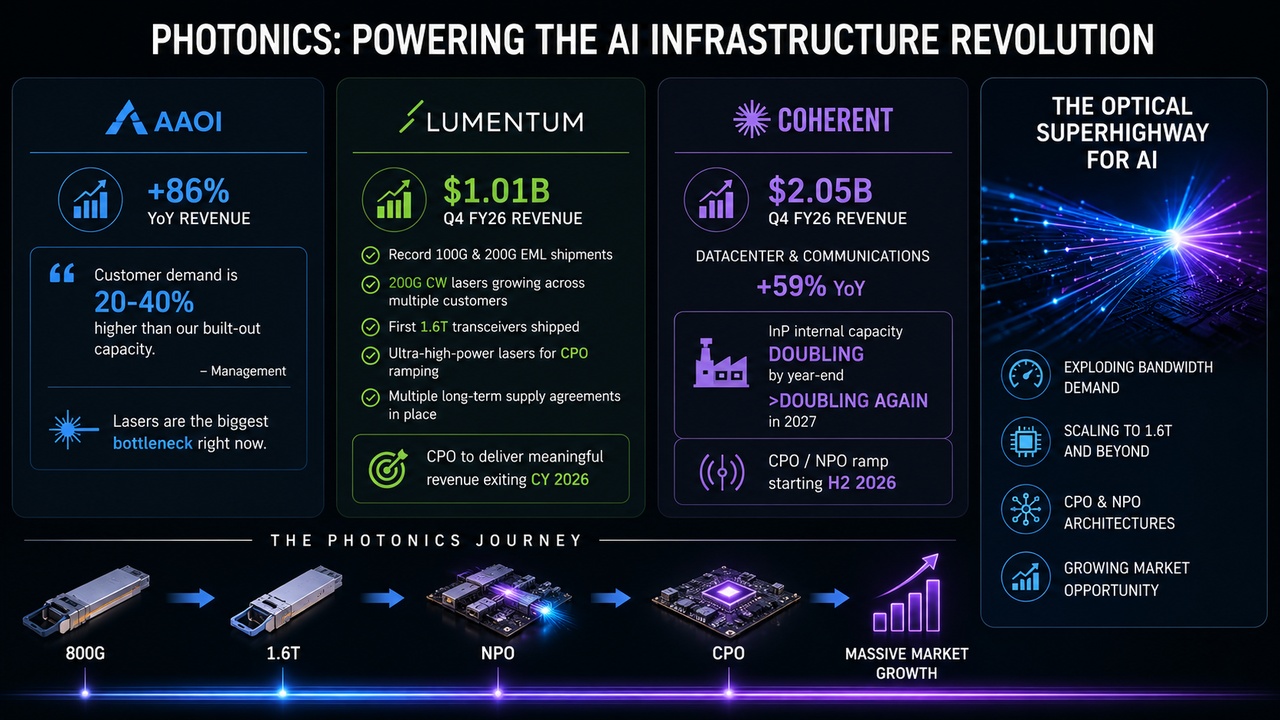
Applied Optoelectronics $AAOI (+3,21 %) reported an 86% year-over-year increase in revenue for Q2. Even more interesting, however, were statements made during the earnings call.
Management explained that customer demand is 20–40% above the capacity that has already been expanded. At the same time, CEO Thompson Lin identified lasers as the current biggest bottleneck in the transceiver business. This is noteworthy: The problem isn’t a lack of demand. The problem is being able to produce enough components.
2. 1.6T and CPO are beginning to ramp up
At Lumentum $LITE (+1,2 %) , the next phase is already taking shape. The company reported revenue of $1.01 billion for Q4 FY26, up from $808 million in the previous quarter. At the same time, the non-GAAP operating margin rose to 36.6%. Even more important than the numbers themselves are several operational statements:
• Record shipments of 100G and 200G EMLs
• Rising sales of CW lasers to several transceiver customers
• First shipments of 1.6T transceivers
• Increasing shipments of ultra-high-power lasers for CPO
• Several long-term supply contracts in the Scale-Across segment
Lumentum expects CPO to make a significant contribution to revenue as early as the end of calendar year 2026.
3. Manufacturers are massively expanding capacity
Coherent $COHR (-0,05 %) confirms this trend. Revenue in the Datacenter & Communications segment rose from approximately $1.0 billion to $1.6 billion within a year. At the same time, Coherent aims to double its internal InP output by the end of the year and more than double it again by 2027. CPO/NPO is expected to emerge as an additional growth driver starting in the second half of 2026.
This is slowly painting a fairly consistent picture:
800G → 1.6T → NPO → CPO
With each stage, the demand for optical components increases. At the same time, the necessary laser and InP capacity cannot be scaled up as quickly as desired.
That’s why I find the latest quarterly reports so interesting. They don’t just show that photonics could become important at some point. They show that the bottleneck is already becoming apparent today.
And if 1.6T, NPO, and CPO do indeed scale up more significantly in the coming quarters, a market that’s already tight today could turn into an even much bigger bottleneck.
For me, that’s why photonics is currently one of the most exciting areas within AI infrastructure. Because several companies are now independently sending the same signal: Demand is growing faster than the available optical capacity.
1616
6 Comentarios
Thanks for the fascinating analyses!
Do your positions reflect these findings in any way, or do they tend to confirm your current stance?
Do your positions reflect these findings in any way, or do they tend to confirm your current stance?
•
33
•

2Lun·
Gains
$AXTI (+10,15 %) 18%
$MP (-2,58 %) 19%
$COHR (-0,05 %) 24%
All of them sold yesterday.
+20k$
Not bad 👌
$NBIS (+1,46 %) already with a stop loss on more 5,5k gains.
22

2Lun·
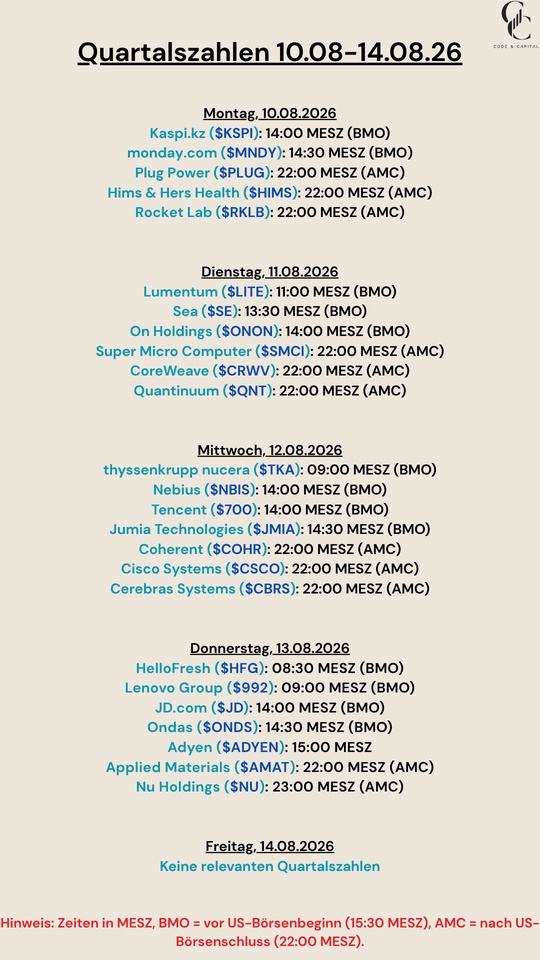
Quarterly Results: August 10–14, 26
I'd also like to send warm greetings from my vacation in Sardinia ☀️🏝️
$KSPI (-0,24 %)
$MNDY (+3,6 %)
$PLUG (-0,81 %)
$HIMS (+0,68 %)
$RKLB (+0,71 %)
$LITE (+1,2 %)
$ONON (+1,68 %)
$SMCI (+2,24 %)
$CRWV (-1,16 %)
$QNT (-2,79 %)
$TKA (-1,73 %)
$NBIS (+1,46 %)
$700 (-1,15 %)
$JMIA (-2,28 %)
$COHR (-0,05 %)
$CSCO (-0,31 %)
$CBRS
$HFG (+1,5 %)
$992 (+0,88 %)
$JD (-0,83 %)
$ONDS (+0,46 %)
$ADYEN (-2,02 %)
$AMAT (+1,36 %)
$NU (-0,39 %)

2020
4 Comentarios
Enjoy your vacation! And thank you.
•
55
•
2Lun·
Exclusive-Trump administration drafting ban on Chinese data center devices, sources say
https://www.aol.com/articles/exclusive-trump-administration-drafting-ban-100549000.html
"The Federal Communications Commission, which oversees the U.S. telecom industry, is working on the measure to bar imports of new Chinese optical transceivers, which allow data to travel over fiber-optic cables at the speed of light within data centers. Officials hope to publish it this year, when it would take effect."
Who's affected: $AXTI (+10,15 %)
$GLW (+0,93 %)
$AAOI (+3,21 %)
$COHR (-0,05 %) and $SIVE (+3,3 %) let's see how this will play out
www.aol.comExclusive-Trump administration drafting ban on Chinese data center devices, sources say - AOL

4Lun·
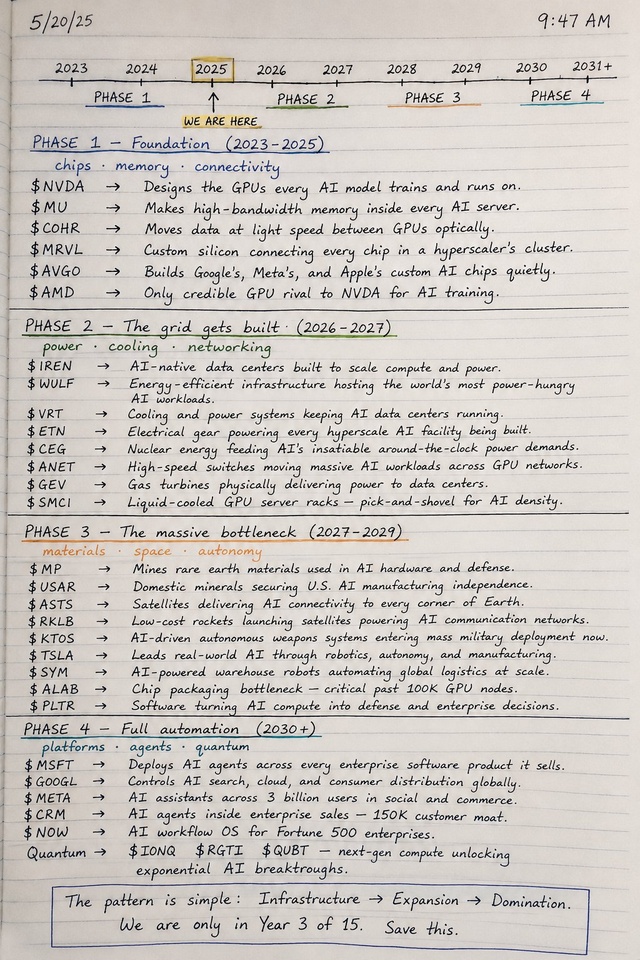
The AI supercycle is in year 3 of 15. You didn't miss it.
You'd make millions by knowing whats coming and buying dips until 2030+
Pay attention, we just finished Phase 1 2023-2025
chips · memory · connectivity
$NVDA (+1,48 %) → Designs the GPUs every AI model trains and runs on.
$MU (+3,21 %) → Makes high-bandwidth memory inside every AI server.
$COHR (-0,05 %) → Moves data at light speed between GPUs optically.
$MRVL (+4,1 %) → Custom silicon connecting every chip in a hyperscaler's cluster.
$AVGO (+1,68 %) → Builds Google's, Meta's, and Apple's custom AI chips quietly.
$AMD (+1,74 %) → Only credible GPU rival to NVDA for AI training.
PHASE 2 — The grid gets built (2026–2027)
power · cooling · networking
$IREN (+2,53 %) → AI-native data centers built to scale compute and power.
$WULF (+3,46 %) → Energy-efficient infrastructure hosting the world's most power-hungry AI workloads.
$VRT → Cooling and power systems keeping AI data centers running.
$ETN → Electrical gear powering every hyperscale AI facility being built.
$CEG → Nuclear energy feeding AI's insatiable around-the-clock power demands.
$ANET → High-speed switches moving massive AI workloads across GPU networks.
$GEV → Gas turbines physically delivering power to data centers.
$SMCI → Liquid-cooled GPU server racks — pick-and-shovel for AI density.
PHASE 3 — The massive bottleneck (2027–2029)
materials · space · autonomy
$MP → Mines rare earth materials used in AI hardware and defense.
$USAR → Domestic minerals securing U.S. AI manufacturing independence.
$ASTS (+2,68 %) → Satellites delivering AI connectivity to every corner of Earth.
$RKLB (+0,71 %) → Low-cost rockets launching satellites powering AI communication networks.
$KTOS → AI-driven autonomous weapons systems entering mass military deployment now.
$TSLA (+4,51 %) → Leads real-world AI through robotics, autonomy, and manufacturing.
$SYM → AI-powered warehouse robots automating global logistics at scale.
$ALAB (+0,79 %) → Chip packaging bottleneck — critical past 100K GPU nodes.
$PLTR (+4,83 %) → Software turning AI compute into defense and enterprise decisions.
PHASE 4 — Full automation (2030+)
platforms · agents · quantum
$MSFT (+1,14 %) → Deploys AI agents across every enterprise software product it sells.
$GOOGL (+1,38 %) → Controls AI search, cloud, and consumer distribution globally.
$META (-0,31 %) → AI assistants across 3 billion users in social and commerce.
$CRM (+0,47 %) → AI agents inside enterprise sales — 150K customer moat.
$NOW (+2,88 %) → AI workflow OS for Fortune 500 enterprises.
Quantum
$IONQ $RGTI $QUBT — next-gen compute unlocking exponential AI breakthroughs.

5Lun·
Future AI bottleneck #2: Photonics 💡
Many AI investors are primarily looking at GPUs, memory or energy supply. I believe that the next big bottleneck is already slowly emerging: Photonics.
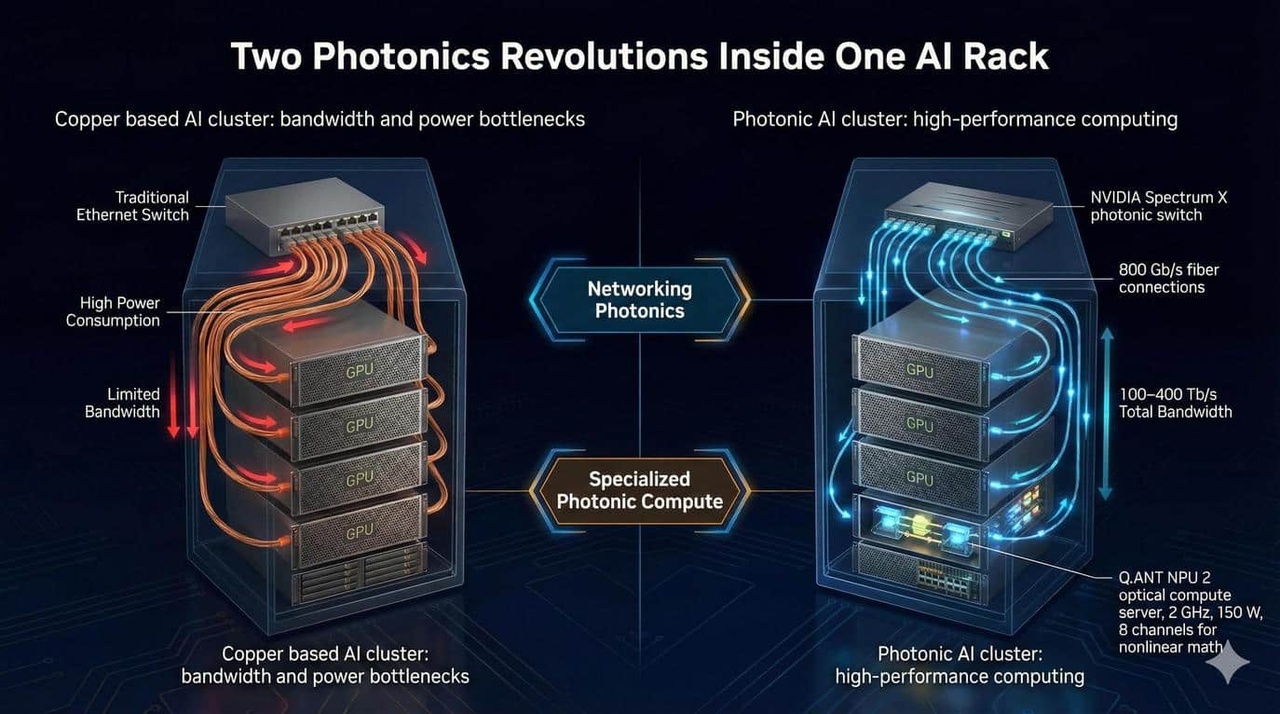
The background: modern AI systems have to move ever larger amounts of data. However, classic copper cabling is increasingly reaching its physical physical limits. Energy consumption, heat generation, signal losses and susceptibility to errors are increasing massively. This is why the industry is moving step by step towards light instead of electricity.
- Photonics simply put, means that data is no longer transmitted primarily electrically, but optically via light signals.
- Optoelectronics as a sub-sector combines electronics and lighting technology.
- CPO/Co-Packaged Optics describes the approach of placing optical components directly next to AI chips in order to massively improve speed, energy efficiency and bandwidth.
NVIDIA is now visibly driving this development forward. The company is investing billions in optical infrastructure and partners in the field of AI photonics. (For example, Lumentum and Coherent are currently benefiting from a 2 billion dollar investment each).
For me, this is therefore likely to be the next big upcoming AI bottleneck. What I find particularly interesting is that photonics does not consist of just one area. There are very different levels of risk and maturity within the stack.
Level 1: Established photonics infrastructure
This is where the more stable infrastructure players are located. Companies such as $COHR (-0,05 %) (Coherent), $LITE (+1,2 %) (Lumentum), $CIEN (+3,8 %) (Ciena) or even $FN (+0,25 %) (Fabrinet) are already benefiting from the fact that optical systems are increasingly moving into AI data centers.
This is mainly about:
- lasers
- optical components
- Fiber optic infrastructure
- transceivers
- Optical Networking
Level 2: Optical Interconnects & Data Center Connectivity
A field in which there is currently a lot of momentum. AI clusters require ever faster connections between GPUs, storage and switches. I'm thinking of companies like $AAOI (+3,21 %) (Applied Optoelectronics), $ANET (+4,01 %) (Arista Networks) or in some cases also $5802 (+0,66 %) (Sumitomo Electric). Optical interconnects could develop into a central AI bottleneck in the next few years.
Level 3: Materials, substrates & manufacturing bases
This area usually receives much less attention, although it is here that important prerequisites for modern photonics systems are created. Photonics requires highly specialized materials, new substrates and precise manufacturing structures. I find companies such as $AXTI (+10,15 %) (AXT), $SOI (+1,15 %) (Soitec), $5802 (+0,66 %) (Sumitomo Electric) or in some cases also $TSEM (+2,73 %) (Tower Semiconductor).
Materials such as indium phosphide (InP), special wafer technologies and optical integration platforms are becoming increasingly important as data rates and integration density rise. And the more complex optical systems become, the more relevant the future bottleneck of "test & metrology" becomes, because these structures have to be controlled and measured with extreme precision (see my last post).
Level 4: Optionality & Next Generation Photonics
The risk increases significantly here. At the same time, however, the potential leverage effect also increases. Companies such as $LWLG (Lightwave Logic), $SIVE (+3,3 %) (Sivers Semiconductors), $INFQ (Infleqtion) or even $LASR (nLight) are working on technologies that could make future optical systems even more efficient or powerful. For me, these are not sure winners. But they are often the early technological options for the next wave of infrastructure. Incidentally, Sivers will soon also be listed in parallel on the NASDAQ.
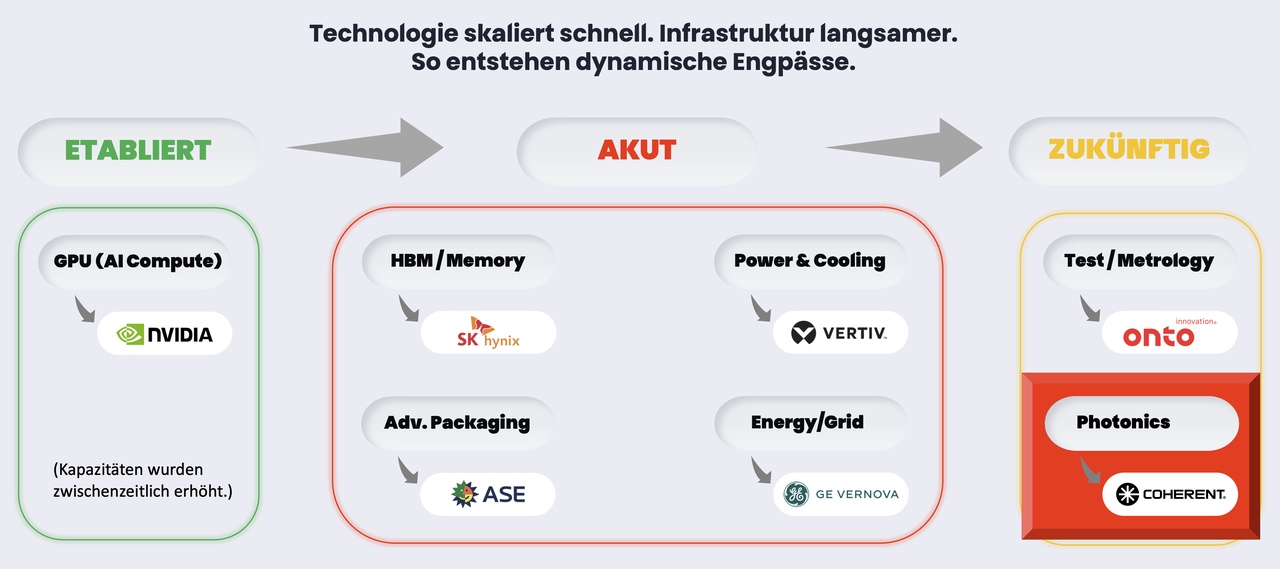
The exciting thing is that the AI bottleneck is shifting further and further away from pure compute and into the physical infrastructure of data movement.
Acute/Active:
HBM + Power & Cooling + Advanced Packaging + Energy/Grid
Future/Emerging:
Test & Metrology + Photonics
AI will not only need more computing power in the future. Above all, AI needs the ability to move gigantic amounts of data efficiently, quickly and stably.
A third AI bottleneck in the "future/emerging" category could already arise: Edge AI. More on this soon.
5353
14 Comentarios
•
33
•6Lun·
Photonics - Computing with the lower-energy speed of light
The photonics industry has virtually completed its first major cycle - some players are still taking the last leg, others are already making corrections.
One basic idea is the difference in weight between electrons and photons, which massively reduces the energy required to transmit a datum in transmission lines - keyword fiber optics.
The more interesting part, however, is the spreading of the binary logic in light wavelengths in the CPU in order to be able to calculate in a defined space/frame with a higher base than 2. These analog protocol options are physically unlimited, as there is no longer a base number.
In my view, this is one of the most disruptive markets of the next few years.
For the watchlist
Q.ANT (IPO pending) https://qant.com/de/
From a chart technical point of view $CRDO bottoming out since the beginning of February, accumulation is still possible. Average price target $199 (+86%).
1414
7 ComentariosWhich companies do you find most interesting and why?
•
22
•

11Lun·
AI infrastructure continues to be one of the most exciting investment themes
$IREN (+2,53 %)
$CIFR (-0,87 %)
$BTC (+0,93 %)
Maybe some exciting companies for you ✌️
I am currently only in $IREN (+2,53 %) and $CIFR (-0,87 %) which are the most promising for me in terms of the opportunity/return ratio. In the event of a further setback, I would $CIFR (-0,87 %) probably add a little more and perhaps pick up one or two other companies.
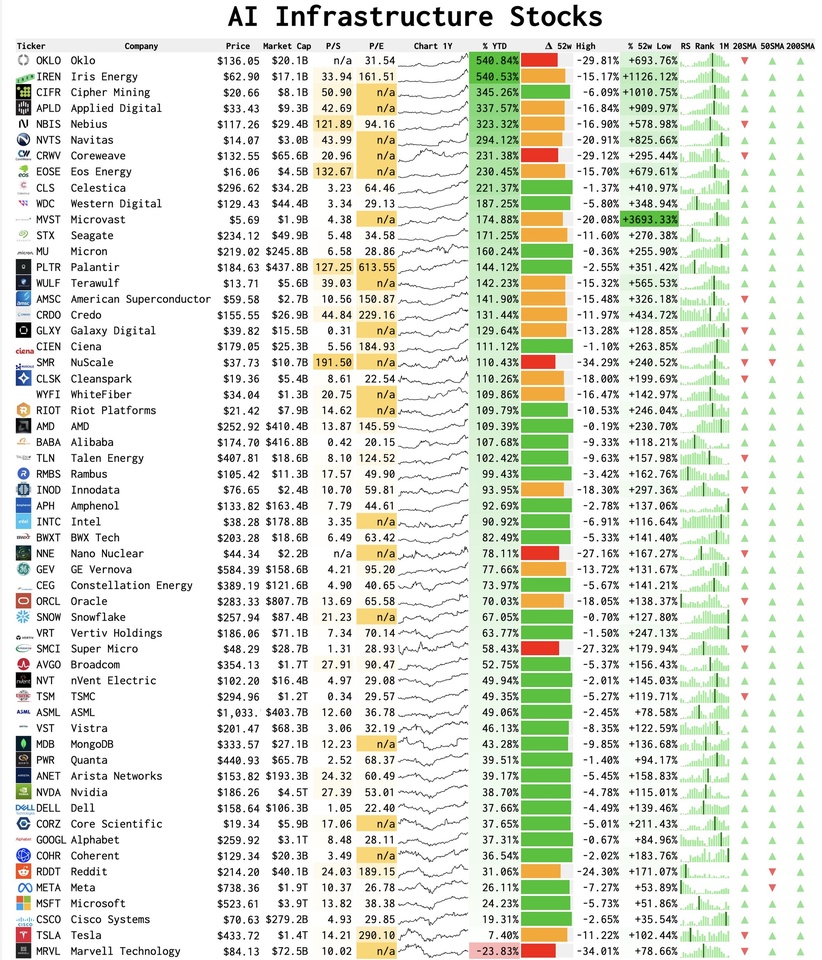
AI stocks, sorted by YTD performance:
Hyperscalers: $GOOGL (+1,38 %)
$MSFT (+1,14 %)
$AMZN (+5,26 %)
$ORCL (+1,09 %)
$BABA (-0,41 %)
Neocloud: $NBIS (+1,46 %)
$IREN (+2,53 %)
$CRWV (-1,16 %)
$APLD (+6,09 %)
$GLXY (-2,34 %)
$WYFI (-0,96 %)
Memory: $SNDK (+6,06 %)
$STX (+3,88 %)
$MU (+3,21 %)
$WDC (+6,61 %)
$PSTG (+2,72 %)
Semiconductor: $NVDA (+1,48 %)
$AVGO (+1,68 %)
$AMD (+1,74 %)
$TSM (+1,09 %)
$ASML (+0,84 %)
$ARM (+0,49 %)
$KLAC (+0,06 %)
$INTC (+2,77 %)
Networking: $CIEN (+3,8 %)
$CLS (-0,74 %)
$CRDO
$RMBS (+6,29 %)
$ANET (+4,01 %)
$APH (+0,54 %)
$COHR (-0,05 %)
Servers: $VRT (+0,57 %)
$DELL (+0,94 %)
$HPE (+1,77 %)
Data: $INOD (+2,97 %)
$PLTR (+4,83 %)
$SNOW (+2,74 %)
$DDOG (+5,92 %)
$MDB (+3,24 %)
Energy: $LEU (-4,48 %)
$CEG
$OKLO
$TLNE
$GEV (-0,94 %)
$NXT
Batteries: $EOSE (-1,23 %)
$QS (-3,06 %)
$TSLA (+4,51 %)
$MVST (+0 %)
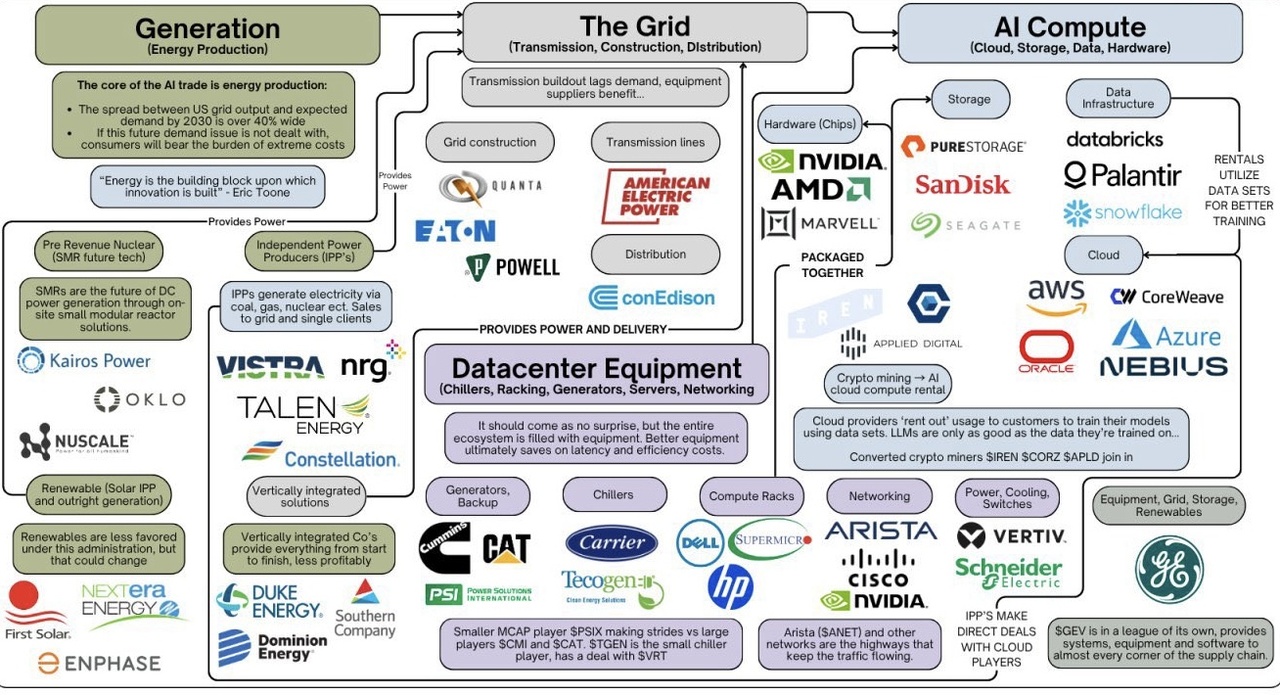
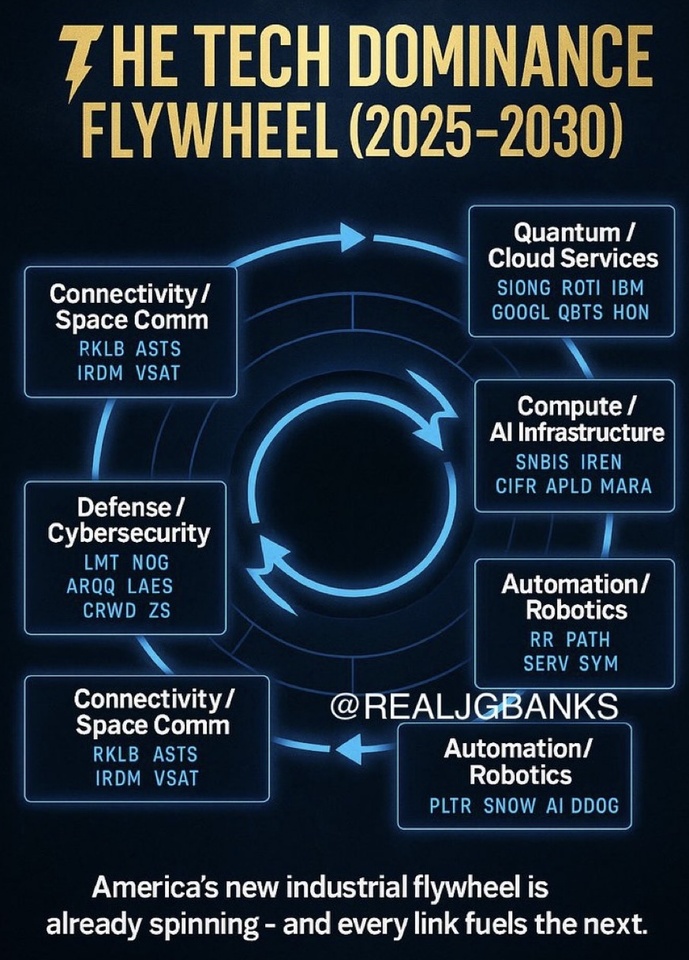
Every AI Value Chain explained:
7171
34 Comentarios
11Lun
Thanks for the overview. Despite having already sold some of $AMD, $NBIS and $APLD, I still have more in my portfolio.
In addition to $IREN and $CIFR also $GLXY, $INOD, $NVDA and $DDOG.
Plus $GOOGL, $AMZN and $BABA
So I'm pretty broadly positioned in this area when I look at it like this 😉😎
Others would say there is a cluster risk. However, the strategy of focusing on the highest possible returns means investing in the booming sectors, which at the moment are AI and commodities.
•
1818
•