$RKLB (-3,32 %) Rocket Lab, My Blue-Sky Scenario for $200
First outlined in July; an update following the quarterly earnings report
Why I Believe Rocket Lab Deserves a Premium Valuation
Before I do the math, it must be clear why I’m even using a premium multiple.
To me, Rocket Lab is the clear No. 2 in the space industry behind SpaceX.
No other publicly traded company builds rockets and satellites, manufactures the components itself, launches them itself, and—starting in 2027—will also operate its own constellation with recurring revenue through Iridium.
Rocket Lab itself describes Iridium as the step toward becoming a true end-to-end space company that builds, launches, and operates its own constellation.
Since SpaceX’s IPO, there has been a benchmark for this model. SpaceX was valued at $1.77 trillion at its IPO—95 times its 2025 revenue. Anyone looking to own space infrastructure outside of SpaceX has exactly one vertically integrated option on the stock market.
Payload to Orbit: The Industry’s Bottleneck
In the case of AST SpaceMobile, I demonstrated that “payload to orbit” is the bottleneck. Rocket Lab is right in the middle of this bottleneck. Since its first orbital launch in 2018, Electron has been the second-most frequently launched U.S. rocket per year. By 2025, there had been 21 Electron launches without a single failure. Electron is now approaching its 100th launch and is on track to reach that milestone faster than any other rocket—even faster than Falcon 9. Neutron can deliver up to 13 metric tons to low Earth orbit, and its first stage is designed for reuse. The first 16 Neutron launches have been sold before the rocket has even flown. Available launch slots won’t be available until the 2030s. In Q3, Rocket Lab deliberately chose higher prices over higher volume; the current Neutron price is already $70 million. Limited launch capacity—which the company owns itself—means pricing power. Added to this is HASTE for hypersonic testing, the largest launch contract in the company’s history to date, worth $266 million from the U.S. Space Force. Together with Stoke, Rocket Lab holds a framework contract worth up to $5.6 billion for national security launches.
Satellite Manufacturing and Cleanroom Capacity
Space Systems is already the larger segment today. More than 55 spacecraft are in development and under construction. Over the past 12 months, 12 satellites built by Rocket Lab have been launched, including a mission for the Space Force, two NASA probes for Mars, and 8 platforms for Globalstar. The Space Systems backlog stands at $1.7 billion, an increase of 194% over the previous year.
I see the real competitive advantage in cleanroom facilities and manufacturing. Rocket Lab manufactures solar cells and complete solar arrays, reaction wheels, star sensors, separation systems, flight software, payloads, optics, and robotics in-house.
In Q3, output increased across all satellite components. An Electron rocket leaves the assembly hall every 8 days, and there’s also a new production line for the Gauss electric propulsion system, with more than 200 units per year.
Anyone who orders a satellite from Rocket Lab gets the bus, components, and launch all from a single source. This generates margins that would otherwise go to suppliers, as well as speed—a factor for which government customers are increasingly willing to pay.
Lasers: The Data Superhighway in Orbit
The acquisition of Mynaric was completed on April 14, 2026, for $155.3 million in cash plus approximately 2.28 million shares. Mynaric supplies the CONDOR Mk3 laser terminals for Rocket Lab’s SDA Prime contracts worth over $1.3 billion. In the SDA networks, these laser terminals connect the satellites to one another; they are the bottleneck component there. With Mynaric, Rocket Lab controls this component itself rather than purchasing it. In Q3, the full quarter of laser business operations has already bolstered the gross margin. Even more is at stake for the future. Anyone capable of networking satellites with lasers provides the foundation for any next-generation constellation—for Iridium as well as for data centers in orbit.
Iridium, Licenses, and a Ready-Made Constellation
With Iridium, Rocket Lab is acquiring something that cannot be replicated in this decade. Iridium operates 66 active, interconnected satellites in polar orbits and is the only system to offer true global coverage all the way to the poles. Added to this is the L-band spectrum with global licenses acquired over decades. Spectrum is the scarcest resource in satellite communications. At the end of Q3, Iridium had 2.696 million paying subscribers. Its largest single customer is the U.S. government, accounting for 15% of service revenue. It also has an ecosystem of more than 500 partners. Through Aireon, Iridium has owned the world’s only space-based ADS-B system for flight monitoring since July. Aireon tracks an average of 190,000 flights per day, and air traffic control agencies covering more than 50% of global airspace use the data. Iridium generates approximately $1 billion in revenue with a 55% EBITDA margin—and this revenue is recurring. Starting in 2027, part of the group will therefore generate revenue like an infrastructure operator. This mitigates the risk associated with the growth story. Rocket Lab itself will then hold the reins for the next phase of its operations: building its own rockets, equipping them with its own lasers, and launching them with Neutron.
Rocket Lab Germany, the European counterpart to SpaceX
On August 10, 2026, Rocket Lab officially founded Rocket Lab Germany GmbH in Munich. The goal is to establish satellite, payload, and component manufacturing in Germany as a regional hub for constellations. European programs are also set to receive launches on Electron and Neutron. Approval from the German federal government was granted on March 30, 2026. Mynaric will retain its headquarters and workforce in Munich, and it is precisely through this that Rocket Lab aims to qualify as an independent provider for EU and ESA programs such as the IRIS² constellation. Mynaric brings with it approximately 300 engineers in Munich and ESA contracts such as HydRON. Germany is also planning a €35 billion expansion of its military space program. The ESA has awarded Rocket Lab its first contract—an Electron launch—for the first satellites of a future European navigation constellation. Europe has a real gap in access to space. Isar Aerospace has so far completed one test flight without reaching orbit, while Rocket Factory Augsburg is still planning its first test flight. Rocket Lab brings together nearly 100 launches of experience, satellite construction, and lasers manufactured in Germany. Europe wants to become more independent in space, including from any single provider. To me, Rocket Lab Germany represents an attempt to become for Europe what SpaceX is for the U.S. In my view, this is the aspect the market is paying the least attention to.
The Orbital Data Center Option
Starting in February 2026, Rocket Lab will offer silicon solar arrays for data centers in orbit. According to the company, Rocket Lab also has the world’s largest installed production capacity for gallium arsenide and germanium solar cells.
Peter Beck believes that small, secure data centers in orbit for defense purposes are feasible; there is already a Neutron customer for this. Starcloud is listed on the Q3 slide among the new launch customers. Power, lasers, satellite bus, and launch—Rocket Lab provides all the components for an in-orbit data center from a single source.
What this means for the multiple
Scarcity, vertical integration, recurring revenue, two strong customer bases in the U.S. and Europe, plus the option for data centers in orbit. Only SpaceX typically has this combination on the stock market.
That’s why, in my blue-sky scenario for 2030, I expect a multiple of around 60 times EBITDA or 23 times revenue. That’s still well below what the market paid for SpaceX at its IPO and below what it valued Rocket Lab at in May 2026.
The following calculation shows what this multiple means in numerical terms.
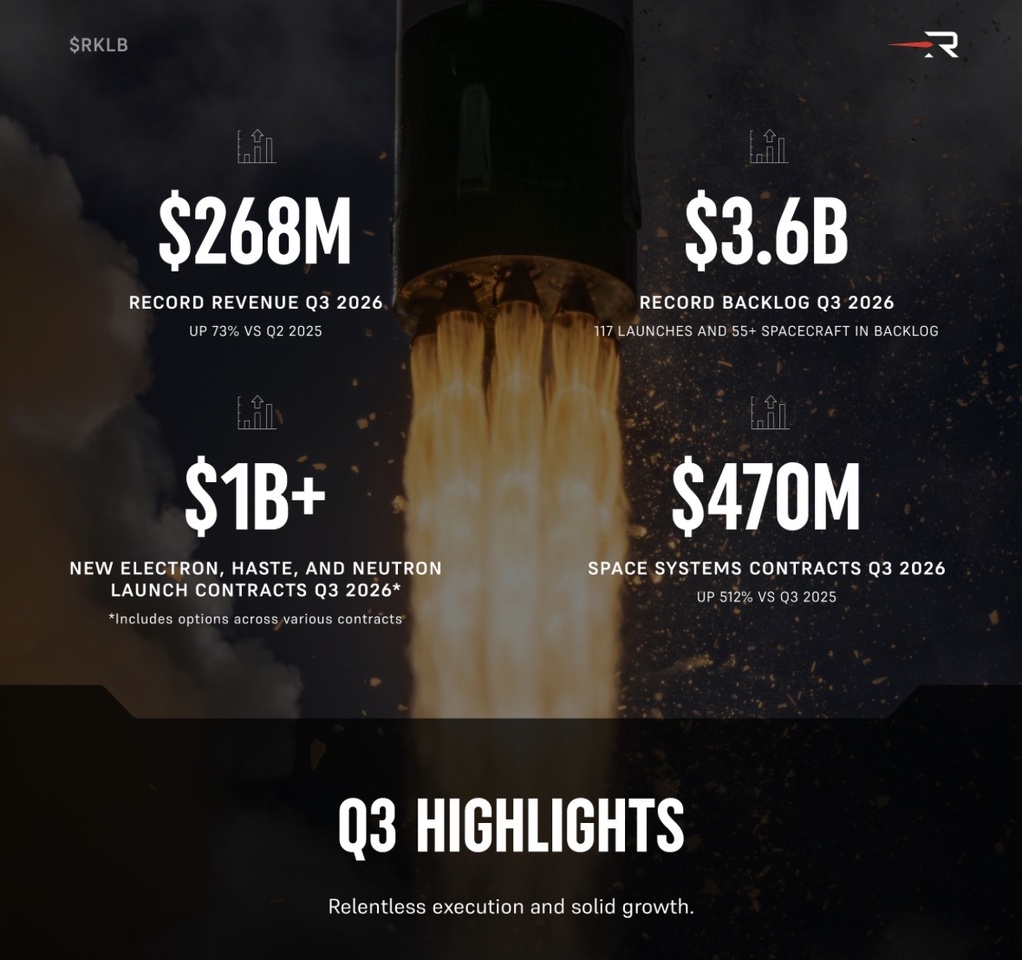
Rocket Lab reported record results in Q3 2026.
Revenue rose 73% to $267.8 million.
The backlog grew by 51.7% within a single quarter to $3.57 billion. Of this, $1.85 billion is attributable to Launch, with 117 booked launches, and $1.7 billion to Space Systems, an increase of 194% year-over-year. In the third quarter alone, more than $1 billion in new launch contracts and $470 million in Space Systems orders were added. For 2026, the figures point to $972–992 million
in revenue, following $601.8 million in 2025.
Neutron will not launch before 2027.
The replacement dome for the first-stage tank has been built and cured. Rocket Lab replicated the error during testing and adjusted the process. Peter Beck will not announce a date until the tank has completed the full test series. The first 16 Neutron launches are booked; available slots won’t open up until the 2030s. Rocket Lab deliberately prioritized price over volume in Q3. According to CFO Adam Spice, $70 million per Neutron launch is already the current price. Adjusted EBITDA is expected to turn positive approximately six months after the first successful Neutron flight.
What $200 per Share Means
Rocket Lab expects 681 million shares outstanding in Q4 2026. This figure already includes the $1.94 billion capital increase for the cash portion of the Iridium deal. Iridium shareholders will receive $27 in cash per share plus RKLB shares, which, depending on the share price at closing, will result in an additional 26 to 43 million shares. After closing, I expect approximately 725 million shares; factoring in stock-based compensation through 2030, that number rises to about 740 million. At $200 per share, this corresponds to a market capitalization of approximately $148 billion. That’s a good five times the approximately $29 billion prior to the Q3 earnings report. Net debt after the closing will be roughly $0.3–0.5 billion and is irrelevant to this calculation.
The stock price results from a simple calculation: a key metric multiplied by a multiple, divided by the number of shares—that is, $148 billion divided by 740 million shares. There are exactly two variables: the earnings figure (either revenue or EBITDA) and the multiple the market assigns to it. In July, the target was still $124 billion. The additional $24 billion comes solely from the higher number of shares.
The Two Variables
Based on 2030 EBITDA, Rocket Lab reaches $200 with $3.0 billion in EBITDA and a 50x multiple. Alternatively, $2.5 billion in EBITDA at a 60x multiple is sufficient. Based on revenue, $6 billion at a 25x multiple or $7.5 billion at a 20x multiple would suffice. My July range for 2030 was $5.5–7.5 billion in revenue and $2.0–3.0 billion in EBITDA. The midpoint of $2.5 billion, at a 50x multiple, currently values the stock at $169. To reach $200, the company would need to hit the upper end of the EBITDA range or achieve a multiple of around 60.
A 60x EBITDA multiple sounds like a lot. SpaceX went public in June 2026 at $135 per share. That represented a $1.77 trillion valuation, roughly 95 times 2025 revenue; EBITDA estimates were around 109 times. Rocket Lab itself was trading at $151 in May 2026, with a market capitalization of roughly $90 billion on revenue of about $1 billion. A 2030 multiple of 60x EBITDA or 23x revenue is significantly lower than that.
A breakdown by segment shows where the value must come from. Rocket Lab is paying around $8 billion for Iridium, roughly 15 times OEBITDA. If this multiple holds, Iridium will be worth around $10 billion in 2030. The core business—comprising Launch, Space Systems, and new fields—must then account for approximately $138 billion.
The Blue Sky Path
In the Blue Sky scenario, Rocket Lab grows from approximately $1 billion in revenue in 2026 to $6.47 billion in 2030.
Electron and HASTE will generate approximately $0.2 billion in 2026. Electron approaches its 100th launch with 96% reliability, and a rocket is built every 8 days. The launch pad in Alaska comes online in 2027; HASTE grows as prices rise; and Rocket Lab increases prices across the board. In 2030, under the Blue Sky scenario, approximately 48 Electron and HASTE launches are scheduled at an average of $12.5 million each, totaling $0.6 billion.
For Neutron, management plans a ramp-up of 1-3-5—that is, 1, 3, and 5 launches in the first three years. Mathematically, the 16 booked launches exactly fill a ramp-up schedule of 1-3-5-7 through 2030, which is why the next available slots are in the 2030s. Blue Sky’s maiden flight will take place in 2027, and the work on increasing the launch rate is paying off. The ramp-up schedule will then be 1-5-10-16. The booked launches will be completed by the end of 2029; in 2030, Neutron will operate entirely under new pricing. I estimate $55–65 million for the booked launches, since older contracts are still in effect at $50–55 million. For 2030, I expect $75 million. This results in $0.06 billion in revenue in 2027, $0.30 billion in 2028, $0.65 billion in 2029, and $1.2 billion in 2030.
Space Systems will generate approximately $0.78 billion in 2026. This is supported by a $1.7 billion backlog, 55+ spacecraft in development and construction, SDA tranches, Globalstar, and components from the solar, laser, and optics segments.
In the Blue Sky scenario, the segment grows by 43%, 38%, 35%, and 33% to $2.8 billion in 2030. The gross margin is 35–37% because satellite platforms generate lower margins than components.
Iridium reported $245.7 million in revenue and $135.6 million in OEBITDA in Q3; Aireon has been fully consolidated since July. On an annualized basis, this amounts to approximately $0.98 billion in revenue and $0.54 billion in EBITDA, with a 55% margin. Rocket Lab will consolidate Iridium starting in mid-2027. In the Blue Sky scenario, Iridium grows by about 5% to $1.17 billion in 2030, driven by NTN Direct, PNT, Aireon data services, and the 2027 EMSS renewal. Another lever does not appear in the revenue figures at all. If Rocket Lab builds and launches the successor constellation itself, this reduces capital expenditures but keeps the funds within the group.
In the Blue Sky scenario, these new areas will generate $0.08 billion in 2028, $0.3 billion in 2029, and $0.7 billion in 2030.
These include secure orbital data centers for defense—with one Neutron customer already on board—as well as Mynaric’s silicon solar arrays and laser terminals for Iridium services.
Together, this results in revenue of $1.98 billion in 2027, $3.37 billion in 2028, $4.65 billion in 2029, and $6.47 billion in 2030. EBITDA rises from –$0.07 billion in 2026 to $0.20 billion in 2027 and $0.95 billion in 2028, reaching $1.56 billion in 2029 and $2.51 billion in 2030. The margin thus turns from negative to 39%. In 2027, Rocket Lab remains slightly negative without Iridium because EBITDA does not turn positive until about 6 months after the first Neutron flight.
Iridium contributes approximately $0.27 billion in the second half of the year. In 2030, Launch will generate $0.99 billion in gross profit at a 55% margin, Space Systems $1.04 billion, and the new business segments $0.39 billion. Costs of $0.75 billion will be deducted from these figures. Added to this are Iridium with $0.64 billion, $0.12 billion in synergies, and approximately $0.09 billion in depreciation from manufacturing costs—totaling $2.51 billion. The Blue Sky scenario falls within my July range every year and exactly matches its midpoint for 2030 EBITDA.
What Needs to Add Up Mathematically
To reach $200 in 2030, consolidated revenue must more than sextuple compared to 2026. That represents approximately 60% growth per year. Excluding Iridium, the core business grows from $0.98 billion to $5.30 billion—an increase of about 52% per year. Rocket Lab grows by 63% in 2026. The Blue Sky scenario thus requires this pace for the core business, with a slight discount, for four more years.
To achieve this, Neutron must fly successfully in 2027 and ramp up to 16 launches by 2030. New launch slots must generate $75 million, Space Systems must reach $2.8 billion, Iridium must be acquired by mid-2027 and resume growth. The new business areas must generate $0.7 billion, and the number of shares must remain at around 740 million. Finally, by 2030, the market must pay around 60 times EBITDA for a company that is still growing at just under 40%.
Each lever has a clear price per share, calculated using 60x EBITDA and 740 million shares. A 10-point increase in the multiple is worth $34 per share. $0.5 billion in Space Systems revenue at a 37% margin yields $15; a $5 million higher Neutron price with 16 launches yields $6.5. $0.1 billion from new fields at a 55% margin yields $4.5, and a single Neutron launch at $75 million yields $3.3. An additional 10 million shares—or fewer—accounts for $2.7. Based on the multiple, the Neutron ramp-up is the biggest single driver. 16 launches instead of 7 in 2030 alone account for about $30 per share.
2028 or 2030
To reach $200 as early as 2028, the market would have to pay 44 times revenue or 156 times EBITDA, thereby anticipating the 2030 figures.
That sounds like a lot, but it’s less than half of what SpaceX received at its IPO. Rocket Lab itself was already valued in May 2026 at about 90 times its 2026 revenue. For that to happen, it will need a successful maiden flight of the Neutron, the Iridium deal to close, and a space sector that’s back in full swing. By 2030, it won’t be about market sentiment anymore, but about delivery—that is, $6.5 billion in revenue, $2.5 billion in EBITDA, and a multiple of around 60 for a company with just under 40% growth. The math shows which levers need to be pulled; the timing will be determined by Neutron and market sentiment. Whether the $200 mark is reached in 2028 or 2030 remains to be seen.
This is not investment advice. It is solely my personal opinion.