So today I stuck to my savings plan after getting paid again yesterday. It’s slow going, but I’m getting there. Now it’s just a matter of sticking to the savings plan, savings plan, savings plan 😀.

L&G Gerd Kommer Multifactor Eq ETF
ETP
ETP
ISIN: IE0001UQQ933
Ticker: GERD
IE0001UQQ933
GERD
Price
Debate sobre GERD
Puestos
27


1Semana·
🇦🇹 - A Question for Austrians About Net ETF Policies
With a net policy (also known as a “Nettopolice”), you invest in ETFs for retirement planning: without the 27.5% capital gains tax, commission-free, and with full compound interest.
You pay a one-time 4% insurance tax upon purchase, and the money is locked in for at least 10 years if you want it to remain tax-free.
The more affordable options on the market have a management fee of ~0.4% per year.
It’s important that it’s a double-net policy so that as few fees as possible are paid.
The specific products included vary by provider.
At ÖBV, for example, there are $GERD (-0,75 %) and $D5V0 (-0,22 %) to choose from.
Standard Live offers Dimensional Fund products.
What do we think of double-net policies?
Have you ever heard of them?
What are the downsides to putting a third or half of my assets into such an insurance-wrapped investment?
Here’s a comparison calculator:

nettopolizze.atETF-Nettopolizzen 2026: Der transparente Vergleich für Österreich
11
4 Comentarios
1Semana
I’m holding my 1xGTAA stake (15%) through mylife Rente. A 0.2% annual fee for a tax-free vehicle is just about acceptable compared to a broker. 0.4% would be too much for me.
One drawback of a net policy that many people don’t realize is that the ETFs don’t belong to you, but to the insurance company. If the insurance company goes bankrupt, your money is gone. An emergency fund then takes over your claims and pays you 2–3% per year at some point in the future. Then you’re out of luck.
So net policies are okay as a supplement to retirement savings, but they should never form the core of your retirement plan.
One drawback of a net policy that many people don’t realize is that the ETFs don’t belong to you, but to the insurance company. If the insurance company goes bankrupt, your money is gone. An emergency fund then takes over your claims and pays you 2–3% per year at some point in the future. Then you’re out of luck.
So net policies are okay as a supplement to retirement savings, but they should never form the core of your retirement plan.
•
33
•1Lun·
Looking for a Portfolio Addition
Hey guys, I'm looking to add to my current portfolio. Right now, I have just under 3.5k in my portfolio (at 18), and of that, just under 1.9k is in $GERD (-0,75 %) even though a lot of people don’t like it. Now I’m looking to expand my portfolio with more money and maybe add a new asset class—do you have any ideas on what I could look into (focusing on low risk and maybe some monthly cash flow)?
Best regards, and thanks in advance ✌🏻
1Posición
1874,63 €
1,71 %
33
12 Comentarios
How exactly do you envision building up €100 million in family wealth? I think that’s a very ambitious goal, especially if you want to minimize risk and invest mainly in ETFs. Just to give you an idea of the scale: Assuming an 8% annual return, you’d have to invest about €14,300 per month over 50 years to reach €100 million. That’s why I’d be really interested to hear what your plan is :)
•
33
•2Lun·
July Performance
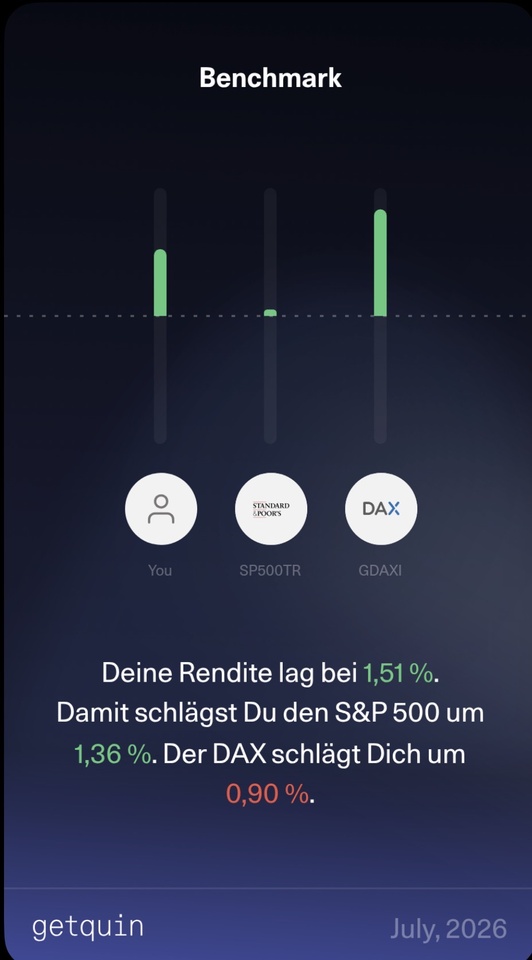
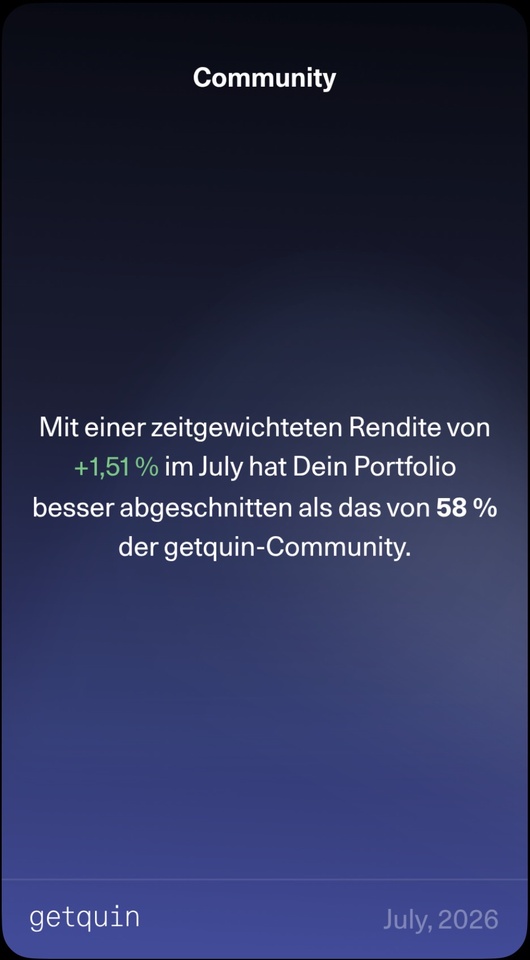
I’m a little late to the party, but as they say, better late than never 😂. Actually, I’m a bit surprised by how I did—I wouldn’t have thought the DAX would outperform the S&P 500, but if that’s the case, then we can be a little prouder of the German economy once again. What really surprises me, though, is that I beat 58% of the people here, even though so many tell me that my $GERD (-0,75 %) ETF is such a bad choice and that I don’t really know what I’m doing—but anyway, how’s your performance?
55
2 Comentarios2Lun
I think these Getquin comparisons to the DAX and the S&P 500 are total nonsense... Because the S&P 500 fluctuates wildly, especially from month to month, and above all, it experiences the steepest drawdowns when the global market as a whole takes a downturn...
And the DAX doesn’t reflect the German economy at all, because most of the 30 companies in the DAX conduct their business (and generate their profits) worldwide, and only to a very small extent in Germany.
(A perfect example of this is VW, which is struggling right now precisely because it’s no longer selling cars in China—not because German workers aren’t working hard enough, as Fritze Merz always suggests.)
...It would make much more sense to compare your own portfolio’s performance with the current GLOBAL average market return, which is best reflected by the MSCI ACWI IMI UCITS Index. (The AI analysis at Getquin takes this into account, but unfortunately this monthly comparison does not.)
Equally nonsensical is the emphasis on dividend yields in the monthly comparison: because dividends always cause the stock price of dividend-paying stocks to fall at the same time.
(And that’s why many people only hold reinvesting ETFs.)
So there’s still plenty of room for improvement for the folks at Getquin!
P.S.
The $GERD is top-notch! I have it too, and I’m very satisfied with it because it always outperforms the global average market return by a bit! :-)
And the DAX doesn’t reflect the German economy at all, because most of the 30 companies in the DAX conduct their business (and generate their profits) worldwide, and only to a very small extent in Germany.
(A perfect example of this is VW, which is struggling right now precisely because it’s no longer selling cars in China—not because German workers aren’t working hard enough, as Fritze Merz always suggests.)
...It would make much more sense to compare your own portfolio’s performance with the current GLOBAL average market return, which is best reflected by the MSCI ACWI IMI UCITS Index. (The AI analysis at Getquin takes this into account, but unfortunately this monthly comparison does not.)
Equally nonsensical is the emphasis on dividend yields in the monthly comparison: because dividends always cause the stock price of dividend-paying stocks to fall at the same time.
(And that’s why many people only hold reinvesting ETFs.)
So there’s still plenty of room for improvement for the folks at Getquin!
P.S.
The $GERD is top-notch! I have it too, and I’m very satisfied with it because it always outperforms the global average market return by a bit! :-)
••

2Lun·
Getquin AI in the Wealth Plan: Room for Improvement
@getquinsupport: Paying professional users of getquin subscriptions have had the option to have portfolio analyses performed—most recently, up to 15 per month.
In principle, this is a good thing, but when it comes to evaluating ETFs, there’s still plenty of room for improvement!
For example: the $GERD (-0,75 %) is probably miles away from being “insufficiently diversified.”
On the contrary, this passively managed fund is more diversified than the MSCI World Index and, due to its investment strategy, is also less dependent on individual countries, such as the U.S.
However, getquin’s automated system responds by stating that the “diversification is poor” (5 out of 25 points). Of course, this is true if the assessment is based solely on the number of different investment products (stocks, funds, crypto, money market accounts, etc.).
But the fact that a portfolio containing only this one fund is labeled as poorly diversified, while another portfolio containing three different stocks plus a sector ETF scores better—that’s simply not right.
The AI needs to be improved in this regard!
If I compare such an ETF to a portfolio consisting solely of stocks, then the diversification of that ETF should be factored into the evaluation alongside the pure stock portfolio.
99
3 Comentarios2Lun
The same applies to Andreas Beck's GlobalPortfolioOne... The Getquin AI apparently has trouble performing a "deep dive" and analyzing such fund-of-funds (rather than standard MSCI ETFs).
••
2Lun·
Major Restructuring
I finally reallocated a large sum—I had just under €1,500 in my savings account earning a mere 0.001% interest, which is obviously a joke. A few days ago, I moved the entire amount to the $GERD (-0,75 %) to get more out of the money
1616
14 Comentarios
2Lun
It's more expensive than an All World ETF but offers the same performance—what made you choose this particular ETF?
•
1212
•4Lun·
Need a refill ?
I bought another 14 shares today as the price is still relatively cheap. I prefer this ETF as it has less than 46% US exposure and still has all the big players in it. Let's see how it will develop.
88
17 Comentarios
Kommer investors also stop everything under the comforter as soon as momentum deviates from the long-term expected value.
•
44
•
6Lun·
Brief presentation of self-made ACWI-IMI portfolio with satellites
Hello dear Getquinners,
I started investing in securities at the beginning of the year.
For many years, we parked our assets in call money accounts, which meant that we lost money for years due to high inflation with (negative) compound interest effects. I now want to change this and have therefore decided to invest some of our assets in the capital market.
We are a family with two small children (aged 1 and 4). We parents are in our mid-30s and in the middle of our working lives.
My goals/hopes are:
- long-term investment >10 years and more
- Inflation protection and (real) asset accumulation beyond overnight interest rates
- If necessary, partial transfer of assets to help the children get started when they come of age
As I don't want to gamble, it should be as "simple" as possible to handle and I am not a daredevil, I have created a "boring" ACWI-IMI portfolio.
We have invested around 60%, the rest is free liquidity, which would last for around 12-14 months without income given our current cost of living. A little conservative perhaps, but that's a start. I also don't want to get scared if the markets take a nosedive.
This is how it looks:
75% core:
- 55% MSCI World $IWDA (-0,69 %)
- 10% MSCI World Small Cap $WSML (-0,93 %)
- 10% MSCI Emerging Markets IMI $EIMI (-1,48 %)
8.5% Precious metals
- Physical gold $IGLN (-0,86 %)
15% Satellites with approx. 2% each
- $IB1T (-1,63 %) Bitcoin share with high opportunity and high risk. Personally, I am not yet completely convinced of this position, I see the "intrinsic" value of a (this) digital currency as being confronted with major environmental problems and am therefore critical. On the other hand, it is supposed to be "digital gold". We will see in the future what is true and what is not...
- $SEMI (-3,53 %) and $XDWT (-2,41 %) I believe in the AI boom and growing markets in digitalization, and see growth opportunities there, but also risks. Naturally increases the USA share in the portfolio...
- $$DFEN (-0,09 %) : Anti-cyclical position in the current increasingly global conflicts. Defense spending is rising worldwide...
- $WMIN (-3,56 %) and $RARE (-3 %) as a commodity mix in basic materials. See this as an opportunity with risk, but perhaps this also reacts anti-cyclically to weak markets
- $GERD (-0,75 %) as a personal experiment, as I have read and heard a lot from Gerd Kommer. Can be seen as a core holding, perhaps as a benchmark to the core. I wanted to give it a try.
I also toyed with $WNUC (-4,88 %) but I have to think about whether I really want to invest in nuclear technology (personally subjective thing...). I also read and follow 3XGTAA with interest, but that's too risky for me (for now), for now I'll stay in the World fairway...
Monthly savings installments go equally into the core. I plan to rebalance once a year during the Christmas vacations.
I read a lot in the community and regularly follow the posts. Time and again I also read negative statements about sector and industry bets.
I would be interested to know what you think of my portfolio and why some of you think that sector and sector bets are bad.
Thank you for your feedback and for your consistently excellent contributions to the community!
1313
16 Comentarios
2% weighting for BTC and thematic ETFs is unfortunately completely pointless. Unnecessarily complicated in form and without any significant impact on the overall portfolio. Unfortunately, the purpose is not clear to me at all.🤷🏼♂️
•
2121
•
9Lun·
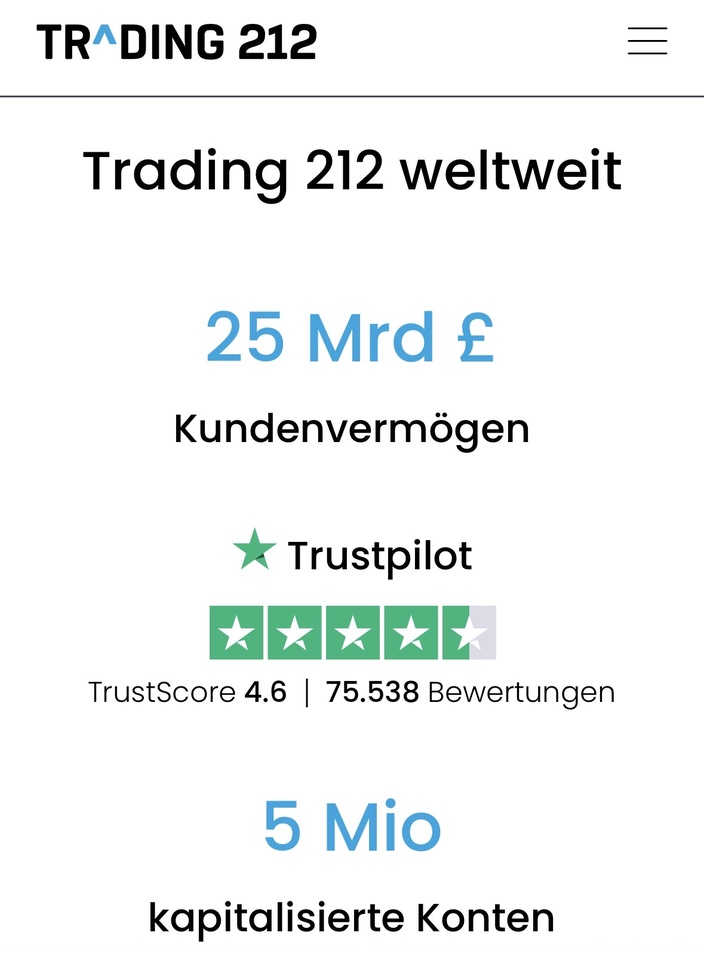
Trading 212 Pies
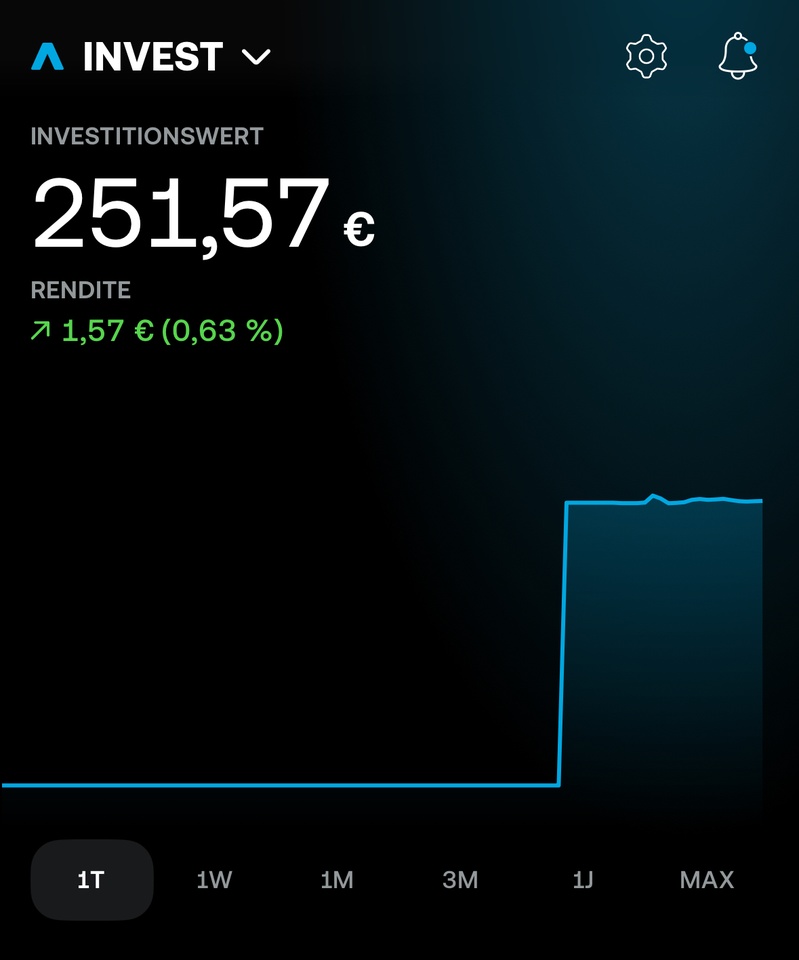
I had already flirted a few times with posts about Trading 212 and the possibility of creating pies to open a portfolio and yesterday after the post of @Novius finally went through with it (kiss goes out). The opening was also very easy with just a few clicks, only the flash transfer was rejected yesterday by my Sparkasse app and was credited to the broker this morning.
The year is only 12 days old and I've already broken all my New Year's resolutions not to take on any additional individual securities for the time being and to put more money into the good $GERD (-0,75 %) in addition to the savings plans. Instead, the money went into Salesforce $CRM (-0,59 %) and BB Biotech $BION (+0,38 %). I have no idea why I lack the discipline to invest. Maybe it will get better in
February... Maybe it will get better with the Pie 🥸
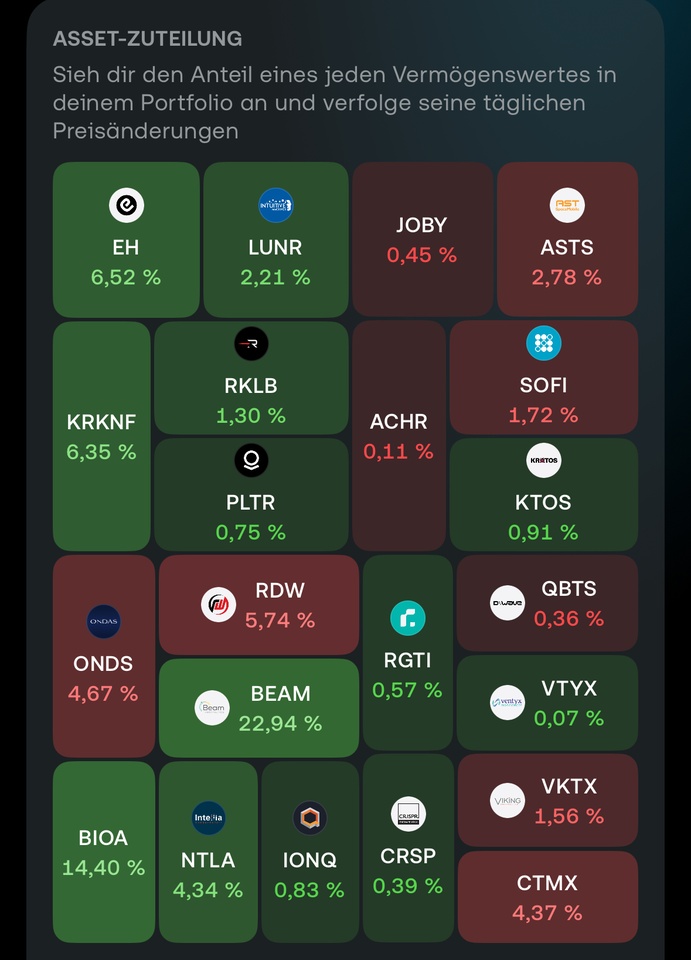
I'm only using Trading 212 as a gimmick for the time being and have picked speculative individual stocks from six sectors/thematic areas that have actually run too hot for me (the classic community stocks 😃) and would only find their way into the portfolio in the event of a setback.
would only find their way into the portfolio in the event of a setback or whose business model I don't understand (quantum computing, biotech) and therefore have no place in the portfolio without research.
Most of the stocks will be familiar to you. I will therefore refrain from describing them. With the exception of biotech. Since Gemini really had to serve as an advisor for individual stocks. However, I also had $VTYX an egg in my portfolio where the takeover modalities are already set at 14 $/share.
1. Quantum: IonQ, D-Wave, Rigetti.
2. Space: Rocket Lab, Intuitive Machines, Redwire, AST SpaceMobile.
3. defense (autonomous): Kraken Robotics, Ondas, Kratos.
4. Future Mobility: Joby Aviation, Archer Aviation, EHang.
5.. Disruptive Tech: Palantir, SoFi.
6. biotech & genomic revolution (2026 candidates)
- Viking Therapeutics ($VKTX (-3,03 %) ): Hottest candidate in the obesity market (weight loss drugs); considered the No. 1 takeover target for Big Pharma.
- Beam Therapeutics$BEAM): Pioneer in "base editing"; more precise gene correction than the first CRISPR generation; focus on sickle cell anemia.
- Intellia Therapeutics ($NTLA (-4,2 %)
): Leader in "in vivo" editing (healing takes place directly in the patient's body).
- Ventyx Biosciences $VTYX
): Specialist in immune and inflammatory diseases; currently the target of a billion-euro takeover by Eli Lilly.
- BioAge Labs ($BIOA (-2,03 %)
): Focus on longevity and metabolism; uses AI to research anti-ageing therapies.
- CytomX ($CTMX (-5,21 %)
): Develops "masked" antibodies that only become active in tumor tissue in order to massively reduce side effects.
- CRISPR Therapeutics ($CRSP (+1,14 %)
): The market leader in gene scissors; first commercial approvals for genetic defects already obtained.
9Lun·
Pies for the GQ community?
A few weeks ago - based on a post by @Hotte1909 - about Trading 212 and the possibility of pies for the community. Since then, I have been investing in a dividend pie every month.
Perhaps it would be interesting for the active GQ members to create their own pies, which can then be copied / used by the other - e.g. more passive - members?
For example, I myself would be interested in the one or other investment idea from @Tenbagger2024 | @SAUgut777 | @Klein-Anleger | @Multibagger | @Shiya and others. But everything has its 💰limits. Others may feel the same 🙂.
Perhaps pies from the above-mentioned "active people" could help to participate in the ideas, within the limits of their own financial means?
99
4 Comentarios
9Lun
For me it's initially "just" a securities account to play with and the securities will therefore be managed separately from my B&H securities account at TR. Let's see what happens...
•
11
•9Lun·
Kommer lowers the TER
From December 2025, the total expense ratio (TER) of the Gerd Kommer ETFs ($GERD (-0,75 %)
$K0MR (-0,74 %) ) was reduced to 0.45% p. a.. This is due to the rapid growth of the fund volume, which has exceeded the USD 1 billion mark within a short period of time. The resulting economies of scale are passed on to investors.
In addition, the ETF now benefits from the implementation of a securities lending program, as is customary for large funds. An above-average 80% of the additional income generated as a result flows into the fund assets, thereby increasing the financial benefit for investors.
2323