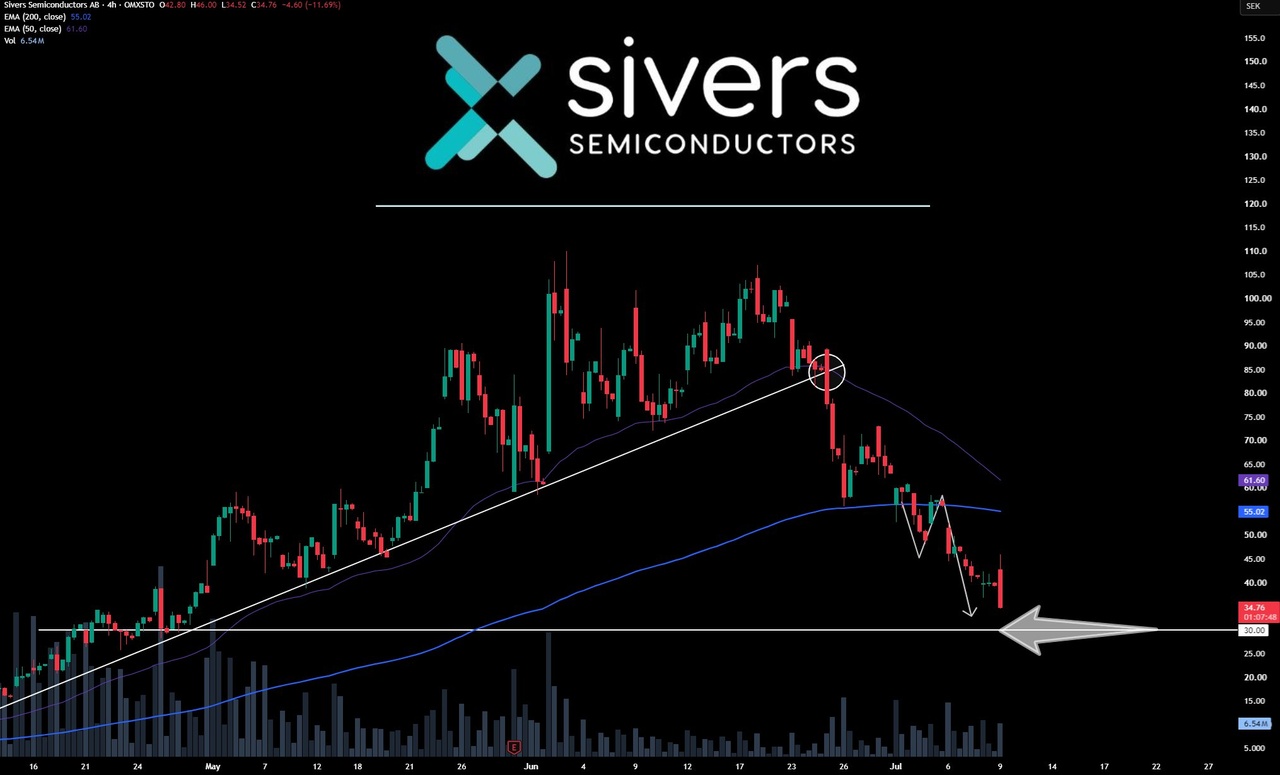
After share price drowned to 2.3€ mid July.
the bulls appeared roaring claiming for a new all time high

Puestos
16$SIVE (-0,18 %) Not sure if it was the best bet but my guts tell me it touched a hard bottom.
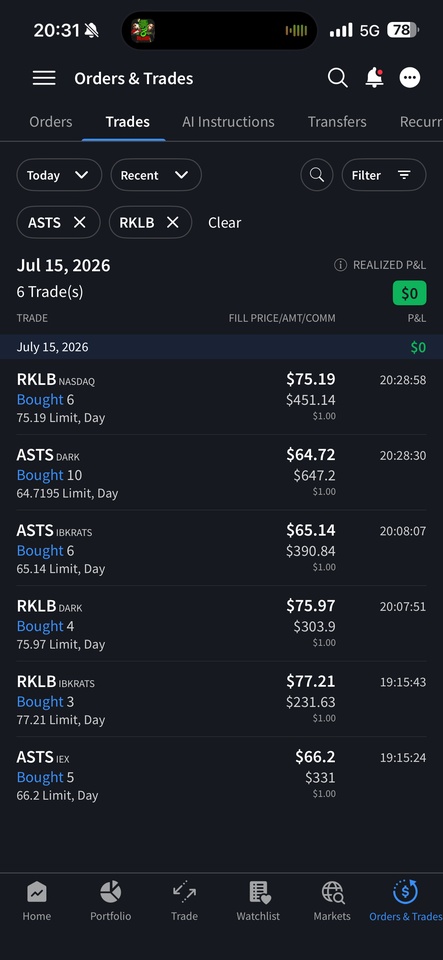
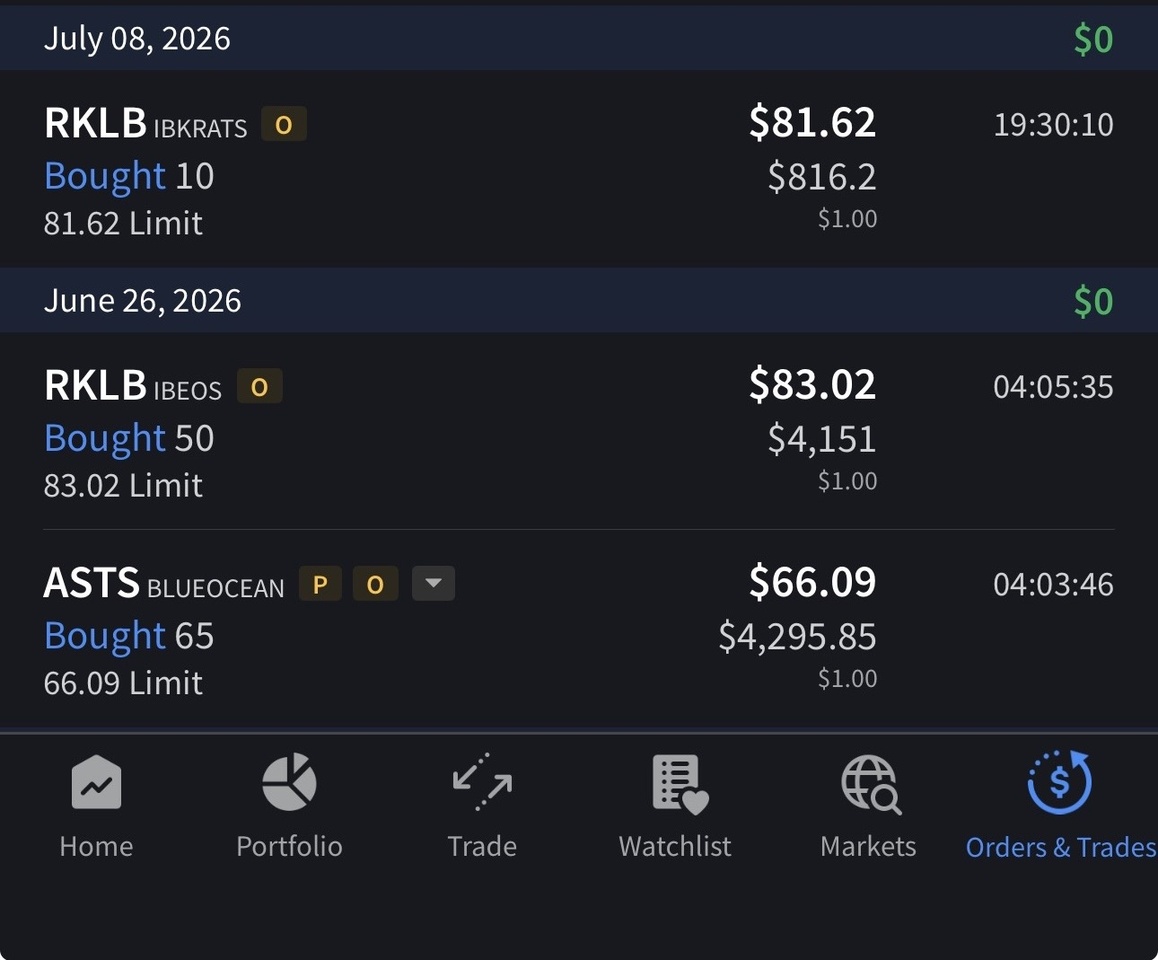
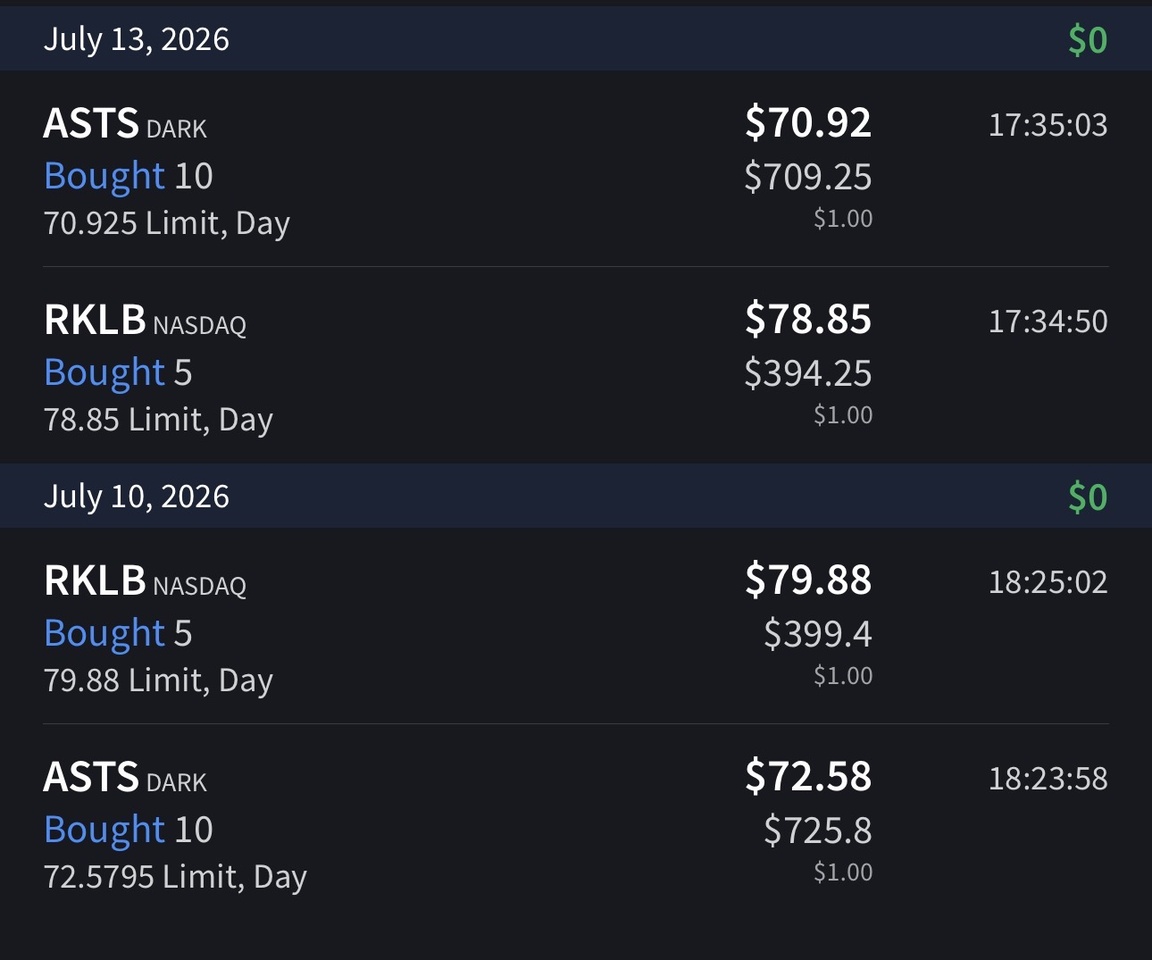
Im building a very high risk/high growth portfolio, im very aware of that. But I’m young, have a very long way to go and I can stomach volatility. I’m betting on two of the most explosive, capital-expensive trends of the decade: space economy and photonics/semis.
This portfolio is being built to capture multibagger asymmetric returns. However, the coming months won’t be easy to stomach, having 5% to 10% days in the portfolio.
My bull case scenario: $100K to $120K in the coming years without further deposits
My bear case scenario: $10K to $25K
I will never be content with 8% a year returns, I’m here to make gains that can change my life. If it does not play out, I still have a family, a job, a home and a healthy life.
$RKLB (-1,23 %)
$ASTS (-1,84 %)
$AAOI (+2,08 %)
$FLY (-2,95 %)
$SIVE (-0,18 %)
The waiting is finally over, decided to get back in on $SIVE (-0,18 %) , down almost 65% from its ATH.
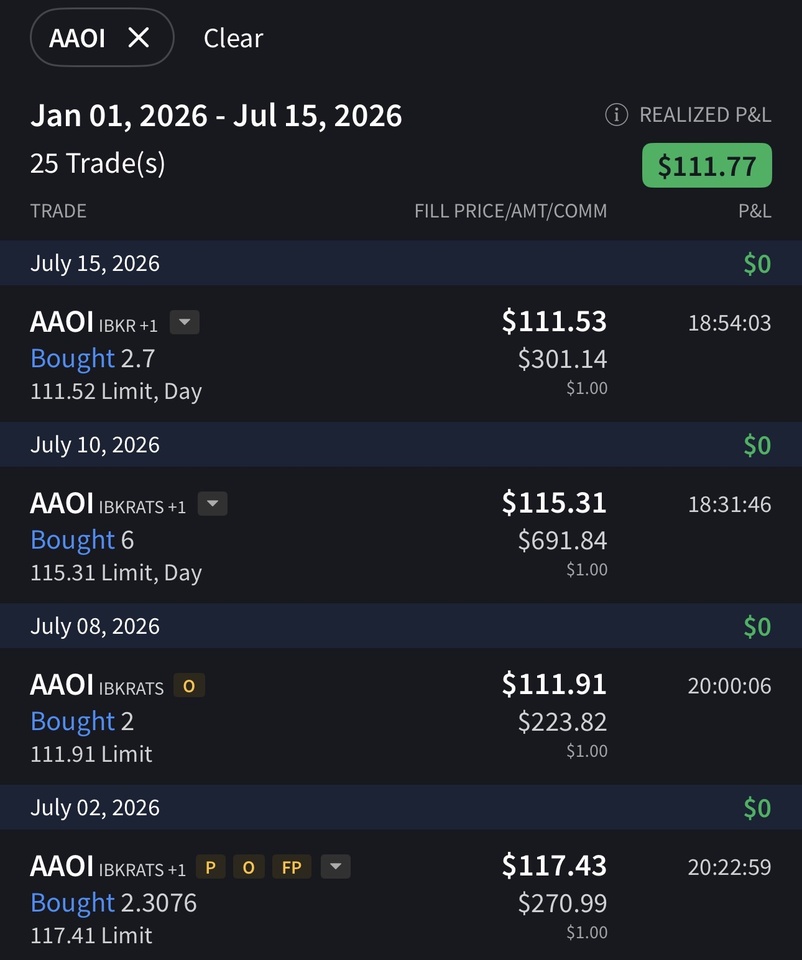
Today’s price action suggests momentum shifting from semis to mag7, but I rather much being a contrarian and position myself accordingly. I don’t expect a quick turnaround, I’ll buy more if it dips. Also, continuing to add more $AAOI (+2,08 %) , planning to increase even more my stake in the company if it goes below $100. I expect them to crush earnings coming early August.
Over $SIVE (-0,18 %) the past few days, you can see just how quickly prices can move with such rocket-like gains. I became aware of the company through several posts by our good friend, the Next Limits Wiki operator @ScaleLimits . I find the business model exciting, but after a gain of over 3,000% in just one year (congratulations again to @ScaleLimits for getting in early and, more importantly, for locking in profits), I decided to sit this one out for now. Now, the annual performance has dropped to “just” 1,300% within a few days. If the price reaches €4 or below, it might be worth considering getting back in. We’ll see.
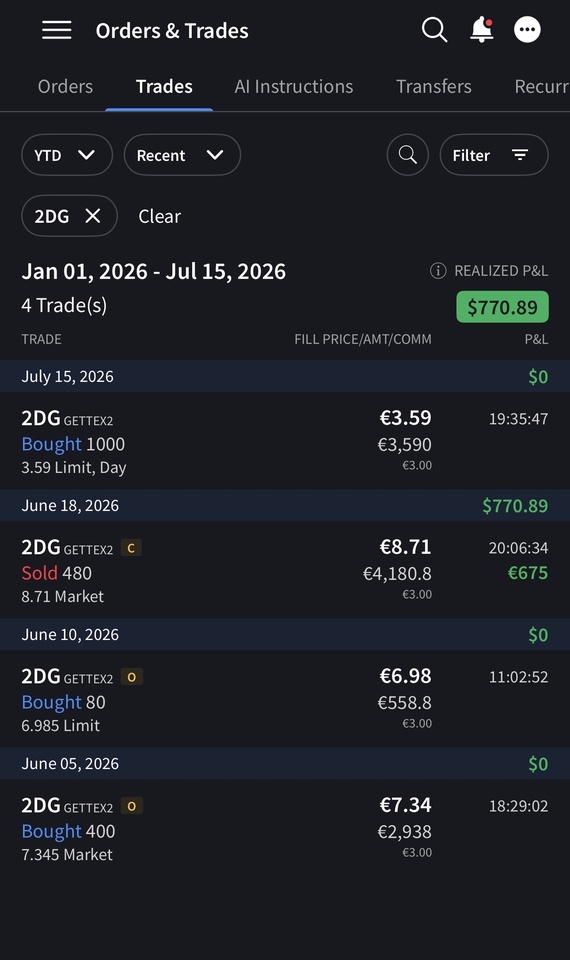
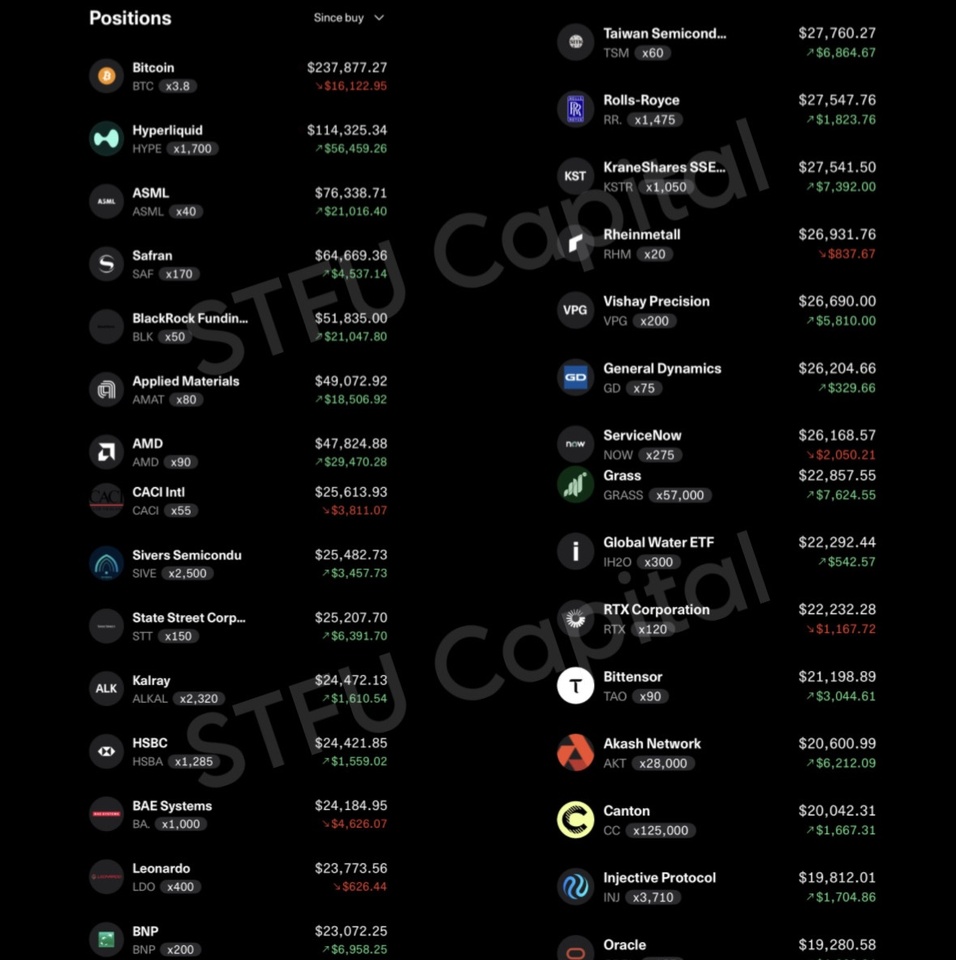
I’ve seen various people wondering if we ever make money considering our, sometimes sudden and repetitive moves, so here’s a screenshot montage of a part of our portfolio from 3 days ago.
These screenshots alone show cumulative profits of ~$214,021 and cumulative losses of ~$29,239.
This is not to flex, brag or anything, this is to provide context. We’re a team, and when there’s a concern that is raised about an asset, or a suggestion, we have to acknowledge it and act accordingly. We have no problem changing parts of the portfolio, readjusting positions and strategies or selling/buying assets in a short period of time. The whole organization is built for this.
Last week, I decided to reduce the size of some positions in my portfolio in order to invest more in the current AI boom.
This involved 35 $BRK.B (+0,28 %) and 350 $SHEL (+1,17 %) shares were sold from my portfolio.
The following additions were made:
I didn’t quite time the entries perfectly in some cases, but let’s see what happens over the next few months and in 2027/2028. I’m curious to see how it goes.
In addition, the following stocks are on my shortlist for future purchases:
Have a nice evening, everyone!
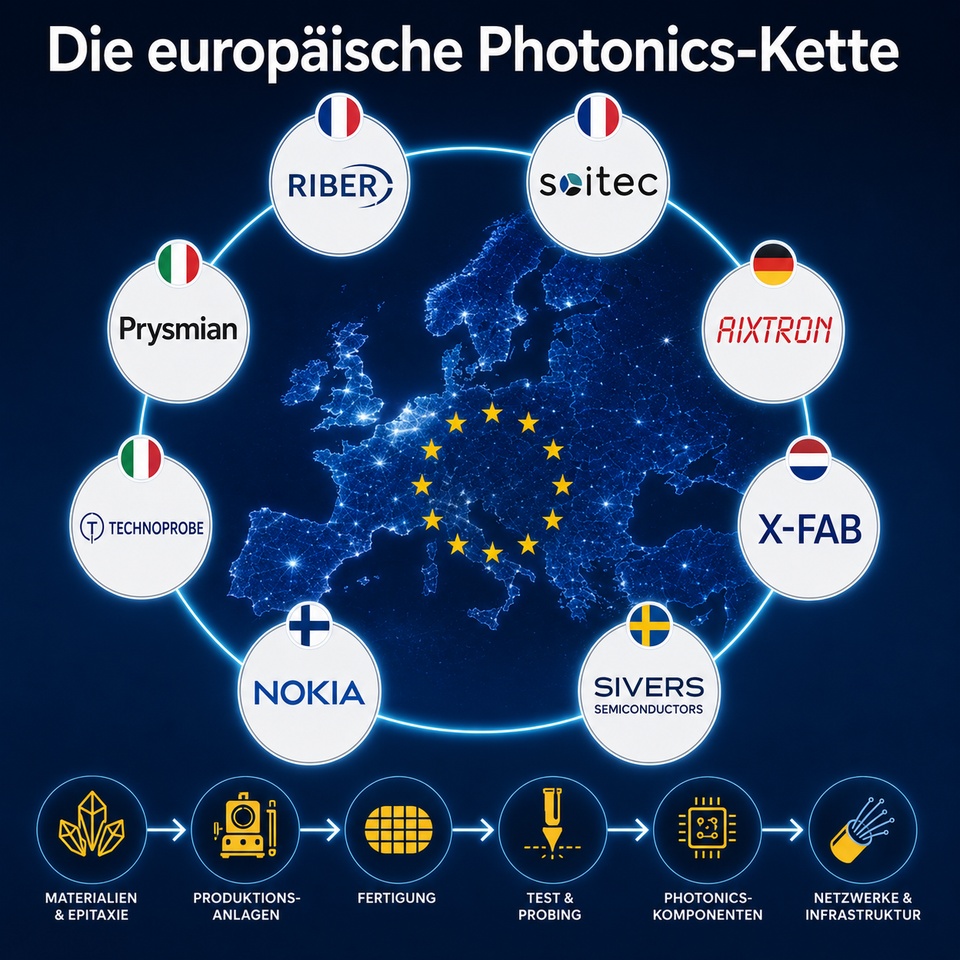
Probably not. Perhaps a European photonics cluster. When people talk about AI, it’s usually about NVIDIA, data centers, or the next language models. At the same time, something exciting has happened in Europe: In the planned Chips Act 2.0 , photonics has been explicitly named for the first time as a strategic field of the future.
This comes as no surprise. After all, modern AI systems need more than just computing power. Above all, they must process ever-larger amounts of data quickly, reliably, and energy-efficiently. This is precisely where a future infrastructure bottleneck could emerge.
What I find exciting is that (with the exception of X-Fab and Nokia) my own portfolio and, to some extent, the bottleneck wikifolios already include several European companies that together almost form a complete photonics value chain :
🇫🇷 Riber
$ALRIB (-3,69 %)
MBE systems for the production of highly specialized III-V semiconductors.
🇫🇷 Soitec
$SOI (+0,19 %)
Specialty substrates and wafer technologies as the foundation for photonic integration.
🇩🇪 Aixtron
$AIXA (+2,62 %)
Production equipment for InP, GaN, and other photonics applications.
🇳🇱 X-Fab
$XFAB (-9,24 %)
European foundry expertise for sensor technology and photonic applications.
🇸🇪 Sivers Semiconductors
$SIVE (-0,18 %)
Photonics and high-frequency chips for data transmission.
🇮🇹 Technoprobe
$TPRO (+0,65 %)
Probe cards and test solutions for increasingly complex semiconductor structures.
🇫🇮 Nokia
$NOKIA (+0,86 %)
Optical networking technologies for the next generation of data transmission. The acquisition of Infinera makes Nokia an increasingly relevant European player in the field of optical networking.
🇮🇹 Prysmian
$PRY (-0,58 %)
Fiber-optic infrastructure as the physical backbone of digital data transmission.
Taken individually, some of these companies seem rather unremarkable. Taken together, however, they tell a different story. Not that of a continent that has fallen behind. But rather the story of a potential European photonics ecosystem in the making.
Whether this will actually give rise to global champions, no one knows today. But that is exactly where I look for bottlenecks: one level below the obvious winners. Where new technologies are made possible in the first place.
⚠️ Not investment advice.
$SIVE (-0,18 %) who's holding this?
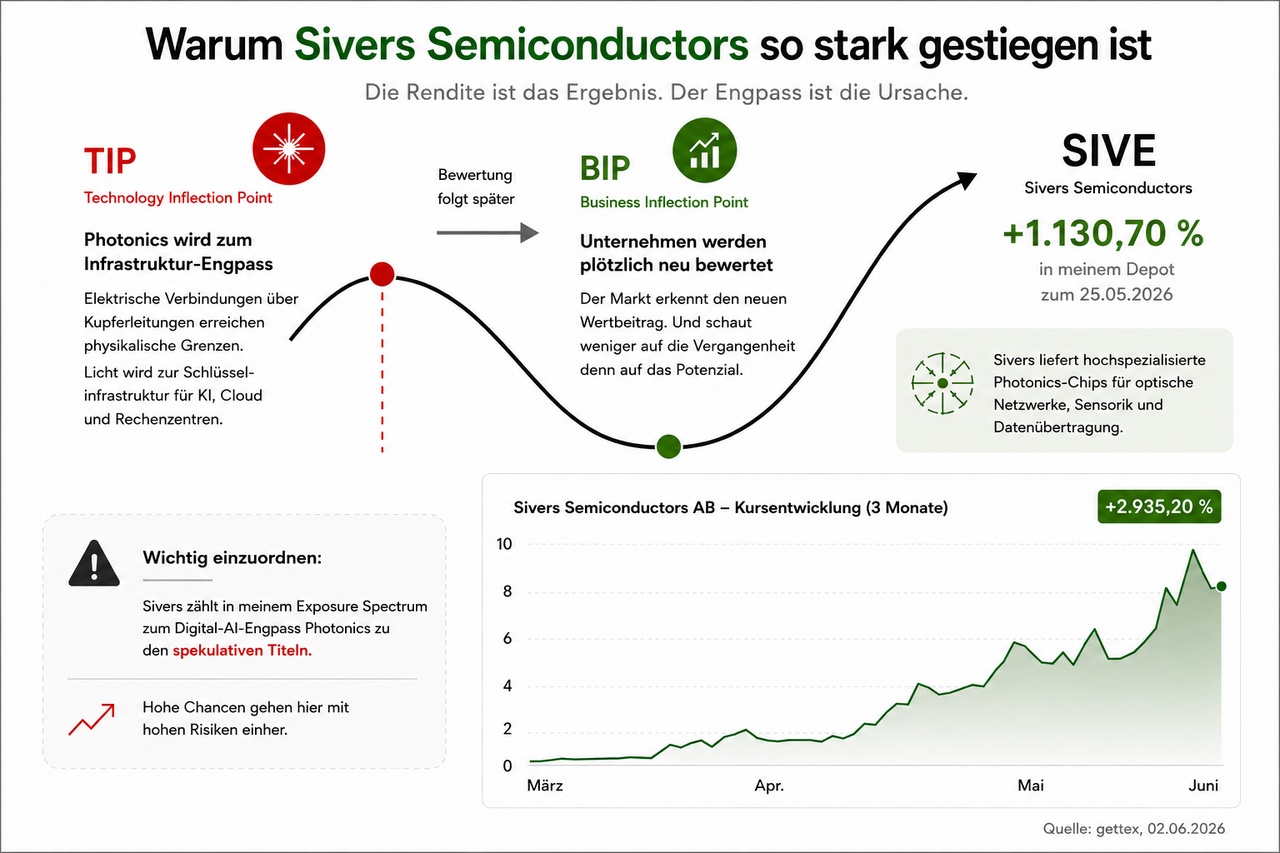
If you only look at the price trend, you will see a classic high flyer. If you dig a little deeper, you will see something else: a potential possible infrastructure bottleneck that is just beginning to become economically relevant.
For me, the development of $SIVE (-0,18 %) well explained by two terms:
🔴 TIP = Technology Inflection Point
A technology inflection point occurs when a technology goes from being an interesting niche solution to a potentially indispensable infrastructure.
This could currently be the case with photonics could happen. AI systems are generating ever larger data streams. At the same time, electrical connections via copper are increasingly reaching their physical limits. Energy consumption, heat and signal losses are increasing.
This is why the industry is investing heavily in optical data transmission. Light instead of electricity. Photonics is therefore increasingly developing from a specialist topic into a potential AI infrastructure bottleneck.
🟢 GDP = business inflection point
The business inflection point often comes later. It occurs when companies suddenly benefit economically from this technological change. also benefit economically.
New orders.
New customers.
New sales potential.
New valuations.
A current example is the example is the collaboration between Sivers Semiconductors and GlobalFoundries that was announced today. This is interesting for me because such partnerships can show that a technology is finding its way out of the development phase and towards industrial scaling.
This is precisely the point at which a reassessment by the market. The market then looks less at the past and more at the question: "How big could this market become if the technology catches on?"
Nevertheless, it remains important that Sivers is still one of the speculative stocks in my exposure spectrum. speculative stocks in my exposure spectrum. The company is not an established infrastructure heavyweight like Coherent. It is much earlier in the cycle. The opportunities are therefore greater.
But so are the risks.
For me, Sivers therefore remains above all a bet that the current technology inflection point will eventually become a sustainable business inflection point.
After all, returns are rarely generated when everyone is convinced. They often arise when a new infrastructure bottleneck is just becoming apparent.
Incidentally, Sivers is also my driving force in the NextLimits wikifolio with a current gain of 822%.