$AXTI (-13,96%) 18%
$MP (-3,12%) 19%
$COHR (-13,5%) 24%
All of them sold yesterday.
+20k$
Not bad 👌
$NBIS (-8,87%) already with a stop loss on more 5,5k gains.

Postos
11$AXTI (-13,96%) 18%
$MP (-3,12%) 19%
$COHR (-13,5%) 24%
All of them sold yesterday.
+20k$
Not bad 👌
$NBIS (-8,87%) already with a stop loss on more 5,5k gains.
https://www.aol.com/articles/exclusive-trump-administration-drafting-ban-100549000.html
"The Federal Communications Commission, which oversees the U.S. telecom industry, is working on the measure to bar imports of new Chinese optical transceivers, which allow data to travel over fiber-optic cables at the speed of light within data centers. Officials hope to publish it this year, when it would take effect."
Who's affected: $AXTI (-13,96%)
$GLW (-8,54%)
$AAOI (-13,31%)
$COHR (-13,5%) and $SIVE (-13,3%) let's see how this will play out
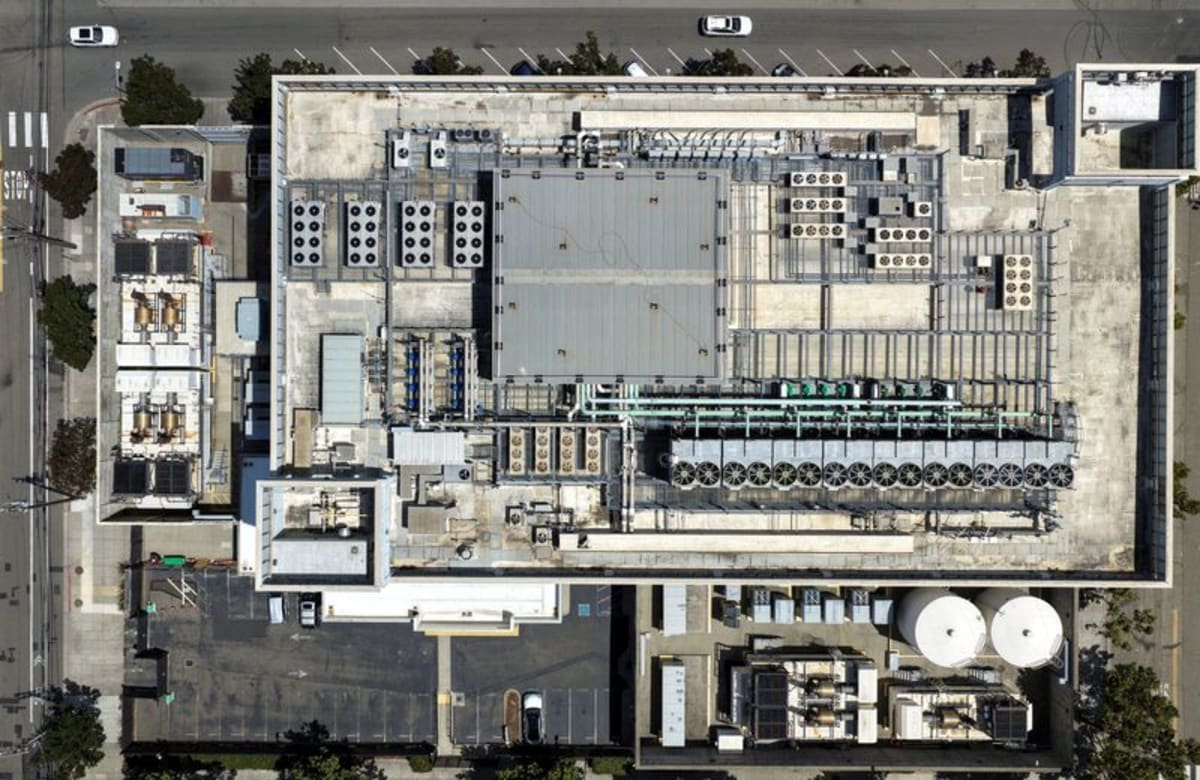
Days like today come with the territory.
If you want to participate in a bull market you have to be prepared for volatility, drawdowns, and pullbacks.
You can’t just have the benefit of participating in a bull market without the risk and moments like this. If it was a risk free and volatility free way to make money everyone would do it, but they don’t.
Most people invest in index funds, they don’t capture a move like $SNDK (-10,61%)
$MU (-6,95%)
$NBIS (-8,87%)
$AXTI (-13,96%)
$RKLB (-5,71%) etc.
If you want to trade or invest in individual stocks you have to accept the risk and volatility that comes with individual stock picking.
It’s all part of the game.

Last week, I decided to reduce the size of some positions in my portfolio in order to invest more in the current AI boom.
This involved 35 $BRK.B (+1,79%) and 350 $SHEL (+0,55%) shares were sold from my portfolio.
The following additions were made:
I didn’t quite time the entries perfectly in some cases, but let’s see what happens over the next few months and in 2027/2028. I’m curious to see how it goes.
In addition, the following stocks are on my shortlist for future purchases:
Have a nice evening, everyone!

Hey community,
I am 24 years old, a student and have been actively investing for almost two years. Like many people, my goal is simply financial freedom and not to depend on the pension system later on
I follow a hybrid strategy: a stable ETF core combined with concentrated individual stocks where I have real conviction. No active trading, but buy and hold, unless I notice that a share is getting hot, then I sell and buy again at a lower price when it has corrected.
My underlying strategy:
in the first few years, I blindly followed many trends and other "finfluencers" and didn't always make good and wise decisions as a result. When I invest in individual stocks now, I do so with conviction and that they are future-oriented and will bring me long-term returns.
I would like to reduce the USA share to ~55% in the medium term
I have around €2,500 in cash that I would like to invest now. On my watchlist: $ISRG (+3,58%) Intuitive Surgical , $ACN (+6,13%) Accenture, Space X and $POET (-6,51%) Poet Technologies $AXTI (-13,96%)
I know it's not an exciting portfolio rather basic but maybe I would like to change that :)
I am grateful for any honest feedback, even if it is uncomfortable.

1. $AXTI (-13,96%) +761%
Catalyst: $632M equity raise to double indium phosphide capacity. Pure-play AI optical infrastructure InP substrates are the critical supply bottleneck for AI data center connectivity. Record $100M+ backlog.
2 $SNDK (-10,61%) +523%
Catalyst: Nasdaq-100 inclusion + blowout Q3 earnings ($5.95B revenue, 3.5× YoY). AI data center storage supercycle NAND prices rising 234% in 2026 per Gartner. $42B in long-term supply deals signed.
3. $AAOI +421%
Catalyst: Hyperscaler demand surge for fiber-optic transceivers driving AI data center buildouts. Applied Optoelectronics became the top-performing large-cap stock as the optical networking supercycle took hold.
4. $AEHR +371%
Catalyst: New silicon photonics customer win (March 31) ordering multiple FOX-XP burn-in systems for high-volume production. Record $50.9M backlog. Direct beneficiary of the optical transceiver boom.
5. $NVTS +310%
Catalyst: GaN/SiC power platform showcase for AI data centers at PCIM 2026. Revenue inflection as design-wins with hyperscalers and Nvidia Blackwell rack systems begin to ramp. Q1 beat on revenue + EPS.
6. $BE (-16,03%) +248%
Catalyst: $2.6B partnership with European AI infrastructure company (May 2026). AI data center power demand making Bloom Energy's fuel cells a critical off-grid energy solution for hyperscalers.
7. $DOCN +229%
Catalyst: AI-driven cloud demand surge among SMB and startup developers. DigitalOcean's simplified GPU cloud offering became the go-to for AI builders who can't navigate hyperscaler complexity. Strong revenue reacceleration.
8. $INTC (-8,67%) +225%
Catalyst: CEO Lip-Bu Tan's foundry turnaround 18A node in HVM, Xeon 6 selected for Nvidia DGX Rubin systems, Apple + Terafab foundry deals. 6th consecutive earnings beat. Stock hit 26-year all-time high.
9. $WDC (-13,87%) +181%
Catalyst: Post-$SNDK spin-off refocus on enterprise HDD/flash. AI data center storage demand driving record HDD shipments. Rode the same memory supercycle as $SNDK rising NAND prices lifted all boats.
10. $ARM (-7,99%) +180%
Catalyst: AI chip designers shifting to ARM architecture for power efficiency. Royalty revenue acceleration as Arm-based AI accelerators and server chips proliferate. Near-total dominance of mobile + growing data center share.
11. $VIAV (-14,34%) +178%
Catalyst: Network test and optical component demand surging alongside AI data center fiber buildouts. Viavi's network visibility tools became essential as hyperscalers upgraded to 800G+ optical interconnects.
12. $MU (-6,95%) +163%
Catalyst: HBM (High Bandwidth Memory) for Nvidia GPUs Micron became the critical memory supplier for AI training chips. Analyst note: "HBM can be priced ridiculously high." Memory supercycle with AI-driven pricing power.
13. $LITE +157%
Catalyst: Optical transceiver demand for 800G/1.6T AI data center interconnects. Lumentum is the key bottleneck supplier for coherent optics hyperscalers have no alternative. Highest quant rating among top performers (4.99/5).
14. $NBIS (-8,87%) +157%
Catalyst: Q1 2026 revenue of $399M up 684% YoY. Raised 2026 guidance to 4GW+ contracted power. Nebius is Europe's leading AI cloud infrastructure play, backed by Nvidia and benefiting from US-centric hyperscaler capacity constraints.
15. $OSS (-4,23%) +148%
Catalyst: Q1 2026 revenue +55% YoY with record 51.6% gross margin. One Stop Systems provides rugged AI compute for defense and edge AI defense contract wins accelerating. Lake Street, Roth Capital, and Alliance all raised targets to $18.
Every winner on this list is an AI infrastructure play.

Many AI investors are primarily looking at GPUs, memory or energy supply. I believe that the next big bottleneck is already slowly emerging: Photonics.
The background: modern AI systems have to move ever larger amounts of data. However, classic copper cabling is increasingly reaching its physical physical limits. Energy consumption, heat generation, signal losses and susceptibility to errors are increasing massively. This is why the industry is moving step by step towards light instead of electricity.
NVIDIA is now visibly driving this development forward. The company is investing billions in optical infrastructure and partners in the field of AI photonics. (For example, Lumentum and Coherent are currently benefiting from a 2 billion dollar investment each).
For me, this is therefore likely to be the next big upcoming AI bottleneck. What I find particularly interesting is that photonics does not consist of just one area. There are very different levels of risk and maturity within the stack.
Level 1: Established photonics infrastructure
This is where the more stable infrastructure players are located. Companies such as $COHR (-13,5%) (Coherent), $LITE (-12,38%) (Lumentum), $CIEN (-10,87%) (Ciena) or even $FN (-11,45%) (Fabrinet) are already benefiting from the fact that optical systems are increasingly moving into AI data centers.
This is mainly about:
Level 2: Optical Interconnects & Data Center Connectivity
A field in which there is currently a lot of momentum. AI clusters require ever faster connections between GPUs, storage and switches. I'm thinking of companies like $AAOI (-13,31%) (Applied Optoelectronics), $ANET (-7,81%) (Arista Networks) or in some cases also $5802 (-5,78%) (Sumitomo Electric). Optical interconnects could develop into a central AI bottleneck in the next few years.
Level 3: Materials, substrates & manufacturing bases
This area usually receives much less attention, although it is here that important prerequisites for modern photonics systems are created. Photonics requires highly specialized materials, new substrates and precise manufacturing structures. I find companies such as $AXTI (-13,96%) (AXT), $SOI (-11,19%) (Soitec), $5802 (-5,78%) (Sumitomo Electric) or in some cases also $TSEM (-11,42%) (Tower Semiconductor).
Materials such as indium phosphide (InP), special wafer technologies and optical integration platforms are becoming increasingly important as data rates and integration density rise. And the more complex optical systems become, the more relevant the future bottleneck of "test & metrology" becomes, because these structures have to be controlled and measured with extreme precision (see my last post).
Level 4: Optionality & Next Generation Photonics
The risk increases significantly here. At the same time, however, the potential leverage effect also increases. Companies such as $LWLG (Lightwave Logic), $SIVE (-13,3%) (Sivers Semiconductors), $INFQ (Infleqtion) or even $LASR (nLight) are working on technologies that could make future optical systems even more efficient or powerful. For me, these are not sure winners. But they are often the early technological options for the next wave of infrastructure. Incidentally, Sivers will soon also be listed in parallel on the NASDAQ.
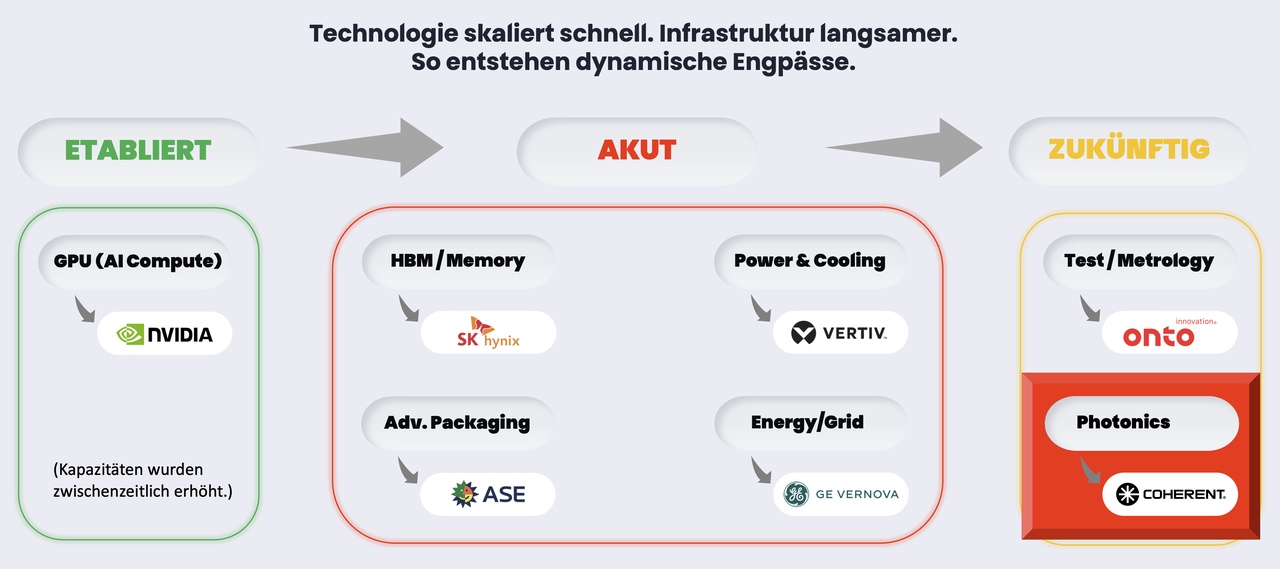
The exciting thing is that the AI bottleneck is shifting further and further away from pure compute and into the physical infrastructure of data movement.
Acute/Active:
HBM + Power & Cooling + Advanced Packaging + Energy/Grid
Future/Emerging:
Test & Metrology + Photonics
AI will not only need more computing power in the future. Above all, AI needs the ability to move gigantic amounts of data efficiently, quickly and stably.
A third AI bottleneck in the "future/emerging" category could already arise: Edge AI. More on this soon.

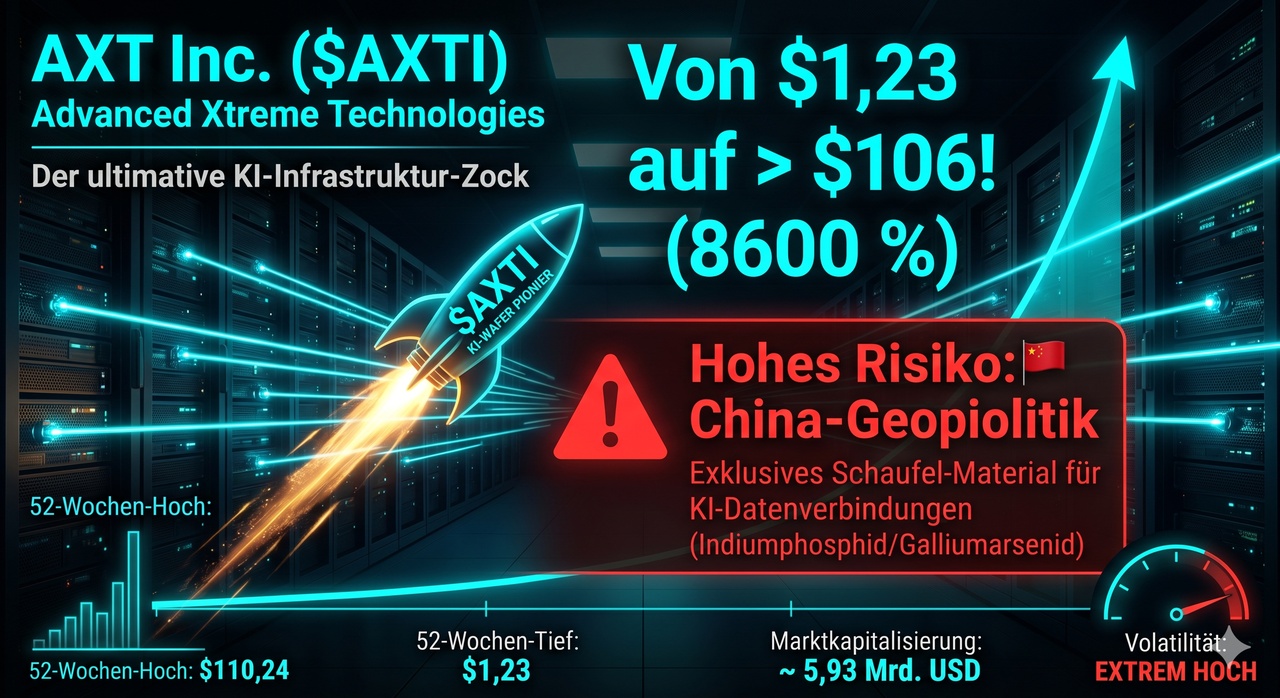
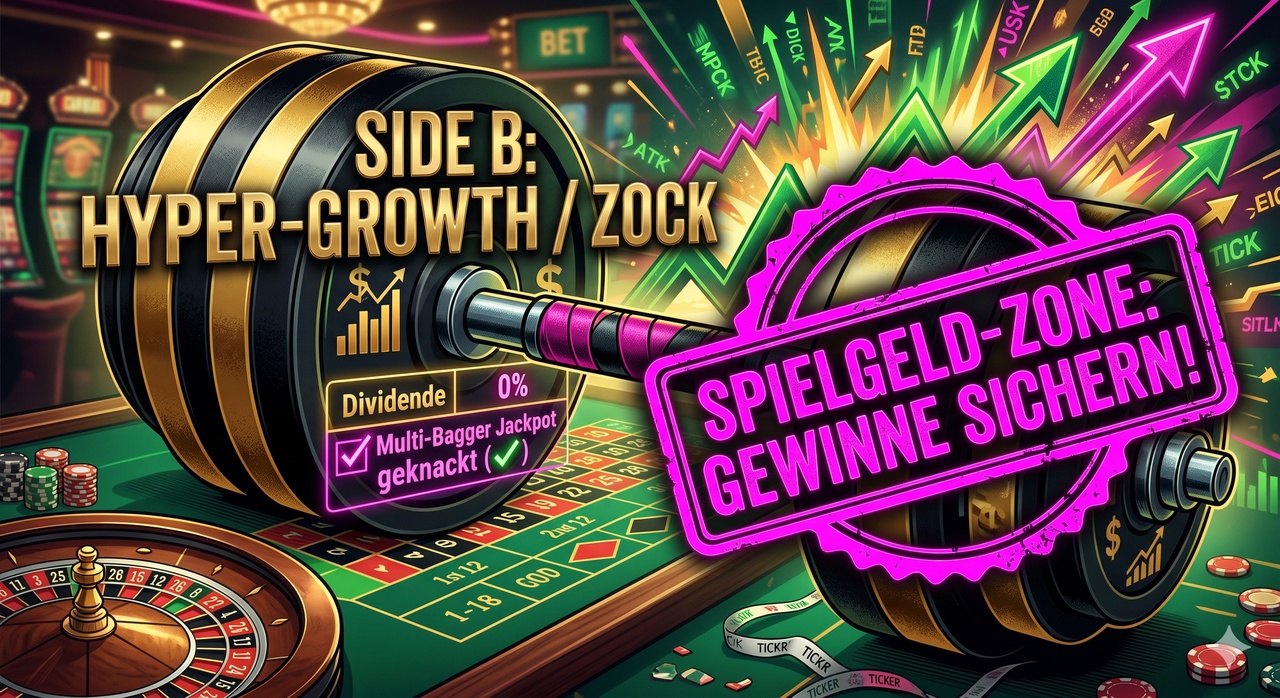
How do you make almost 8600% plus in one year? You buy a company $AXTI (-13,96%) that the market declared dead at USD 1.23 and that suddenly has a monopoly on a technology that the AI world desperately needs. Anyone who bought AXT Inc. at the bottom with play money can now pay off their house cold turkey at a price of around USD 106.80. This is not an investment for retirement, this is the most extreme form of Side B on our barbell, which has hit the absolute jackpot.
Disclamer: I was invested until 5 days ago and unfortunately had to sell the position from the German portfolio due to the move to Denmark. But don't worry, it was only play money at the time and I had already taken my profit out after 100%. In the end, it is the best performing stock I have ever had apart from the hydrogen era :) But don't worry, I didn't take 8000% with me either :(
It's funny that the share was never introduced here :)
1. what the company does
AXT grows wafers from indium phosphide (InP) and gallium arsenide (GaAs). This is the absolute bottleneck for the AI revolution. The massive amounts of data in AI data centers require optical connections (transceivers), and their lasers only work with the material of $AXTI (-13,96%)
2 The moat (The Chinese minefield)
AXT manufactures almost all of its products in China. The moat is therefore located in the middle of a geopolitical powder keg. If China stops exports, AXT will be on the front line of the economic war. It was this extreme risk that caused the share price to plummet to USD 1.23 - and made today's 8600% opportunity possible in the first place.
3. the bare facts & key figures
4. chart analysis of the last few months
The share has set its sights on the 52-week high. Exploding from USD 1.23 to this level is a parabolic ride that is almost unparalleled in history. The momentum is gigantic, but brutal intraday fluctuations are completely normal at this level.
5. the ice-cold formula check (quality & cash flow)
6. future prospects & catalysts
As long as Microsoft, Google and Meta pump billions into AI infrastructure, faster and faster optical transceivers will be needed. Without AXT's InP wafers, there are no data highways. That's the only fuel keeping this course rocket flying right now.
7 Competition & market environment
There are hardly any competitors who can supply InP wafers in this purity and scale. The market is small, but has suddenly become absolutely systemically relevant thanks to AI networking.
8. special entry zones (the "Bargain Hunter's List")
Anyone who buys after an 8600% rise is playing pure FOMO and taking full risk.
9. profit margins & scalability
Margins are currently scaling brutally because the fixed costs of the factories are minimal at full capacity. Every additional wafer that rolls off the production line is almost pure profit.
10. the geopolitical risk (the elephant in the room)
The absolute knock-out criterion. An export ban from China and the almost USD 6 billion market capitalization disappears into thin air faster than you can press "Sell".
11. the voices from the engine room (what the CEO says) CEO Morris Young is extremely bullish and proud of the turnaround. He sees AXT at the absolute beginning of a multi-year investment cycle for AI infrastructure. His key message: the copper frontier has been reached, the optical era has begun, and AXT is supplying the monopoly material.
12. the voices of the analysts
Wall Street ignored the share for years. Now they are panting after the share price with red heads. Almost all original price targets have been pulverized. Analysts are currently pricing in the absolute best-case scenario and completely ignoring the geopolitical risks because FOMO (Fear of Missing Out) is dominating the market.
13 Mr. Prompt's ice-cold conclusion (The 8000% reality check)
$$AXTI (-13,96%) has on the defensive Side A (income core) has lost nothing, absolutely nothing. But for the aggressive Side B it is the prime example of a lottery ticket that has hit the jackpot. From USD 1.23 to over USD 106 in one year is pure madness. Anyone who gets in now is buying an extreme drop and needs a stomach of steel.
Congratulations to those who were at the bottom! Secure your profits, pay off the house and let the rest go as an ice-cold free ride!
@Multibagger Did you know them?
@Get_Rich_or_Die_Tryin
@Tenbagger2024 and all the others :)

With this $NOC (+2,51%) $5,000 purchase, we’ve officially distributed all the profits ($76,000) from our previous $AXTI (-13,96%) position, across several positions :
$EWJ (-1,05%) ($30,000)
$TAO (-0,38%) ($15,000)
$IGLN (-2,9%) ($5,500)
$MCHI ($20,000)
$ORCL (-3,21%) ($700)
$NOC (+2,51%) ($5,000)
Selling AXT $AXTI (-13,96%) after a $27,000 profit to reevaluate the possibility of buying again if the price falls, or to rebalance to a less risky position. 🫡
Principais criadores desta semana