

The 40 DAX-listed companies are expected to pay out 53 billion euros this year—nearly one billion euros more than a year ago—and thus more than ever before.
This strong performance is driven by high corporate profits and unexpectedly rising dividends at a good dozen companies, including $ALV (+0,35%) Allianz, $MUV2 (+0,23%) Munich Re, and $RHM (+2,61%) Rheinmetall.
According to Handelsblatt calculations, DAX companies are expected to have earned 109 billion euros in net profit in 2024—the same amount as the previous year. Profit declines at the three automakers $BMW (+0,16%) BMW, $MBG (-0,78%) Mercedes, and $VOW (-1,78%) VW are offset by companies in other sectors, particularly the major insurers Allianz, Munich Re, and $HNR1 (-0,63%) Hannover Re, as well as $DTE (+0,75%) Deutsche Telekom, $HEN (+1,52%) Henkel, and $EOAN (+0,32%) E.ON.
More than a dozen DAX-listed companies have announced higher dividends than the market had previously expected. For example, $ALV (+0,35%) Allianz plans to pay out 15.40 euros per share, up from 13.80 euros the previous year. Analysts had forecast just under 15 euros. The insurer will thus distribute just under six billion euros—a record in the German corporate landscape.
The biggest jump is at $MUV2 (+0,23%) Munich Re: The reinsurer is raising its dividend by a full five euros per share to 20 euros.
The two healthcare specialists $FRE (+1,89%) Fresenius and $FME (+2%) Fresenius Medical Care, the brand-name manufacturer $HEN (+1,52%) Henkel, and the automotive supplier $BTR Continental, $CBK (-1,68%) Commerzbank, $RHM (+2,61%) Rheinmetall, and $HNR1 (-0,63%) Hannover Re have raised their dividends—in some cases significantly more than expected. Here, too, the reason is rising profits, which justify a higher share of earnings for shareholders.
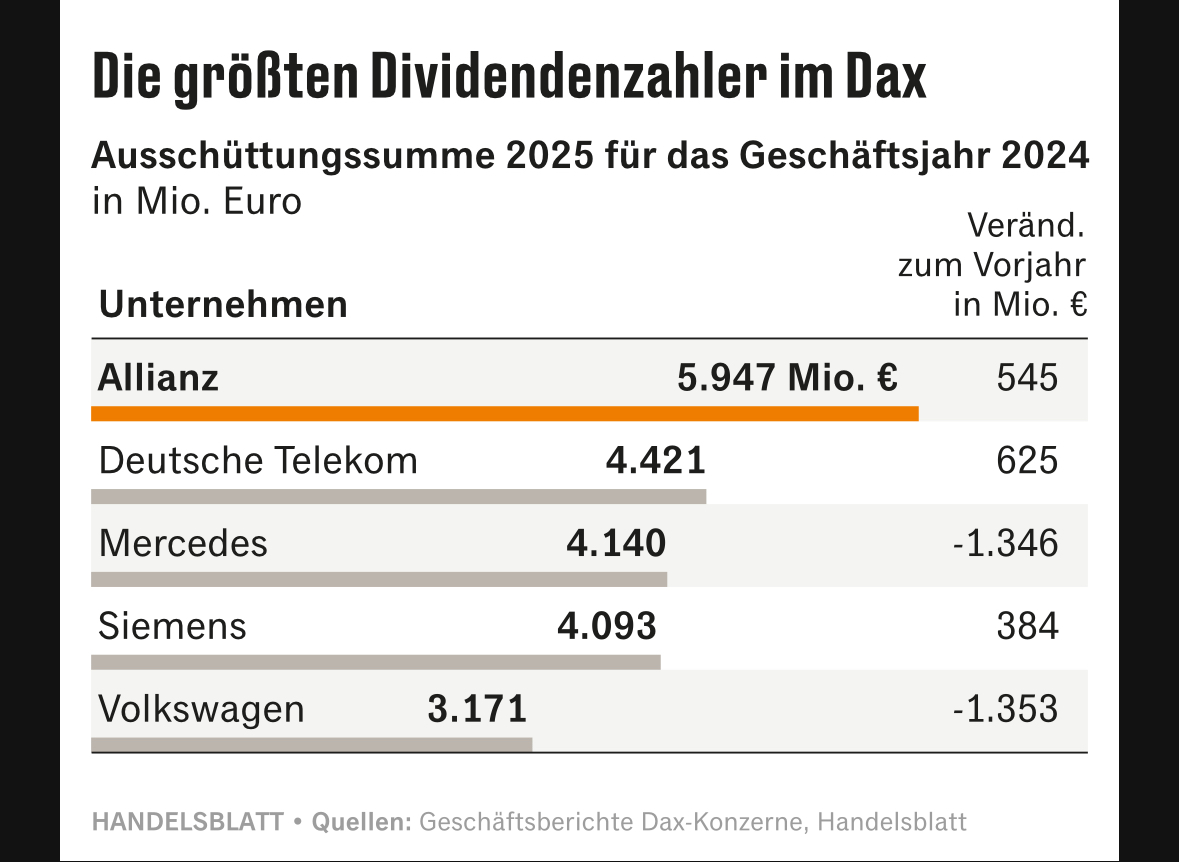
The largest dividend payers in the DAX are
Just like the automakers, a number of companies in the DAX remain below the internationally customary payout ratios, including the family-run conglomerates $BEI (+1,49%) Beiersdorf and $MRK (+2,16%) Merck. They distribute less than 30 percent of their profits. This leaves enough of a buffer to avoid having to cut dividends immediately during more difficult times.
Germany’s most valuable company, $SAP (+0,07%) SAP, is pushing the limit more with a payout ratio of 85 percent: a net profit of 3.1 billion euros last year was offset by a total dividend payout of 2.7 billion euros. However, the profit was impacted by a one-time effect.
So far, a total of 20 companies have increased their dividends, while only $BAS (+1,55%) BASF and the three automakers have cut them. Four companies have yet to announce their decisions: $RWE (-1,03%) RWE, $SY1 (+0,75%) Symrise, and $VNA (-0,23%) Vonovia are expected to increase their dividends, while analysts anticipate a reduction at $PAH3 (-2,49%) Porsche Holding, analysts expect a reduction.
Source (excerpt) & chart: Handelsblatt, March 15, 25