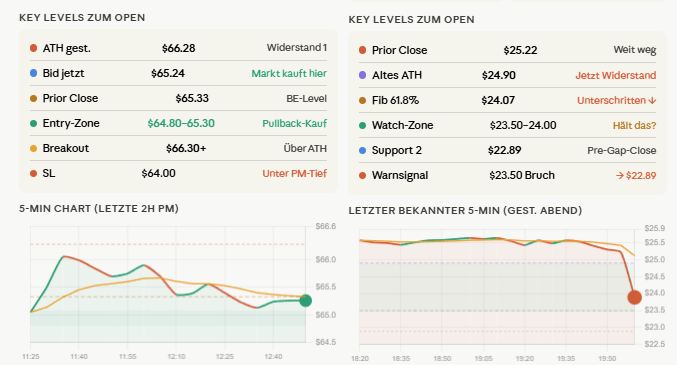
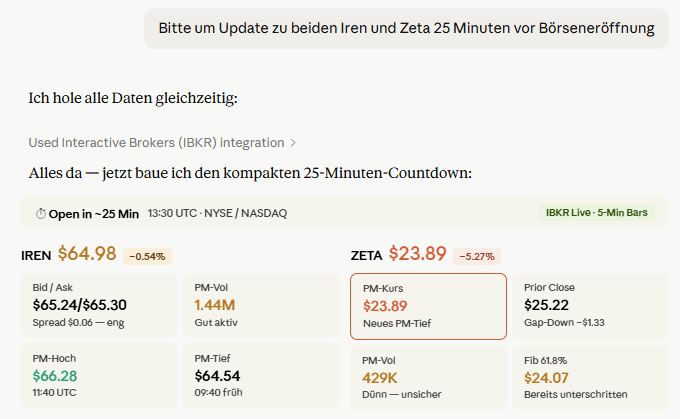
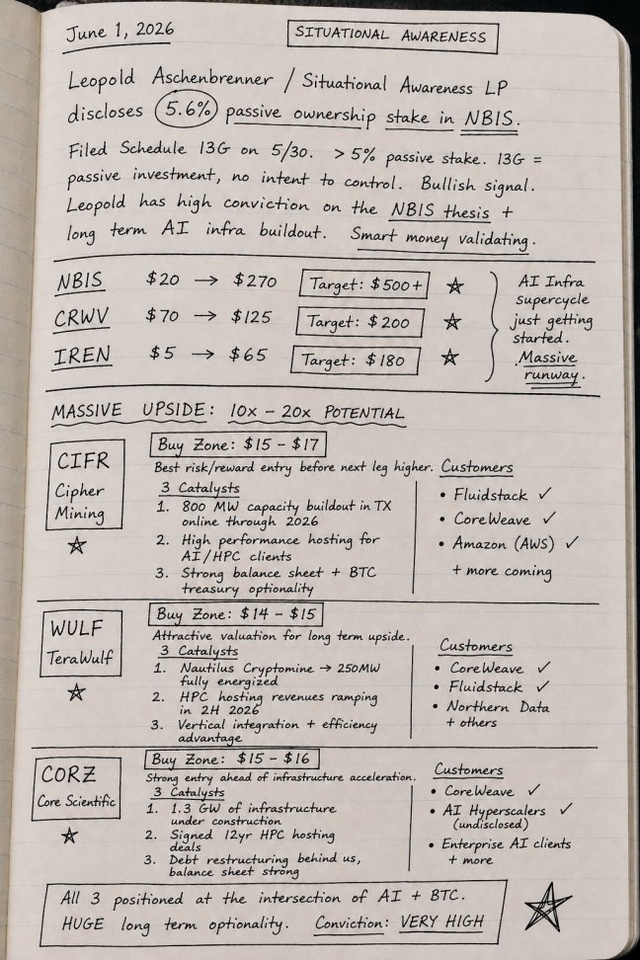
on $IREN (-6,36%) I exited via TSL. For such a hard core trade from last Thursday it went quite well with +66% despite a nightly KO outside trading hours
Iris Energy
Price
Discussione su IREN
Messaggi
438Good time to buy?
I would be interested in your opinion on Innodata and IREN. Are you invested?
Do you think now is a good time to invest? Especially with Innodata? Or do you think there is still room for downside?
I am already invested in Iren myself.
I would like to include Innodata in my portfolio as an "AI share". The need for training data for AI models will become even greater in the future.

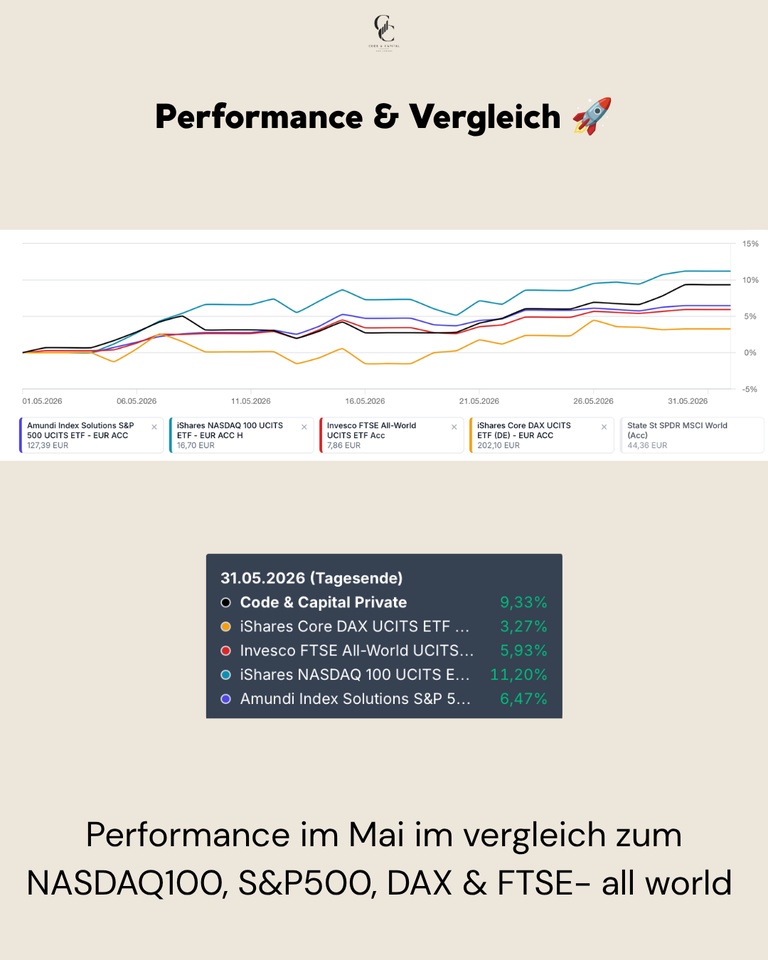
January review, 9.85% 📈
@Multibagger has put me to sleep with 10.33% miles 😛 Should I be ashamed now? 😏😬🙈
All joking aside, it was a volatile month,
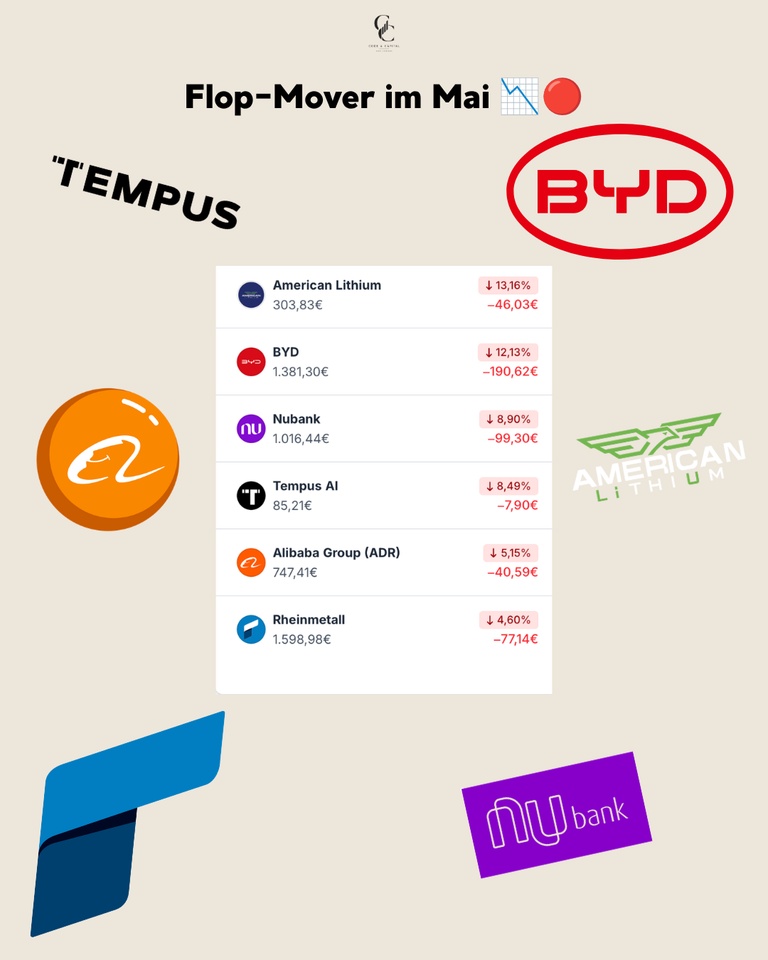
drivers were $IREN (-6,36%)
$RKLB (-5,12%) and $PNG (+1,2%)
The warrants on $ASML (-0,94%) and silver, as well as $HIMS (-8,71%) and $SOFI (+0%) ...
January performance is respectable but...
Nevertheless, I have decided to minimize the risk in my portfolio for the first time.
What did I do?
Stocks that I am not (or no longer!) 100% convinced of were removed from the portfolio and shifted into ETFs.
Thank goodness with a manageable loss.
ETF share increased and higher monthly savings, because I'm now an apprentice and earn more.
Savings as follows:
$COPX (+1,05%) is saved with 600€
$IWDA (+0,19%) with 400€
$XEMD (+0,44%) with 250€
250€ overnight money
In 3 months, my Volksbank membership in the amount of € 4800 will be terminated. This will then be used to buy shares again.
Until then, my securities account will remain: $IREN (-6,36%) , $RKLB (-5,12%) , $QBTS (-3,15%)
So: more safety, lower risk= better sleep, less headache
Review January 2026 📈📉
A few days before the end of January, I was still enjoying a 15% return - then it fell rapidly.
Nevertheless, I am satisfied.
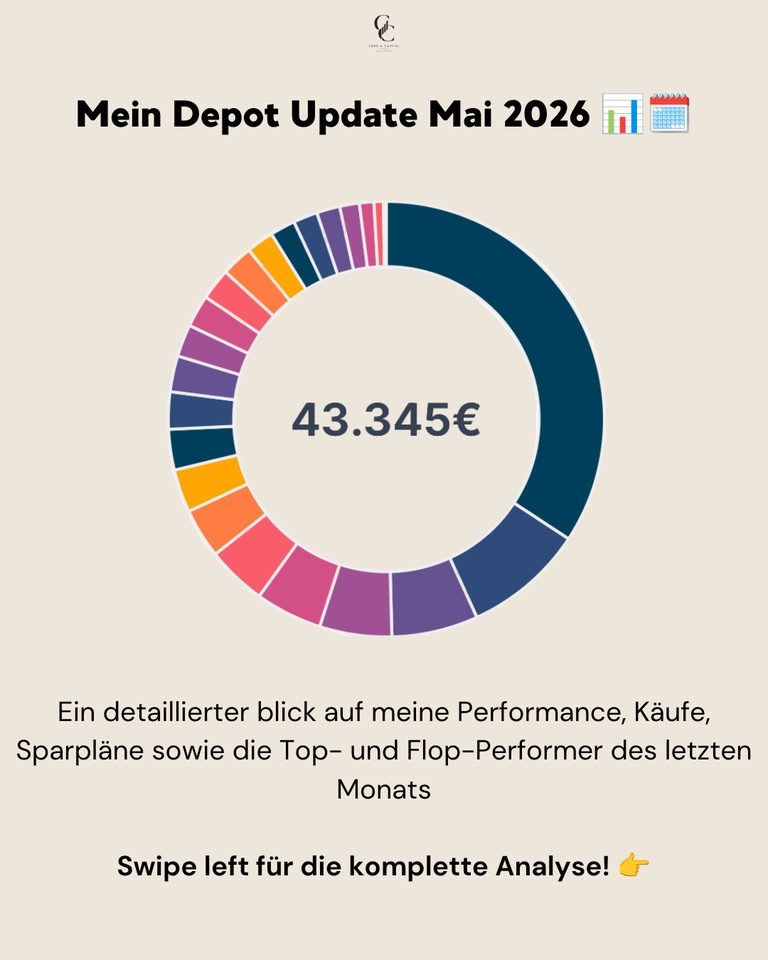
Below are the portfolio values and their performance in January:
Precious metals
$4GLD (-1,15%) ➕ 12,4 %
- Portfolio share: approx. 67 %
_________________________
Crypto assets
$BTC (-0,17%) ➖ 11,9 %
- Portfolio share: approx. 7 %
$ETH (-0,1%) ➖ 20,7 %
- Portfolio share: approx. 5 %
_________________________
Individual stocks
$IREN (-6,36%) ➕ 24,6 %
- Portfolio share: approx. 2.3 %
$PNG (+1,2%) ➕ 17,3 %
- Portfolio share: approx. 4.3 %
$CVX (+0,01%) ➕ 12,3 %
- Depot share: approx. 0.9 %
$RKLB (-5,12%) ➕ 4,3 %
- Depot share: approx. 5 %
$SOFI (+0%) ➖ 17,8 %
- Deposit share: approx. 1.9 %
$HIMS (-8,71%) ➖ 19,8 %
- Deposit share: approx. 1.3 %
To a new
$IREN (-6,36%) Saved €20 on the last mishap and got out.
40 € plus made with $PLTR (-2,28%) and made virtually no loss. I should have let it run, got out too early.
Derivatives strategy
Hello dear community,
As I am often asked what I look for in my derivative trades and what my strategy is, I would like to share a few basic things with you.
First of all, I differentiate between very short-term derivative trades of a few days and medium-term trades of several weeks to a maximum of 6 months.
So let's start with the short-term ones like the ones below. There are 2 approaches for me here. The first one I would call event trading. This refers either to upcoming quarterly figures.
I look at how the interesting stocks (usually the ones that show the biggest reactions after the figures) have developed before the figures. If prices have risen sharply, I assume that expectations for the figures are very high and the possibility of disappointment is high. In this case, I tend to go short. If the prices have fallen before the figures, i.e. expectations are lower and there is a chance of a positive surprise, I go long. Of course, this doesn't always work, but on average I'm right in 3 out of 4 cases. Importantly, when it comes to US stocks, where the figures come after the market closes, I always take a base price in USD. This has the advantage that even if I am wrong at first, I still have the chance of a contrary development until the US stock markets open. An example from the recent past is $IREN (-6,36%) . All derivatives with a strike price in € and a spread of less than 15% were knocked out the next morning as a reaction to the after-hours sell-off in the USA. The price had recovered by the afternoon opening in the USA and the derivatives remained active.
The second clue for short-term derivative trades, in my view, is exaggerated movements in one direction without fundamental reasons. This was the reason for entering the stocks below last Thursday. All of them had fallen 20-40%. So I bet on a quick countermovement. I make sure that the leverage is not so high. With a leverage of 5, as was the case with all of them, the share has to lose another 20% for the bond to be knocked out. In my view, that was rather unlikely after the previous sell-off. For short-term trades, I always use turbo KO certificates and not normal OS. These always follow the performance of the underlying 1:1. This is not the case with OS, as they are also dependent on vola and premium.
The 3rd point of reference for an entry are shares or other underlyings that repeatedly move in a certain range, e.g. between 200 and 250$. Then I go short at 250$ and long at 200$, but it is important to hedge the position tightly, because at some point it breaks out of the range in one direction or the other and then it can go quickly to the KO.
In summary, the derivatives strategy is therefore characterized more by risk appetite and not necessarily by chart technology or fundamental analysis.
Longer-term derivative trades are then based more on fundamental data and momentum. These can either be shares that I can't afford given the small size of my portfolio because they are simply too expensive and I could only buy 0.5-3 shares. Then I either buy an AI certificate with low leverage, or a longer-term warrant or a discount certificate to accompany the expected development. Here, however, I trade 90% long or call OS. Long-term puts would only be an option if we were to enter a bear market.
In general, I would like to emphasize once again that all my trading involves an extremely high level of risk and is aimed solely at achieving a maximum return.
Total losses are included in the calculation.
On average, three out of 10 trades end in a loss, one of which is a total loss. I normally invest between 1-2% of the portfolio volume per trade. As a result, the bottom line return is normally always positive.
So that's it for now. I hope I was able to give the newcomers here a little more insight.
I am of course available to answer any questions.
Your Multibagger Chris
Small interim result!
I know that many people called me crazy yesterday when I bought additional derivatives on many of my shares during the big sell-off. I would like to say that apart from $IREN (-6,36%) none of the stocks in my portfolio were in the red, only the profits were reduced. But I figured that after 3 days of selling off and some stocks being down 30-40%, there would at least have to be a countermovement. And of course it could have gone wrong. Even with all the purchases yesterday, I only went in with leverage of 5, which is rather modest by my standards.
Today I would like to give you a brief overview of how the trades have developed, even though the day is not yet over and there have often been sell-offs in the last hour of trading just before a weekend. I always write you the daily performance first and then my previous performance behind it, as I did not buy at the lowest price.
$TTE (-0,01%) - 3% + 10%
$LMND (-1,24%) +35% +18%
$INOD (-2,52%) +42 % +31%
$ONDS (-6%) +71 % + 41%
The bill on $IREN (-6,36%) which was already from the day before yesterday, was stopped out shortly before 22:00 with TSL at +/- 0%. I bought a new one instead, but to be fair it is out of competition here. I bought it at the low yesterday and, like many here, it would have $IREN (-6,36%) would have been knocked out by the start of trading. so far it is up 40%.
Project Stargate
The project "Stargate" marks a turning point in the global dominance of artificial intelligence and is transforming the desert of Abu Dhabi into the new epicenter of industrial AI. The project is part of a gigantic infrastructure initiative estimated at 500 billion US dollars, which is being led by OpenAI, Microsoft and the Emirati sovereign wealth fund MGX is being driven forward.
Setting the geopolitical course: Trump's signature
A decisive catalyst for this project was the formal approval by President Trump (as of 2026). After intense negotiations, the White House signed export licenses that paved the way for the delivery of the most powerful Nvidia chips - namely the Blackwell GB300-series - to the Gulf state.
This signature was not a mere administrative act, but a strategic barter deal: the US eased export restrictions in return for security guarantees from the UAE to distance itself more strongly from Chinese influence in terms of technology and to invest heavily in US infrastructure. This secured orders worth billions for Nvidia and consolidated the UAE's role as a "bridgehead" between the West and the emerging markets of the global South.
The architect behind MGX: Sheikh Tahnoon bin Zayed
The main person responsible on the Emirati side is Sheikh Tahnoon bin Zayed Al Nahyan. As National Security Advisor to the UAE and Chairman of the dedicated AI fund MGX and the AI company G42 he is the strategic mind behind Abu Dhabi's technological transformation. He is considered a visionary who is channeling the capital of the oil era into the digital infrastructure of the future. Under his leadership, Abu Dhabi is no longer just positioning itself as a buyer, but as an operator of data centers with a capacity of up to 5 gigawatts (GW).
The Saudis' ambitions
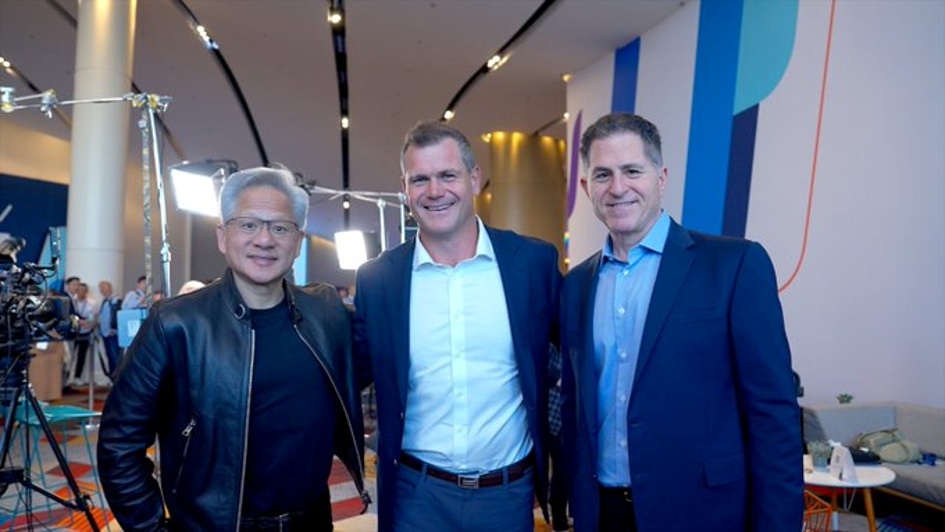
At the same time Saudi Arabia with its project "HUMAIN" (often mentioned in the context of GAIA and NEOM) is pursuing similar plans. In close cooperation with Nvidia boss Jensen Huang, the kingdom is building so-called "AI Factories". The aim of the Saudis under Crown Prince Mohammed bin Salman is to convert the country's abundant energy resources into computing power directly on site. The volume of planned investment in US semiconductors and infrastructure is estimated at hundreds of billions of dollars, creating direct competition - but also synergies - with the plans from Abu Dhabi.
Listed profiteers
The massive capital flows into these infrastructure projects reveal clear winners on the markets:
- Nvidia (NVDA): The undisputed hardware supplier. The sale of Blackwell systems to the UAE and Saudi Arabia alone generates billions in predictable revenues.
- Microsoft (MSFT) & Oracle (ORCL): As operational partners of the Stargate project, they benefit from the cloud infrastructure and the integration of their software stacks into these new superclusters.
- SoftBank (SFTBY): Masayoshi Son is a major funder and chairman of the Stargate project, securing SoftBank a central role in the AI value chain.
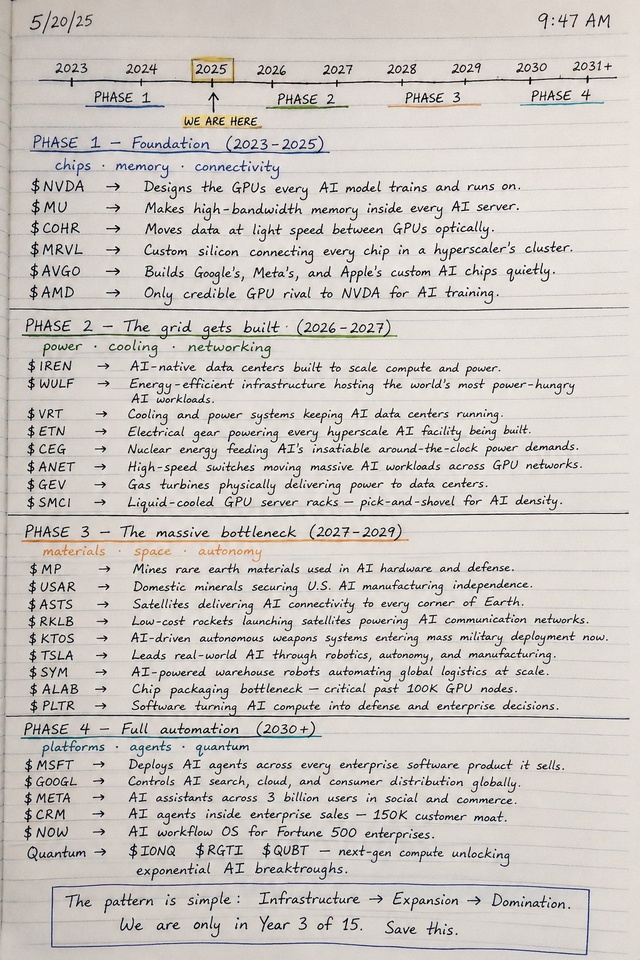
- Energy assets: Due to the immense demand for electricity (Stargate requires up to 10 GW), nuclear power plant operators and energy infrastructure stocks such as Constellation Energy (CEG) or Vistra (VST) are coming into focus.
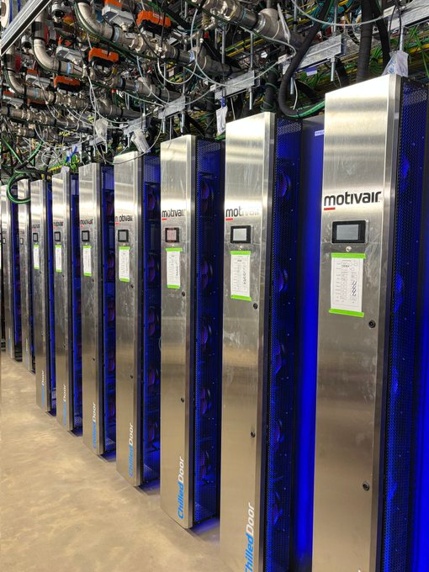
others: $VRT (-1,38%) for cooling (critical in the deserts of Abu Dhabi)
$IREN (-6,36%) to cushion Microsoft's needs
There are old traders and there are brave traders. But there are no old, brave traders! 📈📉📈📉📉
What is this quote trying to tell us?
As always, this topic is aimed at anyone interested in trading. The rest just keep scrolling. Although after the last week with some extreme drawdowns, it may also be of interest to some B&H investors 😅
Source of the picture: YouTube Mind Math Money
What are my reflections from my trading journal?
For the TL;DR my conclusion first:
The optimal position size is not the one that mathematically promises the highest profit. It is the one at which you psychologically stable, disciplined and clear remain!
Because in the end, it's not the bravest trader who wins. It's the one who stays in the game long enough.
In the course of my trading posts, someone asked me last year: https://getqu.in/cbIOkg/
"If you have an 80% win rate, why don't you just increase your position sizes? Then you would earn a lot more!"
A legitimate question, it sounds logical. Mathematically even absolutely correct. Pretty much at the same time as this question, I also started to raise my upper limit from 10k per trading position to 15k and later 20k last year. It worked, but I didn't feel comfortable. Something has changed. I couldn't put my finger on it at the time, but I felt it: These 20k positions are doing something to me.
In Q4 2025, I then consistently went back to around 10k per position. My absolute profit in euros was no higher in the end, despite larger position sizes.
Today I stumbled across a YouTube video that describes exactly what I intuitively felt at the time. I can recommend it to anyone interested in trading!
The core message is simple, but extremely important:
Position size doesn't determine your profit, it determines your psyche.
The following happens above a certain size:
- You you lose the ability to think clearly ("the ability starts to disappear").
- You no longer trade the market, you trade your account.
- Discipline fades into the background.
- Trading becomes less of a probability game and more of a psychological psychological stress management.
Mark Douglas, whose book is also quoted in this video, sums it up perfectly:
"The market is a probability environment. Your brain is not designed to operate calmly when too much is at stake."
Link YouTube https://youtu.be/yWOviauHmT8?si=_AQpcXk5URZ2ZmbT
The matching book recommendation: "Trading in the Zone" by Mark Douglas
As with swing trading or buy&hold, there is also the risk appetite that you should know and where you feel comfortable and it makes sense.
For the last 3-4 years I've had around 5K positions in individual stocks.
This year I opened a larger position. Over 20k in one position.
I don't feel nervous or worried (or so I thought)- but something has changed and there is a new feeling that I haven't experienced before.
Of course, this week was the best example of this - it went down a lot. But even weeks like that are part of it and then maybe it shows you that it can trigger some nervousness that you didn't know before.
I still feel comfortable with it, but you can tell that it does make a difference. 🙏🏼
Week 13 🚀"Tenbagger of the future" 🚀 - Biggest drop since the start of the project 🔻📉
What a week. The community project has also been hit hard - even today's Green Friday couldn't save much.
But let's first take a look at the current status of the project Tenbagger der Zukunft of the project:
As a reminder, the project started with around €2,500, which was divided almost equally between the five titles in the portfolio.
Below are the five stocks selected by you for the project and their performance to date since 12.11.2025:
- Kraken Robotics +46% 📈 $PNG (+1,2%)
- Since last week: -4% 📉
- Rocket Lab +35% 📈 $RKLB (-5,12%)
- Since last week: -14% 📉
- Iris Energy -27% 📉 $IREN (-6,36%)
- Since last week: -29% 📉
- SoFi Technologies -37% 📉 $SOFI (+0%)
- Since last week: -13% 📉
- Hims & Hers -44% 📉 $HIMS (-8,71%)
- Since last week: -23% 📉
Kraken has thus Rocket Lab from first place.
Since start:
Last 7 days:
Unfortunately, none of the stocks were able to end this week on a positive note either. The price of $IREN (-6,36%) , which is attributable to the poor quarterly figures on Thursday.
_________________________
The beta value is: 2.18 (last week: 2.57)
The beta value (β) of a share measures its market volatility compared to the overall market: a beta of 1 means the share moves in sync with the market; a beta > 1 means it fluctuates more (e.g. at 1.5 it rises or falls by 1.5 % if the market rises/falls by 1 %); a beta < 1 shows less fluctuation, while a beta < 0 indicates an opposite movement to the market. It helps investors to assess the systematic risk (market risk) of a share.
_________________________
Due to the sometimes high volatility, the stocks are represented as follows
Kraken Robotics: 31% (+4% since last week)
Rocket Lab: 29% (no change since last week)
Iris Energy: 15% (-3% since last week)
SoFi Technologies: 13% (no change since last week)
Hims & Hers: 12% (no change since last week)
_________________________
Yield:
Since the start of the project:
The return on the portfolio is currently negative and is at -4,8% 📉, at the last update it was still at +4,7%📈.
The yield reached its lowest point on 21.11. at -17,7% 📉, the high on 16.01. with +23,7% 📈.
Since the beginning of the year:
_________________________
Below is the progress of the last ten days:
As always, I look forward to your thoughts! Have a nice weekend :)
+ 2
Titoli di tendenza
I migliori creatori della settimana