$GS (-2,77%)
$MC (-3,52%)
$BLK (+1,73%)
$JPM (+0,13%)
$JNJ (-1,03%)
$TNIE (-1,26%)
$WFC (+0,24%)
$C (+0,55%)
$KER (-0,98%)
$BAC (+0,6%)
$MS (+0,54%)
$ASML (+0,37%)
$JBHT (-0,49%)
$2330
$JKS (+3,8%)
$PEP (-0,67%)
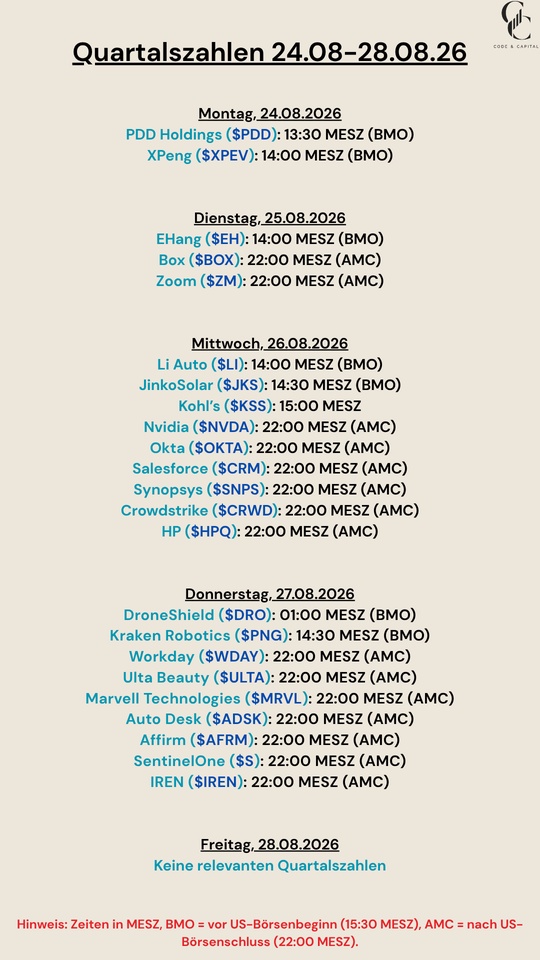
$PNG (+6,63%)
$NFLX (+0,28%)
$STT (+0,61%)

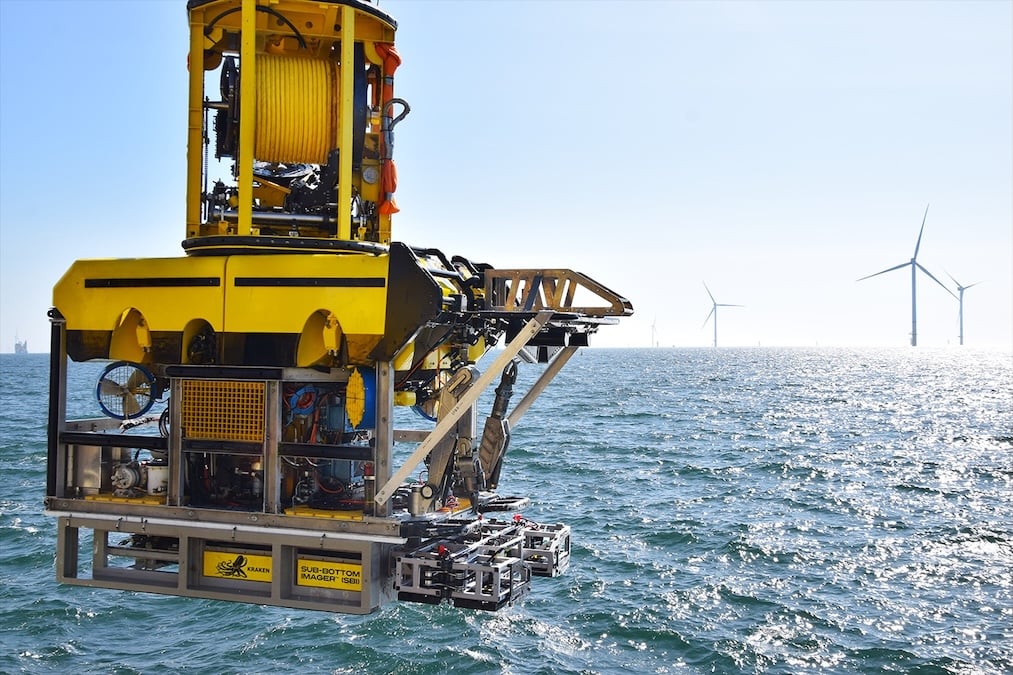
Kraken Robotics
Price
Discussione su PNG
Messaggi
120Quarterly figures 13.04-17.04-26
Shopping tour
Today I treated myself to a little shopping trip.
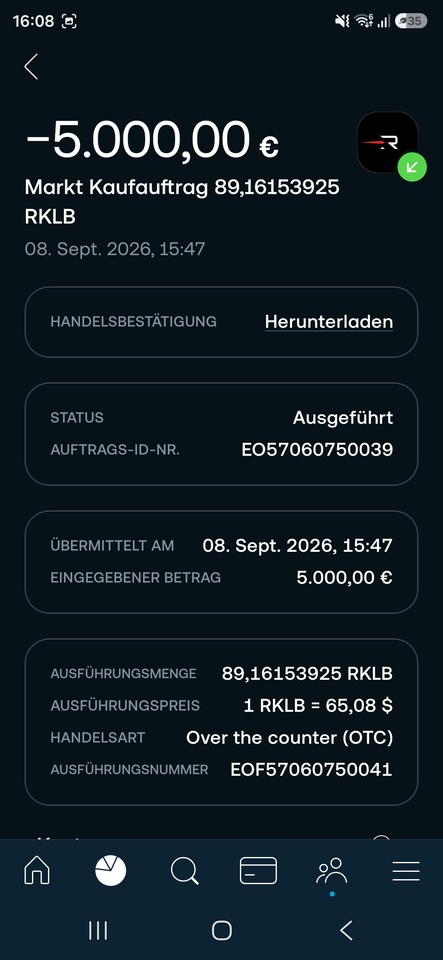
My main aim was to strengthen my core. To do this, I first added $ALV (+0,46%) into the depot.
I continued with increases in $DHL (-1,32%) and $TDIV (+0,2%) .
I also built up and expanded satellite positions.
At first I was $CRM (+4,38%) was a bit of a laugh. When I see how far we are at the beginning of implementing $CRM (+4,38%) in our company (Fortune 500), I am not worried about the business model. I'm happy to take advantage of what I see as an exaggerated sell-off after some AI headlines.
The expansion of the position at $INTU (+5,08%) . The nice thing is that both pay dividends.
Last but not least, there was some risk and Fomo. I have been looking at the wikifolio of our dear @Epi for a long time, and today I managed to get into $DE000LS9U6W1.
At $PNG (+6,63%) I have to admit that I had FOMO here. I've been following the news for a while and certainly got in far too late. But the position is correspondingly small and still fits in with the defense weighting in my portfolio.
All in all, I feel very comfortable with my decisions. Core significantly strengthened, dividends increased, some satellites added in the growth area and small zooms.
What do you think of my new additions and position increases?
Edit: my annual dividend has increased by a nice 10% to just under € 2350 gross.
Underwater autonomy for reconnaissance and special forces
As in all areas, developments in underwater autonomy are currently progressing rapidly. This involves the flexible and automated deployment of autonomous underwater vehicles (AUVs) ranging from submarines to the integration of advanced lithium-ion batteries in order to improve or redefine reliability and operational readiness in maritime operations. These UAVs can be used for everything from reconnaissance missions and the transportation of special forces to the logistical supply of special forces after a landing.
Current developments by the U.S. Navy and the British Royal Navy in the field of underwater autonomy are expected to set new milestones in cooperation with the industry. Both navies are working together with the technology group L3Harris, among others. A few key innovations have already been achieved in the past, which are now ready for use across the entire fleet.
- In January 2023, the first company succeeded in launching and recovering an unmanned underwater vehicle from a moving U.S. Navy submarine. This speeds up operations and makes the submarine less vulnerable during this time. According to the manufacturer, this groundbreaking technology developed by L3Harris is a revolution for the deployment and recovery of autonomous underwater vehicles (AUVs) and enables smooth operations in real maritime environments.
- In November 2024, the first lithium-ion technology was approved by the U.S. Navy for use on submarines. L3Harris integrated the advanced lithium-ion battery system into unmanned platforms, improving range, safety and energy efficiency. This milestone is a proactive response to changing energy needs.
- First Torpedo Tube Launch and Recovery (TTL&R) technology in the UK Royal Navy in 2025, when the Royal Navy first introduced this technology.
For underwater autonomy, it offers runtimes of up to 20 hours and a range of 40 nautical miles with rechargeable NiMH batteries, while runtimes of 40 hours and 80 nautical miles are possible with lithium-ion batteries. (Graphic: L3H)
Pioneering hybrid AUV technology for superior usability
According to the manufacturer, the IVER AUVs from L3Harris set new standards for hybrid autonomous systems by combining the strengths of manned and unmanned systems. These AUVs are designed for superior operational capability in complex underwater environments.
Equipped with modular payloads, advanced autonomy and integrated sensors, the Iver AUV offers unparalleled situational awareness and flexibility. This hybrid design enables seamless collaboration between operators and unmanned platforms, ensuring the success of underwater autonomy missions in even the most demanding conditions.
The Iver AUVs are capable of operating in both shallow coastal waters and the deep sea. This adaptability is critical as the industry increasingly relies on integrated and hybrid mission models.
Advanced energy solutions thanks to lithium-ion technology
In November 2024 L3Harris reached an important milestone with the delivery of unmanned systems equipped with advanced lithium-ion battery technology. This breakthrough represents a significant advance in the endurance, reliability and safety of autonomous platforms.
Lithium-ion batteries offer higher energy density and longer life compared to conventional energy sources. This allows autonomous underwater vehicles (AUVs) to carry out longer missions without any loss of performance.
The integration of lithium-ion technology into unmanned systems underlines the changing needs of customers. By prioritizing energy efficiency, the performance of the platforms is increased.
However, it is also crucial that the improved capabilities and greater flexibility go hand in hand with the greatest possible safety. After all, these AUVs are carried on board submarines, and fire is one of the greatest dangers of all. Therefore, the lithium-ion batteries must be absolutely safe.
Underwater autonomy - mastering the challenge of launch and recovery
Launch and recovery are still among the most complex operations in maritime robotics. A milestone was reached in July 2023. For the first time, an AUV was launched and recovered by a moving U.S. Navy submarine. According to the system manufacturer L3Harris, the first time ever worldwide.
By mastering launch and recovery techniques, the company has solved a key challenge for users and further improved the user-friendliness and effectiveness of its AUV platforms.
Vision for the future
These technologies will now be scaled up for the AUKUS submarines. The AUKUS security agreement between Australia, the UK and the USA provides for Australia to be equipped with conventionally armed but nuclear-powered hunting submarines (SSNs) to limit China's influence in the Indo-Pacific.
Australia plans to acquire up to eight of these submarines. Initially US Virginia class boats (from the 2030s) and later newly developed SSN AUKUS boats (from the 2040s). The boats are designed to be around 8,000 to 9,800 tons (submerged) and can operate for several decades without refueling. The development of the new SSN-AUKUS class is to be based on British design, initially in the UK and later in Australia (Adelaide).
The propulsion technology (reactors) and weapon systems are to come from the USA. However, Australia is initially to receive three to five US Virginia-class submarines as an interim solution in order to close the gaps until its own fleet is available with the SSN AUKUS class. These will then be used to replace the conventional Australian Collins-class submarines.
Manned-unmanned teaming will be a core capability of all newly built submarines. The AUVs can serve as a sensor ahead and reconnaissance platform as well as an effector or to transport and supply the special maritime forces deployed from the submarine.
Text: Editorial team / af
🔋 Who supplies L3Harris underwater batteries?
👉 Kraken Robotics is a very likely supplier for Navy programs where L3Harris AUVs are integrated.
👉 Whether they supply directly to L3Harris is not publicly confirmed - but technically absolutely plausible.
Unterwasserautonomie für Aufklärung und Spezialkräfte
New US Navy robot submarine unleashes swarms of drones at a depth of 6000 meters
The US Navy is relying on a new robot submarine as a "mother ship" for swarms of drones. The Dive-XL system is set to change underwater warfare.
Dive-XL from Anduril.
Kraken is considered an important supplier for Anduril's maritime programs, especially in the field of UUVs. @Klein-Anleger
The US Navy is introducing a new generation of unmanned submarines with the "Combat Autonomous Maritime Platform" project, or Camp for short. The focus is on the Dive-XL autonomous underwater vehicle from US defense contractor Anduril. This large robotic submarine is designed to deploy smaller underwater drones and torpedoes and thus function like a "mother ship", reports the news portal "New Atlas".
The Navy wants to use this to monitor much larger sea areas and relieve the burden on manned ships. The unmanned systems are intended to serve as additional weapons platforms and increase strike power at sea.
Technical data and capabilities
The Dive-XL is around 11 meters long, around 2 meters wide and fully electrically powered. The submarine should be able to dive to depths of up to 6000 meters. "New Atlas" reports a range of around 2000 nautical miles and a tested underwater dwell time of 100 hours within ten days.
Anduril has not yet announced the maximum speed of the Dive-XL. Typically, systems of this type operate at around 3 to 5 knots. It is estimated that the Dive-XL can briefly reach speeds of 8 to 10 knots (approx. 15 to 18 km/h) in order to quickly change positions or overcome currents.
The Dive-XL is built differently to conventional submarines: it does not have a solid, air-filled pressure hull, but a freely submersible structure. This means that the water simply flows through the housing, preventing the boat from being crushed at depth.
,regionOfInterest=(2213,832)&hash=1c3256db1afa2a0f2ffae079adc8df23ed259756ce326e9588a42377a92921aa)
4 months 🚀"Tenbagger of the future" 🚀 - Kraken Robotics speeds away 🐙🏎️💨
In the last month $PNG (+6,63%) further, while $IREN (+5,66%) slowly recovered. The problem child remains $SOFI (+3,21%)
The US attack on Iran, which violates international law, has not yet had any negative impact on values.
Let's take a look together at the current status of the project Tenbagger der Zukunft together:
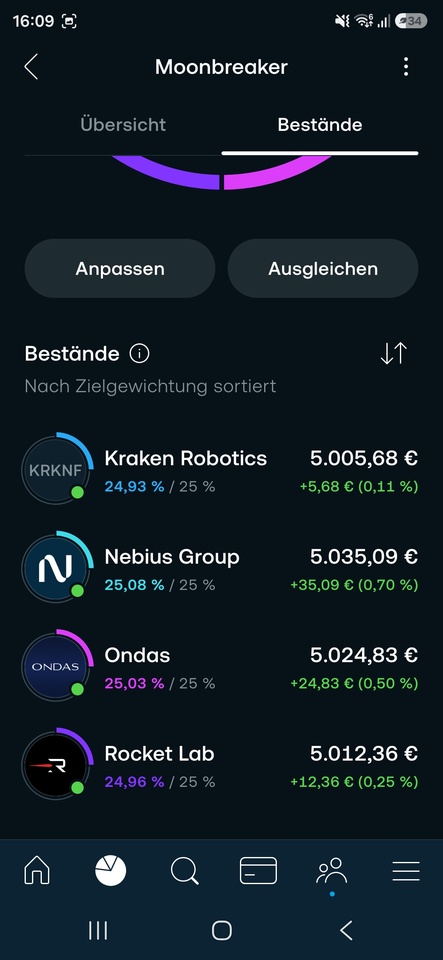
As a reminder, the project started with around €2,500, which was divided almost equally between the five securities in the portfolio.
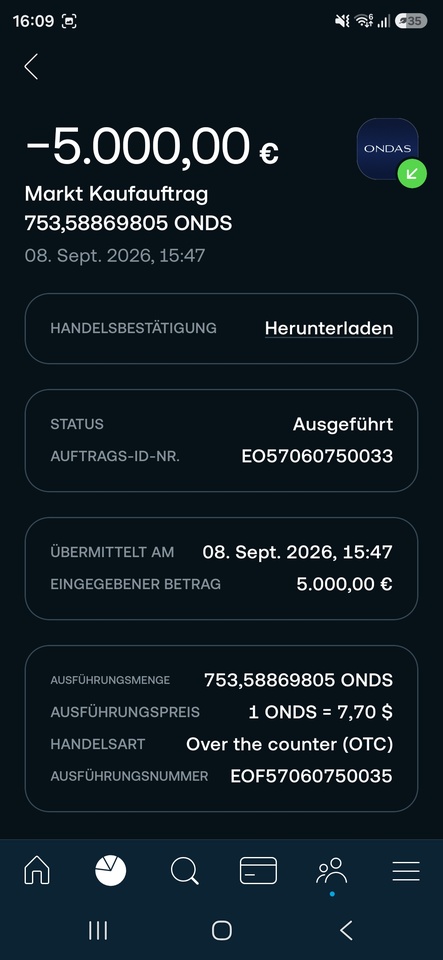
$HIMS (+9,8%) was sold at a loss of almost exactly 50%. For the new value$ONDS (+3,28%) was topped up again to €500 - in the end, 64 shares ended up in the Tenbagger portfolio.
Below are the five values of the project selected by you and their development to date since 12.11.2025:
- Kraken Robotics +83% 📈 $PNG (+6,63%)
- In the last 30 days: +36% 📈
- Rocket Lab +46% 📈 $RKLB (+4,04%)
- In the last 30 days: +13% 📈
- Ondas Holdings +28% 📈 $ONDS (+3,28%)
- In the last 30 days: +16% 📈
- Iris Energy -21% 📉 $IREN (+5,66%)
- In the last 30 days: +10% 📈
- SoFi Technologies -45% 📉 $SOFI (+3,21%)
- In the last 30 days: -8% 📉
Since inception:
Last 30 days:
This month $PNG (+6,63%) further extend its lead.
$SOFI (+3,21%) is once again in the red.
_________________________
The beta value is: 1.84 (no change)
The beta value (β) of a share measures its performance
Marktvolatilität compared to the overall market: a beta of 1 means the share moves in sync with the market; a beta > 1 means it fluctuates more (e.g. at 1.5 it rises or falls by 1.5 % if the market rises/falls by 1 %); a beta < 1 shows less fluctuation, while a beta < 0 indicates an opposite movement to the market. It helps investors to assess the systematic risk (market risk) of a share.
_________________________
Due to the sometimes high volatility, the stocks are represented as follows
Kraken Robotics: 31%
Rocket Lab: 25%
Ondas Holdings: 22%
Iris Energy: 13%
SoFi Technologies: 9%
_________________________
Return on investment:
Since the start of the project:
The return on the portfolio is (with taking into account the loss of $HIMS ) is currently positive and stands at +7,8% 📈, at the last update it was still at-7,5%📉.
The yield reached its lowest point on 21.11. at -17,7% 📉, the high on 16.01. with +23,7% 📈.
Since the beginning of the year (with taking into account the loss of $HIMS ):
+9,3% 📈
_________________________
Below is the trend over the last three months:
Feel free to share your thoughts! :)

+ 1
KRAKEN
$PNG (+6,63%)
ST. JOHN'S, NEW FUNDLAND, March 17, 2026 /GLOBE NEWSWIRE/ - Kraken Robotics Inc ("Kraken" or the "Company") (TSX-V: PNG, OTCQB: KRKNF) announces approximately $24 million in new orders from over ten customers in five countries, including three new customers in the defense sector. The orders include Kraken's SeaPower batteries, KATFISH synthetic aperture towed sonar (SAS) and Kraken SAS.
"Sales of SeaPower batteries continue to develop positively and several new customers are helping to diversify our customer base in this business area. Production of our batteries at our new facility in Nova Scotia will begin next month, significantly expanding our production capacity," said Greg Reid, President and CEO of Kraken Robotics. "We are also pleased to announce the sale of a new KATFISH to the Polish Navy for their mine hunting program and SAS to several defense customers for their autonomous underwater vehicle (AUV) platforms."
The Polish Navy first selected KATFISH in 2020 for use on its Kormoran II class minesweepers to support mine countermeasure operations in complex shallow water areas. This latest order was placed through Thesta, Kraken's partner in Poland, which was appointed as an authorized KATFISH dealer at Oceanology International last week.
Expert on the fear of sea mines: "The risk is enormous" Which company will benefit
Hello my dears,
At the weekend I did a little research on the subject of sea mines. And found one of the market leaders for you, whose systems are indispensable for disposal. Many of you will already be familiar with the company, or perhaps have already invested in it.
Unfortunately, I missed my entry yesterday due to further research. And by the end of the day, the share price had already risen by 8%.
It seems that some others also believe in my thesis.
Even after the end of the war, the topic of sea mines will not disappear and will remain in focus.
Furthermore, the company is about much more than just sea mines. We also have a player here in the growth area of Space and satellites.
Even though I am already invested in $PNG (+6,63%) Kraken Robotic, I see a good addition here. Because I'm also still looking for a drone player.
I also like the chart.
Yes, my dears, the company is no longer cheaply valued.
But due to the growth and the growth sectors, I still see good potential here.
What do you think?
Iran has started laying sea mines in the Strait of Hormuz, which poses a major threat to shipping and exacerbates international tensions.
According to Moritz Brake (maritime security expert and reserve officer in the German Navy), the danger posed by sea mines in the Strait of Hormuz was a major issue even before the war began. Even older mine technology was sufficient to endanger modern merchant ships.
"On the ship, the captain has first and foremost responsibility for his crew"
Military security would also be costly: First, mines would have to be cleared, then warships would accompany the freighters and fend off attacks from the air or from the water. Nevertheless, there can be no such thing as complete security, says Brake.
The specialist for underwater drone systems Exail Technologies is a leader in the field of mine clearance and has a record order backlog of 1.1 billion euros!
Updated on 08.12.25
The market for maritime underwater systems, in particular autonomous underwater vehicles (AUVs), is at a turning point and is revolutionizing the way underwater operations are carried out in the fields of defence, scientific research, but also seabed mapping.
are carried out.
Exail Technologies is a highly specialized technology group based in France that has achieved remarkably dynamic growth and numerous milestones in major contracts, innovation and its financial strategy so far in 2025. Exail Technologies is a vertically integrated autonomous systems group: Its focus is on maritime robotics (drones, sensors, mission software) and inertial navigation systems (based on fiber optics, gyroscopes and laser photonics).
Exail Technologies is an industrial company specializing in cutting-edge technology in the fields of autonomous robotics, navigation, aerospace and photonics. With a strong entrepreneurial background, Exail Technologies guarantees performance, reliability and safety to both civilian and military customers working in harsh environments. From the depths of the ocean to the remotest corners of space, the Group enhances its customers' capabilities with components, products and systems. Exail Technologies operates in nearly 80 countries.
Number of employees: 2,059
Exail Technologies is a leading high-tech champion with a strong with a strong entrepreneurial culture. The group was created in 2022 through the convergence of ECA Group and iXblue and shares a common DNA of entrepreneurship.
Exail Technologies is one of the few medium-sized companies in the defense sector in Europe. This enables the company to have both the decisive scale to win large programs of several hundred million euros and the agility to move quickly and innovate in high-tech markets.
As a family-run company under the leadership of Raphaël Gorgé, Exail Technologies has a long-term perspective on value creation. This creates the solid foundation for a culture of innovation and the ability to continue to push the boundaries of science and take our technological excellence to new heights.
Exail announces the first sale of DriX H-9 for civil offshore operations to a European customer
March 12, 2026
Erster Verkauf von DriX H-9 für zivile Offshore-Einsätze an einen europäischen Kunden
Exail supplies LBL positioning systems for large deepwater energy projects in Brazil and Angola
March 10, 2026
Exail liefert LBL-Positionierungssysteme für große Tiefwasserenergieprojekte in Brasilien und Angola
Delivery of the Vlissingen, the second mine countermeasure vessel of the Belgian-Dutch rMCM program
Exail and INTRA strengthen strategic partnership to further develop aviation training capabilities in Saudi Arabia
February 26, 2026
18/02/26
Aktivität des 4. Quartals 2025: Umsatzwachstum von 26 %
07/01/26
05/01/26
Neuer Auftrag für mehrere hundert K-STER Unterwasserdrohnen für rund 40 Millionen Euro
Exail starts production of the sixth control console for the Korean Navy's submarines
November 27, 2025
Start der Produktion der 6. Steuerkonsole für ein koreanisches U-Boot
Exail supplies key optical technologies for the SOLiS Terabit space laser communication demonstrator
October 16, 2025
Exail achieves world market record with 1,100 nautical mile autonomous USV transit across the Strait of Gibraltar
September 25, 2025
Welterster mit 1100 Seemeilen langem autonomen USV-Transit
Exail delivers hundreds of Advans series navigation systems for large European ground-based radars
September 9, 2025
Exail to equip the Indonesian Navy with the next generation unmanned mine countermeasure system
June 24, 2025
Exail, um die indonesische Marine mit einem unbemannten MCM-System auszustatten
Exail introduces Spacelink-PCE, a new propagation channel emulator for satellite communications
March 11, 2025
Exail stellt Spacelink-PCE vor, einen neuen propagationskanal-Emulator für Satellitenkommunikation
CORPORATE PRESENTATION
Geographical distribution of sales:
Year 2024 (EUR)
Europe 139 million
France 89.22 million
Asia 52.81 million
Americas 35.18 million
Africa 2.25 million
Oceania 4.55 million
EUR in millions
Estimates
Year Turnover Change
2024 373,1 15,56 %
2025 477,9 28,09 %
2026 572,1 19,71 %
2027 711,8 24,42 %
Year EBIT Change
2024 73,82 13,39 %
2025 103,7 40,54 %
2026 132,4 27,57 %
2027 179 35,24 %
Year Net result Change
2024 -3,641 -122,92 %
2025 14,72 504,4 %
2026 32,43 120,26 %
2027 35,71 102,62 %
Year Net debt CAPEX Leverage ratio
2024 258 33,93 3,49x
2025 244 40,3 2,35x
2026 242 44,56 1,83x
2027 178 49,14 0,99x
Year Free cash flow change
2024 57,47 141,1 %
2025 38,4 -33,19 %
2026 46,63 21,44 %
2027 65,3 40,03 %
Year EBIT margin ROE
2024 12,2 % -2,92 %
2025 15,15 % 10,79 %
2026 17,04 % 16,66 %
2027 19,64 % 22,81 %
Year Earnings per share Change
2024 -0,2142 -122,97 %
2025 0,8492 496,45 %
2026 1,718 102,31 %
2027 3,32 93,25 %
Year P/E ratio PEG
2024 -81x 1x
2025 150x -0x
2026 74.3x 1x
2027 38.4x 0.4x
Market value 2,166
Number of shares (in thousands) 16,972
Date of publication 25.03.2025
Sector comparison
(Source Onvista) EXAIL Kratos Kraken Rob.
Earnings p share
2026 1,47 0,25 0,0833
2027 3,41 0,49 0,11
2028 4,34 0,61
Profit growth (%)
2026 +110,71 +123,08 +160,41 %
2027 +121,02 +89,66 +32,01 %
2028 +37,27 +15,36
P/E RATIO
2026 86,91 304,15 114
2027 37,43 157,77 86,2
2028 29,39 124,96
PEG
2026 +0,62 +3,28 +1
2027 +1,37 +6,01 +2,7
2028 +0,62 +2,92
Performance
1 week +1.43 %
1 month +14.54 %
6 months +10.19 %
1 year +308.32 %
3 years +557.73 %
5 years +754.08 %
7 years +1,088.08 %
@Get_Rich_or_Die_Tryin
@Multibagger
@Klein-Anleger
@schlimmschlimm
@HoldTheMike
@Derspekulant1
@Liebesspieler etc.
+ 3
That's why I was so happy about your idea of $EXENS at the time.
I think Exail is mega, but the valuation leaves much more room for downside than upside in my view.🫣
Kraken Robotics update 🐙🚀 (Acquisition of Covelya and tenfold increase in turnover 2024-2028)
Here is an update on Kraken Robotics and my research into the takeover of the Covelya Group.
With the acquisition of the British Covelya Group for a total value of USD 615 million (financed by USD 480 million in cash and USD 135 million in shares), Kraken Robotics has made the leap from a specialized sensor manufacturer to a vertically integrated company in underwater technology. This takeover is accompanied by a dilution of around 21% of existing shareholders. I will briefly explain how this dilution is to be classified later and what exactly was taken over. I am primarily concerned with how the financial key figures, sales and profit targets and customer landscape have changed. But let's get started:
Who is Covelya? Brief overview
To understand the scale of this acquisition, you need to look at the Covelya Group portfolio. Covelya Group is a group of market-leading maritime technology companies with over 750 employees and twelve locations worldwide.
The subsidiaries include:
- Sonardyne: The heart of the group. Sonardyne is the global market leader in underwater acoustic navigation, positioning and communication. Its technology is the "gold standard" for the offshore energy industry and modern western navies.
- Voyis: Specialists in high-resolution optical sensors and laser scanners that create millimeter-precise 3D models of the seabed and underwater structures (e.g. pipelines).
- Wavefront Systems: Experts in sonar systems for obstacle avoidance and diver detection.
- EIVA: Provider of software and hardware solutions for efficient mapping and surveying of the oceans.
As Covelya is significantly larger than Kraken Robotics, the acquisition also brings numerous well-known customers on board. Covelya's largest customers include Shell, BP, TotalEnergies, ExxonMobile, the US Navy, the Australian Navy, the UK Royal Navy and companies such as Oceaneering. With this acquisition, Kraken Robotics now controls the entire value chain - from sonar/laser systems to maritime navigation and power supply through SeaPower batteries.
Significance - massive expansion of the moat
The market shares following the merger create an almost monopoly-like position in critical segments:
- Underwater Navigation: Kraken/Sonardyne now control an estimated 40% to 60% of the global high-end positioning market.
- Synthetic Aperture Sonar (SAS): (underwater sonar systems)Kraken is the dominant player here with OVER 70% market share.
- Precision inspection: The company now holds around 30 % to 50 % of global capacity in laser scanning.
To reiterate, Kraken Robotics now controls between 30% of the global market for laser scanners and over 70% (!) for sonar systems in all key areas of underwater technology!
After the takeover, there is no comparable company in the underwater technology sector with such a position. By integrating Covelya, Kraken Robotics has created a monopoly in the field of state-of-the-art technology for the oceans.
Although there are many companies that also market a certain part of this technology, there is no competitor that has such control over the entire value chain in this area. This is also reflected in the figures:
The figures: Turnover and profit development until 2028 (estimate)
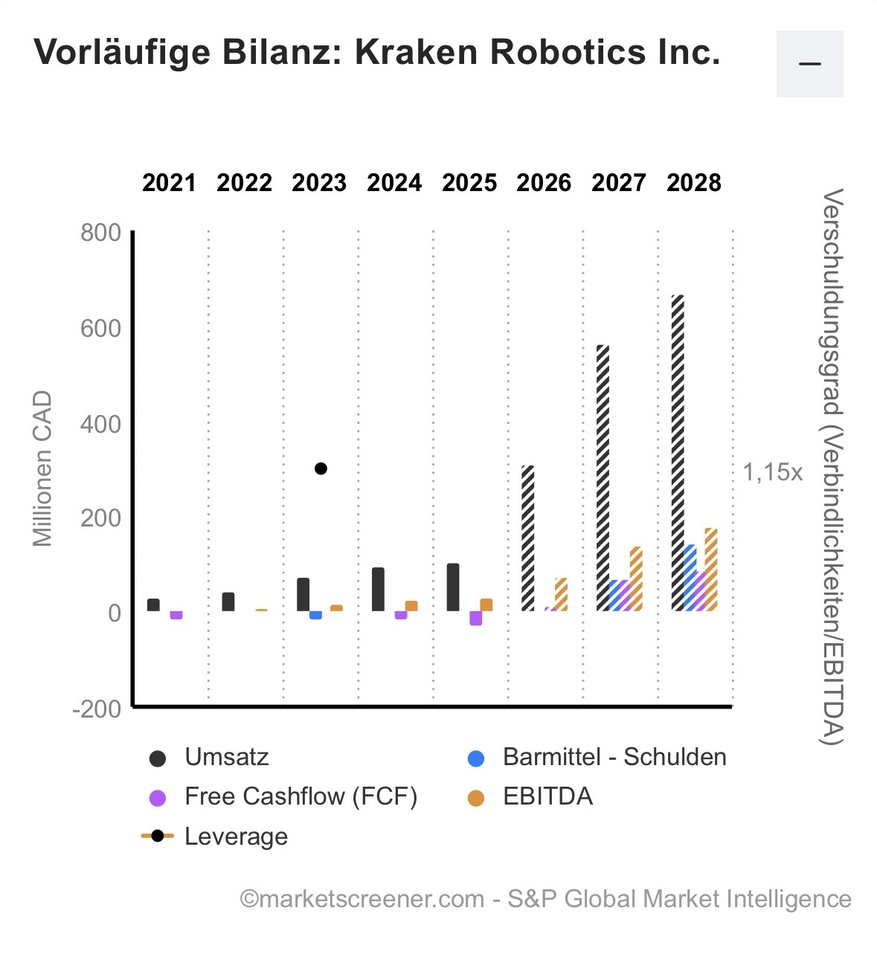
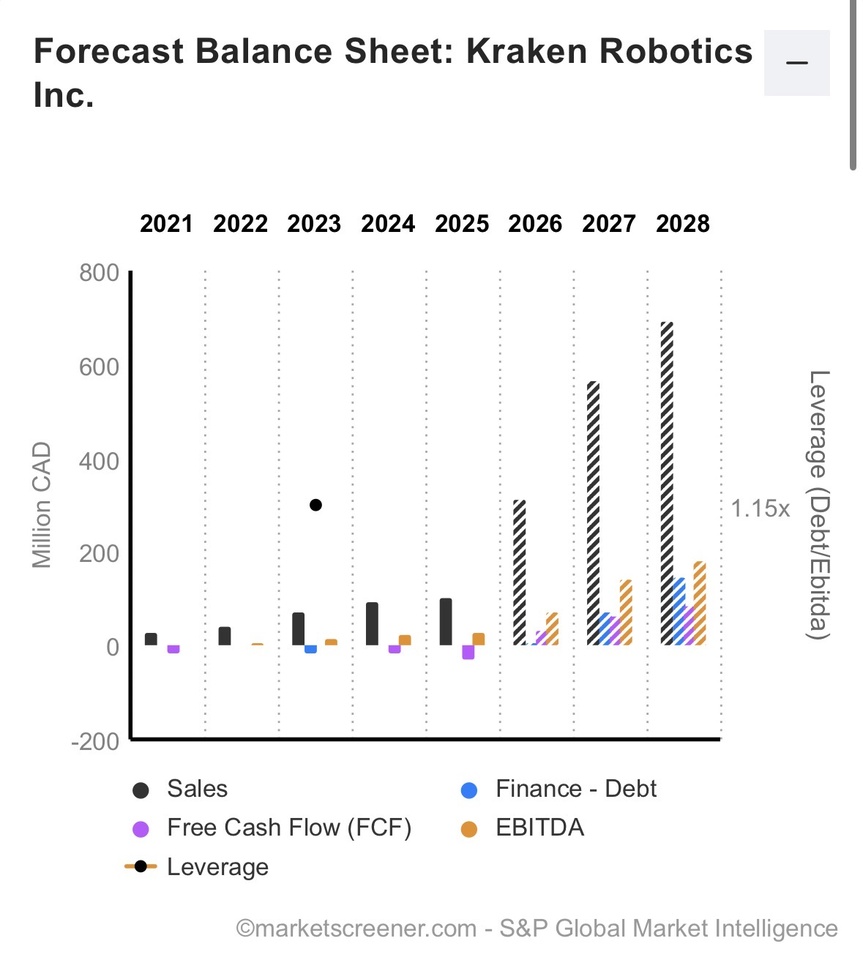
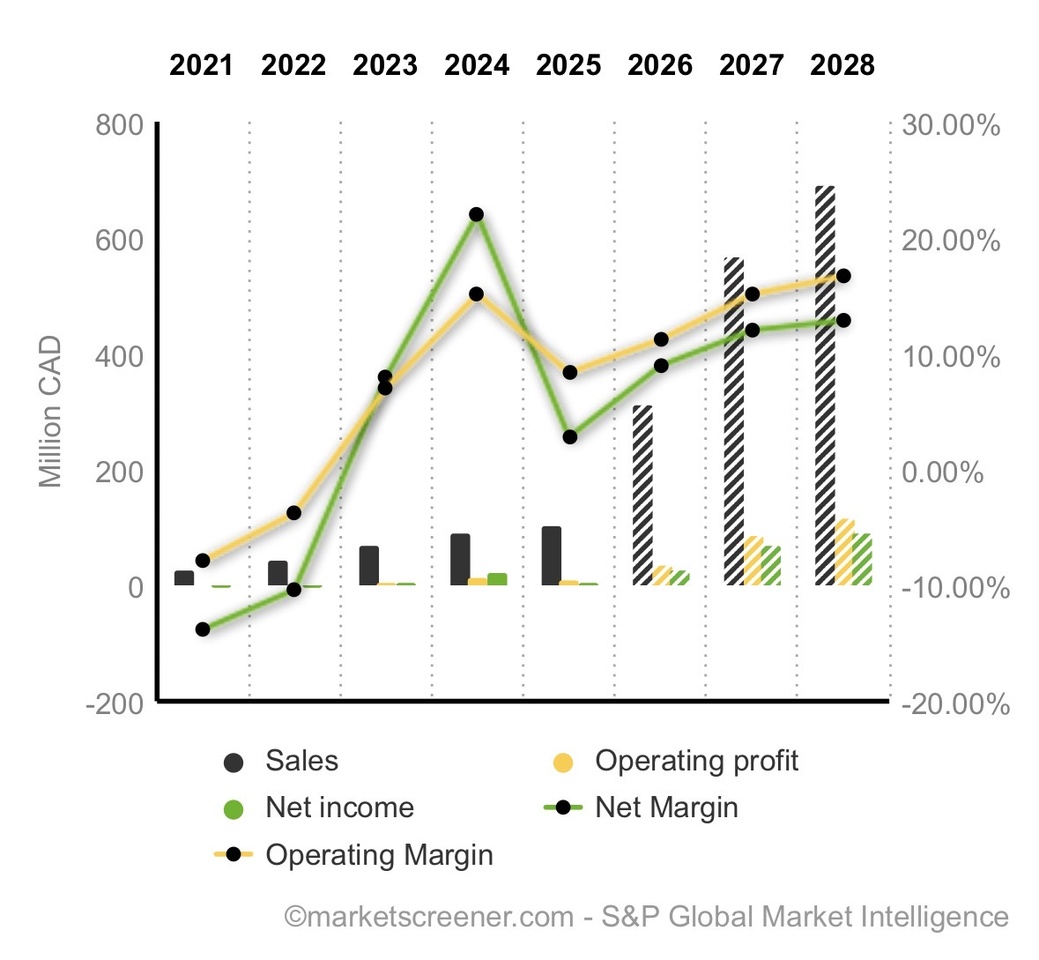
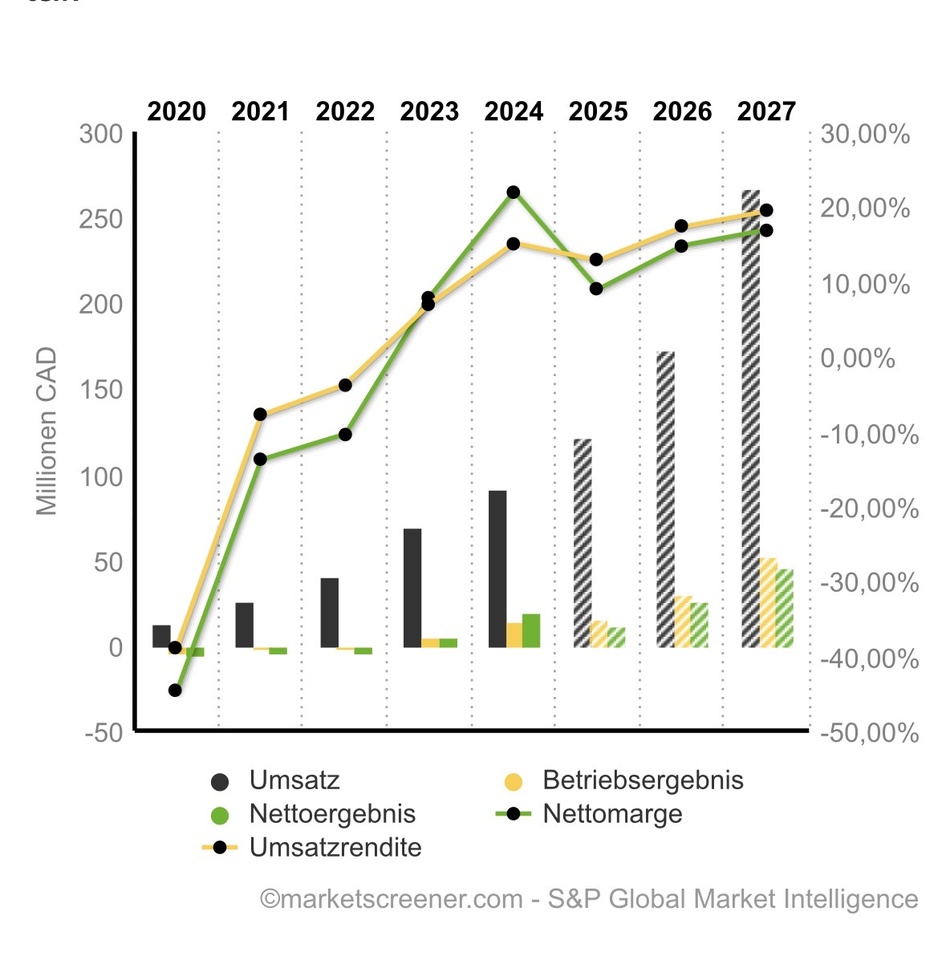
While Kraken still reported revenue of around USD 70 million in 2024, the merger takes the company to a new level:
- 2025 (preliminary): Approx. USD 115 million (purely organic growth).
- 2026 (+acquisition): Expected turnover of USD 495 million after integration of Covelya. (Almost 300 million of the sales come from Covelya)
- 2027 (estimated): Increase to USD 620 million, driven by stronger integration of Covelya and major orders in the defense sector.
- 2028 (target): The company is targeting the USD 800 million sales mark.
-> from USD 70 million in 2024 to USD 800 million in sales by 2028 is more than a tenfold increase in sales in four financial years!
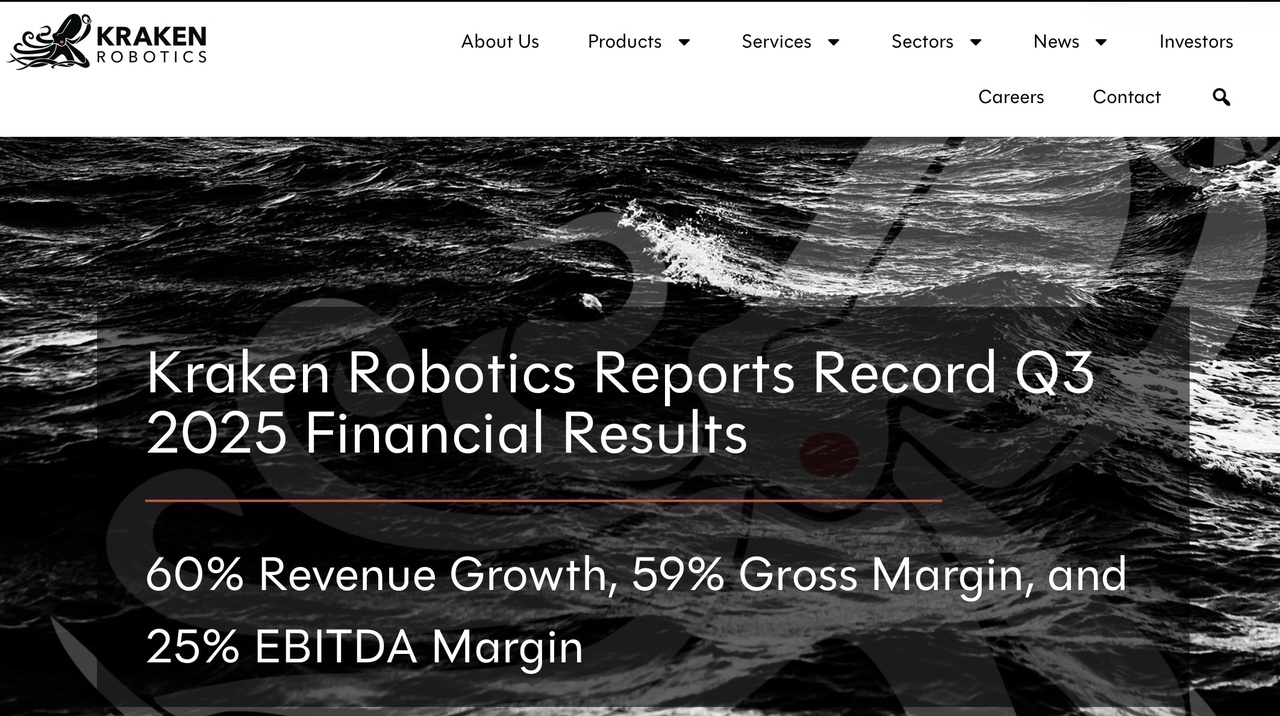
The EBITDA margin (including the acquisition) is set to rise from 22.7% in 2024 to 25% in 2026 and to over 31% by 2028 thanks to synergy effects of USD 15 million per year.
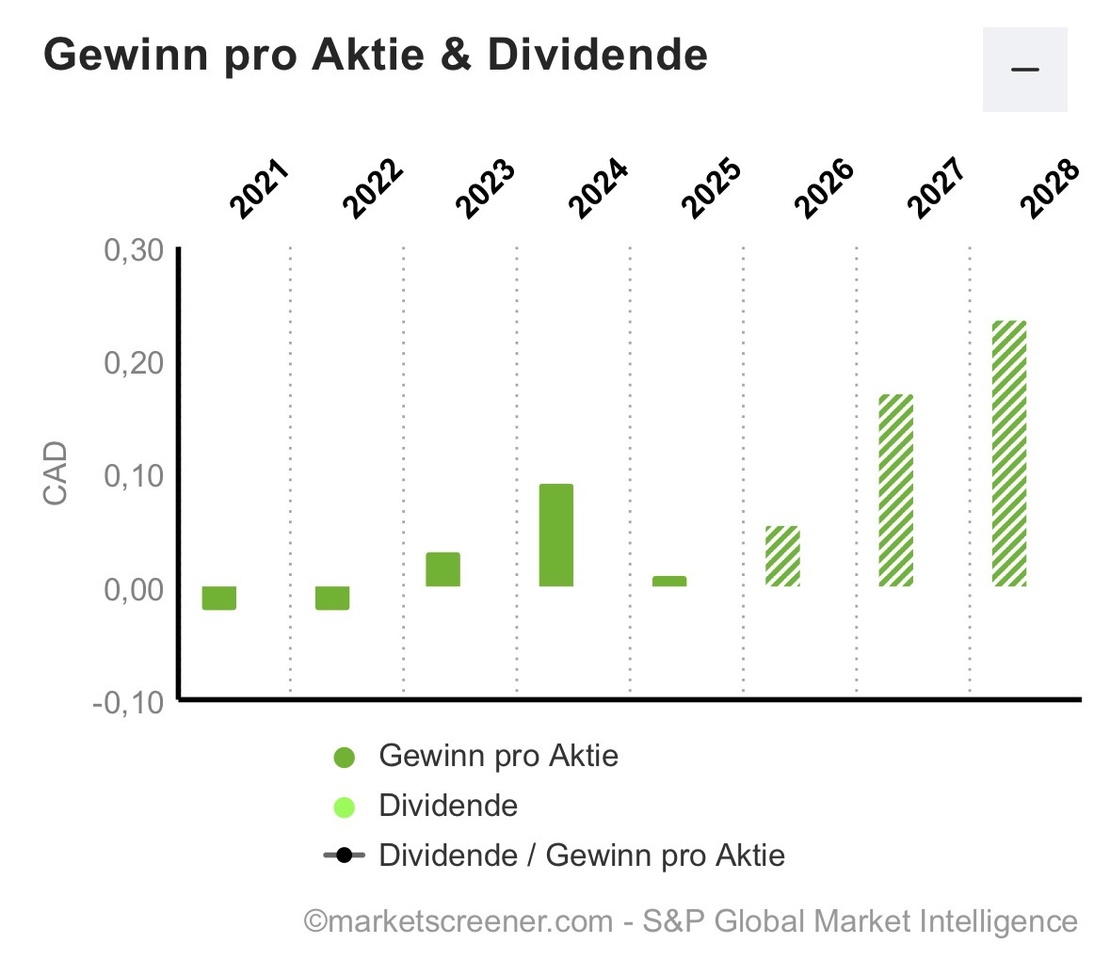
Despite the dilution caused by the capital increase, earnings per share (EPS) are forecast to double to around USD 0.12 by the end of 2027.
Takeover price
For a purchase price of USD 615 million, Kraken Robotics is securing a company that already generates stable annual sales of around USD 275 million and contributes a strong EBITDA margin of around 28% to its balance sheet. Just for comparison, Kraken Robotics itself did not even generate USD 200 million in sales last year and is not that profitable with a margin of 22.7%.
In terms of valuation, Kraken has benefited extremely here: At an EV/sales multiple of around 2.2x and an estimated takeover P/E of 14 to 16 (based on Covelya's net profit), the price is well below the multiples that Kraken itself has on the market. You have to imagine that.
Covelya is being acquired at a P/E of 14-16 - the stock market would certainly be willing to pay a P/E of 60-70 for the company's organic growth of over 20% and Kraken Robotics' management has recognized this. This valuation arbitrage effect means that Kraken buys "cheap" earnings, which are immediately revalued on the stock market at Kraken's higher growth premium. This not only buys the technology and market share, but also ensures an immediate increase in value.
Dilution of shareholders
In order to finance the acquisition of the Covelya Group, Kraken Robotics carried out a capital increase in March 2026, which resulted in the issue of around 47.4 million new shares. Together with the share component for the sellers, this increases the total number of outstanding shares by approximately 21%, which means a corresponding percentage dilution for existing shareholders. Management itself says that the acquisition is immediately accretive and that this move is considered "accretive" as the massive increase in revenue and EBITDA is expected to fully outweigh the dilutive effect as early as 2027. While the dilution is around 20%, Kraken's revenue will increase by several 100% as a result of the takeover! Although I am of course not super happy that my share in Kraken Robotics has decreased, I see far more opportunities than risks as a result of the massive expansion
Valuation
In terms of valuation, Kraken is currently trading at a P/E ratio (2026e) of approx. 125x (if Covelya's profit is not included). What initially seems high is put into perspective by the enormous profit growth and an EV/EBITDA ratio of around 20x, which in my opinion is justified for a market leader in the high-tech defense sector with well over 30% growth per year. And because profits are rising disproportionately due to the margin increase, the P/E ratio will fall significantly towards 60 in 2027...
Current drivers: situation in Iran
The current security situation, in particular the conflict in Iran and the associated threat to the Strait of Hormuz, has once again made maritime security a priority for NATO countries. The protection of critical infrastructure (pipelines, data cables) is no longer feasible without the autonomous technology of Kraken.
Iran has partially blocked the Strait of Hormuz with sea mines - the use of underwater robots is crucial for the removal of sea mines. This means that the navy soldiers are not exposed to immediate danger, but can defuse the sea mines from a distance...
Conclusion
The acquisition of Covelya makes Kraken Robotics an indispensable company in the western maritime world. With a stable balance sheet (USD 402.5 million gross proceeds from the last capital increase) and a dominant market position, the company is excellently positioned to benefit from the massive increase in investment in maritime sovereignty. Of course, a takeover is always accompanied by risk, as the integration could fail. In my opinion, however, the opportunities here clearly outweigh the risks and I am even more convinced of Kraken Robotics than before. The company is growing strongly and is positioned as a technological leader. I see prices of well over EUR 10 as likely in the near future and will continue to hold the share.
You can find my detailed analysis of Kraken Robotics and other shares in my profile and here:
Please let me know what you think about the takeover and whether I have forgotten anything important...
LG small investor 😊

80% of the Ocean Is Still Unmapped — Is Kraken Robotics Building the “Google Maps of the Seabed”?
Hi everyone,
I’ve been digging deeper into $PNG (+6,63%)
Kraken Robotics lately and the more I look into it, the more interesting the story becomes. I already have a position, and I’m honestly considering adding more, but before doing that I’d really like to hear some other perspectives.
For those unfamiliar: Kraken Robotics develops advanced subsea robotics, synthetic aperture sonar, and subsea battery systems used for seabed mapping, underwater drones (UUVs), offshore infrastructure inspection, and naval defense applications.
A few things that make me increasingly bullish:
1️⃣ The “Google Maps of the ocean” thesis $GOOGL (+0,39%)
Around 80% of the ocean floor is still not properly mapped. Kraken’s high-resolution sonar technology can produce extremely detailed 3D images of the seabed.
If offshore wind, subsea cables, deep-sea exploration and defense surveillance keep expanding, someone will need to map and monitor the oceans in a way similar to how Google Maps mapped the land.
Could companies like Kraken essentially become the mapping layer of the oceans?
2️⃣ Massive defense spending tailwind
With everything happening geopolitically, navies are investing more and more in unmanned underwater vehicles (UUVs) for mine detection, surveillance and protection of underwater infrastructure.
Underwater cables and pipelines are suddenly considered critical infrastructure, and protecting them is becoming a priority.
Kraken’s sonar and battery systems seem well positioned for that trend.
3️⃣ Offshore wind and subsea infrastructure growth
We’re building an enormous amount of offshore energy infrastructure, and all of it sits on the seabed. That means inspection, mapping and monitoring will become more important over time.
Autonomous subsea robots could end up being the cheapest and safest way to do that.
4️⃣ A niche technology company in a specialized market
Kraken seems to operate in a fairly specialized niche where technical expertise and intellectual property matter a lot. If their technology truly stays ahead of competitors, the company could scale quite nicely.
But obviously there are risks too:
small cap volatility, reliance on large contracts, competition from bigger defense players, etc.
So I’m curious what people here think.
A few questions for the community:
- Do you believe the subsea robotics / ocean mapping sector could become a major growth industry?
- Could increasing defense spending on underwater drones drive this market much bigger?
- Is the “Google Maps of the ocean” analogy realistic, or just a nice story?
I might be missing something here, but it feels like the market still underestimates how big subsea robotics and ocean mapping could become.
The bull case seems pretty clear to me, but I’m genuinely curious what the bear case would be here.
If the oceans are really the next frontier for mapping and robotics, are we still in the early innings of this industry?
I’m leaning bullish and thinking about increasing my position, but I’d really value hearing some counterarguments or alternative views before doing that.
Curious to hear your thoughts.
🚀"Tenbagger of the future" 🚀 - Future update interval ⏱️
Dear Community,
In mid-November we launched the Tenbagger der Zukunft community project. Since then, there have been weekly updates. Shortly after the start, I asked you about the desired update interval and the majority of you were in favor of weekly updates.
This made perfect sense for the first few months.
However, I have now decided to change the interval to monthly monthly.
Instead, I want to focus more on company ideas and work on Deep Dive in this regard.
In future, the updates will therefore always take place around the middle of each month.
Thank you for your feedback and support so far. 💪🏼
Ps: The project consists of $RKLB (+4,04%)
$SOFI (+3,21%)
$ONDS (+3,28%)
$PNG (+6,63%) and $IREN (+5,66%)
Titoli di tendenza
I migliori creatori della settimana