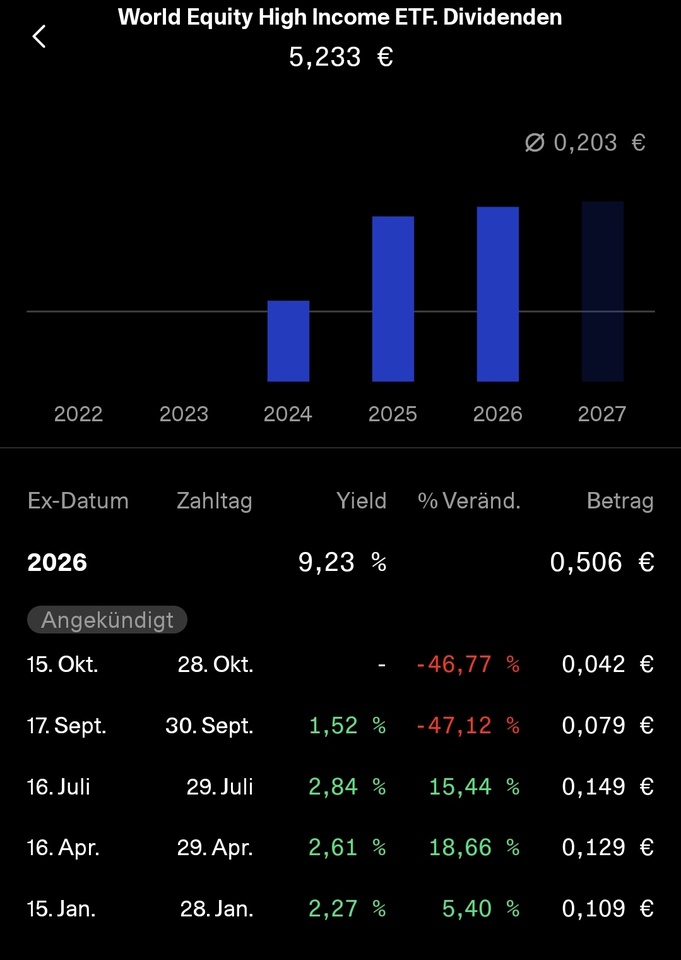
0.0891 USD
Announcement Date:
September 10, 2026
Expiration Date:
September 17, 2026
Record Date:
September 18, 2026
Payment Date:
September 30, 2026
https://www.londonstockexchange.com/news-article/market-news/dividend-declaration/17779498
Puestos
880.0891 USD
Announcement Date:
September 10, 2026
Expiration Date:
September 17, 2026
Record Date:
September 18, 2026
Payment Date:
September 30, 2026
https://www.londonstockexchange.com/news-article/market-news/dividend-declaration/17779498

Today I’d like to discuss an idea @GoDividend —his so-called “Bauspar-Hebeldepot.” Perhaps some of you have already read his posts on this topic (most recently about two months ago). I find the strategy remarkable for two reasons.
1) This is a very unusual idea. Namely, borrowing at a low interest rate through a home savings contract and investing the funds in securities that pay higher dividends. If the setup works out—and I think it certainly can—you’ve built up some nice leverage from borrowed capital.
2) He’s following through with this even though he’s pretty much the only one with this investment idea, and very few—if any—others here in the forum are pursuing this approach.
Here’s the link to his post https://getqu.in/U6H5wA/
The principle is actually very simple. He pays 2.1% per year in interest on the money borrowed through the home savings loan (in his case, 17,000 euros). He invests the borrowed money in securities such as $WINC (+0,33 %) with a projected distribution of nearly 10%. He takes the difference of just under 8% as a risk premium to account for the possibility that the security’s price could fall and that he’ll have to make up the difference between the security’s value and the loan amount at the end of the loan term.
If the scheme works out, he earns 8% on 17,000 per year (approx. 1,360 euros gross) without investing any of his own money (return on equity = infinite).
Why am I bringing this idea up? I’ll have three land registry entries become available in about two months, and I’m currently considering whether I can use them in a similar way. I don’t have a home savings loan, but I could take out a loan at standard interest rates for real estate financing—e.g., 100,000 at approx. 4.1%–4.4% p.a. Admittedly, I’d need securities with high distributions (and taxes would also eat into that). But it would be a way to generate some additional returns. I think 3% per year on 100,000 would be realistic. With a 10-year loan term, that would add up to a decent amount. Do you think the risk is worth it? Would you do something like this?
...another month has come and gone, and nothing has really changed—except that the milestone isn’t a stock market event, but rather my passing the DATEV certification exam (law firm accounting/financial accounting) 🥳
"But investing in yourself often pays off much more than just stubbornly clinging to the past."
Otherwise, there wasn’t much spectacular going on, except for more gradual growth...
...so things continue to look good month-over-month and are also steadily on track for the year...
...the same trend can be seen in the overall view...
...so even though this isn’t a high-flyer portfolio, I’m still looking to the future with confidence, despite all the ups and downs.
And of the last 10% to reach the halfway point, another solid 1.5% has now been achieved (maybe there’s still room for more @Solitair )
》DIVIDENDS《
Unfortunately, this month’s net total was only €91.53 (-13.77% YOY), but this is due to the fact that one stock won’t pay out until next month and another is paying out less.
Looking at the year as a whole, the YOC stands at 6.78%, which is still close to the 7% target, despite investments in growth stocks.
》TOP 3《
$AII (-6,55 %) +53.08% (+61.44%)
$DTE (+2,19 %) +5.70% (+3.76%)
$YYYY (+1,24 %) +5.82% (+1.01%)
》FLOP 3《
$BATS (+1,32 %) -8.92% (+98.49%)
$3750 (-2,4 %) -4.83% (+117.94%)
$HSBA (+1,18 %) -4.60% (+84.70%)
》NEW POSITIONS《
44.14 x $WINC (+0,33 %)
65 x x $FTWG (+0,89 %)
》DISPOSALS《
------
》CONCLUSION《
Everything remains the same, and personal education and professional development continue to be key to success...
With that in mind, here’s to continued success for all of us here in the community 💪🏻

I think I'm satisfied with how the past month went. There were a few major unforeseen personal expenses that I had to cover. That's why I want to start by building up my cash reserve, which I'll fund with my salary and dividends.
I sold $YYYY (+1,24 %) and invested the freed-up capital in $WINC (+0,33 %) (50%) as well as $JEPQ (+0,94 %) and $ASWM (+1,37 %) (25% each).
I also bought a few more shares of Pepsi, Pfizer, and American Tower.
Lately, I've been reading more and more about so-called covered call ETFs.
There are countless examples of these, such as $WINC (+0,33 %) , $CHPY (+1,58 %) , $QYLE (+0,63 %) , $XYLP (+0,33 %) , $SXYD (+1,08 %) , which attempt to track specific indices and use options.
These ETFs entice investors with high payout ratios—usually starting at 7–8%, sometimes even 11–12%.
In a recent post, the author @Dividendenopi already wrote about the fact that you shouldn’t underestimate the risks.
It was during a break between sets at the gym that this got me thinking, so I did some research on my own. Dear @Testo-Investo —no, of course I didn’t do the research on the bench press, but later. Not that I’d want to block the machine and get pelted with your Bitcoin…
I’d like to share the results of my research with you here and also encourage discussion. I’m sure we’ll need an informed comment from @Epi , and a less qualified one from @DonkeyInvestor :D plus a few more like @Tenbagger2024 , @Multibagger , @Simpson and @PoorDad let’s mark those too :) @MozartsGeist And @Solitair I’m sure you have an opinion on this, too, and @NichtRelevant and has an extremely relevant opinion on the matter.
Given all these negative aspects, one naturally wonders why anyone would buy this fund at all. There are actually a few reasons:
Conclusion: It can make sense to have a covered call ETF in your portfolio. However, I doubt it would make sense for most people here on Get Quin, since the majority are not currently in the payout phase of their lives. When it comes to the psychological aspect—the regular distributions—I believe you should still try to achieve this with a distributing global ETF. Of course, the dividend yields here are nearly ten times lower, but at least you’re generating sustainable price growth, which is far more important over decades than high short-term distributions.
What’s your take on this, and more importantly: have I forgotten anything important?
Your FinanzMechaNik
*AI-generated image*
I've never posted this here before, because my portfolio is actually always publicly viewable on my profile—but now I'd just like to introduce my portfolio.
Please note: This is a dividend-paying portfolio! The goal is to receive monthly dividends to supplement my income. A secondary goal is medium- and long-term capital appreciation, but at a minimum, to offset inflation (though, of course, I’d be happy with significantly more). The portfolio aims to avoid excessive volatility so that, in the event of a liquidity crunch (if necessary!), I can liquidate positions without taking too much of a hit during market downturns.
Background: I’m 51 years old, married, and have two children aged 7 and 9 (their investment accounts aren’t shown here). I haven’t been actively working for about two years—I only take on occasional real estate projects that interest me. I’ve sold my small business, and I don’t receive a statutory pension. Our primary family income consists of rental income and my wife’s modest salary.
The portfolio (as I see it): I have a “core” consisting of an actively managed fund from Fürstlich Castell’sche Bank (which is essentially their asset management service for “less affluent clients”) combined with the $TDIV (+0,45 %) (dividends and conservative growth) and $WINC (+0,33 %) (boosted dividends via CC). Below that are individual stocks that either pay high current dividends or offer reasonable dividend growth. With $WAWI (+1,11 %) and $MPCC (+0,68 %) I have a few riskier shipping companies in my portfolio (you’ve got to have a little fun, after all) and, as small-cap picks, a few exotic stocks—also with a focus on dividends (I’m still working on expanding the position sizes here to at least 5,000 each).
Why a fund and not an ETF as the largest position? Well, that’s a separate issue. This is my primary bank, which I use mainly for my real estate financing. I’ve had the same account manager there for 25 years, who can make decisions with virtually no consultation. That’s worth its weight in gold, which is why I can’t evaluate this holding based solely on the TER.
Important note: I invest primarily in real estate; this portfolio accounts for only about 14% of my total investments. The rest consists of rental properties. So I have an extremely high weighting in real estate; the overall allocation could probably be described as ultra-conservative. Here are the key figures for this asset class: total market value of approximately 6.5 million euros, outstanding loans of approximately 1.4 million euros, annual net rental income of about 275,000 euros, 56 residential units (mainly in Leipzig)—and a few more are being added right now.
I look forward to your feedback—perhaps you have suggestions on how you would further develop this portfolio given my situation.

...and so my wife has once again consistently stuck with her ETF, catapulting it to second place in our overall portfolio. Together with the $WINC (+0,33 %) , we now have a great duo at the top 👍🏻
$WINC (+0,33 %) For those who didn’t know “yet” is officially shifting its distribution frequency from quarterly to monthly dividend payments, effective September 4, 2026.