Prysmian
Price
Discussion about PRY
Posts
32

Euro AI Backbone - August Review / Portfolio Rebalancing in September 2026
Brief Review: August 2026:
Through mid-August, the Euro AI Backbone saw a recovery. In mid-August, the wikifolio’s price came under pressure. Price drivers from the semiconductor and tech hardware sectors declined, in some cases significantly.
As of August 1, the certificate’s price stood at €91.81; on August 31, it closed at €90.71, representing a loss of 1.2%.
_________________________
At the start of the new month, the regular portfolio rebalancing will take place as follows.
- The weighting of the VAT Group
$VACN (-0.48%) is reduced from 2.1% to 1.4%. - The weighting of Enel
$ENEL (-0.15%) will be reduced from 5.6% to 5.0%. - The weighting of Geberit
$GEBN (-0.18%) is being reduced from 1.3% to 0.7%. - New addition Huber+Suhner
$HUBN (+1.21%) at 2.1%.
_________________________
Background
VAT Group reduction / Fine-tuning in the semiconductor sector:
The position of the VAT Group will be reduced as part of the optimization of the semiconductor specialists (taking into account the existing position in Atlas Copco $ATCO B (+0.99%) ) in order to reduce concentration risk in vacuum technology.
Reduction in Enel:
For the major utilities, the reduction is intended to lock in profits and free up capital for highly specialized technology niches, while coverage of the core power grid holding remains stable.
Reduction in Geberit:
The weighting of Geberit is being adjusted to reflect its actual AI leverage (cooling water circuits/piping systems in data centers), ensuring that the physical data center infrastructure segment remains represented without tying up unnecessary capital.
Addition of Huber+Suhner:
In the Optical Interconnects and Passive Infrastructure segment, Huber+Suhner is a specialist in high-precision fiber-optic and connection technology within data centers. Huber+Suhner bridges the gap in optical signal transmission between AI servers, thereby complementing network equipment providers such as Nokia
$NOKIA (-0.02%) as well as cable giants such as Prysmian
$PRY (-0.6%) and NKT $NKT (+1.13%) .
P.S.: The Wikifolio will likely be granted "Investable" status later this month, and you'll be able to start investing in it at that time!


Euro AI Backbone - Portfolio Rebalancing in July 2026
Since the wikifolio was created on June 18, a review will not take place until the end of July.
The first rebalancing will take place at the start of the second half of the year.
- The weighting of the VAT Group $VACN (-0.48%) will be reduced from 4.5% to 2.3%.
- The weighting of Nexans $NEX (+1.85%) will be reduced from 1.6% to 0.3%.
- New addition Alfa Laval $ALFA (+0.31%) at 1.7%.
- New addition: Atlas Copco $ATCO B (+0.99%) at 1.7%.
_________________________
Background
Reduction of VAT Group / Addition of Atlas Copco:
One of the goals of the Euro AI Backbone is to cover as much of the value chain as possible. While the VAT Group manufactures vacuum valves, this is now complemented by the global market leader in vacuum pumps.
Reduction in Nexans:
In the cable/infrastructure sector, in addition to Nexans, Prysmian $PRY (-0.6%) and NKT $NKT (+1.13%) are also represented. Prysmian, with its large operational scale, and NKT, with its deep roots in European network expansion, already cover a large portion of this sector.
Addition of Alfa Laval:
In the automation and data center cooling sector, Alfa Laval is the global market leader in thermal heat transfer, separation technology, and fluid control. Alfa Laval complements Siemens $SIE (+0.51%) , Schneider Electric’s $SU (-0.35%) and ABB $ABBN (+0.58%) , as well as RWE $RWE (+1.2%) , Iberdrola $IBE (+1.05%) and Enel $ENEL (-0.15%) .
Hier geht es zum Euro AI Backbone-wikifolio
P.S.: Almost there! The wikifolio has already been bookmarked seven times—just three more to go before the certificate can take the next step toward “Investable” in a few days.
🏗️ Introduction: Euro AI Backbone Wikifolio ⚡⚙️
Dear Community,
To kick off the week, I’d like to introduce you to my “Pick-and-Shovel” wikifolio “Euro AI Backbone” (in German: Backbone). More detailed information will follow; for now, this is just a rough overview.
_________________________
Background
The market’s focus is primarily on the U.S., while Europe often plays a more subordinate role. Yet recent years in particular have made it clear just how dependent Europe is on other countries such as the U.S., Russia, and China.
By the time the “Orange Man” began his second term, it had become clear:
Europe must become more independent —not only in the field of defense but also in the field of AI.
For nearly five years, Goldman Sachs has maintained an index called “EU AI Capex,” which consists of 64 European stocks. This served as the blueprint for my wikifolio.
The wikifolio was launched on June 18, 2026. For the wikifolio to receive “Investable” status, it needs, among other things, 10 bookmarks. So I’d really appreciate it if you could click “Add to Watchlist” on the wikifolio—thanks in advance.
_________________________
The “Pick-and-Shovel” Approach
The wikifolio aims to cover as much of the value chain for operating modern artificial intelligence as possible.
The focus here is primarily on five areas:
- The Shovels: Semiconductors and machinery (e.g., lithography systems, wafer deposition, chip assembly)
- The Gas: Electricity and energy generation (e.g., wind power, hydroelectric power, solar power plants)
- Highways: Networks and cables (e.g., transformers, high-voltage undersea cables, power grid infrastructure, transmission lines)
- The brain: Automation and data center cooling (e.g., liquid cooling, power distribution cabinets, data networks, control systems)
- The Physical Foundation: Construction, emergency power, and security (e.g., construction of the facilities, emergency power generators, cybersecurity)
_________________________
Investment Universe
The portfolio includes European large-, mid-, and small-cap stocks.
Focus: Technology (semiconductor equipment), utilities (electricity, grids), and industrials (automation, specialty cables, data center construction, cybersecurity).
The Core: European market leaders with global monopolies and competitive moats.
The Tech Specialists: Profitable second-tier suppliers as yield boosters.
The foundation: Energy producers, grid operators, and construction specialists for stable cash flows and risk hedging.
Regular rebalancing, which typically takes place at the beginning of each month, prevents concentration risk. While the foundation remains unchanged, the weightings of individual securities may be adjusted. The replacement of individual stocks, the addition of new stocks, or the exclusion of individual stocks can also take place at the beginning of the month.
Initially, the portfolio consists of 37 stocks. There is no cash reserve.
The current allocation of holdings is as follows:
By sector:
- Industrial: 44%
- Utilities: 29%
- Technology: 26%
- Consumer Discretionary: 1%
By country:
- Germany: 24%
- United Kingdom: 14%
- Switzerland: 13%
- Netherlands: 12%
- France: 12%
- Spain: 10%
- Italy: 9%
- Denmark: 2%
- Finland: 2%
- Austria: 2%
Investments are made exclusively in European stocks. None ETFs, no investment certificates, no funds, no leveraged products.
_________________________
Initial Holdings
At the start, the portfolio comprises the following 37 securities, sorted by their current weighting:
Infineon $IFX (-1.56%) , ASML Holding $ASML (+0.49%) , Siemens $SIE (+0.51%) , Enel $ENEL (-0.15%) , Rolls-Royce $RR. (+0.56%) , Schneider Electric $SU (-0.35%) , Iberdrola $IBE (+1.05%) , ABB $ABBN (+0.58%) , VAT Group $VACN (-0.48%) , Siemens Energy $ENR (+1.93%) , Prysmian $PRY (-0.6%) , ASM International $ASM (+0.59%) , BE Semiconductor Industries $BESI (-0.22%) , STMicroelectronics $STM (-0.43%) , RWE $RWE (+1.2%) , E.ON $EOAN (+0.34%) , Legrand $LR (+0.65%) , National Grid $NG. (+0.38%) , Nokia $NOKIA (-0.02%) , SSE $SSE (+0.17%) , EDP Renovaveis $EDPR (+0.77%) , Hochtief $HOT (+0.79%) , Red Eléctrica de España $RED (+0.41%) , Nexans $NEX (+1.85%) , United Utilities $UUGRY (+1.78%) , Enagas $ENG (+0.43%) , Centric $CENTR , Spirax-Sarco Engineering $SPX (+0.58%) , Soitex $SOI (-1.08%) , Geberit $GEBN (-0.18%) , Aixtron $AIXA (-0.52%) , Orsted $ORSTED (+1.23%) , Verbund $VER (+0.38%) , SAFRAN $SAF (+0.52%) , Thales $THALES (+1.65%) , NKT $NKT (+1.13%) , Andritz $ANDR (+0.49%)
_________________________
Holding Period
Since infrastructure development is likely to continue for several more years, the holding period is clearly geared toward the long term. Short-term trading is avoided.
_________________________
Sources of Information
The following sources of information are primarily used to identify stocks:
Companies’ quarterly reports and financial statements.
Analyst reports and industry studies from global investment banks.
Business media and financial publications.
_________________________
I’m curious to see how the portfolio will perform over the long term. Monthly updates will keep you informed.

🏗️ Introduction: Euro AI Backbone Wikifolio ⚡⚙️
Dear Community,
To kick off the week, I’d like to introduce you to my “Pick-and-Shovel” wikifolio “Euro AI Backbone” (in German: Backbone). More detailed information will follow; for now, this is just a rough overview.
_________________________
Background
The market’s focus is primarily on the U.S., while Europe often plays a more subordinate role. Yet recent years in particular have made it clear just how dependent Europe is on other countries such as the U.S., Russia, and China.
By the time the “Orange Man” began his second term, it had become clear:
Europe must become more independent —not only in the field of defense but also in the field of AI.
For nearly five years, Goldman Sachs has maintained an index called “EU AI Capex,” which consists of 64 European stocks. This served as the blueprint for my wikifolio.
The wikifolio was launched on June 18, 2026. For the wikifolio to receive “Investable” status, it needs, among other things, 10 bookmarks. So I’d really appreciate it if you could click “Add to Watchlist” on the wikifolio—thanks in advance.
_________________________
The “Pick-and-Shovel” Approach
The wikifolio aims to cover as much of the value chain for operating modern artificial intelligence as possible.
The focus here is primarily on five areas:
- The Shovels: Semiconductors and machinery (e.g., lithography systems, wafer deposition, chip assembly)
- The Gas: Electricity and energy generation (e.g., wind power, hydroelectric power, solar power plants)
- Highways: Networks and cables (e.g., transformers, high-voltage undersea cables, power grid infrastructure, transmission lines)
- The brain: Automation and data center cooling (e.g., liquid cooling, power distribution cabinets, data networks, control systems)
- The Physical Foundation: Construction, emergency power, and security (e.g., construction of the facilities, emergency power generators, cybersecurity)
_________________________
Investment Universe
The portfolio includes European large-, mid-, and small-cap stocks.
Focus: Technology (semiconductor equipment), utilities (electricity, grids), and industrials (automation, specialty cables, data center construction, cybersecurity).
The Core: European market leaders with global monopolies and competitive moats.
The Tech Specialists: Profitable second-tier suppliers as yield boosters.
The foundation: Energy producers, grid operators, and construction specialists for stable cash flows and risk hedging.
Regular rebalancing, which typically takes place at the beginning of each month, prevents concentration risk. While the foundation remains unchanged, the weightings of individual securities may be adjusted. The replacement of individual stocks, the addition of new stocks, or the exclusion of individual stocks can also take place at the beginning of the month.
Initially, the portfolio consists of 37 stocks. There is no cash reserve.
The current allocation of holdings is as follows:
By sector:
- Industrial: 44%
- Utilities: 29%
- Technology: 26%
- Consumer Discretionary: 1%
By country:
- Germany: 24%
- United Kingdom: 14%
- Switzerland: 13%
- Netherlands: 12%
- France: 12%
- Spain: 10%
- Italy: 9%
- Denmark: 2%
- Finland: 2%
- Austria: 2%
Investments are made exclusively in European stocks. None ETFs, no investment certificates, no funds, no leveraged products.
_________________________
Initial Holdings
At the start, the portfolio comprises the following 37 securities, sorted by their current weighting:
Infineon $IFX (-1.56%) , ASML Holding $ASML (+0.49%) , Siemens $SIE (+0.51%) , Enel $ENEL (-0.15%) , Rolls-Royce $RR. (+0.56%) , Schneider Electric $SU (-0.35%) , Iberdrola $IBE (+1.05%) , ABB $ABBN (+0.58%) , VAT Group $VACN (-0.48%) , Siemens Energy $ENR (+1.93%) , Prysmian $PRY (-0.6%) , ASM International $ASM (+0.59%) , BE Semiconductor Industries $BESI (-0.22%) , STMicroelectronics $STM (-0.43%) , RWE $RWE (+1.2%) , E.ON $EOAN (+0.34%) , Legrand $LR (+0.65%) , National Grid $NG. (+0.38%) , Nokia $NOKIA (-0.02%) , SSE $SSE (+0.17%) , EDP Renovaveis $EDPR (+0.77%) , Hochtief $HOT (+0.79%) , Red Eléctrica de España $RED (+0.41%) , Nexans $NEX (+1.85%) , United Utilities $UUGRY (+1.78%) , Enagas $ENG (+0.43%) , Centric $CENTR , Spirax-Sarco Engineering $SPX (+0.58%) , Soitex $SOI (-1.08%) , Geberit $GEBN (-0.18%) , Aixtron $AIXA (-0.52%) , Orsted $ORSTED (+1.23%) , Verbund $VER (+0.38%) , SAFRAN $SAF (+0.52%) , Thales $THALES (+1.65%) , NKT $NKT (+1.13%) , Andritz $ANDR (+0.49%)
_________________________
Holding Period
Since infrastructure development is likely to continue for several more years, the holding period is clearly geared toward the long term. Short-term trading is avoided.
_________________________
Sources of Information
The following sources of information are primarily used to identify stocks:
Companies’ quarterly reports and financial statements.
Analyst reports and industry studies from global investment banks.
Business media and financial publications.
_________________________
I’m curious to see how the portfolio will perform over the long term. Monthly updates will keep you informed.

🏗️🔋Euro AI Backbone - My Bet on Europe's AI Backbone 🎲
Dear Community,
Throughout last year, I found myself repeatedly wanting to focus on the European market as well. But the same old arguments kept dissuading me: The European market doesn’t deliver; Europe doesn’t meet my desire for a growth-oriented, high-yield portfolio, etc.
I also asked myself: Which sectors and industries do I want to cover? Where do I see enough potential to justify taking the risk? To what extent do I want to align my portfolio with this strategy?
In today’s episode, Alles auf Aktien: Fiese Gewinnwarnung bei BMW und Europas KI-Unabhängigkeitsaktien , something caught my attention:
A basket from Goldman Sachs, consisting of 64 European stocks, with the wonderful name: EU AI Capex.
Performance over the past five years: 17.5 percent annualized, including dividends.
_________________________
And which industries are covered?
- Semiconductors
- Machinery
- Electricity
- Networks
- Cables
- Energy
- Automation
Unfortunately, existing ETFs such as the iShares STOXX Europe 600 Utilities UCITS ETF or the iShares STOXX Europe 600 Technology UCITS ETF do not cover all of these sectors.
"Sounds exactly like what I was looking for," I thought to myself, and used my day off today to create an index tailored to my preferences.
Goldman Sachs has listed 12 of the 64 holdings, including their percentage allocations. The remaining 52 holdings appear to be known only to institutional investors, as the index isn’t publicly available.
So I created my own “Pie” through Trading 212. More specifically, a “Pie” is a personalized investment portfolio in which I can invest in multiple stocks and ETFs according to a percentage allocation I set myself and save toward them simultaneously via a single automated savings plan—with no expense ratio and no order fees.
It would go beyond the scope of this post to write about every individual security, which is why I chose this particular one. I didn’t make these decisions entirely on my own. Gemini helped me with this. In the end, we settled on 37 securities.
_________________________
On Selecting the Holdings
Together, we gradually added European market leaders across the entire value chain. We always kept an eye on the sectors—none should be left out.
_________________________
On the Percentage Allocation
It’s important to note upfront that the “pie” will be funded with 150 euros per month going forward. Since the minimum investment amount at Trading 212 is one euro, the smallest weighting in the “pie” must be at least 0.7%:
1.00 euro / 0.70% = 142.85 euro
The percentage allocation was then based on pricing power and global scalability.
More details on this may follow in a later post.
_________________________
About the Stocks
From EU AI Cortex Basket taken over by Goldman Sachs:
- Infineon ($IFX (-1.56%)): 7.10%
- ASML ($ASML (+0.49%)): 6.80%
- Siemens ($SIE (+0.51%)): 6.00%
- Rolls-Royce ($RR. (+0.56%)): 5.40%
- Enel ($ENEL (-0.15%)): 5.40%
- Schneider Electric ($SU (-0.35%)): 5.40%
- ABB ($ABBN (+0.58%)): 5.00%
- Iberdrola ($IBE (+1.05%)): 4.90%
- Siemens Energy ($ENR (+1.93%)): 4.70%
- ASM International ($ASM (+0.59%)): 3.70%
- Prysmian ($PRY (-0.6%)): 3.60%
- BE Semiconductor ($BESI (-0.22%)): 3.20%
Supplemented by the following stocks:
- VAT Group ($VACN (-0.48%)): 4.50%
- STMicroelectronics ($STM (-0.43%)): 2.50%
- Legrand ($LR (+0.65%)): 2.00%
- RWE ($RWE (+1.2%)): 1.95%
- Nokia ($NOKIA (-0.02%)): 1.90%
- E.ON ($EOAN (+0.34%)): 1.90%
- National Grid ($NG. (+0.38%)): 1.80%
- SSE plc ($SSE (+0.17%)): 1.70%
- EDP Renováveis ($EDPR (+0.77%)): 1.60%
- Red Eléctrica ($RDEIY (+1.37%)): 1.50%
- Nexans ($NEX (+1.85%)): 1.50%
- Hochtief ($HOT (+0.79%)): 1.50%
- Enagás ($ENG (+0.43%)): 1.40%
- United Utilities ($UU. (+0.32%)): 1.40%
- Spirax-Sarco ($SPX (+0.58%)): 1.30%
- Centrica ($CNA (-1.4%)): 1.30%
- Aixtron ($AIXA (-0.52%)): 1.30%
- Orsted ($ORSTED (+1.23%)): 1.15%
- Verbund AG ($VER (+0.38%)): 1.10%
- Soitec ($SOI (-1.08%)): 1.10%
- Safran ($SAF (+0.52%)): 1.00%
- Thales ($HO (+0.59%)): 1.00%
- Geberit ($GEBN (-0.18%)): 0.90%
- NKT A/S ($NKT (+1.13%)): 0.80%
- Andritz ($ANDR (+0.49%)): 0.70%
The figures $IG (+0.44%) , $SRG (+0.52%) , $TRN (+0%) , $ALFA (+0.31%) , $ATCO B (+0.99%) or $AEMMY can unfortunately only be traded via CFDs on Trading 212. Therefore, these securities could not be included.
_________________________
Trading 212 Pie
The Pie now accounts for about 10% of my portfolio, and I’ll be contributing 150 euros to it each month going forward.
I am convinced that Europe will succeed in becoming more independent. However, in my opinion, a self-sufficient Europe without any dependence whatsoever is simply not possible (keyword: globalization).
_________________________
Pie Composition
By country:
- Germany: 24.35%
- France: 15.4%
- Netherlands: 13.7%
- United Kingdom: 12.9%
- Switzerland: 10.4%
- Italy: 9%
- Spain: 7.8%
- Denmark: 1.95%
- Austria: 1.8%
- Portugal: 1.6%
By sector:
- Technology: 32.3%
- Industrial & Capital Goods: 31.5%
- Utilities & Energy Infrastructure: 36.2%
By industry:
- Semiconductors & Data Center Chips: 27.8%
- Energy Equipment & Grid Technology: 25.5%
- Electricity Generators: 16.1%
- Physical Networks & Storage: 10.1%
- Cable Infrastructure: 5.9%
- Vacuum Technology & Components: 6.5%
- Network Technology & Connectivity: 1.9%
- Data Centers & Industrial Construction: 3.1%
- Cyber and Perimeter Security: 3.1%
_________________________
I’m curious to see how the pie chart will develop.
P.S.: You can find the pie chart on Trading 212 under the name Euro AI Backbone GS to copy.

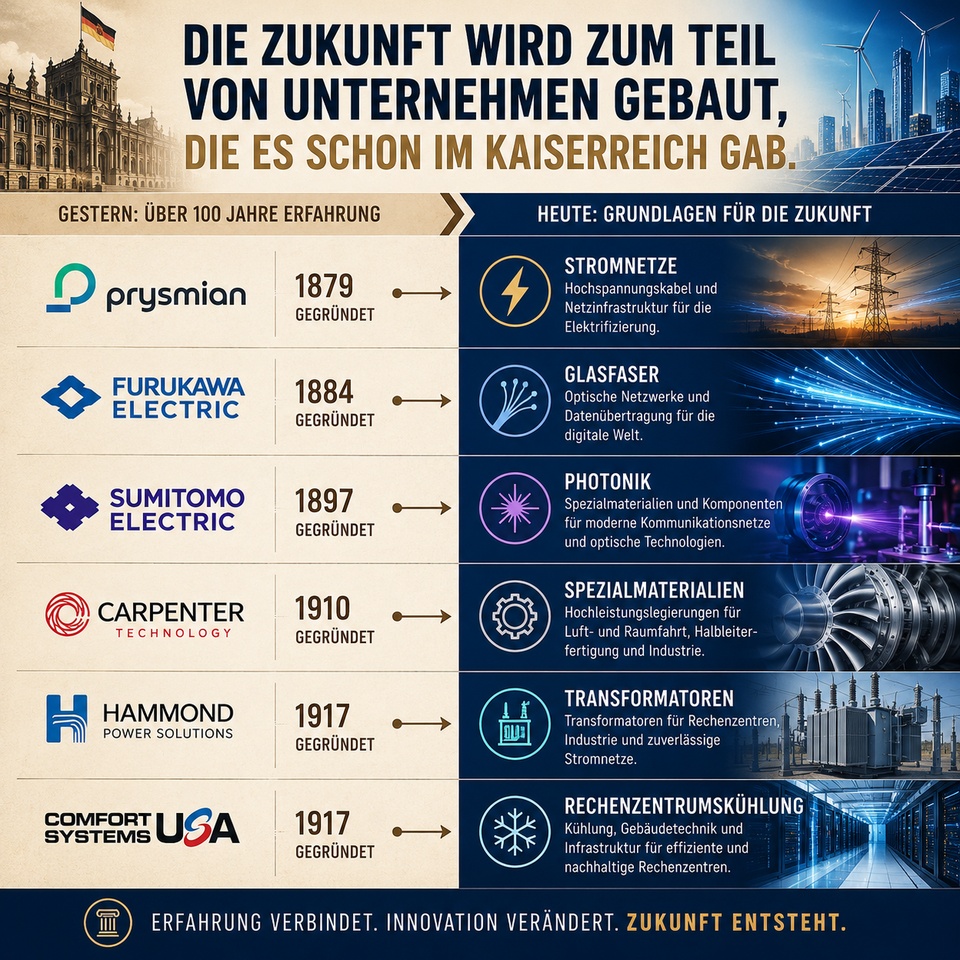
Did you know? The future is being shaped in part by companies that already existed during the German Empire.
When people talk about future technologies or next-gen technologies, the first thing that comes to mind is startups. In my research, however, I keep coming across companies that have been around for more than 100 years!
A few examples from my portfolio:
• Prysmian (1879)
$PRY (-0.6%)
Electric highways, high-voltage cables, and grid infrastructure for electrification.
• Furukawa Electric (1884)
$5801 (-0.24%)
Fiber optics, optical networks, and data transmission.
• Sumitomo Electric (1897)
$5802 (-0.9%)
Photonics, specialty materials, and components for modern communication networks.
• Carpenter Technology (1910) $CRS (+0.01%)
Specialty alloys for aerospace, semiconductor manufacturing, and high-performance systems.
• Hammond Power Solutions (1917)
$HPS.A (-0.26%)
Transformers for data centers, industry, and power grids.
• Comfort Systems USA (1917)
$FIX (-0.52%)
Cooling, building services, and infrastructure for modern data centers.
The more I delve into AI, energy, photonics, or data centers, the more often I come across companies like these.
New technologies can emerge within just a few years. The industrial infrastructure behind them often takes decades to develop.
That is precisely why it’s not just the companies making headlines that benefit from technological upheavals. Often, those who have been laying the groundwork for generations also benefit.
Another example is Caterpillar $CAT (-0.08%). The company was founded as early as 1925 and today supplies, among other things, the emergency power systems that play a key role in many data center projects.
Strictly speaking, only two companies on your list were actually founded during the Empire: Furukawa and Sumitomo. Prysmian was founded in Milan in 1879—but Lombardy had already seceded from the Austrian Empire 20 years earlier and had long since become part of the Kingdom of Italy (and the U.S. and Canadian companies were founded in republics and the British Empire, respectively). The paradox here is that the only true empire on your list (Japan) is, formally speaking, the only one still in existence anywhere in the world today! 😉
But setting historical geography aside: When it comes purely to the combination of over 100 years of tradition and the fundamental foundation for cutting-edge technologies of the future, there’s actually one very specific giant missing from your portfolio:
IBM $IBM (founded in 1911).
The company that’s building the invisible backbone for global enterprise AI today—and, above all, the actual hardware for tomorrow’s quantum computing—would fit perfectly into this lineup.
How do you view IBM compared to the other infrastructure stocks you mentioned?


European AI “Independence”
According to Ifo President Clemens Fuest, Europe faces an “existential threat”: Europe uses AI but has virtually no infrastructure. About 75 percent of the world’s high-performance computing capacity for modern AI is located in the U.S., with China accounting for about 15 percent and the EU for less than five percent.
He is therefore calling for an emergency program that includes more data centers, chip factories, energy infrastructure, faster approvals, and, if necessary, special economic zones. Energy is becoming a strategic issue, as AI data centers require enormous amounts of reliable electricity.
A study by the American investment bank Goldman Sachs titled “The Post-Modern Cycle” describes a new investment supercycle: AI, data centers, electricity, chips, defense, and infrastructure. The digital world suddenly needs concrete, cables, transformers, and power plants.
Goldman has created a corresponding portfolio called EU AI Capex.
It comprises 64 components. It is Europe’s publicly traded bet on AI infrastructure. Over the past five years, the index has gained 124 percent including dividends, which translates to an annualized return of 17.5 percent. The Stoxx Europe 600 has only managed 64 percent over the same period—an annualized rate of 10.3 percent.
The largest holdings show what this is all about: Infineon
$IFX (-1.56%) has a weighting of 7.1 percent, ASML
$ASML (+0.49%) stands at 6.8 percent, Siemens $SIE (+0.51%) accounts for 6 percent, Rolls-Royce $RR. (+0.56%) , Enel $ENEL (-0.15%) and Schneider Electric
$SU (-0.35%) at 5.4 percent. ABB $ABBN (+0.58%) has a weighting of five percent, Iberdrola
$IBE (+1.05%) at 4.9 percent, Siemens Energy
$ENR (+1.93%) at 4.7 percent, ASM International
$ASM (+0.59%) at 3.7 percent, Prysmian $PRY (-0.6%) at 3.6 percent, and BE Semiconductor
$BESI (-0.22%) at 3.2 percent.
This means the index is not purely a tech index, but rather reflects Europe’s physical AI value chain: semiconductors, machinery, electricity, networks, cables, energy, and automation. ASML is Europe’s strategic crown jewel. Fuest even says that ASML is so far Europe’s only truly strategic asset in this sector, because the U.S. also depends on it.
The risk: Europe talks, but doesn’t build. Energy remains expensive, permits take a long time, regulation slows down projects—and in the end, we remain customers of American models.
The opportunity: Europe is waking up. Then digital sovereignty will trigger a capex boom, and stocks will get a new boost. Anyone who wants European AI must definitely buy European infrastructure.
Source: “Welt” (excerpt), June 17, 2026

🇪🇺 Has Europe missed the AI boat?
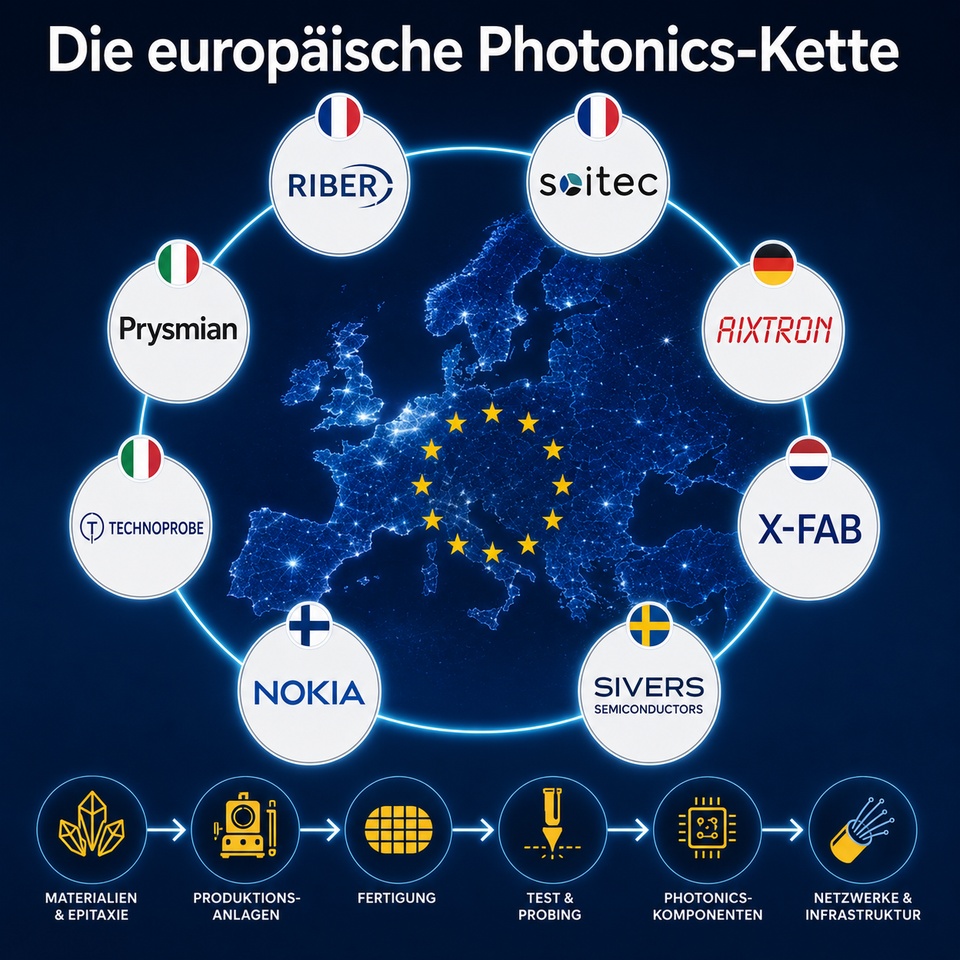
Probably not. Perhaps a European photonics cluster. When people talk about AI, it’s usually about NVIDIA, data centers, or the next language models. At the same time, something exciting has happened in Europe: In the planned Chips Act 2.0 , photonics has been explicitly named for the first time as a strategic field of the future.
This comes as no surprise. After all, modern AI systems need more than just computing power. Above all, they must process ever-larger amounts of data quickly, reliably, and energy-efficiently. This is precisely where a future infrastructure bottleneck could emerge.
What I find exciting is that (with the exception of X-Fab and Nokia) my own portfolio and, to some extent, the bottleneck wikifolios already include several European companies that together almost form a complete photonics value chain :
🇫🇷 Riber
$ALRIB (+0.92%)
MBE systems for the production of highly specialized III-V semiconductors.
🇫🇷 Soitec
$SOI (-1.08%)
Specialty substrates and wafer technologies as the foundation for photonic integration.
🇩🇪 Aixtron
$AIXA (-0.52%)
Production equipment for InP, GaN, and other photonics applications.
🇳🇱 X-Fab
$XFAB (-2.39%)
European foundry expertise for sensor technology and photonic applications.
🇸🇪 Sivers Semiconductors
$SIVE (-4.83%)
Photonics and high-frequency chips for data transmission.
🇮🇹 Technoprobe
$TPRO (-0.61%)
Probe cards and test solutions for increasingly complex semiconductor structures.
🇫🇮 Nokia
$NOKIA (-0.02%)
Optical networking technologies for the next generation of data transmission. The acquisition of Infinera makes Nokia an increasingly relevant European player in the field of optical networking.
🇮🇹 Prysmian
$PRY (-0.6%)
Fiber-optic infrastructure as the physical backbone of digital data transmission.
Taken individually, some of these companies seem rather unremarkable. Taken together, however, they tell a different story. Not that of a continent that has fallen behind. But rather the story of a potential European photonics ecosystem in the making.
Whether this will actually give rise to global champions, no one knows today. But that is exactly where I look for bottlenecks: one level below the obvious winners. Where new technologies are made possible in the first place.
⚠️ Not investment advice.

I also find$NOKIA very interesting… Thanks for your research! I’ll take a look at the other stocks as well. 🙂
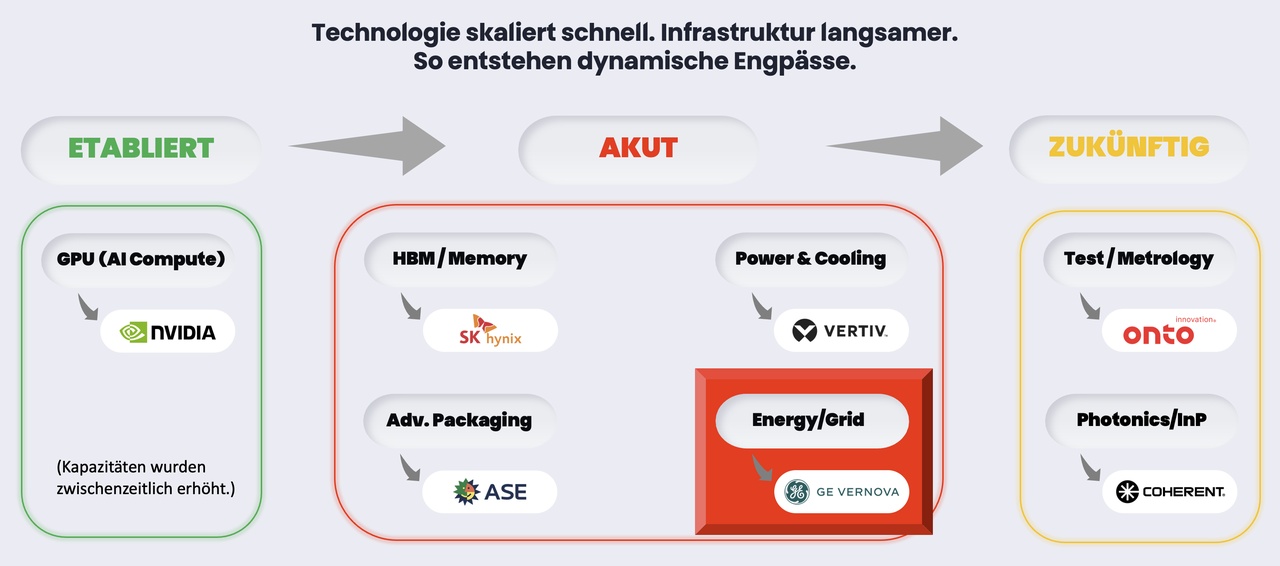
Acute AI bottleneck #4: Energy/Grid ⚡
My last bottleneck posts were about HBM/Memory, Power & Cooling and Advanced Packaging. All three topics show that the critical points in the AI stack are shifting further and further into the physical infrastructure.
Today it's all about energy/grid.
Modern AI systems not only require computing power, but also enormous amounts of of stable energy. Several bottlenecks are now emerging in parallel. What I find particularly remarkable is that many investors think of energy almost exclusively in terms of electricity production. The actual bottleneck is spread across several levels of the infrastructure.
Level 1: Generation
This is where the energy itself is generated. For me $GEV (-0.23%) (GE Vernova), $RR. (+0.56%) (Rolls-Royce Holdings) and $BE (-1.01%) (Bloom Energy) are exciting examples. The bottlenecks here are mainly in base load, flexible generation and local energy supply around new AI and data center load profiles. And Rolls-Royce could also become a player in Small Modular Reactors (SMR).
Level 2: Transmission
This is about being able to transport large amounts of energy at all. This sector is currently almost the biggest physical grid bottleneck. I find it particularly relevant here $PWR (+0.03%) (Quanta Services), $PRY (-0.6%) (Prysmian) and $HPS.A (-0.26%) (Hammond Power Solutions). Typical bottlenecks are HVDC, high voltage, transformers and the massive expansion of the grid infrastructure.
Level 3: Distribution
Ultimately, the energy must be available locally, for industry, cities, data centers or critical infrastructure. There I look above all at $POWL (-0.26%) (Powell Industries), $VICR (+4.72%) (Vicor) and $MPWR (-1.25%) (Monolithic Power Systems). The problems here are increasingly arising with power delivery, medium voltage, AI rack power and stable local grids.
Level 4: Implementation
This area is often underestimated. Because even if technology, capital and planning are available, projects still have to be physically implemented in the end.
That's why I think $FIX (-0.52%) (Comfort Systems USA), $EME (+0.3%) (EMCOR Group) and $STRL (-0.25%) (Sterling Infrastructure) interesting. The bottlenecks here often lie in EPC capacities (plant construction), skilled workers, construction speed and the actual realization of large infrastructure projects.
Energy/Grid is currently so exciting for me because the bottleneck is not in a single place, but runs through the entire energy chain. but runs through the entire energy chain. That's why I consider this topic to be one of the most important bottlenecks around AI infrastructure at the moment.

Trending Securities
Top creators this week