

I'm new here, and I'll be starting to invest soon. I'm really excited—do you think this $SPYI (-0,17 %) a good place to start? I’d like to expand to more ETFs later on to cover all sectors.

State Street SPDR MSCI All Country World Investable Market ETF (Acc)
ETP
ETP
ISIN: IE00B3YLTY66
Ticker: SPYI
IE00B3YLTY66
SPYI
Price
Debate sobre SPYI
Puestos
47


1D·
This is now my final portfolio breakdown 🔒
Hi everyone,
Some of you have noticed the changes I’ve made over the past few weeks. I’ve gone back and forth a lot, removed some components, added new ones, and adjusted the weightings. Now that’s over. This is the portfolio I’ll be sticking with for the next few years.
My savings rates (€2,000 per month)
🌍 €1,000 – SPDR MSCI ACWI IMI $SPYI (-0,17 %)
The core. Around 9,000 stocks worldwide, including emerging markets and small-caps. The component that always works.
💻 €350 – iShares S&P 500 Information Technology $IUIT (-0,1 %)
A deliberate, moderate overweight in tech and AI. I’ve recently reduced it significantly because the concentration became too large for me. But I don’t want to be without it entirely.
🌏 €250 – iShares Edge MSCI EM Value $5MVL (+0,76 %)
Emerging markets with a value approach. Attractive valuations and a counterbalance to the U.S.
📊 €250 – Avantis Global Small Cap Value $AVWS (-0,34 %)
New addition. Small, undervalued companies—the factor with the strongest evidence of long-term excess returns. And a nice counterbalance to the megacaps.
🥇 approx. 150 € – EUWAX Gold II (manually managed) $EWG2 (-1,08 %)
Gold as a crisis buffer. Physically backed, with no ongoing costs, and tax-free after one year. Unfortunately, it’s not eligible for a savings plan with my broker, so I buy one share manually every month.
On top of that, I have a small liquidity buffer in a money market ETF so I never have to sell at an inopportune time. $XEON (+0,02 %)
Why I’m satisfied now
For the first time, each component has a clear purpose: The global ETF provides returns and diversification, the three satellite holdings add targeted exposure, gold cushions against crises, and the buffer ensures peace of mind. The tech concentration has shrunk, and the portfolio is significantly more diversified than it was just a few weeks ago.
I’ve realized that constant optimization brings more anxiety than returns. From now on, the plan is: let the savings plans run their course, check in once a year, and let time do its work. At 21, that’s my biggest advantage.
Thanks for your feedback over the past few weeks—it’s really helped me! 🙌
6Puestos
44.258,26 €
0,83 %
1313
4 Comentarios
1D
Never say “final” on the stock market. Why would you think you’re the perfect investor right now and stop learning?
“A portfolio for the next few years” and “let it run and check it once a year” are technically contradictory, since the weightings of the positions shift automatically.
What’s your approach to rebalancing?
“A portfolio for the next few years” and “let it run and check it once a year” are technically contradictory, since the weightings of the positions shift automatically.
What’s your approach to rebalancing?
•
22
•1Lun·
A Change in Strategy and Why I'm Now Focusing on 4 ETFs 🔄
Hi everyone,
I'm 21 and invest €2,000 entirely in ETFs. In September, I restructured my portfolio, and I want to show you what it looks like now and what my reasoning was behind it.
The Strategy Change
Until now, I still held the Xtrackers MSCI World Financials ($XDWF (+0,71 %) ) and the individual stock IREN ($IREN (-0,41 %) ) in my portfolio. I sold both of them entirely and invested the proceeds in my core ETF. My portfolio was too scattered for my liking: a sector bet here, a single stock there. I wanted a clear structure with a broad core and a few targeted additions where I know exactly why they’re there.
My savings plan (€2,000/month, executed on the 15th)
🌍 €1,000 – SPDR MSCI ACWI IMI ($SPYI (-0,17 %)
)
This is my core. Over 9,000 stocks from developed and emerging markets, including small-caps. This essentially gives me the entire global stock market in a single ETF. No matter what else I do, this part ensures a broad base.
📉 €500 – iShares Edge MSCI World Value Factor ($IWVL (+0,04 %)
)
Historically, value has been a driver of returns over long periods, and after years of growth dominance, I find undervalued companies particularly appealing. It also helps balance out the heavy weighting of U.S. tech stocks in the global ETF.
💻 €250 – iShares S&P 500 Information Technology ($IUIT (-0,1 %)
)
My deliberate bet on tech. I believe that technology and AI will shape the coming decades, and I want to be specifically overweight in that sector. I realize this is a concentration risk, but at 21, I can afford the volatility.
🌏 €250 – iShares Edge MSCI EM Value Factor ($5MVL (+0,76 %)
)
Emerging markets are relatively undervalued and have long-term growth potential. Using a value-investing approach, I’m specifically buying the undervalued companies there.
My reasoning behind this
A broad global ETF as a stable core (50%) surrounded by yield-oriented additions (50%). My investment horizon spans several decades, which is why the portfolio is deliberately focused entirely on stocks.
What do you think? Would you weight things a little differently, or do you have any concerns about a particular component?
I’m looking forward to your feedback! 🙌
4Puestos
44.840,43 €
3,15 %
2424
15 Comentarios
I’d take another look at whether the MSCI World Value Index is the right vehicle for tracking this factor.
Sure, it’s performed well over the last two years, but for long stretches when other value funds were doing well, it was simply lagging behind…
I’d also question whether the index’s sector neutrality makes sense.
Actually, I’d like my value fund to include the sectors that are currently undervalued.
In the past, the index has often been packed with the weaker stocks in their respective sectors (cheap for a reason).
I’d rather go with $TDIV and/or $BUYB —which, by the way, also have a stronger value orientation than the MSCI World Value (according to Morningstar StyleBox).
The recent outperformance of the MSCI World Value is primarily a methodology effect.
Due to the required sector neutrality, the index must hold stocks with low valuations across all sectors, including the tech sector. As a result, semiconductor stocks, among others, were included in the index, causing the ETF to unintentionally benefit from the AI boom. Its strength is therefore based more on growth and momentum drivers than on traditional value investing.
In other words, the outperformance over the past two years is attributable not to the value factor but to the momentum factor.
Further evidence of this is that, as of today, the top stock with the highest weighting is $MU —the same top stock as in the MSCI World Momentum Index.
It’s a bug, not a feature.
•
1414
•
1Lun·
I'm back!
Hi everyone 👋
I haven't posted anything here in a while, but that's about to change. Starting now, I'd like to share updates on my portfolio and my wealth-building journey more regularly again. 📈
The reason for my long break:
About three years ago, I sold my entire portfolio to buy an apartment together with my brother. We’ve since rented it out.
However, the apartment is a bit older and needed extensive renovations. I was generally aware of the costs involved, but the renovations took longer than expected. As a result, I unfortunately had practically no money left over in recent years to invest.
My portfolio at the time was worth around €30,000, which I had built up in just two years. 💪
Of course, this isn’t necessarily a textbook example, since ideally, you shouldn’t need the money you invest in the stock market in the long term. However, I didn’t want to miss out on this opportunity with the apartment. Unfortunately, I had to sell my portfolio at a small loss back then—in hindsight, of course, not ideal—but buying the apartment and the subsequent renovation were my top priorities at the time.
Now the renovation is mostly complete, and I can finally start rebuilding my portfolio step by step. 🚀
To get started, I’ve devised a strategy based on the knowledge and experience I gained earlier on the stock market:
📊 60% MSCI World
💰 25–30% dividend ETF simply because I find it motivating to receive regular payouts. However, I’ll keep this portion somewhat flexible so I can occasionally buy individual stocks.
₿ 5–10% Bitcoin – as a little gamble 😉🎰
It all starts today! 🚀 My savings plans for all three positions kicked off today.
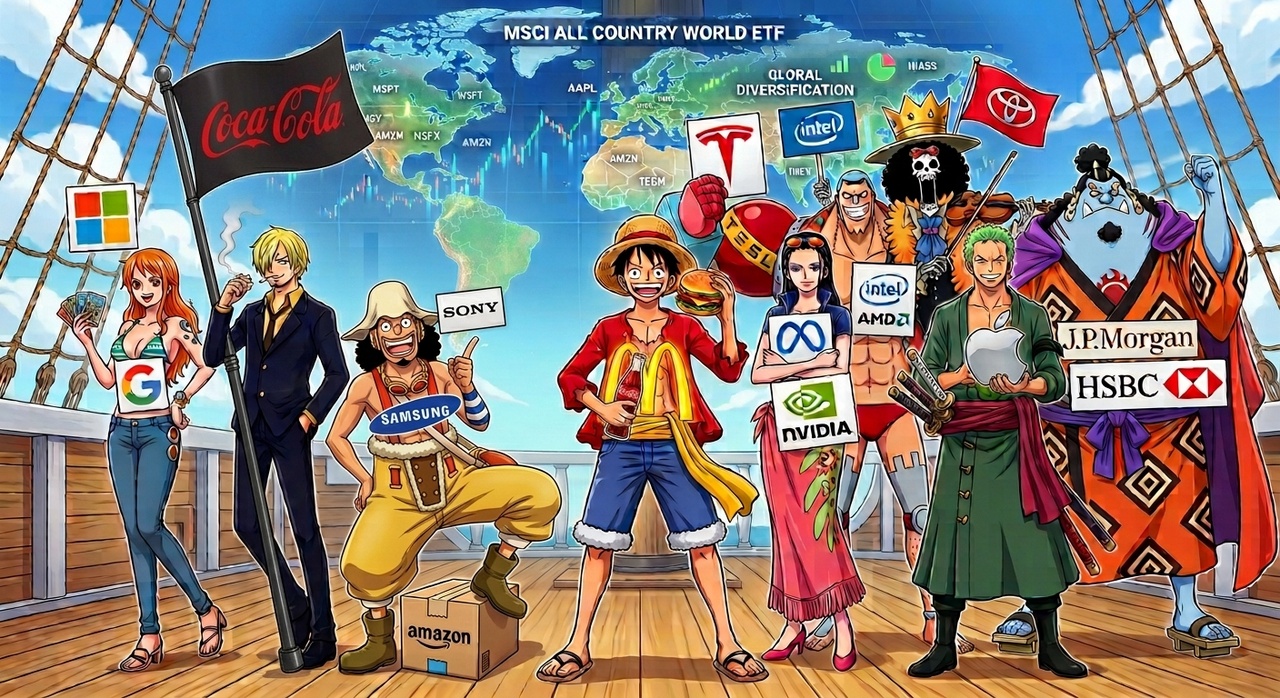
Back when I was actively trading on the stock market, AI didn’t exist in its current form. So this is obviously an exciting new opportunity for me now. As you can see in the attached image.👌
I know, of course, that there are many different opinions on such strategies, but for me, it’s important to have a strategy that I can actually stick with over the long term.
I’m looking forward to being more active here again and sharing my journey with you, and I’m always open to suggestions and discussion! 📊💪
2424
6 Comentarios
•
44
•
3Lun·
Portfolio Check: Does the number of shares I own make sense given the size of my portfolio?
Hi everyone,
I’m currently thinking about how to structure my portfolio and would love to hear your thoughts on it.
My basic idea so far has been to build a solid foundation of quality stocks. My plan for the future is not to simply add to these positions steadily, but to make targeted, countercyclical purchases during periods of market weakness.
My question for you:
Are 19 positions (excluding ETFs $SPYI (-0,17 %) ) with a portfolio size of about 13k already too much of a good thing?
Is there a risk that I’ll spread myself too thin with this many stocks, or do you think this is a healthy diversification to lay the foundation for further wealth accumulation?
If so, which stocks would you sell if you were in my shoes?
Oh, and it’s not entirely out of the question that $BTC (-1,59 %) be added to the mix 😅
I look forward to your opinions and input!
22Puestos
13.144,80 €
12,22 %
77
17 Comentarios
Your mini-positions are probably stock gifts; as for the rest, you might want to consider how to spread out any additional purchases—after all, the U.S. stocks are also included in the ETF. Otherwise, the number is up to you—as many as you can keep track of with reasonable effort without losing sight of the big picture.
•
66
•

7Lun·
Ftse-All-World vs ACWI vs ACWI IMI
Hello everyone,
I have a quick question about the three All-country-World ETFs $VWCE (-0,01 %) and $ISAC (-0,07 %) and $SPYI (-0,17 %) .
Often in the targeted portfolios you see the $VWCE (-0,01 %) and much less frequently the other two.
In the commentaries, too, the $VWCE (-0,01 %) is recommended again and again when it comes to "core" investments...
At just-etf, NO clear "favorite" has emerged from the comparison:
https://www.justetf.com/de/academy/ftse-all-world-vs-msci-acwi-imi.html
What are your reasons for choosing the $VWCE (-0,01 %) ? I would be interested to know....
Thank you and have a nice weekend!
44
6 Comentarios
7Lun
For me, the composition or number of shares, country distribution and average return also played a role in the decision.
For example, a FTSE All World (3,400 to 4,600 stocks from industrialized and emerging countries) covers more than an MSCI World (1,300 to 1,600 stocks from industrialized countries), and an MSCI ACWI IMI (8,000 to 9,000 stocks from large, mid and small caps) covers even more of the global world than the FTSE All World.
However, the broader the coverage of the world, the lower the return, because it is less concentrated on the world's economic leaders, to put it bluntly.
It is a matter of weighing up how much of the global market you want in a product and whether or not to add missing areas separately.
•
55
•
7Lun·
Invest or wait
Hello dear community,
First of all, I would like to thank you all here. I've been here for almost a year now and am trying to learn as much as possible.
I've had some tough times myself and have been rebuilding my portfolio since October. My friends are already saying ironically that I should stop investing because whenever I buy something it falls afterwards. That's why I've spread everything out and everything has really fallen. Even gold.
But that's not the point now. I'm convinced of my satellites in the long term and won't sell anything with a big loss.
What I'm still missing is a core ETF. Here I have chosen the $SPYI (-0,17 %) chosen.
Now it's about the right implementation.
My gut feeling tells me that there should be a small setback soon. There has hardly been a year in which it has never gone down and since May it has not even gone down more than 2% without being bought again immediately. Or am I saying the wrong thing here?
I hold over 40% cash and am now thinking about the best way to do this. I know that time in the market answers are coming but do you really think that applies in the current situation? I recently tried going long and short on the Nasdaq-100 for the transition. Unfortunately, the bottom line is that I lost more than I gained. How would you react now? Wait for the setback? Continue long and short in the current situation? Invest 30% in the core immediately and then let the savings plan run? Put everything in and hope that there will be no setback in 2026?
Have a nice weekend everyone!
14Puestos
21.074,49 €
12,09 %
44
33 ComentariosWithout wanting to offend you, your friends are right in the sense that you should let it go if you don't change your behavior. Your portfolio history goes back to Nov. 2024, during which time you have made well over 100 sales and partial sales. Every share that went up by more than 3% was sold. With respect, that's not going to work. And according to your own statement, you now have your satellites and are looking for a core. Putting the cart before the horse. I'd like to cheer you up, but you write that your sense of construction is already in play again, which is not exactly the best prerequisite for long-term and successful investing. Yes, of course, sales and purchases are part of it, but the operational hustle and bustle that you have displayed over the last few months won't get you anywhere. Get really!!! clear about what you want, analyze the right stocks, ETFs or whatever and invest and see it through.
•
2929
•
9Lun·
Intro & My path as a newcomer
Dear getquin community
Having been a silent reader here for a few months now, I would like to briefly introduce myself and my journey so far. Before I do, however, I would like to say a big thank you to everyone who regularly shares very exciting posts here and helps this community to grow. You are not only convincing in terms of content, but also create a really pleasant atmosphere in the forum with your appreciative way of writing.
My Story
Against the background and with the expectation of a substantial inheritance, I have been looking into investment opportunities as a complete newcomer to the stock market since the beginning of 2025. As I wanted to gain some experience first, I started investing my annual savings on a trial basis instead of paying off my mortgage as usual.
I started with an investment in $SPYI (-0,17 %) . As I didn't like the heavy weighting of the USA, in a second step I tried to build up a 35/25/30/10 ETF portfolio with a weighting of the world regions by GDP. The result did not convince me due to the complexity (at times over six ETFs → manual rebalancing effort) on the one hand and the manageable long-term return prospects on the other. In the meantime, I had the idea of investing in slightly better-performing and riskier thematic ETFs such as $SEMI (+1,14 %) and $XAIX (-0,98 %) but in the end this only led to an even more complex setup.
I then decided to try a buy-and-hold approach based on individual stocks, but was quickly impressed by the return prospects of riskier stocks. So - also influenced by posts here in the forum - I went all-in at the beginning of November with $IREN (-0,41 %) at a buy-in of around € 61 at the time. I now know that this impulse is called "FOMO" 🙂. When a sharp correction immediately began, I realized that return also means risk and that timing plays a role when buying individual stocks. Encouraged by posts here in the forum, however, I didn't sell in a panic, but continued to buy during the correction phase until I was able to reduce my buy-in to €45 at the end of December.
I am now slightly in the green again and the further prospects do not currently motivate me to sell my shares. I am setting myself a price target in the region of the old ATH in order to then reduce the position to a more reasonable size and restructure my portfolio. If I am satisfied with this, I will also invest the larger sum from the inheritance. At the moment, I can imagine a core of $VWCE (-0,01 %) , $TDIV (+0,02 %) and @Epis 3xGTAA Wikifolio Index as well as a somewhat smaller portion for selected, higher-risk stocks. There are numerous well-founded ideas for the individual stocks here in the forum, for which I would recommend, among others@Multibagger , @Tenbagger2024 , @Iwamoto and @Shiya are very grateful.
It's fun to be here.


11Lun·
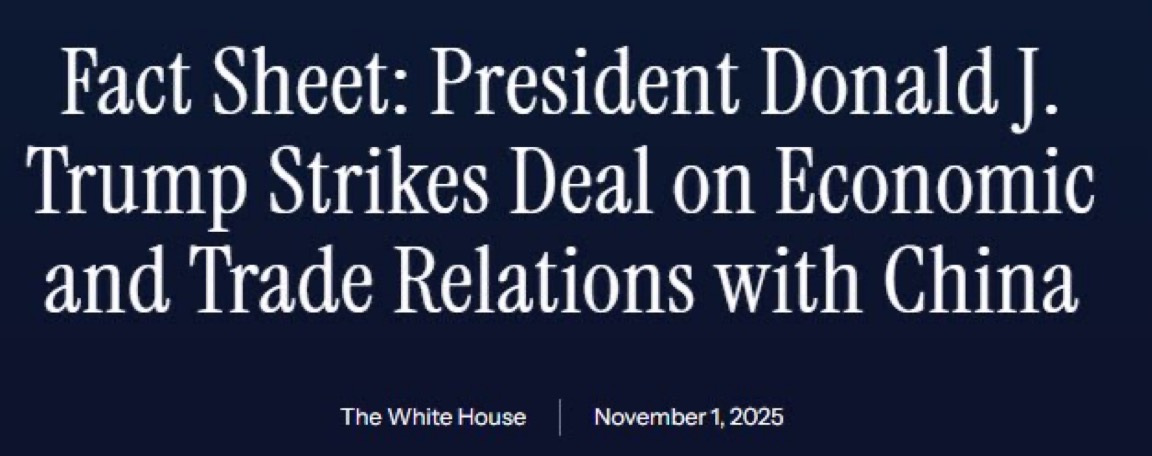
BREAKING : President Trump announced an economic and trade agreement between the USA 🇺🇸 and CHINA🇨🇳
$CSPX (-0,11 %)
$IWDA (-0,19 %)
$EIMI (+0,01 %)
$CSNDX (-0,64 %)
$VUSA (-0,11 %)
$VHYL (+0,04 %)
$SPYI (-0,17 %)
$HMWO (-0,49 %)
President Trump announced an economic and trade agreement between the USA and China:
- China suspends all retaliatory tariffs and non-tariff measures imposed since March 4
- China issues new general licenses for the export of rare earths and suspends new export controls.
- China pledges to stop the flow of fentanyl to the US
- China will buy at least 12 million tons of US soybeans
- The USA reduces tariffs on Chinese goods by 10 percentage points
The biggest de-escalation in relations between the US and China since the start of the trade war.
China 🇨🇳 will suspend all retaliatory tariffs and non-tariff measures in place since March 4, lift export controls on rare earths, issue global licenses for rare earths and critical minerals such as gallium and graphite, and commit to buying 12 million tons of US soybeans this year and 25 million tons annually through 2028. China will also take "significant measures" to stop fentanyl shipments to the US.
In return, the U.S. 🇺🇸 will reduce tariffs on Chinese imports imposed to curb fentanyl trade by 10 percentage points of the cumulative tariff rate, effective November 10, 2025, extend Section 301 tariff exemptions through November 2026, and suspend new export control measures for one year.
4848
29 Comentarios
11Lun
The market will probably rise again. Don't think I'm crazy, but I would be in favor of a correction. The market is currently running far too hot. 🫣
•
55
•