$AMA

Euronext
Stock
Stock
ISIN: NL0006294274
Ticker: ENX
NL0006294274
ENX
Price
Debate sobre ENX
Puestos
73Semana·
What to invest in now?
14Puestos
40.443,34 €
13,42 %
33
3 ComentariosDEW_7240@DEW_7240
3Semana
••
Ver todas las 2 respuestas adicionales


3Lun·
What is your opinion about:
$BLK (+1,13 %)
$ENX (-0,3 %)
$IVZ (-2,26 %) & $SPGI (+0,53 %)
- safe investement or it's not worth it ?
- And if it's not worth it, why?
22
1 Comentario3Lun
SPGI is a quality compounder. Would buy it at these levels! The rest I have No idea ;)
•
11
•
2Año·
🌐 Stock exchange battle: Deutsche Börse, ICE, Euronext, NASDAQ - who dominates trading? 📊
Company presentation
Deutsche Börse AG
Deutsche Börse is one of the world's leading exchange operators and offers a wide range of services in the areas of trading, clearing and market infrastructure. In addition to the Frankfurt Stock Exchange, the company has particularly distinguished itself through its innovative strength in the field of electronic trading.
Euronext NV
Euronext is a pan-European exchange group that operates markets in Belgium, France, Ireland, Italy, the Netherlands, Norway and Portugal. It is the largest stock exchange in Europe and offers a platform for trading shares, bonds and derivatives.
Nasdaq
As the world's first electronic stock exchange, founded in 1971, Nasdaq has developed into the leading trading center for technology companies. It is known for its high liquidity and the immense trading volume that is handled daily.
Intercontinental Exchange (ICE)
ICE operates global financial and commodity markets and is best known for its acquisition of the New York Stock Exchange (NYSE). The company offers a wide range of services, including trading in energy, commodities and financial derivatives.
Historical development
- German Stock Exchange: Its origins date back to the 16th century. The modern Deutsche Börse was created in the 1990s through mergers of regional exchanges and has since undergone extensive digitization.
- Euronext: Founded in 2000 through the merger of several European exchanges, Euronext has become the leading European platform through acquisitions, such as Borsa Italiana 2021.
- Nasdaq: Since its inception, Nasdaq has revolutionized electronic trading. The launch of the Nasdaq 100 index in 1985 strengthened its position as the central trading platform for tech companies.
- ICE: ICE was founded in 2000 and has rapidly expanded its position as a global player through strategic acquisitions, including NYSE in 2013.
Business model
- Deutsche Börse: It offers a comprehensive range of securities and derivatives trading as well as clearing and settlement services via Clearstream. Its diversification strengthens its competitiveness.
- Euronext: As an integrated platform, Euronext covers trading in equities, bonds and derivatives and offers additional services in the areas of corporate services and technology.
- Nasdaq: Nasdaq focuses on electronic trading, particularly in the technology sector, and offers innovative products such as ETFs and indices.
- ICE: ICE combines trading in commodities and financial derivatives and also offers clearing services, which increases the efficiency and transparency of its platforms.
Core competencies
- Deutsche Börse: Excellent technical infrastructure and market knowledge.
- Euronext: Leader in European market infrastructure with a diversified service offering.
- Nasdaq: Innovative power in electronic trading and a strong presence in the technology sector.
- ICE: Expertise in commodities and derivatives trading as well as strong clearing capabilities.
Future prospects
- Deutsche Börse: Focus on digital transformation and entry into new markets.
- Euronext: Investing in sustainable financing and consolidating its market position in Europe.
- Nasdaq: Expansion of AI and blockchain-based technologies for trading optimization.
- ICE: Expanding its product portfolio with innovative trading solutions and technologies.
Strategic initiatives
- Deutsche Börse: Securing its market position through acquisitions and investments in new technologies.
- Euronext: Focuses on expansion through acquisitions of regional markets to create an integrated European trading platform.
- Nasdaq: Focuses on launching new products, especially to support growing technology companies.
- ICE: Strong integration of new technologies to optimize trading processes and expand its business model.
Market position and competition
German Stock Exchange
Strong in Europe
Euronext
Euronext
Leading in Europe
German Stock Exchange
Nasdaq
Leading in the USA
NYSE
ICE
Strong global position
CME Group
Total Addressable Market (TAM)
- German stock exchange: Coverage of the European market with a focus on equities and derivatives trading.
- Euronext: Coverage of the European market with a focus on equities and bonds.
- Nasdaq: Global technology market with a particular focus on the USA.
- ICE: Covers global commodities and financial derivatives markets.
- Equity performance
- $DB1 (+1,05 %)
: TR over 10 years is 366% - $ENX (-0,3 %)
: TR is 620% over 10 years - $NDAQ (+1,15 %)
: TR is 503% for 10 years - $ICE (+1,82 %)
: TR is on 10 years is 343,1%
For the development (company figures), better view and more check out the free blog:https://topicswithhead.beehiiv.com/p/b-rsen-battle-deutsche-b-rse-ice-euronext-nasdaq-wer-dominiert-den-handel
Conclusion
Stock market shares are always interesting because they benefit disproportionately from good stock market years due to their relatively fixed costs. In addition, these companies are increasingly developing into data managers, which promises further growth and efficiency gains. There is still plenty of potential for consolidation and growth in the European stock exchanges in particular, especially due to the dynamic market activities.
When looking at capital efficiency, Euronext and Deutsche Börse stand out, either as top performers or as only slightly worse alternatives. Therefore, they are my preferred candidates if I had to make a decision. Despite everything, all the stocks mentioned have performed impressively, which is why I hold all but ICE and regularly buy more.
If you are active on the stock market and want to participate, you can hardly go wrong with these stocks. My three stocks in particular offer excellent diversification, as each of the exchanges has its own advantages and disadvantages.
It should be particularly emphasized that the Nasdaq also includes Scandinavian stock exchange operators, which also contributes to diversification and offers interesting growth opportunities.
If you look at historical performance, Euronext would be the clear outperformer and therefore the best choice over the last 10 years.

topicswithhead.beehiiv.com🌐 Börsen-Battle: Deutsche Börse, ICE, Euronext, NASDAQ - Wer dominiert den Handel? 📊
1414
10 Comentarios


3Año·
Investment philosophy, "diversification" and dividends
Hi all, as this is my first slightly larger post I would generally appreciate some constructive feedback.
First something About Me
I'll be 22 in a month and I've been active in the stock market for about 2 years now. After a lot of back and forth, I can almost say that I have tried every strategy - but I never really felt comfortable. One learns from mistakes, and I have made many of them.
But what I have also done is to spend countless hours, days and weeks with books, videos, shareholder letters and internet research. I was particularly fascinated by the investment approaches of Terry Smith and the way of Joseph Carlson on Youtube.
My goal quickly became clear, I don't want to have thousands of companies in my portfolio that I don't know, understand or fully support. So an ETF focus was off the table.
Thereupon I built my own investment philosophy, which I would like to present to you in the following.
If you want to know more about me and my goals, there might be another article with a portfolio presentation soon :-)
First I would like to explain to you why I do not believe in diversification hold:
A quote from Warren Buffet is well known: "Diversification is protection against ignorance. It makes little sense if you know what you are doing."
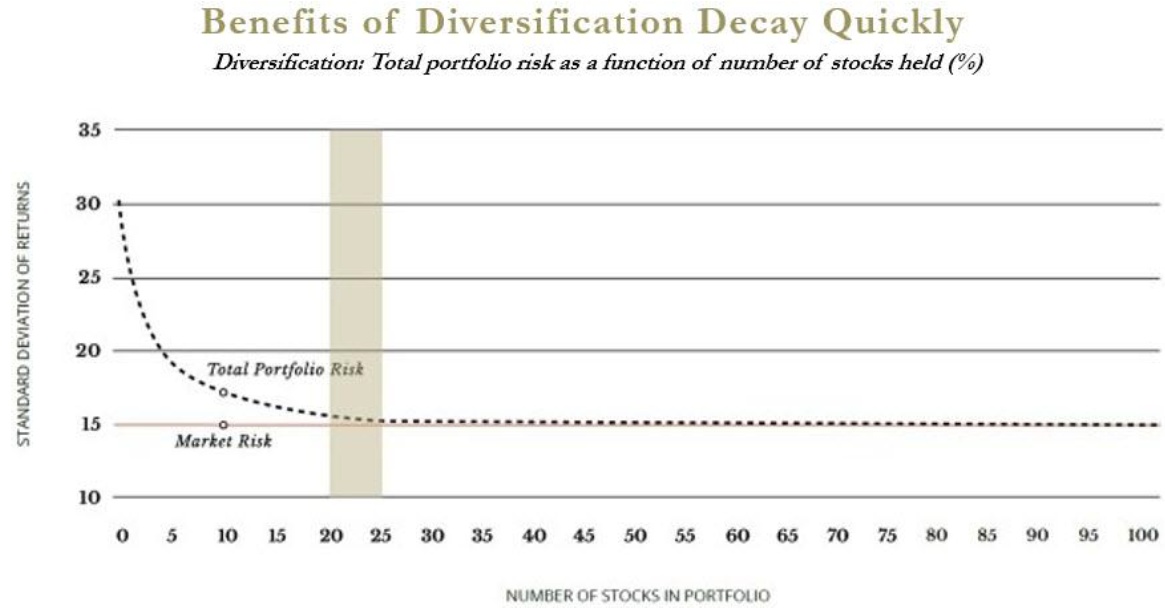
However, a quote from one of the world's best investors alone is unlikely to convince everyone. Studies also support Buffet's view. The advantages of diversification decrease very fast and the gap between market risk and total portfolio becomes minimal from a portfolio size of 20-25 companies - 25 companies give you all the advantages of diversification, more positions only worsen your performance and overview. (Figure 1)
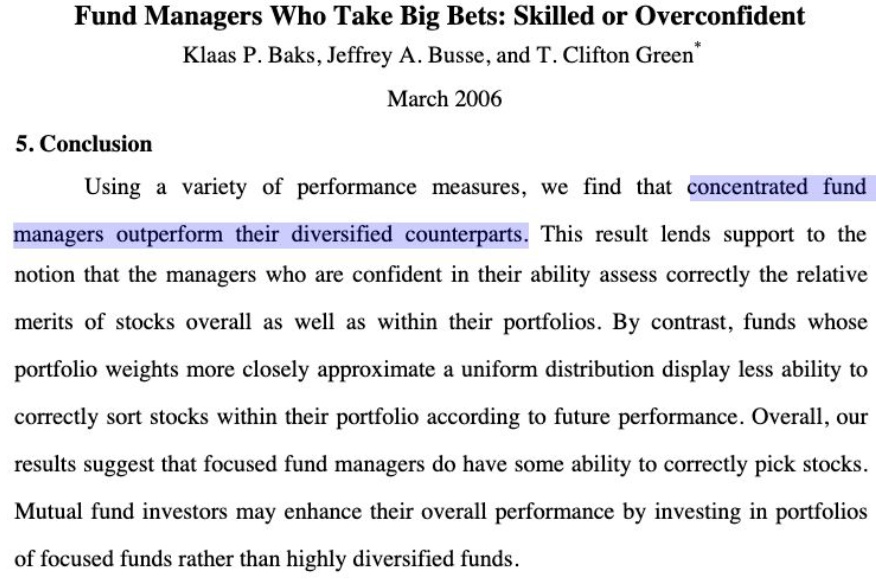
Because concentration delivers better performance. Fund managers who concentrate their knowledge in a few companies deliver better results than more diversified managers. (Figure 2)
Investment philosophy
I want to outperform the market, so I look for the best companies. What makes good companies?
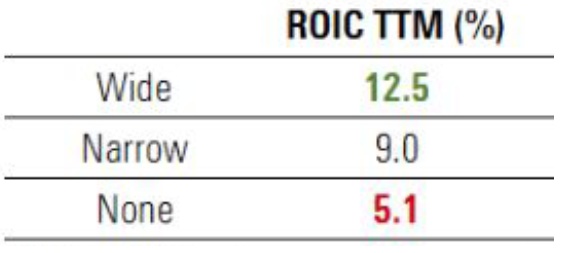
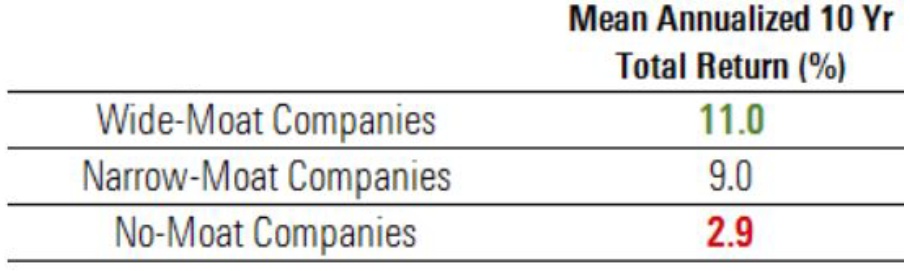
Companies with competitive advantages (moats) outperform the market (Figure 3), and they do so because they have high returns on capital. My first metric for evaluating quality of a company and with a high value in my company analysis is ROIC (Return on Capital Invested). I look for companies with at least 10% ROIC. (Figure 4) Furthermore I want high ROCE (Return on capital employed) and high ROA (Return on Assets) figures.
This directly eliminates some companies and also whole sectors, namely exactly those in which it is not worth to invest anyway. Why is this so?
There are sectors that historically outperform the market (Software, Consumer, Healthcare) - on which my focus is -, and sectors that consistently underperform and are not considered in my investment approach (Banking, Energy, Insurance, Mining, Utilities, Airlines) - just compare the sectors with the main index ;-)
Consumer goods, healthcare and software companies perform better because they generate sustained profits, so they remain profitable even during economic downturns. This allows for consistently high returns on capital.
Next, a look at the margin here I would like to see high Gross Margins >60%, which are also a good indicator of a competitive advantage, and a high Profit Margin, which is an indicator of the efficiency of a company's value creation. However, the most important margin for assessing profitability is the FCF margin.
A company's focus should be maximally on Free Cash Flow, we should invest in companies that are as profitable as possible. In the long run, the share price follows the Fcf/Share.
Beyond that I don't want any debt, any company with Debt/EBITDA > 3 flies right out, preferably anything less than 2.
In terms of growth, I look for stable and good EPS and revenue growth, but FCF growth has the highest priority.
The higher the better, the more important the key performance indicators are.
My minimum benchmarks for the most important metrics:
- ROIC > 15%, ROCE > 15-0%
- Gross Margin > 60%
- Profit Margin > 20%
- FCF Margin > 20%
- Debt / EBITDA < 3, preferably < 1
- FCF 5Y CAGR > 10-15%
(Not all of my companies always meet every metric, but I have built my own score where a minimum score must be met and by score I set the "Conviction" to a company).
Buy & Hold and long-term investing outperforms
As long as a company continues to reinvest its capital at high returns there is no reason to sell. (Figure 5)
What about dividends?
Some of my companies pay a dividend, others don't - I don't put much emphasis on dividends, and will definitely not put bad companies in my portfolio just to get a payout in a given month ;) Dividends should be minimized if capital can be reinvested at high rates of return. At my young age and with a long term investment horizon the focus should be on yield, in old age I will also shift to dividends ;)
The most important thing to conclude: Invest in profitable companies that you UNDERSTAND
A few final tips:
- Don't chase trends, they fade away
- Do not be blinded by dividends
- Don't care about macroeconomics, invest in companies - not cycles
- Market timing is impossible
- Look for established companies, not one-hit wonders
- BUY GOOD COMPANIES - DON'T OVERPAY - DO NOTHING (Terry Smith)
My current investable universe:
$ADBE (-2,65 %)
$NVO (-1,26 %)
$CUV (+0,16 %)
$CDNS (-1 %)
$ASML (-1,11 %)
$VRTX (-1,75 %)
$V (+0,58 %)
$MA (-0,13 %)
$MSFT (-1,82 %)
$QLYS (-6,19 %)
$MKTX (-0,1 %)
$KLAC (-3,72 %)
$GOOGL (-2,33 %)
$REG1V (+2,97 %)
$TNE (+3,7 %)
$ENX (-0,3 %)
$EW (-1,77 %)
$VRSN (-0,74 %)
$FICO (-0,36 %)
$FTNT (-7,17 %)
$NEM (+0,83 %)
$MONC (-2,91 %)
$CSU (-3,1 %)
$6861 (+0,08 %)
$ENGH (-2,18 %)
$MC (-1,51 %)
$AAPL (+0,25 %)
$6857 (-7,17 %)
$7741 (+1,26 %)
$PAYX (-0,22 %)
$MTD (-1,2 %)
$TXN (-0,48 %)
$OR (-0,46 %)
$ZTS (+1,03 %) (Companies I watch, in my portfolio I have only 8 of them).
That's it from me for now. Please leave me some feedback and share the post if you like it :-)
What would you like to hear from me next? More about free cash flow? Portfolio presentation? Company presentation? My slightly different valuation approach, far away from P/E?
Some of the illustrations are from a slightly smaller fund ("Long Equity Investing" on Twitter - can only recommend you) or from Terry Smith's Shareholder Letter.
No investment advice
+ 1
1010
21 Comentarios
Many would like to outperform the market, but the current state of science/data is that this does not work systematically. It might work, but then you have to be lucky that it works for you.
•
22
•

