2G Energy
Price
Debate sobre 2GB
Puestos
302G Energy takes over Belgian company

Tops and flops in May!
I still owe you my top & flops.
In 1st place by a wide margin $DGX (-3,38 %) with + 84% in only 8 days! After that I sold it again. It was also part of my Wiki Challenge.
$BB (-1,61 %) with + 56% also from the challenge depot follows in 2nd place
$CORT (-0,21 %) with + 48% followed by the 3rd value from the challenge portfolio
$ENPH (-0,97 %) with + 45%.
After that comes
$IREN (+5 %) with + 41%
And what I generally find quite surprising is that $JEDI (-6,52 %) has made it into the top list as an ETF with + 39%. If there hadn't been a serious setback on Friday, it would even have been in the top 3.
Yes, there were also losers, although the word doesn't really fit.
$FTC (+2,15 %) with - 6.5%
$NRXS with - 5.9%
$KYTX with - 2.5%
These are normal fluctuations for these values.
The top 3 have accumulated in the portfolio:
$PPTA (+2,84 %) with + 130%
$CORT (-0,21 %) with + 110%
$2GB (+5,62 %) with + 81%
Flop 3:
$KVHI with - 13 %
$KYTX with - 7,25%
$FTC (+2,15 %) with - 6.5%
This shows that the most important thing in such a high risk strategy is to limit losses. Shares that do not perform are eliminated at - 20% at the latest.
I have also reduced the number of positions from over 80 to around 50.
The performance in May according to TTWROR was + 20.5%.
On a YTD basis, I am also at 20.7% due to the disastrous March.
The internal rate of return, because that was also important here recently, is at 55% YTD.
By way of comparison, the TTWROR for the whole of last year was
TTWROR was 91.6%
and the interest rate
was 82.6%.
Of course, it will be difficult to repeat that. But there's no such thing as impossible!
Have a nice weekend!🌞
Your Multibagger
Chris
2G Energy share: Profiting from the AI boom or already too expensive?
The 2G Energy share $2GB (+5,62 %) is currently one of the most conspicuous German second-line stocks in the energy sector. While many investors are primarily looking at big names such as Siemens Energy, 2G Energy is developing more in the background as a potential winner of the energy transition - and now even of the AI boom.
The company from North Rhine-Westphalia produces combined heat and power plants and decentralized energy systems. Put simply, 2G builds systems that generate electricity and heat where they are directly needed. This is becoming increasingly important because power grids around the world are reaching their limits and energy demand is rising massively at the same time.
Why the share is suddenly in such demand
Just a few years ago, 2G Energy was regarded as a solid specialty stock for long-term investors. In the meantime, the share has become much more imaginative. The main reason for this is the USA and the global expansion of AI data centers.
Large data centers require enormous amounts of electricity - and as reliably as possible around the clock. This is precisely where 2G's systems could play an important role. The company recently announced several projects in the North American market and is benefiting from the fact that many operators want to become less dependent on the public power grid.
This development has been very well received on the stock market. The share price has risen significantly in recent months and has increasingly become the focus of institutional investors.
Operations remain stable
Business is also developing solidly beyond the stock market fantasy. The management expects further sales growth and rising profits in the coming years. One particularly positive aspect is that 2G is now much stronger internationally than it was a few years ago.
While Germany used to be particularly important, international business is now growing strongly. North America in particular is developing into a key future market.
And then there is another point: hydrogen. For years, 2G has been investing in technologies that can also run on hydrogen in the long term. If hydrogen becomes more established in the energy supply, the company could also benefit from this.
But the risks remain
Despite all the euphoria, the share is not a sure-fire success. The sharp rise in the share price has driven up the valuation considerably. Many expectations for the future appear to have already been priced in.
It has also recently become apparent that rapid growth can also cause problems. Delays in internal processes and a difficult ERP changeover led to uncertainty among investors at times. Smaller growth companies in particular often react sensitively to operational problems.
Added to this is the general market situation: if the global economy weakens or investment in new energy projects declines, 2G Energy could also suffer.
Competition: small against large corporations
In terms of competition, 2G Energy is up against much larger companies such as Caterpillar, Cummins and Siemens Energy. Financial strength and global networks clearly speak in favor of the large corporations.
However, 2G has another advantage: specialization. The company is regarded as technologically strong in the field of flexible combined heat and power plants and can often react more quickly to customer requirements. 2G therefore has a good market position, particularly for medium-sized projects.
While Siemens Energy tends to serve large infrastructure projects, 2G focuses on decentralized and flexible solutions. It is precisely this area that could see particularly strong growth in the coming years.
What are the forecasts?
Most analysts remain positive at the moment. Many expect sales and profits to continue to rise in the coming years. In particular, the combination of the energy transition, rising demand for electricity and the AI boom is causing optimism.
However, the decisive factor will be whether 2G can actually meet the high expectations. If the company successfully continues its expansion in the USA and wins further major orders, the growth story could be far from over.
At the same time, the share remains volatile. Investors should therefore bear in mind that strong price fluctuations are possible at any time.
Conclusion
2G Energy is increasingly developing from a traditional German medium-sized company into an international growth company in the energy sector. The opportunities offered by AI data centers, hydrogen and decentralized energy supply are enormous.
The share therefore offers a lot of potential - but also a higher risk than established large corporations. Anyone who believes in a long-term boom in energy infrastructure and flexible power supply should continue to find 2G Energy exciting.
*WARBURG RESEARCH RAISES TARGET FOR 2G ENERGY TO EUR 80 (44) - 'BUY'
2G Energy share price jump $$$
Share jumps almost +20
Reason:
A record order from the Data Center division catapults the 2G Energy AG has catapulted itself into a new order of magnitude: a North American customer - about which confidentiality has been agreed - has ordered a large number of containerized power plants including on-site commissioning. The order volume is in the lower three-digit megawatt range and, according to 2G Energy, represents the largest single order in the company's history. The first deliveries will begin in the second half of 2026 and will be spread over several years.
As a result of the order, 2G Energy is specifying its sales forecast for 2026 at the upper end of the previous range of EUR 440 to 490 million. The EBIT margin for 2026 is likely to be pushed to the lower end of the forecast of 6.5 to 8.0% due to the higher share of machinery in sales and increased one-off costs from the ERP introduction. For 2027, the Executive Board expects revenue to grow to between EUR 570 million and EUR 620 million with an EBIT margin of over 11%, as the majority of deliveries from the major order will take place next year.
2G Energy with major order for data center in North America
- Delivery of containerized energy systems over several years from H2 2026
- 2026 revenue now expected at the upper end of the forecast range: up to € 490 million
- 2027 sales expected to jump to € 570-620 million, around +20%
- EBIT margin expected to rise to over 11% in 2027
- 2025 EBIT margin at lower end of forecast due to ERP costs: 6.5-8.0%
Conclusion: Strong data center deal with significant growth effect from 2026/2027.
The next push is here!
Yesterday I wrote in a post that $2GB (+5,62 %) is one of my favorites in the energy sector. And today🚀🚀🚀🚀🚀
2G Energy postpones FY25 figures to mid-June
- Publication of preliminary FY25 figures postponed from May 21 to mid-June
- Reason: ERP closing routines at new production company "2G Heek GmbH" take longer than expected
- Company emphasizes close coordination with auditors
I remain invested.
Analysis of 2G Energy AG: An in-depth examination of decentralized combined heat and power generation as an investment case
The analysis of the $2GB (+5,62 %) (ISIN: DE000A0HL8N9) reveals a company that has positioned itself at the interface between traditional mechanical engineering and modern energy technology. At a time when the global energy supply is facing the dual challenge of decarbonization and security of supply, decentralized combined heat and power (CHP) is one of the key bridging technologies. This report examines the company from the perspective of a savvy investor seeking not just short-term returns, but the potential for long-term value multiplication.
The evolution of the business model: from components to system solutions
Since its foundation in 1995, the fundamental business model of 2G Energy AG has evolved from a pure manufacturer of combined heat and power plants (CHP) to an integrated provider of system solutions for decentralized energy supply. The core of this model is based on the highly efficient simultaneous generation of electrical energy and usable heat directly at the point of consumption.
A combined heat and power plant uses the principle of cogeneration to convert primary energy - usually in the form of gas - into electricity, whereby the resulting waste heat is not released into the atmosphere unused, but is used for heating or process heat purposes. This leads to overall efficiencies of often over 90 %, which means primary energy savings of up to 40 % compared to the separate generation of electricity in a large power plant and heat in a boiler.
2G covers a broad performance spectrum, which is divided into three main series: The compact g-box, with an electrical output of 20 to 50 kW, primarily serves hotels, residential complexes and clinics with natural gas or biogas. The agenitor series with 75 to 450 kW forms the backbone for medium-sized industry and agriculture and is already optimized for the use of hydrogen. For large-scale industrial applications, municipal utilities and data centers, the avus series offers outputs from 500 to 4,500 kW.
Strategic expansion through large heat pumps and demand response
A decisive step in safeguarding the business model against regulatory changes in Europe, such as the German Building Energy Act (GEG), was the addition of large heat pumps to the portfolio. These achieve efficiencies of 300 % to 500 % and can be operated as hybrid systems in combination with CHP units. In such scenarios, the CHP unit takes over the base load and the power supply to the heat pump at times of high grid load, while the heat pump supplies highly efficient heat when there is an oversupply of cheap electricity from renewable sources. In addition, 2G addresses the market for "demand response" - i.e. the provision of capacity that can be called upon at short notice to stabilize the grid, which is particularly relevant in volatile electricity systems.
The future market of hydrogen
2G is regarded as a global pioneer in hydrogen CHP technology. The first plant that can run on 100% hydrogen was commissioned back in 2014. The special technological feature is that the gas engine modified by 2G has hardly any loss of efficiency compared to natural gas operation. The retrofit concept ("H2-Ready") is important for investors here: customers can invest in a natural gas system today and convert it to hydrogen later at a manageable cost as part of a regular general overhaul.
Management and personnel continuity: a generational change
For an investor, the quality and integrity of the management is a key factor. At 2G Energy, this aspect is underlined by a high proportion of ownership by the founding families and a carefully planned generational change. Pablo Hofelich was appointed CEO on June 12, 2025, having previously sharpened the sales strategy as Chief Sales Officer. Hofelich has extensive experience in international large-scale plant construction, including management positions at Hitachi Power and Thyssenkrupp.
Friedrich Pehle has been CFO since 2017 and is responsible for the financial structure, while Frank Grewe has been CTO and head of technological development since 2007. The shareholder structure underlines the enormous "skin in the game": co-founder Christian Grotholt holds 29.6% of the shares, while co-founder Ludger Gausling controls a further 15.5%. Together with institutional investors such as Berenberg (1.63%) and a free float of around 47.5%, this results in a stable basis that favors long-term thinking over short-term quarterly optimization.
The moat: Why 2G is hard to displace
An analysis of the moat shows that 2G Energy has powerful defenses. The most important anchor is the global service network with over 9,000 installed systems. The service share of sales is around 45 % and is significantly more profitable than the new system business. As CHP systems are highly complex, customers are prepared to enter into long-term full maintenance contracts, which leads to high replacement costs.
Added to this is the digital advantage provided by the "I.R.I.S." system (Intelligent Realtime Information System), which enables cloud-based monitoring, allowing 78% of all faults to be resolved online. This efficiency is a massive competitive advantage over smaller competitors. In addition, the strict regulatory certification processes for decentralized energy feed-in act as a natural barrier to market entry.
Financial analysis: growth, margins and resilience
The financial performance demonstrates a solid operational basis. Over the past ten years, turnover has grown by an average of 11% per year. In 2021, turnover was still at EUR 266.4 million with an EBIT margin of 6.7 %. By 2023, this figure had risen to EUR 365.1 million with a margin of 7.6 %. The year 2024 marked a preliminary peak with sales of EUR 375.6 million and an EBIT margin that improved to 8.9% (earnings per share: EUR 1.32).
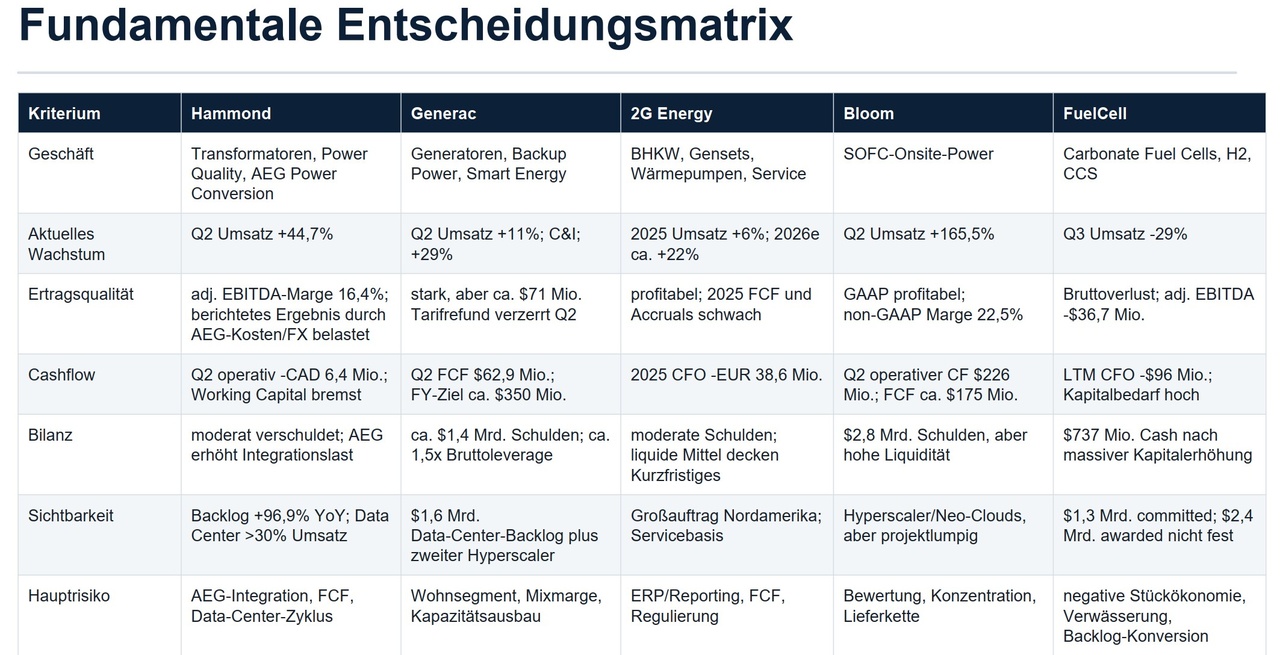
For the transition year 2025, sales of between EUR 380 million and EUR 400 million are expected with a reduced margin of 6.5% to 8.0%, which is mainly due to a complex ERP software changeover and delayed orders from Ukraine. However, the big leap is forecast for 2026: Targeted sales of EUR 440 to 490 million with an EBIT margin of up to 11% and earnings per share of around EUR 2.00. With an equity ratio of over 50% and an almost debt-free position, 2G has an extremely solid balance sheet.
Critical review: risks and challenges
No investment is without risks. The market for CHP is highly dependent on political framework conditions such as the GEG or the Combined Heat and Power Act. A one-sided political focus on pure electrification without CHP backup could limit the potential. In addition, the current problems with ERP implementation show that internal processes must keep pace with rapid growth. Finally, 2G is competing with global heavyweights such as Caterpillar or INNIO Jenbacher, which have significantly greater financial resources, for major projects.
Summary and investment verdict: the multiplier potential
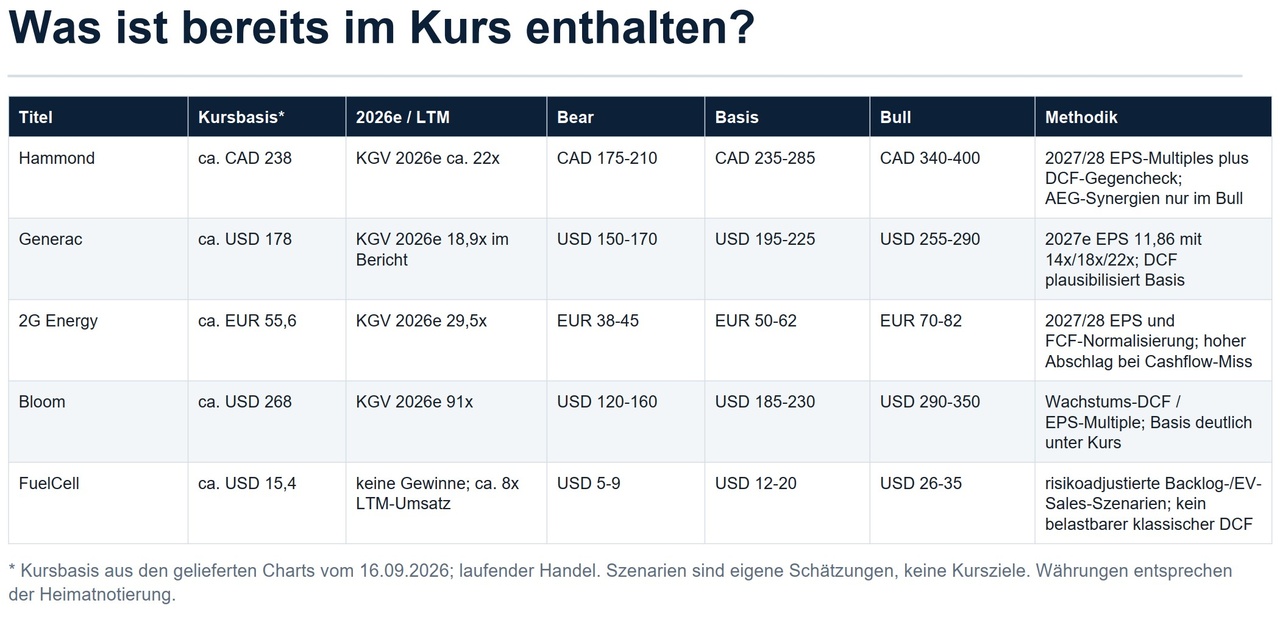
The analysis leads to the conclusion that 2G Energy is one of the most attractive German quality stocks in the energy transition sector. With an expected P/E ratio for 2026 of around 16 to 17, the share is not expensive in relation to the forecast earnings growth. The potential for a significant increase in value comes from scaling in new markets such as data centers, margin expansion through the service business and a possible revaluation as an "H2 enabler".
For private investors, the current share price slump due to the operational challenges in 2025 offers an excellent entry opportunity before the expected growth spurt begins in 2026. The risk/reward ratio can be classified as excellent due to the company's technological market leadership and financial stability.
We are and remain committed to this!
Find $2GB (+5,62 %) mega exciting. Has been running in the savings plan for a few months.
There are five potential megatrends from which 2G Energy should benefit in the short and medium term: Biomass, heat pumps, gas reserve power plants in Germany, the reconstruction of Ukraine and data centers - especially in the USA. The already well-filled order books should therefore continue to grow. The outlook is set and the share is working on continuing the trend.
AKTIONÄR readers know: With its combination of CHP systems, large heat pumps and peak load gensets, 2G Energy, as a system provider for decentralized energy solutions, is already energizing its customers. Accordingly, the company recorded considerable incoming orders in the fourth quarter of 2025. More details can be found here.
With the current water level reports on the order situation, the Management Board confirms the forecast for 2026 with sales of EUR 440 to 490 million and an EBIT margin of 9.0 to 11.0%.