$CSPX (+0.58%) jumps directly 3%
- Markets
- ETFs
- iShares Core S&P 500 ETF
- Forum Discussion

iShares Core S&P 500 ETF
Price
Discussion about CSPX
Posts
318March 2026 Monthly Portfolio Update - – Navigating Volatility
March has started off as one of the most challenging periods in global markets in recent memory.
The ongoing escalation between the United States, Israel, and Iran has driven widespread risk-off sentiment across equity markets, with oil and energy prices surging and stock indexes under pressure.
As a result, my portfolio is currently down around -2.5% for the month. This reflects the broader market reaction, where indices like the S&P 500 and Nasdaq have shown volatility and downside pressure as geopolitical tensions impact investor sentiment and inflation expectations.
Strategic Adjustments
In response to this environment, I’ve made several tactical adjustments:
Reduced exposure in some positions and closed others to secure partial liquidity
Currently holding approximately 10% in cash, which provides flexibility and optionality
Diversified further across new positions — (e.g., $TCL (+2.12%)
$LOV (+3.66%)
$APA (+4.46%) , and from Swiss market $UBSG (+2.43%) )
These recent additions reflect my focus on quality names with strong fundamentals, diversified geographies and sectors rather than simply chasing index performance.
What this means for Copiers
We’re in a risk-off market regime, not a bear market per se — volatility is a natural response to major geopolitical uncertainty.
Panic selling is rarely the best course of action — losses can be locked in permanently, whereas disciplined investors can find opportunities in dislocations.
The current cash buffer gives us dry powder to scale into positions at more attractive prices if the market continues to sell off.
Broader Market Backdrop
The current sell-off is driven by the escalation of conflict involving the US, Israel and Iran, which has:
Pressured global equity markets and raised inflation and risk aversion concerns
Pushed oil prices sharply higher amid fears of supply disruptions
Increased demand for safe-haven assets such as gold and the US dollar
Led to broad risk-off behaviour across major benchmarks in Asia, Europe and the US
Moneycontrol
No one can predict with certainty how this geopolitical situation will unfold, or how markets will react in the short term. But history shows that volatility tends to be temporary, and well-selected exposures often recover and outperform when clarity returns.
Final Thought
This isn’t a time to exit the market, but rather a time to reassess where capital can be deployed most effectively, balancing risk with long-term opportunity. I’ll continue adjusting positions as conditions evolve and will keep transparency front and centre.
Let’s stay calm, focused, and strategic.
😎 𝗗𝗶𝘀𝗰𝗹𝗮𝗶𝗺𝗲𝗿: This is my personal opinion and is for informational purposes only. You should not interpret this information as financial or investment advice
$NVDA (+0.38%)
$CSPX (+0.58%) $$GOLD
$TSLA (+1.96%)
$AAPL (+0.45%)
$PLTR (+5.34%)
Please keep calm !
The current tensions surrounding Iran are understandably causing nervousness. Oil reacts immediately, indices fluctuate, headlines roll over. It is precisely at times like these that it is worth taking a look back.
In 2019, after the attacks on Saudi oil facilities, the oil price rose sharply for a short time - a few weeks later, the effect was largely digested.
In 2020, after the killing of Qasem Soleimani, the markets reacted with a risk-off move - the S&P 500 $CSPX (+0.58%) was trading higher a few months later.
Even major geopolitical shocks in recent decades have mostly led to temporary volatility in globally diversified portfolios, not to structural bear markets - provided there was no massive consequential economic damage.
Geopolitics creates uncertainty. However, lasting market slumps are usually caused by systemic financial problems or recessions - not by political escalation alone.
Investors should distinguish between noise and long-term value creation. Check liquidity, know the risk structure, but do not make panic decisions.
Discipline beats drama.
A few months offline - clarify priorities
I just wanted to let you know that I will be withdrawing from the forum for a few months or uninstalling the app for this time.
The reason is simple: I'm writing an important exam in about four to six months and would like to consciously shift my focus elsewhere during this time. I've also realized that I'm extremely FOMO-driven. Of course, this is ultimately my own responsibility, but it has become very clear to me that this is simply not good for me in the long term.
Because of all the good stock ideas here, you constantly feel like you have to be everywhere. This is exactly what leads to me not implementing my own plans properly. Instead of a clear structure (e.g. 30 % $BTC (+3.06%) , 30 % $CSPX (+0.58%) , 40 % individual shares), I end up with eight or nine individual shares simply for fear of missing out. And I'm increasingly realizing that this is not the way that works for me.
That's why I'm now making a conscious cut, focusing on learning, bringing in structure and gaining distance.
Thank you all for the time, the cool comments and the exchange 🙏
We might see you again at the beginning of winter, maybe even with a small portfolio update.
Until then, all the best and successful investments! 🚀
Good luck and if you come back
Introduce yourself and be active.
Citrini Report
For all those who wondered why we started Monday in such deep red: Citrini Research published a report on February 22, 2026 describing a possible scenario in which AI could trigger a global economic crisis. Many of the companies mentioned in the report fell significantly at the start of the week.
https://www.citriniresearch.com/p/2028gic
$CSPX (+0.58%)
$CSNDX (+0.65%)
$ABNB (+2.19%)
$BKNG (+1.61%)
$DASH (+1.97%)
$UBER (+1.21%)
$AXP (+1.42%)
$MA (+0.64%)
$V (+0.93%)
$NVDA (+0.38%)
$TSM (+2.9%)
$KKR (-0.13%)
$BN (+3.64%)
Beginning of a small/large correction ?
📊Reviews:
The S&P 500 $CSPX (+0.58%) is currently trading at a high price/earnings ratio (approx. 21.5), which is above the 5-year average. A lot of positive news is already priced in (?)
🔐Extreme market concentration:
The S&P 500 $CSPX (+0.58%) is more top-heavy than ever before. The top 10 companies (including Nvidia $NVDA (+0.38%) Microsoft $MSFT (-0.72%) Apple $AAPL (+0.45%) ) currently account for over 40 % of the total market capitalization of the index.
- The problem: For comparison - during the dotcom bubble in 2000, this figure was only around 27%. If just two or three of these heavyweights deliver disappointing figures, this can drag the entire index down, even if the remaining 490 stocks remain stable.
📈The expectation:
Analysts have extremely high expectations for companies' earnings growth in 2026 (in some cases 14-16 %).
- The risk: The market is currently "perfectly priced in". This means that even good news often no longer leads to price gains, while the smallest disappointments (e.g. AI investments that pay off more slowly than expected) lead to disproportionately high sell-offs.
Weakening of the US consumer
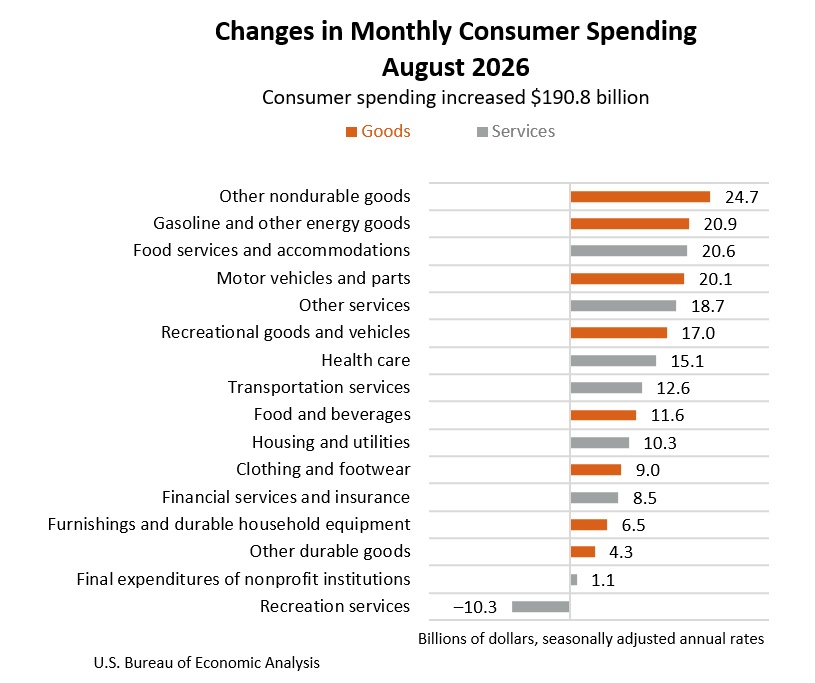
US private consumption is the engine of the US economy. Cracks are appearing here:
- Credit card delinquency: Credit card delinquency rates (90+ days) have risen to over 2,5 % have risen.
- Household debt: At a record high of over 18.8 trillion USD in household debt, consumers' resilience is reaching its limits, especially if interest rates remain high for longer than expected.
And last but not least
🤖 Fear (?) of artificial intelligence :
This is currently the biggest bugbear on Wall Street. Companies like Microsoft $MSFT (-0.72%) , Alphabet $GOOGL (-0.3%) and Meta $META (+1.28%) have poured hundreds of billions of dollars into data centers and chips (Nvidia).
- The problem: Investors are now asking: "Where's the profit?" If productivity gains in the broader economy (e.g. banking or marketing) don't increase fast enough to justify these gigantic expenditures, a massive revaluation of tech stocks looms.
How do you assess the current situation? Have I forgotten anything or have I described it incorrectly? Let's discuss 🗣️
@Tenbagger2024
@Multibagger
@Get_Rich_or_Die_Tryin
@TradingHase
@Liebesspieler@WarrenamBuffet
@Sansebastian
@Klein-Anleger
@Dividendenopi

What really makes a successful investor?
$LXS (+8.59%)
$DBXD (+2.74%)
$IWDA (+1%)
$CSNDX (+0.65%)
$CSPX (+0.58%)
Eight percent reality, fifty percent hysteria? The psychology behind price jumps and how investors can deal with them correctly.
Volatility: normality instead of risk?
Hardly a day goes by without some share in the DAX environment recording a significant price swing. This could look like this, for example: A Quartalsberichtminimally misses expectations - minus ten percent. An outlook sounds a touch more optimistic than feared - up eight percent.
But a look at the long-term figures reveals this daily excitement for what it usually is: Irrationality.
Because the bottom line is that the DAX over the past 25 years - including Dividenden - around eight percent per year. Eight percent. Not 20, not 30, eight.
And since the Index is ultimately nothing more than a basket of its constituent companies, this inevitably means that the share prices of these companies have also risen by an average of around eight percent per year over the long term.
Expectations, forecasts, whispered estimates
Anyone who realizes this should find the daily Volatilität seem absurd. If the "fair" value of a company grows by eight percent annually over the long term, how rational can it be that the share price of most Aktienfluctuate by 50% during the year?
Or plummet by eight to ten percent or shoot up after the publication of individual quarterly figures - even though the long-term earning power has often hardly changed?
Of course: information must be priced in. Profits, margins, outlooks, risks - all this is part of the valuation. But in reality, companies Märkte rarely react to facts, but to expectations upon expectations.
In addition, there is a structural problem of modern capital markets: the time horizon has shrunk. It is now only about whether the share price will rise tomorrow - and no longer about where a company will be in a few years' time.
Algorithms, ETFs, short-term funds and a media news cycle that declares every decimal place a "game changer" amplify minimal signals into drastic price movements.
Drama vs. reality
If the daily price fluctuations were taken seriously, the economic reality of DAX companies would have to change radically on a permanent basis. But it doesn't. Mechanical engineering companies, chemical groups or insurers are not suddenly worth ten percent less just because one quarter was a little weaker. Nor are they fundamentally ten percent better overnight because an analyst raises his forecast slightly.
The long-term return of the DAX shows how little remains of all the drama. Eight percent per year - calm, steady, unspectacular. The daily swings are the noise around this trend, nothing more.
And that is exactly what investors should understand. Don't let yourself go crazy if share XY comes under pressure again. In most cases, there is little or hardly anything behind it.
From depression to euphoria - a lesson
Industries and sectors fall out of favor and come under pressure. A few months later, they are back in vogue.
In 2022, for example, we experienced a major tech depression. Meta, NetflixGoogle and many more were on the hit list, only to go on to soar to incredible heights.
Today, everything labeled "AI loser" or "software" is on the brink. In retrospect, the current sell-off in many of these stocks is probably just as incomprehensible as the fact that Meta collapsed to below USD 100 in 2022 from today's perspective.
Those who understand this separation between price and value experience volatility in a completely different way. Price fluctuations lose their horror because they are no longer perceived as a threat, but as the normal state of an irrational market. The Börse is not a precise measuring instrument, but a barometer of sentiment - and sentiment fluctuates more than fundamental data
Lanxess share: Chart from 10/02/2026, price: EUR 20.91 - symbol: LXS | source: TWS
Lanxess, for example, is trading up 7.6% today at EUR 20.91. The only relevant news I could find on the company was an upgrade by Goldman Sachsfrom sell to neutral and an accompanying price target increase from 10 to 23 euros.
What could better illustrate all the short-term madness than this Rating? It fits like a glove. Yesterday Lanxess was only worth EUR 10, today it is worth EUR 23.
New factories must have sprung up overnight.
Source
When it comes to capital market investments as a retirement provision, vola is anything but irrelevant. With maxDD of 73%, as with the Dax, the safe withdrawal rate drops to 2-3%pa. That comes close to a savings account.
Anyone who dismisses vola as market noise has never experienced a 73% drawdown. The psychological strain is enormous if the entire pension provision is invested there. And the risk of selling in panic is also very high.
Finally, the irrationalities you mentioned follow certain rules. You can use them to get more than 8%pa with less than 73% mDD. Momentum investing is the key word. 😬
The crash is coming - or is it? An attempt to classify the overall market at the beginning of 2026
Reading time: approx. 6 minutes
At first glance, the current stock market seems contradictory. On the one hand, many indices are trading close to or at all-time highs, but on the other, there is no feeling of widespread euphoria. There is no widespread speculation, no classic "everything is rising" phase. Instead, we are seeing a market that is expensive, but at the same time selective, more rational than previous high phases and strongly characterized by expected values.
If you start with the naked valuation, the picture is clear. The US equity market, represented by the $CSPX (+0.58%) (S&P 500), is clearly trading above its long-term norms. The forward P/E ratio of the index is currently around 21 to 22, while the 10-year average is closer to 18 to 19. This corresponds to a valuation premium of around 10 to 15 percent. However, this figure alone is only of limited significance, as it is heavily dependent on the current earnings situation and the respective estimates.
It is therefore worth looking at long-term smoothed valuation measures, above all the Shiller CAPE. This ratio compares the current index level with the inflation-adjusted average of corporate profits over the past ten years. The aim is to smooth out cyclical exaggerations in individual years and obtain a more stable picture of the structural valuation.
The Shiller CAPE of the S&P 500 is currently in the range of around 38 to 40. The long-term median is around 16, the long-term average around 17. This means that the market is trading at more than twice the level of a historically normal valuation situation. Comparable levels have only been reached in a few phases in the past, such as at the turn of the millennium or in individual exceptional situations thereafter.
A regional comparison helps to classify this figure. Japan is currently trading at a CAPE of roughly 28, while Europe is more in the region of around 20, which means that these markets are not cheap either, but are valued much less ambitiously than the USA. This underlines the fact that the high valuation level is not a global phenomenon, but is strongly US-centric - and is in turn particularly characterized by a few heavyweights.
The correct interpretation of this signal is crucial. The Shiller CAPE is not a timing instrument. It says nothing about when a market will fall or rise. Its strength lies exclusively in the classification of the long-term expected value. Historically, it has been shown that the higher the CAPE at the time of entry, the lower the average returns over the following seven to ten years. High CAPE values did not necessarily lead to losses, but almost always to below-average results compared to more favorable entry phases.
Today's market fits exactly into this pattern. The high CAPE does not signal an imminent correction, but an environment in which future earnings must come more from profit growth, cash flows and distributions. The scope for further multiple expansion is limited. The market demands substance.
A second long-term valuation framework is the so-called Buffett indicator. It puts the total market capitalization of a stock market in relation to economic output, usually measured by gross domestic product. The basic idea behind this is simple: in the long term, corporate profits cannot grow faster than the underlying economy. If market capitalization diverges too far from GDP, the demands on future profits and returns on capital increase considerably.
For the USA, this indicator is currently over 200%. Historically, the long-term average has tended to be in the range of 70 to 100 percent. Again, this is not a short-term warning signal, but a structural one. Such a high value means that the market is making very optimistic assumptions about margins, returns on capital and earnings growth.
These assumptions have not been plucked out of the air. Two factors explain a large part of today's valuation levels: firstly, an interest rate environment that continues to imply low long-term real yields despite monetary policy tightening, and secondly, unusually high margin stability of large companies. Dominant platform models, high barriers to market entry and economies of scale ensure that many heavyweights consistently achieve higher operating margins than previous market generations. This justifies higher multiples - at least as long as these margins can be defended.
The Buffett indicator becomes particularly revealing when the concentration effect is taken into account - analogous to the forward P/E ratio and CAPE. The so-called "Mag 7" now make up around 30 to 32 percent of the total market capitalization of the S&P 500, but account for an even larger share of aggregated profits. If this group is approximately excluded from the Buffett indicator, the ratio of market capitalization to GDP is significantly reduced. Instead of a value of over 200 percent, the adjusted indicator would be roughly in the range of around 140 to 160 percent.
This value is also historically high, but is in a completely different order of magnitude. It does not signal a structural extreme, but an ambitious but explainable valuation. The extreme character of the aggregated Buffett indicator is therefore - just as with the Shiller CAPE - to a large extent a concentration phenomenon.
If this observation is combined with the other indicators, a consistent picture emerges. The forward P/E ratio of the $SPX is currently around 21 to 22, without the "Mag 7" it would be around 16 to 17 and therefore close to the long-term average. The Shiller CAPE is falling from around 38 to 40 to around 26 to 28 and the Buffett indicator is falling from over 200% to a historically high, but not extreme, level. Three different valuation approaches, constructed independently of each other, thus come to the same conclusion: the perceived overvaluation of the market as a whole is largely the result of a strong concentration on a few, highly valued heavyweights.
A look beyond the USA reinforces this impression. The global equity market, as represented by the $IWDA (+1%) (MSCI World), is also trading above its historical averages, but to a lesser extent. Europe remains more moderately valued in comparison, which is reflected not only in the lower P/E ratio, but also in the lower CAPE.
What does this mean for the return outlook? Historical CAPE regressions provide at least a rough guide here. At a CAPE level of around 38 to 40, the average annual returns of the US market in the following ten years were typically in the range of around 2 to 4 percent. This is not an exact forecast value, but a corridor of expectations. It does not necessarily imply poor results, but significantly lower returns than in phases of low valuation. Markets with CAPE values of around 20, such as Europe, have historically tended to be in a range of around 4 to 6 percent.
Putting valuation, market phase and capital flows together, a clear picture emerges. The market is no longer in a build-up phase in which bad news is ignored. However, it is also not in a classic euphoria phase. It is a mature acceleration phase. Profits are available, capital is invested, but it is flowing selectively. Mistakes are being punished again, quality is being paid for, hope without cash flow is increasingly being questioned.
The consequence of this is a shift in the source of returns. The past few years have been strongly characterized by multiple expansion. At today's valuation level, returns come primarily from earnings growth, cash flow and dividends. This explains why business models with strong cash flows are still in demand, while insubstantial story stocks are becoming less attractive.
Perhaps this is the real insight of this market environment: it is not the market that is the problem, but the expectation of it. Those who expect the same returns today as in the past decade will inevitably be disappointed. On the other hand, those who accept that the market has become more mature, more selective and more demanding will continue to find approaches that work. Not everywhere. Not automatically. But where price, expectation and substance fit together again. This is precisely why it is currently less about market opinions - and more about clean decisions.
The story contiues…
$NOW (-0.47%)
$IGV (+0.2%)
$CSPX (+0.58%)
ServiceNow Bought a Company. SaaS Fell Apart
“The speculation out there is that M&A is the new playbook out of necessity… We have never acquired a single company for revenue alone. We use M&A to expand into an even larger TAM, and it is now beyond $600 billion, based entirely on where our customers need us to go, where we know we can build exciting growth businesses.”
- Bill McDermott, ServiceNow CEO (Q4 Conference Call)
On Wednesday, the enterprise software giant ServiceNow beat analyst estimates for both Revenue and Earnings, but you wouldn’t have known it by looking at the stock price.
Source: ServiceNow on Fiscal.ai
Instead, investors had a different point of focus. Acquisitions.
Throughout ServiceNow’s history, the focus has always been organic growth. There have been many small tuck-in acquisitions over the years, but by and large, the strategy has been to build new products internally, expand the overall product suite, and upsell the new features to existing clients.
That took a turn in 2025.
In March, ServiceNow made its largest acquisition ever by buying agentic AI platform Moveworks for $2.85 billion in cash and stock. Nine months later, they spent another ~$1 billion to acquire the identity management company Veza. And to cap it all off, in late December, they announced their biggest deal by a landslide with their $7.75 billion purchase of cybersecurity platform Armis.
For the first time in their history, ServiceNow went on a buying spree. To the tune of $11 billion.
Naturally, investors have become cautious.
The concern among analysts is not just that these acquisitions might be defensive moves amidst AI disruption threats, but that they’re using acquisitions to mask their slowing organic growth. Analysts estimate that without any acquisitions, ServiceNow would have reported 18.5%-19% revenue growth for the quarter, marking their slowest growth rate on record.
ServiceNow’s stock plummeted as the 4th quarter conference call took place, and CEO Bill McDermott tried his best to quell concerns:
“I want to make it very clear to the investors… we did not, and never have, bought an asset like many others have, and I know that's probably why it's on your mind, because we needed the revenue.”
“I noticed that we lost about $10 billion in market cap on that because of the worry. So now the worry is gone. You can give us back the market cap”
- Bill McDermott, ServiceNow CEO (Q4 Conference Call)
SaaS Shockwaves
ServiceNow’s slowing organic growth sent ripple effects across the software industry.
Here’s a look at the iShares Tech-Software Sector ETF v. the S&P 500 over the last ~4 months:
Source: iShares Software ETF on Fiscal.ai
While that gives some visibility into the struggles of the software sector broadly, the iShares Software ETF is actually still being lifted by two of its larger constituents, Microsoft & Palantir.
Underneath the hood, many companies are experiencing far more severe drawdowns.
Source: Dashboard on Fiscal.ai
Is the Sell-Off Warranted?
The sector-wide correlation with ServiceNow shouldn’t come as much of a surprise.
The implication is clear: If a business like ServiceNow (which is one of the most embedded databases and systems of record in the enterprise world) is seeing slowing growth, then it could be far worse for other companies.
After all, there are few businesses on earth with customer retention rates like ServiceNow:
Source: ServiceNow Segments & KPIs on Fiscal.ai
AI is still the “boogeyman” for software investors.
The concern appears to be two-fold. One, AI will replace jobs and therefore reduce the number of seats subscribed to enterprise software products. And two, companies will begin building systems internally instead of relying on outside vendors.
Will these worries materialize?
Let’s take a look at the short history of AI coding assistants/agents.
- June 2022: Amazon launched CodeWhisperer
- June 2022: Microsoft launched GitHub Copilot
- 2023: Cursor is launched
- Feb. 2025: Anthropic launched Claude Code
- May 2025: OpenAI launched Codex
I’m probably missing something in there, but you get the point. AI coding assistants/agents have existed in some capacity for nearly 4 years.
Over that time, many of the large enterprise software companies have grown their customers, revenue per customer, and earnings.
Here’s a glimpse of the combined revenue for a few of the larger players:
If AI has displaced the need for software vendors, it hasn’t shown up in the numbers yet.
Of course there’s the risk these software companies are actually mortgaging their moat by raising prices in the face of increasing competition, but again, most of these companies are reporting increasing customers as well, so that doesn’t appear to be the case.
Long story short, the AI impact remains unclear.
What is clear, however, is that for what feels like the first time in two decades, it is now contrarian to be bullish enterprise software.
Quelle
fiscal.ai
+ 1
A wild January comes to a slightly green end
Hello my dears,
for all of you who are interested.
A short summary with the TOP and FLOP values.
Tenbagger 2024 +5.31 %
I Shares NASDAQ 100 ETF$CSNDX (+0.65%) +0,10 %
I Shares S&P 500 ETF$CSPX (+0.58%) +0,25 %
I Shares MSCI World $IWDA (+1%) +0,87 %
Trending Securities
Top creators this week