„US President Donald Trump on Tuesdayloosely raised the possibility of a ground campaign as the war with Iran heats up, but he was vague about any specifics.“
-cnn
$CACI (-0,76%) bleibt doch erstmal weiter im Portfolio

Postos
19„US President Donald Trump on Tuesdayloosely raised the possibility of a ground campaign as the war with Iran heats up, but he was vague about any specifics.“
-cnn
$CACI (-0,76%) bleibt doch erstmal weiter im Portfolio

My portfolio is now well divided into clear sectors. Will share my journey here 🫡 And I will try and do my best to stick to the plan, and not overdiversify
Total invested : $1,000,339
DEFENSE / $151,428 / 15.14%
ARTIFICIAL INTELLIGENCE / $180,044 / 18%
SEMICONDUCTORS / $218,812 / 21.87%
SOFTWARE / $181,211 / 18.12%
HEALTHCARE / $168,270 / 16.82%
FINANCIALS / $100,574 / 10.05%
This war will be the end of the petro dollar and the dollar as a reserve currency. In the end, Trump achieves his goal and all production returns to the USA because the USD is so weak 😂. It was all planned that way, of course 🦧
So my last American position ($CACI (-0,76%) ) will be sold off when the war is over in 5 years. Unless the USD collapses before the end of the war
First of all, we are NOT filling up our storage facilities at the lowest oil prices for a long time.
Then we continue to insult all our allies.
And then (now it's getting really clever)
Let's not even think about the fact that Iran can also close the Strait of Hormuz with drones and then bomb away every level of leadership so that it becomes impossible to negotiate.
And now the most important point:
Instead of using all our important equipment and personnel for the Ukaine or Taiwan, we would rather use it to reopen the Strait at any cost, since we can no longer negotiate.
Now the USA is making it much more attractive for China to attack Taiwan and Putin is also benefiting immensely, while Hegseth says the Strait is open, you just get shot at 😂
ART OF THE DEAL 🪄


It is foreseeable that the Trump administration cannot justify placing soldiers in Venezuela to renew the oil infrastructure without heavy political losses.
by US corporations, so private security companies such as $CACI (-0,76%) or $BAH (+4,93%) will take over this task.
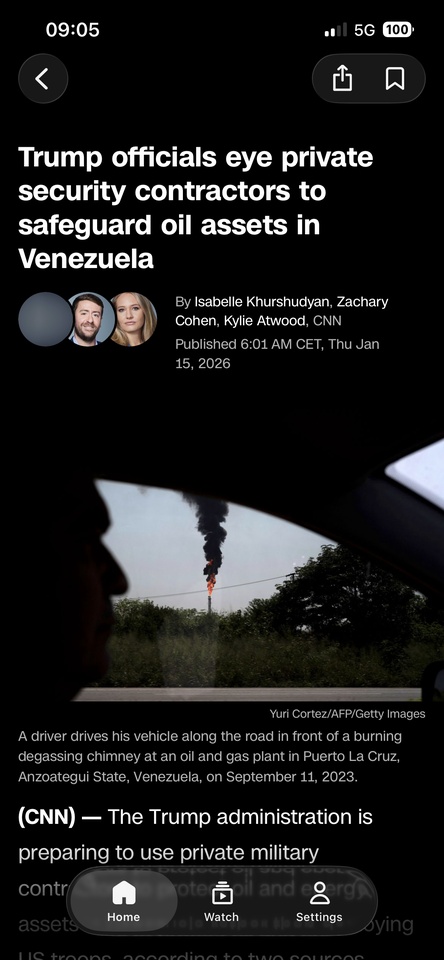
The Trump administration is preparing to use private military contractors to protect oil and energy assets in Venezuela rather than deploying US troops, according to two sources familiar with the plans, setting up a potential boon for security firms with experience in the region and ties to the administration.
I am staying with $CACI (-0,76%) and am considering buying into a few US oil companies.
Everything points to the USA wanting regime change in Venezuela.
At the moment, however, they haven't gathered enough troops to carry out a land invasion and I don't think this is likely, I think the US will mainly rely on air strikes and small sabotage/special operations and use PMCs. Therefore I am still very bullish on $CACI (-0,76%) .
Venezuela also has oil reserves, some of which have been produced by $CVX (+0,29%) part of the reason why the US wants regime change is the issue of this oil and therefore I think it is potentially a good investment. $CVX (+0,29%) also potentially a good investment, as well as of course a position in $3LOI (+6,59%) .
But the idea that I find most interesting so far is that it's not really being discussed much in the markets yet, so there could be a big increase in volatility, so I think it's very interesting. $VIXL (+13,14%) also very interesting.
It is to be expected that major operations will only be carried out towards the end of November - December, due to the hurricane / typhoon season.
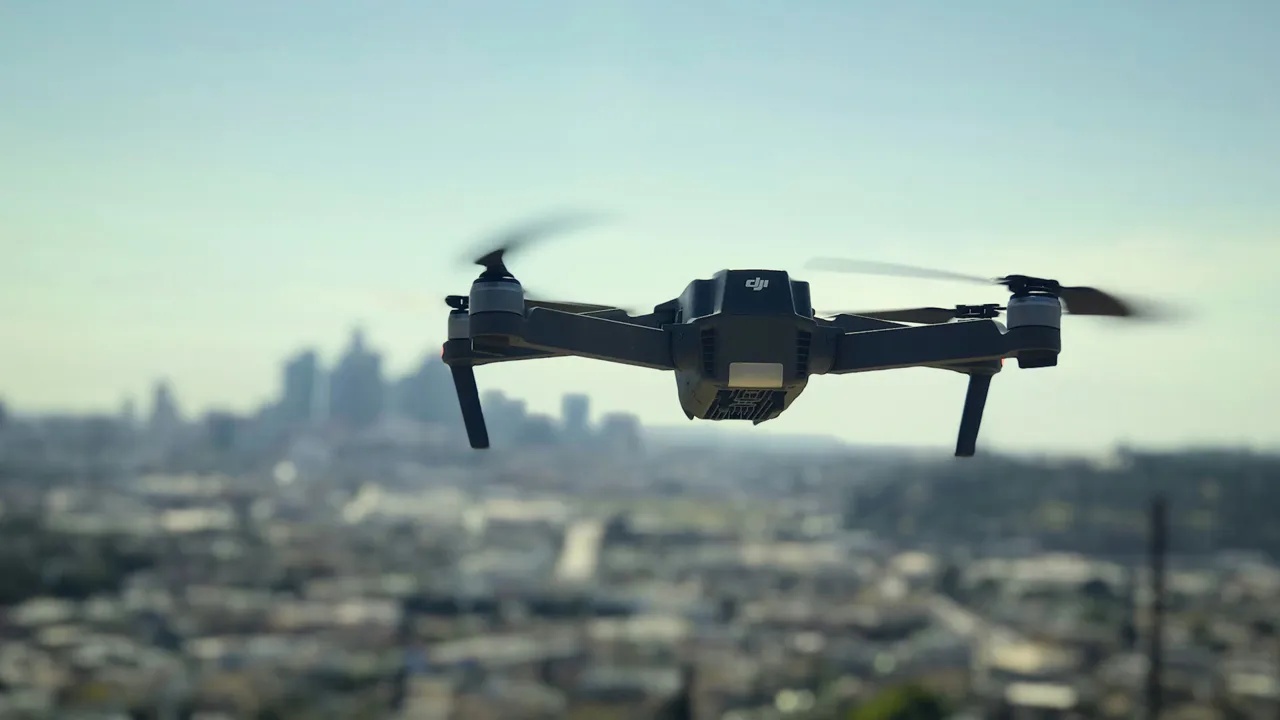
A new analysis by Stifel shows why the next surge in military drones is likely to be distributed differently than many investors expect.
The US defense sector is facing a profound upheaval, according to a new study by Stifel. The analysts expect 2026 to be the "year of the drone" as the Pentagon increasingly shifts its spending from traditional weapons systems to unmanned platforms. In the analysis published on December 15, they speak of an "important turning point", triggered by the interplay of technological advances, growing geopolitical threats and a new political will following the change of government.
Stifel compares the current situation with the role of manned aircraft in 1935, when airplanes accounted for only a marginal share of military budgets before becoming the dominant focus of investment within two decades. Today, unmanned systems also account for only a low single-digit percentage of US defense spending. The analysts see this as a "1935 moment" for drones and expect them to account for a "massive share of budget gains" in the coming years.
According to Stifel, the political tailwind for this change of course is unusually strong. US President Donald Trump has issued several executive orders in 2025 to accelerate the purchase of new military technology and specifically promote drones. The analysts believe that the "Big Beautiful Bill" passed on July 4 is particularly important. It provides billions for unmanned systems, including drones at sea, so-called "kamikaze" drones, $PNG (-3,91%) unmanned underwater vehicles and systems to defend against enemy drones. Additional pressure is being exerted by a new directive from US Secretary of Defense Pete Hegseth entitled "Unleashing US Military Drone Dominance", which Stifel describes as a "declaration of war on the Pentagon's bureaucracy" because it is intended to break up slow decision-making processes and established structures.
The study warns of significant market shifts. Established defense companies could come under pressure if they do not adapt their production models to the fast and scalable production demanded by the Pentagon. "If we were on the board of a large defense company, we would advocate a temporary dividend cut or a reduction in share buybacks," the analysts write. Long-term winners are companies with high manufacturing flexibility and strong commercial integration.
Stifel names several companies as potential beneficiaries of this development. Among the pure drone specialists, the analysts highlight $KTOS (-2,08%) Kratos Defense, $ONDS (-4,64%) Ondas (@All-in-or-nothing ) and $AVAV (-0,02%) AeroVironment. Among the more broadly positioned defense companies $TDY (-2,66%) Teledyne (@Simpson ), $CACI (-0,76%) Caci International and $LDOS (+4,41%) Leidos are well positioned. The analysts expect particularly strong growth in drones that accompany and support fighter aircraft, so-called "kamikaze" drones, unmanned systems for use on and under the sea and technologies to defend against enemy drones. Additional demand could come from the area of homeland security, as the 2026 FIFA World Cup is considered a high-risk event and is likely to trigger increased demand for drone defense.
Despite high valuations, Stifel warns against prematurely dismissing drone stocks as too expensive. Many investors underestimate "how early we are in the transformation of warfare". For 2026, the US House expects a wave of new programs and a possible ban on Chinese drones, which could further strengthen the domestic industry.

I think the attack is getting closer and closer and today was a good chance to buy.
https://www.reuters.com/graphics/USA-CARIBBEAN/MILITARY-BUILDUP/egpbbnzyrpq/

Everything points to the USA wanting regime change in Venezuela.
At the moment, however, they haven't gathered enough troops to carry out a land invasion and I don't think this is likely, I think the US will mainly rely on air strikes and small sabotage/special operations and use PMCs. Therefore I am still very bullish on $CACI (-0,76%) .
Venezuela also has oil reserves, some of which have been produced by $CVX (+0,29%) part of the reason why the US wants regime change is the issue of this oil and therefore I think it is potentially a good investment. $CVX (+0,29%) also potentially a good investment, as well as of course a position in $3LOI (+6,59%) .
But the idea that I find most interesting so far is that it's not really being discussed much in the markets yet, so there could be a big increase in volatility, so I think it's very interesting. $VIXL (+13,14%) also very interesting.
It is to be expected that major operations will only be carried out towards the end of November - December, due to the hurricane / typhoon season.

Bei $CACI (-0,76%) läufts gerade 🥳🚀
Nach dem heftigen Rücksetzer im Februar, ist der Wert wieder ein "Double Bagger" in meinem Portfolio.
CACI International Inc. CACI shares gained 1.7% during Wednesday’s extended trading session after the company reported better-than-expected results for the first quarter of fiscal 2026.
CACI reported first-quarter non-GAAP earnings of $6.85 per share, which beat the Zacks Consensus Estimate by 10.48%. The bottom line increased 15.5% on a year-over-year basis, primarily driven by higher revenues and efficient cost management.
CACI surpassed the Zacks Consensus Estimate for earnings in each of the trailing four quarters, the average surprise being 16.67%.
CACI International, Inc. Price, Consensus and EPS Surprise
CACI International, Inc. price-consensus-eps-surprise-chart | CACI International, Inc. Quote
In the first quarter, CACI reported revenues of $2.29 billion, which topped the consensus mark by 1.66%. The top line increased 11.2% from the prior-year quarter, primarily driven by 5.5% organic growth.
Source:


In my opinion, you can diversify at these levels:
Local (by headquarters, by turnover)
By currency
By industry
By company size (influences volatility)
I try to have as little overlap as possible in several areas in order to keep my portfolio robust.
Example:
$DRO (-2,28%) and $PARRO (-2,59%) : Similar industry, so both are driven by the same news, but have different locations and currencies.
$CACI (-0,76%) Also has some correlation with the two, but is mainly dependent on the movements of the US military.
$8001 (+1,31%) As a boring anchor
$SL (-2,08%) As a "real" luxury play to profit from rising inequality and to have more euro/Italy in the portfolio.
$GRE (-2,5%) Because I see great potential in Greece, see old post
Principais criadores desta semana